Jonathan Haidt On The Social Justice Self-Destruction Of Our Universities

Jonathan Haidt discusses the madness which has taken hold of our colleges and universities

Social psychologist and author Jonathan Haidt has an excellent interview on The Rubin Report, talking about the takeover of universities in the English-speaking Western world by the Cult of Social Justice and Identity Politics.

The full 30 minute video is well worth a watch, but these selected observations in particular stand out.

On the cult-like nature of the new PC movement:

We love to identify something as a sacred object, like a rock or a tree. Traditional religions would make a person or a river, something as sacred. And then we circle around it, we worship it, we make sacrifices to it. And that’s the way religions have always worked.

Well, now that formal religions are fading out, we have these new moralistic religions. So – “fighting racism”. You know, very good cause. But when fighting racism becomes the centre of a religious cult, you get all these extreme policies. And this is what universities have been for several decades – they have been basically been cults devoted to fighting racism. Again, a good aim. But it has been warping research.

And as it applies to racism, so it applies to today’s transgender bathrooms furore in North Carolina and across the United States:

Everybody at university is totally in favour of gay rights, gay marriage, that’s been true for decades. And it’s the most amazing thing that American society just in that twenty years we go from like “no way, never!” to “wow, okay, I guess that’s the law of the land” and most people accept it. So twenty years, that’s amazing.

Okay, but now what’s weird is three years ago nobody knew a transgender person, nobody thought about it – it wasn’t on anybody’s radar. So to make it in three years from that to “You must do this!” – this, I think, is a bridge too far. And this, I think, Obama is going to be remembered for this, I think it’s gonna cause a lot of reaction, because the country was not ready for this and it’s not appropriate for the federal government – I can see why the supreme court would way in on marriage rights because marriage has to be coordinated among the states, I get that – bathrooms? The federal government, bathrooms? Did nobody read The Federalist Papers? Has nobody read the Constitution? This is nuts.

And once this battle has been won by the Social Justice Warriors, new demands will be made:

As certain elements of the social justice Left have been victorious on certain fronts, this is the newest battleground. And so this becomes an object of sort of sacredness and extreme devotion. So the way to understand all these moral movements is as a kind of a crusade that binds people together.

[..] A good moral and political movement needs a good clear enemy. So you must, you must believe that the other side is really strong and is adamant against you, and racism is everywhere, sexism is everywhere, transphobia is everywhere, homophobia is everywhere. So you need a good solid enemy. And even though universities are the most anti-racist, anti-sexist places in the country, but it’s an article of faith that they are institutionally racist, institutionally sexist.

So it’s an incoherent movement if you look at it from the outside, but psychologically it’s very standard sort of Manichean, Us versus Them religion.

And on victimhood culture, and the hierarchy of the oppressed:

What’s happening is kind of a moral movement on campus, where the sort of social justice Left – and you find this on every campus, you find a group, they’ll meet, they’ll often take gender studies courses and intersectionality stuff, all that stuff – so you’ll have a group which is very much in an Us versus Them mindset. And everybody on every side thinks they’re the victim, that’s what’s so interesting here.

[..] So there’s seven. So there’s the big three, which is where almost all the controversy, almost all the stuff on campus is about, so it’s African Americans, women and LGBTs. That’s what almost everything is on campus. Then there’s what you might call the little three – not that they’re small, just less prominent – and that is Latino, handicapped of any kind, and Native Americans. Those are the six that have been around for decades. Just in the last year it’s Muslims. So the Left – and this is very alarming to me, I’m Jewish, and suddenly to say, you know, Jews are oppressors, Jews are evil, so there’s a lot of sympathy on the Left.

Also fascinating is the breakdown by subject – the illiberal, regressive Left has utterly captured some sections of the university while others are holding out far better:

The illiberal Left is a small portion, and then the liberal left – because liberals traditionally believed in freedom, freedom of speech, freedom of thought – so the illiberal Left has everybody else scared. It’s the students overwhelmingly. Because the students – everyone is afraid of the students. Students are afraid of the students, professors are afraid of the students. So the illiberal Left make these demands, they march into the president’s office, they demand this and that, they accuse everybody of racism and sexism, and because everybody is on the Left and everybody is afraid of the students, nobody stands up.

So when the Christakis at Yale [see here for more on the Yale Halloween Costume Drama of 2015]  so within three days there was a giant petition, five hundred Yale professors backing the students. Well, I had one of my research assistants find out what departments they’re all in, it was gender studies, film studies, English, it was that stuff. So the humanities, they’re totally onboard with this. The humanities are full of illiberal leftists.

Four weeks later, a small petition, forty names, mostly STEM – mostly scientists. So the natural scientists are still liberals, they believe in openness, they believe in debate. So that’s what you have to keep in mind. The problem comes out of the humanities, the social sciences are in the middle, and the question is where does the illiberal Left have such dominance that the professors are afraid to speak?

And finally, on the nascent fightback:

The methods that the students have demanded – more social justice training, more bias reporting systems, anonymous reporting systems, diversity training – these are going to make things so much worse.

And what I’m really encouraged by is this: outside the university, everyone thinks they’re crazy. And so the first university presidents who just caved in – so Peter Salovey at Yale, Christina Paxson at Brown, the first university presidents who were faced with a mob of angry students just said “woah, you’re right! We’re so racist! Brown is racist, Brown is racist, oh my god! Here’s fifty million dollars!”, Peter Salovey said. A hundred million dollars for diversity! So the first presidents did that.

What happens? The alumni are like, “what are you doing?! What are you doing to our – no. We’re not giving to you any more”. And Missouri, things are way down in Missouri, they’re in big trouble. The first presidents all caved in. But then they started hearing from alumni, they were laughing stocks, everyone was making fun of them, and so now we’re seeing some presidents willing to stand up because they know that if they cave in they are going to be made fun of forever and they care about their legacy.

The same situation has been observed in Britain, with leaders of Oriel College at Oxford University scrambling to backtrack on lavish concessions granted to angry “Rhodes Must Fall” students after being contacted by furious alumni and finding major pledged donations suddenly in calamitous jeopardy.

Haidt’s conclusion:

So I think we have turned a corner. Presidents aren’t just going to lie down and give in any more, that’s one. Alumni are mad as hell, they’re saying “we’re not giving if you do this because we believe in free speech and we don’t want to turn it into a left wing propaganda factory”. And I think we’re gonna see more students rising up, we’re not that yet. I mean, there are conservative groups on each campus but even they are often afraid to speak up. But I think next year we are going to see a lot more students standing up, alumni standing up, so I think the tide is turning.

I hope and pray that this is the case. But as Britain lags a couple of years behind the United States in the progression of the disease, it could well be that remission is similarly further away.

And:

So I think things are going to change when the younger – when the high school kids now, kids who are in high school now, when they join in laughing at these silly campus snowflakes, at students who are afraid to see a photograph or hear a word – so I think mockery and humour is actually the way that honour revolutions happen. So keep up the mockery and humour, I say, good work.

That certainly chimes with the message of this blog – see here and here.

Haidt himself admits to having been pushed from being first left-wing to centrist, and then again to a sometimes libertarian stance by these developments. And one suspects that Haidt is far from alone in this – that many people with absolutely no racist or homophobic tendencies are nonetheless being alienated by a social justice movement which preaches collective guilt and brings shrill charges of heresy against anybody who does not instantly conform 100% to the latest Newspeak.

This relates to the remarkable lack of magnanimity shown by the victors of the culture wars towards those whose only crime was not to be in the vanguard of change, loudly cheering from the front – something picked up on by Andrew Sullivan, among others.

But then Jonathan Haidt and Andrew Sullivan are just middle-aged white males, so what would they know about anything?


Jonathan Haidt - Social Justice

Bottom Image: The American Conservative

Agree with this article? Violently disagree? Scroll down to leave a comment.

Follow Semi-Partisan Politics on TwitterFacebook and Medium.

Tales From The Safe Space, Part 37 – Whisperings Of A Revolt

NUS Disaffiliation Campaign

Has the NUS finally gone too far?

All tyrants, petty or otherwise, eventually go too far and overextend their vast authority. Maybe they get cocky. Maybe they surround themselves with so many Yes Men that they lose the pulse of the people. But inevitably, somehow or other, they will at some point find themselves overextended, and see their exalted position threatened as a consequence.

It is delightful to see such a thing now happening to the National Union of Students, that censorious, moralising platform for embryonic leftist politicians and demagogues, which long ago gave up any pretence at advocating for students, preferring to exercise paranoid control over them instead.

Now, some students are fighting back. A number of smart, more liberty-minded students have realised that since most Student Unions derive their democratic “legitimacy” from a vanishingly small slice of their respective student populations, it should be relatively easy to mount a small insurgency of their own to topple the Social Justice and Identity Politics cultists in charge, and make their local unions work for the students rather than simply trying to control their thoughts, behaviour and speech.

Hence the brilliant NUS disaffiliation campaigns now springing up at campuses around the country.

Spiked’s Tom Slater reports in The Spectator:

In a move that has left student union politicos across the country clinging to their therapy dogs, the University of Lincoln Students’ Union has voted to disaffiliate from the NUS. Springing from the new, anti-NUS sentiment that is brewing on campuses across the country, Lincoln students voted 881 to 804 to leave.

This was a big breakthrough, putting wind in the sails of disaffiliation campaigns currently being fought at York, Oxford, Exeter and Manchester. And though this was all sparked by the election of new NUS president Malia Bouattia – the overgrown student fond of waxing lyrical about the ‘zionist-led media’ – the gulf between NUS leadership and its members has been growing for years.

After Lincoln’s vote, outgoing NUS president Megan Dunn said she was ‘sorry this decision was made by such a small number of students’. Which was a bit rich, seeing as she was elected in 2015 by a whopping 413 NUS delegates, and turnout at campus NUS elections – which select those delegates – is notoriously low.

Lincoln’s vote is significant. Not least because so many felt so detached from the NUS they didn’t even turn out to vote. And, in an interesting twist, Lincoln SU’s own president appeared to approve of the move, telling the Independent that ‘for some time… the NUS has been far removed from the issues our students tell us are important’.

And now Newcastle University has followed suit:

Newcastle University Students’ Union (NUSU) has become the second to announce it is to disaffiliate from the National Union of Students (NUS) following a controversial National Conference in Brighton last month.

The move has come as a double blow for the national student campaigner after Lincoln University announced on Monday it, too, will be breaking away from the NUS at the end of the year.

NUSU confirmed on Thursday that 1,469 total votes had been cast in the referendum by Newcastle University students, with a majority of 67 per cent voting in favour of disaffiliation.

Brilliant. While this blog contends that the power and influence now wielded by the Cult of Social Justice and Identity Politics can only be truly broken when those with most authority – professors and university administrators – finally rediscover their backbone and begin to defend academic freedom and free speech rights, it is heartening to once again see students in the vanguard of the resistance.

For in truth, it is in the interests of almost no students – save the Identity Politics priests who derive power and influence from policing the culture of their institutions and the behaviour of their peers – to allow the NUS to continue along its present, authoritarian path. As Tom Slater argues in The Spectator, students deserve local unions which fight for their interests as students, rather than a union which wastes its time fighting a culture war and playing off different groups of students against one other based on an arbitrary judgement over how “oppressed” they happen to be.

The growing NUS disaffiliation movement should be encouraged and helped to spread like wildfire, burning through the rotten foundations and (ideally) causing the whole organisation to topple. And now is the time to strike, when the enemy is dangerously overextended, making very specific and highly controversial claims (pro-censorship and the identity politics agenda) on behalf of all students when in fact they speak only for a small but noisy illiberal minority.

First Lincoln, then Newcastle. Who will be next to throw off the puritanical, totalitarian shackles of the National Union of Students?


Safe Space Notice - 2

Agree with this article? Violently disagree? Scroll down to leave a comment.

Follow Semi-Partisan Politics on TwitterFacebook and Medium.

What Hath Social Justice Wrought?

https://www.youtube.com/watch?v=TvRlJ_MzoII

It is our duty to fight.

It is our duty to win.

We have nothing to lose but our chains.


So chant thousands of students at rallies and protests in universities all across the United States of America.

Except that none of these students are oppressed. Not a single damn one of them.

None of them are chained.

They are all students attending university in the most powerful and prosperous country on the face of the Earth.

An ocean of possibility stands before each and every single one of these young students, the likes of which can only be dreamed of by millions of children in war torn, impoverished or otherwise benighted parts of the world.

This is a cult.

These people are cultists.

This is what the Cult of Social Justice and Identity Politics hath wrought.


Postscript: To be fair, from the smirks of some of the students in the last video it does appear that they realise deep down that this is all a fraud, that none of them are “chained”, and that this huge collective tantrum from the most privileged generation in history is nothing but a massive insult toward previous generations who really did have to fight, win, and yes, even cast off their chains.


More Tales From The Safe Space here.


Safe Space Notice - 2

h/t Sargon of Akkad

Agree with this article? Violently disagree? Scroll down to leave a comment.

Follow Semi-Partisan Politics on TwitterFacebook and Medium.

Tales From The Safe Space, Part 36 – Michael Bloomberg’s University Of Michigan Commencement Address

https://www.youtube.com/watch?v=7i23pD38lpE

Michael Bloomberg delivers a college commencement speech worth hearing

While it is true that a generation of university students – the product of our therapeutic culture and “you can’t say that” attitude to political debate – is now being indoctrinated into the Cult of Social Justice and Identity Politics with alarmingly little resistance from the educational establishment, there is at least one graduating class which has been sent out into the world with a rather more inspiring (and small-L liberal) message ringing in their ears.

Former New York City mayor Michael Bloomberg was invited to address the University of Michigan’s graduating class of 2016, and from the first word of his speech he tore into the culture of safe spaces, trigger warnings and all of the other illiberal symptoms of this new orthodoxy.

From Bloomberg’s speech:

The most useful knowledge that you leave here with today has nothing to do with your major. It’s about how to study, cooperate, listen carefully, think critically and resolve conflicts through reason. Those are the most important skills in the working world, and it’s why colleges have always exposed students to challenging and uncomfortable ideas.

The fact that some university boards and administrations now bow to pressure and shield students from these ideas through “safe spaces,” “code words” and “trigger warnings” is, in my view, a terrible mistake.

The whole purpose of college is to learn how to deal with difficult situations — not run away from them. A microaggression is exactly that: micro. And one of the most dangerous places on a college campus is a safe space, because it creates the false impression that we can insulate ourselves from those who hold different views.

We can’t do this, and we shouldn’t try — not in politics or in the workplace. In the global economy, and in a democratic society, an open mind is the most valuable asset you can possess.

Think about the global economy. For the first time in human history, the majority of people in the developed world are being asked to make a living with their minds, rather than their muscles. For 3,000 years, humankind had an economy based on farming: Till the soil, plant the seed, harvest the crop. It was hard to do, but fairly easy to learn. Then, for 300 years, we had an economy based on industry: Mold the parts, turn the crank, assemble the product. This was hard to do, but also fairly easy to learn.

Now, we have an economy based on information: Acquire the knowledge, apply the analytics and use your creativity. This is hard to do and hard to learn, and even once you’ve mastered it, you have to start learning all over again, pretty much every day.

Keeping an open mind to new ideas is essential to your professional success — just as it’s crucial to our collective future as a democratic society.

Note the loud booing quickly drowned out by cheering when Bloomberg talks about the inherent intellectual and academic danger of a “safe space” – while his remarks were warmly received, there is clearly a very vocal group of students who did not want to hear this message, and who will step forth from the University of Michigan with very warped views about how political debate (and even ordinary interpersonal relationships) should be conducted.

Bloomberg then turns his attention to the presidential race and the state of American democracy in general:

Democracy in action can actually produce a lot of inaction, which we see every day in Washington and other levels of government, too. When governments fail to address the needs of the people, voters in both parties get angry and some politicians exploit that anger by offering scapegoats instead of solutions.

If we want to stop demagogues, we have to start governing again, and that requires us to be more civil, to support politicians who have the courage to take risks, and to reward those who reach across the aisle in search of compromise.

Here, Bloomberg is almost channelling Andrew Sullivan, who makes his incredibly welcome and sorely needed return to political commentary in the New York magazine with these words:

An American elite that has presided over massive and increasing public debt, that failed to prevent 9/11, that chose a disastrous war in the Middle East, that allowed financial markets to nearly destroy the global economy, and that is now so bitterly divided the Congress is effectively moot in a constitutional democracy: “We Respectables” deserve a comeuppance. The vital and valid lesson of the Trump phenomenon is that if the elites cannot govern by compromise, someone outside will eventually try to govern by popular passion and brute force.

(I’ll be blogging a response to Andrew Sullivan’s piece separately in due course).

Bloomberg closes with this warning:

Think about this: In 1960, only 4 to 5 percent of Democrats and Republicans said they would be upset if a member of their family married someone from the opposing party. In 2010, one in three Democrats and one in two Republicans said they would disapprove of such a marriage. In 1960, most people would never have believed that interparty marriage would attract such resistance, while interracial and same-sex marriage would gain such acceptance.

For all the progress we have made on cultural tolerance, when it comes to political tolerance, we are moving in the wrong direction — at campaign rallies that turn violent, on social media threads that turn vitriolic, and on college campuses, where students and faculty have attempted to censor political opponents.

As durable as the American system of government has been, democracy is fragile — and demagogues are always lurking. Stopping them starts with placing a premium on open minds, voting, and demanding that politicians offer practical solutions, not scapegoats or pie-in-the-sky promises.

This is a message which many students will not want to hear, but which needs to be transmitted nonetheless – and not only by commencement speakers, refreshing though it is to hear the likes of Bloomberg take up the cause.

University administrators and professors must also absorb and embrace this message and change the way they approach issues of free speech and academic freedom, for while they are not entirely responsible for the censorious and emotionally fragile nature of new students entering their institutions, they do represent the last and best hope of turning those students into robust and resilient young citizens by the time they graduate.

Michael Bloomberg delivering a crowd-riling, viral-ready commencement speech just as students are about to graduate cannot be our only firewall against the onslaught of this new illiberal movement. We must erect meaningful defences and interventions much earlier in the learning process – rather than simply bowing to the excessive demands and exaggerated sensibilities of perpetually offended students – if we wish to prevent our workplaces and government from going the same way as our university campuses.


Safe Space Notice - 2

Agree with this article? Violently disagree? Scroll down to leave a comment.

Follow Semi-Partisan Politics on TwitterFacebook and Medium.

Tales From The Safe Space, Part 35 – Conservative Professors In The Closet

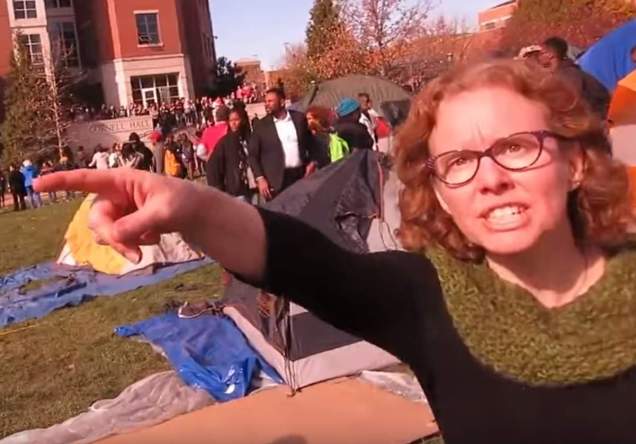
Melissa Click - Mizzou - University of Missouri

Conservative students and professors have long felt the need to downplay, disguise or hide their true political leanings

We have long known that the university campus and large parts of the academy are a hostile environment – an unsafe space, if you will – for those of a conservative mindset, student and professor alike.

One recent study identified just eight right-leaning academics in the field of social psychology and a ratio of 36 liberal to 1 conservative-leaning professors.

Emma Green at The Atlantic introduces an interesting conversation with the authors of “Passing On The Right”, a book about the difficulties faced by conservative university professors who find themselves very much in the minority on campus:

The assumption that most college campuses lean left is so widespread in American culture that it has almost become a caricature: intellectuals in thick-rimmed glasses preaching Marxism on idyllic grassy quads; students protesting minor infractions against political correctness; raging professors trying to prove that God is, in fact, dead. Studies about professors’ political beliefs and voting behavior suggest this assumption is at least somewhat correct. But Shields and Dunn set out to investigate a more nuanced question: For the minority of professors who are cultural and political conservatives, what’s life actually like?

Finding out wasn’t easy, in part because so many conservative professors are—as they put it—closeted. Some of the people they interviewed explicitly said they identify with the experience of gays and lesbians in having to hide who they are. One tenure-track sociology professor even asked to meet Shields and Dunn in a park a mile away from his university. “When the sound of footsteps intruded on our sanctuary, he stopped talking altogether, his eyes darting about,” they write. “Given the drama of this encounter, one might think that he is concealing something scandalous. In truth, this professor is hiding the fact that he is a Republican.”

These professors – the vanishingly small number of conservatives who even bother pursuing careers in the social sciences – are not only scared of their students. That much is a relatively new development. They are also scared of their peers in academia, and their bosses in university leadership roles.

For example:

A historian at an elite research university, for example, said he was initially denied tenure on account of his political views. He discovered that a colleague had in a letter referred to him as an “appalling Eurocentric conservative” for suggesting to students that North Korea should be blamed for the Korean War. Another extremely productive sociologist was voted down for tenure by his colleagues and dean, only to have the vote reversed by a provost — due in part to some liberal colleagues who cried foul at the process. One such colleague reportedly told the sociologist in question, “Your religion, your politics, entered into the discussion for tenure and basically a lot of extraneous things were not relevant to [your] performance were questioned.” That professor and others with similar experiences said they initially — and perhaps naïvely — thought that their research, teaching and service records would speak for themselves come tenure time, and that writing occasional essays for conservative publications or otherwise “showing” their views wouldn’t matter.

So this is the famous liberal tolerance. And now, compounding this hostile environment, we have the Cult of Social Justice and Identity Politics to contend with.

The Right cannot afford to continue surrendering the academy to their opponents. Neither it is in the interests of the Left to wield such dominance, for their ability to debate and innovate sensible new policy is already starting to atrophy through lack of a conservative counterpoint.

It’s time for a fightback.


More Tales From The Safe Space here.


Conservatives - University - Campus Conservatism

Safe Space Notice - 2

Agree with this article? Violently disagree? Scroll down to leave a comment.

Follow Semi-Partisan Politics on TwitterFacebook and Medium.