Tales From The Safe Space, Part 49 – Chicago Universities Are Raising A Generation Of Infantilised Young Adults

father-ted-my-lovely-horse-2

Students who are offered Play Doh and “therapy horses” to help them make it through university will be cannon fodder in an unforgiving, competitive global labour market

At this point we are used to seeing outrageous stories of overbearing, coddling universities going to extraordinary lengths to teach the young adults studying on their campuses like delicate, helpless infants.

But the Chicago Tribune has done quite a job in summarising all of the instances of infantilisation-posing-as-stress-management taking place at institutions in and around the city. And the extent of the trend is quite shocking to behold.

Some excerpts:

Sephanie Delgado can feel the stress of her to-do list as she works to finish the semester at Roosevelt University: three essays, a presentation and exams.

To escape the pressure, the 20-year-old college junior, who also works as a restaurant cashier to help pay for school, sculpted a chunk of blue Play-Doh into Popplio, a Pokemon character. She was at a table next to other students who colored and decorated cookies before two miniature therapy horses wearing sneakers trotted into the room Wednesday for the university’s De-Stress Fest.

“I know I still have to do all that work, but coming here I’m able to take some time off to hang out with friends, have fun and empty my mind for a little bit,” said Delgado, who lives on the Southwest Side. “It’s like a refresh. My mind is nice and clear so when I go to start my homework, I’m well focused.”

As the semester nears its end — and students pull all-nighters to cram for exams, type papers and finish projects that weigh heavily on final grades — colleges in the Chicago area are taking steps to help students manage stress. It’s part of a broader approach to focus on students’ mental health and expand proactive outreach efforts instead of waiting for students to seek help. Local schools this week are offering activities ranging from animal visits at Roosevelt to a bubble-wrapped room at the University of Illinois at Chicago to the long-standing tradition of a stress-busting primal scream at Northwestern University.

More:

At Northwestern, “because of the hectic academic pace that exists here, it is stressful and very pressure-packed,” university spokesman Alan Cubbage said.

Students can blow off steam with a visit from miniature horses Friday and release their frustration through a campuswide scream, in which students let out a collective yell at 9 p.m. Sunday before finals week. Next week, a number of activities such as Lego building, board games, midnight coffee breaks and late-night breakfast are planned for exam relief.

More:

The series of events UIC hosts during finals week helps junior Liz Huss manage stress in a healthful way.

Students got a visit from comfort dogs Wednesday and are invited next week to pop bubble wrap at the student center, get chair massages, do candlelight yoga and leave notes of encouragement for fellow students.

“I like to take 10, 15, 20 minutes to rejuvenate, reflect and relax, and these events really help with that,” said Huss, an accounting major.

I’m sure that the large professional services firm that she may one day seek to join will be more than happy to bend over backwards to accommodate Liz Huss’s artificially-instilled need to reach for the soothing presence of a “comfort dog” whenever the going gets tough.

More:

For Andersonville resident Rob Chesler, a junior at Roosevelt, stress can motivate him to get his work done. But he also welcomed the distraction of the De-Stress Fest, during which he took a selfie with Lunar, the oldest miniature horse from the Barrington-based nonprofit Mane in Heaven.

“If you’re living in this world of hard work every second of every hour of your life, then you’re not going to be happy and you’re just going to be all about work,” he said. “If you have little horses every now and then, you have moments where you can just breathe and enjoy life.”

Little horses for everyone!

Fortunately there are also voices of sanity:

Clay Routledge, psychology professor at North Dakota State University, believes universities should be promoting psychological strength and resilience, not coddling students.

“I’m not ignorant to the fact there are vulnerable students that need services,” he said. “I’m not against that at all. My criticism is: Are we promoting more broadly a culture of sensitivity and victimhood than we need to do?”

Many colleges and universities are becoming more than educational institutions and overreaching by not letting students figure things out on their own, he said.

“We need to promote toughness and strength, and we know from decades of research that humans are extremely resilient,” Routledge said. “You have to have real stressors in life. You have to fail. You have to be embarrassed and you have to face situations where you’re wrong and you’re challenged — and you’ll be strong as a result.”

A rare voice arguing for building resilience the way that university has done for decades, if not centuries – focusing on the academia, not seeking to micromanage every moment of each student’s pastoral experience on campus, and letting them grow through trial, error and experience. Expect Professor Clay Routledge to be blacklisted by the social justice / identity politics cultists at his university and drummed out of his job any day now.

I have always found American universities to be slightly odd places. Having spent a reasonable amount of time on various campuses in the Mid-West, I have always been struck by the way that universities do not treat their students like autonomous adults to the extent that one might expect in Britain.

Despite eye-wateringly high tuition and accommodation costs, undergraduates are usually expected to share a small room with a roommate, at least in their first year, an almost unheard-of indignity for British students (who would probably feel the same way about this as Americans would feel about staying in one of the NHS’s communal hospital wards rather than having a private room of their own). American universities often see fit to correspond with the parents of students as though they are still school children rather than adults over the age of eighteen, old enough to wear the uniform and fight for their country (though not old enough to drink). These, and many other odd customs, long predate the social justice and identity politics craze which has infected Western academia.

But while customs and practices such as these treat students as though they are not quite yet fully-grown adults, the new trend for safe spaces and infantilising activities masquerading as “stress relief” are of a different order because they effectively serve to stunt any further emotional growth, making it harder for students to ever become autonomous, successful adults.

Making an eighteen-year-old incurring $60,000 of annual student debt sleep three yards away from a roommate is one thing. Treating students as though they are fragile and unresilient children who need bubble wrap, puppy videos and therapy horses to make it through the academic year effectively becomes a self-fulfilling prophecy, ensuring that they enter the world utterly unprepared to function in a society and labour market which does not put their feelings and emotional health on a pedestal.

Social psychologist Jonathan Haidt joked about this when he compared two fictional universities – Strengthen University and Coddle University – in a lecture / college recruitment pitch given to high school seniors. But more and more, Haidt’s send-up of Coddle University is coming to pass and being made real on campuses across America, and in Britain too:

We are based on a very simple psychology which is that people are fragile. People are so easily hurt. Anything that upsets you could trigger trauma, repressed trauma, unrepressed trauma, trauma that you somehow put up there in the closet and forgot to take – there’s trauma all over your mind and your memory. And we don’t want to trigger your trauma. That could damage you.

And this is especially true for members of the six protected classes [women, African Americans, Latinos, LGBTQ, differently abled, and Native Americans]. If you are a member of one of the six marginalised and oppressed groups you are especially vulnerable. You’ve been traumatised and oppressed your whole lives. Microaggression theory teaches us that when people repeatedly cut these little nicks, these little insults, these little exclusions, they don’t develop calluses, they bleed to death. And so we will not let you be cut while you are at Coddle. We will protect you. Now don’t try to do it yourself, that’s very dangerous. WE will protect YOU from aggression.

At Coddle University we offer access to therapists 24/7. Just dial 811 from any phone, or we have this new feature – just raise three fingers, go like this [he gestures] and we have sensors all around campus, go like this and a therapist will be airlifted right into you.

University is supposed to be stressful. Balancing the academic workload and social events and newfound freedom away from the family home is supposed to develop key skills required to navigate the world as an independent adult later in life. Shipping in a bunch of therapy horses onto campus is not “offer[ing] students opportunities to learn self-care”, as one University of Missouri jobsworth claims, because it simulates an environment which will not exist outside of the university campus.

There are no therapy horses laid on for employees in the average workplace. Teaching students to survive daily stress by reaching for Play Doh and therapy animals is like training an astronaut to undertake spacewalks while failing to simulate the essential conditions of weightlessness and limited oxygen supply, and every bit as likely to lead to disaster.

But still the universities teach this nonsense and lay on these extravagant, infantilising services, unaware or unconcerned that they are setting their students up for failure the moment they set foot off campus.

 

father-ted-my-lovely-horse

Safe Space Notice - 2

Support Semi-Partisan Politics with a one-time or recurring donation:

Agree with this article? Violently disagree? Scroll down to leave a comment.

Follow Semi-Partisan Politics on TwitterFacebook and Medium.

What It Is Like To Be A Donald Trump Supporter On Campus

The New York Times (in a rare change of perspective) publishes a first-hand account of what it is like to be a moderate, unenthusiastic Trump voter at college.

K.N. Pineda writes:

The presidential election was the last thing on my mind on Nov. 8. I had essays to write and Italian vocabulary to learn. Sure, I kept New York Times and Wall Street Journal tabs open on my laptop, but I was uninterested in indulging in conversation about an election that most everyone could agree was a time bomb.

As a student at New York University and the daughter of a civil servant at the United States Department of State, I am familiar with political unrest and its potentially disastrous outcomes in the arms of ignorance and hysteria. I did not hold any particularly strong opinions about Donald Trump or Hillary Clinton. If I had voted, however, I would have picked Mr. Trump. I was focused on school. I had no idea that a few days later I would be dismissed as a “Trump supporter” and a person of “privilege” who “reflected an us versus them mind-set” in an essay by my college roommate in this publication — an essay that would go viral and change my life.

I did not feel that I should lie to my new college friends, especially at N.Y.U., where we are supposed to be open to hearing opposing views, able to discuss them and put any bias aside. I never tried to persuade my roommate to accept my side, my choice or my views. I even agreed with some of her opinions about Mr. Trump, who has said divisive things about Muslims and other minority groups. As an independent, my feelings toward the campaign were very mixed. I felt strongly that as a country we needed to focus on domestic issues, and for me, the Republicans were more prepared to do that.

My roommate has since apologized to me, but in the meantime I have felt the glare of her friends and been heckled on campus by other students. I have been labeled “racist,” “sexist” and “xenophobic” on Facebook. I have been called a “white without a conscious,” a “misogynist,” a “bigot” and a “barbarian” online by people all over the country.

This tale should make the allied anti-Trump forces stop and think firstly about how they are treating their own friends and neighbours, but more importantly about the image they are projecting to the wider country, and thus feeding into America’s future political discourse.

Presumably those most upset about Donald Trump’s election victory would quite like many of his supporters to vote for somebody else, maybe somebody from the Democratic Party, in four year’s time. They should stop and ask themselves whether this goal is more likely to be achieved by seeking genuine dialogue and understanding with people who voted differently, or by loudly and repeatedly accusing them of complicity in bringing fascism to America.

The enhanced cold-shoulder received by K.N. Pineda is also depressing given her own family background:

Here’s my story. My father is Hispanic. My extended family lives in Southern California and New Mexico. Many of my family members are not native English speakers. My maternal grandmother is an Italian immigrant who holds a green card. Her husband died after struggling with drug addiction and alcoholism; she had to work two jobs to make ends meet. My mother was raised by her stepfather, who is African-American and the only maternal grandfather I have known. He is a kind, devout man whom I love dearly. My family and friends come from all ethnicities, religions and sexual orientations.

Attending New York University was my dream. My dad grew up in a trailer home, and my mom was homeless for a period of time. My parents were the first in their families to graduate from college. They have struggled to provide the best for me and my brother. They have sacrificed financially and worked hard to give us a good life. I came to N.Y.U. partly on scholarship and am accruing debt to pay my tuition.

As minorities, my mother, father, grandparents and I have experienced racial hate. My skin may be light, but I understand discrimination. I may not know each person’s individual experience, but am able to empathize with others.

So not a dumb, ignorant redneck then (incidentally, one of the last groups of people that it is okay to openly mock and denigrate in polite society). Rather, Pineda has Hispanic heritage and so is expected to toe the line and adopt all of the political opinions now expected of that racial demographic by the Identity Politics Left, voting one’s own conscience is seen almost as a “betrayal” of one’s ethnic heritage. This is what the identity politics embraced by the American Left hath wrought, at a time when it otherwise ought to be subsiding – electoral segregation.

Pineda’s conclusion makes one wonder why it has fallen to a freshman college student to express these sentiments so eloquently, and exactly what the American media and commentariat think they are playing at with their own coverage:

I know the fear that the election has inflicted. I comprehend the hurt that people feel. We all have reasons for casting our votes. What I do not understand is hatred toward one another. Supporters of both parties have misunderstood and fueled hate out of reckless emotion and ignorance.

The answer is not to further the divide by labeling and dehumanizing one another. We should fight the “us versus them” mind-set. We have spent too much time in our own bubbles, and we need to begin a dialogue that will allow us to understand one another.

Blind fear and hatred are far more powerful than any candidate. How can we assume we know someone based on the color of their skin, their religion, or their political choices? Why should we be afraid to express our opinions? If we see one another not as a Clinton supporter or a Trump supporter, but as human, perhaps we can discover empathy in the troubled nation in which we exist.

The narrative should be one of inclusiveness, openness, respect and love. It is not only about making “America Great Again,” it is about making America home again.

I think it is fair to say that the New York Times could have found far more unpleasant and even harrowing tales of political persecution on campus had they searched, or possessed the political will to do so. Young conservatives were well used to public opprobrium and seeing their free speech rights constrained while left-wing identity politics activists were given the run of campus by craven university administrators long before the election. And Donald Trump’s surprise election victory has only enraged and emboldened these tormentors all the more.

The American Left, (sometimes justifiably) outraged on behalf of the various minority groups for whom they claim to speak, should bear in mind that in the rarefied surroundings of the college campus, they are very much in the majority – an oppressive majority, one might even say, to use the current social justice parlance.

And there is a notable, shameful irony in the way that many anti-Trump activists on the Left are so ostentatiously welcoming of every kind of difference and diversity, save diversity of political opinion.


pop-art-donald-trump-2

Support Semi-Partisan Politics with a one-time or recurring donation:

Agree with this article? Violently disagree? Scroll down to leave a comment.

Follow Semi-Partisan Politics on TwitterFacebook and Medium.

Tales From The Safe Space, Part 46 – Purging Catholicism From A Catholic University In The Name Of Social Justice

hammerton-college-1751689_960_720

When academic or religious freedom is at stake, principled pro-free speech professors can expect no cover or support from their spineless university administrations

We have already seen how the leaders and administrators at one American Catholic university – DePaul University in Chicago – have demonstrated that they would sooner purge their own faith from campus than do anything which might risk upsetting the SJW cultists and their new secular gods of social justice and identity politics.

And now Rod Dreher brings us news of another persecution taking place, this time at Providence College in Rhode Island, where literature professor Tony Esolen finds himself besieged by vengeful students and hung out to dry by his superiors for having written a thoughtful essay for Crisis Magazine, questioning the current cult of Diversity At All Costs.

Was the essay rather provocative? Well yes – it was titled “My college succumbed to the totalitarian diversity cult”. But at one time university professors were expected to do and say provocative things. It was part of creating a climate of no-holds-barred intellectual debate, the kind which seems to have become so unfashionable of late.

But Esolen made a compelling argument in his essay – writing, remember, from the perspective of an orthodox Catholic teaching at a supposedly Catholic educational institution:

I understand what it is to have a Greek festival or an Italian festival, or a parish festival where fellow Catholics come out to enjoy good high-calorie food, play some innocent games of chance, and try to get the priest to sit in the dunking machine. For man is always united from above, not from below, and that includes even the make-believe transcendence of the local baseball team, which is harmless enough if not taken too seriously. When Catholics come to Mass to pray, they do so as members of one Church, not ten, not fifty, praying the same prayers all over the world, because they give thanks to the one Lord and Savior who died for them on one cross, on the one hill of the Skull, on that one Friday long ago. This was the same Lord who prayed that we would be not ten, not fifty, but one, even as he and the Father are one.

But the watchword at Providence College right now is not unity, but “diversity,” as is made evident by the four-page Diversity Program featured prominently on our website. When I see the word “diversity” in its current use as a political slogan, I ask myself the following questions:

What is diversity, as opposed to divergence?
What is diversity, as opposed to mere variety?
What goods, precisely, is diversity supposed to deliver?
Why is intellectual diversity not served by the study of a dozen cultures of the past, with their vast array of customs, poetry, art, and worship of the gods?

Immediately one can see how this would offend the SJW ideological enforcers, who preach that we are not one, but many, and that we must continually emphasise and acknowledge our differences – often to the extent of resegregation – rather than highlight our common bonds.

Esolen concludes his essay:

But there is no evidence on our Diversity page that we wish to be what God has called us to be, a committedly and forthrightly Catholic school with life-changing truths to bring to the world. It is as if, deep down, we did not really believe it. So let us suppose that a professor should affirm some aspect of the Church’s teaching as regards the neuralgia of our time, sex. Will his right to do so be confirmed by those who say they are committed to diversity? Put it this way. Suppose someone were to ask, “Is it permitted for a secular liberal, at a secular and liberal college, to affirm in the classroom a secular view of sex and the family?” The question would strike everyone as absurd. It would be like asking whether we were permitted to walk on two feet or to look up at the sky. Then why should it not also be absurd to ask, “Is it permitted for a Catholic, at a college that advertises itself as Catholic, to affirm a Catholic view of sex and the family?” And I am not talking merely about professors whose specific job it is to teach moral philosophy or moral theology. I am talking about all professors.

In my now extensive experience, Catholic professors in Catholic colleges have been notably tolerant of the limitations of their secular colleagues. We make allowances all the time. We understand, though, that some of them—not all, but then it only takes a few—would silence us for good, if they had the power. They have made life hell for more than one of my friends. All, now, in the name of an undefined and perhaps undefinable diversity, to which you had damned well better give honor and glory. If you don’t—and you may not even be aware of the lese majeste as you commit it—you’d better have eyes in the back of your head.

So naturally, outraged SJW students at Providence College went running to the college president in tears, claiming that they had been “harmed” by these thoughtful and completely non-malicious essays.

Equally predictably, the university authorities rolled over in the face of this tyrannical power play by the band of wobbly-lipped permanent victim students, and effectively censured Esolen. As Esolen recounted to Rod Dreher:

My friends of course were outraged, and I was stunned — basically, I had been singled out and exposed before the whole faculty, very few of whom were probably even aware that there was such a thing as Crisis Magazine; and of course they and the students are not my audience when I write for Crisis or whatever. Then, as if that were not bad enough, the President met with faculty on Wednesday afternoon, and all they did for a solid hour was to revile the evil Professor Esolen, with a few old-fashioned liberals defending my right to express my opinions, and several of my stalwart friends from philosophy and theology defending me personally and criticizing the president for his decision and for his handling of related matters. When the president said that he believed that he had to act “for pastoral reasons,” they replied that it was a strange form of pastoral care that pits every member of a community against one.

And it is still not over. The faculty have circulated a “petition,” or a resolution, or something neither flesh nor fowl, to the effect that though we all have academic freedom, it has to be exercised responsibly, and reviling “some part of the PC faculty” that is “unabashed” in publishing articles that are racist, xenophobic, sexist, homophobic, and religiously chauvinistic. The petition has been signed by various faculty members and students. And STILL I hear that they are not satisfied, but are trying to figure out if they can use my articles to nail me for “bias” and hate, basically asserting that I am not capable of teaching certain categories of students — gay, female, and so forth.

Though he remains able to appreciate the bitter humour in the situation:

As I’ve said to people, authors don’t choose the titles for articles for Crisis Magazine; the editor does that, for the sake of “traffic” on the page. His title was a bit provocative. But everything that has happened since then has shown me, alas, that the editor saw more than I did, or more than I have been willing to admit. The irony would seem to be obvious: “How DARE you suggest that there is a totalitarian impulse in our behavior? You should be FIRED!” And then of course there is the brazen cheering of the faculty when it is proposed that we should not be Catholic after all.

The strange irony of it all is that I’m the one who believes that a wide diversity of cultures and of institutions is a good thing, and they really do not. I do not WANT all colleges and universities to be basically the same; they do.

The list of demands presented to Providence College by the student protesters is full of all the demands for compulsory re-education (of students and faculty), gutting the core undergraduate curriculum to de-emphasise the Western Canon and make it more SJW-friendly, pumping more money into ethnic and gender studies, aggressive hire of minorities on an affirmative action basis, trained counsellors to minister to the delicate emotions of the student snowflakes, the building of a “multicultural center” and – naturally – the hire of new dedicated Diversity Professionals to oversee the new regime.

We are becoming accustomed to reading these laughably impertinent demands, but this document really does take one’s breath away with its sheer scope. And given the fact that the president (Fr. Brian Shanley) folded faster than Superman on laundry day when students first protested professor Esolen – sending them a grovellingly conciliatory letter which basically threw Esolen under the bus – I would not bet against the list of demands being implemented in full, unquestioningly, within the space of a decade.

When spineless university administrators are forced to choose between academic freedom or facing down the minority of SJW agitators who are determined to turn academic life into a pointless, totalitarian dystopia of identity politics totalitarianism, academic freedom loses every time. And when Catholic university administrators are forced to choose between defending the right of orthodox Catholics to express their faith or bowing to endless demands from the most privileged generation of college students in history, again there is no question. The demands are implemented and Catholicism goes out the window before you can say “that’s oppressive”.

Hopefully the new attention focused on this case – plus the fact that Professor Esolen has tenure – will mean that his job remains safe. But the long term outlook is bleak. Academia having nearly completely fallen to the Cult of Social Justice and Identity Politics, Catholic universities across America may soon become safe spaces for everyone and everything, save Catholicism itself.


Safe Space Notice - 2

Top Image: Pixabay

Support Semi-Partisan Politics with a one-time or recurring donation:

Agree with this article? Violently disagree? Scroll down to leave a comment.

Follow Semi-Partisan Politics on TwitterFacebook and Medium.

Tales From The Safe Space, Part 45 – Puppy Therapy Session Arranged For Stressed Cambridge University Students

cambridge-union-puppy-therapy-therapets-mental-health-stress-infantilisation

Et tu, Cantabrigia?

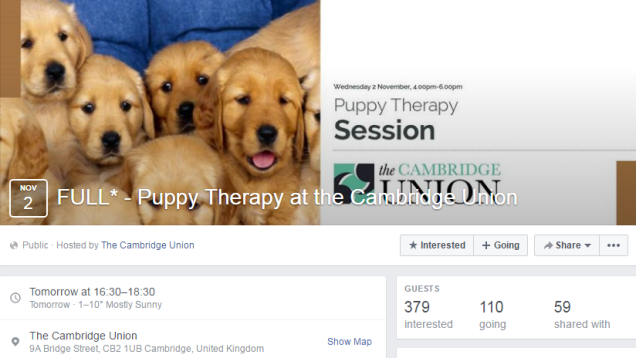
It is sad to see Cambridge University, my first alma mater, playing host to one of these infantilising “student puppy therapy” sessions. But after the Rhodes Must Fall nonsense at Oxford, it was only a matter of time before Cambridge started displaying more symptoms of the Adult Infantilisation Virus rapidly tearing through academia.

The advertisement reads:

Whether you have a deadline looming, are worried about your workload or are stressing over the number of societies’ you signed up to at the Freshers’ Fair, what better way to take a break than with a puppy therapy session, organised with the kind help of volunteers at Guide Dogs UK. The Union welcomes the volunteers and their canine counterparts for a relaxed afternoon of socialising which forms part of the puppies’ Guide Dog training. Donations for the Guide Dogs for the Blind Association welcomed.

Now, to be fair: this is a slightly more laudable event than some other puppy therapy sessions we have seen on other university campuses. In many cases, the puppy therapy has been presented entirely as a student service (like a dining plan or library facilities) but at least in this case there is a clear and worthy charitable connection. Any harm that attending students may do to their own future emotional resilience will at least be balanced by a well trained new generation of Guide Dogs for the visually impaired.

But this could have been sold to students just as effectively by calling it “puppy socialisation training”. This being Cambridge, they probably still would have had a line out the door had they named it “Canine-Human Familiarisation and Interaction Practice in a Social Setting.” But they didn’t, because puppy therapy is now all the rage on college campuses, and because the prevailing culture tells us that we are all only one unexpected bad grade or nasty personal remark away from a nervous breakdown, and so are in constant need of institutional hand-holding.

It is the same corrosive worldview which gave us “Inner Child Day” at Cardiff University earlier this year, and the introduction of “Therapets” sessions at Edinburgh University. Therapy animals have traditionally been used to help PTSD sufferers such as returning armed forces veterans, children with severe autism and hospice patients undergoing palliative care for terminal conditions. Are we really now including “two essays due on the same day” or “signed up to too many societies” in this list of severe mental stresses?

The danger of doing so is that we wrongly exceptionalise the normal stress of everyday life, putting relatively pedestrian problems on a pedestal and making it seem as though the sufferer is truly benighted and in need of external aid. This just about works so long as the student remains within the infantilising university setting and part of the noxious Cult of Social Justice and Identity Politics. But when these links are severed and the real world beckons, students who have been encouraged for years to celebrate and exaggerate their own fragility are opening themselves to incurring real trauma when they have their first less-than-pleasant contact with an indifferent world.

Most employers – excepting some of the large or wealthy technology companies, who were some of the first to be infected by the virus raging through academia – will not provide a puppy room for harried employees under tight deadlines. And while HR departments are scrambling as they (rightly) respond more positively and proactively to mental health issues among their employees, they will never be able to be the overbearing, protecting, auxiliary parent in the same way that universities are now becoming.

If universities are to have a pastoral role beyond pure academia, surely they should see the nurturing of anti-fragility (the quality of absorbing negative impacts and becoming stronger as a result of them) among their students as far more valuable in the long term than pandering to students’ largely imagined sense of vulnerability.

Throughout their storied histories, Cambridge University has provided Britain with 14 prime ministers while Oxford has supplied 27, including Theresa May. These illustrious records will likely soon begin to wither if future Oxbridge graduates are conditioned to reach for the puppy videos every time there is a crisis.

The Cambridge Union – of which I am a disappointed life member – should strongly look at rebranding their puppy therapy event, now and for any future events. The time has come for the university and its associated institutions to take a brave stand and become part of the solution to the rise in victimhood culture, rather than a collaborator in feeding the problem.


puppy

Safe Space Notice - 2

Top Image: Pixabay

Support Semi-Partisan Politics with a one-time or recurring donation:

Agree with this article? Violently disagree? Scroll down to leave a comment.

Follow Semi-Partisan Politics on TwitterFacebook and Medium.

Tales From The Safe Space, Part 42 – Universities Hunker Down For Halloween

halloween-costume-university-of-florida-free-speech

As the nightmare of confected Social Justice Warrior outrage about Halloween costumes comes round once again, spineless university administrators pre-emptively roll over, warning students not to wear “harmful” costumes and preparing lavish contingency plans to flatter and placate anyone who is triggered or traumatised by the annual celebration

Can you believe it has been a year since spoiled and hysterical Yale undergrad Jerelyn Luther achieved her dismal moment in the media sunlight for her on-campus meltdown at a professor who refused to echo the tiresome SJW pre-emptive condemnation of “offensive” Halloween costumes?

A brief reminder:

Some context: the university administrator in question is Nicholas Christakis, the Master of Silliman College. When the university sent a campus-wide notice asking people to be “culturally sensitive” when choosing Halloween costumes this year, Christakis’s wife (repeat: not Christakis, his wife) – who also works for the university – had the temerity to send an email saying that as an educator, what her students choose to wear is none of her damn business.

This didn’t go down at all well with Yale’s coddled population of Stepford Students, for reasons which are now depressingly familiar to many of us. And so it led to a confrontation between some angry young protesters – indignant that the safety of their Safe Space had been compromised – and a harried Nicholas Christakis.

That incident did not end well. The toxic atmosphere churned up by the entitled and oversensitive student protesters led to Professor Christakis having to give up his pastoral position as Master of Silliam College at Yale, while the students themselves shamed themselves in front of the entire world by weeping and rending their garments about Halloween costumes while enjoying the immense privilege of receiving one of the finest educations that money can buy while young people in less fortunate parts of the world are starving, being unjustly imprisoned or having their limbs blown off.

But nobody can say that last Halloween was not an instructive experience – for those currently working or studying at university as well as many other people who became aware of the madness infecting our campuses for the first time. But sadly, it appears that many universities have not learned the right lesson.

Now that Halloween is about to roll around again, the University of Florida is attempting to head off any costume-related hysteria from their student population of adult babies by sending a memo reminding them that wearing the wrong item of clothing could potentially cause “harm” to a completely unrelated third party, and that university authorities will be watching them closely.

From the International Business Times:

Certain Halloween costumes related to race, religion or culture are often deemed offensive. Now, the University of Florida is offering counselling to students who have been troubled by such costumes.

The university sent out a memo to students urging them to make appropriate costume choices for the upcoming holiday. It has also asked students to report incidents of bias to the university’s support team.

“Some Halloween costumes reinforce stereotypes of particular races, genders, cultures, or religions. Regardless of intent, these costumes can perpetuate negative stereotypes, causing harm and offense to groups of people,” the university said in the memo earlier this week. “Also, keep in mind that social media posts can have a long-term impact on your personal and professional reputation.”

Its Bias Education and Response Team will “respond to any reported incident of bias,” the university added. It will also “educate those that were involved, and to provide support by connecting those that were impacted to the appropriate services and resources.”

So standard practice, basically. Students are encouraged to self-censor their own personal expression, with the bar of “acceptable” behaviour set at the triggering level of the most oversensitive and feeble-minded of student crybabies.

That wobbly-lipped little SJW who spends their life hopping from safe space to safe space, and who thinks that encountering the occasional conservative opinion is tantamount to being the victim of “hate crime”? That’s the person who effectively now sits in judgement of all University of Florida students and the costumes that they decide to wear to their own private social engagements. Everyone must limit their own self-expression to avoid triggering the most easily-triggered of souls on campus.

And what if they don’t? What if some awful student, some shameful subhuman, some latter-day Nazi decides to wear whatever they damn well please to a Halloween party, whether it is a white girl wearing a sombrero or some other piece of “culturally appropriative” garb? Well never fear, because the University of Florida’s hilariously named Bias Education and Response Team (the acronym BERT belying its totalitarian mission) is on hand to “educate those that were involved”.

So while students technically keep their First Amendment rights to freedom of speech and expression, in reality the ever-watchful university authorities will be holding them to infantilising yet maddeningly opaque standards of behaviour, and stand ready to send students who cause “offence” to re-education classes.

And what then? What if the student refuses to be re-educated? What if they refuse to be put on “social probation”, as other paternalistic and authoritarian universities are now doing to students who commit speech, thought or clothing crime? Are they to be expelled for

Even the local newspaper, which bends over backwards to be reasonable to the insane people usurping the local university, thinks that they go too far by treating the approach of Halloween as though it as potentially harmful as an incoming hurricane:

We don’t necessarily intend to mock UF. The advisory speaks for itself. But the wording suggests that the current crop of UF students bears no resemblance to the university’s fierce, fearless and armor-skinned mascot. Their collective shells, like their capacity for mirth, seem thin.

It should be noted that UF is not trying to ban Halloween festivities, as far as we can tell. But it would not be surprising to learn that a wayward fraternity prankster who dons The Donald mask would invite chants of “Lock him up!”

[..] One might think mounting debt and a shrinking job market would be more intimidating to these students than a politically incorrect costume. But yes, that’s what we want our next generation of leaders to be: sheltered from controversy, aggrieved by contrary opinions yet critical of, if not revengeful against, those who express them, steeped in identity politics, and adjoined at the hip with some ego-stroking “counselor” so hurt feelings don’t linger. To borrow a phrase popular at the moment, feeding such an attitude at UF and beyond is definitely not how we’ll make America great again.

The behaviour of University of Florida administrators is so far beyond the traditional or reasonable remit of custodians of a place of learning that it quite simply beggars belief. These are young adults, not kindergarten students. These are people old enough to join the military and open lines of credit whom the university does not trust to successfully manage their own interpersonal relationships and any conflicts which arise on their own, without heavy-handed paternalistic intervention?

But to be fair, the students have created the university that they deserve. The minority (and one hopes that it is still a minority) who shriek for the authorities to adjudicate their every social encounter and nurse them back to good mental health in the event of a “bias incident” force university administrators to behave in this way. For as we have all seen over the past couple of years, even bleeding heart leftist professors and administrators with impeccable Social Justice credentials have found themselves vilified and hounded out of their jobs for failing to be sufficiently proactive in anticipating the unique needs of the snowflake generation.

So successful has the campus coup conducted by the Cult Social Justice and Identity Politics been that pre-emptive guidelines about acceptable and unacceptable Halloween costumes (together with stern warnings of punishment and “re-education” for those who transgress) are now all but inevitable.

Spineless university administrators and their thin-skinned, victimhood culture-soaked students are now trapped in a self-reinforcing negative spiral, with each new concession or collaborationist attempt to placate the Social Justice Warriors only serving to validate their actions and encourage them to make ever more egregious demands.

And that’s the real nightmare this Halloween.


Postscript: The University of Florida memo in full:

October brings fall weather and Halloween. If you choose to participate in Halloween activities, we encourage you to think about your choices of costumes and themes. Some Halloween costumes reinforce stereotypes of particular races, genders, cultures, or religions. Regardless of intent, these costumes can perpetuate negative stereotypes, causing harm and offense to groups of people. Also, keep in mind that social media posts can have a long-term impact on your personal and professional reputation. The University of Florida’s Division of Student Affairs Diversity and Social Justice Statement reminds us that UF fosters a community that values and respects diversity. An inclusive definition of diversity recognizes the variety of personal and social experiences that make individuals and communities different from one another.

As a community, we aspire to demonstrate integrity, respect, and compassion that strives to maintain an affirming campus climate for all members of our community. If you are troubled by an incident that does occur, please know that there are many resources available. Please take advantage of the 7 day a week presence of the U Matter, We Care program at the University of Florida by emailing umatter@ufl.edu. Additionally, there is a 24/7 counselor in the Counseling and Wellness Center available to speak by phone at 352-392-1575. Lastly, the Bias Education and Response Team at the University of Florida is able to respond to any reported incidents of bias, to educate those that were involved, and to provide support by connecting those that were impacted to the appropriate services and resources. You may submit a bias incident report at http://www.umatter.ufl.edu/stopbias. Thank you for being mindful of these values, and have a fun and safe Halloween


Safe Space Notice - 2

Top Image: Pixabay

Support Semi-Partisan Politics with a one-time or recurring donation:

Agree with this article? Violently disagree? Scroll down to leave a comment.

Follow Semi-Partisan Politics on TwitterFacebook and Medium.