“I appreciate that it is not easy to explain to people back home why we need to cooperate more closely at European level in such a sensitive field as defence and security policy. Protecting its citizens has traditionally been a key task of the nation State and therefore also one of the foundations of its legitimacy. But we cannot close our eyes to reality: the world has changed and we are existentially connected to that world. Nowadays we can only defend our citizens jointly” – Martin Schulz, 2013
Here’s a good rule of thumb: the more powerful and undemocratic the institution, the better it becomes at using weaponised public relations tools in order to present a softer, friendlier, less threatening – and entirely false – picture of themselves.
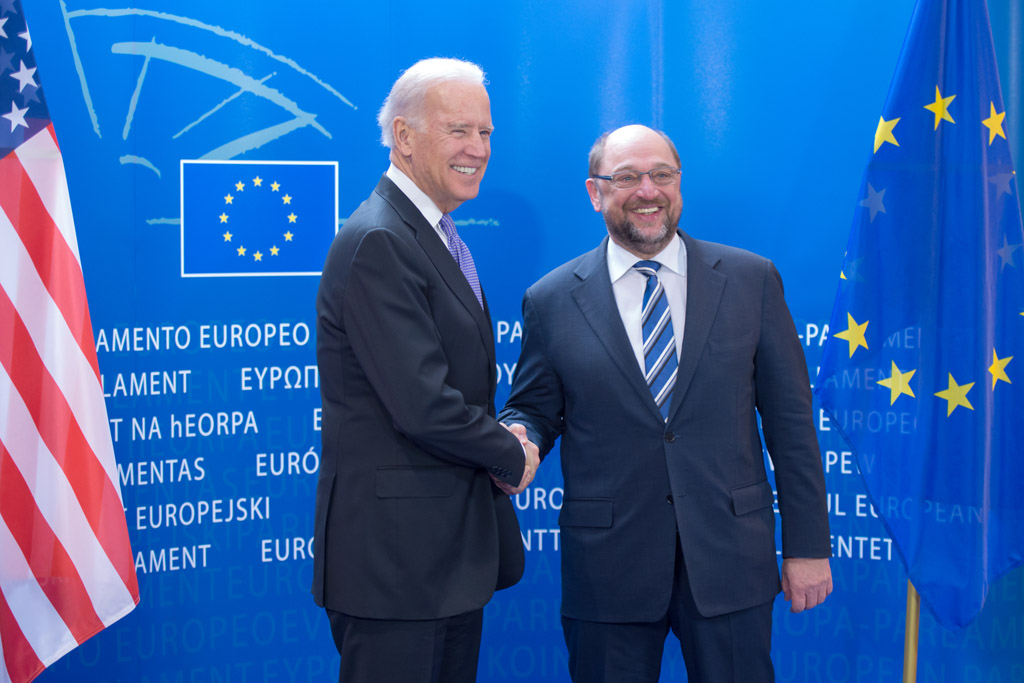
Thus the President of the European Parliament, Martin Schulz, spent Monday morning hosting a laid back online live-chat on Facebook, in which he fielded carefully-screened softball questions from members of the public. And sneaking back onto the radar during that live-chat today was the prospect of a common European foreign policy, and a European army to enforce it.
To questions concerning the recent proposal on a common European army, Schulz replied “we need a common foreign and security policy”, explaining that combined military capacities would be a way of reducing military spending in a time when “money is certainly needed elsewhere”.
Meanwhile, others in the European Parliament are making rumblings about moving toward “permanent structural co-operation” – meaning there will be no way back once the EU starts taking major steps as an independent actor on the world stage:
The launch of UKIP’s immigration policy was always going to be a newsworthy event, especially when it became clear that Nigel Farage’s party was not going to walk into the trap of humiliating the Conservative Party by committing to an arbitrary (and ultimately unachievable) target for net migration.
Many openly antagonistic commentators and journalists are painting Nigel Farage’s refusal to set a precise immigration target as a political error or missed opportunity. But in reality, this pragmatic stance – and advocacy of an Australian-style points-based immigration system – suggests a maturing political party that understands both the constraints of government and the need to be honest with the people.
People want to know more about Ukip’s policies. The issue of mass migration is one of the most important to British people, and as we aspire to hold the balance of power after the election, we have an obligation to set out our stall.
So let me say we believe that migration into the United Kingdom is too high. It’s affecting the NHS. It affects policing, school places, infrastructure, wages, and the make-up of local communities. This is why Ukip wants to see a Migration Control Commission – with a remit to bring down net immigration, while assuring the right number of highly skilled workers from across the globe are able to enter.
This body will be tasked with establishing and controlling the Australian-style points system. While politicians and the people they represent determine the direction of travel for this country, we will not, unlike the other parties, seek to set arbitrary targets which only result in broken promises.
Imagine that you are a young child in an alternate universe, a future world in which the European Union has been disbanded amid popular uprising and economic depression.
Then imagine that you are circling Berlin in an airplane suffering a technical emergency, while Angus Deayton (of all people) sits next to you and bores you to tears with dull morsels of selectively-remembered EU trivia, interspersed with told-you-so left wing laments about how everything would have been so much better if only his generation had spent more time loving the European Union.
Even the most happy-go-lucky child would be willing that aircraft into a terminal nosedive and sweet oblivion after an hour of such torture. I certainly was, after just ten minutes watching The Great European Disaster Movie on BBC Four last night.
You wait years for an apocalyptic mockumentary where Nigel Farage ushers in the end of western civilisation, and then two come along at once.
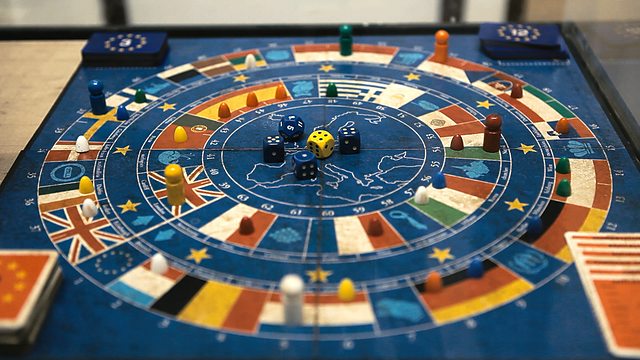
Hot on the heels of Channel 4’s alarmist and liberal bias-reinforcing docudrama “UKIP: The First 100 Days” comes a new offering from the BBC, with the sober and reflective title “The Great European Disaster Movie”.
As often happens with propaganda and political hit pieces, the BBC downplays the documentary as being thought-provoking and witty, falling back on the satire defence while revealing its true bias by never attempting to satirise the opposing side of the argument:
The film includes fictional scenes, set in a post-EU future, which feature archaeologist Charles Granda (played by Angus Deayton) travelling on a flight through a menacing storm, explaining to a child passenger what the EU was. Sombre, thought-provoking and witty, the film frames Europe through the eyes of those who have most at stake – the Europeans themselves.
An army of Islamic State terrorists has advanced to the outskirts of Vienna, Spain has cut off routes to Gibraltar and Nigel Farage – prime minister of ‘Great England’ – has deported all immigrants who have arrived in the past ten years.
This, according to the BBC, is what the world would be like if the European Union were to collapse.
The apocalyptic vision of a continent in which social order has broken down – to be screened on BBC4 tonight at 10pm – has been condemned by Eurosceptic critics as ‘scaremongering’.
Among the issues and contradictions apparently not explored in the documentary:
Why European countries alone face economic ruin and civil unrest if they fail to pool their sovereignty and dilute their national identities
How other geographical regions such as Asia and the Americas prosper without powerful, pan-national and undemocratic institutions, while Europe would face ruin without them
Why UKIP would countenance the upheaval of deporting “all immigrants who arrived in the past ten years” when they have stated repeatedly and often that they favour a points-based immigration system that focuses on skills and quality
Why the economic disruption caused by dismantling the European Union would lead to more anarchy and chaos on the streets than the EU’s calamitous policies, one-size-fits-all monetary policy and lack of democratic accountability are already causing every day
If you sincerely believe that the age of the nation state is over, that Britain is in no way special and cannot compete in the global economy in the same way as, say, Switzerland or South Korea, then fine. But own your position and make your case accordingly from that starting point, not by masquerading as a dispassionate observer with no political bias or financial interest.
More importantly, an organisation like the BBC, in receipt of billions of taxpayer pounds and under a mandate to inform and entertain the whole nation, must recognise that acting as a shill for pro-EU propaganda is incompatible with its founding mission and charter, and renounce all public funding so that it can become a full time political pressure group.
Once the short election campaign is underway everything will become a lot more restricted, and UKIP specifically will benefit from being afforded “major party status” and given the right of rebuttal and increased coverage on broadcast television news programmes.
But until then, expect a lot more hysteria and misinformation of this type, insidious propaganda presented as “just a bit of fun”.
This blog’s full review of “The Great European Disaster Movie” can be read here.
Beyond their obvious stated goal of facilitating Britain’s departure from the European Union it is becoming increasingly hard to discern what the party believes, heading into the 2015 general election. We can rejoice that many of the wackier elements of the 2010 UKIP manifesto – such as repainting trains in traditional colours and capping the number of foreign players on a football team – have now been explicitly disowned. But the 2015 manifesto, originally due to be launched at the Spring Conference, is late, nowhere to be seen.
In the video above, UKIP’s second MP, ex-Tory defector Mark Reckless, enthuses about UKIP’s prospects coming out of their spring conference in Margate. Reckless says:
I talked about how UKIP is the party of the NHS, we’re gonna get three billion more for the NHS. My dad’s a doctor, my mum’s a nurse, our party leader, three times the NHS has been a lifeline for him, and UKIP is the party of the NHS, and that was my message this morning.
Forget the fact that Mark Reckless appears to be earning a handsome commission every time he utters the letters “NHS”. More worrying is the fact that the backup party of small government, personal freedom and individual responsibility, the last resort for small-C conservatives when the Tory party debases itself in centrist appeasement, is now trying to out-Labour the Labour Party in terms of unthinking fidelity to a broken model of healthcare provision from 1948.
Mark Reckless is an intelligent man, so to hear him make the non-point that Nigel Farage supports the NHS because he has received NHS treatment (as though he would have been left in the wreckage of that aeroplane crash back in 2010, were it not for socialised healthcare) is painful and depressing.
Not only is this approach dishonest (Nigel Farage himself has stated his belief that Britain should move toward an insurance-based system), it is also pointless. For better or worse – and it is nearly always worse – the Labour Party have a monopoly when it comes to the NHS. Delivering universal healthcare in 1948 was about the last good thing that Labour did, and so keen are they to maintain this legacy that they would rather preserve the NHS in its current form for all time, falling healthcare outcomes be damned, rather than let anybody else tinker with their brainchild.
This is not fertile territory for a party of the political right. And every promise made by UKIP to throw more money at the same broken model of post-war healthcare delivery in order to woo a potential Labour voter is equally likely to make a conservative, small government Ukipper reconsider their voting choice in 2015.
Nigel Farage’s party appears to be gambling that electoral success in 2015 will come from fusing disaffected traditional conservative support with disaffected angry left-wing support. And tactically (if not strategically) this may make sense. UKIP’s narrative – that of a strong nation state being the bedrock of a prosperous society and a weak nation state inevitably resulting in unhappiness, unemployment and unrest – transcends traditional left/right political lines, attracting disaffected voters from both Labour and the Conservatives. Red and blue, after all, combine to make purple.
But the resulting shade is not necessarily pleasing to everyone, especially not to those who were first attracted to UKIP because of their euroscepticism and belief in small government and a lean state.
Having risen to great heights by castigating the main political parties for looking and sounding the same and for occupying the same crowded space in the political centre, UKIP should think twice before taking any steps toward emulating them.






 Semi-Partisan Politics