A Black Flag Flies In London, Revealing A Schism In Britain

Will Crooks Estate Flag London


A black flag was flown from the gates of an east London housing estate, and an entire neighbourhood was effectively declared last week not only to be in solidarity with the people of Gaza and the cause of Palestinian statehood, but – contrary to any available evidence or the residents’ consent – to also be united in a shared, extremist interpretation of the Islamic faith.

As the Guardian reported at the time:

The flag bears similar writing to the jihadi flags that have been flown by the extremist group in Iraq and other jihadi groups since the 1990s. When the estate was approached last night, a group of about 20 Asian youths swore at Guardian journalists and told them to leave the area immediately. One youth threatened to smash a camera.

When a passerby tried to take a picture of the flag on a phone, one of the gang asked him if he was Jewish. The passerby replied: “Would it make a difference?” The youth said: “Yes, it fucking would.” Asked if the flag was an Isis flag, one local man said: “It is just the flag of Allah.” But another man asked: “So what if it is?”

Should the black flag be banned from the streets, as it is in some European countries such as the Netherlands? Absolutely not – the right to free speech and freedom of expression is one area where it is actually right to take a maximalist, uncompromising stance despite the difficulties and tensions that it may cause.

Banning the black flag, despite its similarities to the jihadi flags flown by ISIS, is not the right move. If a private individual wishes to mark themselves out in public as a ideologically extremist bigot with pro-terrorism sympathies, that should be their protected right. But the flag had no place being flown on council-owned housing property as though it spoke for all of the residents when it did not, and so it was right that the flag was removed by Sister Christine Frost, a Roman Catholic nun and local community activist.

Douglas Murray summed up the most appropriate reaction to the provocation at the time in The Spectator, explaining in stark terms the gravity of the fact that some British Muslims chose to proudly display a flag of this type in London, so far removed from the various conflicts:

When historians look back on Europe in this era, they will rub their eyes in disbelief. ISIS is carrying out actual genocide, ethnic and religious cleansing on the people of Syria and Iraq. Their exact ideological soul-mates in Hamas, Hezbollah and al-Qaeda are doing everything they can to set light to the same region. Right now the western states are finally talking of intervening in Iraq to stop ISIS wiping out the ancient Yazidi and Christians communities of Iraq. Yet we do nothing to stop the same murderous ideology thriving here.

Instead another pattern is set. When we see this disgusting ideology at work, as we have done for the last month, much of Europe turns its hatred onto the Saturday people for defending themselves. Israel continues to defend itself. And we may do something to hold back ISIS in Iraq. But what will we do in our societies when we finally realise that behind the flag of Hamas is the black flag of jihad, and that after failing to stand up for the Saturday people there will be fewer people left to stand up for the Sunday people?

Most importantly, what will we do when we wake up to the fact that, far from being in some neighbouring or far-flung country, we have allowed the enemy to plant itself deep inside our own countries?

But perhaps predictably, LondonLive is now reporting that the same young people who raised the flag over a housing estate in east London are complaining that the flag’s very removal is a sign of racism and Islamophibia:

A controversial black flag flown above the gates of an east London council estate is being defended by young Muslims.

The flag – which has been linked to some jihadist groups – has been removed twice by a concerned nun and police officers. 

But youths at the Will Crooks estate in Poplar have today said assumptions that the flag is linked to extremist groups is ‘racist’. 

One youth said: “It’s just racists complaining. If it was the St George’s flag, it would be alright. But this is our version and there’s this big reaction.”

More than the fact that the flag was raised in the first place by one or two deluded hotheads, it is the fact that the flag was then defended by other, supposedly representative local youths, that should give everyone the greatest cause for concern.

Here, in the young peoples’ protest, is the whole problem in a nutshell, the root of the problem with Islamic extremism in Britain. It’s the regrettable attitude by some Muslims that proclaims “You may be English, but we’re Muslim”. It’s the stubborn belief among its adherents that they are Muslims who just happen to live in Britain, rather than British people who happen to follow the religion of Islam. And yes, it’s the craven support from some appeasers on the left, who overlook or excuse the lack of  integration with British society, and echo their accusations of Islamophobia and racism directed at anyone who argues for greater cultural assimilation and the embracing of British values.

The fact that the go-to defence offered up by the local youths was a comparison with the St George’s Flag, one of the home nation flags of the United Kingdom, reveals the height of the mountain that must be overcome. The St George’s Flag belongs just as much to the angry Muslim youths in the Will Crooks housing estate as it does to anyone else in England, but they choose to reject it in favour of a religious flag, despite the fact that their chosen standard has a violent, gory recent history.

In modern Britain (with the partial exception of Northern Ireland, where sectarianism and flags are still linked with intolerance and violence), one’s religion and faith is not demarcated with a flag. Indeed, religion and national identity or patriotism exist, for the most part, on separate planes – and much the better for it. A British Catholic may follow Church doctrine and hold the Papacy in the highest reverence, but will likely identify as British first and foremost, and it is to the country that their primary allegiance lies. The same could be said of most British Jews, or mainstream British Muslims.

But there is a sizeable, vocal block of non-mainstream Muslims who clearly do not identify themselves as British first and foremost, who in some cases feel that they are pitted against their non-Muslim neighbours and compatriots because of their faith. And these people are eagerly capitalising on events taking place many thousands of miles away – in Iraq, Syria and Gaza – to pledge their solidarity with and allegiance to this religious, cross-border fraternity before they give any thought to Britain, the country that gives them life and liberty.

This has to stop, but in order for the situation to change it must first be recognised as a problem. This recognition needs to come from Britain’s mainstream Muslims first and foremost – of course community leaders and parents can only do so much to teach tolerance and British values when social media and internet voices speak the language of extremism, but still an effort must be made commensurate with the scale of the problem.

But the rest of us have a role to play too. Where there is genuine Islamophobia, we must confront it and correct misconceptions about moderate, mainstream Islam. But equally, we must not be cowed into defending extremism when we encounter it, for fear of being labelled racist or intolerant. We have seen the insidious harm that can be done when a blind eye is turned to the extremist threat in the case of the Birmingham “trojan horse” schools scandal.

The people who chose to hung the black flag from the gates of the Will Crooks estate in Tower Hamlets were not merely expressing solidarity with the people of Gaza in the course of the current conflict with Israel. They went above and beyond that statement of solidarity (which was itself inappropriate as it presumed to speak for the whole community without their consent), and flew a flag which they knew to have connotations of violence and extremism. Any pretence that it was all just an innocent misunderstanding was shattered when the flag was re-flown again days after being taken down.

Unless and until the wall of stubborn, self-imposed segregation is broken down between tolerant, mainstream Britain (including moderate British Muslims) and those sullen holdouts who feel stronger identification and fealty to primitive, medieval dogma than to their own country, Britain will continue to wrestle with this toxic (and increasingly existentially threatening) issue.

And before long, an offensive flag flying in the shadow of Canary Wharf will be the very least of our concerns.


Photograph: From Trial by Jeory blog.

The Underwhelming Return Of Boris Johnson

Boris Johnson Parliament 2015 General Election 3


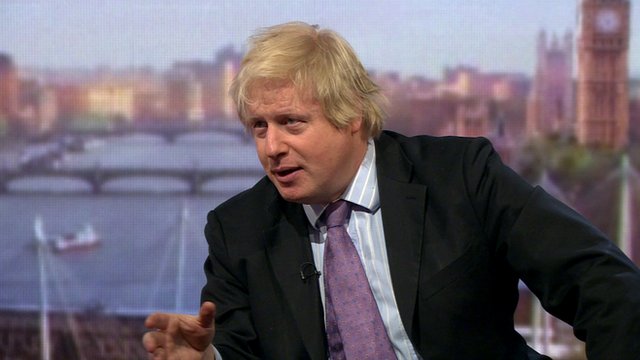
Who cares that Boris Johnson, the current Mayor of London, has finally admitted the blazingly obvious and declared his intention to stand for Parliament in the 2015 general election?

Almost everyone in the commentariat class seems to care, and to have a strong opinion about what is perhaps the most unsurprising revelation in British politics. But precisely why the rest of us should care about this revelation is not so self-evident. There’s obviously something in it for Boris Johnson: the opportunity to compete for the Conservative Party leadership in the event of a 2015 general election or 2017 EU referendum defeat. But what does a potential future Boris Johnson premiership offer the country that merits such a fevered round of speculation and media coverage?

Read any of the articles breathlessly speculating about David Cameron’s annoyance at being outmanoeuvred by Boris whilst on holiday, where the Mayor of London will make his stand as he searches for a constituency, or the pieces imagining the circumstances in which Boris might beat George Osborne and Theresa May to the leadership in the event of Cameron’s early demise, and you will learn everything you possibly need to know about The Decision. Everything, that is, except for why a Boris Johnson administration would be interesting, or different, or especially harmful or beneficial to Britain. But you can’t entirely blame the press corps for the oversight – if they are unable to answer these questions it is because the great man himself is just as uncertain of the answer, and has taken every opportunity to avoid revealing his vision.

Those people hailing Boris Johnson’s announcement should explain to the rest of us exactly what it is about their man that makes it worth getting excited about. Is it his bold, original policies on this or that? Because precious little has been written about the stark policy differences that distinguish the London mayor from the likes of David Cameron or George Osborne. Is it his approach to the electorate and politics in general? Because the Boris trademark down-to-earth, sometimes frank demeanour is nothing that UKIP’s Nigel Farage does not already offer. Or is it because of his years of executive experience managing the capital city of the world? Because the competencies needed to be a competent mayoral figurehead are not necessarily the same skills of tenacity, diplomacy and coalition-building needed to succeed as prime minister.

In one of the few tangible political divides where Boris Johnson has forcibly expressed an opinion, he has been wrong, and unabashedly part of the problem rather than the solution. At a time when airport capacity in southeast England is under pressure and London’s competitiveness impacted, the British government has done what it does best – handwringing, buck-passing and stalling for time with lengthy enquiries – and London’s mayor has campaigned against the obvious solution of expanding Heathrow airport in favour of a hare-brained scheme to close the UK’s largest airport and replace it with an entirely new facility in the Thames estuary. This blog has repeatedly explained the foolishness behind the mayor’s alternative vision.

Boris Johnson is also on manoeuvres to distinguish himself from Conservative Party orthodoxy on the thorny subject of Britain’s EU membership, but even here his newfound embrace of euroscepticism is riddled with disclaimers and lacks sincerity. It is particularly telling that when polled, over half of UKIP voters said that if Boris Johnson were to stand for the Conservatives on their local constituency, it would make no difference to their voting intentions. While eurosceptics and believers in nation state democracy should be pleased when any prominent Conservative politician commits to campaigning for a British EU secession in the event that renegotiations fail, in Johnson’s case it does not automatically make up for his previous equivocation and instinctive desire for Britain to remain inside the European Union.

In David Cameron and his coalition government, Britain already has a thoroughly conservative-lite leader, happy to talk the talk about fiscal responsibility and small government while carelessly treading the same uncompetitive, centrist and statist path as his predecessors. If the British electorate is to be asked to vote Conservative again, do they not deserve an upgrade from the Tories’ 2010 offering? Differences of image and style aside, it is very difficult to discern how Boris Johnson represents anything new, let alone an improvement on David Cameron.

And in a surprise twist, one of the few senior politicians (aside from Boris Johnson’s direct competitors for the Tory leadership) to see through the bumbling, affable persona is the usually hapless deputy prime minister, Nick Clegg:

“The thing about Boris Johnson is despite all the clumsiness and bumbliness he’s actually a really, really ambitious politician,” Mr Clegg said.

“He treats his political ambition like he treats his hair. He wants everybody to think he doesn’t really care, but he actually really, really does care.

“His tousled hair, his bumbliness, all that’s great. But behind all of that is someone who is absolutely fixated with his own political ambitions.”

The only thing missing from Nick Clegg’s timely critique is this blog’s concern that there might actually not be anything beneath the populist image and the driving ambition. It would be bitterly ironic if Britain’s next Conservative prime minister turned out to be the polar opposite of his most recent Labour predecessor in every area except for one – that they both shared a burning desire to reach Number 10 Downing Street, but had absolutely no idea what to do with the prize once they had it.

So why should we care that David Cameron’s former classmate has made official his plans to return to Parliament? The onus is still on Boris Johnson to convince us that it matters in the slightest.

Headline London Debate: Should Britain Make Eid And Diwali Public Holidays?

Samuel Hooper London Live Headline London Eid Diwali Public Holiday 2


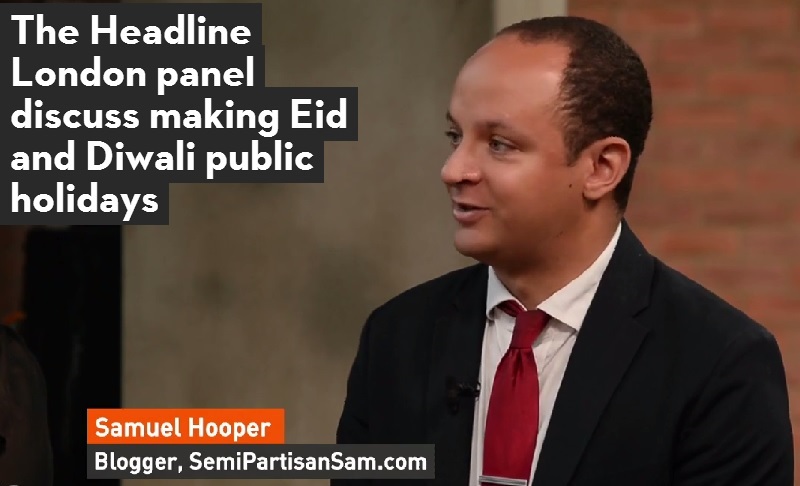
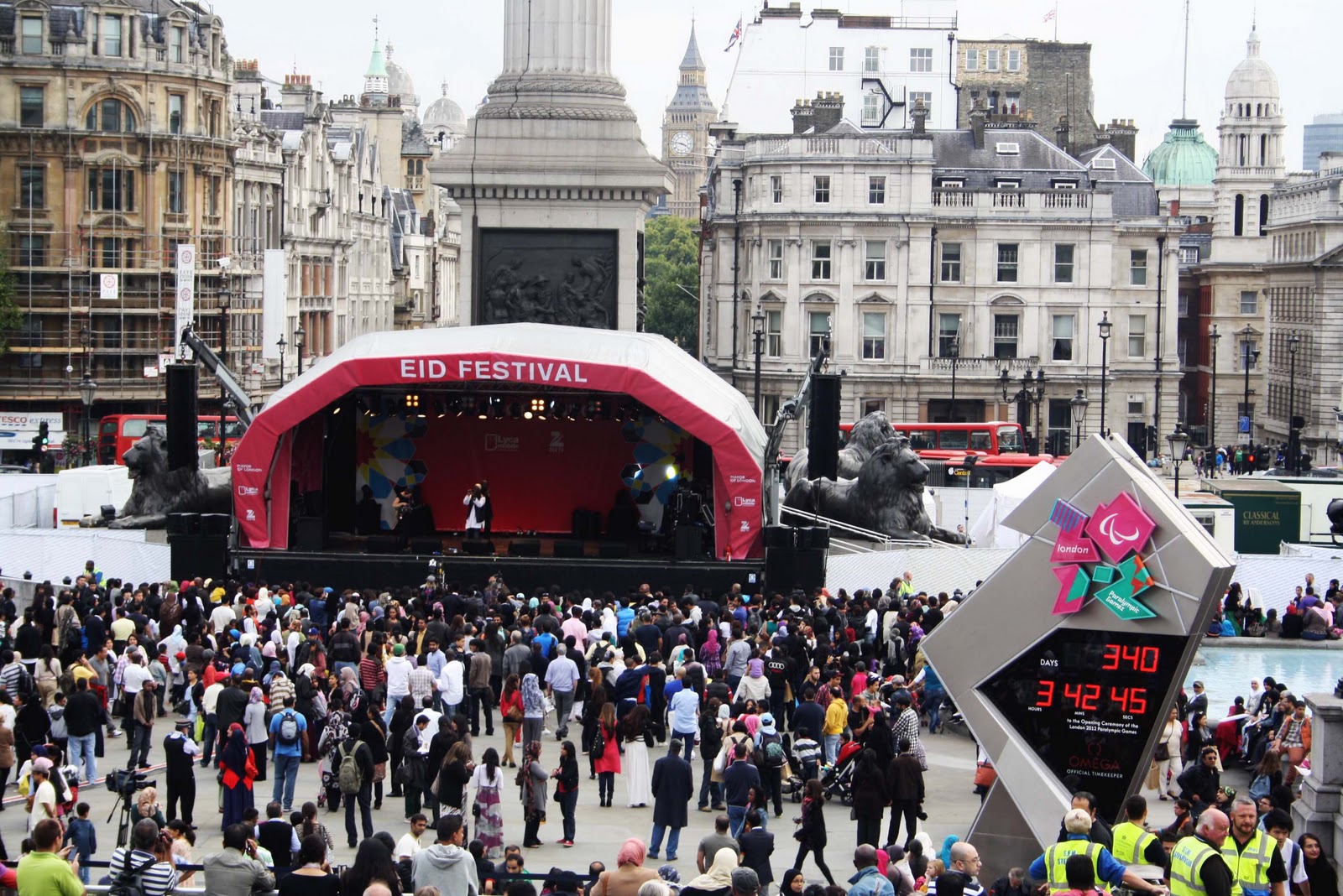
Yesterday, London Live TV’s Headline London lunchtime news programme covered the Eid celebrations taking place in the capital, and asked whether the UK government should make Eid (and the Hindu festival of Diwali) nationwide public holidays.

The idea was first raised in Parliament last week by Conservative MP Bob Blackman, in response to an online petition signed by more than 120,000 people. I vehemently disagreed with the proposal at the time, for the reasons set out here.

Semi-Partisan Sam was pleased to be invited to debate the issue with poet Mohamed “Mo Rhymes” Mohamed and political activist Peymana Assad on the Headline London panel. The debate was courteous and good-natured, which cannot often be said of debates on religion – but I believe my argument, founded on national unity, church/state separation and the rights of the individual won the day.

London Live’s website only shows the first part of the panel discussion, but the full segment is embedded here, via Semi-Partisan Sam’s YouTube channel:

If you enjoyed reading this article, please take a second to LIKE or SHARE it on social media using the buttons below. Help to spread the word and continue the debate.

TV Debate – Making Eid And Diwali British Public Holidays

Eid celebration london


Last week I vociferously disagreed with Bob Blackman MP’s efforts in Parliament to make the religious observance days of Eid and Diwali public holidays throughout the whole of Britain.

This was in no way out of animosity to Britain’s Muslim or Hindu communities; Semi-Partisan Sam acknowledges and appreciates the good that all of Britain’s religions and denominations (as well of people of no faith) contribute to the rich tapestry of our country.

But carving out a new exception, or concession, to minority religions in Britain would be a backward step just as small signs of progress are being made in rolling back the pervasive and anachronistic influence of our own established national church.

Furthermore, if we are to add a new public holiday to our calendar, Semi-Partisan Sam strongly believes that it should be one that unites, rather than divides, the whole of our United Kingdom. At a time when Britain is seemingly fracturing into a loose, uncomfortable coalition of competing interest groups and distinct sub-communities, and when many people struggle even to articulate any sense of British values, any new public holiday should celebrate the history and achievements of our entire nation – the one to which we all belong, Christian, Muslim, Hindu or otherwise – rather than flatter or appease any one particular group marked out for sponsorship by the government.

I will be on London Live TV’s Headline London show today, from 1230-1330 UK Time, participating in a panel discussion in which we will debate this topic.

You can watch on Sky 117, Virgin 159 or Freeview 8 from 1230 onwards.

As The World Burns, Britain’s Political System Remains Broken And Neglected


If it suddenly feels as though there are more loud-mouthed juveniles wandering about during the daytime, it is because both the nation’s schools and the House of Commons have wrapped up their business and gone home for the summer holiday. But while no one should begrudge our young people or their harried teachers a much-deserved break, Westminster’s politicians are returning to their constituencies with few solid accomplishments to their credit, and with the very effectiveness of Parliament itself now in question.

While the world is captivated by the latest slaughter in Israel and Gaza, and scrambles to respond to Russia’s aggressive expansionism and the downing of flight MH17, a number of far less dramatic but equally intractable problems continue to chip away at British democracy and our political institutions. Normally, these “dull” issues only see the light of day at election time – at which point everyone stops to wring their hands about how terrible it is that so few people bothered to vote, or (heresy of heresies) that they voted for UKIP – but a pair of articles in the Spectator and at Conservative Home  sound an early warning that we would all do well to heed before we get distracted by the 2015 general election campaign.

The Spectator piece, by James Forsyth, starts by bemoaning the fact that so many of the ex-ministers recently departed from David Cameron’s Cabinet following the reshuffle have also elected to stand down as MPs at the 2015 general election. But it grows into a broader, important discussion about the kind of MPs that we should want debating legislation and holding the executive to account in the Commons:

Most of those leaving are not doing so because they are past retirement age. Sir George Young might be 73, but William Hague, Andrew Lansley and David Willetts are only in their fifties and Greg Barker is a mere 48. When they go, they will take expertise and experience that the Commons desperately needs to do its job properly. Former ministers play a particular role in the Commons’ ability to scrutinise what the government is doing.

Although the details of each ministerial case are different, Forsyth correctly taps into an increasing sense among many current and aspiring MPs that the only goal worth shooting for is a top-level Cabinet position, and that any other trajectory (a brief tenure as a junior minister or a few terms on the backbenches) is an unacceptable outcome for their political career.

Forsyth then makes an important point about an over-emphasis on youth which seems to attract the ‘wrong’ kind of young people into Westminster politics (such as Labour candidate Emily Benn):

This emphasis on youth precludes people having had a long career outside of politics. One doesn’t have to agree with the former minister who says that ‘we have the worst of all worlds — people who aspire only to be managers but can’t manage’ to think that it is unfortunate that the ambitious feel they have to stand for office before they have had time to reach the top of another profession.

This complaint ties in very strongly with this blog’s own concern at the lack of real ‘citizen politicians’, people whose sense of civic duty compels them to take a mid- or late-career break to sit in the House of Commons representing their constituents for just one or two terms of office. Of course there are always a handful of one-hit wonders, but most one-term departures are a result of losing re-election, scandal, failing to achieve work/life balance or bitterness that plans for rapid promotion and the acquisition of power and prestige did not come to fruition.

Indeed, an MP voluntarily leaving Parliament for a reason other than these typical motivations is almost guaranteed to be newsworthy, as it was when Conservative MP Dan Byles, of the 2010 intake, announced his decision not to seek re-election. And instances of British political candidates pledging upfront to serve only a single term or a set number of terms are almost non-existent.

Forsyth’s twin solutions are quite radical – he proposes increasing constituency sizes to dramatically cut the number of MPs to around the 400 mark, which would make it harder for them to be coerced into wasting time going to battle  for individual constituents and their personal problems, something which better falls under the remit of local government. (It should, however, be noted that US congressional districts are as much as ten times larger than UK constituencies, and American representatives are still expected to fulfil this role).

But ultimately, Forsyth believes it may be necessary to split the executive from the legislature and impose a separation of powers in Britain once and for all. This really is quite visionary stuff, and would form part of the comprehensive UK-wide constitutional reform that Semi-Partisan Sam has long advocated. If the legislature and the executive were separate, the quality and effectiveness of the House of Commons would be less polluted by the presence of young whippersnappers who regarded their seats and duties to their constituents as a mere springboard to higher office. The opposition to such a split would be immense and the details would need to be worked out – would all government positions be purged from the Commons, necessitating a separate election for Prime Minister, for example – but it is a fascinating idea worthy of serious discussion.

Meanwhile, Mark Wallace at Conservative Home has the House of Lords in his sights, arguing that the size of the upper chamber (rapidly nearing 1000 peers) is too large, too inefficient and so stuffed with “cronies and failed politicians” that the ability of the chamber’s subject matter experts to properly scrutinise legislation is severely limited.

With a very unflattering comparison to the 3000-member Chinese National People’s Congress, Wallace explains that such a large body can only be a recipe for confusion:

The swelling ranks are an outcome of the Lords’ confused role. On the one hand, the Upper House is meant to scrutinise legislation as a home of expertise; on the other, it is a tool for morale and political management in the Commons – convenient vacancies are created on the green benches by bumping MPs up, patronage (or the hope of receiving it) is extended to maintain party discipline, and partisan appointments are made in the hope of improving the chances for Government legislation …

The Mail‘s description of many appointees as “cronies and failed politicians” is too often correct – we are meant to get experts, but a lot of the time we get party apparatchiks, trade union officials and the great and good from Whitehall and the media. For every great debate, like that on assisted dying, there are a dozen in which the prevailing ideological trends of our left wing establishment are recited as fact.

It’s hard to argue with that assessment. Semi-Partisan Sam was in the public gallery at the House of Lords on Wednesday, and was shocked by the perfunctory laziness with which Oral Questions was rushed through, the sloppy way in which the self-regulating peers kept (or rather didn’t keep) order, and the sheer amount of timewasting that takes place as the House resolves itself into a committee, out of a committee or divides for a vote (mechanics that are rarely seen by the British people as the House of Lords proceedings tend to be shown only in highlight reels by the BBC). Quite why many of the peers filling the benches for Oral Questions were there at all was a mystery, given their disinterested faces and sleepy postures – until one remembers the £300 daily allowance.

Reform of this sleepy and dysfunctional institution will not be easy – the most recent plans, hammered out in the coalition negotiations in 2010, were abandoned when Conservatives reneged on their agreement to support the changes. But at a time when any mention of House of Lords reform is met with sighs and knowing warnings that it can’t be done, Wallace’s proposal for an easy quick win on the issue should garner support from everyone:

We do agree on a starting point, though: the numbers must be reduced to make the House functional. David Steel’s proposals to require members to commit to being active, working Peers or face expulsion and to introduce an age limit both have merit and would go some way towards fixing the problem.

Yes, it would. We still see the problem of peers “clocking in” to Parliament to be eligible for their daily allowance, while otherwise doing nothing to contribute to the workings of the institution or the democratic process. Accepting an ennoblement should be contingent on making a commitment to turn up for work and do the job. The current situation – where there are life terms, no upper age limits, no requirement to actually do any work and no simple procedure for removing lazy or criminal peers – is a virtual incentive for poor performance and represents the antithesis to a well functioning upper chamber.

None of these very unsexy constitutional issues are likely to set the world on fire, not when so many pressing international human tragedies are doing such a fine job of keeping it aflame in the worst possible way. But we in Britain have a nasty habit of ignoring pressing questions about how we want to govern ourselves and make decisions, allowing them to smoulder untended in the background until events cause them to suddenly burst to life in a wildfire of public outrage.

Think back to 2010, and the pompous outrage that met the formation of a Conservative-led coalition government that “nobody voted for”. It’s certainly true that there was no box on the ballot paper marked “Cameron & Clegg Double Act”, and so in that strict sense the plaintiffs are correct. But we all went into that 2010 general election knowing (or deliberately choosing to remain ignorant of) the way that our voting system worked, and that a hung parliament was a possibility. If the people do not have the proactivity or the attention span to think about these possibilities and make their preferences known beforehand, there are no grounds for complaint when Sir Gus O’Donnell and other senior civil service mandarins facilitate a resolution of their own behind closed doors.

In the same way, we all know (or deliberately choose to remain ignorant about) the variable calibre of politicians that are currently attracted to Westminster, and the hazy unwritten rules and conventions which govern Parliament’s workings. But as well as being cognisant of the problem, we are also now armed with a few radical suggestions for digging ourselves out of our democratic deficit.

With a small window before the 2015 general election campaign to get these issues debated and make them part of the policy discussion before the parties publish their manifestos, advocates of constitutional reform should see this moment as a rare opportunity.