The Christmas View From Your Window

SPS Christmas 2015 View From Your Window Harlow Essex v2


In his Christmas Day column, Dan Hodges invites us to look out of our nearest window and tell him what we see. He isn’t doing this out of voyeuristic curiosity, of course, but rather to make a point:

We see what we choose to see when we look outside. And at the moment, when we look out the window, we are choosing to see a world that scares us. Collectively. As a country. As a people.

This was the year that we become an agoraphobic nation. The year that the trembling upper lip officially replaced the stiff upper lip. The year that fear became our constant companion; paranoia our trusted friend.

Hodges goes on to argue that on a whole range of fronts – terrorism, immigration, Ebola, Evil Corporations, Westminster Elites, paedophile grooming gangs and crazy, swivel-eyed Ukippers – the British people are retreating in the face of difficulty, burying our heads in the sand and failing to confront pressing problems or take positive steps to secure our future. And he is right, up to a certain point – numerous difficult issues have swirled around us during the hectic political year of 2014, and yet we have made precious little progress in dealing with any of them.

Continue reading

Conservatives Should Not Apologise For Wanting To Shrink The State

George Osborne Ed Balls Austerity Big Government debate


“Tories pull into four point lead over Labour” proclaims the headline in today’s Telegraph, citing an Ipsos MORI poll that put the Conservatives on 33 per cent to Labour’s 29. But not so fast: “Labour opens up five point poll lead over Tories” reads a contradictory headline in the Guardian, talking up an ICM poll that put Labour on 33 per cent with the Tories languishing at 28.

Both polls come packaged together with their predictable narratives – Labour have opened a lead because their Road To Wigan Pier attack on the Conservatives is beginning to resonate with voters, according to their supporters, while the Conservatives are gaining ground because of Ed Miliband’s disarray on immigration and the beginning of the inevitable UKIP implosion, according to theirs. But looking past the partisan spin, neither poll makes encouraging reading for Labour or the Tories. In fact, the inability of either of Britain’s two dominant political parties to command the support of more than one third of the electorate is very damning indeed.

The reasons for the Labour Party’s malaise are fairly self evident – residual mistrust and dislike following thirteen recent years in government, a growing alienation between the party elite and their traditional core voters, total incoherence on the topic of immigration and the UKIP threat, and the abysmal personal ratings of their ex-leader in waiting, Ed Miliband. This blog has covered all of these symptoms of Labour decline at one point or another. But far more interesting are the reasons why the Tories are failing to generate any real approval or excitement, even among their supposedly natural voting blocs. These reasons are simple but stark: the Conservative Party has made a hash of delivering against the promises on which it was (kind of) elected, and has spent far too much time apologising for and excusing its policies along the way.

Continue reading

How Will Lying About Immigration And The Deficit Improve Trust In Politics?

Spectator David Cameron Deficit Debt Reduction Lie 2


Somehow, the message still isn’t getting through.

“We just want you to level with us, own up to your past failings and tell us where you really stand on the key issues we care about”, scream Britain’s voters to their increasingly detatched political leaders, in the subtext to every single opinion poll or by-election result of 2014. In response, our political leaders scratch their heads and look confused. “So you want us to pretend as though we understand and respect you?”

Britain’s established political parties have been haemorrhaging support to the new insurgents – UKIP, the Green Party and the fastest growing bloc of all, those who have given up on politics and voting entirely – since the inconclusive 2010 general election and subsequent formation of the coalition government laid bare how vanishingly little difference there really is between the red, blue and yellow team consensus. And as the 2015 general election approaches, each of the establishment parties will come face to face with their own reckoning: David Cameron’s Conservatives face the humiliating prospect of failing to win an outright majority for the second consecutive time, Ed Miliband’s Labour Party behold the implosion of their 35% core vote strategy and Nick Clegg’s LibDems hunker down and wait for the sweet release of electoral oblivion.

In a sane world, the growing revulsion and contempt felt by the British people toward their political class might by now have led to a degree of introspection and a nagging desire among politicians and political parties to cease their endless cycle of cynical, self-destructive behaviour. But we do not live in a sane world. And so the response of Britain’s main parties to the groundswell of public anger at their inability to be honest about their past records and current policies is not to come clean and give honesty a try, but rather to double-down and turn up the brazen deceit to “maximum”.

Continue reading

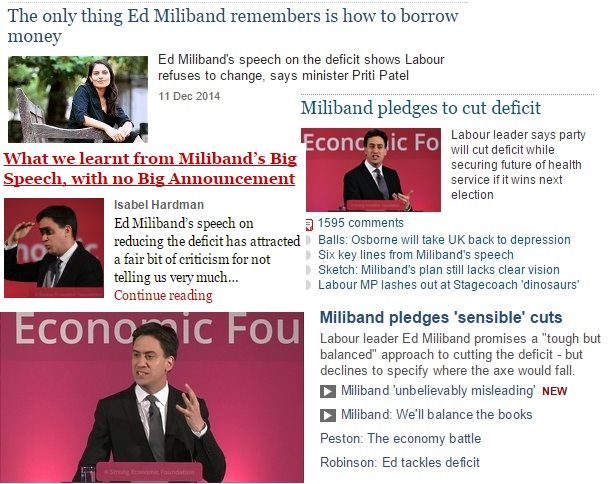
Ed Miliband Talks About The Deficit, Says Absolutely Nothing

Ed Miliband Speech Deficit Austerity Economic Policy Media SPS


How many times have we been told to expect a “big speech” from Labour’s ex-Leader in waiting, Ed Miliband?

Today is the day when Ed Miliband finally gets serious and fires the starting gun for the 2015 general election campaign, we were told. This is the day when the Labour party will stop being scared of its own shadow or apologetic for its past, and tackle the issue of Britain’s persistent budget deficit head-on. In fact, the latest oration by Miliband was so heavily trailed by Labour’s press team that even seasoned and cynical Westminster reporters were teased into expecting some kind of new policy proposal or big announcement. And what did we get? The same lack of specifics and anticlimactic sense of time wasted that Ed Miliband always manages to evoke.

This blog has long pointed out that Ed Miliband wouldn’t know a great political speech if one jumped off the teleprompter and hit him square in the face – a typical Miliband speech is a more or less random assortment of short, standalone platitudes, focus group-tested to ensure their bland inoffensiveness, and none of which exceed ten words so as not to tax the brain of the listener, whose intelligence is so rudely and continually insulted. This being so, it was a pity to see much of the mainstream press, starved of inspiring political oratory for so long, lazily repeating back the assertion that this was indeed a Big Speech by Miliband, just because the Labour press office labelled it so.

Continue reading

The Obscenity Of Middle-Class Giveaways During Austerity

Middle Class Benefits


Are we all in this together, as George Osborne insists, or are we not?

The Labour Party and their sympathisers in the media have been asking this question non-stop since the coalition government came to power in 2010, shrieking with outrage every time a new policy was announced which failed to forcibly grab enough from the rich and scatter the proceeds over the heads of the deserving poor. And throughout this time we have been treated to some wildly over-the-top rhetoric and mischaracterisations, such as Polly Toynbee’s insistence that “people feel in their pockets … that the middle and lower half are deliberately made to pay the price, while Osborne gifts the richest the most.”

(How could it be otherwise, one might well ask. Labour spent thirteen years in government making even middle-class families reliant on benefits, tax credits and public services, so there was no way that government spending could then be cut in times of austerity without causing more pain and human suffering than should otherwise have been the case. And yet still we look wistfully at Gordon Brown as he saunters off into the sunset, and glare sullenly at David Cameron and George Osborne as they deal with Brown’s toxic legacy).

We may still be stumbling out of the crater left by the Great Recession and the dubious economic recovery, but that doesn’t mean that every tax rise or spending decision has to be, or even can be, progressive. To behave in such a way would be foolish – we would end up in a situation where we forcibly “spread the wealth around” in good times because there is more cash to be expropriated from the successful in an economic boom, and then spread the wealth around some more in lean times because that’s the “compassionate” thing to do. Meanwhile, we would have created such a universal disincentive to work hard, invest and succeed that anyone with wealth to expropriate will have dialled back their efforts or fled the country altogether.

Continue reading