With The 2015 Budget, It’s Finally Time For Labour To Put Up Or Shut Up

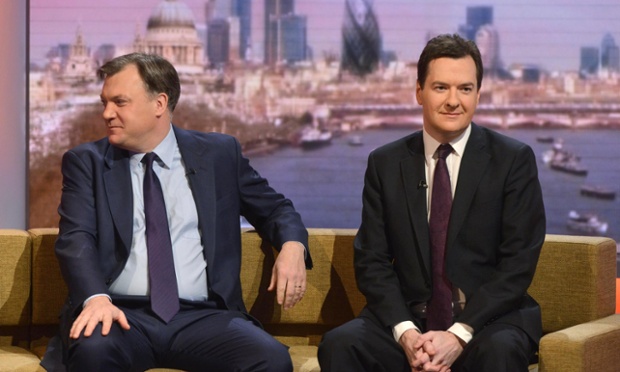
George Osborne Ed Balls Budget 2015


David Cameron’s Conservative Party may only be pretending to care about small government, strutting around in the borrowed robes of fiscal responsibility. But in their feeble reaction to George Osborne’s 2015 budget, the Labour Party – much like the proverbial emperor – have been caught wearing no ideological clothes, and possessing no real principles at all.

We have now experienced nearly five years of coalition government, a Conservative and Liberal Democrat joint venture, and throughout that time the Labour Party has squealed and bitterly protested every single action taken by the government to restore Britain to any kind of good fiscal balance.

One might therefore reasonably expect the Labour Party to be ready with a compelling, explainable and measurable alternative raft of policies to fix Britain as the 2015 general election rapidly approaches. But not only does it seem that Ed Miliband’s Labour Party have no alternative vision for Britain beyond carping about Tory meanness, neither are they willing to commit to reversing any of the coalition government’s spending plans, including those announced in yesterday’s Budget.

The Telegraph reports that Ed Balls will not commit to undoing a single Tory spending measure should Ed Miliband win the keys to 10 Downing Street on 7 May:

Ed Balls, the shadow chancellor, admitted that Labour would not reverse George Osborne’s Budget measures, including the flagship measures on savings and Help to Buy.

Speaking in response to yesterday’s Budget, he said “nothing had changed” because the Chancellor had produced an “quite empty” Budget, meaning Labour “wouldn’t need to reverse any of it” if the party was successful at the general election.

“There’s nothing … I need to reverse. What I will reverse are deeper spending cuts in the next three years than the last five.”

Pushed as to whether he would retain Mr Osborne’s widely welcomed plans to spare millions of savers tax and to provide new “Help to Buy Isas” – savings accounts for first time buyers which would be topped up with government cash – Mr Balls told BBC Radio 4’s Today programme he would, adding: “I think the Help to Buy Isa is an interesting idea. We’re not going to abolish it.”

This leaves two rather burning questions: why would anyone in their right mind vote for Labour now that Ed Balls has admitted that he would copy all of George Osborne’s ideas? And isn’t it about time the Labour Party apologised to Conservative and right-wing voters for having said such horrible things about the Evil Tories when they secretly agreed with David Cameron and George Osborne the whole time?

Continue reading

Why George Osborne’s 2015 Budget Was Such A Big Disappointment

BRITAIN-BBC-MEDIA-STRIKE


Budget 2015 was yet another let-down for fiscal conservatives and opponents of big government, not that this beleaguered group have come to expect any better after five years of Conservative-LibDem coalition rule.

The fact that the Tories are actually happy that the media is reporting that government will “only” shrink back to 2000-era levels (when New Labour ruled the roost) is definitive proof that Britain is not still in thrall to Thatcherism and pro-market conservatism, as some left wing commentators suggest, but rather is clinging petulantly and fearfully to Gordon Brown-style Big Government largesse.

This blog has little sympathy with a modern Conservative Party too afraid to forcefully make the case for small government and lower public spending, and will continue to criticise David Cameron and George Osborne for their timidity in this regard for as long as they remain in office. But the Conservative Party does not operate in a vacuum, and should not bear all of the blame.

When in government, Conservatives have to deal with a public that is used to big government, collectivism and intrusive state involvement in almost every aspects of their lives. Britain never had the pioneering, fiercely independent spirit that characterises America, and the modern institutions that emerged from the post-war consensus (the welfare state and National Health Service) only shifted our political centre of gravity further to the left.

Thus, the BBC’s Robert Peston can ask with a straight face, when analysing George Osborne’s 2015 Budget (emphasis added):

Continue reading

George Osborne’s 2015 Budget: From The 1930s to the ’60s, And Beyond

George Osborne Budget 2015 Conservative Party


“Out of the red and into the black, Britain paying its way in the world again!” boasted George Osborne, pounding the despatch box with satisfaction as he finished delivering the coalition government’s final, 2015 Budget.

This was wishful thinking at best. But by any reasonable measure it constitutes wilful deceit.

From the BBC’s summary of Budget Day 2015:

Setting out his plans in the Commons, Mr Osborne said: “We took difficult decisions in the teeth of opposition and it worked. Britain is walking tall again.

“Five years ago, our economy had suffered a collapse greater than almost any country.

“Today, I can confirm: in the last year we have grown faster than any other major advanced economy in the world.”

He said he would use a boost in the public finances caused by lower inflation and welfare payments to pay off some of the national debt and end the squeeze on public spending a year earlier than planned.

In 2019/20 spending will grow in line with the growth of the economy – bringing state spending as a share of national income to the same level as in 2000, the chancellor told MPs.

The BBC’s Robert Peston said this was a move aimed at neutralising Labour’s claim that the Conservatives would cut spending to 1930s levels.

But nothing did as much to condemn the Conservative Party’s half-hearted attempt to restore fiscal discipline to Britain over the past five years as Telegraph columnist Dan Hodges’ verdict on Budget 2015, the budget that “killed Labour”:

Continue reading

UKIP’s Suspicion Of The Establishment Lapses Into Dangerous Paranoia

Nigel Farage Mark Reckless Douglas Carswell UKIP Defectors Phone Hacking


After a few quiet months, prompting endless speculation about  party rifts and even the health of its leader, UKIP are dominating the news agenda once again. Most notably in the Telegraph, which has had us capitvated all weekend with the serialisation of Nigel Farage’s latest book.

Over the course of eight compelling extracts there has been something for everyone – from the human interest angle of Nigel Farage’s multiple brushes with death, through unapologetic socialist-baiting with his candid thoughts about the NHS, to the political intrigue surrounding his all-important fight to win in the constituency of Thanet South.

There were breathless passages shedding light on the secret talks which lead up to defection of former Tory MPs Douglas Carswell and Mark Reckless. Indeed, parts of the serialisation read almost like like Ayn Rand’s novel Atlas Shrugged, with Nigel Farage assuming the role of John Galt, the outlaw who furtively persuades America’s leading industrialists to abandon their failing nation and defect to his Objectivist promised land.

But while it makes for a jolly good read, Nigel Farage’s book also goes too far. Specifically, at this point in the seventh extract from the Telegraph’s serialisation where Farage writes (emphasis added):

Mark Reckless came twice to see me at my home in Downe, Kent. No lunch, no wine, just pots of tea, and we talked. The first time he came was before Douglas joined, but the second was after. By then, the campaign to put the frighteners on any Tory looking to join us was intense, Mark turned up in dark glasses and a baseball cap so that the neighbours wouldn’t recognise him. He was convinced that he was being followed, most likely by someone at Conservative central office. It was certainly our suspicion that everyone at Ukip HQ – from me to the press office to the strategists – had their mobiles tapped. Life had become quite surreal.

Continue reading

Banning Hate Preachers Will Not Eradicate University Campus Extremism

Islamist Extremism University Campus Britain 1


Prohibiting extremist preachers from speaking on university campuses will not stop the radicalisation of impressionable young minds – and the ongoing coalition row between the Conservatives and Liberal Democrats shows the Tories at their authoritarian worst.

“Should these men be allowed in UK universities?” frets The Times of London, in a report which begins:

Radical and intolerant Islamist leaders preached to crowds of students at almost 200 official events in the past year, according to a study of external speakers at universities including Cambridge, Birmingham and University College London.

Segregated seating for male and female students is understood to have been implemented for at least a quarter of those public meetings held by the Islamic societies at 21 universities.

The issue of university campus extremism has been brought into sharp relief since it emerged that Mohammed Emwazi, or “Jihadi John”, may have been radicalised while studying at Westminster University in London. This revelation has led to renewed scrutiny of various Muslim student organisations, their invited speakers and their practices (such as segregated seating in some instances). And this scrutiny is often welcome.

But the government goes too far when it seeks to make universities responsible for enforcing the censorship of ideas deemed “extremist”, as the BBC reports:

Continue reading