White Privilege Conference: Social Justice Warriors Can Never Be Placated

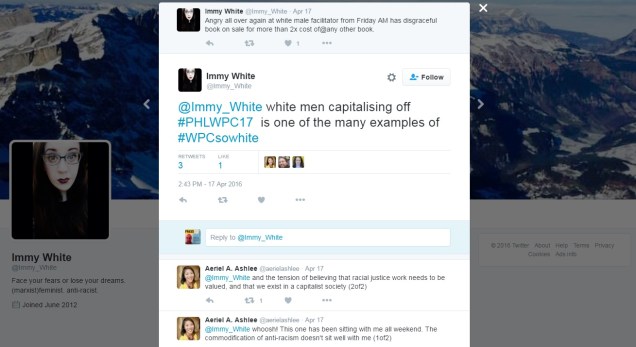
WPC2016 twitter anger

Social Justice Warriors do not want to end oppression. They merely want to become the oppressors themselves

If any further proof were needed that Social Justice Warriors can never be appeased or placated – and that they will keep on moving the goalposts indefinitely so that people with “privilege” can only ever fail the moral tests set for them – then one needs to look no further than the seventeenth annual White Privilege Conference which just concluded in Philadelphia.

One might have thought that an annual confab of contrite white people and their Allies in Privilege to self-flagellate and ruminate on the many ways in which they structurally oppress minorities would have been met with some approval by the SJW brigade. If anything could possibly please the Social Justice Warriors, it should be this event.

And so naturally, the SJWs crawl all over the conference and pick through every speech and interpersonal interaction to find fault with it, to wail and clutch their pearls in shock at the terrible oppression and insensitivity taking place, and to generally flaunt their More Moral Than Thou credentials in public.

The Daily Caller reports:

Disaffected participants in the 2016 White Privilege Conference (WPC) have taken to Twitter to complain that the conference was, ironically, too white and was actually filled to the brim with white supremacy.

Adopting the hashtag #WPCSoWhite, inspired by the recent #OscarsSoWhite campaign, Twitter users claimed the conference that was supposed to battle white privilege instead served to entrench it.

The tag appears to have been started and pushed with particular vigor by Aeriel Ashlee, an education consultant who attended WPC and objected to several parts of a keynote address delivered by (white) historian James Loewen.

She said Loewen’s rhetoric, which was solidly progressive throughout, actually entrenched white supremacy, partly because his speech allegedly lasted too long. When Loewen attempted to defend himself, Ashlee said that any defense was invalid and only further showed his white supremacy.

Every act by non-SJWs, even those desperately designed to appease them and lessen their anger (like university administrators resigning for upsetting their crybaby student populations or whole conferences being set up to discuss the problem with white people) is only more evidence of their guilt. Non-SJWs literally can do no right in the eyes of these totalitarian complainers.

This Twitter exchange between one of the keynote speakers and an antagonist shows the futility of debate, or even of complete capitulation to their demands:

James Loewen - Aeriel Ashlee - Twitter exchange

What exactly was Loewen supposed to do after being accused of overrunning his speaking time when in reality he did no such thing? According to SJW logic, the only appropriate response would have been for Loewen to fall on his knees and beg for forgiveness, even though he had done nothing wrong. And when Loewen failed to do so, the mere act of correcting Ashlee’s false accusation was interpreted as “a white man’s defensiveness intead of accepting responsibility”.

This is madness. In this universe, factual errors and misunderstandings can no longer be corrected if it involves a white male attempting to defend himself or contradicting a POC (person of colour) or other identity group, whose judgement is always final when it comes to determining whether any word or act constitutes “oppression”.

As Rod Dreher commented when social justice warriors criticised a classical music scholar for having the temerity to spend his free time teaching a class about “opera and ideas” to prison inmates:

SJWs ruin everything. They kill everything they touch. Why would anyone want to work in a field where these nuts run rampant?

There is literally no good deed or benign intention which modern Identity Politics cultists will not pick through, determined to find fault. But more tragically for these SJWs, this mindset dooms them to be prisoners of their own (real or perceived) circumstances, passing up endless opportunities for personal growth and even material advancement because they are so self-obsessed and captivated by the injustices meted out on past generations decades and even centuries ago.

More to the point, in the shorter term they will quickly become friendless. Except within their hermetically sealed circle of fellow Identity Politics cultists, nobody will want to socialise or work with these people. Because who wants to be in the company of highly-strung perpetual victims who consider themselves so morally superior that they police the words and behaviour of everyone around them?

But maybe that is where this will end up – with Identity Politics cultists sequestering themselves away in a closed, parallel society, unwilling to engage with the real world lest it corrupt or “harm” them. Perhaps SJWs will be the monks of the twenty-first century, worshipping their narcissistic god of self-identity and living unbearably tense lives as they seek to purge any oppressive behaviour from their systems and excommunicate those who make the smallest transgressions.

Far better than the rest of us having to submit to their tyranny.
 

The White Privilege Conference

Agree with this article? Violently disagree? Scroll down to leave a comment.

Follow Semi-Partisan Politics on TwitterFacebook and Medium.

Tales From The Safe Space, Part 26 – Literally Shredding The Constitution

There is seemingly no limit to what coddling and overindulgent (or scared and intimidated) university administrators will do to keep identity politics-wielding student cultists happy and quiet

Watch this video.

Late last year, an undercover reporter from Project Veritas posing as a student went to university administrators in several colleges to complain about somebody handing out copies of the US Constitution on campus. The Constitution, explains the student, is having a triggering effect and causing her panic attacks because of the document’s inherent racism and oppression.

We all know what comes next. Naturally, the university administrators tell the student to grow up and stop being silly, and that even if the United States Constitution (with all its brilliance and acknowledged flaws) was not an almost sacred document and the guarantor of every single one of their liberties, they would no sooner ban it from campus than they would ban any other book or document.

Except that that isn’t close to what actually happened. In real life, infantilising student welfare administrators listened with concerned attention to the undercover reporter’s tale about being made to feel unsafe by America’s foundational document, nodding along sympathetically at every turn.

And not only did these professors and equal opportunities directors fail in each case to push back against the reporter’s tremulous plea for their respective colleges to create a safer space by removing all copies of the Constitution from campus, in one case they actually offered – unprompted – to destroy the document there and then as a means of providing catharsis and healing to the student.

At Vassar College in New York state, the “student” told Kelly Grab, the Assistant Director of Equal Opportunity:

Last week something kind of happened on campus that kind of really upset me and I ended up having a panic attack.

[..] They were handing the Constitution out on campus. I don’t know, they were handing it out and as soon as I saw it, you know, I started to not be able to breathe, hyperventilating. My vision went blurry and I just – kind of just lost control.

[..] I didn’t think that this would happen, but I realised that the Constitution is kind of a trigger for me.

And rather than telling the undercover reporter to take a hike, Grab responded:

So what I think you are sharing with me is that your interaction in receiving this was harming, right? And that’s what we certainly want to avoid. We don’t want to limit people in exchanging ideas or having opposing viewpoints, but when it’s disruptive or causing harm…

While at Oberlin college in Ohio, Professor of History and Director of Gender, Sexuality and Feminist Studies, Carol Lasser, tells the person she believes to be a student traumatised by the Constitution:

The Constitution is an oppressive document. The Constitution makes change slow, it intends to make change slow.

And then adds, sotto voce:

Right now, given who is in charge of the US House of Representatives, I think it’s a good thing.

Darn that pesky Constitution and its checks and balances for making it hard to impose the latest left-wing thinking on an uncertain America all at once. But at least it is also making it harder for those evil, knuckle-dragging Republicans to kill anyone who is not white, male and on at least $100k a year. Amiright?

But the best response comes from Colleen Cohen, then Director of Affirmative Action and Professor of Anthropology at Vassar College:

It’s horrible that this is something that has caused you such pain. And unless the people are from off campus we can’t keep them from disseminating it.

[..] Can I destroy this? Or do you want to hold on to it?

We already knew that there is a dramatically expanding “equal opportunities” sector within (particularly American) academic institutions, with faculties growing to accommodate ever more impeccably credentialed and highly paid experts brought in to help universities submit more quickly and smoothly to the identity politics revolution.

But until now, many of the horror stories had an apocryphal feel to them – or worse still, they smacked of Daily Mail alarmism. No more. Now, we have hard evidence of exactly how these inclusivity gurus interact with students, and the extreme trade-offs they are willing to make between academic freedom and the rights of the “oppressed”.

And in a battle between the foundational document of the United States government and the rights of any random student to have things which they dislike purged from campus, it turns out there is no contest. The Constitution literally goes in the shredder, while the tearful student (in these instances an undercover reporter) is continually validated and told that they have every right to be upset and to want censorship in response.

Goodness knows how many other similar conversations have been taking place on other university campuses, only with real students. In order to emphasise their own message, Project Veritas deliberately chose very liberal colleges as their guinea pigs – the undercover reporter certainly would have received a much more refreshingly forceful reaction had they attempted the same stunt at Oklahoma Wesleyan University, for example.

But regardless of the obscenity of college administrators actually shredding the United States Constitution (certainly doing so is itself a protected act of free speech), something is seriously wrong when those in authority either buy in to the same identity politics dogma as their students and see eye to eye with them, or when they perhaps vehemently disagree with their students but are too afraid for their jobs to stand up to the students and call them out for behaving in a manner utterly inconsistent with the ethos of a university.

So forget the shredding of the Constitution itself. Far more worrying in practical terms is the fact that when dealing with student complaints, the default response from university administrators is that the student’s feelings, whatever they happen to be, are sacrosanct, and that anything which they perceive as a threat or an insult should be treated as such by campus authorities.

And at this point, you have to defer to age – it is the older adults in charge of universities and campus diversity schemes who should exhibit the wisdom and character to push back on ludicrous student demands when they are made, and tell the adult baby students that their own personal feelings are in fact not the overriding concern of the university authorities. Right now, they are failing in this most important responsibility, and the thought of any university administrator dispensing much needed tough love is apparently completely unrealistic at Vassar and Oberlin colleges.

This undercover reporter managed to get at least three separate copies of the US Constitution shredded – literally fed into a shredder machine and destroyed while she stood and watched approvingly – simply by claiming that the document made her feel threatened and oppressed. Imagine the emboldening effect experienced by real students every day when their equally ludicrous demands are taken deadly seriously and cravenly pandered to by those in charge. Imagine the sense of entitlement and self-regard that it must build.

And imagine the almighty collision with reality which these students face when they graduate and (some of them, at least) enter the real world.


Postscript: This insufferable Vassar student’s aggrieved response to the Project Veritas undercover filming shows the level of intellectual disconnect here. The student is utterly incapable of understanding the reason for conducting the undercover filming, perceiving it as an attack on the confidentiality of real students (none of whom had anything more than a walk-on bit part) and the mental wellbeing of the very administrators who were so happy to destroy the US Constitution.

I don’t know how one can possibly reason with people like this, or communicate meaningfully with anybody who has percolated for so long in a victimhood culture, and who speaks only in the hierarchical grievance language of identity politics.

While there are things we can do now to change the way we raise kids, like re-learning the importance of building resilience and anti-fragility – what doesn’t kill me makes me stronger – in our children, it is hard to view the current cohort of identity politics practising students (appreciating that they are hopefully just about still a minority among their peers) as anything other than a lost generation, whose best and last hope rests on a harsh but highly instructive collision with the real world after graduation.

That is, if they survive the impact.


Safe Space Notice - 2

Agree with this article? Violently disagree? Scroll down to leave a comment.

Follow Semi-Partisan Politics on TwitterFacebook and Medium.

Stephen Fry Commits Egregious Act Of ‘Victim-Blaming’, Torpedoes Own Career

‘Victim-blaming’ the survivors of sexual abuse by daring to suggest that safe spaces and trigger warnings are not the best response? Stephen Fry clearly has a career death wish

Never one to avoid controversy, while giving an interview to American media Stephen Fry decided to share his thoughts on a number of subjects – including the Rhodes Must Fall campaign, the general infantilisation of our culture and (really pushing his luck given the current climate) the demands of some students to slap trigger warnings on works of art and academic materials which include discussion of rape or sexual abuse.

Naturally, this went down tremendously well with Safe Space apologists, who all immediately saw the light and took to Twitter praising Fry for introducing a note of levity into their carefully constructed  culture of victimhood.

The Independent reports:

Stephen Fry has been criticised for suggesting sexual abuse survivors should not “pity” themselves.

Fry made the comments when airing his views on free speech, religion and political correctness while appearing on US show The Rubin Report.

Speaking to host Dave Rubin, he discussed the practice of safe spaces and trigger warnings, including those that are used for plays and books which contain scenes of rape or abuse and can possibly set off traumatic memories and flashbacks for survivors of rape or abuse. They are sometimes used on university campuses.

He said: “There are many great plays which contain rapes, and the word rape is now even considered a rape. […] They’re terrible things and they have to be thought about, clearly but if you say you can’t watch this play […] it might trigger something when you were young that upset you once because uncle touched you in a nasty place.

“Well I’m sorry yes it’s a great shame and we’re all very sorry that uncle touched you in that nasty place. You get some of my sympathy but your self-pity gets none of my sympathy because self-pity is the ugliest emotion in humanity.

“Get rid of it because no one’s going to like you if you feel sorry for yourself. The irony is we’ll feel sorry for you if you stop feeling sorry for yourself. Grow up.”

Stephen Fry can currently be found being roasted alive by the permanently outraged, virtue-signalling Twitterati for daring to promote the sacrilegious concepts of resilience and antifragility, and – if the mob get their way – will be found next year as the “featured guest” presenting a QI knockoff show on a cheap Caribbean cruise.

Well, it was a good career while it lasted.

Grovelling apology and recanting of previous remarks in 10, 9, 8, 7, 6…


Safe Space Notice - 2

Agree with this article? Violently disagree? Scroll down to leave a comment.

Follow Semi-Partisan Politics on TwitterFacebook and Medium.

Tales From The Safe Space, Part 24 – Finally, The Academy Strikes Back

Academic Freedom In An Age Of Conformity - Joanna Williams

When will professors and university administrators realise that they must work together with colleagues and rivals to stand a chance of withstanding and rolling back the current unprecedented threats to academic freedom?

Lest we begin to think it is all doom and gloom, it should be pointed out that some voices within the academy are pushing back on the demands of censorious students and the self-censoring impulse among university faculty to avoid giving offence or courting controversy.

Already in this series we have looked at the inspiring example of Dr. Everett Piper, president of Oklahoma Wesleyan University, whose resistance of “ideological fascism” puts many of his Ivy League peers to shame.

And now, winging its way to an Amazon locker near me is a copy of “Academic Freedom in an Age of Conformity” by Joanna Williams, a book which promises to get into detail as to the specific nature of the problem within our universities. Hopefully it will also provide some more detail – as well as proposed solutions to some of the questions raised – in Mick Hume’s worthwhile polemic “Trigger Warning: Is The Fear Of Being Offensive Killing Free Speech“.

Williams recently gave an interview to Inside Higher Ed to discuss the book, and this section from the Q&A is a breath of fresh air:

Q: Academic Freedom in an Age of Conformity has some choice words for the students who have in recent years sought to ban controversial speakers, discussions, art, etc., from their campuses. But you blame their censorship largely on their instructors, from whom you say they have learned. Is that fair? Some instructors, at least in the U.S., now say they’re afraid of their students, and are self-censoring because of them.

A: I think many academics are looking on in bemusement, or indeed horror, at this generation of censorious students. But I think academics need to engage in a far more honest debate about where such students have got their ideas — and their tactics — from. Of course higher education does not operate in a vacuum — and students do not arrive at university as blank slates. There are lots of different things going on here.

Too often nowadays students arrive at university having led quite sheltered lives and having been protected from discomfort. In many ways I think childhood itself has come to be equated with vulnerability. This carries over into universities. Young adults are treated as if being a student is in and of itself enough to make them vulnerable and in need of special protection. The campus comes to be seen as a safe space with infantilizing therapeutic interventions such as petting zoos. Students do not expect — and ultimately are not able — to deal with things that threaten their fragile sense of self.

These same students are often taught in the classroom that language is all powerful in constructing reality — that words can wound — in a way that goes beyond rhetoric that can upset us, move us and stir our emotions but actually to inflict psychic harm or real violence. When students who have come to see themselves as vulnerable are taught that language and images can threaten their identity, then the desire to ban is understandable.

Academics who are afraid of their students need to enlist the support of their colleagues in creating a university culture that is about learning through intellectual challenge rather than an entitlement to protection from discomfort.

Absolutely. The abysmal position in which even our top universities now find themselves is a confluence of several things going on all at once. There is the notion that some speech is beyond the pale and that bad words can equate to violence, which started with the “No Platform” concept several decades ago, and has grown to result in hate crime legislation which criminalises speech, writing or online activity which is perceived by any third party as likely to cause alarm or distress – a remarkably low bar for censorship.

Then there is our modern therapeutic culture, which as Joanne Williams (and this blog) rightly notes has raised a generation of young adults who believe that they are special, beyond reproach but also uniquely vulnerable and in need of constant protection by watchful authority figures. This sees students equating good mental health with a state of childlike regression, trying to face-paint and colour their way to equanimity.

And finally there is the rise of the Cult of Identity Politics or what Dr. Everett Piper calls “ideological narcissism”, whereby young minds are conditioned to believe that their arbitrary (and sometimes shifting) identity trumps not only the rights of other people to hold and express ideas which criticise those identities, but even trumps physical reality itself. Thus some students openly fret that allowing, say, a speaker who does not hold the mandatory stances on transgender issues to air their opinion will “invalidate the experience” or even the existence of trans students – as though Brendan O’Neill setting foot on their university campus would cause all trans people within a five mile radius to vanish in a puff of smoke.

What has been missing so far is any sign of co-ordination in terms of a fightback by the academy, which is where Joanna Williams’s book comes in. She herself has lamented that one of the problems is that professors and university administrators do not care about academic freedom in the abstract as much as they should, only becoming alarmed when their own campus or lecture theatre is engulfed in protest by self-entitled Identity Politics cultists.

Hopefully this book, “Academic Freedom in an Age of Conformity”, will begin to change that introverted aspect of academic life and prompt more professors and others to realise that the slide toward illiberalism and censorship taking place on one far-away college campus is a direct threat to their own.

Stay tuned for a full review of the book here in the coming weeks.


Safe Space Notice - 2

Agree with this article? Violently disagree? Scroll down to leave a comment.

Follow Semi-Partisan Politics on TwitterFacebook and Medium.

Tales From The Safe Space, Part 22 – Students For Slightly Less Coddling!

NUS Protest - No Platform Policy - Free Speech
What do we want? Slightly less censorship! When do we want it? At some point!

The student resistance to campus safe space policies and academic trigger warnings does not inspire much confidence

This student from the University of South Florida is mad as hell at being coddled and treated like a child with endless trigger warnings and safe spaces on campus, and she is not going to take it any more:

At USF’s Faculty Senate Executive Committee meeting on Wednesday, faculty members discussed trigger warnings and how to approach sensitive issues as they sought an answer to the growing demand for “tolerance” in classrooms.

No one is arguing most graphic material shouldn’t come with a warning, but creating campus-wide policies catered to coddling students will only inhibit our education.

So far so good. But it doesn’t take long before the wheels start to come off this student’s plea to be treated like an adult:

Obviously, no one wants a student to undergo stress or anxiety because of something they were blindsided with in class. However, it is ultimately up to both the professor and the student to ensure they can avoid that situation.

Professors need to begin offering detailed syllabi for their classes. Not a basic one-page overview of the course, but a week-by-week outline of what they intend to teach. While some professors already offer a detailed breakdown of their courses, many do not.

Yes, this will take more time to create, but let’s be honest — most professors don’t make major changes to their courses. Taking the time to create a detailed syllabus isn’t a big deal considering they can re-use it for years with just minor tweaks along the way.

Then it’s up to the students. Students, take five minutes out of your oh-so-busy schedule and actually read the syllabus handed out on the first day of class. If you see something is going to be covered that will trigger you, drop the class.

Do some research. Find out exactly what you’ll be reading before you commit to a course, and you won’t be caught off guard when the sensitive material comes.

Universities could even have a frank conversation with incoming students at orientation or during campus tours. Let them know this is a university, not an elementary school. In an effort to grow students’ minds and character, the university will approach subjects students may disagree with or find uncomfortable.

Oh dear. This isn’t so much an argument to sweep away the whole infantilising concept of trigger warnings and begin treating students like moderately resilient human beings once again, but rather a technical argument that trigger warnings should be brought forward to the beginning of the academic experience.

Breanne Williams is not upset with the idea of trigger warnings in general. She just wants one massive trigger warning placed at the beginning of each college class, or perhaps when students first arrive on campus. Quite how this is any less infantilising than individual content warnings before each lecture or book is never made clear.

Unfortunately, such is the calibre of much of the resistance to campus censorship these days. Even the voices arguing against the harshest and most illiberal measures often accept the general principle behind them – that words and text can be dangerous, and that students need to be protected from them.

Witness Edinburgh University students union officer Imogen Wilson, who stressed the importance of safe space policies to journalists even as she was being accused by others of violating the safe space of a student council meeting.

Or the protest outside the hugely censorious National Union of Students headquarters, where protesters held the risibly pathetic placards declaring “Reform, don’t scrap, no-platform policies”.

Depressingly, even some of the pushback against the censorious, infantilising treatment of students on campus now accepts the basic rationale behind trigger warnings and safe space policies. This is dangerous because conceding the fundamental principle – that free speech is dangerous, and that words can equate to “violence” – means that the debate becomes a simple matter of degrees, establishing an inevitable one-way ratchet to greater censorship.

The correct response to the slapping of trigger warnings on academic content is not “Please put them at the beginning of the class so that we can avoid studying entire subjects if we spot one thing in the syllabus which might cause us mental discomfort”.

The correct response is “To hell with your trigger warnings! Treat us like the adults that we are”.


Safe Space Notice - 2

Agree with this article? Violently disagree? Scroll down to leave a comment.

Follow Semi-Partisan Politics on TwitterFacebook and Medium.