Remainers Are Trying To Rewrite History, Claiming Media Coverage Favoured The Leave Campaign

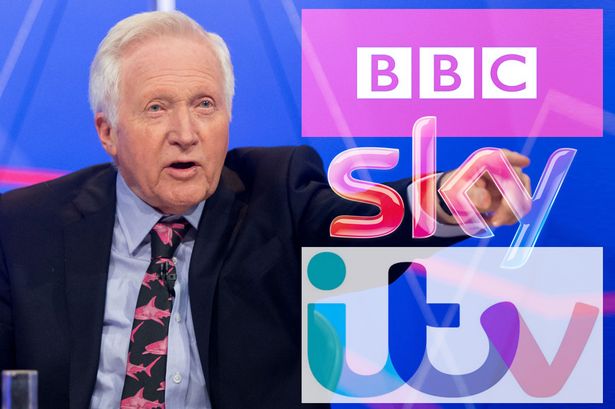
eu-referendum-media-coverage-television-news-bias-2

Yes, the BBC let the public down with their spineless, uninquisitive EU referendum coverage. But this only benefited the Remain campaign, not the Brexiteers, and to suggest otherwise is absurd

Disappointed Remain activist Hugo Dixon takes to the pages of InFacts with with a sullen litany of the many ways in which the (ahem) notoriously eurosceptic television news media supposedly hindered the pro-EU camp’s chances and aided the fact-free Brexiteers at every turn.

Dixon writes:

The BBC has rightly been criticised for its weak referendum coverage. If the broadcaster had done a better job of challenging interviewees, informing the public and making room for a variety of viewpoints, voters would have had a better chance of sifting fact from fiction. The BBC, after all, dominates our news coverage: 77% of the public use it as a news source, according to Ofcom.

The most common criticism aired against the BBC is one of phoney balance – namely that it gave equal airtime to experts and their opponents’ unsubstantiated bluster. But this is probably not the most serious charge. After all, it would not have been fair to deny the two sides of the referendum equal airtime or to keep off the air campaigners who were telling fibs or spinning fantasy.

However, what the BBC could and should have done was grill its guests more vigorously – and make more space for coverage that didn’t fit into the tired Punch-and-Judy style battle between spokespeople put up by the two official campaigns.

There is a kernel of a sensible point in here. This blog has written numerous times that sensationalist or craven news coverage which merely allows two opposing talking heads to scream at each other without any effort to arbitrate or discern truth is a pox on our journalism – whether it is infecting the US presidential election or the EU referendum in Britain.

Dixon is also admirably on-point when he criticises the media’s reliance on the sanitised, focus-group approved  media grids of the two opposing lead campaign groups, effectively suggesting to their viewers that these incompetents and nepotism beneficiaries represented the full spectrum of eurosceptic and pro-European thought:

This wasn’t the BBC’s only failing. It also allowed too much of its coverage to become a Punch-and-Judy style battle between the official campaigns. The broadcaster, of course, had to give a lot of airtime to Vote Leave and Stronger In. But it allowed its coverage to be virtually dictated by their agendas.

I know the Remain side of the story better. Stronger In had a “grid”, on which it set out what stories it wanted to push on particular days and which people it wanted to push those messages. It coordinated this grid closely with Craig Oliver, David Cameron’s director of communications. Indeed, Stronger In was effectively in Number 10’s pocket. It rarely put forward people who weren’t on message with its Project Fear strategy.

The BBC should not have allowed itself to be manipulated in this way, particularly since it was aware of the potential problem. Its guidelines said: “Where there is a range of views or perspectives, that should be reflected appropriately during the campaign.” They went on to say: “The designated Campaign Groups – whilst offering spokespeople to programme-makers and other content producers – cannot dictate who should or who should not appear on BBC output.”

But the broadcaster didn’t do enough to resist the pressure. As a result, Downing Street and its puppets dominated the Remain camp’s share of airtime, and people who wanted to make a positive case for Britain’s involvement were edged out. Even Gordon Brown – who was trying to argue that we should lead Europe, not leave Europe – found it hard to be heard.

While Hugo Dixon’s heart wells over with sympathy for Gordon Brown’s inability to claim his fair share of the limelight, this blog would point to the many independent and non-aligned voices on the Brexit side who struggled to get a hearing of any kind, despite (in some cases) holding media events in the heart of Westminster under the very nose of the establishment.

So on both of these complaints, Dixon is on solid ground. But to go on and suggest that intellectually lazy journalism which impacted the Leave side every bit as much as the Remain campaign somehow decisively swung the outcome of the referendum is to venture into the realm of fantasy.

Dixon concludes:

For every such example, the BBC could presumably come up with a counter-example. But when its senior figures search their souls, do they really think they fulfilled their mission of informing and educating the public well during the referendum? And, if not, what are they going to do about it? How about an independent, public audit of how the BBC fared during the referendum backed up by recommendations on how to do better in future?

The world is not getting any simpler. Hard, honest thinking about how to cover often very complicated questions could stand the BBC in good stead. Audiences and license fee payers definitely deserve it.

The underlying assertion, carefully left unsaid, is that these various journalistic failures added up to a succession of “microbiases” which somehow cumulatively tipped the referendum result, and that if only BBC and other television news presenters had challenged guests and demanded more “facts” then the British people would have come to their senses and realised just how star-spangled awesome the European Union really is.

And maybe in an alternative universe that was the case – that there simply weren’t enough highly credentialed experts, both hysterical and sober, using abundant media platforms to lecture the British people that seeking freedom from the EU would be an unmitigated disaster.

Why oh why were these noble voices, these latter-day Cassandras so cruelly shut out of the national debate, swamped by a relentlessly pro-Brexit television media amplifying the Leave campaign’s monopoly on falsehoods and scaremongering?

But that’s not how I remember the EU referendum campaign.

Hugo Dixon inhabits an interesting parallel universe, and no doubt a comforting one for disappointed Remain campaigners so deeply invested in their failed euro-federalist dream. But it bears no resemblance to the real world, where the plucky, haphazard, incoherent and almost terminally disorganised Leave campaign triumphed against the arrayed forces of the establishment and a television news media which only amplified rather than diminished their influence in support of the status quo.

 

European Union - United Kingdom - Britain - Flags

Support Semi-Partisan Politics with a one-time or recurring donation:

Agree with this article? Violently disagree? Scroll down to leave a comment.

Follow Semi-Partisan Politics on TwitterFacebook and Medium.

Politicians Aren’t Entitled To Their Own Facts, But Neither Is The Media

An independent political press corps with the knowledge and authority to call the shots and confidently call out lies when politicians tell them – rather than giving equal credence to two diametrically opposed crazy positions – is a great idea. If only our media was sufficiently trustworthy and capable of performing such a nuanced, sensitive role

Something funny seems to have happened to the New York Times.

For the past week or so, the newspaper which once twisted itself into a risible-looking pretzel trying to justify calling the practice of waterboarding “torture” when inflicted by America’s enemies but “enhanced interrogation” when conducted by American forces has discovered a new passion for clarity and bold truth-telling.

Peter Beinart explains, over at The Atlantic:

Last Saturday, The New York Times published an extraordinary story. What made the story extraordinary wasn’t the event the Times covered. What made it extraordinary was the way the Times covered it.

On its front page, top right—the most precious space in American print journalism—the Times wrote about Friday’s press conference in which Donald Trump declared that a) he now believed Barack Obama was a US citizen, b) he deserved credit for having established that fact despite rumors to the contrary and c) Hillary Clinton was to blame for the rumors. Traditionally, when a political candidate assembles facts so as to aggrandize himself and belittle his opponent, “objective” journalists like those at the Times respond with a “he said, she said” story.

Such stories, according to the NYU journalism professor Jay Rosen, follow this formula: “There’s a public dispute. The dispute makes news. No real attempt is made to assess clashing truth claims in the story … The symmetry of two sides making opposite claims puts the reporter in the middle between polarized extremes.”

[..] But the Times, once a champion practitioner of the “he said, she said” campaign story, discarded it with astonishing bluntness. The Times responded to Trump’s press conference by running a “News Analysis,” a genre that gives reporters more freedom to explain a story’s significance. But “News Analysis” pieces generally supplement traditional news stories. On Saturday, by contrast, the Times ran its “News Analysis” atop Page One while relegating its news story on Trump’s press conference to page A10. Moreover, “News Analysis” stories generally offer context. They don’t offer thundering condemnation.

Yet thundering condemnation is exactly what the Times story provided. Its headline read, “Trump Gives Up a Lie But Refuses to Repent.” Not “falsehood,” which leaves open the possibility that Trump was merely mistaken, but “lie,” which suggests, accurately, that Trump had every reason to know that what he was saying about Obama’s citizenship was false.

In other words, the New York Times has sporadically started to report objective facts and truth, rather than doing what has long been traditional among the political press corps – walking a neutral tightrope between two partisan positions of staggeringly obvious falsehood or stupidity.

Despite his protestations and evasions, Donald Trump has been one of the key players in the birther movement from the beginning – picking up from the memorably loopy Orly Taitz – and has certainly been the conspiracy movement’s most public face. I remember blogging about it over four years ago, back in 2012.

Given the context of a presidential election and the extra scrutiny on media bias, it is surprising and rather heartening to see the Times displaying the courage to report fact rather than controversy; the same headline a month ago might easily have read “Trump Withdraws Birther Allegation”, with no reference to the established facts and outcome of the story.

Jon Stewart (formerly of The Daily Show) must be smiling. Since 2004 and even earlier, Stewart railed against political coverage which ginned up conflict in pursuit of ratings and incessantly reported issues through the prism of Left vs Right, Democrat vs Republican without ever seeking to either restrict coverage to facts or move beyond partisan talking points to get to the truth. The video at the top of this article shows Stewart’s memorable appearance on CNN’s Crossfire show, in which he castigated the hosts for “hurting America” by injecting partisanship and sucking nuance out of the political discourse.

Obviously the New York Times does not inhabit quite the same infotainment space as Crossfire, but the basic operating principle has been very much the same of late – present two or more strongly opposing partisan viewpoints, let the talking heads (or journalistic sources) slug it out in defence of their respective positions, and then move on without ever really applying any kind of judgment as to the respective merits of the contrasting positions.

Nowhere is this approach better summed up than the slogan of the Fox News Channel – “we report, you decide”. It is a relativist worldview which suggests there is no truth in even quite straightforward binary debates, and that we are free to pick our own facts and construct our own reality in accordance with our personal biases and interests.

Now, there is yet more evidence that the New York Times is moving away from this risk-averse and rather cowardly stance – yesterday the newspaper described as “false” Donald Trump’s claims that Hillary Clinton has sinister plan to destroy the Second Amendment:

In justifying his remarks, Mr. Trump falsely claimed that Mrs. Clinton wants to “destroy your Second Amendment,” apparently a reference to her gun control policies.

My emphasis in bold.

At face value this is a good development – the “he said she said” approach to political coverage is what has enabled so much of the spineless print journalism and sensationalist, conflict-stoking television news reporting in Britain and America. Seeing a “respectable” institution finally buck that trend and push back against the toxic idea that reality is malleable and truth exists only in the eye of the super-partisan beholder is, in theory, a very good thing.

Peter Beinart certainly seems to think so:

A certain etiquette has long governed the relationship between presidential candidates and the elite media. Candidates stretch the truth, but try not to be too blatant about it. Candidates appeal to bigotry, but subtly. In turn, journalists respond with a delicacy of their own. They quote partisans rather than saying things in their own words. They use euphemisms like “polarizing” and “incendiary,” instead of “racist” and “demagogic.”

Previous politicians have exploited this system. But Trump has done something unprecedented. He has so brazenly lied, so nakedly appealed to bigotry, and so frontally challenged the rule of law that he has made the elite media’s decorum absurd. He’s turned highbrow journalists into referees in a World Wrestling Entertainment match.

Last Saturday, the Times answered Trump’s challenge. He’s changed the rules, so it did, too.

But this analysis only holds if one has reasonable grounds to trust the journalistic institution or media outlet doing the reporting; will they reserve their merciless news analysis features for instances when there really is a right and wrong binary perspective, or will editorial judgment and personal bias cloud the picture?

Remember, the New York Times was happy to characterise the EU referendum and the Brexit campaign as being motivated not out of concerns for democracy and sovereignty but primarily by xenophobia and anti-immigrant prejudice. And while there were highly visible elements of the latter, under the “News Analysis” model what would prevent the Times deciding that the entire Leave campaign was based on racism and then reporting this skewed perspective to their readers as simple, self-evident “truth”?

While the “he said, she said” ra-ra approach may be divisive and unseemly, it at least offers a right of reply to those whose views are misinterpreted or deliberately slandered by shameless opponents. And while conventional wisdom might hold that it is more often conservative voices who live in a sealed bubble of their own facts, in reality we would all be vulnerable to a style of news reporting in which reporters and editors are given sweeping new authority to pass what often amount to value judgments on behalf of readers. At some point in the future, any one of us could find our unpopular, minority opinion almost entirely  frozen out of the public discourse.

So this blog will cautiously cheer along with Peter Beinart at the New York Times’ sudden willingness to call out lies – provided that this is to be genuinely bipartisan new scrutiny rather than merely a one-sided club with which to bash the Trump campaign.

But we should be aware that we are at the top of a slippery slope here. Smacking down candidates and their statements is a positively good thing when we are dealing with easily proven questions of who said what, and when. But the temptation to apply this swashbucklingly assertive style of journalism to more subjective debates (like economic policy, immigration or foreign affairs) may prove to be irresistible for journalists with human biases and editorial boards with agendas.

In case they hadn’t noticed, the mainstream media doesn’t presently enjoy a particularly enviable trustworthiness rating among the general public. Abuse “news analysis” by using it as a blatantly partisan cudgel and they will drive that rock-bottom rating still lower.


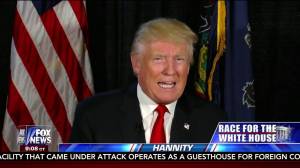
donald-trump-fox-news

Support Semi-Partisan Politics with a one-time or recurring donation:

Agree with this article? Violently disagree? Scroll down to leave a comment.

Follow Semi-Partisan Politics on TwitterFacebook and Medium.

The Greatest Threat To American Democracy Is The Sensationalist, Ratings-Obsessed Television News Media

It took two monsters to create Donald Trump, Presidential Candidate Edition: the debased Republican Party of Sarah Palin, and the slavish, contemptible American television news media

After getting heartily sick of watching the British rolling news channels the past few weeks, I decided to spend the last couple of days watching CNN (the US version, not the godawful international version).

It wasn’t pretty. In fact, it was almost enough to make one long for the BBC’s barely concealed hysteria at the thought of Brexit and being forcibly ripped apart from their beloved supranational European political union, or Sky’s never-ending quest to be the first news organisation to get their newscopter hovering directly above anything which may or may not turn out to be of interest.

Take today as an example.

For the past four hours, CNN has been reporting the “breaking news” that Donald Trump claims that his campaign has “never been more united” when various Republican talking heads that CNN was able to lure into the studio were willing to say the exact opposite – and hardly surprising, since their presidential candidate is is a proudly ignorant egomaniac with a borderline personality disorder.

This couldn’t even be charitably described as “breaking news” when I first tuned in at around 8PM London time, and it certainly isn’t breaking news four hours later. But still, there it is: “Awaiting Trump Rally In Florida” proclaims the banner, while five disembodied talking heads float on a giant screen behind Wolf Blitzer, waiting to air their opinions.

What you notice watching American news – besides the constant advertisements for dubious pharmaceutical products whose long lists of compulsorily recited side-effects often outweigh their curative properties – is the degree to which everything, and I do mean everything, is about Donald Trump.

(At this point it is worth pointing out to uninitiated British readers that CNN is the closest you’ll get to “objective” cable news reporting in America, with fair ‘n balanced Fox News skewing firmly to the right and MSNBC leaning forward equally firmly left. Not being overt partisan shills for one or other of America’s two main political parties is a nightmare for CNN executives who need high ratings, and so in desperation CNN latches on to every single technical gimmick you can imagine – drone cameras! holograms! – in a desperate bid to make their offering more exciting to fickle viewers).

It is fair to say that were it not for the American television news media, Donald Trump would be filming a new season of The Apprentice and lending his name to another shoddily-made range of “luxury” businesswear right now, rather than facing Hillary Clinton as the Republican Party’s presidential nominee.

This blog has already raked the GOP over the coals for their pitiful part in these dismal proceedings. But in despairing at the intellectually and morally debased Republican Party we should not let the media off the hook.

For the fact is that America’s news networks failed to fulfil their democratic duty by treating a presidential election like it was sweeps week rather than a serious decision with long-term consequences for the future of the republic. Donald Trump makes a great television candidate because he is willing to do and say things – exciting, attention grabbing things – which no other candidate will say. Unfortunately, this nearly always involves Donald Trump being rude, immature, spiteful or wrong about something or someone. But the news networks don’t care. It makes for great TV. And so they show more and more Trump, and less and less of everyone else.

When the Republican Primary campaign was still being fought, at one point we reached the ludicrous position where Senator Marco Rubio made the tactical decision to emulate Donald Trump’s style and start making gratuitously offensive insults and statements of his own, just to try to wrest the attention of the television cameras away from Donald Trump for one wretched moment. Needless to say, it backfired – Rubio could never match Trump’s ability to mock and belittle people, and so he ended up tarnishing his own reputation while doing nothing to halt Trump’s rise.

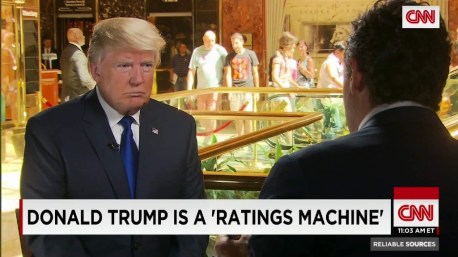
Donald Trump - Ratings Machine - CBS - Les Moonves - CNN - Television News

My point, I suppose, is this.

There is nothing funny or entertaining about this American presidential election. Voters are faced with a rather dismal choice between a far from universally loved Democratic Party candidate on the one hand and an absolute megalomaniac on the other. And they have been put into this position of not having a decent choice between two valid, honourable but competing political philosophies largely thanks to the decision of the television networks last year to break into their regularly scheduled programming every time Donald Trump raised an eyebrow, while giving the other Republican candidates (let’s face it, many of whom were so hopeless that they really needed a media leg-up of their own) almost zero screen time.

The other candidates had to drop what they were doing and go to Washington or New York if they wanted to be featured on the Sunday shows. Trump was permitted to appear by satellite link or even telephone, so eager were American news executives for a bit of Trump’s verbal gold. And whenever Donald Trump has been interviewed, the questions have frequently been of the most depressingly softball variety. America does not have a Jeremy Paxman figure, or even an Evan Davis (God help them). Nor do they have as strong a tradition of confrontational political interviews as we have in Britain – the tradition of deference to authority is, rather counter-intuitively, very strong in America. And so during all of his unearned media time, Donald Trump has very rarely been faced with a single question which caused him to stumble, despite his lengthy back catalogue of cruel and ignorant public pronouncements. Rarer still has Trump faced a searching follow-up question when he replies with one of his repetitious, opaque defensive statements.

All of which makes Amy Goodman’s excoriation of the American news media very true, and rather refreshing:

The media manufactures consent – for war, for candidates in elections, by bringing you more, for example, of one person. Like Donald Trump. He is pumped into everyone’s home. He can just stay in a gold gilded mansion in New York or one of them in Florida. The rest of the candidates trudge from one state to another. Why does he get this unfiltered pipeline into everyone’s brain, into your eyes and to your consciousness?

It matters. The Tyndall Center did a report in 2015, they looked at the whole year, and they found Donald Trump got 23 times the coverage of, say, Bernie Sanders. They found ABC World News Tonight did something like 81 minutes on Donald Trump and I think they gave Bernie Sanders 20 seconds.

[.] In this high-tech digital age, with high-definition television, digital radio, all we get is static, that veil of distortion and lies and misrepresentations and half truths that obscure reality, when what we need the media to give us is the dictionary definition of static. Criticism. Opposition. Unwanted interference. We need a media that covers power, not covers for power. We need a media that is the fourth estate, not for the state. And we need a media which covers the movements that create static and make history.

Obviously Goodman’s interest was promoting the candidacy of Bernie Sanders (the video was made several months ago before he officially dropped out of the Democratic primary contest), but her critique of the wildly excessive time and attention lavished on Donald Trump by the television news media is dead accurate.

As a Brexit campaigner during the EU referendum, representing an organisation (The Leave Alliance) which was the only group to actually offer a comprehensive Brexit plan yet struggled to get any meaningful media attention, all of these same criticisms apply to the British media too. It’s nice to know that these problems are universally felt on either side of the Atlantic, I guess.

As a small campaign organisation it was almost impossible to get our word out when the television news was racing to cover every last syllable which dribbled from the mouth of Boris Johnson, while our own esteemed experts – including one of Britain’s foremost authorities on the EU – struggled to get journalists to show up to a launch event right in their own Westminster back yard.

Nobody expects perfection from the media. Media companies have to pay the bills too, and often keep shareholders happy. But for so long as telegenic ignoramuses dictate television (and print) coverage to the extent that they do, our democracy will remain vulnerable to demagogues like Donald Trump.

On election night in America, we will see (as we always do) the great and the good of American TV journalism pat themselves on the back and endlessly congratulate themselves about the moving spectacle of democracy which they are helping to transmit to a grateful nation. Brian Williams, Rachel Maddow, Wolf Blitzer, Diane Sawyer, Lester Holt, Dana Bash, Joe Scarborough, Shepard Smith, Chris Wallace, Bret Baier, Greta van Susteren, Andrea Mitchell and all the rest of them will be churning out platitudes about the beauty of democracy faster than you can stick knitting needles in your ears.

This year, they might consider dwelling on the role they have played in debasing and jeopardising that democracy in the tawdry pursuit of ratings.


Donald Trump - Make America Great Again

Support Semi-Partisan Politics with a one-time or recurring donation:

Agree with this article? Violently disagree? Scroll down to leave a comment.

Follow Semi-Partisan Politics on TwitterFacebook and Medium.

Lessons In Journalism, Populism And Diversity At ITN London (Extended Feature Version)

ITN CDN Open Day semipartisansam 004


I walked through a doorway, found myself standing in the ITV National News studio, and for a moment I was shocked to realise that I didn’t recognise the space at all.

Not because of the floor-to-ceiling green screen backdrop and the absence of the computer-generated background – the final version, familiar to viewers, was displayed on a monitor to the side – but because I hadn’t deliberately or consciously watched the ITV News in more than a decade. The news desk, the set, the logo – nothing seemed familiar or evoked the old ITV I remembered from the late 1990s.

I’m a voracious reader and consumer of domestic and international news. In fact, I’m currently embarking on a side career in political journalism. And yet I was somehow completely untuned from one of Britain’s main news outlets. Should that be cause for concern?

Then came another shock. As our tour group wound its way through the humming newsroom, quite by chance I found myself standing behind a bona fide news celebrity – veteran broadcaster and news presenter Alastair Stewart – as he sat at his workstation, deep in conversation with colleagues sitting at identical high-tech hotdesks in the middle of the newsroom floor. Gosh, I thought, thinking back on his many years presenting London Tonight, I didn’t know he was still working.

Continue reading

Lessons In Journalism, Populism And Diversity At ITN London

ITN CDN Open Day semipartisansam 004


I walked through a doorway, found myself standing in the ITV National News studio, and for a moment I was shocked to realise that I didn’t recognise the space at all.

Not because of the floor-to-ceiling green screen backdrop and the absence of the computer-generated background – the final version, familiar to viewers, was displayed on a monitor to the side – but because I hadn’t deliberately or consciously watched the ITV News in more than a decade. The news desk, the set, the logo – nothing seemed familiar or evoked the old ITV I remembered from the late 1990s.

I’m a voracious reader and consumer of domestic and international news. In fact, I’m currently embarking on a side career in political journalism. And yet I had somehow become untuned from one of Britain’s main news outlets. Should that be cause for concern?

The reason I was deep inside ITN’s London newsroom at all is thanks to an invitation to attend the Creative Diversity Network open day, one of many similar events being held around the country where major broadcasters (Sky, BBC, CNN, ITN and others) open their doors to give people from ethnic and socially diverse backgrounds the taste of a career in TV journalism. My invitation came through Poached Creative, the social enterprise with whom I trained earlier this year.

Continue reading