
–
If you have ever read a John Grisham novel or watched Law & Order, you probably know more about the American legal system than the average British citizen knows about our own
When the firebrand US Supreme Court associate justice Antonin Scalia died last weekend, the news made headlines around the world, and the story was covered extensively on the television and print media here in the UK.
Legal experts and part-time America watchers (like me) all came crawling out of the woodwork to offer their analysis of what impact the Supreme Court vacancy will have on the remainder (and legacy) of President Obama’s second term, the likelihood of any Obama nominee being successfully confirmed by the Senate, and the impact of a rebalanced court on American social policy.
All of this earnest discussion and analysis, over a vacancy on a court which sits thousand of miles away, and has absolutely no jurisdiction over anyone in Britain! And yet people were interested – partly because many of us likely have a greater understanding of the American legal system and its personalities than our own.
Today, conservative American publication The National Review bemoaned the fact that a third of Americans don’t know who Justice Scalia was, according to the latest opinion polling. They seize on this fact to (rightly) condemn the disengagement of those who fail to educate themselves on important civic matters:
Strangely, the percentage of people who said they had “never heard of” Antonin Scalia increased from 29 percent in 2001 to 39 percent in 2005. Was that the Greatest Generation, who read newspapers, dying off and the Millennials, who never look up from their cell phones, entering the polling sample?
This is a free country, and you’re free to not care, and free to not pay any attention to, say, one-third and arguably our most powerful branch of government. I understand the sense that it would be a better world if we could spend more time thinking less about what government is doing about more pleasant things — food, sports, movies, home furnishings, how awesome the finale of Gravity Falls was, etc.
But if you choose to pay no attention to these things, and refuse to read anything about them, watch anything about them, or learn anything about them . . . then I’d rather you left the voting to those of us who do care.
The National Review would be shocked, then, to learn just how few citizens of America’s closest ally understand the basic tenets of their own legal system. Because although I don’t have an opinion poll to back me up, I would be surprised if one third of British citizens knew that we even had a Supreme Court, let alone the names of a single one of its justices.
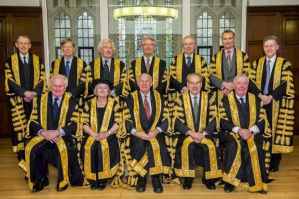
(The PC Left and rabid practitioners of Identity Politics are also missing a trick – eleven of the twelve current justices of the UK Supreme Court are old white men, with the remaining justice an old white woman. Are these people really the most qualified for the job, or did they get their positions through the chumocracy and establishment connections? Why is there no public confirmation process, to give democratic oversight to the selection of new justices? And yet how many times has the UK Supreme Court been picketed by angry Social Justice Warriors demanding ethnic balance on the court?)
I will be honest and start by admitting that before writing this piece, I could only name one justice of the UK Supreme Court – Lord Neuberger, the court’s president. And that’s awful. I write about politics and UK current affairs every day and consume several hours of news on television, the internet and social media besides, but I could only name one person on the bench of the UK Supreme Court. And if I can’t rattle off a handful of names together with a brief commentary on their respective legal and ideological outlooks, how many people are actually able to do so?
How many laymen – people without a direct professional or personal interest in the workings or judgements of the court – actually do know who sits on our own version of the Supreme Court? How many could explain at a high level how the legal system works, with the division between civil and criminal court, the work done by solicitors and barristers, and the hierarchy of trial and appellate courts? Or the difference between the Scottish system and that of England and Wales? All that I currently know, I learned from an Introduction to Business Law course while studying at university – there were no civics lessons in the 1990s National Curriculum. And most others will not have even received this basic primer.
But how are we to fulfil our potential as informed and engaged citizens when we fail to understand how one of the three major branches of government works? Most people have a passable grasp of the executive and the legislature, even if they don’t recognise the Government and the Houses of Parliament using those terms. But I very much doubt that one adult in fifty could explain the fundamentals of our legal system, let alone the many layered intricacies.

But flip it around. Why would we know how our legal system works, or recognise the major personalities in the British legal scene? And why should we bother to take the time to educate ourselves?
People in America know the names and ideological leanings of the justices on their Supreme Court for a number of reasons. For a start, they take their civics a little bit more seriously on that side of the Atlantic – something that we could learn from.
But more than that, the American legal system is far more responsive to the citizenry than the British system is to us. One major difference is that many local judges are elected. Now, this may or may not be a good idea – and having watched a number of local races for positions on the bench, I have my grave doubts as to the wisdom of elected judges. But you can’t deny that you are likely to feel much closer to the legal system if you have a direct say in who gets to don the black robes.
Even more important is the fact that unlike we Brits, Americans have a written constitution to act as a common frame of reference when talking about legal matters. Even half-educated Americans will talk about whether something is “constitutional” or not, and apply this test to all manner of public policy debates, from government surveillance to gay marriage. This is important, because it gets people thinking beyond the mere fact of whether they agree or disagree with a particular law, and toward the broader question of exactly why the law in question is good or bad. That’s not to say the ensuing debate cannot still be ignorant and intemperate – it often is – but at least everyone is able to take part in the debate along the same parameters.
Consider the Edward Snowden leaks, when one whistleblower’s actions laid bare the extent of secret government surveillance in Britain, America and the other “Five Eyes” countries. In America, the people – outraged at this secret, systemic violation of their privacy – were able to haul officials in front of congressional committees and debate the legality of the government’s actions with reference to the Fourth Amendment, which prohibits unreasonable searches and seizures. And in due course, the American government had to make a number of concessions and restrict its surveillance activity. In Britain, by contrast, we had David Cameron pompously telling us that he respects the “tradition of liberty” but is basically going to do whatever he wants. And what recourse have we to stop him? None.
Then there is the central role which the US Supreme Court often plays in matters of great social importance in America. In Britain, Parliament’s “elected dictatorship” is the Alpha and the Omega for nearly all significant decisions made in this country – the government can pass or repeal any law almost at will and with no reference to any higher text or law, so long as it can muster the votes in the House of Commons. The courts then simply apply what has been handed down by Parliament, which is sovereign. Refreshingly, this is not so in the United States.
Consider just some of the most famous cases – household names, even to those of us living in Britain. Dred Scott. Citizens United. Roe vs Wade. Brown vs Board of Education. We may know next to nothing about American current affairs, but we know that these relate to slavery, campaign finance, abortion and racial segregation. Because in America, the president is not the only person who matters. Nor are the leaders of Congress. The third branch of government matters equally, and how the Supreme Court chooses which cases to hear and applies their interpretation of the Constitution to those cases constitutes a vital check and balance in the American system.
Can you name a comparably important British case? They do exist – the Al Rawi case, for example, with its implications for the legality of secret hearings, or Nicklinson vs Ministry of Justice, which confirmed the current illegality of voluntary euthanasia, or the “right to die”. But few people know about these cases or why they are important, because the British legal system is so much more remote and unaccountable to the people.

Finally, there is the question of sovereignty. The United States Supreme Court is the final arbiter of what is and is not constitutional, and therefore applicable to American citizens. It cannot be shunted aside by an impatient government if it holds up or overturns key legislation, and nor can it be undermined from the outside – the court determines for itself which cases it will hear, and a majority decision made by five out of nine Supreme Court justices will then bind the government and lower courts. This goes against everything that the current British establishment – who are only too happy to wreck every institution and overturn any tradition in pursuit of their short term goals – stand for.
But crucially, the US Supreme Court is also not subordinate to any external or foreign body. By contrast, the UK Supreme Court is treaty-bound to defer to the decisions of the Court of Justice of the European Union (CJEU), and must interpret all UK legislation not through the lens of compatibility with a British constitution, but rather to ensure its compliance with the European Convention of Human Rights. That might sound all well and good until one realises just how broadly “human rights” have come to be defined.
And one must also ask why we as a country do not trust ourselves enough to be the final arbiter of important cases. Are we naturally more barbarous than our European neighbours, and in need of constant judicial restraint by our moral betters on the continent? Whatever the answer, the inescapable truth is that legal subjugation to an external, supranational body is the antithesis of national democracy.
So to recap, there exist a number of deficits between the American and UK legal systems in terms of ensuring citizen understanding and engagement with the judicial branch of government, namely:
1. A weaker sense of civic duty and engagement in Britain
2. Greater democratic distance between the people and the legal system in Britain, compared to America
3. Lack of a written British constitution as a common frame of reference when discussing legal matters
4. A much clearer link between decisions made in the US Supreme Court with American social policy
5. Lack of sovereignty: the American legal system is sovereign and subordinate to no external body, unlike the British legal system which is subordinate to EU law

There is no good argument for continuing to abide such a remote, elitist and unaccountable legal system as we suffer in Britain. None. And anybody tempted to sniff haughtily at the American system, with their elected lower court judges and Scopes Monkey Trial culture wars should remember that however passionate and unseemly the public discourse can sometimes be across the Atlantic, this is only because more American people are actually engaged citizens with a moderate grasp of how their country actually works. We should be so lucky to have a system as simple, accessible and easy to explain as they have in the United States.
And it should be a source of great shame to us that our journalists, politicians and private citizens often know more about another country’s legal system through watching Hollywood movies or Law & Order than they do about our own.
The American public is rightly fixated on the issue of who President Obama will nominate to fill the Supreme Court seat left vacant by the late Antonin Scalia – incidentally a first rate mind and writer of opinions and dissents which are accessible and entertaining even to laymen like myself. They care about who takes up the ninth seat on their Supreme Court, because unlike Britain, their legal system is more than a rubber stamp for the government of the day.
The ninth justice of the US Supreme Court may well end up casting crucial swing votes in important matters of human governance in the next decades, such as the right to bear arms in self defence, the right to privacy and the right to free speech. And these decisions could well have tangible, real-world consequences for the 330 million people who live under the court’s jurisdiction, as well as anybody else to whom the Constitution applies – like your First Amendment right to free speech when you go to holiday or work in America as a British citizen.
Elevating the people and the institutions into the public consciousness is not crass sensationalism, as some may charge. On the contrary, focusing on the personalities helps to elevate the issues to a place of prominence in our public discourse, which is exactly what we should be doing here if our own elites were not so busy trying to hide from public accountability anywhere they can scurry – be it behind the black veil of EU lawmaking in Brussels or the bewigged, dusty obscurity of the British legal system.
It would be ironic if it took the death of a supreme court judge in another country to force Britain to finally take a proper, critical look at our own impenetrable legal system. But public interest in legal matters peaks only very rarely, and so those of us who want to see real legal and constitutional reform have a slim opportunity – but also an obligation – to make our case.
For as things stand, a constitution and legal system in force over 3,000 miles and an ocean apart often feels more familiar – and less remote – than our own.

–
Agree with this article? Violently disagree? Scroll down to leave a comment.
Follow Semi-Partisan Politics on Twitter, Facebook and Medium.




 Semi-Partisan Politics