General Election 2017: Tory Apocalypse / Brexit Salvation Reax

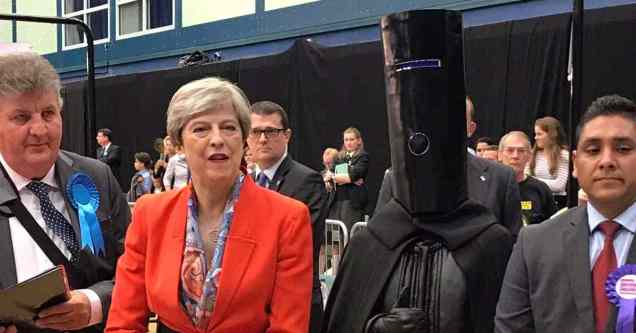
Theresa May - Lord Buckethead

A self-inflicted catastrophe for small-C conservatives with one – potentially enormous – silver lining

Who knew that Theresa May was quite so staggeringly incompetent? I mean, we all knew that she wasn’t a real conservative, at least in the best Thatcherite traditions of the party. That much was made clear from successive party conference speeches and her idiotic manifesto’s all-out assault on the libertarian or free market wing of the party.

But her years plugging away in the Home Office and quietly manoeuvring herself into the most powerful job in the country belied the fact that as prime minister, Theresa May would be revealed as little more than a puppet manipulated by her two closest aides (also both cuckoos in the conservative nest) with almost zero reliable judgment of her own.

Through her sheer campaigning ineptitude and inability to articulate a positive conservative vision (remember how this blog kept banging on about the need for one of those?), Theresa May has allowed Jeremy Corbyn’s brand of 1970’s style socialism to regain a foothold in British politics, and for this unforgivable high crime alone she needs to be sent to political Siberia with no undue delay.

But as I made clear in my election night live-blog, Jeremy Corbyn also deserves enormous credit for improving Labour’s electoral position and enthusing so many people with socialist politics. Sure, in one sense it is easy to sway people with the promise of endless free stuff, always paid for by someone else. But as I noted a couple of weeks ago, it is still necessary to overcome voter scepticism that the promised Utopian land of plenty can actually be achieved.

Jeremy Corbyn successfully made the pitch to lots of people – or at least got them to temporarily suspend their disbelief. And he did so in the context of a still-centrist Parliamentary Labour Party which hates his guts and has been trying to undermine him since before his leadership even began, not to mention a hostile television news media which only fell into something approaching balance when election campaign rules took effect, and a pro-Tory print media which pulled out all the stops to get Theresa May over the finish line. That is no small feat.

The other major factor was the youth vote. While we still don’t actually know how many young people voted or quite to what extent they broke for Jeremy Corbyn’s Labour Party, it seems clear that the promise of free university tuition – and let’s face it, just an ounce of empathy for a generation coming of age at a time when the prospect of home ownership is more distant and potential career paths more disjointed and precarious – won the support of millions of young people.

Apparently when it comes to closing time at nightclubs, young people are spontaneously breaking into the sung refrain “Oh, Jeremy Corbyn!“. The naive chant of mostly low-information voters who wear their political views more as a trendy fashion statement than a considered position? Sure. But also a demographic which Theresa May and her campaign team, in their infinite wisdom, did absolutely nothing to court.

I blogged about this in the heat of the moment on election night, and then split out my thoughts into a separate piece here. And it seems clear to me that British conservatives (I use a small C deliberately) simply cannot go on writing off the youth vote and ceding it to the parties of the Left. We have been doing so for far too long, at our peril, and now that a charismatic conviction politician (in the unlikely form of Jeremy Corbyn) has come along who can actually speak to this demographic we are totally defenceless.

And then there’s Brexit.

The one silver lining of this confused election result is that Theresa May’s stubborn insistence that “Brexit means Brexit” – by which she means that Brexit means abandoning the EEA, denying the existence of non-tariff barriers to trade, demanding a bespoke comprehensive free trade agreement within two years and threatening to walk away with no deal if the EU failed to acquiesce – may now be moderated by more sensible voices which lean toward the once-maligned “Norway Option”.

The DUP, on whose support the Conservatives must now rely to command a majority in the House of Commons and remain in government, are against a hard Brexit, as are many Tory Remainers and many small-C conservative Brexiteers across the country. While the Tory Brexit Taliban (a wonderful phrase concocted by Pete North) will kick up an almighty fuss if they sense any dilution of their maximalist approach to Brexit, suddenly it has become a lot harder to see the pathway toward that goal. Good.

Aside from these thoughts, I am still digesting the surprising election result and the potential ramifications of a new political reality with many moving parts. But below are some of the hot takes and more considered reactions which have resonated most with me in the hours since the fateful exit poll was released.

Author and blogger Paul Goldsmith rips into the Tories’ awful manifesto, the incompetence of their leadership and their small-minded, fear-based campaign:

Let’s not beat around the bush here. Theresa May’s manifesto was almost like saying ‘come on, I dare you to vote for us’. The idea that people who had worked all their lives and paid taxes and national insurance to build up a nest-egg to pass onto their children and grandchildren should run down that nest-egg to the last £100,000 to pay for care they thought was part of their social contract with the state in return for those taxes and that insurance? A return to a grammar school system that might look superficially advantageous to poorer children but with no clarity on how it wouldn’t once again abandon 75% of the population to the mental slavery of under-education? A free vote on fox hunting? A determination to insist that the ‘will of the people’ had been clearly expressed for the hardest of Brexits including withdrawal from the Single Market and customs union and immigration controls that include the preposterous 100,000 a year immigration cap?

Let’s add that to the person delivering this, it turned out, far more madcap scheme. Theresa May came across as arrogant, complacent, prickly when challenged, and downright mendacious when insisting ‘nothing had changed’ during her unprecedented manifesto u-turn on social care. Then there was the refusal to engage in TV debates. I wonder if any leader will do THAT again. Her refusal to properly involve her Cabinet in creating that manifesto left them hung out to dry when defending it, as they were reduced to constant ‘dead cat’ strategies of shouting ‘IRA’, ‘MARXIST’ and ‘TERRORIST SYMPATHIZER’ at Jeremy Corbyn, because they had so little positive to say.

Then look at what she was up against. Every night I would watch the news with Mrs G. We are not, and never will be ‘Corbynistas’, but by g-d did he look good compared to the Prime Minister. Mrs G often said it herself “every night he seems like the only person in this election who really believes what he is saying.”

This last point is particularly valid. Don’t underestimate the attraction of a political leader who (regardless of the rightness or wrongness of their policies) actually sincerely believes what they are saying, and has the courage to defend those beliefs.

When Theresa May first called this general election, I wrote a piece pondering whether Jeremy Corbyn’s likely defeat would spell the end for conviction politics altogether. How wrong I was. If anything, the Tory implosion and Corbyn’s solid showing (and the enthusiasm he has generated among many young people) have reminded us that having strong principles and the willingness to defend them can actually be attractive to voters. If only the conviction politician in this case had been on the Right rather than the Left.

Daniel Hannan, writing for the Washington Examiner, reaches for some low-hanging fruit about how young people voted for Free Stuff:

It’s true that the Conservative campaign could have been better, but that is true of every campaign in history. The prime minister, Theresa May, was criticized for calling an unnecessary election and then refusing to participate in the televised debates. But that doesn’t come close to explaining how Labour rose from 30 to 40 percent support during the campaign.

No, I’m afraid we’re down to the simplest and most depressing explanation. Quite a few voters will support any party that seems to be offering them free stuff.

Labour’s manifesto was a ridiculous list of public handouts. More money was promised for healthcare, schools, the police, public sector pay rises, pensions and free university tuition. All the extra cash was vaguely supposed to come from “big business” and “the rich.” In the event, an awful lot of people liked the sound of goodies that someone else would pay for.

The Labour vote came disproportionately from people under the age of 25, who turned out in unprecedented numbers, confounding every opinion poll. Few of voters of that generation know about the IRA bombing campaign in the 1970s and 1980s, which far surpassed today’s Islamist terror in its scale. They do not remember the Cold War. They do not even recall, except in the vaguest sense, the last Labour government which, in 2010, left Britain with a deficit higher than Greece’s.

On polling day, a Labour activist tweeted a photograph of students queuing outside a polling station. It was, she said, a sign of the political upheaval that was taking place. But my immediate thought was: “If your guy implements the socialism he wants, we’ll all have to get used to queuing.”

He’s right. The case for free markets and fiscal conservatism has to be made anew in every generation. Many of the young people who helped power Jeremy Corbyn to victory are at best dimly aware of the extent to which post-war consensus, socialist policies doomed Britain to slow and steady decline up to 1979. They didn’t experience the Winter of Discontent themselves, just as I didn’t.

But if nobody makes the case for the kind of policies which rescued Britain from near-terminal decline and which are at the root of the historic prosperity and plenty which we now enjoy, then they will take this stability and prosperity for granted, assuming that it is the baseline, the default setting. They will wrongly assume that things can only be improved by overturning conservative policies and attacking the free market, when in fact conservative economic policies and free markets underpin nearly every good thing in their lives, from the clothes they wear, the variety of food in the grocery stores where they shop to the smartphones in their hand from which they glibly re-tweet “For the many, not the few”.

Here’s Margot James, Conservative MP for Stourbridge, making a similar point in Conservative Home:

Apart from a level of debt which is unsustainable over the long term, the economy is now in good shape.  We have brought sanity to the public finances, as we promised we would. Consequently, the economy has not been to the fore when people have been deciding how to vote.  Labour have been able to latch on to this relative economic security by peddling a message that the state should provide more at every turn.

The election descended into a profligate binge over how much taxpayers’ money Labour proposed to give away: keeping the triple lock for pension increases, maintaining winter fuel payments for older people as a universal benefit, thousands more police officers (regardless whether or not they are needed, given the changing nature of crime), more money for schools, health, and social care…all this was added to the billions needed for the nationalisation of the railways and the Royal Mail. And finally, the game-changer: an end to tuition fees for higher education.

The moment I heard Labour’s policy of free university education I knew young people would turn out to vote in unprecedented numbers.  This was a policy that would deliver votes in the same way that the sale of council houses did for us during the 1980s.

At a radio hustings I took part in, we were asked what we would do for young people.  Labour was all about handouts: free higher education with no regard for how universities were to be funded, the reintroduction of housing benefit for 20 olds and an equal minimum wage.  I was a lone voice calling for improving opportunities for young people to gain skills, start businesses, and access better jobs brought about by encouraging investment.

Paul Goldsmith picked up on this point, too:

Many right-wing commentators have pointed out that all Jeremy Corbyn was doing was bribing people with other peoples’ money. One said that the election could be summed up in six words: ‘young people vote for free stuff’. Yes, there is an argument for both. But this is why it was incumbent upon Theresa May and the few people she takes advice from to present an optimistic picture of the benefits of the free market, or maybe stepped back, considered that if you keep on cutting spending per pupil in education the country will pay the price for generations, and changed course in a way that stays true to the now normal Conservative consensus that instead of spending a load of money to manage demand, money should go towards increasing productivity and supply, and demand will take care of itself.

But no. Instead we got the cowardice of fear. Fear of proper debate, fear of the demands of those on the Eurosceptic right who  will not stand for a single penny going to the EU and who insist with no justification that the world will simply dance to our tune, and fear of antagonising those who fund her party. Meanwhile, Jeremy Corbyn offered the audacity of hope, a hope that economic theory might be turned on its head, a hope that people who would be milked for money would turn it over quietly, but more importantly a hope that no-one in this rich country will live in desperation anymore.

It is astonishing, the degree to which the Conservative Party fought the election and generally structured its messaging according to the terms of the socialist Left. Restraining the growth of the state has continually been portrayed as a regrettable necessity rather than a good thing in itself. And that’s when certain ex-advisers who shall not be named (cough, Nick Timothy) were not busy advocating an even more activist role for the state altogether.

When you start speaking in the other side’s tone of voice, using their turns of phrase and echoing their agenda (Theresa May’s first act as PM was to stand on the steps of 10 Downing Street and talk about how government could help the “Just About Managing” rather than getting out of the way and lowering their tax burden) then you legitimise their arguments. If you concede that it is the job of an activist, paternalist state to help everybody by shovelling benefits in their direction and artificially limiting their choices, why would anybody vote for the Tories when Labour promise to do the job so much more enthusiastically?

Sam Bowman, of the Adam Smith Institute, is not in a forgiving mood:

The Tories did so badly in part because they did not give people a reason to vote for them; in part because they doubled down on a hard Brexit strategy; in part because they neglected and even attacked their own base. For many years they and almost everybody else have totally failed to make a broad-brush case for free markets, with the honourable exception of a few think tanks and newspaper columnists. With that in mind, why is it surprising that someone who despises markets is so popular? How good the moderate and coherent Osborne brand of social liberalism and fiscal conservatism now looks.

[..] The Tories did not offer anything to voters or to their own supporters. A free market manifesto could have energised Tory campaigners and candidates who would have had a reason to go to bat for May when she stumbled. It could have included policies that would have been popular with voters, like stamp duty and inheritance tax cuts, or ways of unlocking more infrastructure investment, that could have been sold on the doorstep as a reason to vote for them if you didn’t like them on Brexit. Fox hunting doesn’t count.

[..] Virtually no time at all was spent on the economy. What a colossal mistake. Many people’s incomes are the same in real terms as they were ten years ago, which is unprecedented. It was insane to ignore this and not to offer policies that might have boosted investment (chronically low in Britain by international standards) and people’s wages. All we got was a crude parody of continental European industrial policy, which in practice meant hectoring firms about worker representation on their boards and baseless claims about price gouging. What good is a polling lead on the economy for a right-wing party if you’re only interested in talking about business to attack it?

The Conservatives could have had a powerful and, to their base, exciting election platform. More homes, more investment, and better infrastructure could all have been delivered through smart, density-focused planning reforms, by restoring capital allowances in the corporation tax and cutting the part of business rates that falls on property investment, and by allowing local government to finance new infrastructure from private investment.

These ideas are free market to the core but are about fixing the problems that ordinary people have. Standing for free market conservatism does not mean having to be a dogmatic ideologue — something May and her team never understood.

Over on Facebook, Brendan O’Neill – who does himself no favours with his strident insistence that his is the only One True Brexit – does make some good points, first about the nature of the current Labour Party:

As more election number-crunching is carried out, it’s becoming clear that the Tories and Labour now play entirely different roles to the ones they played just 20 or 30 years ago.

The first thing that’s becoming clear is that people have overstated the extent to which Labour won over Leave voters. According to Lord Ashcroft’s exhaustive national survey, 60 per cent of Leavers voted for the Tories and only 25 per cent voted for Labour. John Curtice, the BBC’s key number-cruncher, reports that the biggest swings to the Tories were in Leave areas, while it was in “seats which voted Remain last year [that] Labour pulled off some of its best performances”. This means the Tories had huge swings in very poor areas like Boston and Skegness and working-class areas like Bolsover — which are Leave areas — while Labour made enormous gains in Hampstead, Kensington and Canterbury, which are Remain areas and / or well-off areas. The Tories made inroads with the poor, Labour made gains among the posh. This is fascinating.

More number-crunching is needed, but two things are becoming clear. 1) The idea that the Brexit issue or the Brexit divide has gone away is a fantasy. It merely takes a different form now, with Leave largely orientating around the Tories and Remain around Labour. Ashcroft says 68 per cent of Tory voters are Leavers and 64 per cent of Labour voters are Remainers. That is extraordinary. It’s the divide of our time, and we shouldn’t deny that. And 2) Labour, even led by Corbyn, is not a party of the working class. In fact it is becoming something else. It is morphing, or at least might morph, into being a party of the middle class that wants to *keep in check* working-class anger with institutions like the EU. Let that sink in. And let’s see what happens next.

And:

Okay, the wild Labour celebrations are getting weird now. Labour didn’t win. Even against grey, dull, U-turning May — the worst Tory leader of my lifetime, by far — it didn’t win. It is testament to Labour’s low ambitions that it is getting so excited about this. This is clearly a party that never expects to be in government again and must therefore welcome upward blips and handfuls of gains as the best it can get, proof it still has a pulse.

I also agree with O’Neill on the excessive celebration of the youth vote, as though their participation in the democratic process is somehow more valuable than that of older voters:

The message we’ve been bombarded with since Brexit and the Corbyn surge is that when the old vote, everything goes to shit, and the sooner these selfish, nostalgic bastards die, the better; but when the young vote, it’s all milk and honey and roses and light, and the sooner this fresh, caring generation takes over society, the better. The old are demonised, the young sacralised, giving rise to what must surely be one of the nastiest divides in our society right now. I can’t get behind the enthusiasm for the youth vote, I’m afraid, because much of it seems to me to be driven by a culture-war sense of entitlement against the apparently unfeeling, uneducated elderly. The culture war has come to the ballot box.

Now of course we should celebrate when a normally apathetic demographic group actually turns out to vote, but there is a worrying narrative building of young people, furious at having had their “futures taken away” by the selfish Leave votes of older people, finally striking back by supporting Jeremy Corbyn.

As well as being false, this is highly offensive. As though old people – many of whom sacrificed and laboured to give their EU-supporting kids the best possible chances in life – were not thinking about their children’s futures when they voted for Brexit, and as though young people – literally members of generation Me Me Me, consumerists who struggled to frame the EU referendum debate in terms other than what it meant for them and their own travel opportunities, love lives, mobile roaming charges etc. – were high-mindedly voting for the good of society and the future of our democracy. I have no time for this sanctimonious, false narrative, and it is good to see O’Neill also forcefully pushing back.

Turning to Brexit, here’s Pete North, angrily rebutting those who continue to fatuously declare that “the people” voted only for their specific, idiotic brand of Brexit:

As to the assertion that remaining in the single market is not leaving the EU, this is a zombie argument used by liars. The single market as it stands now is a collaborative venture between the EU and Efta states – and Norway etc only adopt about one in five EU rules by way of a system of co-determination – laws which we will likely have to adopt even if we left the single market – but without any means of disputing council decisions. Not least since many of them are rooted in global conventions.

I won’t go into the gory details because I will revisit these issues in the near future. The point of this post is simply to say that leavers do not get to call the shots on how we depart. They were given that opportunity over a year ago and declined the opportunity. It is therefore up to all of us to debate. Democracy is a continuum and though the decision to leave may well be sacrosanct the mode of departure still hangs in the balance and there is everything to play for.

You probably already know my views on this. There is no economic gain or utility in terms of sovereignty from leaving the single market. The main objective and the the single most important one is that we end political union with the EU and an off the shelf treaty is the fastest and safest path to that outcome. The rest can be sorted out later and revisited by way of EEA review.

There is no scenario where we don’t have to make compromises and fetishising sovereignty for its own sake is pointless since absolute sovereignty no longer exists unless you’re a regulatory superpower like China or the USA. Diverging from the existing regime brings us no efficiencies and comes at the cost of European trade. That was a tough pill to swallow for me being a long standing critic of EU regulation – but that is the reality of it nonetheless.

[..] In that regard do not let anyone tell you the debate is settled or let them interpret the result of the election for you. The question of how we leave has always been open ended and there is every reason to get involved. Plenty of people want to close down the debate by telling lies. The usual suspects. I’m not standing for it and this ain’t over til it’s over. The fight over Britain’s destiny did not end in June last year. The referendum was only the beginning and hardline leavers do not own this debate.

Meanwhile, the Telegraph columnist Christopher Booker can’t believe our good fortune in having inadvertently steered a course between two dangerous options (Corbynite socialism and Mayite Brexit illiteracy) with the electorate’s inconclusive verdict:

After a very short night, I was woken before 8am on Friday by a call from my son Nick, 5,000 miles away in India, who had been following the drama 8,000 feet up in the Himalayan foothills. “This is yet another amazing tribute,” he said, “to the unconscious political genius of the British people. They have somehow managed to steer between the Scylla of Corbyn’s suicidal economic illiteracy and the Charybdis of Mrs May’s hard Brexit.”

“She will only be able to govern with the support of 10 Northern Irish MPs who insist that we must keep a ‘frictionless border’ with Ireland and the 13 Scottish Tories who, with Ruth Davidson, are equally insistent that we must somehow remain free to trade in the single market. That is brilliant for the Union, because both Northern Ireland and Scotland are crucial to her survival.

“With all the other parties also somehow committed to staying in the European market, plus many of the less reckless Tories, that means that it will be extremely difficult for her to press on with her hard-Brexit, ‘walk away without a deal’ line. “I am now more optimistic about Britain’s future”, Nick concluded, “than I have been for a long time.” Many of my readers, I know, will be shocked, if not surprised, to hear that I agree with him.

Booker’s son is not wrong – and this is what makes the election result so bittersweet from my own perspective. Anything that moderates the nature of Brexit and injects some light rather than heat into the debate is clearly a good thing. But Theresa May has led the Conservative Party to a very bad place, perilously close to defeat, and there is no guarantee that either she or her replacement will learn the correct lessons.

The danger is that the Tories, rather than rediscovering their ideological backbone and making the case for free markets and a less activist state to the people, instead now join Labour in a full-on race to the political left, which would be devastating for conservatism as a whole as well as being a competition which the Right can simply never win. Must the price for Brexit be the shifting of the Overton window ten degrees back toward the Corbynite Left? It looks increasingly as though this may be the case.

Conservative Home’s Paul Goodman looks at the mechanics of the Conservative Party’s current predicament:

Better by far, say the wise old owls, to hang on.  An arrangement with the DUP would give the new Government a majority, they say.  There is no prospect of a no confidence vote succeeding.  And May can find shelter behind our old friend, the Fixed Terms Parliament Act.  Maybe she should see the Brexit talks through, some muse, and then depart with the thanks of a grateful nation.

Perhaps the old birds are right.  But this site is nagged by the uncomfortable feeling that they may be failing to see the wood for the trees.  May won the biggest Tory share of the vote since Margaret Thatcher, but the landslide she anticipated did not take place.  Voters seem to have mulled her refusal to level with them over social care, her reluctance to debate, her lack of ease with campaigning and engagement – and, having weighed her in the balance, found her wanting.  It is not certain that she has the flexibility and adaptability to share power with her Cabinet and Party and Parliament, as she must now do to survive.

It is all very well to take refuge behind fixed terms plus hope in the DUP.  David Cameron had a majority, and his government was crippled by rebellions.  May was at mercy of the Commons even before the election: remember the Budget and national insurance?  Conservative MPs may not yet have grasped that we face the possibility of five years of a Do Nothing Government – with all that this implies for the proper management of the country’s finances.  On paper, such an administration may be able to stagger on – at the mercy of tide and chance, with a Party leader vulnerable at any moment to a leadership challenge via letters to Graham Brady.  But in practice?

No, Theresa May needs to go now. None of the pieces I have read since that exit poll came out have convinced me otherwise, well argued though some of them are. In a sense, it doesn’t really matter that none of the likely options to replace her are any better (and Pete North forcefully explains why this is the case). The key is that the contenders could hardly be any worse, either in their zeal for a particularly destructive form of Brexit with almost no real thinking behind it, or in their dubious commitment to free markets and restraining the size of the state. And recall, May’s successor will be equally constrained in their Brexit approach by parliamentary arithmetic, so there is no need to keep May around for fear of a more hardline approach to Brexit.

Theresa May needs to go because she single-handedly destroyed her own authority, not just within her party or the country at large, but on the world stage too. These are momentous times, and with the metro-Left political elites of most countries currently scoffing at Britain for supposedly relegating ourselves from the ranks of serious countries by voting for Brexit, we need a strong, charismatic leader who is capable of going toe to toe with Emmanuel Macron, Angela Merkel and Donald Trump. Not a weak supplicant caretaker PM whose permission to continue representing us is extended only one day or one week at a time.

Perception matters, and right now Theresa May is correctly perceived as a loser with no authority. Better to make the change now, even if it means enduring five more years of aggrieved leftists who don’t understand how our system of government works (or make any effort to change it) moaning about another unelected Tory prime minister. Better to make the switch now rather than changing horses midstream in the middle of Brexit negotiations. And while whoever replaces Theresa May will probably be just as, uh, problematic from a conservative viewpoint, we should compensate by using the turmoil to finally promote some of the more Thatcherite, liberty-minded backbenchers – the likes of James Cleverly or Kwasi Kwarteng – to cabinet positions so that next time around we have a better talent pool to fish in.

The only problem is that by the time of the next general election, the Tories will have been in government (mostly in coalition / confidence and supply agreement, but also alone) for the past seven-plus years. The window for making radical changes to the way the country operates, tantalisingly opened after the Great Recession but stymied by David Cameron’s failure to win an outright majority against Gordon Brown, will have fully closed again. How many political parties or administrations can you think of which suddenly burst to life with original ideas and bold new policies 7+ years after first coming to power? Surely none. Anything radical must happen at the beginning, before the impetus wears off, steady state sets in and the people ultimately tire of the party of government and demand a change.

Regrettably, the Tories have wasted their years of potential firstly in coalition with the LibDems, then alone after the 2015 victory and now in some still-to-be-decided arrangement with the DUP, and accomplished very little save holding the EU referendum which gave us Brexit and presiding over a reduction (but not eradication) of the budget deficit. It is now quite possible that we must soon suffer through some form of left-wing government – perhaps a progressive alliance of the childlike Left, though who can now put it past Jeremy Corbyn to secure a majority of his own if May’s government falls? – before the Tories can then return once again to fix or limit the damage.

And yet in mitigation of this depressing fact, there is now a fighting chance that the new parliamentary arithmetic will see Brexit taking a more sensible, palatable and less destructive form, which is what this blog wanted all along.

Politics giveth and politics taketh away.


These are my current thoughts on the fluid post-election situation, together with some reactions from other people which have resonated with me since election night. I have quite a busy few days coming up so the blog may go a little bit quiet for the next week with only an occasional sporadic update, but normal service should be resumed by next weekend.

Stay tuned to the Twitter feed @SamHooper for more short-form ranting in the interim.
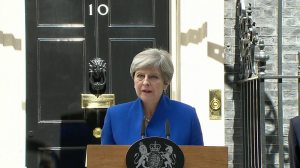
 

Theresa May - Downing Street speech

Support Semi-Partisan Politics with a one-time or recurring donation:

Agree with this article? Violently disagree? Scroll down to leave a comment.

Follow Semi-Partisan Politics on TwitterFacebook and Medium.

Left Wing Self-Awareness Award, Part 2

Samuel Hooper - Left Wing Self-Awareness Award - British Politics - Socialists

Jon Ashworth sees the light

More credit where credit is due to Jonathan Ashworth, Labour’s Shadow Health Secretary, who took a break from leading public worship of Our Blessed NHS (genuflect) to encourage Labour activists to see Conservative voters as potential hearts and minds to be changed rather than unconsionable, amoral degenerates.

From the Guardian:

The shadow health secretary has urged Labour to see Conservative voters as the party’s “friends and neighbours and relatives” rather than portraying those who are attracted to Theresa May’s offer as the enemy.

[..] He claimed that while there was no intention by Labour figures to portray Conservative voters in a negative light, the “febrile world of Twitter and social media can sometimes inadvertently convey that”.

Ashworth said his message was to stress: “Those who vote Conservative aren’t our enemies. They are our friends and neighbours and relatives. We need to be convincing them to switch to Labour where we can.

“They are people who live in our communities – we need to be persuading them as well as ensuring that those who voted Labour in past elections are sticking with us again.”

It’s a little bit cheeky of Jon Ashworth to suggest that there has never been any intention by Labour figures to portray Conservative voters in a negative light. The mere fact that prominent Labour politicians and activists choose to argue in such stridently moral terms about left-wing policies being altruistic and right-wing policies being motivated by base self-interest makes a clear implication that Tory voters are morally deficient – there simply is no other inference to be drawn from the rhetoric.

One might also consider the official Labour party leaflets distributed in the recent Copeland by-election, warning that a Conservative victory would literally “cost mums their children”.

The Guardian reported at the time:

A graphic Labour pamphlet warns voters in Copeland that a Tory victory in the by-election will “cost mums their children” in an open letter aimed at highlighting the risks of NHS cuts in the constituency.

The handwritten letter in support of Labour candidate Gillian Troughton, a St John ambulance driver and former hospital doctor, is from local mother Paula Townsley. The leaflet is the second posted through letterboxes by Labour activists to contain dire warnings about the closures of maternity services at West Cumberland hospital.

Accusing conservative voters of aiding and abetting in the death of babies doesn’t seem particularly inadvertent. On the contrary, it sounds like a deliberate attempt to make conservative policies seem not simply misguided and erroneous (as conservatives believe left-wing policies to be) but deeply, profoundly wicked. And presumably this election pamphlet was signed off by somebody with at least some authority within the Labour Party.

That being said, Jon Ashworth’s clear and explicit exhortation to Labour activists encouraging them to see the humanity in conservative voters (rather than Evil Tory vermin to be avoided or exterminated) can only be a good thing.

Not everybody agrees, though. A below-the-line commenter over at LabourList retorts:

What troubles me is the sacrifices in our values we have to make in order to appeal to Tory voters. What aspects of our manifesto would we have to dump? And how would that go down with our core vote?

None! At this point, you don’t have to make any sacrifices to your values. Just stop treating the other side as though they are pantomime villains, and you will be at least 30 percent of the way there. Dare to imagine that your opponent’s conservatism is borne of a legitimate moral framework and a sincere belief in what is best for society and the country, just as you believe that left-wing policies are the panacea. That’s all you have to do at this stage!

When it comes to toxic left-wing activism, it is the grassroots that do 80 percent the damage – on social media and through their coarse and vulgar protests. Jon Ashworth is correct to say that it is not usually Labour MPs themselves who are most responsible for whipping up anti-conservative hatred – or at least they tend not to do so while the cameras are rolling. Therefore Labour politicians have a responsibility to warn their more hot-blooded activists that treating Theresa May’s really very moderate centrist government as some kind of evil Nazi-like regime to be “resisted” is counterproductive and highly offputting to those who vote Conservative in good conscience.

Jon Ashworth’s conversion to the cause is therefore most welcome.

More, please.


Jonathan Ashworth - Labour Party - shadow health secretary

Support Semi-Partisan Politics with a one-time or recurring donation:

Agree with this article? Violently disagree? Scroll down to leave a comment.

Follow Semi-Partisan Politics on TwitterFacebook and Medium.

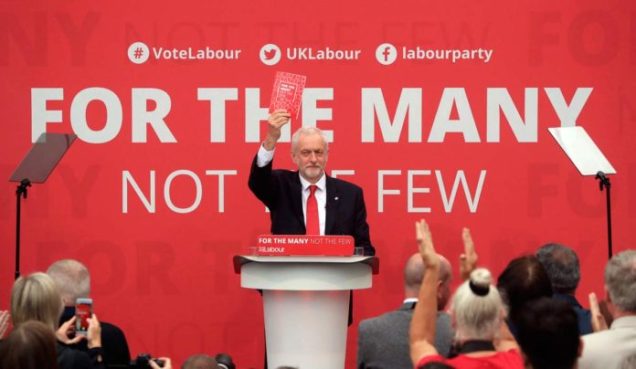
Labour Manifesto: Voters Know Left Wing Policies Are Individually Alluring But Collectively Foolish

Labour Party General Election 2017 Manifesto - Jeremy Corbyn - For The Many Not The Few

Left-wing party manifestos fail to deliver electoral wins despite the popularity of their individual components because voters are smart enough to realise that promising the moon on a stick is not realistic

One self-deceiving mantra that we hear time and again from the Labour and the British Left is that people supposedly love individual left-wing policies but fail to vote Labour in the same numbers, and that if only they change X, Y or Z then the public will fall in love with the great package deal of free stuff + no responsibility and usher in a perpetual era of socialist government.

Currently, the excuse for failure is Jeremy Corbyn, and a number of leftist activists are busy consoling themselves that the Labour leader’s reputation is the only problem. Swap him out and keep the same policies, the self-deception goes, and everyone will suddenly start clamouring to vote Labour at all times.

How many times have we heard the likes of Polly Toynbee sanctimoniously declaring in a TV news debate that people “overwhelmingly” support left-wing policies like the renationalisation of the railways and the utilities sectors, hiking taxes on “the rich” or funnelling ever-increasing sums of money toward “Our NHS”? Too many to count.

And yes, certain individual policies can be very popular, particularly left-wing ones. If you prance around promising more stuff for less money – better public services, faster healthcare, higher welfare payments, all conveniently paid for by somebody else – you are bound to pick up a number of gullible admirers. But more importantly, when pollsters test the appeal of individual policies, people are likely to be very warm to left-wing, redistributive ideas when they are named individually.

It is only when you look at the systemic effect of implementing a basket of left-wing policies all at once that the appeal begins to wear off, as people engage more deeply with the question and the shine starts to come off the socialist Utopia. You might be able to convince voters that a punitive tax raid on the most productive people in society will cobble together enough money for one shiny new government programme, but when you start spending the revenues from that same tax hike multiple times and promising to do fifteen wonderful things with the same small pot of cash, that’s when voters’ natural scepticism kicks in.

Here’s the Guardian, falling into the same trap:

Renationalising the railways was backed by 52% of voters, with 22% opposed and 26% saying they did not know. Nationalising the energy market was supported by 49% with 24% against and 28% saying they did not know.

Labour’s most popular policy among those surveyed was banning zero-hours contracts, with 71% in favour and 16% against.

Despite the strong support for the party’s policies, only 30% agreed with the sentiment that Corbyn should be given a fair chance at leading the country, while 56% said he would be a “disaster” as prime minister.

And the Mirror, doubling down:

There is also widespread support for increasing income tax on those earning more than £80,000 a year.

This is backed by 65% of voters, with just 24% opposed.

A small majority (51%) of Tories also support the policy as do 80% of Labour voters, 72% of Lib Dems and 69% of UKIP voters.

Labour’s pledge to limit the state pension age to 66 is supported 74% of voters, with 15% against and 11% don’t know.

Again this policy goes down well with Tory voters, with 67% of them supporting it and just 22% against.

Here’s Manuel Cortes banging the drum at LabourList:

Make no mistake, Labour’s programme is transformative in a way not seen since 1945 or, Thatcher’s counter-revolution. We know our policies are overwhelmingly popular. Our challenge between now and June 8, is to turn the debate in our country away from Brexit onto the bread and butter issues which our policies tackle.

The polls tell us this will be a Herculean task but they are also saying that our manifesto commitments, on a raft of issues, have huge majorities in favour.

Meanwhile, Josiah Mortimer at Left Foot Forward at least recognises that voter preference is more complex than approval for a basket of individual policies, but still manages to miss the point:

It begs the question: if voters agree with most of Labour’s headline policies – what’s going wrong?

The latest poll of polls has Labour on around 30% – 16 percentage points behind the Conservatives. It’s a divide that makes sense only if you understand politics as being about much more than policies – but leadership, and above that: presentation of those policies and that leadership.

There are of course the usual misgivings over Jeremy Corbyn’s qualities as a statesman (56% say they think he would be ‘a disaster’ as Prime Minister while 30% think he should be given a ‘fair chance at leading the country’).

But beyond that, there is the issue of presentation. It’s been said time and again that Labour’s current policies aren’t significantly to the left of his predecessor (‘warmed up Millibandism’). From renationalising the railways and ending private involvement in the NHS, to prioritising council housing and clamping down on the energy companies: all this has been done and said before.

But it often feels that the left do ourselves few favours – in presenting policies as more radical than they really are – and voters do perceive Corbyn as much more left-wing than he is: with 0 being effectively a communist, and 10 being the most right-wing, voters put Corbyn at 2.2, and Labour at 3.

But the discrepancy between individual policy popularity and overall opinion poll performance is due to more than the “Corbyn effect”, and it is disingenuous of the Guardian and other left-wing media to pretend otherwise.

We see similar enthusiasm gaps between individual left-wing policies and overall voting intention throughout recent British political history – support for rail renationalisation has been high since the railways were privatised – and also in the United States, where Democrats love to crow that many voters actually support their high-taxing, pro-union, pro-redistribution policies only to be disappointed on election day when conservative Republicans keep being elected to various levels of public office.

But many leftists genuinely seem to struggle with this notion. To their minds, if one promises one wonderful free thing after another, the cumulative effect will be enormous and should result in nothing but a Labour landslide in the general election. They make no allowance for the diminishing returns of left-wing fiscal incontinence, or realise that each further promise makes the complete package less believable rather than more.

Owen Jones actually gets closer to the truth, admitting to Varsity:

However, Jones is quick to point out that popular policies aren’t enough saying “individual policies don’t win elections, you need a clear vision to inspire people in terms of what you’re going to do.”

And developing his point in the Guardian:

As has been noted, Labour’s recent policies are indeed electorally very popular. You don’t win elections, though, with policies that – taken individually – have high levels of support, as Ed Miliband discovered. There has to be a vision to bring them together. If you don’t define what you are for, you will be defined by your opponents, already the critical problem afflicting Labour’s leadership. You need a sunny, optimistic vision, not a miserable shaking of the stick at everything that’s wrong.

Jones is right and wrong here. A vision certainly helps. However, the Tories have just launched their 2017 general election manifesto which contains no discernible vision or philosophy of government at all, beyond a final repudiation of Thatcherism, a spiteful kick at libertarianism and a pledge to make random gestures to the Just About Managing (JAMs) by pinching from the Labour playbook.

This blog certainly wishes that it were otherwise; that Theresa May had decided to fight the 2017 general election on an unapologetically small-government, conservative platform – particularly since electoral victory is all but guaranteed, together with the opportunity to reshape the country if only the political will was there. But the Conservatives’ imminent victory is proof that one does not need a logical set of policies or a coherent philosophy of government in order to win support.

If anything, the problem is that many voters know the left-wing vision only too well, and simply want nothing to do with it. Jeremy Corbyn may be bad at communicating an appealing left-wing worldview, sometimes couching even relatively pedestrian policies in the off-putting language of revolutionary struggle, but his predecessor Ed Miliband was as bland as bland can be, and still nobody took the bait. Likewise, since leaving office the heavy fisted Gordon Brown has developed a talent for giving angry TED-style intervention speeches at crucial political junctures, but he too was unable to sell an attractive, convincing left-wing vision to voters tired of centre-left New Labour rule.

The problem is not that the left-wing vision does not exist, or lacks decent salespeople to pitch it. The problem is that people who know it tend to dislike it. Envy of the rich, a desire to tear the successful down rather than build the underprivileged up, a seething antipathy to business and entrepreneurship, the stubborn insistence on inviting the government deep into the private lives of every citizen, treating half the country as perpetually helpless and “vulnerable” people in need of constant nurturing by the state, endless moralising about being the sole keepers of compassion, and now the embrace of toxic and divisive identity politics – there is no confusion about what Labour stands for, only dislike ranging from mild indifference to complete revulsion.

Unfortunately, though, these beliefs and attitudes run deep through the political Left. Even when voters like a particular individual Labour policy they are too often unconvinced to give Labour their vote because they rightly perceive that the policy is borne from the wrong motives.

Labour could promise to cut income tax to zero for everybody earning below £50,000 and throw in a £10k rebate on top, funded by punitive taxes on millionaires and confiscatory wealth taxes on assets, which would be a hugely popular policy, but they will not persuade an election-winning coalition of voters to back them based on it because in the back of their minds, voters know that even if they are to personally benefit from one of Labour’s pie-in-the-sky ideas, everybody will suffer – themselves included – when they quickly succeed in driving the country into the ground.

Hard as it is for some on the Left to believe, voters sometimes actually appreciate it when political parties level with them rather than endlessly trying to flatter and bribe them with “free” stuff. It was a Democratic president, John F. Kennedy, who exhorted his fellow citizens to ask what they could do for their country rather than what their country could do for them. Somewhere along the way, on both sides of the Atlantic, the Left seems to have lost this spirit, and replaced it with the gnawing certainty that voters want a shopping list of bribes, a promise to be perpetually looked after by the state and alleviated of all responsibility for their lives.

Fortunately this is not the view of most voters, which is why the Labour Party and the British people look set to continue talking past one another, on June 8 and into the future.


Labour Party Manifesto 2017 - For the many not the few

Support Semi-Partisan Politics with a one-time or recurring donation:

Agree with this article? Violently disagree? Scroll down to leave a comment.

Follow Semi-Partisan Politics on TwitterFacebook and Medium.

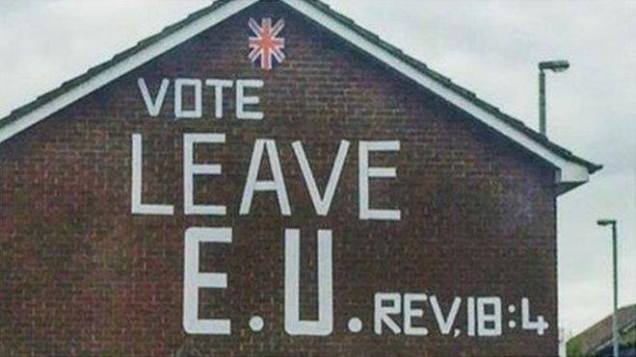
More Christian Brexit Hysteria From The Anglican Church

Brexit - Christianity - House mural - Revelation Chapter 18 verse 4 - EU Referendum

To believe that Brexit is the greatest threat to Britain’s Christian heritage and values is profoundly misguided

The people over at Reimagining Europe are at it again.

The Rt. Revd. Dr. Gregory Cameron, Bishop of St Asaph, is concerned that Britain may be about to throw it’s European-given Christian heritage out with the EU bathwater. One might consider it strange that he considers Brexit to be the existential threat to British Christianity rather than, say, increasing secularisation or the aggressive attacks by the Cult of Social Justice and Identity Politics on what were once traditional Christian family values, but such is the way of things these days within the Churches of England and Wales.

Bishop Cameron writes:

In spite of the fact that the Bible has more to say about the distribution of wealth, social justice and the welfare of nations than ever it does about eternal life, Christianity and religion have gently been tidied away by many to the sidelines of political life. To ask therefore about a “Christian Brexit” might provoke the response “Why should there even be talk of such a thing?” While fear of religious extremism may have fuelled the leave vote, Brexit is trumpeted as a clinical economic exercise, perhaps with a little national pride thrown in but free from ideological fancy. So many might wonder why would religion get mixed up in it?

In fact, Christian philosophy is something woven into the very fabric of British society.  It undergirds many of our attitudes and values, even if the rationales have become obscure, and the foundations repudiated by many.  Christianity came to us from the continent, and bound us to the continent, whether it was the mission of Pope Gregory to the Angles on the cusp of the seventh century, or the repudiation of one sort of Europe (the Catholic) in order to embrace another (the Protestant) in the sixteenth.  Even if we’ve chosen to renounce the politics of European integration, this doesn’t imply a rejection of a shared European culture – which is just as well given that most of British culture derives from a classical and Christian European past.  Could there even be a Britain without Christendom, the Angevin Empire, and the struggles for the European soul played out in the Napoleonic and World War conflicts?

It’s great that somebody is now asking these questions. I’m just astonished that the good bishop has identified Brexit as the greatest threat to this cultural heritage, rather than any of the other far more pressing issues. Of course Britain would not exist in anything like it’s current form without Christendom. Why does that mean that Britain should have voted to remain in a supranational political union beset with so many problems and unloved by so many?

And of course renouncing the EU’s explicitly political union and integrationist purpose does not mean that we reject our “shared European culture”. Given that Bishop Cameron understands that these are two different things, one wonders why he is concerned that rejecting one would even endanger the other.

More:

So which Christian values do I wish to see thrive in a Britain set apart?  One of the worst aspects of the Brexit vote, much commented upon, was the permission unintentionally given for xenophobia.  Too many immigrants (even to the third or fourth generation) are now made to feel unwelcome; too many folk have been given licence to be rude or violent.  I want to see a Britain which affirms our human connectness and the fundamental attitudes of respect and hospitality.  We need a people centred Brexit, which respects the individual choices and irrevocable commitments that immigrants and ex pats have made about their futures in the expectation of a border free Europe which is now slipping away from us.

I’ll have to take the bishop’s word for this. I have many friends and acquaintances in parts of the country condescendingly referred to by elites as “Brexitland“, but I myself live in cosmopolitan London, where Brexiteers and not “immigrants” are the scorned and endangered species. And while I do not question the veracity of media reports of xenophobic and racist incidents in the wake of the EU referendum campaign, from my own experience of strongly pro-Brexit places such as Stoke-on-Trent or my hometown of Harlow, neither have I witnessed anything like the wave of supposed anti-immigrant sentiment which the left-wing, pro-EU media insist is taking place.

Furthermore, if third and fourth generation immigrants are being made to feel unwelcome, clearly this is an issue which extends far beyond Brexit and Britain’s place in the European Union. As with the disastrous start to Donald Trump’s presidency in America, there is a tendency to blame every bad thing that happens in Britain on Brexit rather than seek to intelligently separate those factors which existed prior to the referendum and need addressing separately, and those which are legitimately connected with Britain leaving the EU.

The bishop then waxes lyrical about the “irrevocable commitments that immigrants and ex pats have made about their futures”. I’m sorry, but I have to take issue with this. The ultimate expression of making an irrevocable commitment to a new country that you want to call home is to become a citizen of that country. When my wife and I eventually move back to the United States, I eagerly look forward to the day when I receive my US citizenship as it will be an acknowledgement of the commitment I am making to that great country. Why should it be any different for somebody who intends to permanently settle and build their new life in Britain?

While EU citizens have been bribed for several decades with promises of a “borderless world” – while politicians have simultaneously kept silent about the damage done by undermining the nation state through the EU project – there is in fact nothing abnormal about expecting people to take that final oath of loyalty and allegiance before fully accepting them as a fellow countryman. You don’t prove your commitment to small-L liberal, British values simply by turning up, getting a job and starting a life here. An immigrant’s commitment to their new country should be more than the sum of the taxes that they pay and the personal enjoyment that they and their families receive as a result of making the move. To paraphrase John F. Kennedy, citizenship is about asking what you can do for your (new) country, not just what your (new) country can do for you.

More:

I want to see a Britain which reasserts its care for the weakest in its own society and in the citizenry of the world; which is committed to international development and international exchange.  We need a culture which is open to and accepting of heterogeneity.  In such a future, “British” should not stand in contradiction to “European”, but incorporate an international spirit: a continuing commitment to lowering barriers and not raising them.

Now this is just generic leftist pablum. Do we not already have an extensive welfare state? Do we not already lead the world by (wrongly, in my opinion) devoting an extraordinary fixed percentage of our GDP to inefficient, government-administered international aid? “British” does not stand in contradiction to “European”. But rather than becoming interchangeable, as EU integration ultimately demands, in future

Of course we should remain an open and tolerant society, but a culture which is “open to and accepting of heterogeneity” to an unlimited degree is a culture which refuses to assert its own values, fails to properly assimilate new immigrants and which fosters breeding grounds for unimaginable, unforgivable horrors like the sexual abuse epidemic in Rotherham, or the infant mortality rate as a result of consanguineous relationships in the London Borough of Redbridge. One might expect a Church of Wales bishop to be at least as equally concerned with these social problems as with the feelings of immigrants who felt perfectly happy in Britain until the Brexit vote but who now apparently feel besieged and despised, but apparently this is too much to ask.

More:

Brexit may not be a spiritual or religious enterprise, but we do have to defend the best aspects of our national life to build a future of which to be proud.  All the churches, including the Church in Wales, have to engage vigorously in the public debate about Brexit and our society as advocates of a Christian vision of social inclusion and people centred politics.

No. The trouble is that the Church has been lustily involved in the Brexit debate all through the referendum campaign and now it’s aftermath, but in an incredibly one-sided manner. Almost to the last person (with a few honourable exceptions) the bishops and clergy have come down hard on the side of remaining in the EU, often argued by clerics with a tissue paper-thin understanding of the issues at hand but a burning desire to signal their progressive virtue.

Has Bishop Cameron ever stopped to consider how an ordinary, decent, Brexit-supporting person might feel when confronted with the Anglican church’s institutional metro-leftism and scornful opinion of Brexiteers? Has he stopped to think what effect the Archbishops of Canterbury and York might have on the Brexit-supporting faithful when they so transparently agitate in favour of remaining in the European Union, and cast aspersions on the morals of those who dared to take a different position?

The bishop’s article concludes:

In challenging times of change it falls to us to demonstrate what loving our neighbours really means.

Yes, it does. Bishop Cameron might like to reflect on how he lives out those values in his own ministry, with particular regard to how he engages with the sincere beliefs of those within his own Welsh diocese who voted in good conscience for Brexit, are now looking forward in a spirit of optimism to its enactment, and are perhaps hoping for some pastoral encouragement (rather than despairing forgiveness) as they do so.

Because if this article is any guide, he has a long journey ahead of him.


christianity-europe-eu-brexit-3

Support Semi-Partisan Politics with a one-time or recurring donation:

Agree with this article? Violently disagree? Scroll down to leave a comment.

Follow Semi-Partisan Politics on TwitterFacebook and Medium.

Left Wing Self-Awareness Award, Part 1

Samuel Hooper - Left Wing Self-Awareness Award - British Politics - Socialists

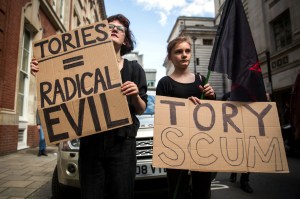
An award to honour the courageous few on the British Left who have come to realise that blindly screaming “Tory Scum!” at half the country might not be the surest path to victory, and who instead risk life and limb (or at least their careers) to propose speaking to conservatives as though they are human beings

Credit where credit is due to Peter Ormerod, who foresees the British Left’s imminent collision with reality on June 8, writing in the Guardian:

It seems many on the liberal left are determined to repeat the mistakes of the 2015 general election, the EU referendum and the US presidential race. There is a widespread failure – perhaps even a refusal – to understand the reasons May and the Conservative party are so popular. Until we try to do so, we will always lose.

We will break this cycle only by condemning less and understanding more. If the appeal of May’s Tory party eludes us, we surely need first to appreciate that we are relatively unusual, and then try and see what all those others see. This is not to say that they are right and we are wrong, or to ditch any of our principles; only that May evidently represents something that huge numbers of people in our country want, and that it is worth our while to analyse that and take it seriously.

Only then can we win back the people whose support we need. This is something the New Labour project, for all its flaws, understood: we must meet people where they are, not where we would like them to be. Only then can we take them with us. It just takes some emotional imagination on our part. And this brings us to the heart of our problem.

For all our supposed touchy-feeliness, many on the liberal left seem to forget that elections are fought not only on the grounds of reason but also on the battlefields of emotion. It should be obvious that responding with snark and hostility to people with whom we disagree just raises defences and entrenches beliefs: after all, we know how we react when we are mocked and insulted. But we should also have learned by now that facts in themselves are often unpersuasive too. If we have not grasped this from experience, then there is plenty of scientific research to make that clear. We can recite statistic after statistic, pointing to failing after failing, and they’ll just bounce off our intended target because Theresa May gives them a sense of confidence that Jeremy Corbyn does not. You can win a hundred arguments and change not a single mind.

This is also good, on the role of the media in influencing public opinion – one of this blog’s pet peeves:

We can believe that these millions of people are wrong, but we cannot say they are stupid. Nor are they all zombies, or all brainwashed, or all unenlightened. And it’s not enough to blame “the media”, either: newspapers are commercial operations and if the public mood changes, the media often changes with it. This was the case in 1997 and continues to be the case today: it is why, say, the political position of the Scottish Sun may differ from that of its English counterpart. It would obviously be naive to underestimate the extent to which some newspapers shape public opinion, but these publications would not exist if they failed to reflect it.

Peter Ormerod’s conclusion? Listen more, judge less. Meet the people where they are, not where the Left would like them to be. Dare to imagine that a political disagreement may be borne not out of a catastrophic moral failure on the part of the other person, but from a legitimate different perspective on life, one worth exploring and understanding if not necessarily accepting.

One can still quibble with parts of Ormerod’s article – despite the general thrust being correct, he still manages to accuse conservative-leaning voters of irrationality in the opening paragraph. But to focus on likely rhetorical slips like this would be churlish, particularly when so few others on the British Left – either among the political leadership, the commentariat or the grassroots – are willing to be so introspective or make such a concession.

Ormerod admits that it will take a “concerted effort” from his ideological colleagues to “lay off the sneering”, and right now I’m just not sure that the appetite is there. Certainly not before the general election on June 8. For better or worse, the two main parties will butt heads on election day more or less screaming their current war cries – “strong and stable leadership!” from the Conservatives, and something about the Evil Tories being worse than Hitler from the Left. The only question remaining is precisely how many voters this petulant strategy will manage to alienate by polling day.

There will then doubtless be a period following Theresa May’s victory – as there was when David Cameron vanquished Ed Miliband in 2015, breaking the hearts of many a Tumblr Milifandom blogger – when the red mist descends even deeper over the British Left. We will hear about how the stupid working classes voted against their own interests for Goebbels to be prime minister, and for the government to wage a deliberate holocaust of the sick, the disabled and the otherwise perpetually “vulnerable” (a term which the British Left have conveniently extended to cover over half the country).

But every such outburst is only a further step taken in the wrong direction; one which must be re-trodden when the fever cools, the temper abates and the Left finally decides that they want to make up with the British people rather than continue to bitterly rage at them.

As things stand, though, every angry leftist outburst on Twitter, every snarky and sanctimonious meme shared on Facebook, every slanderous anti-conservative status proudly shared, every “Tories are vermin” t-shirt proudly worn around the streets of London, every weepy Huffington Post article about how some precious little “citizen of the world” can no longer bear to look at the parents who raised and sacrificed for them simply because they dared to vote for Brexit – all of this must be paid for in a lump.

Peter Ormerod is one of the few to sense the impending crash before it takes place. Perhaps, before long, he will be joined by others.


Bankers Toffs And Tory Scum - General Election 2015 - London Protests - Downing Street

Support Semi-Partisan Politics with a one-time or recurring donation:

Agree with this article? Violently disagree? Scroll down to leave a comment.

Follow Semi-Partisan Politics on TwitterFacebook and Medium.