The Left’s Self-Serving Hypocrisy On Immigration And Free Movement

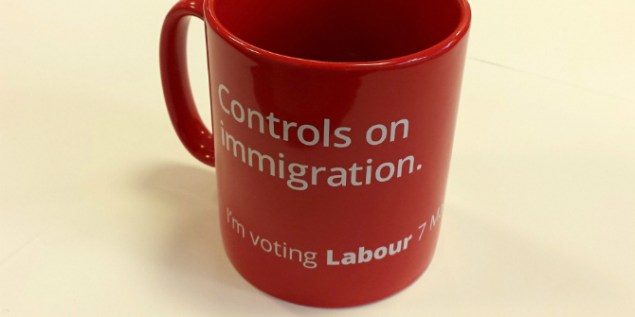
Labour - controls on immigration mug - general election 2015

The Left’s extreme attachment to the principle of free movement of people speaks volumes about whose interests they really serve

This, by trade unionist and Blue Labour activist Paul Embery, really gets to the heart of the modern metro-Left’s extremist stance on immigration and free movement of people within the EU, so divorced from the fears, priorities and aspirations of the Labour Party’s traditional working class base:

“Access to the single market and freedom of movement are inextricably linked, and it would be wrong… to put the economy anything other than first,’ Diane Abbott told The Andrew Marr Show on Sunday.

Leaving aside that there is, in fact, no inextricable link between access to the single market and free movement (she may be confusing access with membership), what is most striking is that Abbott’s argument here – that everything must be subordinated to economic imperatives, that policies must ultimately be judged not by their impact on society or quality of life but according to whether they boost GDP or make someone somewhere a fast buck – is the very embodiment of market-obsessed Thatcherism.

Abbott isn’t a Thatcherite, of course. Anything but. She is, on virtually all things, on the side of the angels in a head-to-head with Thatcher. Yet it is weird how, when it comes to the subject of immigration, she and so many others on the Left are willing to suddenly embrace the philosophy of a woman they have spent their lives opposing.

When did it become the norm for the Left to put the demands of the market above what was right for wider society? To allow the dictates of the balance sheet to trump all? To know the cost of everything but the value of nothing?

When Thatcher closed the mines and destroyed whole communities, didn’t she do so because she wasn’t prepared to ‘put the economy anything other than first’?

We can argue until the cows come home about whether particular policies or strategies do indeed bring economic advantages. But, for the Left especially, that should never be the sole consideration – and certainly not when those policies or strategies give rise to profound consequences for society.

It is certainly very telling when the Left pivots from disparaging corporations and viewing business as evil (their standard M.O.) to fawning over multinational corporations and anxiously tending to the every care and concern of their CEOs.

I noted this point over two years ago:

Isn’t it funny how the voice of big business – usually the object of scorn and hatred from the left – suddenly becomes wise and sagacious when the short term interests of the large corporations happen to coincide with those of the Labour Party?

Labour have been hammering “the corporations” relentlessly since losing power in 2010, accusing them of immoral (if not illegal) behaviour for such transgressions such as not paying enough tax, not paying employees enough money, paying employees too much money and a host of other sins. In Labour’s eyes, the words of a bank executive were valued beneath junk bond status – until now, when suddenly they have become far-sighted and wise AAA-rated pronouncements, just because they have come out in support of Britain remaining in the EU.

(In fact, I wonder whether the Left’s eagerness to talk about the economics of immigration is actually a classic piece of misdirection designed to sway conservative or swing voters; that in actual fact, they don’t give a hoot about the economy but rather want to ensure maximum immigration levels for cultural and political reasons that they dare not speak out loud. Why else would Diane Abbott of all people, hardly the sort of person who you would picture fretting about a multinational corporation’s labour costs and investment decisions, be speaking about economics, well outside her comfort zone?)

Embery is quite correct, though – the Labour Party did indeed once value additional metrics beyond raw GDP when evaluating public policy. This formed a large basis of their objection to Thatcherism, bordering on hatred. (While this blog remains convinced that the Thatcher reforms were entirely necessary and hugely beneficial on the balance, it must be acknowledged that too little was done to ameliorate the harsh impact of deindustrialisation on many Northern, Welsh and Scottish communities – the Left actually has a valid critique here, and a reasonably strong moral point).

Yet large elements of the Left, driven mad by Brexit, now seem willing to squander any moral high ground they may once have held by openly contradicting their former principled critique of the Thatcher government. According to the new post-Brexit leftist playbook, Thatcher was completely correct to sacrifice close-knit industrial communities in order to save the overall British economy. The needs of the many outweigh the needs of the few, after all, and if a few livelihoods have to be crushed in order that the City of London continues to prosper then so be it. These are strange sentiments indeed to hear emanating from people who usually won’t shut up about how kind and compassionate they are.

It continually astonishes me that so many leftists – the type of urban, metro-left progressive who wear their political opinions like this season’s latest fashion and consider themselves to be super woke and compassionate – can be so callously disregarding and downright heartless when it comes to acknowledging legitimate concerns about immigration from an important segment of their collective movement.

And yet it should not be so surprising. Britain’s membership of the European Union, and free movement of people specifically, has greatly benefited this class of people – the young creative professionals working in the city and the Labour MPs who share the same outlook. These people have an extremely consumerist outlook on politics, always asking what their country or government can do for them rather than dwelling on their own responsibilities and obligations as citizens.

They are sworn adherents to the politics of Me Me Me. And a super-streamlined process for moving to another European country for work is to their great benefit, while the fact that many of the people for whom they claim to speak probably do not have glittering international careers in their future barely seems to register. This isn’t compassion – it is pure selfishness.

Embery goes on to make this very point:

How depressing it has been to witness so many on the Left fall into the trap of defending free movement almost unconditionally, presenting it as some kind of advancement for working people. One wonders whether they have ever stopped to ask themselves why the multinationals are so enthusiastic about it. In this case, they are guilty of defending a system which, in the quest for greater profits, commodifies humanity, uproots families and fragments communities. When that happens, the bonds of solidarity, mutuality and community are weakened, and instead we get loneliness, alienation and atomisation. ‘Migrants are not to blame,’ the free movement defenders will often retort. Well, of course they aren’t. But that was never the argument. It’s as meaningless as saying ‘The unemployed are not to blame’ as a response to opposition to unemployment.

A few other brave souls, such as Richard Johnson, have dared to tentatively make the same criticism of the Left:

People’s concerns about immigration haven’t been invented out of thin air. The real experience of immigration in Britain since the EU expanded into Central and Eastern Europe has been one of rapid change, over which people have felt little control. As Geoff Evans and Jon Mellon have shown, the salience of people’s concerns about immigration has closely tracked actual levels of net migration since 2004. Areas which saw the fastest increases in migrant populations were more likely to vote Leave. In areas where the migrant population increased by 200 percent or more between 2001 and 2014, there was a 94 percent chance of voting Leave.

[..] To oppose new controls on immigration is to speak for, at best, the 4 percent who want higher immigration and the 17 percent who are satisfied with current levels. It is not a 48 percent strategy; it is a 21 percent strategy. Too many in Labour seem to want the party to become the Lib Dems of c2005 – one which appeals to liberal, university-educated, cosmopolitans in big cities and university towns. It’s a fine strategy, but only if you want to win 60 seats in Parliament.

All too often, working class people only now exist in the eyes of the Labour Party to be used as convenient props when a political attack on conservatives needs to be made. The progressive left will happily get all weepy about the impact of gentrification and “social cleansing” on working class people, but then treat those same people like lepers if they dare to offer any political ideas or opinions of their own – especially those relating to Brexit and immigration. And almost nobody calls them out for this rank hypocrisy.

Thanks to Paul Embery for having the courage to do so. We may come from opposing sides of the political spectrum, but Embery clearly believes strongly in self-determination and the idea that British democracy should be accountable first and foremost to British people, not transnational elites or Labour’s progressive clerisy.

 

Labour 2015 General Election Mug Control Immigration - Immigration Policy

Support Semi-Partisan Politics with a one-time or recurring donation:

Agree with this article? Violently disagree? Scroll down to leave a comment.

Follow Semi-Partisan Politics on TwitterFacebook and Medium.

Winter Is Coming For Conservatives Unless We Wake Up To The Socialist Threat

Momentum - socialist - online campaigning - videos social media

The hard Left is on the march, and all the anti-Corbyn negative ads in the world will not save an ideologically bankrupt Conservative Party which cannot clearly articulate an appealing and realistic vision for Britain

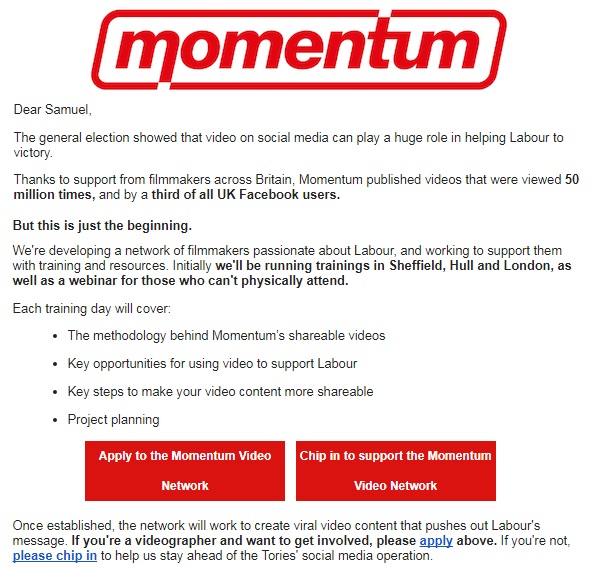
Look at this email, which pinged into the inboxes of Momentum members and supporters today.

The socialists are on manoeuvres. They haven’t wasted their summer sipping limoncello on the Amalfi Coast or plotting Oxford Union-style leadership coups with their Cabinet chums. No, having drawn blood from the Conservative Party and reduced the British prime minister to a laughing stock in the June general election, Momentum and other hard-left elements of the Labour Party sense that their long-awaited victory is nearly at hand. And they are training for the battle to come.

I wrote the other day about how the Conservative Party is fiddling while the country burns and Momentum creeps up behind them. This isn’t a laughing matter. Momentum are organising, deploying the latest in voter outreach strategies imported from the Bernie Sanders presidential campaign in America, and – shock, horror – daring to have conversations with traditionally Tory voters rather than engaging in fruitless navel-gazing introspection as the Conservative Party is currently doing.

Much was written during the election campaign about how much slicker and better financed the Tory online campaign was than its Labour counterpart. The Conservatives spent over £1 million on negative ads on Facebook alone. But it was not an effective campaign. It was soulless, clinical and relentlessly negative. All of which might have been forgivable if it had been properly targeted. But it wasn’t. Instead, CCHQ-produced messages designed to energise the existing Tory base were thrown relentlessly in the faces of swing voters, who did not respond to shrill warnings about Corbyn’s impending socialist takeover.

As with literally everything else about the Conservative Party, the online and voter outreach campaigns were hideously overcentralised and clearly managed by some of the same gormless nepotism beneficiaries who infested Theresa May’s pre-election Cabinet.

And still this might have been survivable if the Labour Party was as terminally dysfunctional as nearly every Westminster-based journalist was confidently reporting prior to the release of the exit poll. But it wasn’t, and still isn’t. Centrist doubters sat on much of their criticism for the duration of the campaign, and following the stronger-than-expected result came crawling meekly back to the leader they once openly undermined.

A vindicated Jeremy Corbyn is bolstered in his position. And the socialist hard-left of the Labour Party has benefited from this injection of confidence, immediately pivoting toward the next general election, where they believe they can dislodge this tired and pointless Tory government and turn the clock back to 1979.

I wrote the other day about how Momentum, Jeremy Corbyn’s praetorian guard, are holding group training sessions to teach their activists the latest in voter engagement techniques, with even doddery old folk less familiar with the latest technology being inducted into the organisation’s Slack group so that they can communicate in real-time on their smartphones. And now, today’s Momentum bulletin shows that the organisation also intends to revolutionise its social media campaign activities, potentially turning each of their members into a YouTuber capable of creating viral internet videos in support of the Labour Party.

Bear in mind: while the Tories vastly outspent Labour in the online campaign war, their dismal content failed to articulate any positive vision of conservatism and probably alienated half the people who viewed it. Meanwhile, Momentum’s videos were viewed 50 million times, and by a third of all the Facebook users in Britain. That level of penetration and engagement, on a shoestring budget, is incredible.

But you can’t just put it down to a superior grasp of online campaigning by the hard Left. People watched Momentum videos and kept coming back for more because they liked what they were seeing and hearing, or were at least open to the message. They did not respond warmly to the Conservatives, who engaged nearly exclusively in fearmongering and robotic negative messaging about their opponents, but many of them did respond to the side who took enough pride in their political values and had sufficient confidence and faith in those values to make a bold public case for More Socialism. And still Momentum is not satisfied. Still they seek to improve their messaging and hone their campaigning ability.

Meanwhile, what are we conservatives doing to retool ourselves to better fight the next general election? We are creating juvenile Jacob Rees-Mogg fanclubs on Facebook, engaging in pointless speculation about a cast of future leadership contenders all alike in blandness, and spending more time trying to ingratiate ourselves with the Tory party machine in constituency and at conference than figuring out what we should actually stand for, and how we can persuade others to stand with us.

Fellow conservatives, you need to wake up and hear this message while there is still time:

The hard, Corbynite Left are gunning for us. Hard.

Unlike conservatives, they have worked out exactly what their values are.

They are not ashamed of those values, and do not apologise for them.

They are hard at work translating those values into policy.

They are proud to proclaim those values and policies in messaging which appeals to the electorate, while we sound defensive and almost ashamed of our own policies and record.

They are convinced that they are on the right side of history, while we seem to have lost faith in the principles of free market capitalism and individual liberty.

They make an unashamedly moral case for their worldview while we seem content to sit at the back and pick holes in their sums, looking like soulless technocratic bean-counters.

They have a thriving youth movement. Ours was disbanded because of a bullying scandal, and because it was basically a giant Ponzi scheme with risible promises of future candidacies dangled in front of naive young activists.

Their activists dominate university campuses, their leftist dogma reigning supreme in the lecture hall and students’ union alike, while conservatives are an endangered minority who often face ostracisation or even official censure for speaking out.

They have a national party with strong and growing constituency branches, while we have a decaying national party with withering constituency branches, ruled from Westminster by proven mediocrities.

They have a party leader who can pack a 3000-seat theatre with excited and motivated activists, while we have a party leader who was too cowardly to even debate during the election campaign, and who is so robotic that she short-circuits if she goes out in the rain without an umbrella.

But here’s the good news – this is a fight that we can win.

Regressive leftist policies of redistribution and nationalisation have brought poverty and misery in their wake everywhere that they have been tried, while the free market that we support has lifted more people out of poverty, subsistence and despair than any other economic system devised by man. There is a reason that the Left has gone very quiet about Venezuela, once their favourite case study of socialism in action.

The traditional Left/Right political divide is being augmented (if not replaced) by the Anywheres vs Somewheres dichotomy (or “open vs closed”, to use the more patronising terms). The Labour Party is marching away from its working class base of Somewheres because their self-serving parliamentary caucus is in thrall to the self-entitled demands of other Anywheres like themselves. This gives us conservatives a huge opportunity to steal their votes – after all, we stand for country, community and patriotism, the very values that the metro-left openly despises.

But we will only win this fight if we get our heads out of the sand, stop manoeuvring for status or creating stupid memes on Facebook and learn instead to boldly and unapologetically articulate conservative principles in the public sphere, without apology. Not the craven, Labour-copying principles of Theresa May’s authoritarian government. Not the paternalistic statism of Nick Timothy and the Joseph Chamberlain afficionados. Rather, we need to re-embrace the timeless principles of individual liberty, patriotism, respect for institutions, strong national defence and flourishing civic society over paternalist statism, which always come through for us when we actually have the confidence to articulate them.

And we don’t have much time. In this unpredictable age, with no majority and a number of difficult things to push through Parliament, Theresa May’s government could conceivably be toppled at any moment. Momentum and the hard Left is ready for the fight. We are not.

To use a topical Game of Thrones analogy, when the White Walkers are massing and threatening to breach the wall, it’s no good squabbling over which lacklustre, uncharismatic Cabinet minister should next occupy the Iron Throne. Now is the time to find some ideological dragonglass and fashion it into a viable electoral weapon before we are swept away by the Army of the Socialist Undead and Britain succumbs to another long winter of discontent.

Momentum have given us fair warning. They are not being secretive about their strategy and tactics. So we conservatives will have only ourselves to blame if we find ourselves undone by them.


White Walkers - Game of Thrones

Support Semi-Partisan Politics with a one-time or recurring donation:

Agree with this article? Violently disagree? Scroll down to leave a comment.

Follow Semi-Partisan Politics on TwitterFacebook and Medium.

The Conservative Party Fiddles While Momentum Aggressively Courts Tory Voters

Jacob Rees-Mogg - Moggmentum - Conservative Party - Tory Leadership

Momentum and other leftist groups supportive of Jeremy Corbyn are using new tactics to aggressively court Tory voters. Meanwhile, lacking a compelling vision of its own, the rootless and enfeebled Conservative Party has no response

We may be in the depths of summer silly season, but it is rapidly becoming evident that the forces of the Left are using their time productively while complacent Conservatives sun themselves on generally undeserved vacations.

This week in particular there has been a flurry of activity from the Corbynite wing of the Labour Party, with Owen Jones launching a “decapitation strategy” targeted at vulnerable (and in some cases very high profile) Tory ministers and MPs defending greatly reduced majorities. At the same time, the grassroots campaign group Momentum is trialling new voter outreach tactics lifted from the Bernie Sanders campaign, aimed at getting dissatisfied voters unimpressed with the performance of Theresa May’s government to give socialism a second look.

Emma Bean at LabourList crows:

Owen Jones is joining forces with pro-Corbyn campaigning group Momentum in a push to seize the seats of several current and former Tory cabinet ministers.

The new Unseat campaign will target Boris Johnson, Amber Rudd, Justine Greening and Phillip Davies, all of whom saw their majorities slashed in the general election. Another MP, Stephen Crabb, who has been linked to an organisation which claims that homosexuality and bisexuality can be “cured”, will also face Momentum’s efforts on the doorstep.

The group seeks to create a series of “Portillo moments”, a reference to the unseating of the Tory defence secretary in the 1997 Labour landslide victory.

The Hastings seat of Rudd, the home secretary, was held by Labour as recently as 2010.

While Momentum are currently so swaggeringly confident in their shiny new US-style voter outreach strategy that they bragged about it to the New Statesman:

Momentum’s approach to canvassing, inspired by the Bernie Sanders campaign in the US, attempts to create a deeper engagement between the activists and the members of the public they are speaking to. The message at the training session was ambitious – even the staunchest Tory can be convinced to vote for Labour.

Momentum’s approach to canvassing, inspired by the Bernie Sanders campaign in the US, attempts to create a deeper engagement between the activists and the members of the public they are speaking to. The message at the training session was ambitious – even the staunchest Tory can be convinced to vote for Labour.

Canterbury’s swing to Labour this summer is a case in point. A previous Tory stronghold, the constituency swung to Labour by more than nine percentage points, and was won by Labour’s Rosie Duffield with 45 per cent of the vote.

One workshop attendee who canvassed in Canterbury believes this swing was because Momentum “went to every house” and that even those who seemed hostile to Momentum “still wanted to talk politics with them”.

After the result of the snap election, with Theresa May’s plans for Tory domination in tatters, Momentum announced plans to continue to campaign as though there was another snap election on the horizon. Activists and canvassers have descended on  Boris Johnson’s Uxbridge and South Ruislip seat as recently as three weeks after the snap election, supported by notable Labour party figures such as Sir Keir Starmer MP and Shadow Foreign Secretary Emily Thornberry. While May has clung onto power over the summer break, the continued political turbulence adds a sense of urgency to the training session.

Ambition. A sense of urgency. Most Conservatives have probably forgotten how those sensations feel. Apparently at the end of one Momentum activist training session in Euston, all of the attendees were added to a Slack group so that they could better coordinate through the instant messaging app – even the older Momentum members who were a bit dubious about technology. What we have here is a hard left socialist group given strategic rocket boosters through the accumulated lessons of the Howard Dean and Barack Obama campaigns.

Meanwhile, what do the Tories have to show for themselves? How has the party which carries the torch (or should that be the tree) for conservative politics been spending its downtime this summer?

One might have thought that having guided her party to such catastrophic near-defeat, Theresa May would be keen to make amends by cancelling any holiday plans and visibly knuckling down, devoting every spare moment to damage control, overseeing Brexit negotiations and coming up with a conservative strategy that doesn’t involve cross-dressing in Labour’s hand-me-down clothes.

But no – the prime minister has been off hiking in Italy, where the only headline she generated in the domestic press occurred when she led guests at her five-star hotel in a rousing rendition of the British national anthem.

Disaster is staring the Conservatives in the face, but they are either too busy sipping limoncello in Italy (the prime minister), plotting their pathetic and utterly indistinguishable future leadership bids (the MPs) or having Jacob Rees-Mogg’s face tattooed onto their left buttocks (the activists) to notice the peril. The shock general election result in June should have been a wake-up call, but instead the Tories have immediately lapsed back into complacency, apparently content to be in a minority government propped up by the DUP with Jeremy Corbyn’s hard-Left Labour Party breathing down their necks.

If British conservatism (and the UK’s political system) were healthy right now, as opposed to being on life support, then this summer would have seen a wellspring of new ideas bubbling up from all quarters – promising backbench MPs, radical think tanks, grassroots conservative movements unwilling to allow the captain who already crashed the ship once to continue to set the course. But conservatism, like our political system as a whole, is not healthy, and we have seen no such ideas, no such developments.

The Conservative Party still cannot decide what it wants to be. “But wait for the party conference!”, I hear you shout. Don’t get your hopes up. Do you really think that anything positive, anything remotely useful in the small government conservative mould is going to emerge out of the Tory autumn conference in Manchester? This conference will be devoted to two things: trying to shore up Theresa May’s failed premiership, and providing a platform for a lot of chest-thumping idiocy about Brexit. There will be no bold new vision for British conservatism in the 21st century because there are no bold new thinkers. There are barely any thinkers at all, and what few there are remain consigned to the backbenches (Kwasi Kwarteng, James Cleverly) while mediocrities continue to hog the limelight.

And what of the Conservative Party’s hopeless performance with the youth vote? Has any action been taken to learn the lessons from the 2016 general election, or counter-strategies developed to rebut Jeremy Corbyn’s ludicrous false promises? Does any action look likely to be taken?

Immediately after the general election disaster I wrote:

In some ways, Jeremy Corbyn seems like a most implausible politician to court the youth vote – an old, grey haired career politician with absolutely zero interest in doing anything fashionable, sartorially or politically. But my god, he is an authentic conviction politician. And if your average voter hates overgroomed, telegenic bland politico-bots then young people clearly hate them even more. Canned soundbites don’t work on social media-savvy young people, if they work on anyone. And yet the Conservatives went into battle – largely thanks to the “genius” Lynton Crosby – with an arsenal made up almost exclusively of glib, canned soundbites in place of anything remotely authentic.

Not that authenticity alone is enough. Right wing politics are clearly hugely toxic to many young people, who would sooner die than consider voting Conservative, let alone admitting any conservative leanings to their social circle. The Tories are too closely associated with grey, uninspiring “austerity”, even though austerity is largely a myth. The Tory brand, fair or unfair, is still toxic to many people. And the parties of the left have perfectly tapped into the consumerist politics of Me Me Me by promising to firehose endless sums of money into the gaping, insatiable mouth of Britain’s public services.

It seems painfully apparent to me that we need a prominent, national vessel for the development and promotion conservative policies (and personalities) separate from the Conservative Party, which simply can no longer be trusted to make the case for its own worldview.

And as I emphasised in another piece, the same point applies to policy:

Theresa May’s team seemingly forgot that people don’t become more conservative as they get older automatically or without some prompting, and that if the Tories continually screw somebody over through their formative years, young adulthood and early middle age then they won’t magically become Tory voters when they get their first grey hair. People become more conservative as they get older because historically, sensible government policy has allowed them to become greater and greater stakeholders in society, largely through property and equity ownership. Cut off millions of young people from this ladder to prosperity and security, and the conveyor belt which gradually moves people from political Left to Right as they age will come grinding to a halt.

And on strategy:

We particularly need to work closely with conservative organisations in the United States, which face a similar uphill struggle in overcoming a historic disinterest in the youth vote but which are now starting to have some success, generated in part by their opposition to the illiberal Cult of Social Justice and Identity Politics sweeping American university campuses, with its disregard for freedom of speech and toxic obsession with the politics of victimhood.

We should be sharing best practice back and forth with American conservative organisations as to how to build strong redoubts for conservatism in overwhelmingly leftist places, so that conservatism isn’t washed away altogether. Frankly, British conservatism is in such a parlous state that we need their help. And then, once things have stabilised, we can look to reclaim some of the ground we have lost among young voters.

It looks like Momentum and the Left took this idea and ran with it, and are already benefiting from adopting their new strategy. What a pity that the message has been so roundly ignored by its actual intended audience.

Conservatism decline and a slide toward irrelevance is not inevitable, but preventing it will take hard work and a capacity for self-criticism. We all dropped the ball in 2016; we all need to do better. But it is no good pushing harder in precisely the same direction, or shouting the same slogans even louder than before. “Strong and stable” doesn’t work when much of the population is dissatisfied and wants change. And at a time when many voters responded warmly to Jeremy Corbyn’s conviction politics of the Left, confounding all expectations, the Conservatives must regrow some convictions of their own.

Yet a plurality of Tories either don’t care about the crisis we face, or are simply deny its existence. They think that slapping a new coat of paint on the same rusty old banger will convince voters already tiring of seven years of Conservative government that they are buying a shiny new Tesla rather than a wobbly old Reliant Robbin. They bizarrely think that Moggmentum is the cure, or simply sticking with a failed prime minister who should never have ascended to the top job in the first place.

No, no, no. The Conservative Party needs to stop squabbling about personalities and which interchangeable Cabinet nonentity is best placed to succeed Theresa May, and decide what it actually stands for. And any conservative groups, think tanks and private individuals with an ounce of vision and charisma need to step up and push the party in the right direction, just as John Hoskyns and Norman Strauss did with their Stepping Stones Report in 1977, planting the seed of the Thatcherite recovery.

The Tories cannot make an informed decision about who should be their next leader without first deciding what kind of party they want to be – a limp and apologetic outfit which grovels and apologises for its limited principles, trying to make itself look as much like the Labour Party as possible, or a virile and ambitious party with transformative instincts, belief in individual liberty and the zeal to roll back the administrative state.

The Conservative Party conference opens in Manchester on Sunday 1st October. And rather than painting a false picture of unity, let’s actually have it out once and for all. And if a few unremarkable political careers end up getting caught up in the crossfire, so much the better. We need to clean house in terms of leadership, but more importantly in terms of ideology and basic principles.

At present, Theresa May and her rootless Tories are effectively in office but not in power. And if they do not take swift and dramatic action in the face of a resurgent leftist movement, the office could also slip away, sooner than they think.


Conservative Party Logo - Torch Liberty - Tree

Momentum Logo - Labour Party - Jeremy Corbyn

Support Semi-Partisan Politics with a one-time or recurring donation:

Agree with this article? Violently disagree? Scroll down to leave a comment.

Follow Semi-Partisan Politics on TwitterFacebook and Medium.

‘Compassionate Conservatism’ Plays Into The Left’s Hands

If any more evidence were needed (and at this point it really shouldn’t be) that embracing “compassionate conservatism” is not the answer to the Tories’ problems, then a new piece by Abi Wilkinson mocking their efforts at rebranding should make things clear.

Wilkinson writes in Total Politics:

Since the recent general election, there has been a noticeable upswing in the number of Conservatives fretting about inequality, material hardship and issues with the current economic system.

[..] At some level, it’s gratifying to see an increased willingness amongst right-wingers to admit that things are not currently alright. On the other hand, it’s hard not to be frustrated that these conversations are only happening now – when the left is in resurgence and appears a viable political force. If they’re capable of seeing these issues, why didn’t they say something sooner? Why have they been happy to cheerlead governments that have overseen massive increases in homelessness and child poverty, underfunding of public services, the erosion of employment rights and growing income inequality?

The biggest issue with this sudden surge of compassionate conservatism, however, is the failure to identify real solutions to the stated problems.

The moment that conservatives start waffling on about compassion is the moment that we start fighting on Labour’s terrain and lose the war. The parties of the Left have already convinced a huge swathe of the electorate that compassionate conservatism is an oxymoron:

https://twitter.com/sestos007/status/896261761267097600

Any time that conservatives try to frame their pitch to the electorate in terms of compassion or any of the other paternalistic buzzwords used by the Left, voters will simply ask why they should pick the Tories when Labour is offering the full-fat version of socialism.

If anything, conservatives should attack the Left’s lazy, self-serving definition of compassion, which largely consists of assuming that half the population belongs to a perpetual victim class in need of constant nourishment, assistance and succour from the state; that parking people on welfare and forgetting about them is somehow a sign of love and solidarity; that tearing down the wealthy through punitive taxation will do anything to improve the material circumstances of the poor; that interfering with free markets, the greatest engine of wealth creation available, will somehow protect consumers.

The term “virtue-signalling” is becoming quite overused (not least on this blog), but it really does apply to much left-wing policy-making, where what matters most is to be seen to be taking action against some social injustice or inequity rather than coming up with sustainable policies to attack those problems in the long-term. We need to start making this point more forcefully, pointing out that it is in fact evil to do what feels good and conscience-soothing today if it only perpetuates or exacerbates a problem further down the road (see the Left’s sanctimonious outrage when it was proposed that migrant boats heading to Europe be stopped and sent back – by thwarting this policy, hundreds if not thousands more people have drowned, just so that leftists could look compassionate on Twitter).

For too long, conservatives have been content to portray themselves as rational and dispassionate administrators of the machinery of state, making difficult but necessary decisions in the name of fiscal rectitude (not that this rhetoric ever carried through into action – see the persistent budget deficit and rising national debt). And in so doing, the Right has repeatedly ceded the language of morality, of right and wrong, to the parties of the Left, who are only too happy to run with it and paint themselves as having a monopoly on virtue.

This approach won’t cut it any more. To halt the advance of Jeremy Corbyn, a party leader who actually has principles (however misguided and odious some of them may be) and the courage to defend his beliefs in public, conservatives need to start talking in the same self-assured language of right and wrong. Pointing out the unworkability of socialist policies is insufficient – we need to make the moral case for why cranking up the size of the state and making more people dependent on the government is bad for everybody. We need to become more comfortable speaking in the language of good vs evil – which people understand and respond to – rather than the dry, technical language of financial feasibility.

But more than anything, we conservatives must stop apologising for our belief in smaller government and individual liberty. Our stance should not be that Jeremy Corbyn’s hard left policies would be wonderful if only the magic money tree actually existed. Rather, we should make the case that even if we could afford to implement the Labour manifesto it would have negative impacts on incentives to work, invest and be self-reliant. We have to fight fire with fire.

That’s not to say that the conservatives should not come up with compelling policies to offset the negative consequences of globalisation and automation, some of the most pressing medium term issues we face – of course we should. But we should also explain that the Left’s perpetual fallback of waving their magic wand and creating an expensive new government programme to solve every issue is the wrong way to go – that if we are actually to bind ourselves more closely together as a nation we need to reinvigorate civil society rather than continually undermining it with big government.

Will it be difficult to change our messaging? Absolutely. But as Theresa May can attest, our current method of engaging the electorate isn’t exactly delivering great returns (yes, you can argue that the Tories received their highest vote share in many years, but this doesn’t really matter when conservatives are effectively fighting against a coalition of all the parties of the Left and can’t muster a Commons majority on 42% of the vote).

Chasing after the Labour Party on a race to the Left will not work. If voters want socialism, they’ll choose the real thing. And waffling on about compassionate conservatism will only evoke scorn from commentators like Abi Wilkinson, and provide an easy opening for the Left to virtue-signal all over again.

If the Tories want to actually be in power rather than merely in office, a new approach is required. One which involves more courage and less appeasement.


My longer essay on why embracing compassionate conservatism will not make the Tories more popular is here.


Conservative Party Logo - Torch Liberty - Tree

Support Semi-Partisan Politics with a one-time or recurring donation:

Agree with this article? Violently disagree? Scroll down to leave a comment.

Follow Semi-Partisan Politics on TwitterFacebook and Medium.

Calls For A 100% Inheritance Tax Reveal The Far Left’s Evil Heart

Abi Wilkinson - 100 percent inheritance tax

Renewed calls by leftists for a 100% inheritance tax force us to have the argument all over again – does the state exist to serve us, or do we exist to serve the state?

I’m sure that many others have already published their own incredulous reactions, but I cannot let my return to blogging commence without comment on Abi Wilkinson’s “brave” idea (filed under the Guardian’s “Utopian Thinking” category) for a 100 percent inheritance tax, levied in order to fund Our Precious Public Services.

In case you haven’t already encountered it, Saint Wilkinson appreciates our public services so much, and cares about the downtrodden in society just so darn much, that she thinks that a 100 percent confiscatory raid on assets upon every person’s death is both meritorious and desirable as a tribute to the all-powerful state, as well as being totally economically feasible.

The article reads like an earnest sixth-form essay, untainted by familiarity with much political theory and penned by somebody who sincerely believes that they are making this proposition for the very first time, and that it is therefore deserving of serious consideration and public debate.

Of course, the complete opposite is true – people have loudly clamoured for the expropriation of wealth from the dead and the living for centuries, with the idea of a 100% inheritance tax proving sufficiently odious that it is not enforced in any successful advanced economy.

Nevertheless, Wilkinson boldly writes:

The idea that we should be able to pass on our life’s accumulated wealth to descendants is deeply embedded. It appeals to the fundamental biological urge to protect your offspring and propagate your genes. Though only a small minority of estates are subject to inheritance tax in Britain as it currently stands, opinion polls consistently find that the majority of people oppose it. Instinct seems to override common sense. VAT falls disproportionately on people with low incomes, but it’s far less hated.

Understandable sensitivity around issues relating to death make it difficult to discuss, but it’s time this conventional wisdom was held up to proper scrutiny. Yes, the desire to pass on property to your descendants may be natural – but why should we be slaves to our biology? Social progress has frequently depended on our ability to transcend individualistic urges and work together for the common good.

A leftist may well ask why we should be slaves to biology (at least now that most of them have stopped promoting eugenics). Half the time prominent voices on the left can be found deliberately trying to negate, undermine or deny basic biology across a whole host of areas, because feelings and virtue-signalling must now trump science (which, after all, is very oppressive).

And as for “instinct overrid[ing] common sense”, it is far more likely that most people, being more perceptive than Abi Wilkinson, can perceive the ruinous implications of implementing a 100 percent inheritance tax policy – not least a vast and unprecedented brain drain of wealth and talent from this country, together with hugely adverse incentives for those who remain behind. Would I vote for a policy which benefited me by stealing from my neighbour, while also knowing that the same policy would lead to the ruin of the country? Unsurprisingly, probably not.

Wilkinson continues:

Some may argue that leaving inheritance is a moral right. It’s not about whether the recipients deserve or need it, nor whether having the ability to do so results in productivity gains. The point is that the deceased earned that money and it should be up to them where it goes.

This is where it gets a little murky. We tend to honour the wishes of the dead – at least to some extent. Those of us who are religious may believe their souls live on and they can witness what’s happening. Even committed atheists recognise the value of respect in this context, even if their primary concern is the emotional impact on those left behind. If someone wanted a certain sort of funeral, for example, it seems right to try and fulfil that. But what if the desires of the dead directly damage the wellbeing of the living? Is there any situation in which the previous instructions of someone no longer actually present in the mortal realm should be prioritised over the needs, interests and opinions of those who are still alive and kicking?

How gracious that we are still to be allowed funerals and other religious rites in Abi Wilkinson’s brave new world. Perhaps we should be grateful for this small dispensation and humbly surrender our accumulated life’s work on our deathbeds without any further complaint.

More:

In the UK, official statistics suggest around £77bn is passed on in inheritance each year (tax avoidance means the real amount could be even higher). That’s money that no living being has a moral claim to, according to standard justifications of wealth inequality and private property. Were that money redistributed by the state, it would cover the cost of adult social care several times over. It could plug gaps in NHS, education and police funding. It could provide the kind of comprehensive welfare state that meant nobody had to worry about their family after they passed away – because there would always be a safety net.

Cultural norms teach us that the inheritance of private property is the default and any expropriation of this wealth must be justified. It should be the other way round. There’s some value in respecting the wishes of the dead, yes, but why is that more important than social housing, healthcare or any number of other possible uses for the money? It’s natural to want to protect and care for your family, but what about people who don’t stand to inherit a penny? Is there any reason their needs should matter less? We have to fund our state somehow – what makes inheritance tax more objectionable than income tax or VAT charged on essential consumer goods?

And what when that £77bn is spent in Year 1 of this nightmare programme, and Britain’s public services come back ravenous for more in Year 2, when the brain drain and disincentives to save or invest reduce next year’s haul by over half? What about Year 3, when the biological urge to defer gratification, save and build for subsequent generations is overridden by benevolent leftist policy, and the tax revenue is even smaller? What about Year 5, when Our Blessed NHS is still in perpetual crisis but inheritance tax revenues now bring in less money than would be required to power a street light?

The perpetual problem with the Left is that they insist on working against, rather than with, human nature. Market capitalism remains by far the best way of allocating scarce resources for the good of the most people because rather than going against the grain of embedded human instinct it works with that instinct, incentivising people to provide value in return for other needed items of value.

But the Left cannot accept this, because inequality. Never mind that this inequality is often less than they contend, and that any inequality takes place in the context of rising living standards for all – no, this is not enough. A functioning system and a great engine of prosperity must be sabotaged and brought down because it does not conform with certain Utopian political theories – theories which Abi Wilkinson might do well to better acquaint herself.

But more than all of this, the great question which not only Abi Wilkinson but the entire Corbynite, Utopian Left must answer is this: does the state exist to serve us, or do we exist to serve the state? Are we entitled to the product of our own labour with the state performing certain acts and services by our permission, or does the state ultimately have a claim to everything that we are, everything that we create and everything that we do, in life and in death?

Of course, we already know the answer to that question. The answer shines through brightly with every weepy new article about how we the people are failing “Our NHS” by not protecting it from the Evil Tories and by failing to firehose sufficient taxpayer money into its gawping, insatiable mouth. The answer shines through with every inane tweet misquoting Aneurin Bevan about how the NHS will continue to exist “as long as there’s folk with faith left to fight for it”, and with every false assertion that cutting taxes is somehow “giving money away” to the wealthy.

In short, it simply could not be more clear that the ideologues within the Corbynite Labour Party – as well as the journalists and commentators who support them – believe that we exist at the pleasure of the state, to serve the state. Sure, they might not put it quite like that. Instead, they waffle on endlessly about society and community, or piously lecture the rest of us on our responsibilities to one another – responsibilities which human beings are perfectly capable of managing through individual charity and civic society, but which the Left insist on funnelling through the state.

And if you are of this mindset, then why indeed not propose a 100% inheritance tax on everybody (save a few “objects of sentimental value” as graciously conceded by Wilkinson)? Abi Wilkinson presumably believes that she too is just a small cog in the machine of the British state; that if it were deemed to be better for society that she stacked shelves in a Tesco distribution centre rather than writing socialist twaddle for a living she would gladly switch occupations in a heartbeat, before giving up her meagre possessions to the taxman upon her deathbed. And she is fully entitled to believe in a totalitarian, dystopian state where the mere words “for the good of society” can be used to compel us to do anything.

But know, when these cherub-faced young socialists get on their soapboxes, eyes aflame with passion and fervour, what they really mean when they talk about “the good of society”. Know the warped moral framework through which these left-wing, self-appointed Defenders of our Public Services see the world – the individual utterly subordinate to the state in every way that counts, save a few highly revocable “rights” given as a distraction.

Because this same black-hearted evil informs nearly every policy that the Corbynite Left proposes, including many which are far more likely to come to pass than Abi Wilkinson’s totally original 100% inheritance tax brainwave.


Inheritance tax

Support Semi-Partisan Politics with a one-time or recurring donation:

Agree with this article? Violently disagree? Scroll down to leave a comment.

Follow Semi-Partisan Politics on TwitterFacebook and Medium.