Want to change religion? Then you’d better get permission from a judge first, if you happen to be under the age of eighteen and your parents can’t don’t give you their blessing.
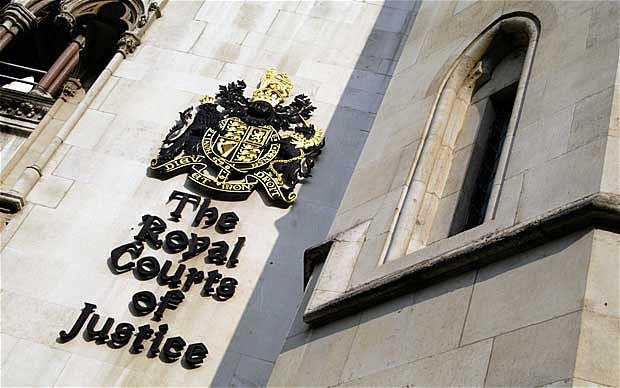
That is apparently the law of the land in Britain today, or at least the precedent set by a recent ruling in which a a County Court judge ruled that a ten-year-old girl would be allowed to follow her wish to convert from Judaism to Christianity and be baptised, denying a request from the girl’s mother to grant an injunction forbidding the father from allowing her to proceed.
The court heard that the girl, who cannot be named for legal reasons, was born in late 2001 to Jewish parents and grandparents. But her mother and father divorced in 2010 and she, and her younger brother, now live for a week at a time with each under a shared parenting agreement.
Her father converted to Christianity after the breakdown of his marriage.
In November the girl’s mother, without telling anyone, applied for a court order forbidding the father from baptising or confirming her into the Christian faith. The judge heard evidence before deciding how to respond to the application.
I happen to think that the judge in this case ruled very wisely and sensitively on the case – you can read the full decision here. He also wrote and made public a letter to the girl in question, explaining his decision. I believe that he did a good job in a difficult situation.
But to my mind, this isn’t the type of matter that should ever come up for judicial review at all, or be subject to the whims of a random judge. Family law is a complicated area in which I have absolutely no expertise, but the crucial principle at hand in this case is liberty. There mere fact that the mother and father of this girl were arguing in court about the worthiness of an injunction preventing a person from changing their religion is highly inappropriate.
Religion and faith are matters of personal conviction and are private to that individual. No conceivable harm could befall this girl as a result of converting from one religion to another, and therefore this matter should be well beyond the remit of what a court injunction can be used for. The girl, and she alone, should be free to believe whatever she wants to believe, and to be received into the faith of her choosing in a manner consistent with their customary rites and practices. There is no welfare issue at stake for the child – indeed, the only conceivable harm that could occur would be to the hurt feelings of one or other parent.
In this case, the girl’s freedom of thought and speech were ultimately protected by an empathetic and restrained judge. However, a future court might rule differently, and issue an edict forbidding the person concerned from following their own will and their beliefs. In order to preserve freedom for the individual, and religious liberty, it must be made clear to the courts that they have no business arbitrating parental disputes such as this, or making religious choices for any British citizen.
Whether this is done through bespoke legislation, or my preferred route of a full-scale UK constitutional convention to once and for all settle the limits of crown, government and judicial power, rests – depressingly – in the hands of those who hold power today.
I would hope that they will see this case as a warning sign, and take meaningful action in defence of liberty.
In an interesting piece from Slate Magazine, Hanna Rosin delves into the deeper meaning behind the fact that the men strived to protect the women as the horror of the Aurora Colorado shooting unfolded. In an interesting and poignant article, noting the various ways that traditional “manhood” is being eroded by economic and social forces, she concludes: “Throwing your body in front of your girlfriend when people all around you are getting shot is an instinct that’s basic, and deeper. It’s the same reason these Batman and Spider-Man franchises endure: Because whatever else is fading away, women still seem to want their superhero, and men still seem to want to be him.”
Through the prism of astronaut Buzz Aldrin’s memoirs and a recent Soyuz rocket launch, Atlantic magazine takes an interesting look at the intertwining of human spaceflight endeavours (perhaps the pinnacle of our scientific accomplishment) with religion and the sacred world. As well as the obvious example of Aldrin taking communion while on the surface of the moon, the author also considers other examples: “here is a priest, outfitted in the finery of a centuries-old church, shaking holy water over the engines, invoking God’s protection for a journey to near-earth orbit. That these two spheres of human creation co-exist is remarkable. That they interact, space agencies courting the sanction of Russian Orthodox Christianity, is strange”. A long article, but well worth a read.
Mike Huckabee thinks that Chick-fil-A’s decision to come out in opposition to gay marriage equality is just super, and is proposing that Americans make this Wednesday “Chick-fil-A Appreciation Day” in recognition of their “principled” (some might say irrelevant, because a corporation is harmed by gay marriage even less than a heterosexual human being) stance.
NPR reports in depth on the Vatican’s decision to send a crack team of Bishops to oversee the Leadership Conference of Women Religious – an organisation representing the majority of nuns in the United States – due to concerns that they are promoting “radical feminist themes incompatible with the Catholic faith”. Sister Pat Farrell, whose interview forms the basis of this article, sees things rather differently, and while she says that the LCWR will do its utmost to engage with the Vatican in good faith, there may be some elements of the mandate with which they cannot comply. Money quote from Sister Pat: “The question is, ‘Can you be Catholic and have a questioning mind?’ That’s what we’re asking … I think one of our deepest hopes is that in the way we manage the balancing beam in the position we’re in, if we can make any headways in helping to create a safe and respectful environment where church leaders along with rank-and-file members can raise questions openly and search for truth freely, with very complex and swiftly changing issues in our day, that would be our hope. But the climate is not there. And this mandate coming from the Congregation of the Doctrine of the Faith putting us in a position of being under the control of certain bishops, that is not a dialogue. If anything, it appears to be shutting down dialogue.”
A British couple holidaying in British Columbia caught a big fish. A really, really big fish. A really, really, really really big fish. The creature weighs nearly half a metric tonne, is 4 metres long and is estimated to be at least 100 years old. Makes for some good bragging rights back at the local pub when they go home…
BRITISH POLITICS
Minister of the Bleeding Obvious states the bleeding obvious in this story from The Telegraph. Treasury minister David Gauke informs us that it is “morally wrong” to pay tradesmen (plumbers, builders, electricians etc.) with cash in hand, as this makes it easier for them to evade VAT or income tax. Aside from the fact that every cabinet member from Cameron on downwards needs to quit the moral preaching (why can’t you just say “illegal” or “wrong”?), his basic point is right. Until he goes on to say: “Getting a discount with your plumber by paying cash in hand is something that is a big cost to the Revenue and means others have to pay more in tax”. Seriously, Mr. Gauke? You expect us to believe that the black economy makes our taxes higher? You would tax us just as much as you already do even if you could get your hands on this missing slice of revenue, you would just find new ways to fritter it away on pointless, undeserving goals. So let’s not pretend that the cash-in-hand job that your local plumber does on the sly is the one thing standing between us and an actual competitive tax code. You must think we’re all really dumb.
The Commons Culture Committee has reported that they believe the UK’s current gambling laws are outdated and have not kept pace sufficiently with technological innovations such as online gaming. Overall, this appears to be a liberalisation of the market, which is good news. However, the proposed bill has been somewhat watered down in an attempt to assuage the concerns of detractors who worry about potential negative externalities.
It’s starting to get real. The BBC reports that the Crown Prosecution Service has decided to charge eight individuals with a total of 19 charges relating to the “phone hacking scandal”. Included in those facing charges are Rebekah Brooks and Andy Coulson. So now the Long-Winded Leveson will not be the only thing keeping this dull story in the news. Hooray.
AMERICAN POLITICS
Inspired by the movie “Legally Blonde”, 22-year-old US State Senate candidate Mindy Meyer has blinged up her website with a lot of bright pink, bad MIDI sound files and other bells and whistles. If you ever wanted to know what you would get if you crossed a political website with MySpace at the peak of its popularity, here is your answer. She would clearly make a great state senator, because according to her homepage, she is against corruption. Says Meyer: “This is how politics has to change. There is always corruption, but I have the intention to follow my values and ensure that none of what happens in my district is corrupt.” Well, that’s sorted, then.
Commentary magazine takes a hatchet to President Obama’s reputation for being a brilliant orator. Alana Goodman calls Obama out for his recent speech in Roanoke, Virginia, not because of his “you didn’t make that” line but for dull, flat words and delivery when he goes off the autocue. She takes the line where Obama says “There are some things, just like fighting fires, we don’t do on our own. I mean, imagine if everybody had their own fire service. That would be a hard way to organize fighting fires” as a particularly egregious example of pedestrian speech-giving. She concludes: “For the past four years, liberals have tried to sell us on the idea that Obama is one of the greatest speakers of all time. Now they’re complaining that conservatives are taking his words literally and not cutting him enough slack. Which one is it?”.
In an excellent, frank op-ed in the New York Times, David Blankenhorn charts his evolution from opposing to supporting the idea of gay marriage. Though disappointed that society no longer thinks of marriage primarily in terms of providing the optimal environment in which to raise children, but instead as an official sanctioning of private relationships, he concedes that given this is how marriage is now viewed by most, the best thing to do is to try to strengthen the institution under its new definition, by welcoming committed gay and lesbian couples into the fold. He eventually comes to the conclusion: “So my intention is to try something new. Instead of fighting gay marriage, I’d like to help build new coalitions bringing together gays who want to strengthen marriage with straight people who want to do the same”.
A good long-form article from The Daily Beast explaining some of the underlying factors and influences behind the GOP’s sinister anti-Muslim hysteria. I thought I had heard pretty much everything when it comes to crazy quotes uttered by Republican lawmakers and “intellectuals” on this topic, but this article introduced me to a few more sad examples.
This morning I came across a thought-provoking piece by Mehdi Hassan, now of Huffington Post but writing here in The Guardian, about the rising tide of Islamophobia in British political commentary, and what he considers to be the insidious attempt to smear or question the pro-western credentials of all moderate Muslims in public life so as to create the impression that there are no moderate Muslims to be found.
Hasan speaks in candid terms about the effect that the ignorant, baseless abuse which he has received in response to his work at the New Statesman magazine has had, both on himself and his family:
To say that I find the relentlessly hostile coverage of Islam, coupled with the personal abuse that I receive online, depressing is an understatement. There have been times – for instance, when I found my wife curled up on our couch, in tears, after having discovered some of the more monstrous and threatening comments on my New Statesman blog – when I’ve wondered whether it’s all worth it. Perhaps, a voice at the back of my head suggests, I should throw in the towel and go find a less threatening, more civilised line of work. But that’s what the trolls want. To silence Muslims; to deny a voice to a voiceless community.
And the money passage, summing up the aggregate effect of this abuse, and the fact that too few commentators in the mainstream media are willing to take a stand and denounce it when they witness sloppy or prejudicial reporting of Muslim life or the rise of radical Islam written in their own publications:
The truth is that the fear-mongering and negative stereotyping is out of control. I’ve lost count of the number of websites that try to “out” every Muslim in public life as an extremist or Islamist of some shape or form. The promotion of Sayeeda Warsi to the Conservative frontbench in 2007 provoked the influential ConservativeHome website to describe her appointment as “the wrong signal at a time when Britain is fighting a global war against Islamic terrorism and extremism”. Labour’s Sadiq Khan, the shadow justice secretary, was accused of holding “extremist” views after he called for a “more independent foreign policy” and was spuriously linked to Hizb ut-Tahrir. In April, Labour peer Lord Ahmed was suspended from the party after he was falsely accused of having put a £10m bounty on Barack Obama’s head (the suspension has since been lifted).
If Muslims such as Warsi, Khan, Ahmed and me are all secret extremists, who are the moderates? That, of course, seems to be the implicit, insidious message: there aren’t any. But if those of us who try to participate in public life and contribute to political debate are constantly painted with a broad brush of suspicion and distrust, then what hope is there for the thousands of young British Muslims who feel alienated and marginalised from the political process? I used to encourage Muslim students to get involved in the media or in politics, but I now find it much harder to do so. Why would I want anyone else to go through what I’ve gone through? Believe me, Muslims aren’t endowed thicker skins than non-Muslims.
The targeting of ConservativeHome here is a little unfair; I followed the link and the quote about the “wrong signal” refers to a press statement by the pathetically-named “Margaret Thatcher Center [sic – yes, American] for Freedom” at the Heritage Foundation, not the most intellectually robust of groups these days and certainly not representative of ConservativeHome editorial positions or the views of their readership (though I concede that there is likely to be a degree of overlap in this case).
But Hasan’s broader point is valid – if even those Muslims in British public life who have impeccable records of patriotism and public service have their motives and allegiances called into question, this most certainly does feed the perception that there is no such thing as moderation within the Muslim community, a situation that no one interested in reasoned, free debate should allow to stand.
The only area where I would take issue with Hasan is where he states:
I’m a fan of robust debate and I’m not averse to engaging in the odd ad hominem attack myself. This isn’t a case of special pleading, on behalf of Britain’s Muslims, nor do I think my Islamic beliefs should be exempt from public criticism. But the fact is that you can now say things about Muslims, in polite society and even among card-carrying liberal lefties, that you cannot say about any other group or minority. Am I expected to shrug this off?
Are Muslims getting a rough deal at the moment, and is it shameful and wrong and concerning? Absolutely. But are they the only group? Hardly. Has no one reading this moaned about gypsies lately, or perhaps laughed at a “pikey” joke?
Let’s take a stand when we hear untruths being spoken about moderate Islam, Muslim public servants or commentators. But let us also apply this same standard to every community; trying to silence people with threats, or drumming them out public office based on false evidence or highly selective interpretation of their past statements is not a route that we should be going down.
Ah, who am I kidding? Alabama has always been on the list. But stories like this don’t give me much hope that it will be coming off the list of pariah states any time soon. Apparently, now, a “Christian” organisation known as Christian Identity Ministries is planning to hold a three-day, whites-only conference in Lamar County, AL.
A three-day whites-only religious conference — which will conclude with a flaming cross — in Lamar County, Alabama, has some residents upset at the racist implications while the minister complains that his freedom of speech is being violated.
The church espouses the belief that “The Anglo-Saxon-Keltic-Germanic-Scandinavian People are Israel”, which interestingly would seem to exclude the Israelites themselves, not to mention a certain rather crucial person called Jesus, and though the group insists that they harbour no ill-will or prejudicial thoughts against God’s darker-skinned outcasts, they explain their whites-only policy to the local CBS News affiliate on these grounds:
“We don’t have the facilities to accommodate other races and we have nothing not one bit of animosity no racism whatsoever,” said Pastor William J. Collier, Christian Identity Ministries.
I can sympathise. Who among us has not tried to organise a party or social event, and been forced to cancel it because we were simply unable to accommodate the people of diverse races who wanted to attend? I’m sure fried chicken and watermelon are hard to come by in Lamar County, so the poor black folk would have nothing to eat, and that just wouldn’t be fair to them. And with a busy conference agenda to get through there would be no time for breaks or siestas, so how would our Mexican and latino friends cope? We’re all just so darned different, it makes organising any kind of large integrated gathering impossible. Isn’t it just far better that we all remain separate? But equal, of course.
The event will culminate with a “Sacred Christian Cross Lighting Ceremony”, which Christian Identity Ministries insists is a symbolic rite of purification, but which the rest of the world knows as a Ku Klux Klan ritual of intimidation toward black people.
Local CBS News interviewed the president of the local chapter of the NAACP, who with great understatement said this of the planned cross-burning:
“The only context that I’m familiar with is one that is not very positive. And one that really symbolizes an era that many of us have hoped to put behind us. And that is this whole era of Jim Crow, this whole era of white supremacy, this whole era of discrimination and racial hatred.”
“I think it’s really hard to clarify what’s going on, but it seems to be some vestiges of what we call white supremacy here in Alabama. We just have to be honest about it.”
Yes, perhaps just a couple of small vestiges of white supremacy remaining there in Lamar County. Way to go, Alabama.
As I was browsing The Spectator website earlier today, I noticed a link to a piece from their archives, an article written to mark the consecration of the newly built Coventry Cathedral on 25 May 1962, half a century ago:
Coventry Cathedral was a temporary spiritual home for me during my time studying at nearby Warwick University, particularly during my second year when the university forced us into off-campus housing in the city. Though I converted to Roman Catholicism at the age of eighteen, I quickly grew to love the Anglican service of Choral Evensong, which I would sometimes attend first at my college in Cambridge and later while studying at Warwick. Though these periods were not anything approaching a high water mark in my ebbing and flowing faith, I do have very fond memories of attending Choral Evensong in these places, and feeling closer to God when I did so.
Coventry Cathedral is a particularly inspiring place. You can walk from the still, quiet, grey remains of the old Cathedral (largely destroyed during the Coventry Blitz on 14th November 1940) to the beautifully designed and lit tranquility of the new building, and the feeling when doing so is quite remarkable.
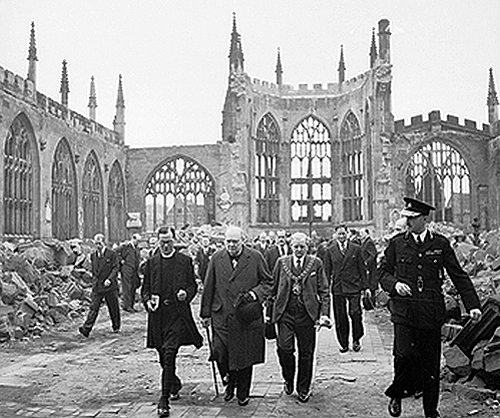
Prime Minister Churchill views the remains of the old Cathedral
The thoughts of the Spectator’s reviewer are worth quoting at some length:
As I stood just inside the glazed ‘west’ wall of Coventry Cathedral, beneath John Hutton’s gaily engraved angels — running, jumping and standing still — I was stunned by the richness of John Piper’s baptistery window, the absolute rightness of the Sutherland tapestry which fills the whole wall behind the altar and the simplicity and serenity of the ‘great barn’ itself — Sir Basil Spence’s own words — in which, from the main entrance, they are the only immediately visible works of art.
It would have been shattering enough simply to see the live version of the building I had admired in models and drawings for several years; it was much more disturbing to hear it. Just by chance, as I approached the cathedral it had been completed — by being filled with music. I cannot remember a more moving experience. With my hand still on one of the tiny bronze door knobs, sculpted as a child’s head by Epstein, I was hit simultaneously by shapes, colours and sounds — the fourteen slender pillars of reinforced concrete which suspend the timber- and-concrete vaulted canopy beneath the roof; the perpetual sunshine that bursts from the centre of deeper colours in the eighty-four-foot-high Piper window, and the familiar hymn tune which reached me — as I reminded myself in an effort to keep emotion in its place — by courtesy of Mr. David Lepine (performing with four manuals and seventy-three speaking stops) aided by acoustic slabs of cork and Weyroc, placed high above the vaulting, and the sound-absorbent surfaces of Sutherland’s Christ in Glory.
I half hoped that by turning my mind towards technical achievements of this kind I would suppress the urge to go away without having the impertinence to write a single word of adverse criticism about the cathedral. So I tore my thoughts away from the simple beauty of the font (a scooped-out boulder from the Holy Land) and Ralph Beyer’s superbly carved lettering on the white stone panels that flank the nave, and tried very hard to see the cathedral as an elegant box of functional tricks. But I had to give in. This is a great and humbling building — a building in which trivial criticisms merely make the critic himself feel trivial. Of course it is a box of functional tricks; but every trick is inspired and designed to help the real user of the building. This is a machine for Worshipping in — a cathedral built round the Communion service.
The ruins of the old Cathedral seamlessly morph into the new building designed by Sir Basil Spence
I like that phrase, “a machine for worshipping in”. I find that it describes very well the utility and efficiency of the building and its contents, as well as the streamlined, modern beauty of the furnishings and commissioned artworks. To my (very) amateur architecture enthusiast mind, Spence’s design epitomises the very best of mid-century architecture. Given the era in which it was commissioned, designed and built, the new cathedral could so easily have been a drab grey brutalist building (not that I object to all of those, but more on that in another blog post), one of many that were being enthusiastically erected up and down the country.
Light streams in through the stained glass of the baptistry window
I will always remember one occasion, one of the first times that I attended evensong at Coventry cathedral. Attendance was particularly light that particular Sunday evening, so one of the Deacons beckoned me from my normal seat in the Nave to sit in the row of seats behind the choir on the raised platform at the front of the church as they sometimes did when there were few attendees. Once I had been guided to my new, front-seat location, however, the Deacon was distracted by some other issue and neglected to tell any of the other arriving congregation members to follow my lead. Soon there was a small gaggle of twenty or so elderly parishioners sitting in their normal places in the Nave, and then me, sitting on the raised section behind the choir, with one of Sir Basil Spence’s soft spotlights gently highlighting my solitude.
And then the organ started to play.
The choir and ministers started to process through to their places from the back of the church, and as they got closer to me, I realised with growing alarm that two of the lead celebrants were walking down the same row that I was sitting on. Was I supposed to move out of their way, or stay there, or acknowledge them or ignore them? I decided to ignore them, and stood there like a lemon while the two men in pointy hats took up position next to me behind the choir. They didn’t seem to be put out at my presence so I figured that maybe I was okay. Not so much.
It wasn’t that anything bad happened; it’s just that in much the same way as you wouldn’t necessarily expect or want to be strapped in next to the pilot for the duration of a commercial flight from London to Paris, neither would you want to be sitting right next to the con-celebrant of a choral evensong service, between him and the congregation, in a large cathedral, when you are not that familiar with the order of service, and haven’t quite mastered the basics of when to stand up and sit down. That’s all I’m saying.
The following week I sat far enough back in the regular seats that the Deacon would not notice me before the service and invite me to “come on down”.
Anyway, enough of rambling anecdotes. I am out of practice at blogging and I’m pretty sure that I need an editor.
But let me close this post by wishing a very happy 50th birthday and a long life ahead to an old friend.




 Semi-Partisan Politics