The Christian Persecution Complex Stands In The Way Of Revival

Public fretting about the supposed War on Christmas may be behind us for another year, but that does not mean that the sound of wailing and gnashing of teeth emanating from certain grumpy Christian quarters has ceased entirely.

There is always some new perceived slight or attack to form the next rallying point for indignant protest at the assault on religious freedom (which can be translated as the end of state-sponsored primacy for one religion over all others, or none). And if nothing is currently happening to cause new outrage – no matter, they can quite happily argue their case to anyone who will read or listen without a clear jumping-off point.

Step forward Cristina Odone. The redoutable Odone has taken to her Telegraph column to bewail the “disappearance of the Bible from our children’s lives”:

Almost a third of children do not know their Adam from their Noah or that David slew Goliah. The Good Samaritan is a stranger and the Nativity just a Christmas play.

The latest Bible Society findings prove that the West has erased its Christian heritage from public life. I’m not surprised – only saddened that No God Zone, my e-book on the subject, has been vindicated. After decades of concerted efforts by secularist zealots, the Bible is a truly alien subject. Future generations will look on “the greatest story ever told” and think it is a 1965 movie starring Charlton Heston and Max von Sydow.

At fault, of course, is the ever-present, ever-menacing atheist brigade, who want nothing more than to tear down her church, prohibit her from celebrating her religious holidays and re-educate her to worship at the altar of multiculturalism:

A few faith schools still teach “the Good Book”; but they are under fire from the atheist brigade, and many feel that they will only survive if they promote a multicultural syllabus that stars Gandhi and Mandela rather than Abraham and Jesus.

The extraordinary, subversive book, with its lessons on charity, compassion and respect for others inspired generations to rebel against tyrannies of all kinds – dictators, addictions, vices. Men and women dedicated their lives to its teachings – and were ready to die for it. But today it seems that a host of martyrs lost their lives in vain: the Bible is just another book that sold more than the Hunger Games trilogy at some point.

How very melodramatic.

No longer the exclusive preserve of Bill O'Reilly and the Fox News Channel.
No longer the exclusive preserve of Bill O’Reilly and the Fox News Channel.


Odone worries about the children, but really it is the adults and parents who should be the focus of her concern – two thirds of British adults have no connection with the Christian church at present, half of whom having left at some point and the other half never having had any involvement at all.

As a practicing Catholic this saddens me, but unlike Cristina Odone it is not my first instinct to go lurching off to the government for redress, to make them make people behave the way that I want them to. Indeed, it speaks very poorly indeed of Odone’s supposed conservative credentials that she thinks that such a thing would be at all appropriate. A religion that requires government promotion makes itself immediately vulnerable to government influence, interference and control – something that no supporter of religious liberty should wish upon themselves.

If there is to be a Christian, or any type of religious revival in this country, it will not come about by going back to what Cristina Odone clearly sees as the “good old days” of having the Church of England shoehorned into every conceivable tradition or aspect of British life. Singing Christian hymns at public school assemblies, cramming public squares with nativity scenes or erecting stone carvings of the Ten Commandments outside courthouses are not going to make a blind bit of difference to church attendance or the practicing of Christian teachings.

Maybe Odone would rather tie the awarding of jobseeker’s allowance to church attendance rather than the claimant’s willingness to take remedial literacy and numeracy training where required – I would love to watch her make that argument, just for the fireworks that it would create. But short of extremely heavy-handed government coercion such as this, I am at a loss as to exactly what external actions she thinks should be taken.

Rather than looking outside for help that will never arrive, people of faith would be far better off engaging with their local churches, parishes or faith groups and helping them in their work to serve their communities and make themselves more relevant to the people whom they serve. For it is only through this bottom-up approach that any meaningful progress will be made.

My own track record in this area is far from impressive – very occasional bouts of deep involvement in parish life followed by months or years of either lazily sitting back in the pews or not attending church at all. But this is exactly the point – if I can only halfheartedly and sporadically muster the will to do something, why should I expect the government to enforce it on people who may have different beliefs and have no desire to follow along at all?

A parallel argument – perhaps better suited to the boardroom than the church hall, but perhaps not – would be that is it not far better to have a smaller, leaner church that is filled with more committed members and does more to show God’s love and do His work in the community than a bloated, lazy, state-supported church, topped up with unwilling attendees and with no clear direction other than to keep pleasing the government on which it depends for survival?

I believe that a strong argument can be made for just such an adaptation, one that is in any case well underway – for just as businesses must retrench and refocus during economic recessions, so too, perhaps, must religious organisations during times of spiritual recession.

Yes, the church and the values that it professes (love, understanding, charity – I’m less worried about society’s rejection of archaic cultural rules about gay people, wearing garments made from multiple types of cloth or the eating of shellfish) have experienced an unbidden and unwelcome decline, and this is a legitimate cause for concern. But if it also provides space for a sober reassessment and recalibration of our understanding as to the role of faith in our society, is there not also a great opportunity to be exploited as well? Sometimes, after all, it is necessary to go backwards first in order to move forward.

There are parts of the world where Christians really are being persecuted, quite terribly. Cristina Odone’s leafy corner of west London is not one of them, and she would do well to acknowledge this and to give thanks that she lives in a place where she is free to openly practice and profess her faith.

Then we can talk about Christian revival.

Regina v. The Mormons

The institutional might of the Church of Jesus Christ of Latter-day Saints is about to come face-to-face with the impartial hand of British Justice. No, scratch that.

The worldwide leader of the Mormon church has been ordered to answer allegations of fraud at Westminster Magistrates’ Court, on pain of arrest if he fails to comply. No, still not quite there.

A malleable judge has been persuaded to use a rarely-used legal procedure in an attempt by a dissatisfied former member to hold a religious organisation to the same standard of proof that one might expect a car manufacturer to be able to guarantee the reliability of its product, in an ego-stroking show trial guaranteed to waste the time and money of everyone involved. There, that’s closer to the mark.

Salt Lake Mormon Temple vs Westminster Magistrates' Court
Salt Lake Mormon Temple vs Westminster Magistrates’ Court

The Telegraph reports on the details of this case, which seems to hinge on the idea that because the Mormon church asks members to tithe a proportion of their income to the church, and because the Mormons cannot offer the same definitive proof of their teachings as I can prove the existence of a physical object such as the computer on which I am typing (Semi-Partisan Sam is not written on golden plates, sadly), their representations amount to a fraud:

A British magistrate has issued an extraordinary summons to the worldwide leader of the Mormon church alleging that its teachings about mankind amount to fraud.

Thomas S. Monson, President of the Church of Jesus Christ of Latter-day Saints has been ordered to appear at Westminster Magistrates’ Court in London next month to defend the church’s doctrines including beliefs about Adam and Eve and Native Americans.

A formal summons signed by District Judge Elizabeth Roscoe warns Mr Monson, who is recognised by Mormons as God’s prophet on Earth, that a warrant for his arrest could be issued if he fails to make the journey from Salt Lake City, Utah, for a hearing on March 14.

In one of the most unusual documents ever issued by a British court, it lists seven teachings of the church, including that Native Americans are descended from a family of ancient Israelites as possible evidence of fraud.

Where to begin?

Firstly, perhaps, with the observation that perhaps the time has come to discontinue this little-used legal procedure that apparently enables anyone nursing a strong grudge or resentment to haul his or her enemy in front of a magistrate for the purposes of making a public statement of disapproval. The British justice system should not be a plaything for individuals to use to settle personal scores – evidence of criminal behaviour, which is what fraud ultimately is, should be reported to the police and go through the proper channels. The Crown Prosecution Service often manages to make a hash of even those cases that have gone through the first round of scrutiny by law enforcement agencies; what chance do they then have of successfully prosecuting a person or organisation whose guilt is not even taken seriously by the police?

Secondly, the exercise amounts to a waste of public funds. Thomas Monson, President of the church, has already dismissed outright the notion of turning up at Westminster Magistrates’ Court to answer the charges. It just ain’t going to happen. The court to could attempt to satisfy itself by trying Mr. Monson in absentia, perhaps with a laminated mugshot propped in his empty seat, but that will be all the satisfaction that they are likely to receive.

Thirdly, can we really abide a justice system that could potentially make the leader of a fairly significant, relatively harmless (if somewhat quirky) religious faith persona non grata in our country, on pain of arrest by the police, if they fail to drop everything that they are doing and hasten to London to take part in a fatuous show trial?

Finally, and most importantly of all, think on the precedent that this case would set if it were to proceed any further (which it almost certainly will not). Yes, the Mormons believe some quirky things – the translation of the Book of Mormon from gold plates by Joseph Smith, an eyebrow-raising explanation of the origins of the Native American people, and the assertion that the Garden of Eden was located in what is now Jackson County, Missouri, to give away just some of the spoilers. But really, all that separates the claims of the Mormon church from those of other major religions such as mainstream Christianity is the factor of time – the Mormons most recent revelations occurred in the nineteenth century as opposed to the first.

If the Mormon church is to be found guilty of fraud for every instance in which it has received a donation or tithe payment on the basis of their religious teachings, then the Catholic Church and the Church of England should start liquidating assets in preparation for one hell of a large class action lawsuit from their followers. The idea is risible.

And imagine the policework, the investigation that would be required to argue the case in court. The fees racked up on both sides to procure the services of archaeologists, historians, theologians and intellectuals to support their respective arguments would be astronomical. Richard Dawkins would become one of the richest men in Britain.

In seriousness, though, perhaps there are shades of grey in terms of the general principle at stake – the question of whether cults should be in any way criminally liable for duping and conning money out of naive followers. I don’t propose to set that line here, nor do I claim any qualification to do so. But I can comfortably say that the Mormon church is not on the wrong side of that line.

Ultimately, it comes down to this: I don’t want District Judge Elizabeth Roscoe going through my Bible line-by-line and telling me whether or not I have a claim against the Catholic Church. I am a person of faith, but I am uncomfortable enough that religion is so intertwined with the legislature and executive of this country, without also having to fend off probing attacks from the judiciary.

If you were raised a Mormon, or if you were persuaded to convert by one of their charming missionaries, then you almost certainly entered into the religion with a sound mind and a free will. If you later come to stop believing in the mysteries of that faith and decide to leave, that is also your choice. But there’s a clear No Refunds policy at the cash register, and you should not be bothering the courts arguing that you are entitled to one.

So let’s have no more talk of fraud.


UKIP’s Choice

I like the commitment to giving the British people a say on our future membership of the European Union. I like the commitment to stripping away burdensome regulation from business. And I really like the libertarian streak which says (with the shameful and notable exception of opposing gay marriage) that you can do what you damn well like in your eating, drinking or recreational life without fearing either chastisement or prosecution by the government. But the recent scandals and dramas within UKIP are making me realise all over again that having a few really great core principles is simply not enough. Not for a political party with serious national electoral ambitions, at any rate.

In moment of great frustration with British politics and the day-to-day compromise of coalition government I have flirted with the idea of giving UKIP my vote. There are parts of the UKIP agenda – you’ll only find them on the UKIP website, the British media generally fails to report the serious stuff – that make perfect sense and which should appeal to anyone of a conservative-libertarian leaning. And in the past it has frustrated me that the focus on UKIP’s more sensible ideas has been continually taken away by the actions of some of UKIP’s more unhinged, out-of-the-mainstream supporters.

I continued to make this argument in good conscience throughout the Godfrey Bloom saga and then the David Silvester affair, because the first was a nonsense and the second was a nonentity. But not so this time.

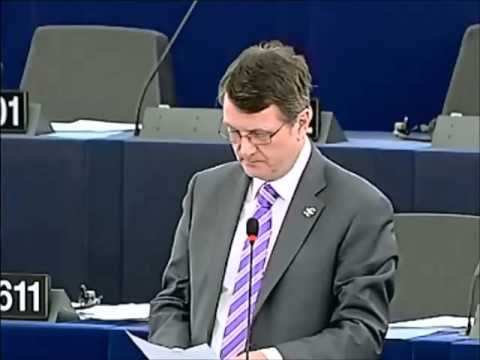
Gerard Batten is a serving MEP and a serious voice within his party – not a swivel eyed lunatic from the fringe. And so when he publicly advocates making Muslims effectively sign an oath of loyalty and nonviolence to prove their harmlessness to the state, this represents a very real problem for UKIP, damages their pro-liberty credentials and alienates many people (myself included) who were otherwise inclined to give them a fair hearing.

gerardbatten

The Guardian gives some of the detail:

Gerard Batten, who represents London and is member of the party’s executive, told the Guardian on Tuesday that he stood by a “charter of Muslim understanding”, which he commissioned in 2006.

The document asks Muslims to sign a declaration rejecting violence and says parts of the Qur’an that promote “violent physical Jihad” should be regarded as “inapplicable, invalid and non-Islamic”.

Critics said his comments represent the “ugliest side of Ukip” and “overlap with the far-right”, in spite of the efforts of party leader Nigel Farage to create a disciplined election machine ahead of the European elections.

Asked on Tuesday about the charter, Batten told the Guardian he had written it with a friend, who is an Islamic scholar, and could not see why “any reasonable, normal person” would object to signing it.

One hardly needs to restate their horror and revulsion at all forms of violence and terrorism in the name of religion before condemning this politician’s attempt to take a redacting pen to the holy book of a faith not his own – but I shall do so anyway. We can abhor the violence, but that does not make it right to propose amendments to the religious texts of a faith that you do not yourself practice. Indeed, if Gerard Batten is to apply his editing skills to every major religious text touting a menu of violent and uncivilised punishments to be meted out to those who accidentally violate the etiquette of their ancient day, he will not only raise Muslim ire but also the outrage of other religions perhaps much closer to his own heart.

Seeing the “I have Muslim friends” card played as a defence by Godfrey Bloom is also quite depressing, and hardly mitigates the fact that he is basically advocating state interference in the workings of a religion, state interpretation of religious texts and state monitoring of compliance with religious teaching.

And in a final flourish, Batten also failed to repudiate his 2010 call for a ban on new mosques in Europe, apparently confirming the suspicions of many that UKIP is concerned about freedom of religion and freedom from religious persecution only when it can be used as an argument to allow certain Christians to continue discriminating against gay people.

The latest UKIP scandal has, naturally and rightly, drawn condemnation from across the political spectrum, with Conservative MP Robert Halfon (of the Jewish faith) describing Batten’s “Islamic code of conduct” as the first step toward making a persecuted people wear a visible gold star on their clothing:

Halfon, who is Jewish and has spoken out repeatedly against Islamic extremism, told the Guardian he considered Batten’s views “unbelievably sinister” and “frightening”.

He tweeted: “Big difference btwn lawful Muslims & extreme Islamists. UKIP MEP Batten’s statement a 1st step to wearing a Yellow Star.”

Sarah Ludford, a Liberal Democrat MEP for London, also criticised the comments, saying they “rip apart Ukip’s pretence” that it treats everybody equally.

“His offensive blanket stereotyping of Muslims speaks volumes about Ukip’s extremism and should warn voters that voting Ukip means associating with hatred and Islamophobia,” she said.

These shenanigans within UKIP must come to an immediate halt if the party is to staunch the bleeding and begin to repair its tarnished reputation. The existing media portrayal of the party as a club for closet racists, little-Englanders and swivel eyed loons is harmful enough without having senior MEPs throwing more fuel on the fire. The fact that some of the provocative statements in question were given in the year 2006 is no defence or mitigating factor here – all that means is that eight years have passed without a public apology and withdrawal of the remarks.

True to recent form, Nigel Farage has been slow to respond to this latest volley of bad publicity – and so, for the moment, Gerard Batten is left to twist in the wind. This, in itself, is unacceptable. This is a time for the leader to lead. Perhaps UKIP wants to be a party of unapologetic Islamophobia and a cheerleader for freedom of religion, but only when Christian freedoms are perceived as being threatened. And if so, that is their choice to make – free speech is still just about protected in this country, and UKIP are entitled to campaign on that platform. In turn, I would also then be freed from the desire to give them any further serious consideration and airtime on this blog, because I would exercise my right to avoid associating myself with such a party.

But if the UK Independence Party actually stands for personal liberty and does not wish to associate itself with religion-specific loyalty tests and bans on practicing Islam (because that is what withholding permission to build new mosques would ultimately mean), with fearmongering or with discriminatory policies, then Nigel Farage needs to speak up and show any recalcitrant members the door.

Newer, less established and experienced political parties eventually have to choose between their fiery, populist rhetoric and the need for sober policymaking; between courting any stray vote that can easily be won and accepting that the votes of some other people are fundamentally undesirable. The Liberal Democrats faced their reality-check on the topic of undergraduate tuition fees, and for better or worse they chose responsible government over delivering on their tuition fee cap bribe to their starry-eyed voters. It increasingly looks as though UKIP will have a dual reckoning – with their attitude to gay marriage on one hand and the decision to condone or condemn Islamophobia on the other.

If Mr. Farage could please make up his mind on these issues and convey the message to his troops, the rest of us will know whether to keep giving UKIP the time of day, or letting them jog on by.

This Extraordinary Pope, Ctd

Andrew Sullivan’s take on the extraordinary interview given by Pope Francis to a Jesuit publication is well worth a read. In this series of articles, Sullivan explores not just the stylistic differences between the new pope and his predecessors, but also the likely (and less likely) implications for church doctrine and policy. Well worth a read.

Andrew Sullivan's avatarThe Dish

Pope Francis Attends Celebration Of The Lord's Passion in the Vatican Basilica

Well, if the theocons hadn’t got the message by now, they can only blame themselves. The new interview with Pope Francis is a revelation. This Pope is not the Pope of a reactionary faction obsessed with controlling the lives of others – a faction that has held the hierarchy in its grip for three decades. He is a Pope in the spirit of the Second Vatican Council, a Pope with a larger and more humane perspective than the fastidious control-freaks that have plagued the church for so long. I need to read and absorb the full interview – it’s 12,000 words long – before I comment at any greater length. But here are the key phrases that are balm to so many souls:

“This church with which we should be thinking is the home of all, not a small chapel that can hold only a small group of selected…

View original post 215 more words

More Praise For The Vatican

Well, for its current occupant, to be more precise. MSNBC host Chris Hayes (who mirrors his mentor Rachel Maddow in speech and writing to a remarkable degree), is the latest to fall under the spell of Pope Francis I, for many of the same reasons that this blog has praised the new pontiff.

francis1

Hayes gushes:

You know who I freakin’ love? This new pope. Pope Francis. You know who I’m talking about, right? The pope. Are you watching this guy? Because you should be. It’s early, but I’m thinking… best pope ever.

That’s original emphasis, by the way. Aside from the redundancy of explaining to his viewers and readers that Pope Francis is indeed the pope, the style is just like Rachel Maddow Mark 2, right? The stylistic similarities between Maddow and her protege are quite astounding. But I digress. Hayes also picks up on the new pope’s penchant for making cold-calls to the faithful who write to him of their problems:

Perhaps most amazing of all: the pope is now picking up the phone and calling people who write to him for advice and prayers—earning him the nickname “Cold Call Pope.” He phoned a woman who had been raped by a police officer in Argentina, telling her she was not alone, and to have faith in the justice system.

He’s comforted a pregnant woman whose married boyfriend tried to pressure her into an abortion, Francis offering to personally baptize her baby.

He also rightly picks up on Francis’ more humble demeanor:

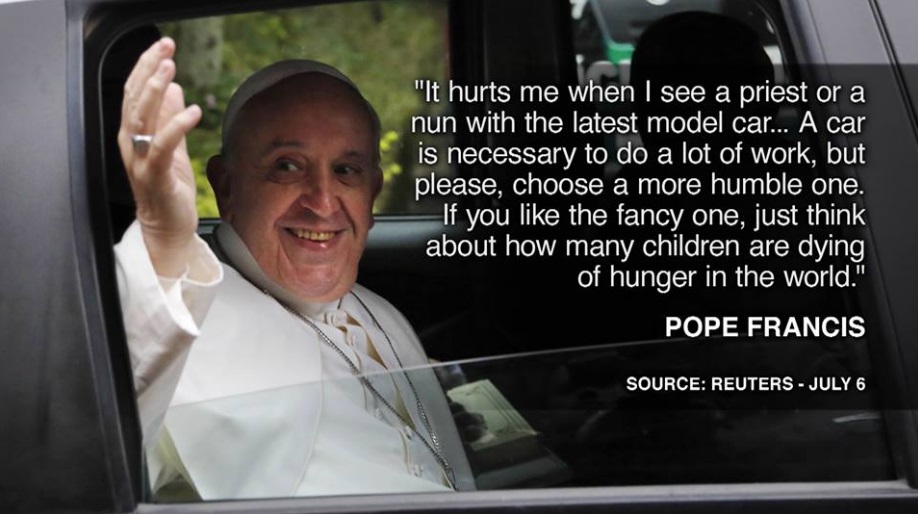
He showed up to World Youth Day in Rio de Janeiro, not in the imposing Popemobile, but in the back of a rental car. He’s not above taking a selfie with the kids. He plans on driving a used car around town. And he’s urged others to do the same: ”It hurts me when I see a priest or a nun with the latest model car. A car is necessary to do a lot of work, but please, choose a more humble one. If you like the fancy one, just think about how many children are dying of hunger in the world.”

francis2

The one area where Hayes and I differ is the degree to which this wonderful, welcome rhetorical shift will actually lead to any significant step change in Church doctrine or Vatican policy. Hayes says this in his article:

But Francis has also shown he’s pretty good substantively, as well. On the once taboo subject of homosexuality, Francis told reporters: ”If someone is gay and he searches for the Lord and has good will, who am I to judge?”

Clearly, he sees this as something substantive, but I find it hard to apply that term unless there are meaningful changes afoot to reform Church teachings on gay marriage, the ordination of women priests and other such issues – something that is clearly not on the horizon.

Nevertheless, I join Chris Hayes in celebrating the warmer, more inclusive tone now emanating from the Vatican. May it spread down from Pope Francis to his brother cardinals, the archbishops, bishops, priests and of course the laity, where it might really start to do some good.

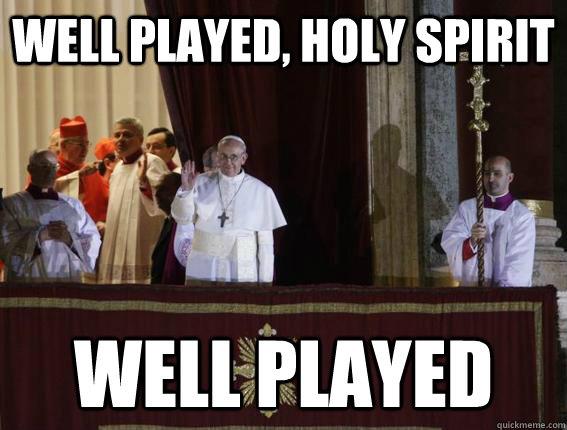
Some interesting and fun Pope Francis memes can be found here.