On Austerity, Learning The Wrong Lessons From Europe

Europe Austerity 2


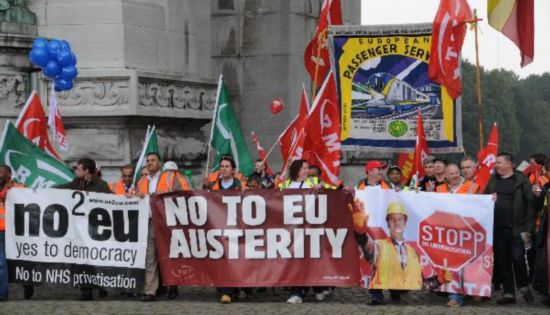
As the US presidential election draws closer and the political debate rumbles on, I find myself becoming increasingly frustrated by those voices on both the left and the right, who seek to hold up the example of “Europe” (that homogenised, cohesive whole) as Exhibit A in an attempt to win their economic policy argument.

I am talking about the ongoing “austerity/stimulus debate” – whether America should make drastic and immediate cuts to public spending in order to tackle large government budget deficits, or whether even higher levels of government spending are required in the short term to spur economic growth, before deficit-tackling measures are undertaken at some point in the future.

When talking about these issues, both Democrats and Republicans are playing fast and loose with the truth, and doing the American people (at least those who have already tuned in to the election-year political coverage) a disservice in the process.

On the left, it is fashionable to point at Europe and exclaim that austerity policies are not working because “Europe” has drastically scaled back government spending, and yet is experiencing either a very tepid recovery or an outright double-dip recession. A typical example, from The Washington Post:

Europeans are rebelling against austerity. That’s the read on Sunday’s elections in Greece and France. But why do voters loathe austerity? Perhaps because, as economists have found, efforts to rein in budget deficits can take a wrenching toll on living standards, especially in a recession.

In a recent paper for the International Monetary Fund, Laurence Ball, Daniel Leigh and Prakash Loungani looked at 173 episodes of fiscal austerity over the past 30 years. These were countries that, for one reason or another, cut spending and/or raised taxes to shrink their budget deficits. And the results were typically painful: Austerity, the IMF paper found, “lowers incomes in the short term, with wage-earners taking more of a hit than others; it also raises unemployment, particularly long-term unemployment.”

The left-leaning media across the pond is also keen to seize on this narrative, as the following opinion piece from The Guardian deftly demonstrates:

Third, the president should make it clear he won’t allow government spending cuts to take precedence over job creation. He won’t follow Europe into an austerity trap of slower growth and higher unemployment. While he understands the need to reduce the nation’s long-term budget deficit, he should commit to vetoing any spending cuts until the unemployment rate in the US is down to 5%. Instead, he should commit to further job-creating investments in the nation’s crumbling infrastructure – pot-holed roads, unsafe bridges, inadequate pipelines, woefully-strained public transportation, and outmoded ports.

Finally, Obama should make sure Americans understand the link between America’s fragile recovery and widening inequality. As long as so much of the nation’s disposable income and wealth goes to the top, the vast middle class lacks the purchasing power to fire up the economy. That’s why the so-called “Buffett rule” he has proposed – setting a minimum tax rate for millionaires – needs to be seen as just a first step toward ensuring that the gains from growth are more widely shared. He should vow to do more in his second term.

Such an economic strategy – forcing banks to help distressed homeowners, stopping oil speculation, boosting spending until unemployment drops to 5%, and fighting to ensure economic gains are widely shared – is critical to jobs and growth. It’s the mirror image of Europe’s failed austerity policies.

These arguments do not stand up to scrutiny for several reasons, many of which are well articulated in this piece from Forbes:

The trouble with Europe’s post-crisis budgets, then, isn’t so much that they’ve increased taxes. It’s that they haven’t meaningfully cut spending. “Following years of large spending increases,” Veronique de Rugy explains, “Spain, the United Kingdom, France, and Greece — countries widely cited for adopting austerity measures — haven’t significantly reduced spending since 2008.” De Rugy points to data that shows those countries “still spend more than pre-recession levels,” with France and Britain making no cuts, and Italy increasing spending in 2011 “more than the previous reduction” between 2009 and 2010. Without significant, substantial cuts, tax increases alone don’t amount to austerity. Yglesias is correct that tax hikes can contribute to austerity. What tax hikes cannot do, however, is be austerity. Tax hikes are neither necessary nor sufficient for an austerity program.

Inconsistent though it may be with the liberal worldview in the US, this is very true. Government spending, by many measures, is actually higher than pre-recession levels in Britain and other countries. The so-called “austerity” that everyone is wailing about is nothing more than a reduction in the rate of increase in government spending. Furthermore, as anyone living in Britain can easily attest, many of the “austerity” measures have been tax increases, and not spending cuts – which also does little to support the liberal view that draconian spending cuts have stymied an economic recovery.

Also missing from the left-wing take on austerity is an understanding of the fact that, unlike the US, European economies grappling with anaemic growth or double-dip recession do not have the good fortune to be underpinned by the world’s primary reserve currency. It is much easier to enact a large scale stimulus programme while retaining the confidence of the global bond markets if your currency is the US dollar, a fact that is glossed over by many people, including some in the Obama administration who hold up Europe as a cautionary tale of what happens if you fail to meet economic downturn with government stimulus.

The Washington Post reports:

“The situation in Europe is slowing things down,” Obama told donors at the New Amsterdam Theatre. At the home of hedge fund executive Marc Lasry, Obama said that Romney and congressional Republicans favored an austerity plan that would “drastically shrink government,” hurting job growth and middle-income Americans.

“That is fundamentally different from our experience in growing this economy and creating jobs,” Obama said.

Where Obama was subtle, not drawing a direct line between Europe’s approach and Romney, Clinton was not.

The former president said Republicans were adopting “the European economy policy.”

As a European watching the American political debate unfolding, it frustrates me to see such sweeping statements and generalisations being made about other countries, and seeing their actions and policy stances mischaracterised without even the pretence of trying to understand them – and this applies to both sides of the political aisle. I also fear that it does not do much to dispel the false but common notion that most Americans are insular and lacking any real understanding of the world beyond their borders.

This stereotype, where true, is unfortunate enough to the extent that it applies to the general population, but even more concerning when it manifests itself in current and would-be future political office holders.

Dancing With Yourself

Tea Party Protest - Barack Obama

It is hard to disagree with this assessment of recent GOP obstructionism from Jamelle Bouie at The American Prospect:

The crux of the matter:

If I sound frustrated—and I am—it’s because we’re in the middle of an absolutely ludicrous scenario. Under a Republican president, the United States endured eight years of disastrous economic stewardship—arguably the worst of the post-war era—that nearly led to a second Great Depression. In response, voters elected a Democratic president and gave him huge majorities in both chambers of Congress. Rather than work with the new president, Republicans ran to the right and promised to defeat this president by any means necessary. They abused institutional rules to block nominees, and imposed a de-facto super-majority requirement on all legislation. Republicans rejected stimulus, the automobile rescue, a climate bill built from their ideas, a health care bill built from their ideas, and a reform bill designed to keep the Great Recession from happening again.

This was an amazingly successful strategy. It destroyed Democratic standing with the public, energized the right-wing fringe, and led to a historic victory in the House of Representatives. Once in command of the House, Republicans pushed hugely draconian budgets, risked a government shutdown, and nearly caused a second economic collapse by threatening to default on the nation’s debt. This reckless behavior depressed the economy, prolonged the recovery, and destroyed trust in the nation’s political institutions. The Speaker of the House has even promised to do this again, if Democrats don’t bow to his demands for greater spending cuts.

The Republican party of today has drifted so far – not just to the right, but into the realm of crazy, where the eight years of disastrous Bush economic stewardship apparently never happened, and the economic malaise is entirely Obama’s fault – that it’s hard for me to see how I could ever bring myself to vote for them. I have joined firmly with those who are hoping for a complete electoral landslide in the upcoming presidential elections, to perhaps convince the GOP to tack back toward a reasonable, pragmatic conservatism.

Of course, this would have been easier if one of the crazies had managed to wrest the nomination away from Mitt Romney. As it is, we will probably have to wait until Romney’s likely defeat in 2012, and then a further tack to the right and an even bigger defeat in 2016 before we might finally have a viable choice between two parties again.

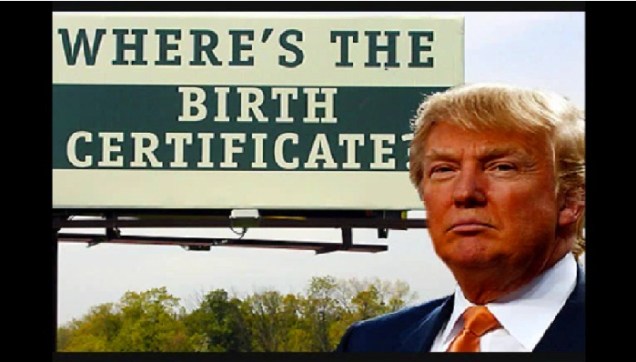
The Hypocrisy of Mitt Romney – Birther Edition

donald-trump-barack-obama-birth-certificate-birtherism

A lot of people have been wondering about the extent to which Mitt Romney would tack back to the centre of the political spectrum in the highly, highly, highly unlikely event that he manages to defeat Barack Obama in November’s contest. And to be fair, Mitt Romney has certainly added fuel to the fire of such speculation by some of his statements, most recently his surprise revelation that everything he has said before about immediately balancing the budget was just a big joke, because he is actually a Keynesian at heart, and knows that to reduce federal spending by $1 trillion in year 1 would not be the most positive thing to do to a fragile economy.

But those people thinking (either worrying or hoping) that a Romney presidency would move to occupy the political centre ground need speculate no more. Because Mitt Romney has now proved beyond question that he is fully and totally beholden to the extreme right wing of the Republican Party, and would no sooner do anything to anger that bastion of support than he would chop off his own hand. How do we know this? Because Mitt Romney refused to distance himself from his most high profile campaign surrogate and supporter, Donald Trump, when he said this:


And then doubled down with this:


Romney, meanwhile, had only this to say when asked about his wayward campaign surrogate:

Mitt Romney said Monday he wasn’t concerned about Donald Trump’s commitment to the “birther” conspiracy, one day before the GOP presidential candidate hosts a fund-raiser alongside the celebrity business magnate.

Asked on his charter plane whether Trump’s questioning of President Barack Obama’s birthplace gave him pause, Romney simply said he was grateful for all his supporters.

“You know, I don’t agree with all the people who support me and my guess is they don’t all agree with everything I believe in,” Romney said. “But I need to get 50.1% or more and I’m appreciative to have the help of a lot of good people.”

Even when his most high-profile supporter and key surrogate goes totally off the rails and revives his old birther conspiracies prompted by nothing at all, Mitt Romney is too afraid of angering his base to unequivocally disassociate himself from the remarks. Surely no one now harbours any remaining belief that Romney would tack back to the centre if he got elected. Tea Partiers, fear not – you may not like the guy and distrust the sincerity of his convictions, but it doesn’t matter – he’s scared of incurring your wrath, so you have him safely in the bag.

If, in some dystopian world, I had to choose between a President Romney and a President Trump, I think I am minded to go for President Trump. He may be batsh*t insane with an ego the size of one of his towers, but at least I would always know what he really thinks about something.

Gove Educates Leveson On Free Speech

I do admire Michael Gove, the UK Education Secretary. When virtually all of the other Conservative cabinet members from David Cameron on downwards have proven themselves to be one disappointment, letdown and betrayal of principle after another, at least Michael Gove has been steadfastly working away at the Department for Education to bring about some real, conservative reforms.

So I was several steps beyond overjoyed when I found out that Gove had been giving evidence to the riveting Leveson Enquiry “into the culture, practices and ethics of the press”.

Suffice it to say that Leveson met his match yesterday:


Bravo! Since our taxpayer money is being frittered away in order that this pompous, self-aggrandising old gasbag Leveson can sit there like some modern-day oracle, cooking up new ways to constrain freedom of speech in our country, I am happy that those of us who disagree with the premise of the whole enquiry in the first place were able to extract some small measure of payback by sending Michael Gove into the fray to make him squirm a bit.

A couple of points to note from this video:

1. Just look at Leveson’s defensive, hunched posture compared to the relaxed, attentive stance of Gove. Leveson is clearly used to being flattered and deferred to almost all the time, and clearly was not ready to have his assumptions – and the preordained outcome of the enquiry – challenged in so articulate a fashion.

2. This is supposed to be an impartial enquiry, remember? So statements like “Don’t you think that the evidence I have heard from at least some of those who have been the subject of press attention can be characterised as rather more than ‘some people are going to be offended some of the time’?” have no place being uttered by Leveson. What does it matter what other evidence he has heard? Michael Gove is on the stand now, giving his opinion, which rightly should be his alone and not influenced by the parade of people who have already taken the stand. I’m not a lawyer, but isn’t that how these things are supposed to work? This is clearly a man who has made up his mind before he has even started deliberating.

The right-wing press in Britain was of course greatly cheered by this turn of events. From David Hughes, writing at The Telegraph:

Throughout the Leveson Inquiry it’s been pretty evident that it was the lawyers who felt they were the smartest guys in the room. Today that changed. Michael Gove, the Education Secretary, gave a virtuoso display of both intellect and guts as he made the case for press freedom. It’s perhaps no surprise that this journalist turned politician should, for the first time, take the argument to the Inquiry and swing it away from its focus on Murdoch and hacking and concentrate its mind on the wider issue of freedom of expression.

Plenty of witnesses have had mini-spats with Robert Jay QC, the counsel for the Inquiry, but no-one has so far tried to lock horns with Lord Leveson himself. Gove did so with brio: “Before the case for regulation is made, there is a case for liberty as well…I am unashamedly on the side of those who say we should think very carefully about regulation. By definition, free speech doesn’t mean anything unless some people are going to be offended some of the time.”

http://blogs.telegraph.co.uk/news/davidhughes/100161393/michael-gove-plays-a-blinder-at-leveson/

Michael Deacon, also writing at The Telegraph, came away similarly impressed:

Mr Gove was once a journalist, and three months ago said the inquiry might have a “chilling” effect on the press. He clearly hadn’t come to roll over. You could see it in his posture: always leaning sharply forward, as if to confront his interrogators. Without embarrassment he described Rupert Murdoch as “one of the most impressive and significant figures of the last 50 years”. He spoke out against the creation of new press regulations, and stressed the importance of free speech.

Perhaps all this makes his performance sound pompous. Yet it wasn’t. Even – or perhaps especially – at his most serious, Mr Gove is drolly camp. There’s more than a whiff of Niles Crane about him.

Lord Leveson didn’t seem amused. “I don’t need to be told the importance of liberty, Mr Gove,” he said frostily. “I really don’t.” Mr Gove didn’t so much as blink.

http://www.telegraph.co.uk/news/uknews/leveson-inquiry/9298341/Leveson-sketch-Michael-Gove-Secretary-of-State-for-Rogets.html

Even the BBC News analysis was quite complimentary:

He is one of the highest profile libertarians in his party and he gave a passionate defence of the right of freedom of speech. But the suggestion that it counted for nothing unless some people were offended some of the time, clearly got under Lord Justice Leveson’s skin.

The long, tense exchange that followed between the two men got to the very heart of the argument that Leveson is wrestling with – whether new laws and regulation will be needed to rein in the press.

The background to all this is a speech Mr Gove made a few months ago when he warned that the Leveson inquiry could have a “chilling” effect on press freedoms.

The education secretary has expressed his concern that the case for liberty could be drowned out by the anger over phone hacking. This performance in the witness box ensures that that argument will be heard and his close relationship with the prime minister means it’s a message that will go right to the top once the inquiry reaches its conclusion.

http://www.bbc.co.uk/news/uk-politics-18257958

Sadly, this excellent exchange is highly unlikely to have any bearing on the outcome of the enquiry, the findings of which Leveson is probably already writing as he still hears evidence. Leveson clearly views himself as the moral arbiter of the media, and will no doubt recommend some new burdensome regulations and oversight to further suppress freedom of expression in the press. The best hope for those on my side of the argument will be that as has been the case with so many other enquiries, the findings will be warmly praised, filed away and never acted upon.

Nonetheless, yesterday was a good day for freedom of expression in Britain, as Michael Gove revealed the faux-concern of the Levesons and other pro-regulation afficionados for the overbearing, control-freakish sham that it is, and sounded a call to arms for the defence of freedom of speech in this country.

As Long As It Keeps Us Safe

CISPA - Congress

Too often, the Republican Party’s already-tenuous commitment to civil liberties and privacy goes out the window at the first mention of national security

The late Ronald Reagan, now viewed as something close to a saint by many Republican minds, for deeds both real and imagined, once said this:

“The nine most terrifying words in the English language are, ‘I’m from the government and I’m here to help'”.

Engage a committed Republican or conservative voter in conversation for any length of time and you will hear all about their passionate belief in limited government, and the inherent dangers of an overactive, overbearing state. I believe in that ideal myself. And certainly the GOP believes in individual liberty and privacy, and the freedom to pursue happiness, right? Always has.

Well, now congressional Republicans seem to have settled on a new mantra, that goes something like this:

“The twelve most benign words in the English language are, ‘I’m from the government and I’m here to protect you from terrorism'”.

Because, of course, the ideological compromises required to perch on the wobbly three-legged conservative stool (social conservatism, hawkish defense stance and very limited regulation of markets) mean that all those Republican platitudes about keeping government out of our lives are tossed out of the window as soon as it comes to “keeping our country safe”, “securing the homeland” or “stopping the terrorists”.

This is made clear once again as the Republican-controlled congress debates the Cyber Intelligence Sharing and Protection Act (CISPA), which is, of course, supported by the GOP. Apparently we were supposed to just smile and nod and ignore the cognitive dissonance caused by hearing Republicans rail against Obama’s supposed expansion of the federal government while simultaneously acting to expand the scope and power of the federal government.

As Juan Williams points out in his article on TheHill.com:

The Republican majority in the House is on the side of giving Internet service providers, private companies and the government a whole new box of tools to fight terrorism. That includes the right for the government and private business to share information on how to build protections against cyberthreats. Under the Cyber Intelligence Sharing and Protection Act, or CISPA, Internet service providers will be free of any legal restraint against disclosing any information to prevent a terror attack.

The big surprise here is that the support for the GOP position includes most of the Tea Party Caucus, including conservative rock stars Michele Bachmann and Allen West. They normally condemn any increase in government power.

Also in that camp is Maryland Rep. Dutch Ruppersberger, the top Democrat on the House Intelligence Committee. He is co-sponsor of CISPA. In fact, about a quarter of House Democrats voted for the bill. Several big high-tech companies, from Microsoft to Facebook, have voiced their support for the GOP approach.

The bill enjoys a measure of bipartisan support, which makes it all the more dangerous, because if enough Democrats-who-don’t-know-any-better join enough Republicans-who-should-know-better, the thing could actually become law.

Williams concludes:

Last week, the Department of Homeland Security released a video of al Qaeda calling for electronic jihad.

But an essential part of the America being protected is our civil liberties, our constitutional freedoms.

“People Power” stopped the online piracy bill because it was too heavy-handed. Once again, it will be up to “People Power,” to make sure that when the House and Senate go into conference on this bill they do not emerge talking about good intentions while putting the nation on the path to George Orwell’s hell – Big Brother watching your every move.

Agreed. Enough is enough. Warrantless wiretapping, indefinite detentions, targeted killings of US citizens by unmanned drones, everything about the Patriot Act, long lines at the airport to go through intrusive, demeaning and pointless security checks designed to guard against the last clever terrorist ruse rather than anticipate the next one – and don’t even get me started on Britain, where there is no pesky written constitution to stop overzealous politicians from overreacting to every security incident with new draconian legislation – the list grows longer by the day.

Let’s hope that there are enough level heads remaining in congress to prevent CISPA from becoming law.


CISPA

Support Semi-Partisan Politics with a one-time or recurring donation:

Agree with this article? Violently disagree? Scroll down to leave a comment.

Follow Semi-Partisan Politics on TwitterFacebook and Medium.