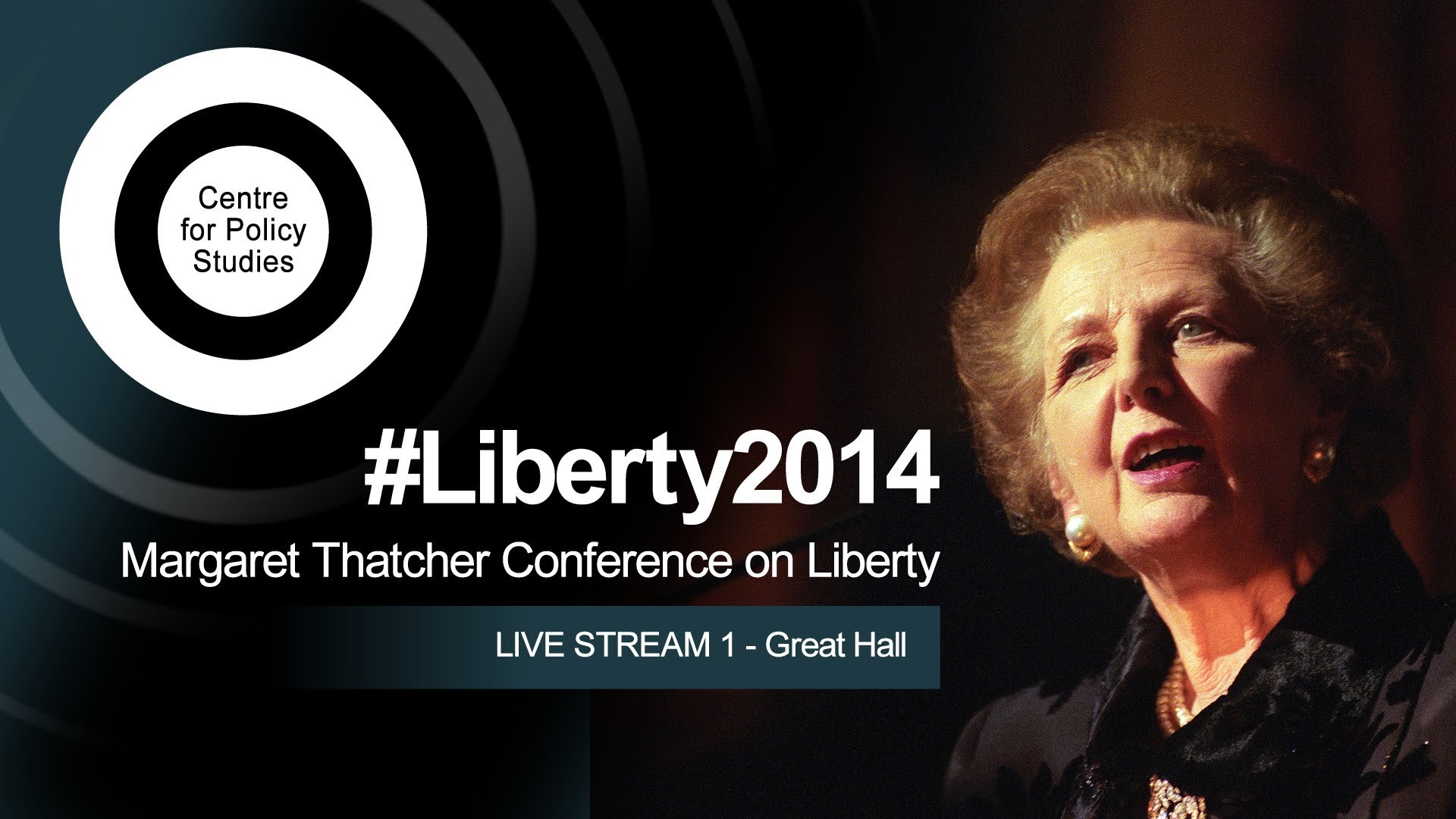
The 2014 Margaret Thatcher Conference on Liberty, organised by the Centre for Policy Studies, takes place on Wednesday 18 June in London. Semi-Partisan Sam will be live-tweeting the event during key sessions, and offering longer-form analysis after the event concludes.
The Centre for Policy Studies was founded 40 years ago in 1942 by Sir Keith Joseph and Margaret Thatcher, and it is no exaggeration to say that the think tank incubated many of the radical ideas that saved Britain from terminal decline when put into practice by the Thatcher Government.
In the year 2014, when the current Conservative Party is able to govern only in coalition, and spends more time fighting with the Labour Party over the same small patch of non-ideologist centrist turf than continuing Thatcher’s work, a new rejuvenation of British Conservatism is needed more than at any time since 1979.
Though the attendee list (full of conservative grandees from Britain and overseas, but many of them now out of power, discredited or both) does not exactly scream dynamism and innovation, anyone favouring small, efficient government and maximum personal liberty should pay attention and hope for positive outcomes and the beginnings of a new birth of freedom (to quote Abraham Lincoln).
The agenda is set to include the following discussions:
The EU and the Big Corporations: are they ganging up against liberty and its protector, the nation state?
The launch of CapX – an organisation tasked with repairing the image of capitalism and rescuing its reputation from damage caused by cronyism and corporate welfare.
Has the West gone soft? 25 years on from the fall of the Berlin Wall
The Road from Serfdom: Lord Saatchi
Big Government, Big Corporations: what chance for small business and innovation?
“After America, what?”
Has the other side won? Or can liberty and popular capitalism fightback?
New media and liberty
A CONVERSATION: What does it mean to be a Conservative?
Stay tuned to @SamHooper on Twitter for live-tweets from the event, and to this blog for discussion and analysis of the conference after the fact.
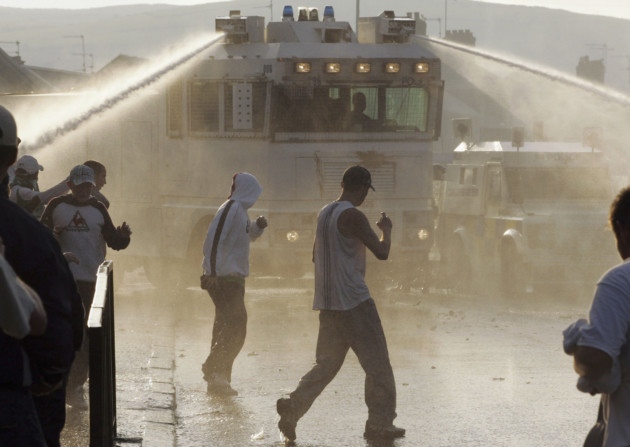
The sinister move by the Association of Chief Police Officers (or ACPO) to seek government approval for the purchase and use of water cannon as a means of crowd control on the British mainland was met with widespread alarm when the idea was first mooted in January.
Even more concerning now is the news that the Mayor of London, Boris Johnson, has unilaterally purchased three such devices from the German police in the presumptuous expectation that the Home Secretary will agree to ACPO’s request before Theresa May has had the opportunity to make her decision.
This blog noted at the time that the ACPO’s move was a transparent power play, that there were no serious concerns about impending violent protests in Britain and that even if there were a repeat of the 2011 riots, water cannon would be uniquely unhelpful to the police in containing the disorder:
So what is this really all about? One explanation could be that ACPO are politically agitating, and trying to send a message of their disapproval of coalition austerity policies to the public and their elected representatives, essentially saying “we told you that cutting government spending would lead to chaos and disorder and we were right; now we have to take the draconian step of procuring water cannon to prevent the country from sliding into anarchy”.
This is one plausible possibility – as we have seen only too recently with the Andrew Mitchell “plebgate” scandal, there are those in the police force with very hardened agendas who would stop at nothing to discredit or cast doubt on the performance of Conservative ministers.
But in truth, a more convincing explanation is that the police just really fancy having these new toys to scare and intimidate people, that they have decided that building good community relations with the public and doing the hard work of policing large scale events just isn’t worth the effort when they can just bully the public into cowed obedience much more easily.
And so it is. The coalition government’s ‘austerity’ policies have now been in effect for over three years, and have yet to provoke widespread public disorder of any significant kind, other than the usual antics of misbehaving students. Why then does ACPO believe that Britain is a smouldering tinder box about to erupt in an explosive delayed reaction to policies which are old news and have already taken effect?
The Guardian also condemns the Mayor of London’s actions in a stinging editorial, and calls on the Home Secretary to refuse ACPO’s request. This would have the double benefit of standing up for civil liberties and giving the mayor of London a slap in the face for presuming to anticipate her decision:
But this cannot be a matter for City Hall and Scotland Yard alone. The Met has a significance that extends beyond London. Westminster should have a say in what would be a profound decision affecting the rights of the UK citizen and the nature of British policing. The mayor will have his water cannon, but cannot use it without the approval of the home secretary. She should ensure it never leaves the depot.
The Guardian’s second point, that Boris Johnson’s move is of particular concern because the significance of the Metropolitan Police extends well beyond London, is also important. With some chief constables up and down the country agitating for water cannon of their own (though to their credit, some realise their lack of utility in policing normal protests), where the Met goes, others would be certain to follow.
The fact that Boris Johnson (in what he thinks is a conciliatory move) is publicly offering to demonstrate the water cannons supposed safety by being blasted by the newly-acquired water cannon himself is entirely meaningless, unless he intends to be hit directly with the maximum force that the Metropolitan Police will be permitted to use the machines. This is unlikely.
Johnson will almost certainly only submit himself to a light sprinkling from one of the machines at its lowest power setting, and then appear charming and even more bedraggled than usual in front of the television cameras, assuring us that he got a good soaking but is otherwise perfectly unharmed.
Others who have come face to face with the full power of water cannon have not been so fortunate as the Independent notes:
Dietrich Wagner, a German pensioner, remembers the exact moment he was knocked over by a water cannon, in Stuttgart in 2010. It felt as though he was being punched. He fell backwards, lost consciousness, and when he woke, blood was running down his face. “I couldn’t open my eyes,” he says. “I only saw black.”
The former engineer, who turns 70 this year and has had six operations on his eyes, is still almost completely blind. He is in London to warn Home Secretary Theresa May not to authorise the use of water cannons on the streets of mainland Britain.
But the devastating injuries sometimes inflicted by water cannon and the potentially chilling effect on the rights and willingness of people to assemble and protest are already known and much discussed.
Of equal concern is the fact that this draconian, illiberal and presumptuous step was taken by a politician with a fair chance of becoming the next leader of the Conservative Party, and therefore also a potential future prime minister. How will Boris Johnson’s unilateral move to acquire draconian new policing weapons in response to a nonexistent threat affect his already somewhat inexplicable popularity?
The simple fact is that Boris Johnson purchased the water cannon before approval for their use has been given by the Home Secretary. Either he is attempting to strong-arm the government into giving him what he wants in the belief that the Home Secretary will rubber-stamp his decision, in which case he has no respect for the democratic process and the deliberations of government, or he has made a huge gamble and is willing to potentially lose taxpayer money by investing in capital equipment that may not be authorised for use at all, in which case he has committed a major strategic blunder and is terrible guardian of the public purse.
Worse still, if this is about forcing his rival for the future leadership of the Conservative Party into making an illiberal and politically damaging decision that he can somehow later use against her, as is also being suggested, then he is also playing political games with the cherished civil liberties of our country.
None of these possibilities or their associated character traits are desirable in someone who has their sights set on the highest political office in Britain.
Did you click “like” when you saw that Facebook picture denouncing cruelty to dogs, or share that touching message exhorting us to honour our veterans on the 70th anniversary of the D-Day landings? Did you also notice the little lion and union flag logo tucked away somewhere deep within the post? You didn’t?
Well congratulations. You probably unwittingly played into the hands of the British far-right’s latest viral social media strategy. You are officially on the same level as the caricatured bumbling, resentful, low-information UKIP voter. Hang your head in shame.
But don’t worry, you were not the only one taken in. So many of the commentariat’s dire warnings from the 2014 local and European election campaign are now coming true. “Well, they make a show of being patriotic and decent,” they said, “but it’s all just a mask concealing their despicable racist views”. Or sometimes it was proclaimed that “people support them without really thinking through what they actually stand for; if only they really knew, they wouldn’t like them”.
Wise words – only they were not so descriptive of UKIP (the establishment’s principal target at the time) as they are of Britain’s real-life far right parties, who are alive and well, take themselves very seriously and who charted a course through election season almost entirely undetected and unengaged by the forces of left-wing and popular outrage.
For those who were too busy throwing eggs at Nigel Farage or dismissively equating euroscepticism with little-England xenophobia to notice, there’s a new kid on the block of British far-right organisations. They call themselves Britain First, and describe themselves as a “patriotic political party and street defence organisation” – because a heady mix of strong political views, mob psychology and unapologetic vigilantism couldn’t possibly lead to anything unpleasant.
As the British National Party faced electoral annihilation in the local and European elections, haemorrhaging supporters and losing the two MEPs they gained in 2009, Nick Griffin’s dying organisation seems to have breathed its hate-filled spirit into a new host, Britain First – itself comprised of disgraced and disgruntled former BNP members.
Britain First is prospering where the BNP failed because they grasp the fact that the old foaming-at-the-mouth racist with a grudge to bear approach to political argument has a naturally low ceiling of support, whereas appeals on behalf of animal welfare or generically patriotic feel-good posts on social media are virtually guaranteed positive click-bait.
Vowing to end dog-fighting or encouraging people to “like” a picture of Prince William may not do much to directly further the party’s core goals, but it does allow them to now truthfully claim that theirs is the most popular political party on Facebook.
But as always with political parties, the carefully polished façade presented to the public and the real sentiments and motivations of Britain First’s activists are two very different things. On Facebook, Britain First may be all LOLcats and union flag bunting, but their activists are generally much less cuddly.
Many videos shown on YouTube and the party’s own website give an idea of what Britain First mean when they call themselves a “street defence organisation”. The following video should be all the introduction needed:
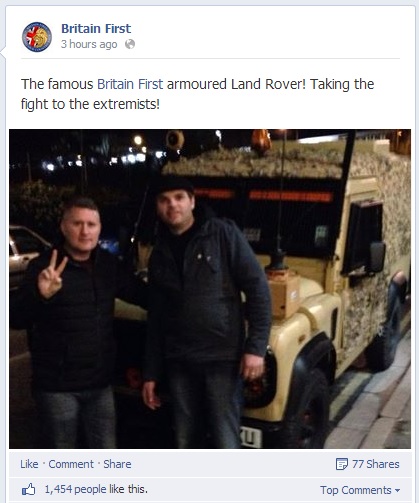
The footage shows a representative sample of the organisation’s work, which largely consists of hitting the streets in a large group, wearing identical quasi-military jackets and berets and holding aloft many union flags, often trailed by one or more decommissioned ex-Army Land Rovers.
Once assembled and decked out in their regalia, the Britain First squads may do one of several things. One of their favourite stunts is the “mosque invasion” whereby a number of squad members (almost all men) burst into a mosque, disregarding the notices to remove their shoes or observe other courtesies, and then start aggressively asking for the imam.
While the imam is being found, Britain First team members berate the bemused-looking worshippers for not acting more decisively to root out what they call “Muslim grooming gangs” or for promoting extremism. They then hand out Britain First literature on the same topic, together with a number of British Army-issue Bibles (this is the visible extent of their piety), exhorting the Muslim worshippers to abandon their “false prophet” and convert to Christianity. Message and literature thus delivered, they depart as rudely as they arrived.
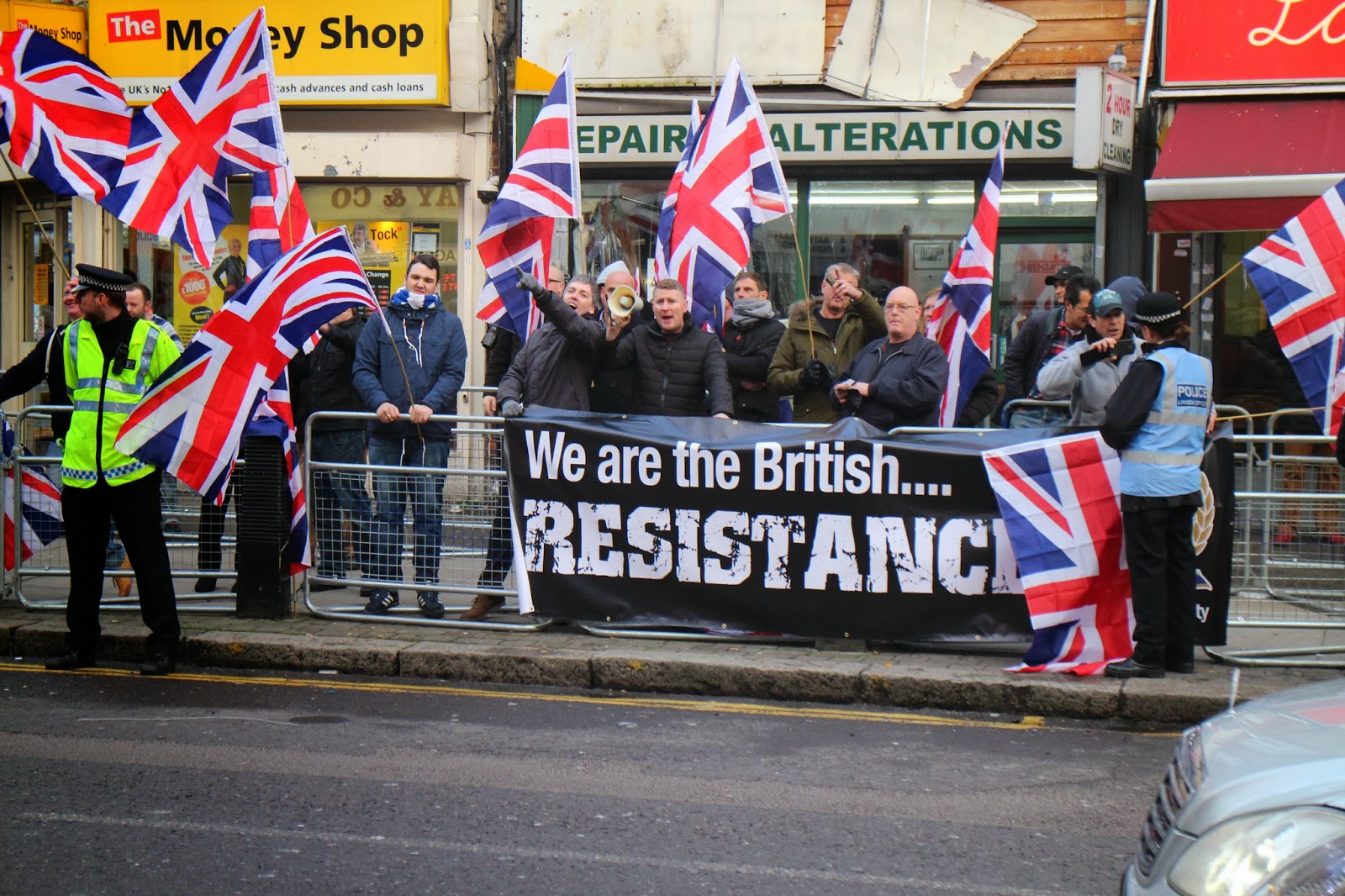
When not invading mosques, Britain First like to assemble to protest in front of the homes of prominent Muslims such as the mayor of Bradford, arriving and standing outside in large numbers (in full uniform, of course) while the leader, Paul Golding either knocks on the door or telephones the victim from the doorstep demanding an audience. When the targets fail to make an appearance, intimidated by the tactics of the Britain First street team, the protesters begin their various chants and make a racket until the police arrive.
Popular chants include “Muslim pedos off our streets!”, “Benefit scroungers off our streets!”, exhortations for various other bogeymen of the paranoid to vacate our streets, and the inevitable battle cry of “Onward, Christian soldiers!”. For you see, theirs is a crusade.
Whatever the activity, the protesters typically film their actions from start to finish and upload them to the Britain First website where they are viewable by members of the public. The production quality is somewhat overwrought, with apocalyptic “Independence Day” style soundtracks suggesting the climax of a Jerry Bruckheimer movie rather than a ragtag group of far-right activists going out on “Christian Patrol” in Bradford.
When interviewed for these in-house videos, activists insist that the British people are “sick to death” of the Muslim grooming gangs that “we’ve all seen in the news”, a preoccupation that eats away at them and which they are convinced is being ignored by communities and local authorities, despite increasing evidence to the contrary. One “defence force” activist added: “English girls are suffering all across the north of England”.
And it’s not just Britain First – there are many other splinter organisations vying for a slice of the far-right nationalist pie. This coming Saturday, the equally unpleasant South East Alliance will be holding a demonstration in Cricklewood, north west London, going up against the Muslim Brotherhood, whose supporters have a presence there – extremism coming face to face with extremism.
There is clearly a real, ever-present and ever-threatening far right element lurking in Britain. Filled with hatred and fuelled by ignorance, these groups acknowledge Britishness only according the narrow criterion of ethnicity, viewing all other races and cultures in Britain with automatic suspicion and fear. Anger and violence are never far from the surface in this xenophobic, nationalistic powder-keg.
The far right was neither dealt a mortal blow by the setbacks of the BNP or invigorated by the rise of UKIP (not a far right party), but it is on the move in Britain once again, only this time aided by a combination of particularly low scruples, social media savvy and viral appeal that the regular political parties can only dream of.
Whose fault is this? The media, the main political parties and those who make it a mission to fight against racism all share a portion of the blame.
Because the establishment – political parties and media alike – expended such huge efforts in their efforts to smear UKIP and halt their advance in the local and European elections, Britain’s actual far right parties have enjoyed a virtual free pass this year. All guns were trained on UKIP, a legitimate party with well-publicised racist bad apples, while the parties that are profoundly and unapologetically racist to the core were scarcely challenged.
When organisations such as Unite Against Fascism temporarily forget their purpose and start actively campaigning against eurosceptics or conflate an opposition to immigration (wrongheaded though it may be) with outright xenophobia and prejudice, they don’t have much left in the tank to take on other groups with really toxic viewpoints when they start to come out of the woodwork.
That’s the problem with crying “racism” every time you encounter a viewpoint that you don’t like or agree with – when you do eventually stumble upon a real life case of racism in action – like Paul Golding’s Britain First organisation – you have already used up all of the warnings and counterarguments in your rhetorical canon, making it impossible to be heard above the noise or to draw attention to the serious cases that we need to tackle.
In one sense, the fact that we collectively took our eye off the ball is not the end of the world – the BNP performed appallingly in the recent election, polling barely above 1% (which was five points down from 2009), while the repackaged Britain First managed just 20,272 votes nationwide, a less than awe-inspiring 0.13% of the national vote.
But to dismiss the far right because of these paltry election results is to miss the point. The fact that BNP and Britain First voters together make up less than the population of Northampton is irrelevant, because they don’t need to win elections to succeed in their goals.
Britain First will never achieve its ultimate aim of turning back the clock and reverting to a bygone time when spotting a non-white face walking around in town is an unusual event worth telling your friends about at the pub, but they don’t have to.
Their ‘street defence volunteers’ are quite happy walking up and down Brick Lane in their quasi-military uniforms with their armoured Land Rover escorts, ‘raiding’ mosques, spreading misinformation, sowing fear, talking apocalyptically about the end of the British people and generally making life miserable for the rest of us. And with their wide range of Britain First branded merchandise available for sale, some of their leaders will likely become quite rich in the process.
This is the type of far-right activism that we can work together to thwart if we are properly focused on eliminating racism and promoting tolerance and respect – not by squashing Britain First’s democratic right to free speech, but through a concerted campaign to inform people that when they share the organisation’s viral Facebook or Twitter messages they are inadvertently helping to spread the word about this BNP offshoot.
Such a “Let’s Unfriend Britain First” campaign could starve the party of the resources and reach needed in order to continue its worrying growth trajectory. The blog Another Angry Voice also lays out good suggestions for fighting back against the group’s manipulative tactics.
The time has also come for some people (they know who they are) to finally take a break from calling UKIP a racist party, desist from the public wailing and rending of garments at the fact that they share a country with such ignorant, backward hillbillies as UKIP supporters, and to admit that there is in fact a vast difference between the radical right and the far right.
Though some may be loathe to give up one of their favourite rhetorical weapons against the political right, they should remember that the marginal wavering UKIP / BNP / Britain First voter has little incentive to select anything other than the most extreme option if even voting UKIP will bring scorn and charges of racism upon them.
(Yes, it is concerning that there are marginal UKIP-BNP voters, but it should be remembered that there are marginal Conservative-BNP and Labour-BNP voters too. All political parties draw some support from the far-right’s natural territory).
In the wake of the local and European elections, the three main political parties are all busy devising strategies to halt the rise of UKIP and stop the erosion of their own support leading up to the 2015 general election. Whatever they ultimately decide to do, it would be encouraging to see passionate anti-racism rhetoric and anti-fascist efforts being launched against the correct targets from now on.
The enemies of fascism and racial hatred – which should be all of us – need to stop using unfounded accusations of racism as a political weapon, get together and identify the real far-right threats in Britain.
Hint: It’s not UKIP.
If you enjoyed reading this article, please take a second to LIKE or SHARE it on social media using the buttons below. Help to spread the word and continue the debate.
Well, apparently the concept is sufficiently fuzzy in the minds of some people that we all now need to take time to argue amongst ourselves and reach a common consensus while one of the biggest and most worrying educational scandals in recent years plays out unobserved.
In response to the ongoing scandal of Birmingham schools being compromised by activist governors to deliver covert Islamic religious teaching, the Education Secretary, Michael Gove, made the slightly awkward if well-meant assertion that in future, all primary and secondary schools will be required to “promote British values”.
Michael Gove, the education secretary, has seized on a finding byOfsted that a “culture of fear and intimidation” existed in someBirmingham schools by announcing that the government will require all 20,000 primary and secondary schools to “promote British values”.
These values will include the primacy of British civil and criminal law, religious tolerance and opposition to gender segregation. Gove also suggested girls wearing the burqa would struggle to find their voice and must not feel silenced in the classroom.
In what is being described by ministers as a decisive shift away from moral relativism in the classroom, the education secretary took action after a landmark series of reports by the schools inspectorate into 21 Birmingham secular schools found an atmosphere of intimidation, a narrow, faith-based ideology, manipulation of staff appointments and inappropriate use of school funds.
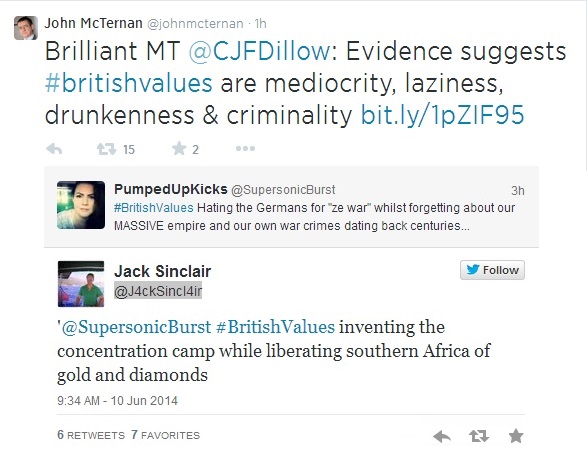
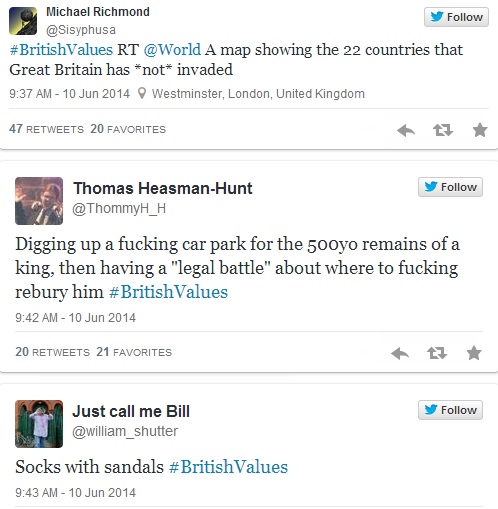
Unfortunately, the predominant response thus far has not been one of outrage that such a thing could happen to compromise children’s education in the UK’s second city; instead, we have seen race to come up with the funniest self-deprecating anti-British putdown as expressed by the #BritishValues hashtag now trending on Twitter.
When presented with the opportunity to express outrage that local school curricula could be so easily hijacked by fundamentalist members of any faith and ‘turned’ to start promoting beliefs very far from the British values of democracy, equality, non-discrimination and obedience to the law, a majority seem more interested in having an introspective discussion about what modern British values really are (at best), or suggesting through Twitter witticisms that any concern is tantamount to xenophobic intolerance (more common).
The Huffington Post has collated a selection of what it considers to be “the best” responses, which take an almost uniformly dim view of British culture and history:
(It should be acknowledged that there have also been some very sensible and thoughtful contributions from others, such as the pianist Stephen Hough).
The hashtag activist comedians and earnest scolds of Twitter currently attempting to look cool by running Britain down on social media are actually revealing a few ingrained British traits of their own – excessive self deprecation and an almost craven desire not to offend or appear controversial – which easily become insidious and harmful when taken to extremes.
There is a gnawing anxiety behind some of the mocking #BritishValues tweets. “Isn’t patriotism so old fashioned?”, they scream. “Let’s list all the bad things that Britain has done so that no-one thinks we’re being boastful”. It may come across as cool, trendy liberalism but look closer and you see that some of it is actually rooted in fear.
Somewhere along the way the idea of expressing pride in Britain, and in British exceptionalism, became interchangeable in the minds of many people with that altogether darker and more insidious disease of racism. To express the former is, in the eyes of many, to come uncomfortably close to embracing the latter. And as a result, people instinctively turn away from patriotism, and instinctively oppose suggestions such as teaching British values at school, mistaking it for something else (and, incidentally, leaving a vacuum that the far right is only too happy to exploit).
And yet there is a serious issue at stake here, with the integrity of children’s education in question. Even the Guardian’s John Harris felt the need to weigh in to the ongoing argument about the fundamentalist Muslim influence in Birmingham schools, reminding his readers that state-subsidised religious indoctrination or interference with the curriculum is wrong whatever the source, and that this is no time for those on the left to bury their heads in the sand:
At the risk of reopening old wounds on the liberal left, for all the noise from those on the right of culture and politics, it is no good crying “witch hunt” and averting your eyes from this stuff. It should have no place in any state school, and most of it is an offence to any halfway liberal principles.
But Harris still felt the need to couch his tortured article in the wider context of a state education system which is failing and falling into disarray under the hated Tory government – the harsh unexpectedness of his gentle reminder that it’s not okay to look the other way and pretend to ignore the fundamentalist corrupting of education for fear of seeming racist or intolerant having to be soothed with a good old swipe at the real enemy, those on the political right.
Efforts to stamp out casual and institutional racism in Britain, while incomplete, have come a long way, even since the 1980s and 1990s. A large part of eradicating the scourge of casual racism has been (quite rightly) to mock it, deride racist thoughts and speech as backward and out of place, and doing everything possible to make racism distinctly uncool. The campaign to eradicate racism from football is a prime example of how successful Britain has been, especially when compared with continental and eastern Europe.
But while there is unquestionably still much work to be done, we must also begin to ask ourselves if one of the side effects has been a growing inability for people to express deeply felt but harmless national pride and patriotism in any but the safest, media-approved settings (such as the 2012 London Olympic Games).
If our generation’s instinctive response when they see criticism levelled at a person or group within a religious or ethnic minority is not to check the veracity and demand action if it is found to be true, but either to flinch and avert their eyes out of shock and unwillingness to believe or to become so embarrassed that their only coping mechanism is to resort to self-deprecating humour on social media, perhaps this is the price that our country has to pay in order to purge itself of the ingrained, widespread, casual racism that was common and socially acceptable for so long. Perhaps.
But being this way makes it much harder for us to deal with the problems facing Britain today, where the pernicious influence of fundamentalists (of all religions) on the young and the lack of assimilation of some cultures into wider British society are real issues that are being only half-heartedly tackled because of the paralysing fear of saying the ‘wrong thing’ or giving the wrong impression.
When asked why it was that Americans are so much more openly patriotic than Brits, the late Christopher Hitchens attributed it to the fact that overt displays of patriotism and love of country in the United States are borne out of the fact that as a nation of immigrants, Americans have no real shared history going back more than a couple of centuries. Therefore, simple acts such as reciting the pledge of allegiance every morning in schools and singing the national anthem before sporting events have, over time, helped to forge that unity within diversity.
But what has always been true of America is now increasingly becoming true of Britain. Immigration into Britain may bring profound economic and cultural benefits, but with each successive year of high net immigration and a lack of assimilation in some quarters, that degree of shared common history is diluted a bit more. And that’s absolutely fine, if other measures are in place to balance it out – like reciting a pledge, offering comprehensive British history as a mandatory subject at schools, or, shock horror, teaching children “British values”.
At the moment, though, these countermeasures are lacking. It should come as little surprise then that certain groups within society do not feel as much desire or pressure to integrate as they rightly should, and that when the door is left wide open in places like Birmingham to influence schools to teach children according to certain subcultural norms, some people will seize the opportunity with both hands.
Unfortunately, in the age of hashtag #Britain, not only does it surprise us when this happens, the thought of condemning or intervening in these events embarrasses us so acutely that we are barely able to have a national conversation without descending to xenophobic conspiracy theorising on one side or accusations of scaremongering on the other, topped off with a sprinkling of nervously self-deprecating Twitter jokes.
As John Harris noted in his article, by this point “inflammatory language and alarmism” have now done their work and made it harder to get to the bottom of what has really been going on in Birmingham’s schools. But there is an equally powerful countervailing force working in the other direction, suggesting that any concern is an unwarranted attack on a minority and misrepresenting any calls for the assertion and teaching of British values as xenophobic, Islamophobic and a direct attack on the principle of multiculturalism. It is not.
If we carry on in this way, we will never succeed in building and maintaining the unified, diverse and tolerant Britain that we all say we want.
If you enjoyed reading this article, please take a second to LIKE or SHARE it on social media using the buttons below. Help to spread the word and continue the debate.
Most British people will go through life not knowing what it takes for a foreigner to become a citizen of the UK. Why would we? By accident of birth most of us had the immense good fortune to grow up in one of the greatest, most wealthy, powerful and free countries on Earth, never giving our 0.89% against-the-odds luck a second thought. We have no experience of uprooting our lives and moving to these isles from somewhere else, or of the financial and bureaucratic hurdles that must be overcome in order to settle here and acquire a British passport.
Our lack of empathy – together with widespread ignorance of the various types of immigration and the differing rules and laws governing them – makes it very hard to have a rigorous, fact-based discussion of past and present British immigration policy. Throw in the careerist short-term focus of our politicians and a sane debate becomes next to impossible, as we have seen over and over again, most recently in the 2014 European elections.
Witnessing the British immigration system close-up when you are already a UK citizen, safe and secure in your legal status, offers a dispassionate but revealing glimpse of what it is actually like to go through the arduous and often stressful process of settling permanently in Britain. If only our political leaders and opinion-setters in the media would disengage from the battle of the 24 hour news cycle for one day and take the time to see for themselves, they might have a small epiphany and (for those with genuinely open minds) become willing to think and talk about immigration in a different way, giving us the debate we need rather than the one we have.
You don’t have to travel far for this reality check because the heart of Britain’s current immigration problem is best expressed not at passport control at Heathrow airport, the migrant camps in Calais or the Polish grocery store on the high street, but in the accredited test centres up and down the country that administer the “Life In The UK” test to people seeking permanent residency or citizenship of the UK.
To be clear, the problem is not the “Life In The UK” test itself – though one could certainly quibble with the curious selection of factoids and trivialities that the Home Office proclaims to represent a sound working knowledge of modern Britain, or speculate endlessly about the percentage of immigrants who exercise their right to take the test in Welsh or Scottish Gaelic (at unknown cost to the taxpayer).
The problem is that the “Life In The UK” test takers are in the midst of a long, demanding and expensive process to settle permanently in Britain, one which an equal number of immigrants – by virtue of being EU citizens – are free to bypass altogether. This disparity of treatment, a function of Britain’s membership of the European Union, inadvertently reveals almost everything that is wrong with the current British immigration debate.
Observing the waiting room in of one of these anonymous-looking test centres as an existing, documented British citizen is a revelatory and slightly humbling experience, because here you are surrounded by people who fiercely covet something that you already have. As you enter, you are quite likely to pass by people leaving in tears because they have failed the test and have to take it (and pay the fee) again.
The prevailing mood is one of fear – the candidates sit in tense silence, often with heads bowed over test prep books, going over a few final practice questions before showtime. Did the Roman occupation of Britain last for 150 years or 400 years? Who fought in two wars against Napoleon – Horatio Nelson or Winston Churchill? And is driving your car as much as possible one of the two things you can do to look after the environment?
Softball questions aside, the bar to settle here when you come from outside the EU is set very high. To seek permanent residency or citizenship is to make a significant investment of time, energy and money towards an application which may not even be successful (and for which there is no refund in the event of rejection).
It involves divulging every conceivable detail about your life and proving to immigration officials beyond reasonable doubt that you are capable of sustaining yourself economically without becoming a burden on the state. And to top it off, your biometric information is taken and added to a database for identity verification whenever you enter or leave the country, and for any other purpose that the government may concoct in future.
A and B might be more fun.
The process by which someone from the European Union settles in the United Kingdom is rather simpler. The single market ensures that citizens of any EU member state can move to the UK to work and live indefinitely as they please, bypassing all of the steps and hurdles facing a Sri Lankan, American, Turkish or Chinese immigrant. The minimum logistical requirements consist of packing a bag and turning up.
This is great for those of us who want (and are able) to live an itinerant life or pursue a multinational European career – the benefits of the single market cannot then be overstated. But for every British person who sees only opportunity in the EU’s free movement of people, there is another working for the minimum wage who will never be offered a secondment to the Brussels office by their company, and who must console themselves with the second-order benefits of free movement – such as “delighting in the capital’s kaleidoscopic culture” or being served their “early morning coffee” by someone from Spain.
The single market in its current and unamended form may yet be in Britain’s best interest, and the free movement of people may be a net positive thing – but the British people have not had a say in the matter since the 1975 European Community referendum, and it’s quite clear that they want to have a debate about it now.
Sometimes that desire is expressed forcefully and unpleasantly – any talk from politicians and their supporters about “hordes of Romanians” or slurs about eastern European workers is rude, disrespectful and unbecoming – but it is categorically not racist. Those who disagree need to check their dictionary and contemporary history books to reacquaint themselves with the true meaning of the word.
(It should – but does not – go without saying that just because the immigration sceptics have their fair share of racists within the ranks, this does not imply or prove that all anti-immigrant positions are necessarily racist. All racists are against immigration by definition, but not all people – or even most people – with concerns about immigration are racist).
Our British democracy is neither perfect or universal. That’s how it comes to pass that people have voted in every general and European election since the 1975 referendum but still ended up in 2014 with an immigration policy widely considered unsatisfactory. We have been guided to this bad place by generations of politicians who were too cowardly to start a difficult conversation on the subject during their own tenures, happy to leave the issue on the back-burner until it is now finally starting to boil over in the age of Cameron, Clegg, Miliband and Farage.
A real leader would seize the opportunity to give the British people the debate that they want, and which has been wrongly suppressed for too long by a political consensus that cried “racism!” at the first mention of immigration. A real leader would step up and proclaim the many benefits that immigration confers on Britain, while acknowledging its wildly varying impact on different sections of society, and discussing ways to mitigate the negative aspects. A real leader – and for all he has done to start the debate, Nigel Farage has failed here – would do all of this without resorting to scapegoating or undue exploitation of people’s fears.
In short, none of Britain’s party chiefs can at present be described as a responsible leader on one of the most important political issues of the day for many people. As it stands, our country loses no matter who wins in 2015.
If Labour (who have been almost entirely captured by their metropolitan professional class at the expense of their former party base) win the general election, nothing will change and the increasingly poisonous status quo will continue. A majority within this rootless Labour Party still see any questioning of immigration as morally equivalent to owning a signed first edition of Mein Kampf, and Ed Miliband has apparently decided that refusing to acknowledge UKIP’s victories and the public sentiment behind them will somehow be interpreted as a sign of his strength and resoluteness.
If the Conservatives win, they will likely fail in their attempts to extract meaningful concessions for Britain on inter-union movement of people from the EU or changing the eligibility for immigrant access to public services and the welfare state (getting unanimous support from the other 27 member states being a dim prospect). The only way the Tories will then be able to save face is to increase the already onerous barriers and impediments to those seeking to come to the UK from outside the European Union, many of whose talents and skills we urgently need – and the last thing we should be doing is further discouraging them from coming here.
If the Liberal Democrats avoid complete electoral annihilation in 2015, their best hope is to join another coalition government, in which case their natural instincts could only lead them to solidify Ed Miliband’s “full steam ahead” policy on Europe in the event of a Labour-led government or act as a minor brake on any destructive moves to crack down further on non-EU immigration in the event of another Conservative-led coalition.
And if UKIP were to perform well and capture a significant number of seats at Westminster without toning down their overly strident rhetoric or adding any kind of nuance or acknowledgement of geopolitical reality to their own policies, the other parties would likely be so unwilling to deal with them that their MPs would simply be frozen out of the process altogether.
For all this ambivalence, Britain is a diverse and mostly tolerant land, and immigrants have played a huge part in our history and heritage. In today’s modern economy we need to be able to compete for the brightest and best of all the world’s talent, making it attractive for people to study at British universities, work for British firms and settle here with their families.
Somewhere between the onerous and expensive application process for non-EU immigrants combined with quotas and limited access to public services on one hand, and the EU single market’s wide open borders on the other, lies the best answer to Britain’s immigration conundrum. Unfortunately, Britain is not able to choose the perfect point along this spectrum because the EU mandates an all-or-nothing approach. You are either part of the European Union and a full member of the single market, or you are on the outside.
The free-movement aspect of the single market makes perfect sense in the context of the ‘ever-closer union’ that the EU’s founders envisaged would one day become a single political European superstate – indeed, such a goal cannot be realised without total, unimpeded free movement of people. But if the goal is anything less than total political union (and a vanishingly small proportion of Brits or other Europeans want to be subsumed into such an entity) then there is no real reason for the absolutist status quo, in which any controls on people coming from the EU to live and work in Britain are prohibited.
Unlike the United States of America – a real political, cultural and economic union – in Europe there are naturally occurring impediments to the free movement of people anyway, due to differences in language, culture, currency (not all of the EU is within the Eurozone) and other factors. Imposing modest, light-touch limitations in response to the wishes of the people need not bring the European Union crashing down or mean the imposition of ‘fortress Britain’.
The free movement of people within the EU may or may not remain the correct policy for Britain once all is said and done. But those who trumpet only the benefits and view any discussion of the cost as tantamount to xenophobia are guilty of shutting down an important debate whose time has come.
In this age of austerity, the main political fault line is over how much the rich should contribute versus the poor at a time of cuts to government services. Some of those who speak out most eloquently and forcefully on behalf of the poor are the same relatively wealthy middle class people who also unquestioningly support unlimited immigration.
These left-wing champions of the downtrodden would be aghast at the suggestion that their noble and high-minded political beliefs are in any way hurting the working classes for whom they presume to speak, but in supporting unlimited EU immigration and seeking to shut down any debate on the matter with accusations of racism and ignorance, they are doing just that – preserving benefits for themselves at the expense of the less privileged.
And if you personally benefit from immigration because it keeps your gentrified city neighbourhood more interesting and makes it affordable to get your house cleaned twice a week, but you don’t care about the effect – real or perceived – on those who are never likely to enjoy these benefits, how are you any better than the hated ‘bankers’ who protest higher taxes because (according to the received wisdom) they are good for society but bad for them?
The current immigration debate sees the British metropolitan left doing what it does best – high mindedly pontificating on what’s best for the country and for the less well-off in particular, and then being horrified when those same people actually express ideas and opinions of their own rather than following the script carefully prepared for them.
Immigrants studying for the “Life in the United Kingdom” exam often use the official Home Office approved test preparation book, which contains 408 practice questions to rehearse before subjecting themselves to the real thing. As a result, some newly-arrived immigrants find themselves better versed in fundamental aspects of British life than those of us who have lived here our whole lives.
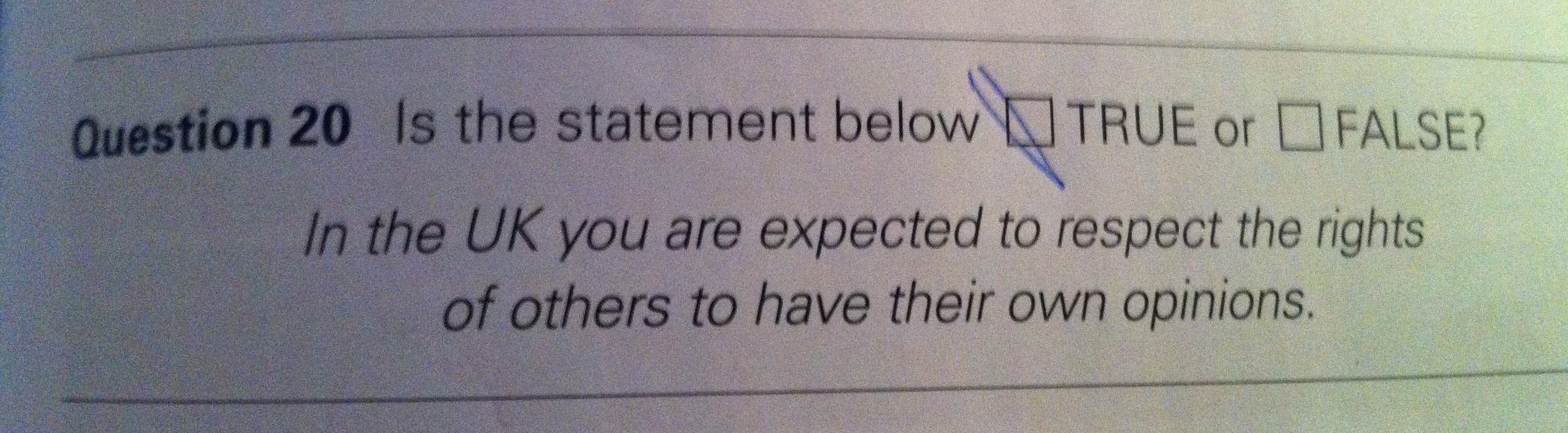
Those politicians, journalists and activists who still seek to police the immigration debate and preordain its outcome could do worse than studying up on this one, known to every new British citizen:
Is the statement below TRUE or FALSE?
In the UK you are expected to respect the rights of others to have their own opinions.
If you enjoyed reading this article, please take a second to LIKE or SHARE it on social media using the buttons below. Help to spread the word and continue the debate.







 Semi-Partisan Politics