Brexit Opposition And The Quiet Death Of Citizenship

It is difficult to have a serious conversation about citizenship in the Age of Brexit when so many people hold a such transactional, materialistic and reductionist definition of the concept as meaning little more than benefits received in exchange for taxes paid

One interesting and overlooked aspect of the Brexit debate is the extent to which the basic concept of citizenship has decayed and virtually evaporated from our public discourse, right under our noses, with barely any note of alarm being sounded in the process.

This decay reveals itself in manifold ways, from the furious pushback one inevitably receives when pointing out the obvious fact that citizens should (and do) have more rights than non-citizens to the outraged, moralising vitriol hurled at anybody who dares to suggest that illegal immigrants are technically lawbreakers and therefore maybe not universally worthy of respect, sympathy or amnesty.

These are now controversial positions to hold. To be steadfast in the belief that British citizenship confers more rights than those held by permanent residents or temporary visitors is to mark oneself out as something of an extremist, at least as far as the media and chattering classes are concerned. Yet many politicians in Britain and America who now wrap themselves in the mantle of conspicuous compassion for all illegal immigrants and effectively agitate for open borders could themselves not so long ago be found calling for tougher immigration enforcement.

This applies to the likes of Hillary Clinton in America, who once supported and voted for the same strengthening of the United States’ southern border which she now denounces as being tantamount to racism. Of course, Clinton has since positioned herself as a tireless champion of the “undocumented”, together with virtually all of the American Left. Similarly in Britain, many commentators who once dared to express reservations about uncontrolled immigration from within the EU have now taken up rhetorical arms against anybody who proposes a more rigorous immigration policy.

In both countries, but particularly in Britain, citizenship is increasingly regarded (to the extent that people think of it at all) as a transactional affair, services rendered for taxes paid – or even rendered with no reciprocity at all in the case of the modern welfare state. The argument goes that by the sole virtue of paying taxes or drawing benefits here one deserves a full voice in the country’s affairs, even if one is a non-citizen or is present in the country illegally.

This very transactional approach has frayed the contract or bond between citizen/resident and the state. Of course, people still expect the state to protect them from foreign foes, guard against domestic security threats, provide healthcare, offer a welfare safety net and distribute various domestic and EU services. But even as they make these demands they offer rapidly diminishing loyalty to the state in which they live. People are increasingly insatiable for the benefits while being less and less willing to accept the responsibility.

This responsibility goes much deeper than just paying one’s taxes. It means making a serious commitment to community and, ideally, the enthusiastic acceptance of and assimilation into one’s home (or adopted) culture. Traditionally, the sign that an immigrant was willing to accept these broader responsibilities was their decision to apply for naturalisation as a citizen. Historically, if an immigrant were to build a life in another country, working and raising a family there, they would ultimately become a citizen of that country in most cases.

But today, many people demand the perks without accepting the responsibilities – hence the outrage of and on behalf of EU citizens who have built permanent or semi-permanent lives here yet refuse to see why they should formalise that commitment through the naturalisation process (or at least the acquisition of permanent residency following Brexit). They forget that the European Union is an aberration, that nowhere else in the developed world would countries offer so much while asking for virtually nothing in return.

Yet to point this out is to invite accusations of callousness and amorality. Of course there are exceptional cases where joint citizenship cannot be taken or some other bureaucratic or financial obstacle stands in the way of an EU migrant formalising their commitment to the United Kingdom. Such cases should be treated generously, with the aim of reducing any uncertainty for the migrants involved.

But this blog has very little sympathy when people demand something for nothing. Freedom of movement and other EU benefits are political entitlements. They are not – repeat, NOT – fundamental, inalienable rights.

A fundamental right is intrinsic to one’s humanity, as applicable to somebody in China, Russia, North Korea or Venezuela as to someone living in Britain. These are best summed up in the US Declaration of Independence as “life, liberty and the pursuit of happiness”, though one can also drill down a level further and acknowledge the universal human right to property, due process under law and so on. Fundamental rights are inherent; political entitlements are nice-to-haves, often given (in the EU’s case) partly as a means of securing support for a dubious political project which would otherwise be utterly unloved.

Of course we should have a degree of natural sympathy for anybody at risk of losing their current political entitlement to live and work in the United Kingdom without going through the arduous and expensive process of applying for permanent residency or citizenship – though a deal between Britain and the EU to secure reciprocal ongoing rights for UK and EU citizens is all but inevitable. Personally, I would offer expedited indefinite leave to remain to all current EU migrants at a greatly reduced fee. But others’ rights as EU migrants do not trump the sacrosanct (though not quite exclusive) right of British citizens to participate in our democracy and determine the course of the country.

The decision of the British people to secede from the European Union can not and must not be vetoed by or on behalf of people who refuse to assume the responsibilities and privileges of full citizenship. That such an obvious statement now sounds harsh or controversial is itself an indicator of how deeply corroded and devalued the concept of citizenship has become in our society. Yet this would have been the mainstream view in Britain a decade or more ago, and still very much is the accepted wisdom nearly everywhere else in the world.

Many Brexiteers – myself among them – did not spend 2016 tirelessly campaigning for Brexit because they hate immigrants, want to kick out existing migrants or even significantly lower net migration. But neither will we allow the protestations of those who refuse to share the commitment and mutual connection of citizenship with us to overshadow or overrule our vote.

This is not extreme, nor is it unreasonable. It is merely the consequence of adhering to the same traditional definition of citizenship which allows us to flourish as a society precisely because we are all bound to one another by something deeper than momentary convenience.

It remains to be hoped that Brexit will spark a renewed discussion about citizenship and the proper relationship between citizen, resident and government – indeed there are some early encouraging signs that such conversations are starting to take place.

But the furious reaction of the establishment Left to political developments both in Britain and America suggests that defenders of the concept of citizenship will be starting at a considerable disadvantage.

 

A British citizenship certificate is seen in London

Support Semi-Partisan Politics with a one-time or recurring donation:

Agree with this article? Violently disagree? Scroll down to leave a comment.

Follow Semi-Partisan Politics on TwitterFacebook and Medium.


Citizenship And The Nation State Remain Relevant, Despite The Efforts Of Their Detractors

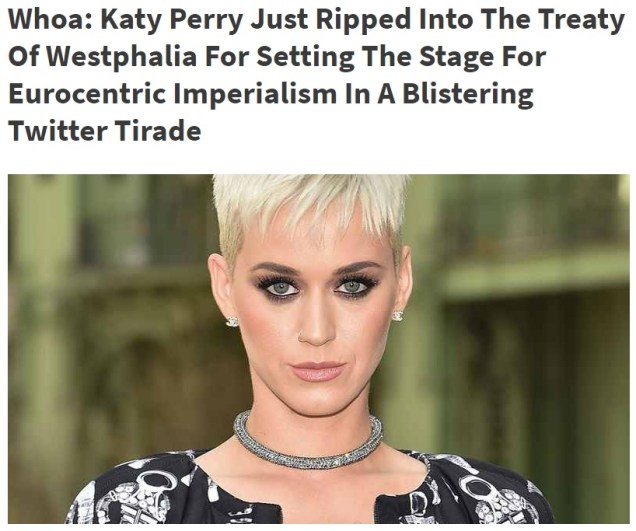
Katy Perry - Treaty of Westphalia - Nation States

There’s life in the humble nation state yet

As the backlash against Brexit grows ever stronger and the Cult of Social Justice and Identity Politics eats away at our national fabric from within, there are many legitimate reasons to fear for the future of patriotism, citizenship and even the nation state itself.

However, there are also a few reasons for optimism, and Rebecca Lowe Coulson sets some of them out in Conservative Home. But first she paraphrases the question that many people are now asking about the continued relevance of the concept of citizenship:

In an increasingly globalised world, however — in which the Westphalian order of nation states is regularly criticised as inward-looking — citizenship is repeatedly denounced as an outdated representation of division and exclusion. It hardly seems necessary to comment that such denouncements typically come from the privileged, within the most economically and politically secure nations. And that, like those Britons angered at the imminent loss of their EU citizenship after Brexit, few “global citizens” seem keen to give up the privileges of their current national citizenships.

Of course, what many of those citizenship-snubbers truly want (like most of the rest of us) is for their own privileges to be extended to those living in less secure places. It is undeniable that great global imbalances remain, even though living standards continue to rise across the world. But then, the question should not be whether the concept of citizenship precludes opportunities in the sense that being a member of one state can be highly preferable to being a member of another, but whether it is still the case that one’s rights and opportunities are best protected and afforded through membership of an individuated state. In a world in which secure states increasingly offer extensive rights to non-citizen inhabitants, aCitind less secure states need more substantial upheaval and help than an improved understanding of the intricacies of membership rules, is the concept of citizenship relevant?

Coulson Lowe then goes on to explain exactly why the concept of citizenship remains relevant, and will not be undermined despite the best efforts of those who see the nation state as an obstacle to be overcome rather than a crucial guarantor of rights:

We all remember how, in her 2016 Conservative Party conference speech, Theresa May said that “citizens of the world” were “citizens of nowhere”. The comment has become symbolic of an approach for which she has been widely criticised: an approach seen both as arrogant, and as attempting to appeal to those on the further right of her party.

At the time, I felt her tone mistaken, in that I would have preferred a use of language implying greater keenness to heal, or at least address pressing divisions within the country. General criticisms of the comment often overlook the argument May was setting out, however. The words came within a section about the “spirit of citizenship”, and read, in full: “But if you believe you’re a citizen of the world, you’re a citizen of nowhere. You don’t understand what the very word ‘citizen’ means”. Surely, it is that forgotten second sentence that is key, here. And that the point May was in the midst of making was about the importance of “respecting the bonds and obligations that make our society work”.

The state, and the society that exists within it, still matters profoundly to those people who aren’t happy with the countries they call home .. Official membership of such societies is conferred in different ways: from the automatic rights of familial lineage to the successful passing of a test. But the standard way of gaining the citizenship of a state is by being born and growing up in it. For those of us fortunate to count somewhere like Britain or Australia as that place, it can be easy to take for granted the relative privileges this affords us.

Yet most of us see that the uncertainties and risks of life make it expedient for us to live together in societies, and that, as social creatures, it is natural for us to want to do so, over and above that expediency. The advancements of the past centuries — in communication, travel, science, military capabilities, commerce, and on — have made it impractical for societies to remain limited to the family groups, villages, or cities they once were. The continuation of that advancement does not mean that our embrace of the nation state must also become outdated, however. For simple reasons of functionality — not to mention the more complex, such as those related to culture or national identity — it is hard to see how bigger blocs or idealist internationalist approaches could work.

This is what many on the Left fail (or are unwilling) to grasp. The Westphalian concept of statehood and sovereignty (combined with 19th century concepts of nationalism) survive the test of time because they work with the grain of human nature rather than against it. Rather than pretending against all available evidence that somebody from country A has as much in common with someone from country Z as their next door neighbour, the system of nation states is a tacit admission that the human instinct to be part of a social communities mean that harmony is best achieved when systems of government are aligned with societal boundaries. And indeed, when there is a mismatch between government and society, nation states have often split and reformed in response.

But the bigger blocs and non-state actors championed by the nation state’s detractors will not become a viable replacement in the foreseeable future, precisely because an entity’s democratic legitimacy and popular support are derived from having a demos which identifies as a cohesive whole and consents to being governed at that level.

The United States works as a country because US citizens see themselves as American first and foremost, and not Californian, Texan, Iowan, Alaskan or North Carolinian. The United Kingdom survived the 2014 Scottish Independence referendum because a majority of Scots (just about) considered themselves British as well as Scottish, if not more so.

Supranational blocs do not command this sense of loyalty or commonality among the people they nominally represent, as the European Union discovered with Brexit and will continue to discover as member states chafe against one-size-fits-all dictation from Brussels. Brexit occurred because the European Union’s drive for ever-closer union and a grander role on the world stage was plain for all to see, and the majority of voters who consider themselves more British than European wanted no part of it.

The “if you build it they will come” approach – where ideological zealots construct all the trappings of a supranational state in the hope or arrogant expectation that a common demos and sense of shared purpose will follow on automatically – has been proven to be nothing more than wishful thinking.

And this is a good thing, because as Rebecca Lowe Coulson correctly observes, supranational and non-state actors have generally proven themselves far less able to effect change than unilateral, bilateral or multilateral efforts by nation states with common purpose. The very nature of trying to shoehorn the competing national interests and priorities of multiple countries into a “common” foreign, fiscal or defence policy gives rise to resentment, suboptimal outcomes (such as stratospheric youth unemployment in Southern Europe) and inevitable net losers.

And yet the myth persists – amplified by bitter Remainers and much of the corrupted civil liberties lobby – that cooperation between countries is only possible under the umbrella of supranational government, and that these non-state actors are somehow a better guarantor of individual liberties than nation states themselves.

Take this hysterical email recently sent out by “civil liberties” organisation Liberty:

Yesterday we took another huge step towards our withdrawal from the European Union as the Government published the Repeal Bill.

If the Bill passes in its current state, people in the UK will lose rights after we leave the EU. It’s that simple and the stakes are that high.

The vote to leave the European Union was not a vote to abandon our human rights.

Yet the Repeal Bill includes worryingly broad powers for ministers to alter laws without parliamentary scrutiny and contains no guaranteed protections for human rights. Worse, it takes away the protections of the Charter of Fundamental Rights without ensuring that we will continue to protect all of those rights in the UK after Brexit.

Every single right we have now needs to stay on our statute books – from those contained in the EU Charter of Fundamental Rights, to equality protections we’ve gained from our membership.

Liberty – and other groups who are content for British citizens to have “rights” imposed on them from above rather than argue for and win them at a domestic level – see supranational organisations as a convenient bypass for national democracy. If the stupid British people are too dumb to vote for more employment protections and other government treats, this line of thinking goes, then advocacy groups who know better should just go over their heads to the EU. This is profoundly undemocratic, but more than that it only affirms the dangerous idea that our rights should be granted by government (at any level) rather than being innate and inalienable.

This is utterly wrong, as I explained back in 2015:

The new, emerging institutions which will replace them are being designed behind closed doors by small groups of mostly unelected people, as well as the most influential agents of all – wealthy corporations and their lobbyists. We have almost no idea, let alone influence, over what they are building together because instead of scrutinising them we spend our time arguing over the mansion tax or the NHS or high speed railways, which are mere distractions in the long run.

The liberties and freedoms we hold dear today can very easily slip away if we do not jealously guard them. By contrast, power is generally won back by the people from elites and powerful interests at a very heavy price – just consider Britain’s own history, or the American fight for independence from our Crown.

The yawning gap in the argument of those who would do away with the nation state is how they intend to preserve democracy in its absence (assuming they even care to do so). Even many of the EU’s loudest cheerleaders concede that the current institutions are profoundly undemocratic and unresponsive to popular priorities or concerns – this tends to be expressed through an exasperated “of course the EU needs reform!”, sandwiched between odes of love and loyalty to the very same entity, as we witnessed countless times during the EU referendum.

But what that reform actually looks like, nobody can say. Or at least, those few tangible visions for a future EU which do exist are so unmoored from reality as to be little more than idle curiosities – see former Greek finance minister Yanis Varoufakis’ DiEM25, which contends both that the European Union can be persuaded to undertake meaningful reforms (ha!), and that this reformed EU should then amplify left-wing priorities to the exclusion of all others (how very democratic).

If you want to do away with the concept of the nation state or actively agitate for its demise then I think you have a responsibility to state clearly and unambiguously what you would have in its place before pushing us all into the undiscovered country. Yet the assorted citizens of the world, so anguished by Brexit, refuse to come up with an answer – at least not one which they are willing to utter in public.

The European Union is not a static entity – it is an explicitly and unapologetically political project moving relentlessly (if erratically) toward the clear goal of ever-closer union. If this is not their preferred outcome for Britain and all other nation states (and few pro-EU types will admit that this is what they want) then it is incumbent on them to offer an alternative goal with a politically viable means of achieving it.

And until they do so, the assorted enemies of the nation state do not really deserve a hearing.

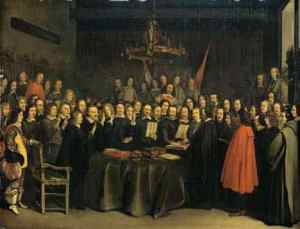
Treaty of Westphalia

Support Semi-Partisan Politics with a one-time or recurring donation:

Agree with this article? Violently disagree? Scroll down to leave a comment.

Follow Semi-Partisan Politics on TwitterFacebook and Medium.

The Left’s New Cunning Plan: Pretend To Support Brexit, Then Sabotage It Later

Brexit Saboteur - Remain - Establishment

Someone needs to tell the pro-EU centrist establishment that plotting an establishment usurpation of democracy in public isn’t the smartest strategy

You have to admire the chutzpah of the establishment centre-left right now. Last week they publicly advanced their super clever idea for Remainers to pretend to make peace with Brexit in order to regain credibility with the public (but only in order to sneakily backstab the whole enterprise a few years down the line).

No, seriously:

An increasing number of Remainers are attracted to an alternative strategy. After a lengthy transition, they argue, voters should be offered a choice between a new EU trade deal and re-entry under Article 49 of the Lisbon Treaty. By the mid-2020s, Remainers calculate, the risks of Brexit will be clearer and the original referendum will be a distant memory. The proviso, they add, is that the EU would have to allow the UK re-entry on its existing membership terms (rather than ending its opt-outs from the euro and the border-free Schengen Area).

Rather than publicly proposing this plan, MPs are wisely keeping their counsel. As they know, those who hope to overturn the Brexit result must first be seen to respect it.

Interesting. So let me get this straight:

Step 1: Pretend to accept the EU referendum result.

Step 2: Work furiously behind the scenes to overturn it in a few years’ time.

Step 3: Keep the whole dastardly plot a secret, so that nobody finds — oh, too late.

And today we see another confession from the Left, this time that they plan on pretending to be on board with the outdated and embarrassing ideas of patriotism and pride in Britain – because their stupid, backward working class base insist on clinging on to those foolish notions. Again, this was done in public.

Alessio Colonnelli over at LabourList begins by stating exactly what he thinks of the backward and dangerous concept of patriotism:

Brexit is a bout of extreme patriotism; an angry Pamplona bull you can’t really grab by the horns. You run away from it, then hide and watch it thunder past. Overwhelmed by it all, gasping for air, the only question left is: how to make the best out of this situation?

This is a promising start – not merely suggesting that the patriotism felt by a majority of Brits is irrational or a hankering for lost empire (the familiar trope from Remainers), but that it resembles an angry charging bull.

Colonnelli continues:

Having lost millions of voters in northern England, Wales and Scotland in between 2010 and 2016, the red party has started doing “patriotism” a bit more. It would be very worrying if it were not so. It’s a card one has to play, given the circumstances. Make no mistake: Machiavelli would pat you on the back for doing that. Whatever it takes, so his lesson goes. Besides, it’s not as if a dash of mild jingoism was ever alien to Labour throughout its history – Hugh Gaitskell was never enamoured with Europe either, after all.

The thing about Machiavelli, though, is that he didn’t advocate that politicians announce their dastardly plans in public before executing them, or make it painfully obvious that they are only pretending to get along with the target of their deception. He assumed that geopolitical actors would have a sufficient baseline of intelligence that pointing this out wasn’t necessary.

Not so for Alessio Colonnelli though, who tells us exactly what he thinks about patriotism, declares that he sees it as a form of “mild jingoism” in which the metro-left should nonetheless pretend to partake for the sole purpose of tricking Brexiteers, and then titters to himself that he is somehow pulling one over on those of us who campaigned and voted for Brexit on the grounds of democracy, sovereignty and patriotism.

He continues:

Occasionally, as we all know, the centre of politics shifts, and momentarily weaker outfits are forced to follow the changes – the zeitgeist. It happens everywhere. In Britain, the centre has moved towards the right over the past seven years (with Ukip’s crucial help), and you would expect social democratic organisations to do something to counter this while playing along to the new tune for a bit and sneakily carving out a new space.

How brave. How principled, to pretend to agree with a current political trend that you find objectionable rather than standing up to it with courage and conviction. First I am astonished that Colonnelli believes that the political centre of gravity has shifted to the right lately, given the fact that Theresa May completely blew the general election, Jeremy Corbyn surpassed expectations and the public seem to be signalling that they are getting tired of this whole austerity thing. But presumably he is talking exclusively about Brexit, which in his two-dimensional mind he sees as being a right-wing phenomenon rather than a democratic one.

In all seriousness, though, there is an interesting contrast between the way that the Left is responding to populist setbacks on either side of the Atlantic. In Britain, we do see the stirrings of this attempt to reach out to Brexiteers and others for whom patriotism is not an embarrassment (the Somewheres, to use David Goodhart’s terminology) – even if it is only a transparent ruse designed to trick them.

This almost certainly would not be the choice of most of the Parliamentary Labour Party, who hold Brexiteers in barely disguised contempt and who wear their fawning, unconditional love for the EU like a badge of honour. But Labour’s centrist MPs are constrained in what they can do because Jeremy Corbyn, their leader, is a eurosceptic at heart and set the tone in the 2017 manifesto that Labour would support Brexit.

In the United States, however, the Democratic Party – despite having thrown away the White House, a minority in Congress and severely weakened in state government – shows no signs of being ready for a rapprochement with the voters that their standard bearer Hillary Clinton once called “deplorable” and “irredeemable”. If anything, the American Left seems increasingly determined to publicly double down on the divisive identity politics messaging which alienates middle America and saw the Democrats lose the Rust Belt (with the exception of a few brave voices in the wilderness, like Mark Lilla).

Two different approaches – on one hand an attempt to understand voters and meet them where they are (even if only as part of an elaborate and cynical deception), and on the other hand a perplexing decision to furiously lash out at the electorate and double down on the same old failed identity politics strategy.

Neither populist insurgency is going tremendously well right now – in Britain, the Conservative government seems determined to enact the most ruinous and disorderly version of Brexit possible, while in America Donald Trump is simply being Donald Trump. This might represent fertile territory for a left-wing party which actually knew what it was doing, a movement which wasn’t consumed by blind fury at being ignored by the electorate and cast unexpectedly from power.

The question is, when will the Left cease their temper tantrum, grow up, regain their senses and try being effective opposition again? Because surely it will happen eventually, and that will be a bad day for the populists.


Remainer paints EU flag on her face - European Union - Brexit

Support Semi-Partisan Politics with a one-time or recurring donation:

Agree with this article? Violently disagree? Scroll down to leave a comment.

Follow Semi-Partisan Politics on TwitterFacebook and Medium.

Remainers: You Can Stop Pretending To Be Patriotic Now

Jonn Elledge - Democratic World Superstate - Brexit

A rare moment of honesty from an arch-Remainer

New Statesman staff writer Jonn Elledge – whom I recently described as “worse than a garden variety xenophobe” for his heinous statements about elderly Brexit voters, much to his indignant outrage – has been engaging in a minor Twitter spat with Tim Montgomerie this afternoon about the nature of Brexit.

This would be utterly unremarkable, but for one inadvertently revealing tweet in the exchange in which Jonn Elledge revealed in a moment of strange candour the real reason that establishment Remainers love the European Union and cannot conceive of a life outside of its cloying embrace.

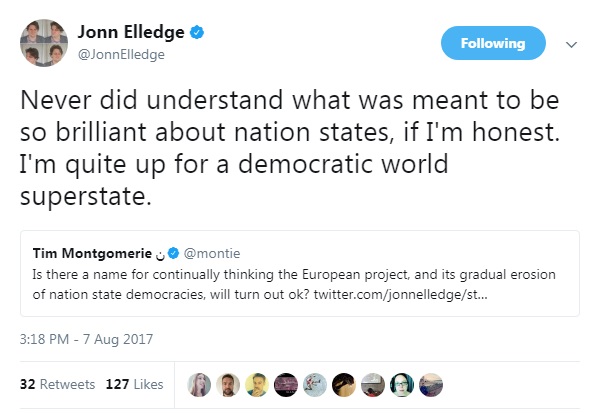
Pressed by Montgomerie, who asked “Is there a name for continually thinking the European project, and its gradual erosion of nation state democracies, will turn out ok?”, Elledge replied, simply and honestly (for once) “Never did understand what was meant to be so brilliant about nation states, if I’m honest. I’m quite up for a democratic world superstate”.

This is an appallingly ignorant and historically illiterate statement, the kind of sentiment that could only be uttered by somebody who enjoys all the benefits of living in the age of the modern democratic nation state without pausing for a moment to consider the true source of all his comfort (hint: not the EU). Would Elledge at least concede that the nation state is a slight improvement on the city state? The multiethnic empire? The dynastic kingdom? Marauding tribes? He is at pains not to say, and yet is quite ready to roll the dice, jack in the nation state and try something new without really giving it a moment’s thought.

And there it is, ladies and gentlemen. Finally, a moment of honesty from the arch-Remainer side of the argument. Of course, those of us who followed the EU referendum debate closely and saw through the paucity and desperately narrow scope of the Remain side’s argument (focused almost entirely on negative scaremongering about trade with occasional rhetorical flourishes about “cutting ourselves off from the world”) knew that something deeper was motivating the EU’s loudest cheerleaders.

But of course Jonn Elledge and his co-conspirators could not admit their dirty desire in public during the referendum. They could not simply admit the truth – that they have no respect or appreciation for the nation state and its role in guaranteeing our core freedoms and liberties, and that they would sooner consign nations to the grave so long as they and their ilk could preserve their current perks and become true citizens of the world.

To admit their scorn for the nation state and eagerness of its demise would have been suicide during the EU referendum. Thus their only hope was to pretend to be patriotic and to have a love for this country and its many positive qualities (some of them are still continuing the pretence to this day to maintain their credibility in the hope of winning a potential second referendum) while secretly loving the EU precisely because it actively undermines nation states by design.

But of course the one world government (or “democratic world superstate”) longed for by Jonn Elledge (and no doubt many other Remainers in the secrecy of their own hearts) is totally impractical in any case, working against human nature rather than with it, as all Utopian left-wing pipe dreams tend to do.

Consider the case of the United States of America, fifty states combined into one great nation, bound together under the motto E Pluribus Unum (out of many, one). When it comes time for presidential elections, Americans do not stubbornly vote only for candidates from their own state, but instead choose from the candidate whose policies they prefer from any of the fifty states. A Californian might vote for a candidate from Illinois without so much as a second thought, knowing that the candidate will represent all of America if elected. Americans can do so in confidence because their sense of being American is stronger than their sense of being an Iowan, New Yorker, Nevadan or even Californian or Texan, the two states with the strongest sense of separate nationhood.

Now imagine an election for Leader of the World. Do you think that people from countries as diverse as Britain, Mexico, Malaysia, Russia, Greece, Kenya and Japan would vote high-mindedly for the candidate who offered the best suite of policies, regardless of his or her nationality? Would it even be likely that a candidate would offer a fair suite of policies rather than a manifesto geared toward benefiting his or her home nation? Of course not. Cultural differences are far more significant across national borders (despite the furious efforts of pro-EU “citizens of the world” to pretend otherwise), and out of protectionist instinct people would inevitably want to vote for a candidate from their own country, or at least a sympathetic country.

And who can say that they would be wrong to do so? Is Jonn Elledge seriously contending that he would be happy for the world to be led by a member of the Chinese Communist party? Or by a Putinesque Russian oligarch? Or a theocratic Saudi cleric? Of course he wouldn’t. Elledge, in his disdain for the nation state and desperate need to virtue-signal his abhorrence of patriotism, paints a fraudulent world of rainbows and unicorns where all cultures are equally praiseworthy and deep-seated cultural and religious differences are non-existent. Again, working doggedly against human nature rather than working practically with it.

There can be no world government because there is, as yet, no world demos. One day, probably quite far in the future, this may change. And that may be a good thing when it eventually happens. But we are not there yet, and to pretend that a “democratic world superstate” is either viable or desirable is foolishly naive as well as being oxymoronic – you can either have democracy or a world superstate, but not both.

I wrote about the ongoing importance of the nation state at some length back in 2015:

The liberties and freedoms we hold dear today can very easily slip away if we do not jealously guard them. By contrast, power is generally won back by the people from elites and powerful interests at a very heavy price – just consider Britain’s own history, or the American fight for independence from our Crown.

If we want to have a say in designing the new institutions that will govern our politics, trade, intra-bloc affairs (for we soon may not call it “foreign relations”) and other issues, we need to put the brakes on the demise of the nation state while we take stock and think about the future that we want, so that we do not end up in the future that our leaders and elites are building now in secret, without our consent.

Even if you find patriotism silly and the importance that conservatives attach to symbols and rituals to be absurd, it is still in your interests to slow down the juggernaut of European integration so that you too can help design the world our descendants will inhabit. You may laugh at the latest sensationalist Daily Mail headline, or think Nigel Farage a fool when he stands in his local pub, resplendent in tweed, drinking a pint of English ale. And that’s fine, you can laugh.

But think about what the world will be like in one hundred years, with its new technologies and services and ideas. Think about what innovations there will be in healthcare and banking and computing (and data collection) and travel. And then think about how much oversight and control we have over any of these things even today, in 2015. It it enough?

Imagine, then, the world of 2115. What institutions will then exist to safeguard our children’s  interests, and which bodies and authorities will they petition for redress of grievances? Who will control foreign relations between whatever nation states or multinational trading blocs remain, and who will decide whether to wage war using whatever unimaginable weapons we have conceived a century from now?

Do you entrust the EU with these powers? The World Trade Organisation? The United Nations?

The answer to this final question is apparently a resounding “yes!”, at least as far as Elledge is concerned. Any international or supranational institution is brimming over with legitimacy and ability to solve “a lot of stuff the nation state can’t do” in the mind of hardcore ideological Remainers, while the despised nation state offers nothing but insularity, bigotry and nationalism.

The naivety on display here is quite simply off the charts. Obviously it is one of the defining characteristics of those on the Left to leap towards radical change without stopping to think through the consequences, but to show a willingness to do so with something as fundamental as abandoning the nation state as the basic building block of human society is reckless indeed. Especially since neither Jonn Elledge or anybody else has proposed a viable alternative.

It is one thing to rage against the status quo and advocate for radical change. But to sneer at the nation state, close one’s mind to the stability and prosperity it has delivered and advocate for One World Government without even beginning to think through the consequences and practicalities should destroy once and for all whatever credibility Jonn Elledge and his ideological brethren have left.

And still we should be grateful. For too long, ideological establishment Remainers have walked a tightrope, angrily proclaiming that they are as patriotic as the next man (and taking great offence when the impossibility of this statement was pointed out to them) while doing everything in their power to ensure that the nation state is weakened, together with the fraying bonds which hold our society together. Now, finally, the mask is slipping. Whether through a moment of frustration or deliberate design, the real motivations are now being unmasked.

Now we see the hardcore ideological Remainers for what they are.


European Union - United Kingdom - Britain - Flags

Support Semi-Partisan Politics with a one-time or recurring donation:

Agree with this article? Violently disagree? Scroll down to leave a comment.

Follow Semi-Partisan Politics on TwitterFacebook and Medium.

Happy Independence Day

Happy Independence Day

And to all those Americans (looking at you, New York Times) celebrating their wonderful country’s independence today while looking upon Brexit as some terrible catastrophe – why would you deny your closest and most reliable ally the same sovereignty and freedom which you rightly demand for yourselves?

How does your unthinking, slavish devotion to this fraying, discredited world order honour the bold legacy of the Founding Fathers?


America! America!
God mend thine ev’ry flaw,
Confirm thy soul in self-control,
Thy liberty in law.


Britain United Kingdom - United States of America - USA - Independence Day

Support Semi-Partisan Politics with a one-time or recurring donation:

Agree with this article? Violently disagree? Scroll down to leave a comment.

Follow Semi-Partisan Politics on TwitterFacebook and Medium.