Olympics Past And Present

Today seems to be the day to look back at Olympic Games past and marvel how far we have come. Both NPR and Slate have pieces documenting the differences in styles, fashions and sporting events that a spectator might have seen at the Olympics in 1908 and 1912 respectively.

NPR looks at the 1908 London games, the first time that the United Kingdom’s capital hosted the competition:

Topical Press Agency/Getty Images

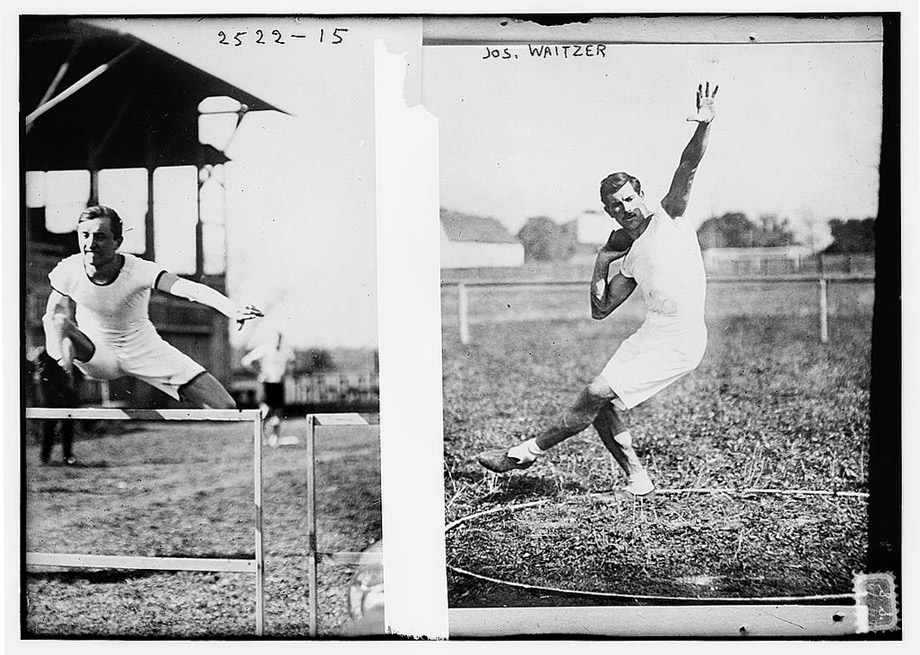
Slate reviews the following games, which took place in Stockholm in 1912:

Flickr Commons project and database, 2008, via Library of Congress.

They go on to explain:

… the 1912 Stockholm Games were “the last Olympics where any individual could just turn up and hope to enter a competition.” In that era, the idea that “natural” skill might enable someone to win a competition without any specialized training was still widely embraced.

As I sit in my living room with twenty four high-definition BBC channels showing almost every Olympic event taking place live, with commentary and instant replay and now apparently optional 3D, it is nice to appreciate what we have now, but also to look back at a time when people were happy to be entertained by watching the tug-of-war and a master of ceremonies wielding a megaphone to address the crowds.

Only In Britain

Isabel Hardman, writing in The Spectator’s Coffee House blog, is concerned that government ministers do not have any real power to effect changes to the London Olympic Games seating policy that would correct the scandal of so many seats remaining empty during popular and supposedly over-subscribed events:

The problem for ministers is that they do not have any official influence over this matter. Jeremy Hunt made this clear when he appeared on the World at One a few minutes ago. He said:

‘We want to be completely upfront with the public, this is a negotiation, we don’t have a right to demand these back, in fact contractually these seats do belong to the International Sports Federations and to the IOC. But, we got 3,000 back last night, including 600 for the gymnastics.’

Meanwhile, the Number 10 spokeswoman repeatedly said today that ‘this is a matter for Locog’, although when asked whether the government was powerless to change the seating situation, added: ‘We have influence: it’s the government.’ Whatever that influence is, it’s in the government’s interest to exert it as powerfully as possible: the public is unlikely to discriminate between ministers and Locog officials when apportioning blame for those empty chairs.

Come on, Spectator. Your Coffee House blog is one of the things that keeps me sane when I’m following British politics. You espouse sensible, Conservative, common sense solutions, and you echo my own beliefs that government doesn’t need to run everything.

The British government has already done enough for the Olympic Games organisers, even going so far as suspending the right to free speech and freedom of expression in some cases with provisions banning small businesses from using certain words or phrases which, if uttered by a non Olympic sponsor, would now constitute a criminal offence.

Of the various possible culprits responsible for the fact that far too many seats at Olympic events remain empty despite massive demand from the British public, David Cameron or Jeremy Hunt’s respective doorsteps are probably the last place I would think of pinning the blame. I would dare to believe and hope that a majority of Brits, despite Gordon Brown’s attempts to turn us into a state dependent society, also would not look to government to be the solution to this or every other problem, even ones that may impact on our national prestige.

Maybe in the case of the “empty seat fiasco”, the British people are not looking to the government for a solution, but to the people organising the Olympic Games. A quick solution, brought about by the people responsible for the problem.

A Queen’s Work Is Never Done

Buzzfeed Sports have what I’m sure they thought would be a funny piece cataloguing the Queen’s sixteen most excited faces captured during the recent opening ceremony for the London 2012 Olympic Games. This is obviously in reference to the numerous remarks by commentators that Queen Elizabeth II seemed less than enthralled or impressed by many of the goings-on in the stadium.

However, as I started to look through the pictures I became more convinced that the bored and often distant facial expressions are much more a symptom of tiredness than boredom. And not just day-to-day tiredness, but a rather more profound one.

Take this, for example:

Image by Pascal Le Segretain / Getty Images

Here, the Queen is declaring the London 2012 Olympic Games officially open. This was a joyous moment, but I believe she spoke fewer than twelve words.

Or this one:

Image by WPA Pool / Getty Images

And compare these to this image of the Queen at the Commonwealth Games in Manchester, a decade ago:

Her Majesty Queen Elizabeth II. Photograph: Ryan Pierse/Getty Images

Of course, she continues to fulfil all of her duties as head of state superbly, and beyond reproach. But, quite understandably, a decade older and with her husband in failing health, and fresh from an exhausting list of Diamond Jubilee commitments, she does appear to be slowing down markedly.

All of which is perfectly fine, but for the fact that more and more of her duties are likely to fall to her heir, the organic food-loving, modern architecture-hating, idiosyncratic Prince Charles.

Ah well.

The Real Austerity Games


To the leadership of the Public and Commercial Services Union, and their leader, Mark Serwotka:

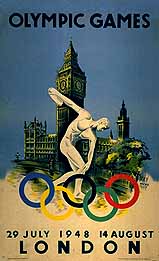
They called the 1948 Olympics the “Austerity Games”.

Britain in 1948 and during the preceding war was the closest that this country has come to real austerity in living memory. Milk, meat, butter, sugar, tea, and sweets were still rationed – as, I believe, were bread and clothing. Many British cities still bore very visible scars from bombing during the Second World War. Thirty years later, some of those scars would still be there.

We couldn’t afford to build a single new sporting venue, or an Olympic Village to house the visiting athletes – they had to avail themselves of pre-existing accommodation.

We were such a weary and depleted nation at the time, that we seriously considered giving the Games to our friends and allies, the United States, to host.

THAT was austerity.

And yet we pulled together as a nation, and opened our doors to the world for the 1948 games of the XIVth Olympiad.

Based on a membership turnout of 20%, you decided to threaten and then lead a strike of UK Border Force customs and immigration officials in an attempt to blackmail better pay and conditions out of the British government, and to further your anti-privatisation, ideological agenda. Creating havoc at UK airports and other points of entry in the immediate run-up to our country playing host to the Olympic Games for the third time.

Go to hell.