–
The deadly inferno at the Grenfell Tower apartment building revealed more systemic and political failures than those relating purely to fire safety
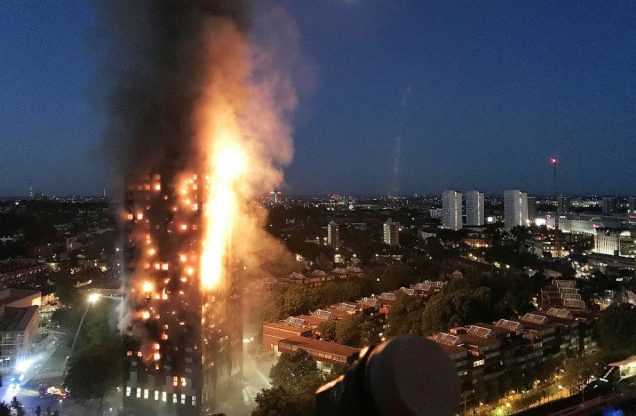
I woke up early on Wednesday morning with the television still playing, the BBC News Channel showing a long shot of a burning tower block with a plume of smoke drifting away across the skyline. It looked like a miniature version of 9/11. Then came the close-up shots taken overnight as the inferno raged, the entire exterior of the building in flames, with people still clearly trapped in their apartments. It was a vision of hell.
This disaster – aptly described as “Dickensian” by Brendan O’Neill – has clearly exposed huge safety concerns when it comes to building codes and fire regulations, particularly with the type of external cladding which has increasingly been widely used to soften the harsh edges of 1960s Brutalist concrete architecture in towns and cities across Britain. I have often remarked to my wife how much nicer the serried ranks of tower blocks in nearby Swiss Cottage look with their new exterior cladding – one can only imagine the trepidation that their occupants must be feeling now, having seen Grenfell Tower burning like a torch.
Predictably, there was a rush to point fingers before the flames had even been extinguished. The Left is naturally running with the theme that the blood of the victims is on the hands of the Evil Tories, as though Theresa May had been secretly abseiling up and down the tower at nighttime, sloshing accelerant across the surface of the building before the blaze. This is deeply unhelpful. Clearly some calamitous decisions and errors have been made, and it may well be the case that criminal liability comes into play. But making a partisan issue out of a mass casualty incident before any facts are known is cynical and wrong.
Brendan O’Neill is quite right when he says:
Such a staggering loss of life in West London, worse than we yet know, and all that observers can think to say in response is “Tory scum” and “We love Corbyn”. The gap between the largeness of this calamity and the smallness and self-interest of the political response to it is vast, and increasingly nauseating. It’s as if the General Election is being restaged on the smoking rubble. I cannot remember any other national tragedy being marshalled so quickly to the cause of petty party politics. It’s dreadful. London deserves a better discussion of this horror.
Pete North does a good job of stepping back and looking at the broader systemic issues rather than seeking to pin the blame on any one person:
So Grenfell Tower is going to be heavily politicised. It’s austerity, it’s private greed, it’s too much regulation, not enough regulation, Toories and blah blah blah.
Rather looks to me like it is a toxic combination of all of the above. The outer cladding is to do with meeting thermal requirements as set out in regulation, fireproof panels were stripped out to meet requirements on asbestos and corners have been cut all over the shop.
Ultimately the failure lies with the local inspectorate. They will blame “austerity” because that’s the convenient scapegoat but ultimately it’s negligence and bureaucratic indifference. The same factors we see in many other scandals involving local authorities.
I did see that a blogger had been threatened with libel for raising the alarm. The claims made were indelicate and probably did fall foul of defamation law, but ultimately the council, probably environmental health, have utterly failed to respond to the concerns of residents. The usual institutional lethargy and arse covering we saw in Rotherham. Anything but admit fault. Similar to my own experiences when trying to confront lawbreaking bailiffs.
This seems to be how things are. Only when there is an egregious failure do we see any real activity – and is soon brushed under the carpet as soon as the immediate risks and liabilities are covered. Then it’s just a matter of time til it happens again. I would say this is a sign of the times, but actually, I don’t ever recall a time when it was any different.
The incident has been described as an accident waiting to happen. I concur. Somebody somewhere is responsible and that person needs to go to jail. Until there are serious consequences for failure we can expect this will happen time and again. But then we say this every time, don’t we?
Ironically, many of those blaming the Evil Tories are likely the same people who patrol Twitter after a terrorist attack, calling out anybody who dares assume that the perpetrator is a Muslim extremist. People who counsel calm and urge others to suspend their judgment when it comes to Islamist terror but are happy to convict conservatives of murder without trial when there is a terrible fire have a truly warped moral code, and one can have no meaningful engagement with them.
Of course, Theresa May has once again been her own worst enemy. I am increasingly coming to the conclusion that Theresa May has simply lost whatever mojo she once had. It’s inexplicable and it happens in the blink of an eye, but sometimes a politician or leader can go from appearing vaguely competent to looking like an utter clown for no discernible outside reason. Why else would the prime minister tour the disaster site, speak to emergency service personnel but fail to publicly meet with residents? Why allow Jeremy Corbyn to become the nation’s de facto Healer in Chief and cement her own reputation as cold, aloof and unwilling to risk unscripted, difficult interactions with people suffering real hardship?
There is simply no recovering from the nadir to which Theresa May has sunk. Humiliated on the world stage having undercut her own authority by calling an election and then losing her majority, stripped of any real authority within her own party and unable to push forward with much of her own pitiful domestic agenda and still displaying the emotional intelligence and charisma of an old sock, this is just untenable.
The prime minister’s unravelling is as astonishing as it is appalling, and while none of her likely successors are remotely better in terms of policy, she nonetheless has to go. A 21st century democracy, particularly a major nation wishing to influence world affairs and defend widespread global interests, simply cannot be led through difficult times by a natural introvert halfway through a political self-destruct sequence.
May’s shameful failure to talk with and be filmed among the survivors of the Grenfell Tower fire is just the latest example of the prime minister’s failure to “engage her humanity”, as Michael Portillo scathingly put it on television this evening. Sometimes as a leader you have to show up and just be among your people, even if many of them rather hate your guts.
Consider US Vice President Mike Pence and Missouri Governor Eric Greitens actively mucking in and helping to sweep up damage caused by vandalism at a Jewish cemetery in St. Louis. Or consider Governor Greg Abbott of Texas, who despite suffering third degree burns from an accident while on vacation still managed to leave the hospital and travel to Dallas to show solidarity and leadership after five city police officers were shot and killed in an ambush.
Do such gestures make an actual practical difference to disaster responses? Not really. But they are highly symbolic and can make a huge psychological difference. Pictures speak volumes, as any leader worth their salt knows. And today’s most memorable pictures showed Jeremy Corbyn hugging sobbing survivors of the Grenfell Tower fire, while Theresa May’s motorcade briefly swept in so that she could stare at the charred building and confer with fire chiefs before whisking her back to Downing Street without the prime minister having to risk any difficult human interaction. The incompetence and cowardice from a basic leadership perspective is simply off the charts.
But the Grenfell Tower disaster has exposed potential issues with leadership not just at the national level, but at the local government and community level, too. From the reports I have seen on the news, together with the personal account of a friend who spent today volunteering at one of the community centres processing donations for the Grenfell Tower displaced families, it sounds as though the aid response – so well-intentioned and earnestly given – has nonetheless been worryingly disorganised at times.
I happened to be living in the American Mid-West when a huge tornado ripped through the town of Joplin, Missouri back in May 2011, killing 158 people and levelling entire neighbourhoods. Driving into town a few days later, it looked for all the world as though an atomic bomb had gone off. Whole blocks of houses were reduced to matchsticks. Big box retail stores had been blasted away so that only their steel frames remained standing. Even big, solid buildings like churches and a concrete-constructed hospital were damaged beyond the point of repair.
And yet within almost no time, there was real organised and disciplined aid on the ground, delivering help and comfort to people who needed it. Charities like the American Red Cross and Samaritan’s Purse sent convoys of trucks with aid and facilities such as washing machines and tumble driers so that people suddenly made homeless could do their laundry. Medical trucks administered tetanus shots to people, like me, who mucked in to assist with some of the repairs. The insurance companies sent mobile offices on the back of trucks to process damage claims. Churches organised the making and delivering of meals to those who needed them. And crucially, mobile command centres helped to coordinate the response, so that the appropriate help reached people who needed it while avoiding duplication of effort wherever possible. Honestly, the response was a sight to see and something I’m not likely to ever forget.
Some of this we have also seen take place in West London in response to the Grenfell Tower fire. Apparently more than £1 million has already been donated to various appeals and JustGiving sites, which is astonishing – as have been the number of donations of physical goods such as clothes, shoes and food.
But still it seems as though the coordination part is not yet fully in place. My friend noted that donations of clothes and toys were being collected but then sent haphazardly to different locations around the city, with no real understanding as to where the aid was most needed or where displaced families would end up. And volunteers arriving to help reported a lack of coordination at the various scattered sites – perhaps understandable, and certainly not a real impediment to mucking in and helping wherever there are obvious tasks to perform.
My friend spoke of volunteers who offered their own vans and trucks to the relief effort, but who ended up largely driving back and forth quite aimlessly, shuffling donated goods around the city with no sense of the broader plan, rather than transporting them in a coordinated way for sorting and redistribution. She spoke of fresh fruit and perishable food being delivered with no capacity to receive, store or refrigerate it. She spoke of people with significant social media followings successfully hitting up companies for funds and goods, which is fantastic – but begs the question of why the job of getting companies to donate phone chargers and other useful items was left to proactive individuals rather than being an integral part of a pre-written disaster response plan.
Accounts that I have heard suggest that overall ownership and accountability for the humanitarian response is falling down the cracks between national government, local government and the charities and community groups which are doing much of the delivery on the ground. Politically, this makes sense – nobody wants to have ultimate responsibility for emergency accommodation or the health and safety of evacuees, because there is only risk and no political upside. Kensington and Chelsea borough council have no desire to be the primary public face of the response, and nor does the Westminster government – particularly the weak government-in-flux that emerged from the general election. That leaves well-meaning community groups to do the hard work of coordination, for which they are perhaps not best suited, backed up by various charities.
Now compare this disorganisation to the scene at US airports when Donald Trump’s ill-considered travel ban saw hundreds of travellers refused entry or detained at the border. In that case, lawyers immediately descended upon airport arrivals halls and self-organised legal aid triage centres to help refugees, US visa holders and citizens who were being impacted by the policy. Any new lawyers arriving to lend their assistance were then quickly identified and routed to wherever they were needed most.
Now, one cannot directly compare the white collar effort of resisting/subverting a dubious immigration ban with the hard physical and logistical work required to address a disaster like the Grenfell Tower fire. But I think we can still learn something from the proactivity and coordination aspect which often seems much stronger in America, where the federal government is more remote and civic organisations are much more capable of stepping up quickly in times of need.
For the avoidance of doubt, this is not a criticism of anybody who is selflessly giving of their time and money to help people in need. The response from faith communities and civic groups has been heartwarming, just as it was after the heinous terror attacks in Manchester and London Bridge. But the wonderful London spirit alone is not always enough. That spirit needs to be coordinated and channelled in the right direction, to make the best possible use of the time, money and talents that people freely offer up in times of disaster.
If somebody has knowledge of housing or insurance law and can potentially help people find accommodation or deal with an insurance claim, for example, they shouldn’t be stuck filling boxes with donated toothpaste. Donations should be better coordinated and where possible, the official response needs to speak with one voice rather than through a multiplicity of separate Twitter accounts.
This is a tragedy, and in so many ways the disaster has brought out the best in the British people, with communities coming together to assist the survivors and numerous people donating their money and their time to the recovery process. But it has also exposed flaws, some of which (like Theresa May’s appalling leadership skills) we already knew about and others (like the organisation of relief efforts) which perhaps we did not.
Once again Theresa May proved herself to be a leaden, unresponsive prime minister without either the courage or emotional intelligence to lead the country. But it also seems as though the organisation of relief efforts on the ground has lacked coordination and struggled to fully leverage the amazing influx of aid and assistance. Again, this is in no way to criticise the individual efforts of anybody who is freely giving of their time and resources to help people beset by tragedy. But neither is it enough to mindlessly praise the strong community spirit, as if by rote, without asking questions as to whether the response could be better planned and coordinated, and whether this ad hoc approach would cope if there were an even larger scale disaster, or if the epicentre was somewhere else in the country, far away from the beating heart of central London.
It is a fact that we rely on the government to assist us and provide us with services more than would be the case in some other countries, particularly the United States. And to some extent we are entitled to demand a more comprehensive service – we certainly pay enough in taxes to expect government to be on call 24/7, even if bitter experience shows us that we will continue to receive RyanAir level service for an Emirates level fee. But has this general reliance on government eroded the ability of civil society to respond effectively to major domestic disasters, particularly at the all-important level of local coordination?
At present it feels a lot like this aspect is falling down the cracks between national government, local government and charities/community organisations. Somebody needs to take ultimate ownership. Perhaps this should be national government (through a new agency such as the United States’ FEMA), since Westminster already takes the vast bulk of our taxes and probably ought to show us something in return. Perhaps it should be local government – and certainly we generally should aim to be empowering local government more and more rather than perpetuate the overcentralisation of services in Britain. Or perhaps it should be charities, provided that they are organisationally capable of providing that coordination role.
We mourn the victims of the Grenfell Tower inferno and the suffering of their loved ones, of course we do. And we should refrain from partisan finger-pointing before the facts are known. Which makes this the perfect time to begin a sober discussion about the way we deal with the aftermath of major disasters, either terrorism-related or not (as in this case), so that we can do an even better job the next time that tragedy strikes.
We take it for granted that our emergency services and first responders will do a brave, heroic job, and they always do. But if there is room for improvement in the way we coordinate a response in the hours and days following such tragedies – the humanitarian aid and relief aspect – then we should not shy away from having those discussions.

–
Support Semi-Partisan Politics with a one-time or recurring donation:

–
Agree with this article? Violently disagree? Scroll down to leave a comment.
Follow Semi-Partisan Politics on Twitter, Facebook and Medium.





 Semi-Partisan Politics