–
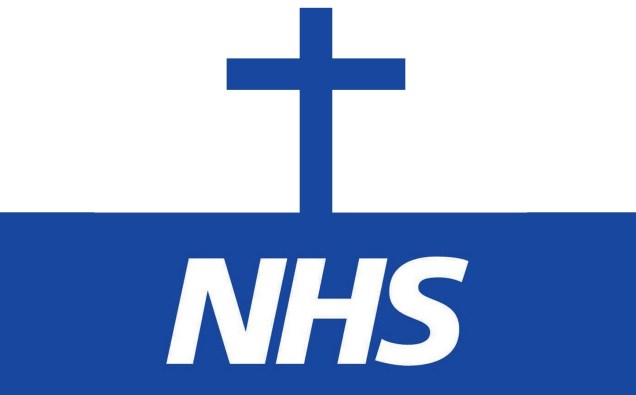
Are we witnessing the high water mark of mindless NHS-worship?
Regular readers will know that this blog is a constant critic of the British cult of NHS-worship. Not of the NHS specifically, but of the fawning, servile and uncritical way in which the National Health Service is viewed and debated in the public discourse.
Whether one prefers state-provided everything and harbours intense suspicion of privatisation, or yearns for the innovation and competition that the private sector (at its best) can bring, any reasonable person should be sickened by the stultifying atmosphere which has surrounded the NHS debate for decades. And yet we tolerate it, even demand it from our leaders.
It is not healthy that in this one specific area of our national life, politicians cannot make important criticisms without feeling obligated to counterbalance the truth with obsequious words of praise. And our stubborn refusal to look around the world for guiding examples of best practice in healthcare delivery has all the arrogance of American exceptionalism, in blinkered defence of something which is very far from exceptional.
At times, this blog has felt like a very lonely voice in the wilderness on the subject of our true national religion. The NHS being the supercharged third rail of British politics that it is, few mainstream commentators (and almost no serious politicians) have traditionally shown any willingness to touch the issue.
But there may now be a few encouraging signs that we have reached the high-water mark of our NHS adulation; that even the NHS’s most ardent supporters are coming to realise that making every arcane debate about healthcare policy or junior doctors’ pay a screeching matter of “Saving Our NHS” is not in their interests or those of British healthcare in general.
Simon Jenkins has a piece in the Guardian in which – shockingly, for that publication – he admits that “our adoration is killing the NHS”:
People may dislike other public services. They see the police as dodgy, train drivers as bolshy, utilities as run by crooks. But the NHS “saved my mum’s life”. So leave the doctors and nurses alone. Just give them money. Give everyone money.
Nothing dents this love. Day after day, the headlines scream of NHS woe. Last month half of all doctors said they offered a worsening service. Eleven thousand heart patients “die because of poor care”. The NHS wastes £12bn on a computer system that “does not work”. One in four hospital staff feels “harassed and bullied”. Three-quarters of them tell care quality commissioners that “patient safety is now at risk”. If the NHS is to the British, as former chancellor Lord Lawson said, “not a service but a religion”, the religion must be juju.
These are the words of someone who is frustrated (as well he should be) by the fact that our blind, unthinking adulation of the NHS – the healthcare equivalent of an ingratiating politician naming Nelson Mandela as his hero – prevents us from recognising the real and intractable flaws in the system.
Jenkins continues:
The NHS’s carapace of love has to be its biggest danger. On Wednesday it was revealed that, despite last year’s Francis report on whistleblowing, not a single sacked NHS whistleblower has been re-employed or manager reprimanded. Instead doctors are eulogised for the “daily miracle of saving lives”. This is despite the OECD reporting that they save fewer lives per head than insurance-based health services in Germany, Switzerland and the Netherlands. Britain’s record on tracing cancer is dreadful.
Doctors are in the business of saving lives. It is their job. Firefighters are not “miracle workers” for putting out fires, or teachers for getting pupils through exams. Healthcare may benefit from fear of death and disease, and we are rightly appreciative of those who relieve it. But when other professionals such as social workers or carers of the elderly fail, they are publicly excoriated. Why is the NHS immune?
Jenkins goes on to talk about the strange sense of security which comes from the “familiar NHS surgery”, with its “wartime air” and feeling of national solidarity. This is something that even I, a heathen free marketeer, have experienced and can relate to. Walk into a large NHS hospital in any of Britain’s big cities and you feel as though you have entered the belly of the beast – a vast, thrumming, living organisation of buildings, computers, machines and human beings, which functions according to its own time zone and alien protocols.
When you are sick, being enveloped in the warm embrace of this organisation – knowing that you will experience the same colour schemes, uniforms, routines and brisk bedside manner anywhere in the country – can feel quite reassuring. And because we tend to be at our most vulnerable when we encounter the NHS – when something is wrong with us, or with a loved one – we crave that reassurance.
But with the power dynamic thus skewed in favour of the state (providing healthcare) and against us (unwell, and receiving it), we have a natural tendency to be uncritically grateful for whatever service we are given, rather than subjecting it to the proper scrutiny of a consumer. Something usually has to go very, very wrong in order for us to complain.
If the NHS delivered your baby, set your broken arm, diagnosed and effectively treated your cancer or gave you a heart and lung transplant, you are likely to be well-disposed toward the NHS. You may even find yourself cheering along when populist politicians shoot for cheap applause by lavishly praising and vowing to defend it from mysterious external threats (usually in the form of the Evil Tories).
Never mind the fact that healthcare systems in developed countries around the world deliver babies, set broken limbs, treat cancer and transplant organs every day, to rich and poor people alike. The NHS Industrial Complex has been very effective in conflating “healthcare” and “the NHS” in the public mind, so that many people genuinely seem to believe that if they experienced the same medical condition as a citizen of another country, they would now be either bankrupt or dead. It is masterful propaganda, but it is most certainly not conducive to measured public debate about healthcare policy.
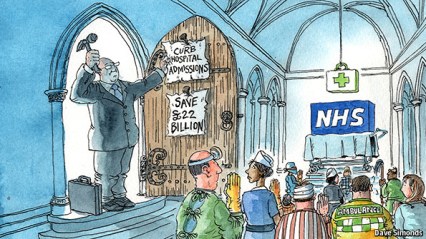
This is why it is good to see the first cracks starting to appear in the massive metaphorical golden idol of St. Aneurin Bevan of Tredegar, which the British people now worship like those before us worshipped Baʿal. Most encouraging of all comes this recognition from Simon Jenkins that “free at the point of delivery” has become more of a quasi-religious chant than unquestionably wise healthcare policy:
I have never understood why so many self-inflicted “health needs”, such as sports injuries, drunkenness and overeating, should be charged to the state. Some fire brigades are charging for careless callouts. Mountain and lifeboat rescues often request “contributions”. Free at the point of delivery has long been a proud boast of the NHS. But that is policy, not papal doctrine.
The drug companies always made sure “free” did not apply to NHS prescriptions. With demand rising exponentially, supply of care must be rationed by something: if not by some form of payment and insurance, it will be by queueing and quality.Last year it emerged that more than 300,000 patients waited in ambulances for more than half an hour just to get into A&E.
It is ironic that Jenkins’ questioning article is published in the Guardian, the newspaper which has arguably done the most harm in terms of inculcating a blindly and aggressively worshipful attitude toward the health service, to the total exclusion of any of the radical thinking for which that paper claims to stand. Only last week, the Guardian concluded a month-long “celebration” of the NHS in which journalistic scepticism and intellectual curiosity were suspended and replaced with a barrage of articles telling the NHS-supporting Left everything that they want to hear. I critiqued their “This Is The NHS” series here and here.
But here we have – from an NHS supporter, and one who says “there is nothing wrong with loving the NHS” – an admission that rationing by price in some certain situations can actually be preferable to our current settlement of rationing by time and quality. This is a breakthrough indeed. If only we could also break the Left’s demand for uniformity at all costs (mediocrity for all rather than excellence for any) then we would really be getting somewhere.
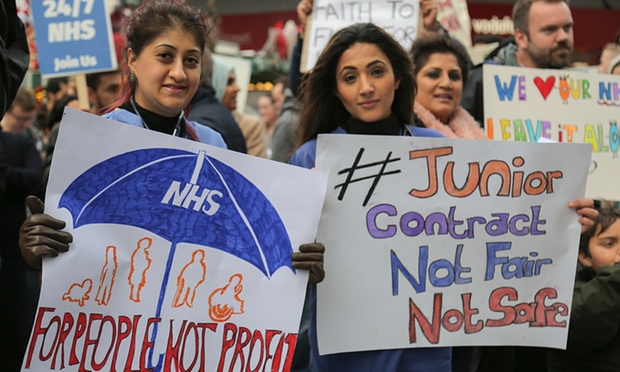
I must admit that I thought things would have to get a lot worse before we finally turned a corner in our misplaced reverence for the NHS – more scandals, more falling metrics, much longer waiting times. But the current level of bipartisan NHS fervour (partly whipped up by the BMA and junior NHS doctors, who are cynically pretending that their current dispute with the government over pay and conditions is actually about patient safety or, laughably, the very survival of the NHS) is clearly proving to be too schmaltzy and blindly uncritical even for some stalwart NHS defenders.
Perhaps the shrieking of the NHS priests and priestesses is most like the closed-minded rhetoric of the Biblical creationists, who shout ever louder and demand ever more concessions to their peculiar sensibilities the more their fundamentalist beliefs are debunked and discredited, eventually pushing the embarrassed moderates away.
Perhaps we are witnessing all of this sound and fury – the constant and strictly enforced praising of the NHS model, on pain of political death – because the NHS Clerisy know that theirs is ultimately a losing fight; that the British people will not long persevere in their belief that the only possible choice is between the NHS and dying in the street of untreated TB.
Perhaps, then, there is real (if still very limited) hope for genuine healthcare reform in Britain, after all.

–
Middle image: Cartoon by Dave Simonds, published in The Economist
–
Agree with this article? Violently disagree? Scroll down to leave a comment.
Follow Semi-Partisan Politics on Twitter, Facebook and Medium.



 Semi-Partisan Politics