Theresa May Calls A General Election: First Reaction

Theresa May - Conservative Party - General Election 8 June - Parliament - Downing Street

Here we go again

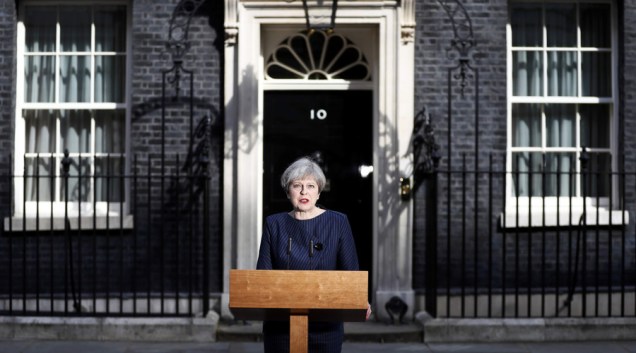
Okay, here is my hot warm lukewarm tepid pretty cold take on Theresa May’s shock announcement that the government will seek to trigger a general election on 8 June.

After a Scottish independence referendum in 2014, a general election in 2015 and an EU secession referendum in 2016, can we really muster the energy and enthusiasm for another vote in 2017?

Well, now we don’t have a choice (not that thinking a bit about the issues and then strolling to your local polling booth is very difficult). Theresa May made a bold decision to reverse her earlier protestations to the contrary and call an early general election, and from a purely party political perspective it was the smart move. Besides the jubilant Liberal Democrats, many of the whiners and naysayers on the opposition benches are unimpressed, bordering on terrified.

Many on the Left have been trying to have it both ways, first by criticising our “unelected” prime minister for daring to lead without an electoral mandate of her own, and now by carping at her decision to go the the public to seek that very mandate. It appears that “put up or shut up” time has snuck up on them.

But how does each party stand to fare in a June general election?


Labour

First and foremost, this is a richly deserved disaster for the Labour Party. Dan Hodges has already taken to Twitter trying to pin the blame for the party’s coming annihilation on Jeremy Corbyn and his supporters, but this is to mistake the symptom for the disease.

Jeremy Corbyn won the Labour leadership and retained it following the coup attempt – both times cheered on by this blog – because unlike the third rate nonentities who currently make up the centrist wing of the party, the Corbynites clearly stand for something. You may not like what they stand for – indeed, opinion polls show that most of the country strongly dislikes the hard left agenda – but at least they have clearly demonstrable values and principles which extend beyond the acquisition and retention of power.

What have the Labour centrists offered since around 2005? Nothing but bland, focus-grouped banalities, preaching enlightened compassion while shoring up a failing consensus (pro-EU, pro-mass immigration, eager to reap the benefits of globalisation but even more eager to throw its victims on the welfare scrapheap rather than help them adapt to the new world) that betrays the interests of its core working class (and principled eurosceptic) vote.

The Corbynite revolution gave the indolent centrists a richly deserved kicking, but Corbynism – with is aversion to patriotism, obsession with nationalisation and statism, obsessively anti-American foreign policy and seething hostility toward wealth generation – is not the solution, but rather a fringe obsession. Throw in the fact that even many Corbyn true believers disagree with Corbyn’s principled euroscepticism (one of the few issues where he happens to be right), and there are more faults running through the Labour Party than they can possibly resolve in the weeks leading up to 8 May.

The key test will be the writing and release of the Labour Party manifesto. Under Jeremy Corbyn’s leadership, the Labour Party must quickly produce a compelling vision for the country that appeals to Corbynite true believers while not scaring off the rest of the country. Sounds impossible? That’s probably because it is.

And after the election? If (as seems likely) Labour end up treading water or going backwards, will that be the end of Jeremy Corbyn and Corbynism? Maybe, maybe not. You can pretty much find a pundit to tell you exactly what you want to hear on that question, depending on your own proclivities. But the centrists’ only hope is to hang the party’s impending defeat firmly around Jeremy Corbyn’s neck so as to discredit his worldview and leadership.

I half wondered whether some panicked shadow cabinet members might try to engineer another last-minute coup to depose Corbyn and replace him with a caretaker leader to see the party through 8 June, but it seems unlikely. The centrists have proven time and again that they lack all courage and conviction, and since victory seems impossible under any circumstances it is better from their perspective to let a general election defeat do what they themselves could not – rid the party of Jeremy Corbyn.

But if Labour does go on to lose the election and Corbyn then resigns, will what follows be any better? The last Labour leadership contest should tell you all you need to know about the calibre of individuals waiting in the wings to succeed Jeremy Corbyn.


Conservatives

One may not agree with Theresa May on all things – this blog certainly has sharp differences, particularly on the manner of Brexit and the role of the state – but one would be hard pressed to argue that she is an incompetent leader, particularly in comparison with the other party leaders. The public sense this too, which is why the Tories currently have a 20+ point lead over Labour in the opinion polls, why even many Labour supporters prefer Theresa May to Jeremy Corbyn as prime minister, and why the Conservatives will increase their majority following the election.

However, the Tories may not gain as many seats as their current commanding poll lead suggests. Some Tory MPs in staunchly Remain-supporting constituencies are vulnerable, particularly those who unseated Liberal Democrat MPs in 2015. Meanwhile, the Tories are potentially poised to pick up some seats from unapologetic Remainer Labour MPs representing constituencies which voted Leave, particularly in Northern England. Therefore we are likely to see a degree of musical chairs, where some formerly Tory seats go LibDem while the Tories pick up a number of seats from Labour. In my opinion, the net effect will favour the Tories (and the Liberal Democrats) at the expense of Labour, but the extent to which this is the case remains open for debate.

More interesting, though, is the likely impact on the composition and mindset of the Conservative Party following the election, assuming that they are returned to government. This will likely be a Tory party where some of its more pro-EU MPs are gone (excellent), but which also suffers from the loss of those MPs who otherwise exerted a more liberal influence on the government. The authoritarians and the head-in-the-sand hard Brexiteers will likely be strengthened and consolidate their grip over the party, which is a problem for anybody who wanted Brexit to act as a catalyst for further liberal reform and democratic or constitutional renewal in Britain.


Liberal Democrats

The LibDems did not deserve their electoral drubbing in 2015, in which they were essentially punished for finally behaving like a responsible party of government and abandoning an unworkable campaign pledge (on university tuition fee caps) in the face of fiscal reality. For this act – for graduating from a party of preening opposition to one of government – they were subject to endless hysterical screeds about “betrayal”, and lost the bulk of their parliamentary party in the process.

Just as the LibDems did not deserve the full extent of their defeat in 2015, so they will not have deserved their likely gains in 2017, which will be fuelled by marshalling hysterical establishment opposition to the outcome of the EU referendum. The party will likely pick up a brace of seats – many retaken from the Conservatives – based solely on their pledge to campaign against a “hard Brexit” they will be powerless to stop. At one time, the Liberal Democrats might have presented a potential fallback option for disenchanted Conservative voters unhappy at the more authoritarian direction of their party. No more. Under Tim Farron, the party has descended into screechy europhilia and blind hatred of that half of the country which voted for Brexit. Civil liberties and other one-time LibDem interests will take a back seat to their efforts to subvert Brexit.

As a further complication, the kind of Brexit that the LibDems now technically argue for is actually not inherently bad in the short term – retaining single market access, openness to immigration etc. But the LibDems are not to be trusted, because:

  1. Their true agenda is to reverse Brexit entirely, not merely to seek the best form of Brexit, and
  2. Rather than pushing for better models of European cooperation and trade regulation, the LibDems seek only to keep Britain as closely shackled as possible to the existing, failed systems. For a party which likes to present itself as the home of enlightened, grown-up pragmatism, the LibDems take their europhilia like a religion, worshipping the EU as something inherently good and never to be seriously questioned.

Finally, Tim Farron is already picking up a lot of flack in left-wing papers and on social media for his fundamentalist Christian beliefs, particularly as they pertain to homosexuality.

This is a shameful, ridiculous witch hunt. So what if Farron refused three times to say whether he considers gay sex to be a sin, as his moralistic tormentors are currently crowing in a bid to damage him? Does anybody seriously think that the Liberal Democrat manifesto is going to call for the recriminalisation of homosexuality, for putting sodomy laws back on the statute books? Be serious. There is a world of difference between private belief and public policy.

There has to be space for private religious belief in this country. Secularists have a fair point when they worry about the influence of religion on public policy, particularly given that we have a legislature where 26 unelected bishops of the Church of England sit in the upper house and meddle in our lawmaking. But religious faith should not and must not become an acid test of eligibility for public office, where anybody professing faith or traditional beliefs is portrayed as extreme and beyond the pale.

More than anything, this is a witch-hunt against Christianity, one which will be cynically used by the other parties of the left as they manoeuvre for political advantage. Interestingly, Islam also has a word or two to say about homosexuality, and one can argue that Islam has a lot further to go than Christianity in accommodating LGBT people and issues, certainly in this country. But one wonders how many of the perpetually outraged critics of Tim Farron would be as fervent in their criticism if Farron were a Muslim rather than an Evil, Backward Christian?


UKIP

I voted for UKIP back in the 2015 general election, not as an endorsement of that party’s more nativist, reactionary tendencies but as a means of expressing disgust in a Conservative Party which had drifted far from conservative principles under the leadership of David Cameron, and whose slide toward bland centrism did not deserve rewarding with my vote. I stand by that decision.

Needless to say, the landscape has changed in two years. Nigel Farage – a man with considerable political courage, if also numerous faults and demagogic tendencies – has retreated to the sidelines, if not quite sailed off into the sunset. And after a period of instability the party has settled on Paul Nuttall, who has shrunk into his leadership position, more of an inept clown than an existential threat to Labour’s Northern base.

Furthermore, the party’s raison d’être was essentially accomplished with last year’s referendum vote to leave the European Union. The party limps on, near bankruptcy and desperately insisting that its existence remains necessary as the guard dog of a hard Brexit, but most people either feel that the job is done following the triggering of Article 50 or realise that a party in such turmoil will be in no position to influence events any further, regardless.

The writing has been on the wall for some time. I attended the UKIP Party Conference in Doncaster in 2015, and spent my time interviewing various party figures and supporters about what role they saw for the party in a post-referendum Britain. Most senior UKIP figures, including Nigel Farage, spoke only in bland banalities.

Only Douglas Carswell had a plausible answer – a return to small-government, free trade, small-L libertarian platform – but this side was never likely to win out over the leftward turn to appeal to disaffected Labour voters. And indeed, Carswell has now left the party to stand as an independent candidate, firmly closing the door on any move in this direction.

At present, UKIP seem doomed to lurch incompetently to the Left, willingly shedding any remaining libertarian voters as they court the disaffected Labour vote by promising the same kind of consequence-free safety and security that Donald Trump promised to his supporters in America. A sad decline of a briefly promising political party.

Nobody can deny the influence that UKIP has had on our national politics. Nobody can say for sure that UKIP will not bounce back from their current political near death experience. But we can say with relative certainty that the party will fail to impress in 2017.

My take from the UKIP conference two years ago seems increasingly prescient:

I can’t help wondering if UKIP might not pay a price in 2017 or beyond for failing to pay enough heed to the type of party they want to be – and the type of supporters they want – by the time of the next general election.

I think it is fair to say that UKIP will now pay in a lump for their lack of foresight.


Scottish National Party

Nicola Sturgeon was quick to declare that Theresa May’s decision to call for a general election is a “political miscalculation”.

Sturgeon said:

“She [Theresa May] is clearly betting that the Tories can win a bigger majority in England given the utter disarray in the Labour Party.”

“That makes it all the important that Scotland is protected from a Tory Party which now sees the chance of grabbing control of government for many years to come and moving the UK further to the right – forcing through a hard Brexit and imposing deeper cuts in the process.”

Because in Nicola Sturgeon and the SNP’s mind, Scotland is a nation of adult-sized, diaper-clad babies requiring constant protection from the Evil Tor-ees, who are constantly threatening to do Bad Things like lower the tax burden and unleash free enterprise.

Will the SNP manage to sweep the three Scottish constituencies they failed to capture in 2015, or will they lose seats? One can only imagine that they will do very well again, and use their strong showing as an excuse to prance around acting as though the couple of million votes they received from a tightly concentrated part of the United Kingdom represent some God-given, stonking mandate to thwart Brexit for the rest of us or else attempt to sever Scotland’s historic union with the UK through another pointless referendum (they would lose, since the choice would be between remaining in the UK or being outside both the UK and EU).

At some point, one might hope that Scottish voters might look around them and realise what godawful, incompetent government they are receiving by lending such overwhelming support to the SNP. One might hope that those Scots who love liberty might balk at a party which introduces an authoritarian “named person scheme” giving the government oversight of every Scottish child, and whose decision to centralise the fire and police services into single unitary authorities is already costing lives. One might hope that Scots who are against independence or ambivalent about it might decide to stop rewarding a party which has abdicated any responsibility for government in favour of a single-minded obsession with independence, even after the 2014 referendum, to the extent that no legislation has passed the Scottish Parliament for over a year.

But all such hopes will be in vain. The SNP will perform well once again, racking up credulous low-information votes in defiance of their abysmal governing in Scotland and the scandal-plagued, ineffectiveTartan Tea Party in Westminster. By their actions and apparent preference for living in a one-party SNP statelet within the United Kingdom, Scottish voters are choosing to deliberately sever themselves from our shared national political discussion.

If the SNP is all but guaranteed to clean up regardless of their abysmal record in government and the ineffectiveness of their Westminster caucus, what incentive do the other parties have to make compelling pitches for Scottish votes, since these pitches will always be ignored? By choosing to half sever themselves from our United Kingdom with blind support for the SNP, Scottish voters are in danger of completely severing themselves from our national political discourse.

This is a tragedy, but it is a tragedy very much of Scotland’s own making.


Britain’s Rainbow, Unicorn-Spangled Progressive Alliance

Ah yes, the super-secret, silent progressive majority which is going to come together in the spirit of unity to lock the Evil Tor-ees out of Downing Street forever and save Britain from the evils of conservatism. Didn’t exist then, doesn’t exist now.

Disregard any breathless commentary about a Labour-LibDem-Green-SNP alliance.


Conclusion

One wonders what was the point in instituting a Fixed Term Parliaments Act if we were only to discard the idea of fixed terms for political expediency at the first opportunity.

Generally speaking, fixed terms of government are a good idea, but it must be acknowledged that they usually do not work well in a parliamentary system. Excuses can always be found to justify circumventing the normal timelines and going to the polls early, particularly when the government’s majority is small or when the country faces a particularly contentious issue which bisects normal party lines. The present situation meets both of these criteria.

Theresa May’s decision to call an early general election was clearly motivated by the opportunity to extend the Tory advantage in Parliament, with her stated rationale about “Westminster being divided while the country is not” being a convenient smokescreen. But that’s politics. If people didn’t like the idea of snap elections held for partisan reasons they had every opportunity to become more involved in campaigns for electoral and constitutional reform. Those who spend their time watching Britain’s Celebrity Horses Dancing On Ice and ignoring the nuts and bold of how their country is run have limited standing when it comes to complaining about outcomes they dislike.

Furthermore, those on the Left who spent the last nine months complaining that Theresa May has no mandate to govern can’t very well also complain when the prime minister responds to their wailing by seeking to claim an electoral mandate of her own. This applies particularly to snivelling Labour MPs (Liz McInnes) who seek to use the death of their own family members as political capital.

Brendan O’Neill perfectly critiques this attitude:

The speed with which Remainers went from saying “May doesn’t have a mandate for Brexit” to “How dare May seek a mandate for Brexit” is breathtaking. All that “no mandate” talk was such hogwash. They know there’s a mandate out there for Brexit — a historic, populous, swirling mandate — and they are horrified that it is being tapped into once again via a General Election.

It’s clear now that by “no mandate” they meant “ignore that mandate”. They thought they had wrestled the issue of the EU, and the whole question of Britain’s political and economic future, back from the people and into the hands of their expert friends and legal minds and level-headed lords and MPs. Wrong. Here come the people again!

When it comes to a summary of where we stand and predictions as to the likely outcome, Pete North makes the most sense as it relates to the election’s impact on Brexit:

If it is to be a shadow referendum then remain has already lost it given that their options are split and they’ve spent the last year telling most people they’re thick and xenophobic. I think it’s fair to say that the Lib Dems will achieve a restoration of a sort but there’s not much to get excited about. It is possible that they could form the next official opposition but by then Mrs May will have all the mandate she needs to do whatever she wants. There will have been a referendum, a parliamentary vote, article 50 and a general election. We are leaving the EU and that’s the end of it.

If I had to make a bet, I would predict that the next two months will see a lot of noise and intrigue followed by an electoral outcome not dissimilar to the one we have today, only with a slightly larger Conservative Party caucus gained at Labour’s expense and a moderately revitalised Liberal Democrat party who then go on to strut around as though their 30-odd seats represent some kind of stunning repudiation of the referendum result. UKIP and the Green Party will go nowhere, and by reaffirming Scotland as a de facto one-party statelet by rewarding the SNP for a job disastrously done, Scottish voters will continue to make themselves increasingly irrelevant to the UK-wide political debate.

Maybe I’ll be proven wrong. Maybe the Independent will come out with a hidden video recording of Theresa May murdering puppies a week before polling day, or maybe some of our EU “friends” will make some kind of infantile play to destabilise the British political situation for their own sadistic gratification. Perhaps Theresa May will astonish me and turn out to be pursuing an expanded Tory majority because she does in fact have an ideological backbone, and needs the wiggle room in Parliament to ram through a proper reforming Conservative agenda. Perhaps.

But if I had to guess right now, I would say that on 9 June we will be looking at “the same, but more of it”.
 

Theresa May - Conservative Party

Support Semi-Partisan Politics with a one-time or recurring donation:

Agree with this article? Violently disagree? Scroll down to leave a comment.

Follow Semi-Partisan Politics on TwitterFacebook and Medium.

The Virtue-Signalling Left Find Their Ideal Spokesman: A Five Year Old Girl

This five-year-old girl actually makes a better case for Corbynism than many writers at the Guardian, Left Foot Forward or LabourList. Someone give her a weekly column and a podcast!

A few years ago, US comedian Bill Maher brought to our attention a 14-year-old wannabe conservative talk radio host called Caiden Cowger, who had so thoroughly absorbed Republican talking points and mastered the Rush Limbaugh speaking style that to watch him at work was both hilarious and unnervingly realistic.

At the time, Bill Maher made this rather potent observation:

If a fourteen year old can deliver your message, it’s not because he’s gifted, it’s because intellectually you are a child.

[..] When fourteen year old boys sound exactly like you do, and can produce radio shows and books and speeches that sound exactly like yours, maybe you should rethink the shit that’s coming out of your mouth.

Remember the Republican debates we had this year? They applauded for the idea of letting a sick man without insurance die. Herman Cain got cheers for saying he’d electrify the border fence. They booed a gay man serving his country in the military. No wonder fourteen year old boys can do your act, you act exactly like fourteen year old boys. There’s no ideology here. It’s just about being a dick.

Well, now it is the turn of the British Left to produce a young child capable of ventriloquising their entire political philosophy.

Meet Brooke Blair, a five-year-old girl who has been trained by her (undoubtedly) sanctimonious, Corbynite parents to screech about inequality, use the poor as ideological weapons and advocate for ever-more government spending funded through the munificence of the Magic Money Tree.

It’s worth reproducing Brooke Blair’s diatribe in full:

Look. My name is Brooke Blair and I’m five years old. I’ve got something to say to you Theresa May.

Yesterday night I was out on the streets and I saw hundreds and millions of homeless people. I saw one with floppy ears, I saw loads.

You should be out there, Theresa May. You should be [giving] biscuits, hot chocolate, sandwiches and building houses.

Look. I’m only five years old, there’s nothing I can do about it. I’m saving up money, and there’ll never be enough. You’ve got the pot of money – spend some and help people. Yes, that’s what you’ve got to do.

Because we’ve had lots of wars in this country and I do not like that Theresa May. I’m very angry!

So yesterday night a middle class, five year old girl was out on the streets (dodging the bombs and sniper fire from our many ongoing wars), keeping the company of “millions” of homeless people? Righty-ho. And we know that this is a true story because of the rich detail Blair provides, like the fact that one of them had “floppy ears” – are we sure she isn’t confusing the homeless with rabbits?

Naturally, the video has gone viral, borne aloft on a cloud of smug, self-satisfied leftist clicks and shares, all delighting in the fact that this “brave” five-year-old has apparently socked it to our cruel and inhumane prime minister. And what’s not to like, from a leftist standpoint? If you believe that the state should be involved in everything and meddle in all our lives, why shouldn’t the prime minister herself be tasked with roaming the streets at night, handing out cash, biscuits and building materials to homeless people?

Throughout the one-minute video you can just hear the pinch-faced, hectoring, virtue signalling, metro-left parents articulating their own political views through their daughter. Perhaps the only honest part is when Brooke Blair declares “and I do not like Theresa May!” That much I believe. And why would she? This girl is clearly being raised by her parents to blindly and unthinkingly hate the Evil Tor-ees and look to government as the answer to every single problem, rather than one day judging for herself which political philosophy best addresses the opportunities and challenges faced by society.

Of course, Brooke Blair’s parents are free to raise her however they want. And if they want to produce a little Owen Jones Mark II then that is entirely their business. But I would be careful, if I were them. Children have a tendency to rebel against the dogmas and beliefs imposed on them at a young age, so in a decade’s time we could quite possibly be welcoming Brooke Blair into the conservative movement, where there will always be a “safe space” for people who have renounced their former socialist ways.

But for now, the British Left should rejoice. The Labour Party may be imploding, its MPs more interested in stabbing their leader in the back than actually opposing a government which is becoming pretty left-wing anyway, but at least there are five-year olds on YouTube and seven-year-olds with handmade signs who are making the case for socialism every bit as eloquently as the adults ever could.

Jeremy Corbyn can sit out the next few rounds and complete the ongoing shadow cabinet reshuffle at his leisure. Brooke Blair will take it from here.


Postscript: Those actually interested in alleviating the problem of homelessness rather than simply broadcasting their trendy lefty compassion credentials to the world may consider donating to Shelter or the excellent Big Issue Foundation.


Labour - Save Our NHS

Support Semi-Partisan Politics with a one-time or recurring donation:

Agree with this article? Violently disagree? Scroll down to leave a comment.

Follow Semi-Partisan Politics on TwitterFacebook and Medium.


How The Corbynites Would Behave In Government – A Lesson From The 1980s

Conservatives should not feel smug about the hard left takeover of the Labour Party. History shows us that these people are tenacious and capable of inflicting real damage on people and communities in pursuit of their warped ideology, from the lowest seats of power

What would Jeremy Corbyn and the hard left of the Labour Party do if they actually gained political power? It is a question we tend not to ask ourselves or discuss, the possibility seeming so laughably remote that we naturally fixate more on what the Conservative Party is likely to do, given a small majority in government but no real organised opposition.

But it is a question that we should ask ourselves. This blog has been unashamedly supportive of Jeremy Corbyn’s leadership of the Labour Party, not because I agree with his ideology or any Corbynite political positions but because Corbyn represents (together now with Brexit) one of the only agents for breaking British politics out of its current stale, centrist consensus.

The managerial, technocratic politics of the last twenty years has alienated people and drives them away from political discussion, essentially boring them to death while the two main parties squabble over relatively trivial differences in attitude toward taxation, regulation, culture and foreign policy. The 2010 general election, taking place at the height of the Great Recession at a time when bold and original thinking was most needed, hinged on a puny £6bn difference in big spending commitments between Labour and the Conservatives. And though the EU referendum and the subject of Brexit divided the country in half, every political party but one came down hard on the side of remaining in that sclerotic and anti-democratic union.

There is not nearly enough choice in British politics. Being a centrist Labour MP today means broadly accepting the status quo on nearly all fronts while droning on continuously and sanctimoniously about “equality” and “fairness” to anyone who will listen, while being a typical Tory means waxing lyrical about personal freedom and responsibility while doing nothing to shrink the state or bring an end to government paternalism. Even the third parties, so long a pressure release valve, tend to fall in line with the consensus. The SNP is nothing but a slightly more authoritarian and social democrat-leaning Labour Party with a sprinkle of anti-English resentment, while UKIP seems to have betrayed its roots as a radical right-wing party in favour of appealing to disaffected left-wing Labour voters.

In this bland, homogenised context, anything which offers people real choice – a real varied palette of political colours to choose from – can only be a good thing, if for no other reason than that bad ideas will fester and grow out of sight of the country at large unless they are regularly expressed, challenged and defeated. So for all of these reasons, having a genuinely left-wing leader of the Labour Party again is not only jaw-droppingly obvious, it is also essential for the renewal of our democracy.

And yet…

One must also consider what ideologues actually do when they are in power. The Left in particular love to use the Thatcher government as a bogeyman and an emblem of everything evil about conservatism as an ideology, while conveniently glossing over the fact that Britain was a terminal patient receiving half-hearted palliative care before Margaret Thatcher gave the economy and the country some painful, revolutionary but absolutely necessary shock treatment.

But what do the ideological Left do when they are in power? Well, thankfully they have never grasped the reins of national government – the suffocating bipartisan post-war consensus was bad enough. But the hard left do have a track record in local government, and it is not a pretty one.

And that’s where this video comes in – kindly shared with me on Twitter by @eddiecoke. It is about fifteen minutes long, and well worth your time. The video is an excerpt from a 1980s American documentary about the behaviour of the hard, ideological (or “loony”) left in British local government. And some of what you see is quite shocking.

Of course, I knew about all of this in theory. Writing daily about politics, one hears about Red Ken and the GLC, or Derek Hatton and Liverpool City Council. But for early millennials like me, born when Thatcher was already in power and coming of age during late Blairism, the antics of the loony left are often now understood only in theory, while it takes seeing them in practice for the mind to recoil.

Watch the whole video.

What do we see?

Council censorship committees literally going through library books and purging those which do not convey a Social Justice message (in one case a picture book is banned because a white girl character has the temerity to tame a black horse with the aid of sugar cubes).

Snow White and Dr. Doolittle similarly banned.

Beauty and the Beast, Rupert Bear and Thomas the Tank Engine, too.

Replaced by books which go far beyond encouraging tolerance and equal rights, with one book for five-year-olds featuring a section entitled “Masturbation (Touching Yourself to Feel Good”.

The phasing out of competitive sports at school, replaced with open-ended games in which there are no rules, no score is kept and everybody “wins”.

Emboldened Marxist history teachers indoctrinating children with unashamedly pro-communist, anti-American diatribes.

The Brent African Women’s Council being invited to suggest changes to the school lunch menus, and then filibustering a meeting when okra soup and plantain were found not on the menu every single day.

A school governor bragging that he has effectively banned the police from setting foot on his school campus by threatening the headteacher’s job.

Social Justice pantomimes, with the traditional stories modified to shoehorn in messages of liberation and equality (because leftists can’t leave a good story unmolested).

Efforts to get schoolchildren to draw comparisons between the introduction of legislation to crack down on militant trade unionism and the Holocaust.

Viewing this litany of crazy, authoritarian leftist social engineering programmes run amok is quite sobering. And it does make one reconsider whether supporting Jeremy Corbyn and the ascendancy of the Labour Left is the right thing to do. After all, they have unleashed horrors like this on ordinary citizens while controlling only local authorities – how much more harm could they do if unleashed again, or (heaven forfend) on national government?

The answer: a lot. They could do a lot of harm. But that is no reason to recoil in horror at a democratic decision made by ideologically fervent members of the Labour Party. The correct reaction is to ensure that conservative thinking is similarly renewed and emboldened so that it presents an attractive alternative to voters.

Conventional wisdom says that this is already the case – that the UK electorate would pick Theresa May to stay on as prime minister over Jeremy Corbyn in a heartbeat, and that all the Tories need to do is remain as blandly inoffensive / desperately boring and unambitious as possible, so as not to spook voters into reconsidering.

I think this is dangerous complacency. After the past year in politics (on both sides of the Atlantic), nobody has any business making confident predictions about what will or will not happen, or to declare the status quo to be a cast iron certainty forever. Politics at its inclusive and inspiring best is about convincing people to consider new or different ideas, including ones which they had previously rejected. The Leave campaign would never have prevailed in the EU referendum had many people who were ambivalent or even warmly disposed towards the EU persuaded that Britain’s future would be brighter outside. Jeremy Corbyn is asking the British people to consider a radically different political settlement too, and while it is highly likely that the people will tell him to take a hike, it cannot be guaranteed.

Smug right-wing columnists may chortle that Jeremy Corbyn will never see electoral success, but they don’t know what economic or geopolitical shocks lie in await around the corner, or how those will impact British politics. Neither can they guarantee that the British political Right will not undergo a similar schism as is now taking place on the Left, instantly making everything competitive again.

It is not enough for small and large-C conservatives to sit back complacently and laugh at the Labour Party’s turmoil, while doing absolutely nothing to revitalise our own thinking and policymaking. It is not enough to assume that the country knows that conservative solutions are inherently better and more in tune with human nature than socialist dogmas.

If we really are about to enter a new political age where ideology actually starts to matter again, then conservatives should be worried, because we have been caught by surprise. The left’s answer was clearly to re-awaken the socialism of the 1980s and the GLC. What is our answer to be?

Hopefully Theresa May will spell out some broad strokes during the upcoming Conservative Party Conference. But I wouldn’t hold out much hope – the government has its hands full trying to deal with Brexit, and Theresa May’s reputation is that of an authoritarian traditionalist, not a small government, pro-market radical.

And until we conservatives can come up with a coherent and appealing vision for what small government conservatism should look like in 2016 (rather than the post-Cameron fudge we are currently presenting to the public) then our best defence – our only defence, really – against the Corbynites will be their own appalling record in government, going back some thirty years.


ken-livingstone-john-mcdonnell-labour-party-loony-left-socialism

Support Semi-Partisan Politics with a one-time or recurring donation:

Agree with this article? Violently disagree? Scroll down to leave a comment.

Follow Semi-Partisan Politics on TwitterFacebook and Medium.

Submission, Part 4

In his FT column today, Janan Ganesh doffs his hat to reality:

Today, lots of people will end a romance, or stop fighting a terminal illness, or let an argumentative colleague have the last word, or fold a bad hand at the poker table. “Nobody likes a quitter” but prudent capitulation is a part of life. Junior doctors in England have saved their dignity and perhaps some lives by backing down from strike action. Would we rather they showed valour for its own sake?

Because our culture accords no honour to the act of giving up, the remaining moderates in Britain’s Labour party cannot be seen to entertain it. Jeremy Corbyn renewed his leadership over the weekend. The left is rampant. A reverse McCarthyism, with socialists doing the interrogation, is the daily lot of critical MPs. And still they will not resign the Labour whip to form a new party.

That is their decision. It is easy for commentators to will a formal breakaway that others would have to perform. But the least they could do is spare us another round of their fighting talk. They will “never surrender”, you see. The comeback “starts now”, apparently. The people who brought you Owen Smith, pallid flatterer of Mr Corbyn’s worldview and unwanted alternative to him, demand to be reckoned with.

Their plan, such as it exists, is to outnumber the left by recruiting hundreds of thousands of pragmatic voters to the party while refreshing themselves intellectually. The first of these projects seems fanciful, the second unnecessary.

The people they want tend not to join political parties. Their participation in real life gets in the way. An entirely fresh movement founded on the pro-European centre-left could, perhaps, attract those who feel dispossessed by Mr Corbyn and what is shaping up to be a hard exit from the EU. An invitation into an old, tainted party to fight ideologues who know the difference between Leninism and anarcho-syndicalism for mastery of things called the National Executive Committee is, for many people, a refusable offer.

If that is really their best idea – and Janan Ganesh is well connected, so he would know – then Labour’s centrist MPs deserve neither respect nor sympathy at this point. They already tried to pack the membership with an influx of moderates who would rise up against Jeremy Corbyn, and it didn’t work, Corbyn was re-elected by an even greater majority. And their new cunning plan is to try the same trick again?

Ganesh concludes:

If this reads like a counsel of despair, it should. There is a reasonable chance, and it becomes stronger by the day, that Gordon Brown will turn out to have been the last Labour prime minister. Even if the rebels dislodge Mr Corbyn and install one of their own, the public will remember their party as one that voted for the hard left twice in as many years. There are such things as lost causes. There is something to be said for giving up and starting again.

They will do no such thing, of course. They will insult our intelligence by talking up a mass harvest of new centrist members and fall back on the wheezing old line they always quote when their steadfastness is in doubt. In 1960, during another struggle with the left, Hugh Gaitskell, the Labour leader at the time, said he would “fight, fight and fight again to save the party we love”.

So much of Labour’s internal culture is contained in that magnificent and deranged line. In the normal world, you are not meant to love a political party. It is not your family. It is a machine with a function: in Labour’s case, the material improvement of working people’s lives through parliamentary means. If it is broken, fix it. If it cannot be fixed, build a new one.

Sentimentality made Labour moderates stick with leaders they should have culled. It made them open their party to the wider left. And it keeps them in a fight they cannot win.

Gradually they come to realise what this blog has been saying for months – that New Labour is irreversibly dead and buried, and that this is Jeremy Corbyn’s party now. The centrists are not merely taking a break – they have been turfed out, just as the old-school socialists were once marginalised and frozen out by Neil Kinnock, John Smith and Tony Blair.

The options are to accept that it is Jeremy Corbyn’s turn for the next four years, or do the decent thing and split from the Labour Party to form their own new party of the centre-left (while watching nervously to see what percentage of the Labour grassroots membership follows them out the door in solidarity).

Honour can be found in either submission or divorce – but please, spare us from another year of overwrought, teenage drama and soap opera shenanigans.


UPDATE: Read Submission Part 1 here, Part 2 here, Part 3 here.


Jeremy Corbyn - PMQs

Support Semi-Partisan Politics with a one-time or recurring donation:

Agree with this article? Violently disagree? Scroll down to leave a comment.

Follow Semi-Partisan Politics on TwitterFacebook and Medium.

Live Blog: Jeremy Corbyn Elected Leader Of The Labour Party (Again)

jeremy-corbyn-victory-labour-leadership-contest-2016

Jeremy Corbyn destroys Owen Smith’s pathetic candidacy, is re-elected leader of the Labour Party – Live Blog

Contact: semipartisansam@gmail.com


13:26

At this point I’m not sure what more there is to say. All of the arguments about how the Labour Party ended up in this position have been stated and restated over and over.

Inglorious defeat was long predicted by this blog – not least here, here and here.

One can only think that the restless, self-entitled centrists have shot themselves (and their party) in the foot with this reckless and doomed leadership challenge – and for what? Corbynism, however misguided, has earned the right to be tested at a general election. And all of these furious attempts by the PLP to circumvent that process and disenfranchise Jeremy Corbyn’s base have only hardened his support – and strengthened the impression that the centrist Westminster establishment do not trust the British electorate to choose from a full palette of political shades, insisting on artificially limiting our choice beforehand lest we make the “wrong” choices.

As this blog recently noted:

One way or another, the establishment seems determined not to give the quaintly antiquated socialism of Jeremy Corbyn the opportunity to fail on its own. Labour’s centrist MPs do so because they are hungry to pursue what they see as the quickest route back to power (and some fear losing their seats in a 2020 anti-Corbyn landslide), and the rest of the political and media establishment do so because they are alarmed by Corbyn’s views on NATO, Trident and other issues, and do not trust the British people to likewise see the flaws in these ideas and reject them.

Of course, the sad irony is that by going to such extreme lengths to prevent Jeremy Corbyn’s socialist ideas being tested in a general election, the establishment is doing more than anyone else – more even than Corbyn himself – to harden support for those failed ideas, ensuring that they live on even longer past their “sell by” date.

Furthermore, the idea of centrist MPs enforcing what is essentially a de facto ideological test for any politician seeking high national office is grossly offensive to our democracy, revealing the establishment’s contempt for the people in all its hateful glory. We the people are more than capable of determining which political ideas are good, bad, offensive, dangerous or otherwise, and we have no need for a sanctimonious elite to pre-screen our choices for us.

The only things necessary to defeat Corbynism are Jeremy Corbyn himself and the British electorate. It’s sad that Labour MPs and the political / media establishment are simultaneously too selfish and too distrustful of the British people to realise this obvious truth.

This failed coup against Jeremy Corbyn has also revealed the utter dearth of talent among Labour’s centrist MPs. Even the supposed “big beasts” are little more than field mice – none of them had the courage to put their own political careers and future leadership ambitions on the line by challenging Jeremy Corbyn, leaving it to the underwhelming Owen Smith to carry their banner.

But worse than failing to field a serious candidate, the centrists had no vision to offer. Like Jeremy Corbyn or loathe him, he has a vision for a different Britain and principles which he has stuck to for decades, not bending and shapeshifting in an attempt to flatter different interest groups. The centrists offered no vision at all, other than their naked hunger for power. But if you cannot articulate in an inspiring way what you choose to do with that power, it will not be granted to you.

Will the Labour centrists finally learn this lesson? I have absolutely zero confidence that they will.

12:40

Submission.

See my “submission” series – Part 1, Part 2, Part 3.

12:29

Good question from Norman Smith to Diane Abbott – “why shouldn’t local parties deselect local MPs who continue to be vocally critical of a popularly elected leader?”

Abbott deflects, choosing to be polite and magnanimous today – but Norman Smith’s question is a fair one. Why should pro-Corbyn CLPs continue to tolerate Labour MPs who do not share their beliefs and actively seek to undermine Corbyn’s leadership?

In fact – mandatory reselection for all!

12:24

To do otherwise would have required competence and vision, qualities with which the angry, self-entitled centrists are not exactly brimming over.

12:22

Thinking of starting an “it’s time for the Labour Party to come together” counter on this blog. Nearly everybody interviewed on the BBC so far has used that phrase, however unconvincingly.

12:16

Interesting report from Huffington Post – apparently Owen Smith “won” among under 24s (and pre-2015 members) according to an exit poll:

Owen Smith beat Jeremy Corbyn among Labour party members who joined the party before 2015, a new exit poll has revealed.

Although he was defeated in the overall election, the YouGov/ElectionData poll found that Smith also won among 18-24 year-olds and Scottish party members.

The survey found that 63% of pre-2015 party members had backed the Pontypridd MP, to just 37% for Corbyn.

But the current leader had a huge lead among the tens of thousands who have joined the party since Ed Miliband quit, with 74% of them backing him to just 24% for Smith.

Among those who had joined since Corbyn became leader, a massive 83% said they had voted for him in the 2016 leader election, and 15% voted Smith.

While this sounds quite surprising at face value, digging a little deeper I’m not so sure that it is unexpected. Look at the young people who typically get into politics – a significant number of them tend to be university Labour/Conservative types, people who entertain either vague or determined ambitions to one day climb up the greasy pole and launch political careers of their own. Young Labour activists such as these likely want to taste political power one day rather than dwell in permanent opposition, and since prevailing wisdom (right or wrong) is that Jeremy Corbyn is unelectable is it really surprising that many of them fell into line behind the candidate who looked the part of the typical, professional political candidate? I don’t think so.

12:14

Yeah, I picked up on this too:

12:11

Not a whole lot of sympathy for Owen Smith from the Left:

Good. Owen Smith is an awful politician and was a terrible leadership candidate. He deserves neither consolation nor sympathy.

12:06

Chuka Umunna on the BBC, on the defensive against the potential deselection of “good, hardworking and popular” local Labour MPs.

Newsflash, Chuka – if they were so tremendously “popular” among the party activists who sweat blood to get them elected to Parliament in the first place, they wouldn’t be at risk of deselection. But since they have openly defied the wishes of their own local party members, they must now steel themselves to face the consequences.

12:02

Hilarious watching sulking centrists stalking out of the conference hall and refusing to even talk to the BBC reporter (Norman Smith) stationed outside. They have only themselves to blame for pitching the biggest hissy fit in the world against Corbyn’s leadership while utterly failing to come up with a compelling vision of their own for the future of the Labour Party and Britain.

12:00

Well, that wasn’t a bad victory speech from Jeremy Corbyn – far more magnanimous than I would have been under the circumstances. He congratulated the supporters and activists of both leadership campaigns in a general paean to political activism, and tried to immediately move the focus forward by plugging some big campaign for education (basically against grammar schools) next week.

I’m not sure if that will be enough to glue the warring Labour Party back together – however many times the phrase “we all need to come together” are uttered by different Labour MPs and officials over the course of the day. But for Jeremy Corbyn, it is clearly now business as usual.

11:50

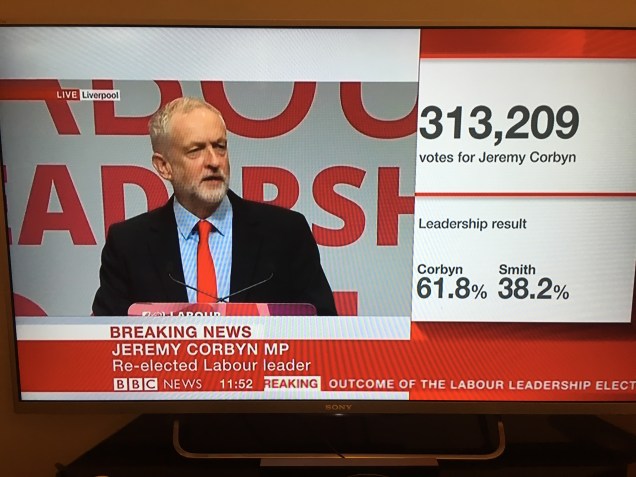
And it’s Jeremy Corbyn (naturally), with 313,209 votes of 506,428 cast, meaning a breakdown of Corbyn 61.8% / Smith 38.2%.


Jeremy Corbyn - Paris Attacks - Terrorism - Appeasement

Support Semi-Partisan Politics with a one-time or recurring donation:

Agree with this article? Violently disagree? Scroll down to leave a comment.

Follow Semi-Partisan Politics on TwitterFacebook and Medium.