–
EU Referendum Live Blog – Britain Votes For Brexit; The Aftermath
Contact: semipartisansam@gmail.com
4 July – 13:10
52% is enough to win a referendum, but not enough to make a guaranteed success of Brexit
In closing this live-blog of EU referendum result reaction (and before normal business resumes), I want to close with an email sent from the German office to the London office of a certain multinational company the day that the referendum results were announced.
The email was entitled “You’ll Never Walk Alone”, and reads (with redactions to protect anonymity):
Dear Friends,
On this truly disturbing day, we want to send you our greatest empathy and heartfelt solidarity to London and the whole UK [company] Team. Although troubling times maybe ahead of all of us here in Europe, the whole team of [company] Germany keeps on believing in the European idea and the future of peaceful and prosperous unity for Europe with the United Kingdom and all the wonderful people living there.
So for us this is not the end of the road. Our friendship with you will be stronger than ever and we will get through this together.
Big Hugs from Germany
Please share with the whole office
This text is followed by a picture of the entire German team making heart shapes with their hands as they hold aloft the German, EU and UK flags.
This is what we have to contend with as we try to navigate Brexit and secure a prosperous, independent but interconnected future for Britain outside of the European Union – whole offices full of undeniably smart people who legitimately view the events of the past two weeks as a nearly unspeakable calamity with no redeeming features.
The author of this email (and the senior person who authorised it) clearly had absolutely no doubt that their sentiments would be shared by every single one of their colleagues. There was no recognition that smart, professional people might come down on different sides of the argument on the great question of Britain’s future place in the world. On the contrary, there was only the arrogant but utterly genuine assumption that everybody working for the company (both in Germany and the UK) shares this view. Certainly no Brexit-supporting employee would dare to openly admit their own political views in such a one-sided, hostile climate.
I’m delighted that we won this referendum and finally have the chance to build the positive, enterprising and independent Britain that this blog longs to see. But while 52-48 is a firm victory, it cannot be denied that we have been helped over the line with the support of some retrograde, even unsavoury supporters and ideas, while we convinced too few of the professional class to join with us. It simply should not be the case that the entire staffs of any organisation (save perhaps the EU itself) view Brexit as an unmitigated calamity. That this is currently the case is a failure on the part of Brexiteers – despite the unwavering effort of many of us to present the progressive, internationalist case for leaving the EU.
But what strikes me most in this email is the way that its author describes Brexit – the prospect of Britain regaining the kind of democratic control over its own affairs enjoyed by every other developed country in the world outside Europe – as “truly disturbing”. We currently live in a country where many people are consumers first and conscientious citizens a distant second; where the elimination of the smallest short-term risk is seen as more important than safeguarding the long term democratic health of Britain.
But it is not enough to rail at pro-EU professionals for voting for their own short-term economic self interest, just as it is not enough for disappointed Remainers to berate Brexiteers for supposedly voting against their own. We must go out and convince people, rebuilding the proper respect and reverence for democracy in the hearts and minds of the people. If we fail to do this, it is only a matter of time before we barter our freedoms away again, for some other shiny new trinket.
It is simply not right – and not sustainable – for Britain to be a country where so many urban professionals continue to hold democracy in such low regard (or not even consider it at all). Bright, educated young professionals should be the biggest enemy of an elitist, antidemocratic anachronism like the European Union, not its loudest cheerleaders.
And until that changes, securing our ultimate freedom from the EU and a prosperous new independence will continue to be an unnecessarily punishing, uphill slog.
–
4 July – 11:15
Airbrushing Brexiteer women from history
Brendan O’Neill makes a really good point:
Liberal commentators are always saying “Don’t airbrush women from history!” Yet their moany depiction of Brexit as the handiwork of Boris and Farage utterly erases Gisela Stuart, Andrea Leadsom, Kate Hoey, Women for Britain, Dreda Say Mitchell, and those thousands of Brexiteer nurses and female trade unionists and workers and mums. Seems wiping women from the historic record is cool if those women did something Guardianistas don’t like.
Quite.
–
3 July – 11:25
Pity the young and their lost “European identity”
The New York Times, which distinguised itself with one-sided and incredibly biased coverage catastrophising Brexit at every turn while utterly failing to even consider the democratic case for independence from European political union, is back with a “won’t somebody please think of the children!” lament for Britain’s youth.
In an incredibly narrow-minded article entitled “Brexit Bats Aside Younger Generation’s European Identity”, the NYT opines:
You could say theirs is the Generation of Three E’s.
There is Erasmus, the European Union program that organizes and subsidizes student exchanges among universities across its 28 countries and elsewhere. There is easyJet, the budget airline that lets them hop between European cities as simply and cheaply as it can be to trek across town. And there is the euro, the currency used in most of the member countries.
Young adults are now grappling with what Britain’s vote to exit the European Union means for their profoundly European way of life. For them, it is perfectly normal to grow up in one country, study in another, work in a third, share a flat with people who have different passports and partner up without regard to nationality.
“It means that we are not going to be sisters and brothers of a big project,” said Antoine Guéry, 24, a Frenchman whose résumé and network of friends provide a crash course in European geography.
“At best, we are going to be allies” — friends, but no longer family. “It feels less like home.”
Waah waah waah. Of course, Erasmus will continue to exist (no doubt with British participation) despipte Brexit. Low-cost airlines will not suddenly disappear in a puff of smoke now that the British people have voted to free themselves from unwanted European political union. And the euro was never a reality for Brits anyway. Yet all of these things are cited in an attempt to catastrophise Brexit, to make it seem as though the granular details of peoples’ lives is going to be irrevocably harmed in some way.
The NYT goes on to cite the sob stories of exactly the kind of people who make up the modern metro-Left, utterly oblivious to the fact that these people in no way represent the majority of the youth (most of whom did not even bother to vote in the EU referendum):
Mr. Guéry works at a public-relations firm in Paris but had been looking for job opportunities in London — an exercise he shelved immediately after the “Brexit” vote on June 23. His degree is from Sciences Po University in Paris, but he also studied at Stockholm University and Germany’s University of Potsdam.
It was in Stockholm that two German women, Carolina Leersch, now 26, and Kim Seele, 28, joined his inner circle. In Berlin, Mr. Guéry lived with Ms. Seele’s aunt, had an Irish boyfriend and befriended Lauren Muscroft, who is British, and Marion Desbles, who is from Rennes, France.
This group and others like it are, to be sure, a subset within a subset, part of a fourth E — the elite — who studied at the Continent’s top institutions and took advantage of the Pan-European doors open to them. Splitting Britain from the European Union may put a damper on future changes important to this globalized generation, like the move toward a single European digital market for movie and music streaming, and the end, by next year, of cellphone roaming charges when crossing European Union borders.
Days before the British referendum, Mr. Guéry, Ms. Muscroft and Ms. Desbles jokingly wondered, while waiting in the passport lines at the airport in Barcelona, Spain, whether Britons like Ms. Muscroft would soon be kicked out of the European Union lane.
The New York Times – and the modern, metro-Left (or “middle class clerisy”, to use the term coined by Brendan O’Neill) for which it is a mouthpiece, simply cannot conceive of a world where not all young people enjoy this upper middle class jetsetting lifestyle. The fact that most young people do not routinely hop on aeroplanes – even easyJet ones – to visit university friends from Norway and Spain simply does not compute.
This is a problem because while it would certainly be great if everybody had the same international career and leisure opportunities that the New York Times apparently thinks is the case, in fact many do not. And hand-wringing about Brexit while completely and utterly ignoring the “minor” question of democracy only provides more evidence that the elite are dramatically out of touch with the wider country, and specifically with the less privileged demographics whose interests they so sanctimoniously claim to care about.
In their haste to catastrophise Brexit by soliciting the tearful opinions of PR professionals and lawyers, the NYT never bothered to interview for their piece a single one of the millions of young people in southern Europe who have been doomed by the EU’s ruinous policies and failing currency union to a life with may now never include the joys of a fulfilling, international career.
The New York Times only recently published a piece pondering whether the educated elite might in fact not be working selflessly for the good of all, but rather perpetuating their own jealously-guarded privileges at the expense of everyone else. Apparently that brief and uncharacteristic moment of introspection has now evaporated.
–
3 July – 10:00
Snowflake students “triggered” by Brexit
The way things are going in our universities, it was only a matter of time:
Since the Brexit was announced last week, there has been outrage, protests and emotional social media posts a plenty.
But some students claim the UK’s decision to leave the EU has left them in a ‘depression’, adding that they feel like they’re ‘grieving for the loss of cultural enrichment’ that the European Union provided.
‘I’ve felt so down all day because of this, and just have this constant sick feeling in my stomach. I genuinely feel like I’m grieving.
‘I feel like I’m grieving for our growing economy. I’m grieving for our loss of cultural enrichment. If we weren’t a part of the EU I’d never have met people from the likes France, Norway, Germany, who have so much to offer to our country. We have so much to gain from these cultures,’ one person posted on The Student Room.
‘Can I class Brexit as a traumatic event when fail my exams next week? Because honestly I’m so distracted now because of it?’ another chipped in.
One person replied: ‘I relate. I somehow survived an exam while still panicking the whole way through.’
Because of course “cultural enrichment”, foreign travel and cultural exchanges are only possible within the stultifying confines of regional political union…
–
1 July – 00:25
Brexit calculus and the Tory leadership
Dr. Richard North’s cold hard calculus as to which Conservative Party leadership candidate would offer the most promise to small-L liberal Brexiteers of a Flexcit mindset leads in a rather distressing direction:
There is not much to fault with Theresa May’s speech.
[..] Gove was less impressive, offering only “in the next few days” to lay out his plan for the United Kingdom. But behind Gove is the poisonous Dominic Cummings: the two go together. That is not a happy choice.
At least though, we are freed from the possibility of Johnson as Prime Minister. I’ve not made any secret of my dislike for him, a loathsome creature who has made a career out of lying, and fronted a disastrous “leave” campaign which was centred on a lie. We are well rid of him.
In the Vote Leave campaign, however, Gove also supported the lie. On that basis alone, he cannot be trusted to manage our exit negotiations. That he is totally opposed to continued participation in the Single Market, in my view, further rules him out.
Perversely, I think the exit negotiations are probably better off in the hands of a “reformed” remainer such as Theresa May. After all, the final arbiter of the settlement is not the Prime Minister, but Parliament. Let those who spoke for a return of Parliamentary sovereignty now hold Parliament’s feet to the fire, and demand that it does it job of holding the Executive to account – if it can.
And, on that basis, the best candidate for Conservative Leader seems to be Mrs May.
I don’t doubt Dr. North’s logic for a moment, but my goodness – what an exquisitely high price to pay in order to give the interim EFTA/EEA Brexit approach maintaining our present single market access the best shot of success.
While this blog came to detest and deplore David Cameron for his utter lack of conservative principle, Theresa May embodies all of the worst authoritarian and paternalistic instincts of the Conservative Party which repel more liberal conservatarians such as myself.
A Britain led by a Prime Minister Theresa May would be a land where ancient civil liberties, already crumbling, were put in the blender and liquidised once and for all, and where the state – acting in the Common Good, of course – controlled and surveillance ever more of our lives, all the time.
Furthermore, Theresa May is a politician who not only supported Britain’s continued membership of the EU during the referendum but who lacked the political courage (less cynical people might say had the strategic smarts) to take a prominent role in the campaign. On the most important political question to face this country in a generation, the long-serving and highly authoritarian Home Secretary effectively hedged her bets and stayed silent. That may well have been politically smart. But it was also rank cowardice. And this is the person best placed to lead Britain to independence from the EU and prosperity without it?
As I said, I take no issue with Dr. North’s assessment of the Tory leadership situation as it affects Brexit, which is by far and away the most important issue in this blog’s estimation. But personally, I’m not quite there yet. Having always been firmly of the opinion that I would sooner be dead in the cold ground than see a flinty-eyed authoritarian like Theresa May in 10 Downing Street, potentially being forced into a 180 degree U-turn to save the precious Brexit cause is an exquisitely painful price to be paid (to the extent that one holds out desperate hope that an alternative may yet emerge, against the odds).
In fact, at present the only bright spot for this blog in a future Theresa May premiership would be watching the preening, virtue-signalling Social Justice Warriors of Britain short-circuit themselves trying to hate on May despite the fact that she is a woman (though surely a self-hating one, according to the current intersectional feminist school of thought).
But the prospect of these delicious moments of humour does not make up for the lasting damage a Prime Minister Theresa May could feasibly do to our country, constitutional settlement and civil liberties, not to mention the already-sullied Conservative Party brand.
–
1 July – 00:05
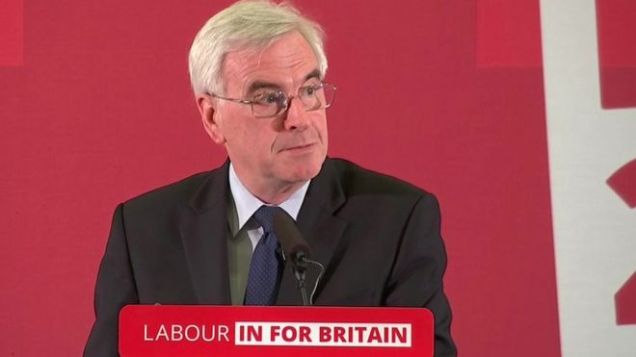
RIP Labour
My Conservatives for Liberty colleague Martin Bailey hits the nail on the head with his diagnosis of the multiple personalities currently occupying the Labour Party host.
Bailey writes:
Commentators are talking about the existence of two Labour Parties– On one side the soft left Centrists, the Blairites, the Gaitskellites, the social democrats and on the other the hard left, the Corbynites, the Trots, the Bevanites, the socialists. The accepted narrative casts these two tribes as locked in a permanent battle for the soul of the party, creating a natural equilibrium, ying and yang. This is no longer the case. There is now a third Labour party.
The third Labour party is the largest of all. It exists not in the drawing rooms of effete London suburbs but in warehouses and Wetherspoons across the land. They care not a jot for ideology or dogma or political correctness or Palestine and have voted Labour out of resentment of the establishment, class prejudice and the belief that it was the best way to protect their marginalised communities.
The working class have supported the Labour party in their millions for nearly a hundred years, a political identity passed down through generations, but they are starting to realise that neither the Blairites nor the Corbynistas articulate their views and are in fact happy to dismiss them as ignorant racists.
The disconnect between Labour’s professional political class and the traditional Labour voter was the real talking point of the referendum. Who can blame the common people for giving a great big two fingers to those who have taken them for granted for so long? Once again the Labour party has learnt nothing, with contempt for the working class reaching new heights in the aftermath of the vote with Guardian columnists writing about ‘Crappy’ Northern towns and David Lammy calling for parliament to ignore the democratic will of the nation.
Lammy’s position is as understandable as it is indicative of the status quo. A London MP who sees the coming typhoon and in an attempt to save his own behind at the next election decides to voice the concerns of the delicate snowflakes of the big smoke, without any thought of the repercussions his words will have in places like Rotherham, Blackburn or Burnley.
UKIP has become the lightning rod for working class anger and malcontent and thanks to Labour’s continuing, indeed increasing, inclination to treat the people as an irrational, immature inconvenience, a party that should have been declared obsolete post-Brexit looks likely to go from strength to strength.
This chimes exactly with my own thinking. Listening to the howls of outrage from centrist, metro-left MPs anguished at being “dragged out of Europe” against their will – the very thing that many of Labour’s traditional working class voters were celebrating – has been an instructive real-time case study of the death of a major political party.
So where does this leave Labour? Bailey rightly points out that any SDP-style split of the centrists would only result in “a party without an electorate, a cart without a horse”. Yet if the centrists stay and succeed in forcing Jeremy Corbyn out, the floor will fall out from under the party with no commensurate benefit – the Momentum wing, enraged, would simply sabotage the party, even costing Labour safe seats by running as a new party.
It’s almost enough to make one feel sorry for Labour. But then one recalls their cynical hysteria in painting the slightest hint of fiscal conservatism as an ideologically motivated attack on the poor and vulnerable, and any feelings of sympathy quickly disappear.
–
30 June – 16:10
The blowback against democracy continues
Garvan Walshe is the latest voice to express his fear and hatred of democracy now that it has dealt up an outcome with which he happens to profoundly disagree.
Writing in Conservative Home, Walshe frets that “democratic fundamentalism is now the most serious threat to freedom in the West”:
Like all fundamentalisms, democratic extremism takes a noble idea, that everyone’s political views should count equally, too far. But if democracy is to endure, voters must inform themselves of the facts, avoid being swayed by prejudice and emotion, and to base judgements on evidence. The romantic invocation of popular sovereignty is no substitute for calm deliberation.
It is not reasonable however for a political elite simply to tell voters they are wrong. The people have every reason to distrust it on the very issue that motivated them to vote to leave: immigration. For more than a decade voters have been told that immigration could be controlled with ease, even though the kind of control they want can only come at enormous economic cost, and by running the risk of stirring up xenophobic feeling across the country. The elite’s greatest error wasn’t, as is often said, to ignore their concerns: but to pretend to address them while doing nothing. Was it asking too much of our political system to try and explain why they were misplaced, and address the real problems that have for the past fifteen years falsely been blamed on immigration?
The remain campaign’s predictions, however disbelieved, are coming true. The pound has had its steepest fall in 30 years. Banks and housebuilders have lost up to a third of their value. $2 trillion was wiped of global stock markets on the day after the vote. Scotland is poised to break away. The mythical “better deal” where greater immigration restrictions could be won without losing access to the single market was immediately rejected by Angela Merkel.
On June 23rd the people voted to take a huge gamble on the outcome of the Brexit negotiations leaves the next Prime Minister trapped. He or she can either sacrifice the interests of leave voters by throwing aside 40 years of business relationships with our largest trading partner, or betray their beliefs by concluding a Norway-style deal that has us formally leave the EU, but maintains economic arrangements more or less unchanged. If they get it wrong, Scotland will secede and UKIP’s rank racism will be almost impossible to stop.
What can one say in response to this preening, hysterical reaction to Brexit? It goes without saying that Garvan Walshe would have no qualms whatsoever if the “tyranny of the majority” had kept Britain in the EU with a 52-48 endorsement of the 40 year status quo. Only when the wrong people with the wrong opinions have heir moment does Walshe shriek like a Victorian prude and reach for the smelling salts.
Walshe is sneeringly dismissive of democracy as a dangerous thing by which the unwashed masses might make the “wrong” choice based on emotion, and presumptuous about the motives of Brexiteers (assuming that they were primarily motivated by immigration concerns when the recent post-referendum ComRes poll showed that democracy was the key issue).
This argument lays bare the arrogance of the Remainers-in-denial. Even now, when their dream of Britain as a subjugated vassal of an ever-integrating European proto- state has been rejected by the electorate, their minds cannot fathom the loss. Instead, the Brexiteers’ victory must be chalked up to “insufficient information” made available to the electorate, while the biggest exercise in British democracy in decades is seen as something to be feared rather than celebrated.
The battle does not end with the EU referendum. People like Garvan Walshe, who believe that the people are incapable of understanding the big issues which affect their lives, and that our job is to be condescended to and have things framed and explained to us by an all-knowing elite technocracy, are lurking under every rock.
And we must fight them every inch of the way if we are to make a success of Brexit.
–
30 June – 15:30
Help from New Zealand
The Telegraph reports details of an important offer of help from New Zealand:
New Zealand has offered its top trade negotiators to the United Kingdom, relieving the British civil service as it prepares for the strain of seeking new deals with countries across the globe.
The Telegraph understands that the Commonwealth country has made an offer to loan staff to the British civil service, which has few trade negotiators of its own.
Wellington’s olive branch came alongside an offer to discuss a trade agreement with the UK, which would help Britain get out of the starting blocks and begin replacing the trade access lost as a result of the Brexit vote.
[..] Murray McCully, New Zealand’s foreign minister, confirmed to the New Zealand Herald that he had had a discussion with Jonathan Sinclair, Britain’s High Commissioner to New Zealand, on Monday.
We’ve simply made an offer that we as a country that is a long-standing friend … stands ready to be useful in any way we can be,” Mr McCully said. The foreign minister did not rule out providing the UK with the expertise of its trade negotiators.
So much for backward, isolationist Britain standing alone in the world.
In seriousness, though, this is exactly the kind of gesture which we would want to see from our friends and allies at this time. After 40 years of slow submersion into the EU’s political union, Britain’s own skills and competencies in key areas like trade have atrophied with time.
The plus side of the interim EFTA/EEA approach advocated by the Flexcit plan, not mentioned in the Telegraph article, is that trading with the single market through EFTA would significantly reduce the volume of trade agreements which urgently need to be negotiated in the first place, meaning that any seconded staff from other countries could even be put to use helping Britain to chart a longer term course beyond the EEA. And as an added bonus, rejoining EFTA would immediately make Britain a party to the tens of existing trade deals which that trade bloc has negotiated with other countries.
–
30 June – 15:00
Centrist Labour waves goodbye to reality
Luke Akehurst, writing in LabourList, entertains dreams (echoed by many in the party establishment) of a grand centrist coalition wresting control of the party back from the Corbynites.
Akehurst writes:
Now more than ever Britain needs the Labour values which were notable only by their absence in the referendum campaign.
Now more than ever Labour needs a new leader who can stand up for those values in Parliament, in negotiations with the EU and the remaining 27 member states, and in Downing Street after the coming election.
And now more than ever we need mainstream Labour supporters to sign up as party members, stand up for their values and elect a new Leader.
Anyone who is devastated by the referendum result and wants to take a step back on the road to serious, progressive politics should now join the Labour Party.
A leadership election is looming and, while Jeremy Corbyn has lost a lot of support among party members in the last few months, we need more to join us if we are to elect a mainstream, credible Leader.
If there is a contested leadership ballot we need to counteract the mass recruitment of Corbyn supporters that happened last year not just by persuading the wing of his previous voters who have been alienated by incompetence, sectarianism, failure to make electoral headway and what increasingly looks like the deliberate sabotage of the Labour In campaign to switch, but also by recruiting hundreds of thousands of new members and supporters ourselves.
All that energy and desire for change in our politics apparent from the referendum campaign and the reaction to it needs to be channelled into a concerted membership drive across every town and city in our country.
Labour is the party of the many, not the few.
And now is our chance to show that the mainstream are many and the far left are few.
The only problem is that vague, wishy-washy people beloved by pandering centrist politicians are by their very nature the hardest to tempt off their sofas to vote, let alone getting them to stump up £50 a year to join a political party and remember to vote in its leadership election.
The plain truth is this: the Labour Party is now reaping what it sowed during its opportunistic period of opposition from 2010 under Ed Miliband. Faced with an utterly bland, centrist and inoffensive not-very-conservative government – in actuality nothing more than Tony Blair’s fourth term only with less money to spend – the Labour Party decided that their quick route back to power lay in portraying the smallest acts of fiscal responsibility and spending restraint as “Thatcherism on steroids”, and sensible reforms to welfare as a deliberate war on the poor, the sick and the disabled.
Unable to run on their own record, which saw Britain uniquely ill-equipped among rich nations to weather the financial crisis, Labour MPs (and they are nearly all guilty) instead pretended that David Cameron was Genghis Khan and that Iain Duncan Smith wanted to reopen the work houses.
Having egged on their own supporters and activists in this way, it is hardly surprising that following Ed Miliband’s departure a large number of them became receptive to a leadership candidate who promised to end the “crippling austerity” gripping the nation, even if this austerity mostly existed only in their own heads.
And now the same bland, centrist, careerist labour MPs who screamed “Tory genocide of the sick!” in a tawdry attempt to drum up votes are now throwing their toys out of the pram because they find themselves led by a man whose far-left politics were deemed by the party membership to be the best antidote to the very phantoms which the Labour parliamentary caucus themselves encouraged. Quite frankly, it’s pathetic.
The Labour Party membership overwhelmingly voted for Jeremy Corbyn to be their leader. One year later, if the majority of Labour MPs don’t like this fact it is for them to find a new party (and new supporters), not to subvert the will of their own members and activists.
–
29 June – 14:40
Nicola Sturgeon put back in her box
The Telegraph hearteningly reports that EU leaders are spurning self-important Nicola Sturgeon’s attempts to negotiate her own deal for Scotland with Brussels, separate and in contradiction to the UK government’s own negotiations:
Nicola Sturgeon will now meet Jean-Claude Juncker during her visit to Brussels today to discuss Scotland keeping its EU status but she suffered another major blow after receiving short shrift from Germany.
The pair were not originally expected to meet thanks to Mr Juncker’s full diary but talks have been scheduled for this evening.
She is also meeting Martin Shulz, president of the European Parliament but Donald Tusk, the president of the powerful European Council comprising the heads of member states, has refused an invitation for talks.
It also emerged today that a series of member state governments have indicated they will not hold direct talks with the SNP about protecting Scotland’s status in the EU.
The German government told the Glasgow Herald this was an “internal” British issue and declined to comment further when asked if it would engage directly with the Scottish Government.
Denmark said its minister for foreign affairs “will not intervene in the internal UK discussions following the referendum last week”. The Czech government said it was “premature to address the question of an independent Scotland and its relation to the EU.”
The Estonian Foreign Affairs Ministry did not wish to engage in “speculation” but its Slovakian counterpart opened the door to bilateral talks, saying its appreciated Scotland’s pro-EU attitude.
Good. This is right and proper – any other response from our European allies would have constituted a major diplomatic incident and breach of protocol. It is not for other sovereign nations to undertake subversive negotiations with any one province or state of an allied nation, particularly when the putative negotiating partner is operating so far beyond her own remit and authority as First Minister of Scotland.
Nearly all domestic matters are now (rightly) devolved to the Scottish government, and the SNP should concentrate on making less of a hash of those areas already under its control before wading into foreign policy areas which it would have no right to participate in even under an ideal federal UK model.
Perhaps this is a sign of the Foreign Office – so tremulously ineffective under the weak leadership of Philip Hammond – finally reasserting itself and insisting that our European allies play it straight. Or perhaps they are all doing the right thing unbidden, with only EU leaders (excluding Donald Tusk) and not heads of government giving Nicola Sturgeon five minutes of their time.
And so it should be. Were the positions reversed, it would be unthinkable for a British government to enter into parallel talks with separatist parties or assembly leaders in, say, Spain, if Basque or Catalan leaders wanted Britain to pull strings allowing them to remain in the EU if Spain as a whole seceded. This would represent an unwarranted interference in another country’s domestic affairs, which is why no matter how much Scottish MEPs preen and posture and win applause in the European Parliament, they will rightly gain zero meaningful support from the chancelleries of Europe.
–
29 June – 08:00
Molly Scott Cato, writing in Left Foot Forward, exemplifies the sanctimonious metro-left’s sheer incomprehension that 17 million Britons, including many working class voters, could possibly have voted against what Cato and her peers arrogantly deem (without any consultation) to be their best interests.
Cato rages:
I think it may have been the novelty of their vote counting that confused the ‘Regrexiteers’; they regarded their little cross as a gesture and then were horrified when they discovered that they had changed history.
Despite there being no evidence that a significant number of Brexiteers regret their vote (save the smattering of examples gratefully and desperately seized on by a terrified pro-EU media), Cato picks up this idea and runs with it.
Just how morally and intellectually superior does one have to consider oneself to be in order to decide that everybody else – a clear majority of the country – didn’t understand the question put to them in this EU referendum, asking whether we wanted to leave or remain in the EU? Sadly, such Olympian levels of unearned superiority are to be found across whole swathes of the British Left, who having lost all meaningful connection with and understanding of their traditional working class base now seek to justify the gulf of opinion by psychologising working class thought.
Cato continues:
The faux rebellion narrative of the Brexiteers has succeeded.
They have managed to persuade a majority of the British people to support them against their own interests and the advice of every breathing expert.
Tory Brexiteers managed to exploit the hostility felt towards politicians – something they themselves have engendered – and presented voting Leave as an act of rebellion.
During the campaign I was reminded of Yeats’s poem The Second Coming when he says that ‘the best lack all conviction, while the worst; Are full of passionate intensity’.
Although the content of the arguments of those arguing for a withdrawal from our own continent was nonsense and their statistics largely bogus, their passion for their cause was compelling.
Here we see every other desperate left-wing evasion deployed throughout the EU referendum campaign, now repackaged to explain the Remain campaign’s defeat. First, the repeat of John McDonnell’s insidious line “Tory Brexit”, trying to paint the decision on Britain’s place in the EU as a partisan affair supported only by the Evil Tories – a direct contradiction of Cato’s later admission that “people on the right and the left voted for Brexit and it implies nothing in terms of domestic politics.”
And then Cato talks explicitly and hysterically of “withdrawing from our own continent”, as though by leaving a dysfunctional and ever-more tightly integrating political union which no longer works for us we are somehow literally cutting ourselves off from the continent and suspending diplomatic relations with our close friends and allies in Europe.
In their rage at being overruled by the working classes whose support they take for granted and whom they fatuously claim to represent while doing no such thing, the coddled metro-left are making themselves look utterly ridiculous.
But these paroxysms of rage directed at their own supposed base (and the Evil Tories who led the simple, uneducated working classes astray) – in this case offered up by Molly Scott Cato, a decadent Green Party MEP – only serve to reveal the festering black hole where the heart of left-wing politics once beat.
–
28 June – 23:10
Matt Taibbi at Rolling Stone magazine has a great rebuttal to the increasing number of pundits arguing that Britain’s vote to leave the EU is a symptom of “too much democracy”:
Were I British, I’d probably have voted to Remain. But it’s not hard to understand being pissed off at being subject to unaccountable bureaucrats in Brussels. Nor is it hard to imagine the post-Brexit backlash confirming every suspicion you might have about the people who run the EU.
Imagine having pundits and professors suggest you should have your voting rights curtailed because you voted Leave. Now imagine these same people are calling voters like you “children” and castigating you for being insufficiently appreciative of, say, the joys of submitting to a European Supreme Court that claims primacy over the Magna Carta and the Bill of Rights.
The overall message in every case is the same: Let us handle things.
But whatever, let’s assume that the Brexit voters, like Trump voters, are wrong, ignorant, dangerous and unjustified.
Even stipulating to that, the reaction to both Brexit and Trump reveals a problem potentially more serious than either Brexit or the Trump campaign. It’s become perilously fashionable all over the Western world to reach for non-democratic solutions whenever society drifts in a direction people don’t like. Here in America the problem is snowballing on both the right and the left.
Whether it’s Andrew Sullivan calling for Republican insiders to rig the nomination process to derail Trump’s candidacy, or Democratic Party lifers like Peter Orszag arguing that Republican intransigence in Congress means we should turn more power over to “depoliticized commissions,” the instinct to act by diktat surfaces quite a lot these days.
Taibbi concludes:
If you think there’s ever such a thing as “too much democracy,” you probably never believed in it in the first place. And even low-information voters can sense it.
It is hard to describe just how strongly anti-democratic sentiment is coursing through social media at the present time. This gem came from the timeline of a friend:
Here’s an idea. For our next referendum, let’s settle the question of the correct interpretation of quantum mechanics. Maybe make up for the shortfall in science funding #askamoron
The sneering, snide attitude toward Brexiteers is not going anywhere. Nor is the furious refusal to look at the EU referendum as a question of democracy, but rather as a purely short-term economic question from which the public should take their lead from self-described “experts”. Of course, as Taibbi argues in his Rolling Stone piece, the experts from ancient times, including Plato, were far from agreement themselves as to the meaning and worth of democracy.
Fortunately, while we must do without Plato, we do at least have an abundance of self-righteous, sneering millenials, all furious that their ‘”futures” have somehow been ripped away, and all convinced that democracy is not worth a damn if it means other people (especially the ignorant working classes and selfish older people) having a voice.
–
28 June – 22:55
Some unexpected graciousness in defeat from Janan Ganesh in the FT today:
Pro-Europeans must learn to see the virtue in retreat. Spurred by the 48 per cent of voters on their side and the British impulse to make the best of things, they want to influence whatever settlement emerges between their country and Europe in the coming years. Conservative Remainers such as Theresa May, the home secretary, still have ambitions to lead their party. The Remain campaign aspires to live on as the liberal conscience of the more probable next prime minister — Boris Johnson — by encouraging his openness to markets and migration against more nativist competitors for his ear.
This is all very plucky, but so is turning up to work after you have been sacked. The British people have instructed their rulers to leave the EU. The execution of their will is the work of years and soul-sapping detail. It cannot be done by a prime minister who believes the instruction was foolish in the first place. It is awkward enough that the technical process of extrication will be managed by reluctant, deflated civil servants.
As a point of democratic principle, the highest offices in government — prime minister, chancellor of the exchequer and foreign secretary — should now go to committed Leavers, preferably ones with compatible accounts of what Leave should mean. A government of all persuasions would be magnanimity for its own sake and a perversion of the referendum result.
None of this is pleasing to say as a Remainer but it is no less true for that. Imagine our reaction if, having lost the referendum by a four-point margin, the other side invoked their hefty vote share to justify a prominent perch in the making of European policy with a view to loosening the terms of membership.
Democracy, like sport, is governed by a cruel clarity. Forty-eight per cent of votes does not entitle pro-Europeans to 48 per cent of their manifesto or 48 per cent of major ministries. Victory and defeat are more absolute than that, and not out of some misplaced machismo. It is for the sake of accountability that winners take all in our system.
That accountability is now everything. Leavers have won what was essentially a referendum and a general election all in one. They must be responsible for the country in the coming years. The economy, the union and the commitments made during the referendum campaign are all theirs to safeguard. A European settlement that simultaneously satisfies Brussels and the 52 per cent is theirs to negotiate.
All very admirable, but I dispute the idea that everything must now be in the hands of the Leavers – particularly if this is taken to mean only Vote Leave apparatchiks, who by no means represent the full depth and spectrum of Brexiteer opinion. This EU referendum was emphatically not a general election. The question before the British people was whether or not we should leave the European Union, and that is the question which was answered. To claim that it was a mandate for anything else is disingenuous. We did not elect a Vote Leave government with our referendum choice, and Brexiteers’ collective support for leaving the EU does not mean that we wish to see a prime minister Boris Johnson – in this blog’s case, emphatically not.
And so while the instruction given by the voters to leave the EU must absolutely be respected, this does not mean that Remainers should automatically be shut out of government. In fact, if the Brexit approach is to proceed along the liberal lines that we hope for, harnessing the desire of Remainers to maintain our preferential access to the single market will be important for building political support for the approaches outlined in Flexcit.
But more than that, Brexit requires the best of all Britons, including those who supported the Remain campaign. Taking their toys and walking away from active participation in the political process as an act of retaliation for having been “taken out of Europe against my will” (to quote the oft-heard whine on social media) is childish in the extreme. Now is not the time for disappointed Remainers to sit back with their arms crossed, hoping for the Leave campaign’s worst elements to fail. That is no kind of citizenship.
Nonetheless, the tone of Janan Ganesh’s piece is to be welcomed. The FT lobbied hard and shamelessly for a Remain vote, making their newspaper virtually unreadable in the process. Perhaps this will mark the start of a renewal.
Earlier in the campaign, I excoriated Ganesh for his earlier lazy and miserabilist comments that Britain is no longer a country “where history happens”, and challenged him to a debate on the point (I received no reply despite repeated attempts).
Perhaps in addition to his gracious words in today’s FT, Ganesh would also now like to retract his assertion that Britain no longer makes history, in light of recent events?
–
28 June – 10:55
“The dogmas of the quiet past are inadequate to the stormy present. The occasion is piled high with difficulty, and we must rise with the occasion. As our case is new, so we must think anew, and act anew. We must disenthrall ourselves, and then we shall save our country.” – President Abraham Lincoln, annual message to Congress, December 1862
This, from Pete North, is so important to remember:
I am not the only one to be having a post-referendum wobble looking at what we have unleashed. But mostly the shockwave is psychological. We are waking up to the enormity of what we have decided. It’s bigger than even I thought.
But what drives that fear is what my good friend and compatriot Sam Hooper calls “catastrophisation”. Many on the remain side are now in apoplexy going full tilt to find any scrap of evidence that supports their dire warnings. It’s pervasive and quite persuasive. They do it because they believe there is, by so doing, a chance of overturning the result.
But we should hold our nerve. We should not cave into second thoughts. What is done is done. If we go back on our decision now and go crawling back we will be treated in the same way as a battered wife who goes back to her abusive husband, begging for forgiveness.
For a moment in time on Thursday, to abuse a cliche, middle England roared with pride at who we are and what we can do. We should hold on to that. If we give way to doubt then we shall be all the more diminished and in a worse position than before. I urge you to continue to trust in you voting instincts, that we prosper because of who we are, not because of the EU.
I freely admit to having had some of the same initial uncertainties the moment it became clear that we were about to win – not least because victory was so unexpected (and I chasten myself for some of my earlier pessimism). When the gravity of what Britain had decided first hit, it was both awe-inspiring and sobering. It is fair to say that Britain has not made as consequential decision as this in a generation, and this one was made not by professional politicians but by the people.
Now, of course, all hell has broken loose. The turmoil in the Conservative Party, the Labour Party and the markets was inevitable and hardly surprising, particularly since the doggedly pro-EU British government had spent months pumping out cataclysmic warnings about how the world would end if Britain leaves the EU. This will settle down, particularly once nervous speculators and jittery investors realise that Britain’s economic fundamentals did not suddenly change in the early hours of 24 June.
But developments are moving quickly now, and thinking Brexiteers must be nimble and quick to shoot down threats to the safe, staged and liberal approach to Brexit that we want. First and foremost, that means defending the referendum result against the kind of people (like Labour MP David Lammy) who would overturn the result entirely, claiming essentially that the British people were not in their right minds when we voted to leave the EU.
But future threats are also coming thick and fast. Now we must also be on guard to defend against calls for a second referendum, a souped-up form of “associate membership” of the EU, attempts to end Britain’s current preferential access to the single market or the puffed-up, self-important posturing of Nicola Sturgeon and the denialist Scottish nationalists.
It is heartening that EFTA itself has signalled that it would welcome Britain back as a member, thus allowing us to trade with the single market through EFTA’s EEA agreement. Given the close run vote nationwide, it should not be beyond the wit of even our politicians to promote this as a solid compromise which acknowledges Remain’s victory by taking us out of the EU and political union, while nodding to Remainer concerns by maintaining our single market access and at least nominal free movement of people.
Will any of this be easy? No, of course not. Things worth doing – things that might unleash radically greater freedom or prosperity – are never easy. A vote for Brexit was a vote for hard work, because we will no longer have the EU’s safety net to limit our choices and insultate us from their consequences, at the expense of our democracy. For Brexit to succeed, it is fair to say that we must all become better, more informed and engaged citizens. Having taken the first step toward clawing back power from Brussels it is not acceptable for us to now lazily leave all of those powers resting with the same Westminster MPs who readily gave them away in the first place.
So brace yourselves for more hard work. Achieving the best outcome from Brexit may prove to be every bit as difficult as winning the EU referendum. But there should be no doubt that it is possible.
At this time I am reminded of the words of John F. Kennedy in his speech at Rice University, where the US president set his country the target of sending a man to the moon:
We choose to go to the moon. We choose to go to the moon in this decade and do the other things, not because they are easy, but because they are hard, because that goal will serve to organize and measure the best of our energies and skills, because that challenge is one that we are willing to accept, one we are unwilling to postpone, and one which we intend to win, and the others, too.
As a country, we in Britain have not attempted anything remotely as inspiring or consequential as sending a man to the moon in the living memory of most Britons. Standing alone against fascism in the 1940s or (some would say) creating the NHS stand as obvious, depressingly dated examples. But now we choose to plot a path as an independent, democratic nation, and reject our current status as a vassal of a deliberately and profoundly antidemocratic EU.
After forty years of slow but steady political integration with the institutions of Brussels and Strasbourg, this will be difficult. Long-ago atrophied skills and competencies will need to be rebuilt at all layers of our government, while the case for democratic (and constitutional) reform in Britain must press ahead if we are to receive the full Brexit dividend.
On September 12 1962, with his country badly losing the space race to the Soviet Union, President John F Kennedy set his country an almost unimaginably ambitious goal. To quote another American president, he “dare[d] mighty things”. And by the end of that decade, the boot prints of Neil Armstrong and Buzz Aldrin were stamped into the moon dust.
These days, our ideologically bankrupt politicians do not set us even the smallest of challenges or seek to inspire us to new heights of achievement, preferring to bribe us with promises of an easy life and more, better public services, always paid for by someone else. So since our politicians no longer dare to challenge us, now is the time for the people to challenge our politicians to set their sights higher. And that is precisely what we have done with this vote to leave the unloved, undemocratic and fraying European Union.
The occasion is piled high with difficulty – but also with promise – and we must all rise with the occasion.
–
28 June – 09:00
Apologies for the radio silence (except on Twitter). I trust that my readers have been well served, as always, by the eureferendum.com blog, Pete North, Ben Kelly, Lost Leonardo and the other superb thinkers and writers of The Leave Alliance.
Updates will be patchier than usual until next week when full normal business will resume. In the meantime, this thread will remain live as a place for semi-partisan analysis of fast moving developments.

–
Support Semi-Partisan Politics with a one-time or recurring donation:

–
Agree with this article? Violently disagree? Scroll down to leave a comment.
Follow Semi-Partisan Politics on Twitter, Facebook and Medium.





 Semi-Partisan Politics