The Left’s Donald Trump Syndrome Is Worse Than The Man Himself

Donald Trump - Muslims - Islamophobia

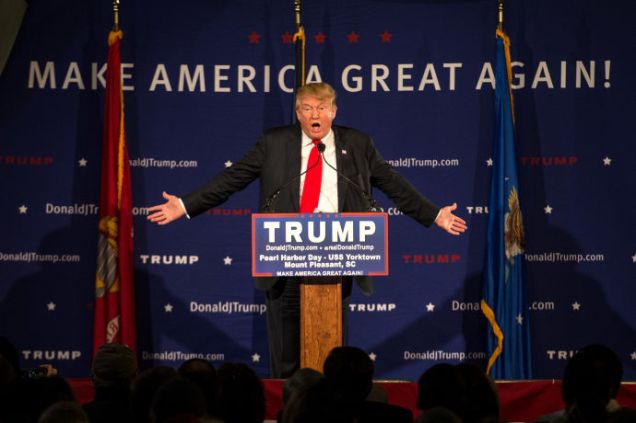
Donald Trump’s derisive comments about London and his proposal to ban all Muslims from entering the United States are idiotic and hugely illiberal. But the self-righteous backlash from parts of the Left is just as bad

American politicians – especially wannabe presidential candidates – insult London at their peril.

Mitt Romney found that out the hard way back in 2012, after his off-the-cuff comments about the London Olympic Games preparations earned the ire of the British public and a personal rebuke from David Cameron.

But current Republican presidential candidate (and, depressingly, frontrunner) Donald Trump managed to make Mitt Romney’s gaffe-prone diplomacy look like a veritable charm offensive with a two-pronged effort to capture the news cycle which saw Trump first suggest that the US implement a complete ban on Muslims entering the country, and then insult America’s closest ally by suggesting that whole swathes of London are so full of Islamist extremists that the police do not enter them for fear of their lives.

From the New York Times:

Donald J. Trump called on Monday for the United States to bar all Muslims from entering the country until the nation’s leaders can “figure out what is going on” after the terrorist attacks in San Bernardino, Calif., an extraordinary escalation of rhetoric aimed at voters’ fears about members of the Islamic faith.

A prohibition of Muslims – an unprecedented proposal by a leading American presidential candidate, and an idea more typically associated with hate groups – reflects a progression of mistrust that is rooted in ideology as much as politics.

Mr. Trump, who in September declared “I love the Muslims,” turned sharply against them after the Paris terrorist attacks, calling for a database to track Muslims in America and repeating discredited rumors that thousands of Muslims celebrated in New Jersey on 9/11. His poll numbers rose largely as a result, until a setback in Iowa on Monday morning. Hours later Mr. Trump called for the ban, fitting his pattern of making stunning comments when his lead in the Republican presidential field appears in jeopardy.

And the Guardian:

In a bid to justify his controversial comments that Muslims should be barred from entering the US, Trump had said parts of London and Paris were so “radicalised” – seemingly a reference to Islamist extremism being rife – that police officers were scared.

“Paris is no longer the safe city it was. They have sections in Paris that are radicalised, where the police refuse to go there. They’re petrified. The police refuse to go in there,” he told MSNBC, refusing to name specific neighbourhoods in the city.

He added: “We have places in London and other places that are so radicalised that the police are afraid for their own lives. We have to be very smart and very vigilant.”

It really isn’t necessary to counter either Donald Trump’s back-of-a-napkin immigration policy, his supremely un-American idea for a religious test in order to enter the United States or his uninformed comments about the city which some years ago overtook New York and Paris as the world capital for finance and tourism respectively. We’ll take it as a given that every thinking person can recognise these comments as the unfiltered bilge that they are.

Of far more concern are the growing hordes of MPs, commentators and members of the public calling for Donald Trump to be banned from ever entering the UK on the grounds of “hate speech”.

The inevitable online petition is already circulating and picking up names, reports the Huffington Post:

An online petition calls on U.K. Home Secretary Theresa May to bar the Republican presidential frontrunner from entering the country for allegedly violating the nation’s hate-speech laws. 

If it receives 100,000 signatures, the petition could be taken up for debate in the House of Commons, according to The Independent. 

The petition launched by Scottish resident and longtime Trump critic Suzanne Kelly blasts Trump for “unrepentant hate speech and unacceptable behavior” that “foments racial, religious and nationalistic intolerance which should not be welcome in the U.K.”

While Sunder Katwala sets out the illiberal case over at British Future:

It is important that the UK Government makes very clear that this extreme view is rejected and repudiated in the strongest possible terms.

The UK Home Office has set out clear guidelines which have led to the exclusion of preachers of hate from the UK if their presence here would not be conducive to the public good. Theresa May has excluded extreme Islamists on these grounds, and also kept out those who have fanned extreme anti-Muslim prejudice, such as the bloggers Pamela Geller and Robert Spencer. Trump’s statements are more extreme than theirs.

Unless and until Trump were to retract these highly prejudiced comments, there is a good case for making clear that he would be refused entry to the UK by the Home Secretary.

No. It is only “important” that the UK government does anything at all about this wretched circus act if you take the view that it is the proper role of government to be a watchful, overprotective parent who oversees everything that we do, say or hear, supposedly for our own good.

It’s only “important” if you take such a dim view of the intelligence of the British people that you believe – like a Victorian prude – that the health and morals of the nation are somehow at stake, and that general public might be inspired to commit racist or Islamophobic deeds either at the mere sound of Trump’s words or at the sight of his ridiculous hairdo.

Such a view is as nonsensical as it is insulting. Why on earth should the UK government care what a reality TV star turned presidential candidate says, and why can’t the British people be trusted to hear what he has to say and judge the merits (or the idiocy) for themselves? Besides, either Trump’s candidacy remains a complete joke, in which case illiberal UK government censorship would be a massive overreaction, or he is a viable contender – in which case the UK needs to remain neutral while our closest ally chooses their next leader.

Donald Trump didn’t cover himself in any glory with his latest comments on Islam and London. But who expected anything more of him? For all his natural gift as a TV personality, Trump is a blowhard, anti-intellectual populist of the worst sort – a man who is fundamentally incurious but convinced that he has the right answer for everything (usually involving “winning” a trade war with China).

And to be sure, Trump’s latest remarks disqualify him as a serious candidate for the presidency, if the ten previous outrage-baiting comments had not already done so. In many ways, this is Trump’s “choosing Sarah Palin” moment – the action which finally doomed his candidacy, much like John McCain’s desperate and opportunistic pick for a vice presidential candidate back in 2008.

But the Left supposedly hold themselves to a higher standard. And yet in response to Trump’s inflammatory words we have seen such a parade of ostentatious outrage and cheap virtue-signalling that one could almost be forgiven for forgetting that the Left are in no small part responsible for the rise of Trump in the first place, as Douglas Murray devastatingly explains in The Spectator:

When the political left refuses to identify where Islamic terrorism comes from, what drives it or what it can even be called, it leaves the ground wholly open for anyone else to do or say anything they want.  Far from being blunt tools or broad brushstrokes, referring to ‘Islamic extremism’ or ‘Islamism’ makes an obvious and conscious effort to put down a delineating line between non-extreme Muslims and the extremists from their faith.  Yet many Muslim organisations, among others, reject this.

[..] But what people seem slow to realise is that suppressing legitimate concerns and decent discussion inevitably leads to people addressing the same things indecently.  We can thank the American left for the creation of Donald Trump and we can thank them for his comments last night.  For years the left made the cost of entering this discussion too high, so too few people were left willing to discuss the finer points of immigration, asylum or counter-terrorism policy and eventually the only release valve for peoples’ legitimate concerns is someone saying – wrongly in my view – ‘keep them all out.’

Yes, of course Donald Trump’s comments are reprehensible. But the answer is not to parade our outrage on social media, as though engaging in a competition to be more publicly offended by Trump’s words is a meaningful substitute for real activism. And nor is the answer to ban Donald Trump from coming to these shores, thus denying Boris Johnson and thousands of eager Londoners the opportunity to prove him wrong about our city – and Trump himself from receiving this much needed education.

Outrage on Twitter is nothing more than empty virtue-signalling, whilst indignant calls for Trump to be banned from entering the UK are every bit as illiberal as Trump’s own proposal to set a religious test for entry into the United States.

Donald Trump’s opponents believe that they are better than the business mogul, reality TV star and presidential candidate. If so – if they are all simply better, more enlightened people, a belief they make little effort to hide – they have a funny way of showing it.

Donald Trump - Make America Great Again

Agree with this article? Violently disagree? Scroll down to leave a comment.

Follow Semi-Partisan Politics on TwitterFacebook and Medium.

Only Fellow Muslims Can Cure Islam Of Its Fundamentalist Cancer

Christian Life Of Brian Charlie Hebdo Terrorism Islamic Fundamentalism
Clear provocation for a fundamentalist massacre


Dan Hodges poses an excellent question in his Telegraph column today: what if the Paris terrorists had been Christian rather than Muslim?

He does this to make a point that should be fairly obvious, but which too many of us continually miss – that were the shoe on the other foot, or rather the other religion, it would be unequivocally expected and demanded of moderate Christianity to root out the fanaticism from within its base, without delay and with no excuses or exceptions.

The fact that we add so many caveats and exceptions when making this demand of moderate Islam is therefore, according to Hodges, prima facie evidence that we currently give leeway and grant concessions to Islam that we would not do for any other faith. In Hodge’s imaginary alternate universe:

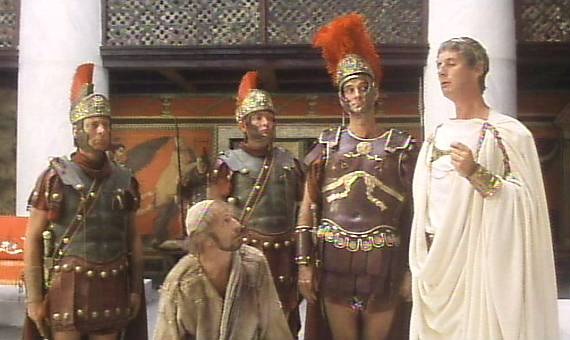
Then came another attack. Two Christian gunman walked calmly onto the stage of the O2 arena, and machine-gunned to death John Cleese, Terry Gilliam, Eric Idle, Terry Jones and Michael Palin, as they performed their comeback tour. It was, their killers later revealed in a video-taped message, in revenge for the lampooning of Jesus in “The Life Of Brian”. Witnesses at the O2 claimed that as they ran from the stage, the assailants were heard to shout “We have just killed Monty Python”.

A day after the O2 attack, the BBC Today program sent a reporter to High Wycombe, to gauge the reaction of members of the local Christian community. It was “painful people had to die in this way” one interviewee conceded. But the Monty Python cast should not have mocked Jesus. “I love Jesus,” he said. “More than my mum, more than my dad, more than my children.” It was legitimate to insult individuals or people he added, “but not God, not Jesus. We will not allow that. If they are going to do that, that [the attacks] will happen again and again.”

Continue reading

A Black Flag Flies In London, Revealing A Schism In Britain

Will Crooks Estate Flag London


A black flag was flown from the gates of an east London housing estate, and an entire neighbourhood was effectively declared last week not only to be in solidarity with the people of Gaza and the cause of Palestinian statehood, but – contrary to any available evidence or the residents’ consent – to also be united in a shared, extremist interpretation of the Islamic faith.

As the Guardian reported at the time:

The flag bears similar writing to the jihadi flags that have been flown by the extremist group in Iraq and other jihadi groups since the 1990s. When the estate was approached last night, a group of about 20 Asian youths swore at Guardian journalists and told them to leave the area immediately. One youth threatened to smash a camera.

When a passerby tried to take a picture of the flag on a phone, one of the gang asked him if he was Jewish. The passerby replied: “Would it make a difference?” The youth said: “Yes, it fucking would.” Asked if the flag was an Isis flag, one local man said: “It is just the flag of Allah.” But another man asked: “So what if it is?”

Should the black flag be banned from the streets, as it is in some European countries such as the Netherlands? Absolutely not – the right to free speech and freedom of expression is one area where it is actually right to take a maximalist, uncompromising stance despite the difficulties and tensions that it may cause.

Banning the black flag, despite its similarities to the jihadi flags flown by ISIS, is not the right move. If a private individual wishes to mark themselves out in public as a ideologically extremist bigot with pro-terrorism sympathies, that should be their protected right. But the flag had no place being flown on council-owned housing property as though it spoke for all of the residents when it did not, and so it was right that the flag was removed by Sister Christine Frost, a Roman Catholic nun and local community activist.

Douglas Murray summed up the most appropriate reaction to the provocation at the time in The Spectator, explaining in stark terms the gravity of the fact that some British Muslims chose to proudly display a flag of this type in London, so far removed from the various conflicts:

When historians look back on Europe in this era, they will rub their eyes in disbelief. ISIS is carrying out actual genocide, ethnic and religious cleansing on the people of Syria and Iraq. Their exact ideological soul-mates in Hamas, Hezbollah and al-Qaeda are doing everything they can to set light to the same region. Right now the western states are finally talking of intervening in Iraq to stop ISIS wiping out the ancient Yazidi and Christians communities of Iraq. Yet we do nothing to stop the same murderous ideology thriving here.

Instead another pattern is set. When we see this disgusting ideology at work, as we have done for the last month, much of Europe turns its hatred onto the Saturday people for defending themselves. Israel continues to defend itself. And we may do something to hold back ISIS in Iraq. But what will we do in our societies when we finally realise that behind the flag of Hamas is the black flag of jihad, and that after failing to stand up for the Saturday people there will be fewer people left to stand up for the Sunday people?

Most importantly, what will we do when we wake up to the fact that, far from being in some neighbouring or far-flung country, we have allowed the enemy to plant itself deep inside our own countries?

But perhaps predictably, LondonLive is now reporting that the same young people who raised the flag over a housing estate in east London are complaining that the flag’s very removal is a sign of racism and Islamophibia:

A controversial black flag flown above the gates of an east London council estate is being defended by young Muslims.

The flag – which has been linked to some jihadist groups – has been removed twice by a concerned nun and police officers. 

But youths at the Will Crooks estate in Poplar have today said assumptions that the flag is linked to extremist groups is ‘racist’. 

One youth said: “It’s just racists complaining. If it was the St George’s flag, it would be alright. But this is our version and there’s this big reaction.”

More than the fact that the flag was raised in the first place by one or two deluded hotheads, it is the fact that the flag was then defended by other, supposedly representative local youths, that should give everyone the greatest cause for concern.

Here, in the young peoples’ protest, is the whole problem in a nutshell, the root of the problem with Islamic extremism in Britain. It’s the regrettable attitude by some Muslims that proclaims “You may be English, but we’re Muslim”. It’s the stubborn belief among its adherents that they are Muslims who just happen to live in Britain, rather than British people who happen to follow the religion of Islam. And yes, it’s the craven support from some appeasers on the left, who overlook or excuse the lack of  integration with British society, and echo their accusations of Islamophobia and racism directed at anyone who argues for greater cultural assimilation and the embracing of British values.

The fact that the go-to defence offered up by the local youths was a comparison with the St George’s Flag, one of the home nation flags of the United Kingdom, reveals the height of the mountain that must be overcome. The St George’s Flag belongs just as much to the angry Muslim youths in the Will Crooks housing estate as it does to anyone else in England, but they choose to reject it in favour of a religious flag, despite the fact that their chosen standard has a violent, gory recent history.

In modern Britain (with the partial exception of Northern Ireland, where sectarianism and flags are still linked with intolerance and violence), one’s religion and faith is not demarcated with a flag. Indeed, religion and national identity or patriotism exist, for the most part, on separate planes – and much the better for it. A British Catholic may follow Church doctrine and hold the Papacy in the highest reverence, but will likely identify as British first and foremost, and it is to the country that their primary allegiance lies. The same could be said of most British Jews, or mainstream British Muslims.

But there is a sizeable, vocal block of non-mainstream Muslims who clearly do not identify themselves as British first and foremost, who in some cases feel that they are pitted against their non-Muslim neighbours and compatriots because of their faith. And these people are eagerly capitalising on events taking place many thousands of miles away – in Iraq, Syria and Gaza – to pledge their solidarity with and allegiance to this religious, cross-border fraternity before they give any thought to Britain, the country that gives them life and liberty.

This has to stop, but in order for the situation to change it must first be recognised as a problem. This recognition needs to come from Britain’s mainstream Muslims first and foremost – of course community leaders and parents can only do so much to teach tolerance and British values when social media and internet voices speak the language of extremism, but still an effort must be made commensurate with the scale of the problem.

But the rest of us have a role to play too. Where there is genuine Islamophobia, we must confront it and correct misconceptions about moderate, mainstream Islam. But equally, we must not be cowed into defending extremism when we encounter it, for fear of being labelled racist or intolerant. We have seen the insidious harm that can be done when a blind eye is turned to the extremist threat in the case of the Birmingham “trojan horse” schools scandal.

The people who chose to hung the black flag from the gates of the Will Crooks estate in Tower Hamlets were not merely expressing solidarity with the people of Gaza in the course of the current conflict with Israel. They went above and beyond that statement of solidarity (which was itself inappropriate as it presumed to speak for the whole community without their consent), and flew a flag which they knew to have connotations of violence and extremism. Any pretence that it was all just an innocent misunderstanding was shattered when the flag was re-flown again days after being taken down.

Unless and until the wall of stubborn, self-imposed segregation is broken down between tolerant, mainstream Britain (including moderate British Muslims) and those sullen holdouts who feel stronger identification and fealty to primitive, medieval dogma than to their own country, Britain will continue to wrestle with this toxic (and increasingly existentially threatening) issue.

And before long, an offensive flag flying in the shadow of Canary Wharf will be the very least of our concerns.


Photograph: From Trial by Jeory blog.

Headline London Debate: Should Britain Make Eid And Diwali Public Holidays?

Samuel Hooper London Live Headline London Eid Diwali Public Holiday 2


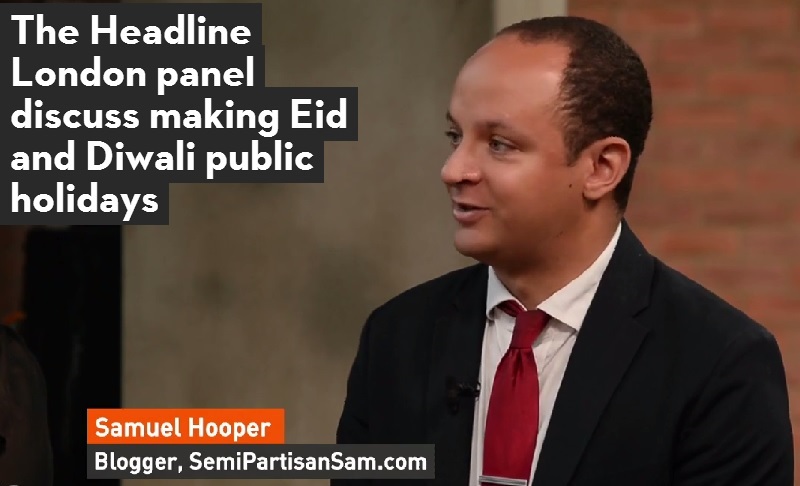
Yesterday, London Live TV’s Headline London lunchtime news programme covered the Eid celebrations taking place in the capital, and asked whether the UK government should make Eid (and the Hindu festival of Diwali) nationwide public holidays.

The idea was first raised in Parliament last week by Conservative MP Bob Blackman, in response to an online petition signed by more than 120,000 people. I vehemently disagreed with the proposal at the time, for the reasons set out here.

Semi-Partisan Sam was pleased to be invited to debate the issue with poet Mohamed “Mo Rhymes” Mohamed and political activist Peymana Assad on the Headline London panel. The debate was courteous and good-natured, which cannot often be said of debates on religion – but I believe my argument, founded on national unity, church/state separation and the rights of the individual won the day.

London Live’s website only shows the first part of the panel discussion, but the full segment is embedded here, via Semi-Partisan Sam’s YouTube channel:

If you enjoyed reading this article, please take a second to LIKE or SHARE it on social media using the buttons below. Help to spread the word and continue the debate.

How Can We Teach British Values In School If We Are Afraid To Assert Them Ourselves?

British Values Twitter 3

Just what are British Values?

Well, apparently the concept is sufficiently fuzzy in the minds of some people that we all now need to take time to argue amongst ourselves and reach a common consensus while one of the biggest and most worrying educational scandals in recent years plays out unobserved.

In response to the ongoing scandal of Birmingham schools being compromised by activist governors to deliver covert Islamic religious teaching, the Education Secretary, Michael Gove, made the slightly awkward if well-meant assertion that in future, all primary and secondary schools will be required to “promote British values”.

The Guardian reports:

Michael Gove, the education secretary, has seized on a finding byOfsted that a “culture of fear and intimidation” existed in someBirmingham schools by announcing that the government will require all 20,000 primary and secondary schools to “promote British values”.

These values will include the primacy of British civil and criminal law, religious tolerance and opposition to gender segregation. Gove also suggested girls wearing the burqa would struggle to find their voice and must not feel silenced in the classroom.

In what is being described by ministers as a decisive shift away from moral relativism in the classroom, the education secretary took action after a landmark series of reports by the schools inspectorate into 21 Birmingham secular schools found an atmosphere of intimidation, a narrow, faith-based ideology, manipulation of staff appointments and inappropriate use of school funds.

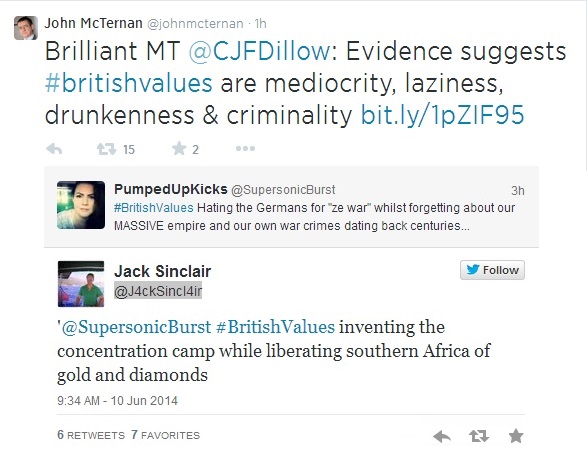
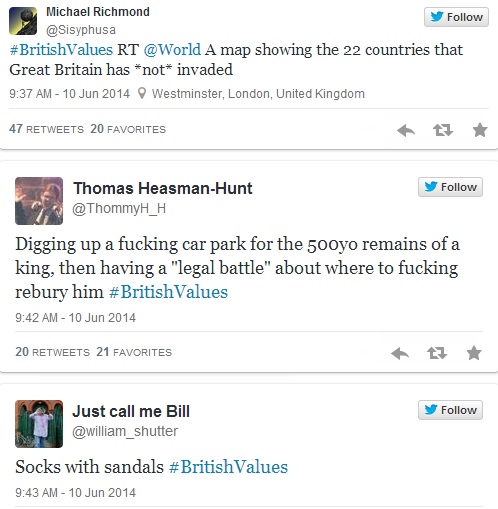
Unfortunately, the predominant response thus far has not been one of outrage that such a thing could happen to compromise children’s education in the UK’s second city; instead, we have seen race to come up with the funniest self-deprecating anti-British putdown as expressed by the #BritishValues hashtag now trending on Twitter.

When presented with the opportunity to express outrage that local school curricula could be so easily hijacked by fundamentalist members of any faith and ‘turned’ to start promoting beliefs very far from the British values of democracy, equality, non-discrimination and obedience to the law, a majority seem more interested in having an introspective discussion about what modern British values really are (at best), or suggesting through Twitter witticisms that any concern is tantamount to xenophobic intolerance  (more common).

The Huffington Post has collated a selection of what it considers to be “the best” responses, which take an almost uniformly dim view of British culture and history:

British Values Twitter 4

(It should be acknowledged that there have also been some very sensible and thoughtful contributions from others, such as the pianist Stephen Hough).

The hashtag activist comedians and earnest scolds of Twitter currently attempting to look cool by running Britain down on social media are actually revealing a few ingrained British traits of their own – excessive self deprecation and an almost craven desire not to offend or appear controversial – which easily become insidious and harmful when taken to extremes.

There is a gnawing anxiety behind some of the mocking #BritishValues tweets. “Isn’t patriotism so old fashioned?”, they scream. “Let’s list all the bad things that Britain has done so that no-one thinks we’re being boastful”. It may come across as cool, trendy liberalism but look closer and you see that some of it is actually rooted in fear.

Somewhere along the way the idea of expressing pride in Britain, and in British exceptionalism, became interchangeable in the minds of many people with that altogether darker and more insidious disease of racism. To express the former is, in the eyes of many, to come uncomfortably close to embracing the latter. And as a result, people instinctively turn away from patriotism, and instinctively oppose suggestions such as teaching British values at school, mistaking it for something else (and, incidentally, leaving a vacuum that the far right is only too happy to exploit).

And yet there is a serious issue at stake here, with the integrity of children’s education in question. Even the Guardian’s John Harris felt the need to weigh in to the ongoing argument about the fundamentalist Muslim influence in Birmingham schools, reminding his readers that state-subsidised religious indoctrination or interference with the curriculum is wrong whatever the source, and that this is no time for those on the left to bury their heads in the sand:

At the risk of reopening old wounds on the liberal left, for all the noise from those on the right of culture and politics, it is no good crying “witch hunt” and averting your eyes from this stuff. It should have no place in any state school, and most of it is an offence to any halfway liberal principles.

But Harris still felt the need to couch his tortured article in the wider context of a state education system which is failing and falling into disarray under the hated Tory government – the harsh unexpectedness of his gentle reminder that it’s not okay to look the other way and pretend to ignore the fundamentalist corrupting of education for fear of seeming racist or intolerant having to be soothed with a good old swipe at the real enemy, those on the political right.

Efforts to stamp out casual and institutional racism in Britain, while incomplete, have come a long way, even since the 1980s and 1990s. A large part of eradicating the scourge of casual racism has been (quite rightly) to mock it, deride racist thoughts and speech as backward and out of place, and doing everything possible to make racism distinctly uncool. The campaign to eradicate racism from football is a prime example of how successful Britain has been, especially when compared with continental and eastern Europe.

But while there is unquestionably still much work to be done, we must also begin to ask ourselves if one of the side effects has been a growing inability for people to express deeply felt but harmless national pride and patriotism in any but the safest, media-approved settings (such as the 2012 London Olympic Games).

If our generation’s instinctive response when they see criticism levelled at a person or group within a religious or ethnic minority is not to check the veracity and demand action if it is found to be true, but either to flinch and avert their eyes out of shock and unwillingness to believe or to become so embarrassed that their only coping mechanism is to resort to self-deprecating humour on social media, perhaps this is the price that our country has to pay in order to purge itself of the ingrained, widespread, casual racism that was common and socially acceptable for so long. Perhaps.

But being this way makes it much harder for us to deal with the problems facing Britain today, where the pernicious influence of fundamentalists (of all religions) on the young and the lack of assimilation of some cultures into wider British society are real issues that are being only half-heartedly tackled because of the paralysing fear of saying the ‘wrong thing’ or giving the wrong impression.

When asked why it was that Americans are so much more openly patriotic than Brits, the late Christopher Hitchens attributed it to the fact that overt displays of patriotism and love of country in the United States are borne out of the fact that as a nation of immigrants, Americans have no real shared history going back more than a couple of centuries. Therefore, simple acts such as reciting the pledge of allegiance every morning in schools and singing the national anthem before sporting events have, over time, helped to forge that unity within diversity.

But what has always been true of America is now increasingly becoming true of Britain. Immigration into Britain may bring profound economic and cultural benefits, but with each successive year of high net immigration and a lack of assimilation in some quarters, that degree of shared common history is diluted a bit more. And that’s absolutely fine, if other measures are in place to balance it out – like reciting a pledge, offering comprehensive British history as a mandatory subject at schools, or, shock horror, teaching children “British values”.

At the moment, though, these countermeasures are lacking. It should come as little surprise then that certain groups within society do not feel as much desire or pressure to integrate as they rightly should, and that when the door is left wide open in places like Birmingham to influence schools to teach children according to certain subcultural norms, some people will seize the opportunity with both hands.

Unfortunately, in the age of hashtag #Britain, not only does it surprise us when this happens, the thought of condemning or intervening in these events embarrasses us so acutely that we are barely able to have a national conversation without descending to xenophobic conspiracy theorising on one side or accusations of scaremongering on the other, topped off with a sprinkling of nervously self-deprecating Twitter jokes.

As John Harris noted in his article, by this point “inflammatory language and alarmism” have now done their work and made it harder to get to the bottom of what has really been going on in Birmingham’s schools. But there is an equally powerful countervailing force working in the other direction, suggesting that any concern is an unwarranted attack on a minority and misrepresenting any calls for the assertion and teaching of British values as xenophobic, Islamophobic and a direct attack on the principle of multiculturalism. It is not.

If we carry on in this way, we will never succeed in building and maintaining the unified, diverse and tolerant Britain that we all say we want.


If you enjoyed reading this article, please take a second to LIKE or SHARE it on social media using the buttons below. Help to spread the word and continue the debate.