Will All Those In Favour Of Open Borders Please Stand Up?

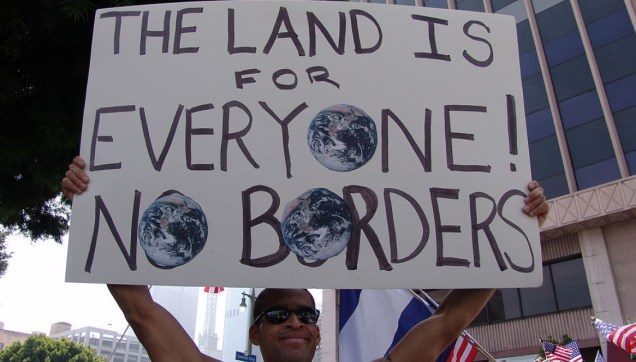
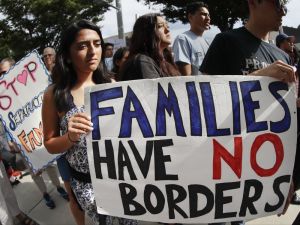
No Borders No Nations Stop Deportations protest banner

Will the Left’s unspoken, newly-extremist position on immigration and open borders be their political undoing?

Using Brexit and Trump as a smokescreen, many leftists have quietly moved towards a de facto “open borders” position on immigration without ever actually uttering the words or having the courage to declare their intentions in public.

Whether it is members of the anti-Trump “resistance” in America or bitter defenders of the European Union in Britain, opposition to what they see as an ongoing regressive right-wing coup is prompting many on the Left to adopt an uncompromising, extremely permissive stance on immigration which previously existed only on the libertarian fringes and which many leftists themselves once opposed.

This extremist new position is red meat for many left-wing activists, particularly certain elements of the Hispanic voting bloc whom Democrats need to fire up and turn out on election days (as well as for self-proclaimed “citizens of the world” living in newly-fascist Britain). But is the Left’s closed information loop of outrage causing them to diverge from popular opinion at a time when conservatism is otherwise discredited and electoral gains are there for the taking? By tying themselves so closely and unapologetically to people who came to and live in the country illegally, have left-wing parties put themselves on a collision course with the electorate?

Vox’s Dara Lind chronicles the strange journey on which the Democrats have embarked:

The thing is, about 10 years ago, many Democrats — including, notably, Schumer — would have championed many of the Trump administration’s enforcement proposals, from increased local cooperation with immigration enforcement to a physical barrier on the US/Mexico border, even if they weren’t part of a deal to legalize unauthorized immigrants. And they’d certainly accept them, happily, alongside legalization.

Absolutely. Applying the Left’s contemporary standards, only a decade ago the likes of Chuck Schumer and Nancy Pelosi were supporters of an oppressive, white nationalist agenda – as, in fact, was Hillary Clinton, who once voted to strengthen and expand border fencing between the US and Mexico. This is how far the Left has come on the subject of immigration, in a very short space of time.

More:

But it’s certainly true that Democrats in 2017, in general, tend to criticize the use of immigration enforcement, and tend to side with those accused of violating immigration law, as a broad matter of principle beyond opposing the particular actions of the administration.

This goes beyond simply representing members of their own communities (and potential electoral constituencies). The activist defense of immigrants caught crossing the border, especially the Central American children and families that now make up a large share of people entering the US without papers, has led Democrats to take a much firmer stance in defending them as humanitarian victims who deserve the chance to seek and receive asylum in the US.

In fact, you would be hard pressed to get a Democratic politician to name a single category of illegal immigrant whom they do not consider worthy of amnesty and eventual citizenship. Accusations of racism and oppression come easily to them, yet they are suddenly struck dumb when asked what kind of border security or immigration enforcement measures they would actually support.

And sometimes this leads the Democrats to new heights of extremism:

More broadly, Democrats are no longer as willing to attack “illegal immigration” as a fundamental problem anymore.

That rhetoric, too, came in part from DREAMers, who didn’t like being talked about as victims of their parents’ crimes who came to the US “through no fault of their own.” Instead they’ve portrayed their parents as “the original DREAMers” — a line that Nancy Pelosi followed in September when she said that DACA recipients’ parents “did a great thing” in bringing their children to the US.

Violating US immigration law is now “a great thing”, in the words of the Democratic Party Minority Leader. It is one thing to turn a blind eye to the abuse of the rule of law, as many on the Left have done for some time regarding immigration. But it is quite another thing altogether to praise that lawbreaking and hold it up as a paragon of civic virtue. This position totally undermines any remaining protestations that the Left are interested in any kind of immigration enforcement, and shows that their idea of “immigration reform” basically means unconditional amnesty with not even a token gesture for conservatives.

Lind’s article is worth reading in full, since she delves into some of the structural reasons why immigration activist voices now carry so much more weight within the Democratic Party, particularly the trade union shift from opposing illegal immigration to protect their dwindling memberships to supporting illegal immigration to boost their enrolment. But whatever the cause, the degree to which Democrats have lurched to the Left on immigration is alarming, and of concern to anybody who would like to see comprehensive reform in which amnesty is given only in exchange for a serious boost to future enforcement.

Andrew Sullivan thinks that the Left are marching off a cliff with their newfound extremism on immigration, and says as much in his weekly column for New York Magazine:

This is, to be blunt, political suicide. The Democrats’ current position seems to be that the Dreamer parents who broke the law are near heroes, indistinguishable from the children they brought with them; and their rhetoric is very hard to distinguish, certainly for most swing voters, from a belief in open borders. In fact, the Democrats increasingly seem to suggest that any kind of distinction between citizens and noncitizens is somehow racist. You could see this at the last convention, when an entire evening was dedicated to Latinos, illegal and legal, as if the rule of law were largely irrelevant. Hence the euphemism “undocumented” rather than “illegal.” So the stage was built, lit, and set for Trump.

He still tragically owns that stage. What Merkel did for the AfD, the Democrats are in danger of doing for the Trump wing of the GOP. The most powerful thing Trump said in the campaign, I’d argue, was: “If you don’t have borders, you don’t have a country.” And the Democrats had no answer, something that millions of Americans immediately saw. They still formally favor enforcement of immigration laws, but rhetorically, they keep signaling the opposite.

I was also astounded when the Democrats chose to devote a large section of their 2016 party convention to sharing their stage with confessed and unrepentant illegal immigrants. Though I cannot claim to have predicted Donald Trump’s election victory, in hindsight it is clear that moments like this just killed whatever enthusiasm existed for Hillary Clinton in the key swing states which she went on to narrowly lose.

When you refuse to condemn any form of illegal immigration, make the concerns of illegal immigrants one of your main priorities (often over and above born and naturalised citizens) and actively praise their lawbreaking, you have adopted an open borders position. You just don’t possess the courage to come out and say so, for fear of the political consequences. Apparently the Democrats are quite happy to ignore the concerns of Middle America, but are not yet quite ready to publicly give them the middle finger.

It is not unreasonable for people to ask politicians and political parties who embrace illegal immigration exactly what (if any) immigration controls they would actually accept. In fact, the only reason that Democrats are not routinely put on the spot and shamed into answering this question is because a spineless, complicit Washington DC media tacitly agrees with the new extremist position (or at least is too scared of being called “racist” by social justice activists to do their job).

To be clear: the idea of deporting all (or even most) people currently living illegally in the United States is unworkable as it is cruel – many people in this position did what anyone else would have done, given their situations and the immense pull factors of demand for labour and sporadic enforcement. Moreover, many illegal immigrants have lived most of their lives in America and are effectively Americans in pectore. Many are probably model citizens. Some would likely become the best of America.

But if the rule of law means anything at all, violating US immigration law while others endured stress, incurred expense and lost time following the legal process cannot be rewarded unconditionally. Illegal immigrants should be lifted out of the shadows and freed from a fearful half-life which does nobody any good, but only after following a similar process to legal immigrants. And there must be proper border enforcement in return, so we do not end up back in the same situation in two decade’s time. Immediately upon amnesty being granted to otherwise law-abiding illegal immigrants, the Left must give up their defence of sanctuary cities which make a mockery of the law. Donald Trump’s wall is overly expensive, impractical and largely pointless, but existing fencing should be fortified and new technologies deployed to stop illegal crossings. In other words, there must be a meaningful quid pro quo.

Neither side in American politics has acquitted itself very honourably when it comes to immigration reform, but at present it is the Left who are rapidly lurching toward a more extremist position, led by their activists on a collision course with a more sceptical public.

And going into the next electoral cycle, all the shrieking about Trump’s “racist” wall will not disguise the fact that the Left have something far more radical in mind.
 

Immigration Reform

Support Semi-Partisan Politics with a one-time or recurring donation:

Agree with this article? Violently disagree? Scroll down to leave a comment.

Follow Semi-Partisan Politics on TwitterFacebook and Medium.

Leftist Open Borders Zealots Are The True Enemy Of Immigration Reform

The Land Is For Everyone - No Borders protest

There can be no meaningful compromise on immigration with those on the Left who will settle for nothing less than open borders but lack the moral courage to say so in public

So the Trump administration has now released its proposal for agreeing to grant legal status to the young illegal immigrants brought to the United States by their parents known as the Dreamers, potential beneficiaries under the threatened Deferred Action for Childhood Arrivals (DACA) program.

The list of concessions requested of the Democrats in exchange for normalising the immigration status of nearly one million people includes approving the much talked-about border wall with Mexico, hiring more Customs & Border Patrol agents, cracking down on “chain migration”, toughening asylum laws and the denial of federal grants to so-called “sanctuary cities” which deliberately limit their cooperation with federal agencies on matters relating to immigration enforcement, even when the administrative burden of doing so is minimal.

Aside from the construction of the wall – a silly waste of money given that many illegal immigrants are visa overstayers and not border jumpers, construction would damage a number of conservation areas and require the compulsory purchase of huge tracts of private land while Mexico has no intention of paying for the thing despite rash promises made by President Trump – these proposals fall into a category which might reasonably be called “perfectly sensible measures to protect the border and immigration rules of a modern, sovereign nation state”.

Of course, the Left sees it entirely differently. The New York Times bleats with alarm:

While it is unclear whether Mr. Trump views the demands as absolute requirements or the beginning of a negotiation, the proposals, taken together, amount to a Christmas-in-October wish list for immigration hard-liners inside the White House. Immigration activists have long opposed many of the proposals as draconian or even racist.

The demands were developed by a half-dozen agencies and departments, officials said. But among the officials behind the demands are Stephen Miller, the president’s top policy adviser, and Attorney General Jeff Sessions, both of whom have long advocated extremely aggressive efforts to prevent illegal entry into the country and crack down on undocumented immigrants already here.

The demands represented a concerted effort to broaden the expected congressional debate about the Dreamers to one about overhauling the entire American immigration system — on terms that hard-line conservatives have been pursuing for decades.

In a letter to lawmakers, Mr. Trump said his demands would address “dangerous loopholes, outdated laws and easily exploited vulnerabilities” in the immigration system, asserting that they were “reforms that must be included” in any deal to address the Dreamers.

Democratic leaders in Congress reacted with alarm, saying the demands threaten to undermine the president’s own statements in which he had pledged to work across the aisle to protect the Dreamers through legislation.

The New York times is quick to define the range of views on immigration which can be described as “hard-line conservative”, but they are noticeably silent on what would constitute a hard-line leftist position on immigration reform.

One can only determine something to be hard-line conservative if one has a birds-eye view of the entire spectrum of opinion, so presumably the New York Times knows that the hard-line leftist position on immigration – the stance with which the Trump administration must negotiate – advocates fully open borders and immediate amnesty for almost anyone who manages to set foot on American soil and declare their intention to permanently remain there. Yet the Times never makes this clear to its readers, who know all about the Evil Conservative position but are not even encouraged to think specifically about what the “liberal” alternative should be.

This is entirely deliberate – the leftist worldview knows that its position on immigration, the nation state and other issues would presently be repellent to a majority of Americans if spoken out loud. Therefore, they try to circumvent public opinion and achieve their ends by riding a wave of whipped-up anger and misunderstanding of conservative positions rather than boldly and unambiguously setting out their own wish-list of demands. Thus they hope to push America toward an irreversible, de facto open borders situation without ever having to utter the words or suffer the political consequences. You might call this smart politics and an astute strategy. But it is also rank cowardice, and perpetuates a fraud on the American people.

The true extremism of the Left’s unspoken stance on immigration can be seen in their reaction to the Trump administration’s proposals. When the Trump administration first stirred outrage and condemnation by declaring his intention to end the DACA program, most Democrats and others on the Left immediately started posturing as brave defenders of vulnerable “undocumented” people, the Dreamers’ last line of defence against an evil, racist Republican attack. One would therefore think that given that the Dreamers are supposedly the top priority of the American Left, they would agree to any compromise on immigration which promised to enshrine the permanent legal status of these people.

But you would think wrong. In their response to the Trump administration, House minority leader Nancy Pelosi and Senate minority leader Chuck Schumer’s joint statement read as follows:

The Administration can’t be serious about compromise or helping the Dreamers if they begin with a list that is anathema to the Dreamers, to the immigrant community and to the vast majority of Americans.

We told the President at our meeting that we were open to reasonable border security measures alongside the DREAM Act, but this list goes so far beyond what is reasonable.  This proposal fails to represent any attempt at compromise.

The list includes the wall, which was explicitly ruled out of the negotiations.  If the President was serious about protecting the Dreamers, his staff has not made a good faith effort to do so.

The statement conveniently ignores the fact that the Trump proposal would give the Dreamers exactly what they wanted – a pathway to permanent residency in the United States, and freedom from gnawing, perpetual uncertainty over their futures. The Democrats’ issue is not that the proposal fails to “help the Dreamers”. Their issue is that they do not get any of the many other things on their leftist immigration wishlist along with the bargain.

But that doesn’t sound quite so noble in a statement. In fact, it sounds rather grasping and selfish. So from a PR perspective it is much better to prance around pretending that the proposal is some kind of grave insult or threat to the sympathetic Dreamers, when in fact the proposal would give the Dreamers exactly what they want but leave Chuck Schumer and Nancy Pelosi empty-handed when it comes to their desire to further erode national borders. The public are far more likely to support Dreamers who they have been told are being threatened than they are to come out in defence of the Utopian open-borders fantasies of leftist academics, politicians and donors.

And since when has a policy being “anathema” to non-citizens without the legal right to reside in the United States been considered sufficient cause to reject it out of hand? Will the Democrats cheerfully go to bat for me if I, a British citizen, decide to take offence at US fiscal or education policy? It hardly seems likely. Is it not enough that this immigration compromise (flawed though it may presently be because of the administration’s insistence on an ineffective wall) would ensure the legal status of Dreamers? Apparently not – because even though it would assuage their primary concern about the risk of deportation, increased border security is apparently anathema to Dreamers and the “immigrant community” for whom the Democrats arrogantly claim to speak.

Debate about the merits of the wall aside, the present impasse is being fuelled almost entirely by Democrats and those on the Left, insistent as they are on getting 100 percent of what they want, despite controlling neither the White House or either house of Congress. They claim to care about the Dreamers, but ultimately are willing to throw every last one of them under the bus by walking away from negotiations unless they are able to extract something further from the Republicans to aid in their push for fully open borders.

And if this accusation sounds harsh, let it be refuted in detail by the American Left. Let them publicly state even one restriction that they would be happy to keep or impose in the name of border security or immigration control, instead of prancing around and flaunting their boundless compassion. Even if Donald Trump and the Republicans were negotiating in a genuine spirit of compromise and good faith – which I will concede is unlikely, based on past behaviour – how can agreement possibly be reached with a side which denounces any attempt to enforce the border as “racist” and conspicuously fails to articulate its own preferred outcome?

After having seen conservatives criticised endlessly by the Left for supposedly using young illegal immigrants as political pawns, what is shocking here is that it is Democrats, not just Republicans, who appear willing to hold the fortunes of Dreamers hostage in attempt to get their way on immigration reform.

If the Democrats actually wanted to do the right thing by Dreamers instead of cynically using them as an emotional prop for their argument, they would hammer out a deal with Donald Trump which conceded to all of the administration’s demands with the exception of the wall, and come up with some compromise there involving the strengthening of fencing and electronic border surveillance. But they won’t. The Left would rather screw the Dreamers and hold out for 100 percent of what they want rather than agree to a compromise which enhances future immigration control in any way.

And this is the uncomfortable truth: For some on the Left, the Dreamers are not people to be sincerely sympathised with and helped toward legal status, but merely a convenient resource to be exploited in the service of achieving their ultimate goal of open borders.

This is not smart politics. And it certainly ain’t compassion for the “undocumented”, either.

Trump Immigration Ohio

Support Semi-Partisan Politics with a one-time or recurring donation:

Agree with this article? Violently disagree? Scroll down to leave a comment.

Follow Semi-Partisan Politics on TwitterFacebook and Medium.

Can Dual Citizens Be Good Citizens?

British citizenship ceremony 2

What does it mean to be a dual citizen in the Age of Brexit?

Following my recent blog post lamenting our society’s devalued and transactional concept of citizenship in the Age of Brexit, I was asked by a reader to write a companion piece on the topic of dual citizenship, a form of recourse which may ultimately be taken up by many EU residents currently living in Britain.

The request was as follows:

Brexit has caused (we are told) applications for passports from people who already hold passports – that is, people who are citizens of one European country seeking to become a citizen of a second country too.

This apparently includes UK citizens applying for Irish passports (without abandoning their UK passports) and people from continental countries who live in Britain applying for a British passport too (presumably this means going through the naturalisation process?). One wonders how many people who announce that they are planning to do it actually do – but it is evidently happening.

It is questionable why people should be able to be dual citizens if they live in democracies and are free to travel and work abroad. The ability to claim benefits in a second country seems to be one impetus. But it can cause people costs, like two tax liabilities. Some countries do not allow their citizens to take another citizenship without renouncing their existing one, but there seem to be many countries which are happy to agree to dual citizenship.

Your article of 12 September explains well how citizenship is becoming a sort of transaction – benefits for taxes, and no longer an allegiance to a nation. The large increase in people obtaining (why not triple?) citizenship could further undermine the significance and value of being a citizen of a country.

My reader seems to build on my assertion that citizenship is increasingly seen (particularly by educated, globally mobile elites) as very much a transactional affair with perks received in exchange for taxes paid, and extrapolates that dual citizenship is necessarily a further dilution of the bond between citizen and nation state.

This is a tricky subject for me to discuss, primarily because I will ultimately be emigrating to the United States with my Texan wife (who is herself currently in the process of applying for British citizenship). Therefore, to rail against the concept of dual citizenship would be hypocritical, while approving too strongly might be seen as merely attempting to justify my own personal circumstances. All I can do when setting out my views, therefore, is to make people aware of this potential bias and lay out my thinking on the matter as it currently stands.

In short, I do not believe that dual citizenship is either inherently good or inherently bad. Though there is undoubtedly a correlation between those who hold dual citizenship and the kind of fleet-footed “Citizens of the World” who feel that they have transcended national identity altogether, it is perfectly possible in my mind for somebody who holds dual citizenship to be a model citizen of both countries, while somebody without an international lifestyle can just as easily be a terrible citizen of the only country they call home.

Therefore, I don’t think it is a question of whether dual citizenship as a concept is right or wrong. The more interesting question to me is what makes somebody a good citizen of their home or adopted country, and what makes somebody a bad or negligent citizen.

One could probably define this a thousand different ways, but for immigrants seeking to naturalise as dual citizens surely it includes a mixture of more tangible qualities (being economically active, law-abiding, involved in the community) and intangible qualities (genuine interest in and acceptance of the country’s culture and values). Immigration authorities typically only look at the tangible aspects – what else could they do? – but while this scrutiny can reveal whether somebody is likely to be an economic burden or a danger to society, it is the intangible (and largely immeasurable) qualities which really determine whether or not somebody will make a good citizen.

From my own experience, I have loved the idea of America since I was an early teenager, and the reality of America just as much, ever since first experiencing the country in my late teens. The architecture, the art, the (classical) music, the landscape and the sheer optimism of America captivated me well before I was politically aware, and the Constitution, federal system and that strange but compelling contradiction between individualism and great community-mindedness equally appealed to me as I came to understand them.

America is a country that I feel I know well. Not just in the sense that frequent holidaymakers might be able to direct somebody to their favourite restaurant in New York City, or the way that US-based foreign correspondents come to know the political and cultural elites with whom they rub shoulders, but at a much deeper level.

I have visited and worked in towns and cities across that great land, from New York to Chicago to Kansas City to Austin to San Antonio to Seattle, and many smaller places in between. I have seen and savoured some of the best of urban and rural living in America, from hearing the New York Philharmonic play John Adams, riding a stranger’s horse in Colorado and experiencing the Catholic Mass with Mariachi music in my wife’s south Texas hometown to eating fried food on sticks at the Illinois State Fair. I have spoken with people from the most left-leaning liberals to the strictest social conservatives and found nearly everyone to be unfailingly polite and welcoming – though a couple of men I once conversed with at a hotel bar in Arkansas were none to happy that America had a black president (they used a different word).

I have seen (some of) the best of America, and glimpsed the darker side, too. And so when the day finally comes that I raise my hand and take the oath of allegiance to the Constitution and laws of the United States of America I will be aligning myself with a country that I know and love, for all its greatness and its imperfections.

I will not become an American to join a closed community of fellow British expats, clustered together in one locale and unwilling to integrate with American society. I will not become an American to try to make the United States more like Britain. I will not become an American because the taxes are lower (though they are), or because I think I can get more from the welfare system (I certainly won’t). I will not become an American merely because the United States is a temporary work posting, a brief stopover as part of a transnational career. No, I will become an American because I will one day make that place my home and want to share that bond of citizenship and fraternity with my fellow citizens; because I want to participate in American democracy and every facet of civic life open to citizens.

But even as I do so, I will not lose affection for the United Kingdom, my homeland. I will remain connected to Britain not only through ties of family and friends, but because I am proud to be British and have been an engaged citizen of this country for so long, politically and culturally. When my wife and I have children we may well want them to spend some years growing up in London so that they know the rich culture that is also their inheritance. Far be it from me to brag about myself, but as an abstract ideal for the model dual citizen this would seem like a decent enough template.

But the diluting effect of loyalties mentioned by my reader is undoubtedly a real phenomenon. I would think it highly unlikely that anybody could maintain such strong connections as the number of countries and citizenships involved ticks upward. I have to tread carefully here, because I have a number of dear and longstanding friends who hold multiple citizenships, and uncontestably have strong attachments to and affection for each country in question. One cannot make judgments about individuals from population trends, or infer population trends from observing individuals, but at a macro level I think it is generally the case that deep attachment to a nation state decreases as the number of citizenships in play increases.

The degree to which the cultures in question differ from one another probably also determines whether it is possible to form a deep bond to multiple countries. I would imagine that growing up in a Middle Eastern theocracy would make it at least somewhat harder to form deep bonds of attachment to a country with Western values and culture while maintaining undiminished affection and loyalty to one’s homeland, though there are undoubtedly many such dual citizens who do not experience (or at least overcame) any cognitive dissonance in this regard.

Many residents holding a particularly high number of citizenships are likely to have acquired at least one from birth or through their parents, and may have very little connection to the culture of that country if they grew up without living there. I know several people who hold Spanish citizenship through birth, though the closest connection they have with Spain is having occasionally vacationed there as a child. Does this make them bad citizens? I wouldn’t necessarily say so, since their citizenship is passive – they do not live in Spain or participate in Spain’s democratic process, and so their effect on Spain is neither positive or negative.

And of course there are particularly mobile members of the economic elite who often tend to have more in common with elites from other developed countries than with their less affluent neighbours. Benjamin Schwarz is the latest to pick up on this particular trend, over at The American Conservative:

Reflecting and exacerbating the cultural divide, these cities have increasingly become culturally homogenous echo-chambers. The consumption patterns and cultural and political attitudes of, say, London, central Paris, the westside of Los Angeles, the northside of Chicago, Manhattan, Seattle, Northwest D.C., Toronto, and San Francisco resemble each other more than they do their outlying districts and suburbs.

As befits these engines of global capitalism, these cities and their inhabitants are pulling away with growing momentum from their native countries and cultures. Untethered from their localities, they are being transformed into an archipelago of analogous islands.

Again, does this mean that a well-travelled, prosperous knowledge worker with an international career cannot be a good and conscientious member of his or her community and country? Of course not. But it seems highly likely that people who are rooted Somewhere will have a greater sense of belonging and loyalty to their country than people who are rooted Anywhere. This is not intended as a moral judgment, but simply a statement of probability.

This hypothesis was proved in the EU referendum, where the vast majority of the foreign-born Anywheres living in Britain were strongly for remaining in the European Union and dumbfounded to the point of trauma at the vote for Brexit. For example, many Americans living in London simply couldn’t understand why Britain would want to secede from a supranational political union in the name of nation state democracy, even though their own country would never in a million years submit to the same kind of incursions on sovereignty inflicted by the European Union. In this regard at least they clearly have more in common with the transnational elite than the majority of citizens of their own country (or Britain, as it turns out).

In all of this, I feel like something of an outsider. I have enjoyed an international career myself, will one day be a dual citizen and in most ways am very much part of the “elite” that I spend an increasing amount of time thinking and writing about. My wife and I live in West Hampstead, an area of London which voted overwhelmingly for Remain in the referendum, and in which French is probably the second-most common language heard on the high street. We have become snobs about good coffee, visit food trucks on the weekend and (God help us) occasionally shop at Whole Foods.

Yet I am not at one with the hive mind of my demographic, which leans strongly toward the pro-European, trendy Left. I don’t think that this makes me any better or worse than people who hold the prevailing views of my social circle, but whether by the circumstances of my childhood or some quirk of the brain I do seem to be able to empathise with those who fall outside my demographic or otherwise think differently. I see the condescending, insular selfishness of the centre-leftist metropolitan worldview even as I personally benefit from many of the resulting policies.

This is probably why my stance on dual citizenship is nuanced to the point of sounding tortured. But since the ability to empathise with people of all circumstances is to my mind an essential part of being a good citizen, to this extent I do consider myself a better citizen (though by no means a better person) than those who hold the typical pro-EU, metro-leftist worldview.

Personally, I feel rooted emotionally and circumstantially to only two countries – Britain and America. There are other countries which I know well, love and respect. I have enormous affection for France, from the scruffy Pas-de-Calais to the trendy Marais district of Paris. I know and like the French culture and character. But I do not feel French, nor would I, even if I were to take a job in France for a number of years. If I were ever to take French citizenship it would only be the result of a need to formally codify my status there for administrative reasons, or because I wanted to participate in the democracy of my host nation. It would very much be the more transactional approach to citizenship that my reader decries. By contrast, I already feel part-American – the only thing which lags behind is the paperwork.

Others may enjoy the rare ability to feel real, abiding love for multiple countries, to hold six or seven passports and be willing to fight and die for each represented flag, if necessary. I am not one of those people, and as a tenuous member of the so-called elite I can report that very few of them cross my path. Therefore I think it almost self-evident that there is a negative correlation between citizenships held and deep attachment to each – but it is a trend with many many outliers, and one cannot prejudge anybody based on this factor alone.

So is it possible for dual citizens to be good citizens of both countries? Yes, of course – or at least I hope so, for my sake. But the qualities that make a good citizen cannot be measured or screened for during the immigration and naturalisation process (even attempting to do so would veer into draconian thought-policing of the worst kind), and so we are left struggling to promote the concept of citizenship to a group of people many of whom have lost faith in the very concept. But just as one hopes that people take the institution of marriage seriously while simultaneously recognising that many people will not do so, so one must accept that some people will become citizens of a new country thinking only of the benefits and not the obligations.

At present, many of those who oppose Brexit – both British citizens and EU residents – declare themselves “Citizens of the World”, meaningless phrase though it is, as a way of signifying their disdain for what they see as an insular and parochial worldview.

But as I wrote last year:

In my experience, self-described citizens of the world have tended to describe their outlook in terms of what they get from the bargain rather than what they contribute in return. They call themselves citizens if the world because being so affords them opportunities and privileges – the chance to travel, network and do business. Very few people speak of being citizens of the world because of what they give back in terms of charity, cultural richness or human knowledge, yet all of the people that I would consider to have been true citizens of the world – people like Leonard Bernstein or Ernest Hemingway – fall into this latter, rarer category.

If the former, more parasitic attitude is what comes to represent dual citizenship then I have no desire to be associated with it. But it need not be like this. Dual citizens can be among the very best citizens of a country, holding a deep appreciation for their new home that many natural born citizens lack or take for granted, while also bringing with them the best values and traditions of their homelands.

And these people we should welcome with wide-open arms.


Dual citizenship - US and British passports

Support Semi-Partisan Politics with a one-time or recurring donation:

Agree with this article? Violently disagree? Scroll down to leave a comment.

Follow Semi-Partisan Politics on TwitterFacebook and Medium.

Brexit Opposition And The Quiet Death Of Citizenship

It is difficult to have a serious conversation about citizenship in the Age of Brexit when so many people hold a such transactional, materialistic and reductionist definition of the concept as meaning little more than benefits received in exchange for taxes paid

One interesting and overlooked aspect of the Brexit debate is the extent to which the basic concept of citizenship has decayed and virtually evaporated from our public discourse, right under our noses, with barely any note of alarm being sounded in the process.

This decay reveals itself in manifold ways, from the furious pushback one inevitably receives when pointing out the obvious fact that citizens should (and do) have more rights than non-citizens to the outraged, moralising vitriol hurled at anybody who dares to suggest that illegal immigrants are technically lawbreakers and therefore maybe not universally worthy of respect, sympathy or amnesty.

These are now controversial positions to hold. To be steadfast in the belief that British citizenship confers more rights than those held by permanent residents or temporary visitors is to mark oneself out as something of an extremist, at least as far as the media and chattering classes are concerned. Yet many politicians in Britain and America who now wrap themselves in the mantle of conspicuous compassion for all illegal immigrants and effectively agitate for open borders could themselves not so long ago be found calling for tougher immigration enforcement.

This applies to the likes of Hillary Clinton in America, who once supported and voted for the same strengthening of the United States’ southern border which she now denounces as being tantamount to racism. Of course, Clinton has since positioned herself as a tireless champion of the “undocumented”, together with virtually all of the American Left. Similarly in Britain, many commentators who once dared to express reservations about uncontrolled immigration from within the EU have now taken up rhetorical arms against anybody who proposes a more rigorous immigration policy.

In both countries, but particularly in Britain, citizenship is increasingly regarded (to the extent that people think of it at all) as a transactional affair, services rendered for taxes paid – or even rendered with no reciprocity at all in the case of the modern welfare state. The argument goes that by the sole virtue of paying taxes or drawing benefits here one deserves a full voice in the country’s affairs, even if one is a non-citizen or is present in the country illegally.

This very transactional approach has frayed the contract or bond between citizen/resident and the state. Of course, people still expect the state to protect them from foreign foes, guard against domestic security threats, provide healthcare, offer a welfare safety net and distribute various domestic and EU services. But even as they make these demands they offer rapidly diminishing loyalty to the state in which they live. People are increasingly insatiable for the benefits while being less and less willing to accept the responsibility.

This responsibility goes much deeper than just paying one’s taxes. It means making a serious commitment to community and, ideally, the enthusiastic acceptance of and assimilation into one’s home (or adopted) culture. Traditionally, the sign that an immigrant was willing to accept these broader responsibilities was their decision to apply for naturalisation as a citizen. Historically, if an immigrant were to build a life in another country, working and raising a family there, they would ultimately become a citizen of that country in most cases.

But today, many people demand the perks without accepting the responsibilities – hence the outrage of and on behalf of EU citizens who have built permanent or semi-permanent lives here yet refuse to see why they should formalise that commitment through the naturalisation process (or at least the acquisition of permanent residency following Brexit). They forget that the European Union is an aberration, that nowhere else in the developed world would countries offer so much while asking for virtually nothing in return.

Yet to point this out is to invite accusations of callousness and amorality. Of course there are exceptional cases where joint citizenship cannot be taken or some other bureaucratic or financial obstacle stands in the way of an EU migrant formalising their commitment to the United Kingdom. Such cases should be treated generously, with the aim of reducing any uncertainty for the migrants involved.

But this blog has very little sympathy when people demand something for nothing. Freedom of movement and other EU benefits are political entitlements. They are not – repeat, NOT – fundamental, inalienable rights.

A fundamental right is intrinsic to one’s humanity, as applicable to somebody in China, Russia, North Korea or Venezuela as to someone living in Britain. These are best summed up in the US Declaration of Independence as “life, liberty and the pursuit of happiness”, though one can also drill down a level further and acknowledge the universal human right to property, due process under law and so on. Fundamental rights are inherent; political entitlements are nice-to-haves, often given (in the EU’s case) partly as a means of securing support for a dubious political project which would otherwise be utterly unloved.

Of course we should have a degree of natural sympathy for anybody at risk of losing their current political entitlement to live and work in the United Kingdom without going through the arduous and expensive process of applying for permanent residency or citizenship – though a deal between Britain and the EU to secure reciprocal ongoing rights for UK and EU citizens is all but inevitable. Personally, I would offer expedited indefinite leave to remain to all current EU migrants at a greatly reduced fee. But others’ rights as EU migrants do not trump the sacrosanct (though not quite exclusive) right of British citizens to participate in our democracy and determine the course of the country.

The decision of the British people to secede from the European Union can not and must not be vetoed by or on behalf of people who refuse to assume the responsibilities and privileges of full citizenship. That such an obvious statement now sounds harsh or controversial is itself an indicator of how deeply corroded and devalued the concept of citizenship has become in our society. Yet this would have been the mainstream view in Britain a decade or more ago, and still very much is the accepted wisdom nearly everywhere else in the world.

Many Brexiteers – myself among them – did not spend 2016 tirelessly campaigning for Brexit because they hate immigrants, want to kick out existing migrants or even significantly lower net migration. But neither will we allow the protestations of those who refuse to share the commitment and mutual connection of citizenship with us to overshadow or overrule our vote.

This is not extreme, nor is it unreasonable. It is merely the consequence of adhering to the same traditional definition of citizenship which allows us to flourish as a society precisely because we are all bound to one another by something deeper than momentary convenience.

It remains to be hoped that Brexit will spark a renewed discussion about citizenship and the proper relationship between citizen, resident and government – indeed there are some early encouraging signs that such conversations are starting to take place.

But the furious reaction of the establishment Left to political developments both in Britain and America suggests that defenders of the concept of citizenship will be starting at a considerable disadvantage.


A British citizenship certificate is seen in London

Support Semi-Partisan Politics with a one-time or recurring donation:

Agree with this article? Violently disagree? Scroll down to leave a comment.

Follow Semi-Partisan Politics on TwitterFacebook and Medium.


The Left’s Self-Serving Hypocrisy On Immigration And Free Movement

Labour - controls on immigration mug - general election 2015

The Left’s extreme attachment to the principle of free movement of people speaks volumes about whose interests they really serve

This, by trade unionist and Blue Labour activist Paul Embery, really gets to the heart of the modern metro-Left’s extremist stance on immigration and free movement of people within the EU, so divorced from the fears, priorities and aspirations of the Labour Party’s traditional working class base:

“Access to the single market and freedom of movement are inextricably linked, and it would be wrong… to put the economy anything other than first,’ Diane Abbott told The Andrew Marr Show on Sunday.

Leaving aside that there is, in fact, no inextricable link between access to the single market and free movement (she may be confusing access with membership), what is most striking is that Abbott’s argument here – that everything must be subordinated to economic imperatives, that policies must ultimately be judged not by their impact on society or quality of life but according to whether they boost GDP or make someone somewhere a fast buck – is the very embodiment of market-obsessed Thatcherism.

Abbott isn’t a Thatcherite, of course. Anything but. She is, on virtually all things, on the side of the angels in a head-to-head with Thatcher. Yet it is weird how, when it comes to the subject of immigration, she and so many others on the Left are willing to suddenly embrace the philosophy of a woman they have spent their lives opposing.

When did it become the norm for the Left to put the demands of the market above what was right for wider society? To allow the dictates of the balance sheet to trump all? To know the cost of everything but the value of nothing?

When Thatcher closed the mines and destroyed whole communities, didn’t she do so because she wasn’t prepared to ‘put the economy anything other than first’?

We can argue until the cows come home about whether particular policies or strategies do indeed bring economic advantages. But, for the Left especially, that should never be the sole consideration – and certainly not when those policies or strategies give rise to profound consequences for society.

It is certainly very telling when the Left pivots from disparaging corporations and viewing business as evil (their standard M.O.) to fawning over multinational corporations and anxiously tending to the every care and concern of their CEOs.

I noted this point over two years ago:

Isn’t it funny how the voice of big business – usually the object of scorn and hatred from the left – suddenly becomes wise and sagacious when the short term interests of the large corporations happen to coincide with those of the Labour Party?

Labour have been hammering “the corporations” relentlessly since losing power in 2010, accusing them of immoral (if not illegal) behaviour for such transgressions such as not paying enough tax, not paying employees enough money, paying employees too much money and a host of other sins. In Labour’s eyes, the words of a bank executive were valued beneath junk bond status – until now, when suddenly they have become far-sighted and wise AAA-rated pronouncements, just because they have come out in support of Britain remaining in the EU.

(In fact, I wonder whether the Left’s eagerness to talk about the economics of immigration is actually a classic piece of misdirection designed to sway conservative or swing voters; that in actual fact, they don’t give a hoot about the economy but rather want to ensure maximum immigration levels for cultural and political reasons that they dare not speak out loud. Why else would Diane Abbott of all people, hardly the sort of person who you would picture fretting about a multinational corporation’s labour costs and investment decisions, be speaking about economics, well outside her comfort zone?)

Embery is quite correct, though – the Labour Party did indeed once value additional metrics beyond raw GDP when evaluating public policy. This formed a large basis of their objection to Thatcherism, bordering on hatred. (While this blog remains convinced that the Thatcher reforms were entirely necessary and hugely beneficial on the balance, it must be acknowledged that too little was done to ameliorate the harsh impact of deindustrialisation on many Northern, Welsh and Scottish communities – the Left actually has a valid critique here, and a reasonably strong moral point).

Yet large elements of the Left, driven mad by Brexit, now seem willing to squander any moral high ground they may once have held by openly contradicting their former principled critique of the Thatcher government. According to the new post-Brexit leftist playbook, Thatcher was completely correct to sacrifice close-knit industrial communities in order to save the overall British economy. The needs of the many outweigh the needs of the few, after all, and if a few livelihoods have to be crushed in order that the City of London continues to prosper then so be it. These are strange sentiments indeed to hear emanating from people who usually won’t shut up about how kind and compassionate they are.

It continually astonishes me that so many leftists – the type of urban, metro-left progressive who wear their political opinions like this season’s latest fashion and consider themselves to be super woke and compassionate – can be so callously disregarding and downright heartless when it comes to acknowledging legitimate concerns about immigration from an important segment of their collective movement.

And yet it should not be so surprising. Britain’s membership of the European Union, and free movement of people specifically, has greatly benefited this class of people – the young creative professionals working in the city and the Labour MPs who share the same outlook. These people have an extremely consumerist outlook on politics, always asking what their country or government can do for them rather than dwelling on their own responsibilities and obligations as citizens.

They are sworn adherents to the politics of Me Me Me. And a super-streamlined process for moving to another European country for work is to their great benefit, while the fact that many of the people for whom they claim to speak probably do not have glittering international careers in their future barely seems to register. This isn’t compassion – it is pure selfishness.

Embery goes on to make this very point:

How depressing it has been to witness so many on the Left fall into the trap of defending free movement almost unconditionally, presenting it as some kind of advancement for working people. One wonders whether they have ever stopped to ask themselves why the multinationals are so enthusiastic about it. In this case, they are guilty of defending a system which, in the quest for greater profits, commodifies humanity, uproots families and fragments communities. When that happens, the bonds of solidarity, mutuality and community are weakened, and instead we get loneliness, alienation and atomisation. ‘Migrants are not to blame,’ the free movement defenders will often retort. Well, of course they aren’t. But that was never the argument. It’s as meaningless as saying ‘The unemployed are not to blame’ as a response to opposition to unemployment.

A few other brave souls, such as Richard Johnson, have dared to tentatively make the same criticism of the Left:

People’s concerns about immigration haven’t been invented out of thin air. The real experience of immigration in Britain since the EU expanded into Central and Eastern Europe has been one of rapid change, over which people have felt little control. As Geoff Evans and Jon Mellon have shown, the salience of people’s concerns about immigration has closely tracked actual levels of net migration since 2004. Areas which saw the fastest increases in migrant populations were more likely to vote Leave. In areas where the migrant population increased by 200 percent or more between 2001 and 2014, there was a 94 percent chance of voting Leave.

[..] To oppose new controls on immigration is to speak for, at best, the 4 percent who want higher immigration and the 17 percent who are satisfied with current levels. It is not a 48 percent strategy; it is a 21 percent strategy. Too many in Labour seem to want the party to become the Lib Dems of c2005 – one which appeals to liberal, university-educated, cosmopolitans in big cities and university towns. It’s a fine strategy, but only if you want to win 60 seats in Parliament.

All too often, working class people only now exist in the eyes of the Labour Party to be used as convenient props when a political attack on conservatives needs to be made. The progressive left will happily get all weepy about the impact of gentrification and “social cleansing” on working class people, but then treat those same people like lepers if they dare to offer any political ideas or opinions of their own – especially those relating to Brexit and immigration. And almost nobody calls them out for this rank hypocrisy.

Thanks to Paul Embery for having the courage to do so. We may come from opposing sides of the political spectrum, but Embery clearly believes strongly in self-determination and the idea that British democracy should be accountable first and foremost to British people, not transnational elites or Labour’s progressive clerisy.


Labour 2015 General Election Mug Control Immigration - Immigration Policy

Support Semi-Partisan Politics with a one-time or recurring donation:

Agree with this article? Violently disagree? Scroll down to leave a comment.

Follow Semi-Partisan Politics on TwitterFacebook and Medium.