Tales From The Safe Space, Part 21 – Monetising Identity Politics With A Safe Space Coffee Shop

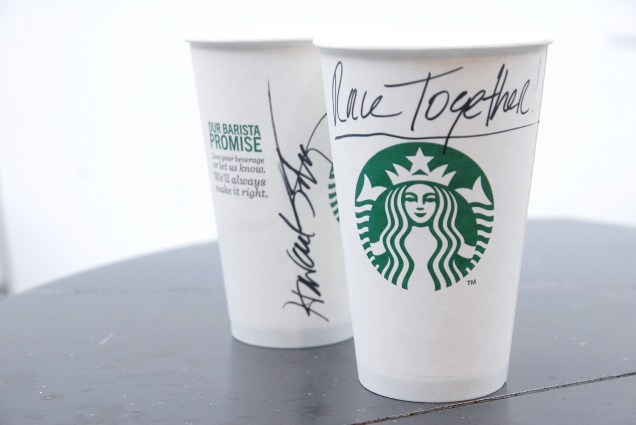
Race_Together_(1)

If safe space dwelling students don’t want to enter the grown-up job market and workplace when they graduate, they may simply create their own parallel Identity Politics economy

Until now, the one source of comfort to those of us alarmed by the rise in student illiberalism and authoritarianism on university campuses in Britain and America has been the fact that those tyrannical student activists will soon face a day of reckoning when they graduate and find themselves in a job market which has no interest in nurturing their fragile egos.

Sadly, that source of comfort is now being taken away from us. Because a former academic from Winchester, Virginia has found a way to successfully monetise the safe space concept with a coffee shop designed for “marginalized populations”.

Your4State reports:

A new coffee shop in the city of Winchester is one of many, but its owners say the open and safe environment it provides is the only one of its kind in the city.

According to Victoria Kidd, part-owner of the Hideaway Cafe, coffee is not an “accessory beverage,” and grabbing your cup of joe requires a journey to reach your ideal destination.

“You’re looking for a coffee house that offers you a great atmosphere and offers you a great product served by people who care about your opinion of the coffee and care about your experience here,” Kidd said.

For Kidd and her wife, Christy, the journey to open the perfect coffee house started in July when they thought of the safe-space concept for the Hideaway Cafe.

Because why leave safe spaces and infantilised life behind at graduation when you can continue behaving in the same sheltered, censorious way right through adult life?

(No press reports as yet give any detail as to precisely what policies or behaviour codes will make the Hideaway Cafe a safe space, or how the safe space will be enforced).

Of course, the cafe’s proprietor fits the exact profile that one would expect:

“Well I never thought I’d be in coffee,” [Dr. Jess] Clawson admitted.  “I have a Ph.D. in education. I’m an education historian, so I thought I would be teaching college right now and on the tenure track.”

According to Clawson, graduate school prepared her to co-own a coffee house.

She said the level of intensity in her master’s work translated well to creating drinks quickly and accurately.

She also mentioned that her dissertation was on the emergence of LGBT student visibility on Florida college campuses in the 70s and 80s.

Given her background, Clawson said she couldn’t refuse to be a part of the “safe space” business, which she said has been a long time coming.

Finding surprisingly little demand for her peerless knowledge of the LGBT university scene in 1970s Florida, Jess Clawson was forced to improvise and tenuously reapply her academic skills to the field of handcrafting caffeinated beverages. And so the Hideaway Cafe now exists to do for supposedly mature adults what campus safe spaces do for decidedly immature students – provide an intellectual cave where occupants can literally hide from scary ideas and the big bad world.

The Hideaway Cafe is not the first such institution to transform itself into a safe space venue. A coffee house at Claremont McKenna College did the same thing, though only on an ad hoc basis, and within an academic campus setting:

Safe spaces for minority students have appeared on the campuses of other Claremont Colleges as well. Last week, the Motley Coffeehouse at Scripps College issued a statement on its official Facebook page, “The Motley sitting room will be open tonight from 6-10 only for people of color and allies that they invite. Please feel free to come and use the space for whatever you need – decompress, discuss, grieve, plan, support each other, etc. In solidarity.”

But neither is Hideaway Cafe the first to bring the safe space concept to the outside world. Last year, Starbucks in Seattle announced that its stores would be working with the city police to turn their locations into safe places where victims of homophobic “hate crime” could wait until the police arrive.

Pink News reports:

The coffee chain has provided special training to its more than 2,000 Starbucks employees across 97 shops, training them to offer help to those who have been victims of hate crimes.

The initiative came about via a partnership with the Seattle Police Department, with special rainbow-coloured ‘SPD Safe Space’ stickers indicating each shop’s status. Staff will contact the authorities, ensuring victims are safe and allowing them to remain on the premises until police arrive.

The bold initiative is the first such take-up of a scheme by the chain, but Starbucks indicated that it would work with police departments elsewhere to set up ‘safe spaces’ in more cities.

This is somewhat less offensive – although the definition of “hate crime” is very vague and encapsulates many things which should probably be classified as protected free speech, at least the Starbucks safe spaces are reactive rather than anticipatory. They exist to help people who have been the victims of unpleasant homphobic experiences rather than seeking to restrict speech within the store lest somebody be offended.

But whether it is the Hideaway Cafe, the coffee shop at Claremont McKenna or your friendly local Starbucks, what is clear is that the idea of providing infantilising places of refuge for grown adults has escaped the college campus and is starting to be taken up in wider society – more ammunition for those of us who are constantly asked why we spend time fixating on something often portrayed as a niche student issue which poses no risk to wider society.

However, it cannot be said often enough that these censorious young generation now at university did not materialise out of thin air. Their self-centred outlook and inability to process contradictory or offensive ideas is very much a product of their environment and upbringing, and older people – including the liberal university administrators now being hounded and forced out of their jobs by emboldened student activists – bear much of the blame for having created a therapeutic culture and a climate which does not value free speech and is happy to place restrictions on freedom of expression for the comfort of others.

Rolling Stone’s Matt Taibbi goes further and suggests that older Americans are actually guilty of creating the first safe spaces and intellectual bubbles, long before they started appearing on college campuses.

Money quote:

But conservatives who get hysterical about the “delicate snowflakes” on campus should take a look at their own media-consumption habits. It’s hard to imagine anything funnier than a 70-year-old who watches 90 hours of Fox News a week and then rails against college kids who are afraid of new ideas.

But it’s not just Fox viewers. Most of the cable TV news industry is just a series of safe spaces. There are conservative channels and liberal channels, all of them huge seas of more or less unanimous opinion. Viewers tune in, suckle their thumbs, and wait to have their own opinions vomited back at them.

The commercial formula at the all-liberals-suck channel is the same as the one at the all-Republicans-are-boneheads channel. People in this country tend to follow politics in the same way they follow sports teams. They don’t think, they root.

The campus safe space movement is often derided as evidence of a rise of a newly censorious political left, a movement that’s ideological in character. And who knows, maybe that’s true. I don’t spend enough time on campuses to know.

But the safe space movement among the somewhat older members of the commercial media has virtually nothing to do with ideology, and everything to do with money.

The political punditry business is all about riling up an ad-consuming, subscription-buying demographic. We’re paid by the eyeball, and you don’t attract eyes by sticking fingers in them. So opinion-makers on both sides quickly learn to stay in their lanes.

If your job is throwing meat to wingers, you’re not going to suddenly start admitting Mexicans are people or criticizing the Israeli occupation of Palestine.

And Taibbi’s conclusion:

The modern American media consumer has a genuine mania for orthodoxy. We’ve habituated readers and viewers not just to expect content that caters to all their opinions down the line, but also to expect and demand a completely binary representation of the political landscape: blue and red, Us and Them.

Consumers on both sides don’t like pundits whose views are all over the place. They want white hats and black hats, allies and enemies, even though in real life most people are not wholly one thing or another. And when one of the performers steps off-script, it’s a “problem.”

To me this is consumerism, not political correctness. Capitalism in this country has become so awesomely efficient at target-scratching every conceivable consumer itch that it’s raised a generation of people with no tolerance for discomfort, particularly the intellectual kind.

There are so many products available now that customers have learned to demand that every single purchase choice they make be perfectly satisfying. People want nacho chips that taste awesome every time, and they want pundits who agree with them every time. They don’t want to fork over time or money to be told they’re wrong or uninformed any more than they want to eat a salad.

This is a very valid point. For what are Fox News and MSNBC if not media-based safe spaces for adults who live in their own ideological bubbles, rarely socialising or venturing otuside their own circle, and whose news consumption is driven less by a desire to hear the facts and reach their own conclusion than the lazy desire to have existing suspicions and prejudices constantly reinforced?

One can certainly criticise the illiberalism of today’s college students for seeking out safe spaces and pressuring their university administrations to enforce harsh new speech and behavioural codes on campus, but one cannot blame the students alone.

Growing up in an MSNBC or Fox News household where the other side are routinely demonised as being evil, traitorous, un-American or oppressive means that many students may arrive at university without ever having been in close quarters with somebody with a different political philosophy. And just as they experience the first twinges of surprise and discomfort at the discovery of non like-minded people, the campus Identity Politics brigade rides to the rescue, telling them that they are right to be upset, that they are uniquely oppressed and that they require ideologically policed safe spaces just to get through the traumatic years which await them at university. It is a toxic message, but a very powerful and compelling one for many young adults.

So by all means let’s criticise instances of campus authoritarianism when they occur. It is important that we continue shining a spotlight on these incidents and helping liberty-minded students push back and wrest control of their campuses away from the priests and priestesses of the cult of Identity Politics.

But we should not be so smug as to think that we who have left university (or who never went) are in any way superior. For it turns out that older generations have been monetising the idea of safe spaces for years before the Hideaway Cafe even opened for business, and many of us have been unwittingly helping them to do so.


More Tales from the Safe Space here.


Safe Space Notice - 2

Top Image: International Business Times

Agree with this article? Violently disagree? Scroll down to leave a comment.

Follow Semi-Partisan Politics on TwitterFacebook and Medium.

Tales From The Safe Space, Part 19 – Cardiff Students Hold “Inner Child Day”

Cardiff University Students Union - Inner Child Day - Infantilisation - Safe Space

Good mental health does not mean regressing back into childhood

One of the most insidious things to emerge from the Cult of Identity Politics taking over Anglo-American university campuses is the false equating of good mental health with a state of childhood.

Safe spaces, campus speech codes and trigger warnings all serve to infantilise students, in the belief that if only these young adults are coddled like children and protected from ever encountering a dissenting opinion or a negative word, it might just be possible to preserve their fragile mental equanimity.

One of the most overt recent manifestations of this trend is the “Inner Child Day” recently held at Cardiff University (the same institution whose students were so traumatised by the hateful presence of Germaine Greer on campus last year).

The ad promoting Inner Child Day encouraged Cardiff students to “embrace your inner child with a whole day of free fun in Y Plas in Cardiff University’s SU! Think inflatables, games, face painting and some 90s classics!”. Because apparently university is no longer a place to emerge into adulthood, but rather place to regress back to the habits and mentality of a toddler.

Johanna Williams paints an excruciating picture of the event in an article in Spiked:

It took place in the nightclub of the students’ union building and featured such mental-health managing strategies as biscuit-decorating, dog-petting, face-painting and jumping about on a bouncy castle. Students were able to work towards the holy grail of positive mental health by practising their forward rolls and uploading pictures of their newly ornamented biscuits to social media in return for the approval of their peers.

The nightclub was suitably decorated. There were balloons everywhere to appeal to the six-year-old children just waiting to burst out of the students’ twentysomething bodies. A giant screen at the front of the room showed a woman cradling a miniaturised version of herself as someone would cradle a child. Apparently, the phrase ‘Can your inner-child come out to play?’ was meant ‘to offer hope to sufferers’.

Watching this event unfold was like walking into a perverse version of Alice in Wonderland. Twentysomething adults were catapulting themselves towards a healthier state of mind on the bouncy castle with an abandon that would get them banned from any normal event involving bouncy castles.

This all sounds disturbingly similar to the Safe Space room set aside during a debate at Brown University in Rhode Island, in which students who felt “triggered” by what they heard during a voluntarily attended meeting were offered infantilising consolations such as puppy videos, snacks, soft furnishings and Play Doh, as well as an army of trained counsellors.

Williams concludes:

This attempt to fight insanity with insanity is worrying. The trend towards medicalising everyday moods, to treat, say, the homesick student as someone with a mental-health problem, has led to the creation of a bogus epidemic of mental ill-health on campus. This means that people who suffer from a genuine mental illness, such as schizophrenia, are missing out on support because too much attention is focused elsewhere.

These childish events will do nothing to help students who are genuinely unwell. What’s worse, they’ll make today’s pampered students even less likely to grow up.

Williams is right. This is dangerous stuff, inflating good mental health with a regression to a sanitised version of childhood, with face painting and cookies and puppy dog videos. And whatever transitory benefit it may provide to students who are not really mentally ill but are simply stressed or homesick, it will do nothing for – and in fact diverts attention and resources away from – the far smaller number who are genuinely in need of help.

True mental health comes about by building a healthy resilience to the kind of everyday emotional bumps and scrapes which characterise adult life. In the real world, people sometimes have completely contradictory views about fundamental issues, but must nonetheless live, shop and work together.

Safe space policy makes that harder by sending the message that students should not have to so much as glimpse opposing ideas, while the entire cult of Identity Politics is built on the notion of a backbiting Hierarchy of Privilege, where everybody is an oppressor and nearly everyone (except for cis white men at the top of the pyramid) is also oppressed.

This culture does not produce resilient, well-rounded adults. Rather, it is producing a generation of self-involved, narcissistic adult babies who worship at the altar of their chosen “identity” and demand that everybody else admire their idiosyncrasies, acknowledge their pain and massage their egos on pain of censorship or disciplinary action.

And if none of that stirs you to anger, then at least be outraged by Cardiff University Student Union’s cynical, tawdry trivialisation of mental health, and the suggestion that ten minutes on a bouncy castle and a spot of face painting are the cure for those students who suffer from genuine mental health issues.


Safe Space Notice - 2

Agree with this article? Violently disagree? Scroll down to leave a comment.

Follow Semi-Partisan Politics on TwitterFacebook and Medium.

Tales From The Safe Space, Part 18 – At Edinburgh, The Revolution Eats Its Own

Imogen Wilson - Edinburgh University - Students Union - Safe Space Policy - Identity Politics

Censured for raising her hand and shaking her head in a student council meeting, but don’t feel sorry for her – this student fully supports the draconian Safe Space policy which saw a complaint raised against her

Edinburgh University has long been one of the dodgiest academic institutions in the country when it comes to tyrannical student activism and the suppression of free speech.

The university has consistently scored Red in the Spiked Free Speech University Rankings, with the student union’s bizarre rules banning “hand gestures which denote disagreement” or applause when a motion fails to pass marking the institution as a particularly insufferable place to take a degree.

(It’s amazing that they tolerate applause at all).

Therefore, in such a sanctimoniously authoritarian atmosphere, it was only a matter of time that the Identity Politics revolution which currently subjugates Edinburgh University claimed one of its own revolutionaries. And in this case, the victim is a student union officer (vice President of academic affairs) named Imogen Wilson, someone no doubt more used to doling out punishment for thought crime than being on the receiving end.

Wilson’s crime? Raising her hand to speak during a meeting of the student council, and then later – pass the smelling salts! – shaking her head in disagreement with something which was said.

The Daily Mail reports:

A student was almost kicked out of a meeting after she violated a ‘safe space’ by raising her arm at Edinburgh University.

Imogen Wilson wanted to make a point at Thursday’s student council session when she was told off by officials.

The vice-president for academic affairs at the university’s Student Association was accused of failing disabled students by not responding to an open letter.

She immediately raised her arm to disagree but was made the subject of a ‘ludicrous’ complaint and told not to make the gesture again.

Imogen was also warned for shaking her head during the meeting as it again breached the ‘safe space’ which is part of the university’s Student Association rules. 

But before you feel too sorry for Imogen, bear in mind that she is an enthusiastic proponent of Safe Space policy and the whole range of illiberal, stultifying policies which are crushing freedom of thought and expression at her university.

The Huffington Post explains:

Wilson later shook her head whilst someone was speaking, and was threatened with another safe space complaint.

“I completely understand the importance of our safe space policy, and will defend it to the ground, but I did not think that was fair, and had it gone further I would have either left or argued against it,” she said.

So Wilson was more than happy for the speech and behaviour of others to be strictly regulated and censored while on campus, but is now throwing a petulant tantrum when she herself accidentally steps on one of the very Identity Politics landmines that she and her student tyrant comrades have been busy laying throughout the political and social discourse, and in the students union rulebook.

This is also hilarious:

A fourth-year student at the meeting, who wished to remain anonymous, told HuffPost UK: “The whole thing was a ludicrous abuse of the entire intent of safe space.

“We were having one of the most emotionally tense councils of the year, with the vote on the BDS movement and people speaking who live in Palestine or are Israeli on both sides of the issue.

“There was ample risk of there being an actual safe space issue taking place—an anti-semitic or islamophobic comment for instance—but the whole debate was actually remarkably civil despite how emotional it was.

“So for someone to have abused the very legitimate purpose of safe space rules to get at someone they politically disagreed with was pretty low.

Gosh, so there was a real danger of an “actual safe space issue” occurring – the possibility that someone might have said something a bit crass or offensive about Palestinians or Israelis, thus immediately shattering the fragile psyches of the adult babies studying at Edinburgh University. How terrifying.

(And as always, it is great to see a students union spending its time debating the issues which really affect the day-to-day life of students on campus – like the BDS movement, whose principle agents will surely be quaking in their boots awaiting the verdict of a bunch of jumped-up student activists in Edinburgh).

But funniest of all is the fourth-year student’s complaint that in targeting Imogen Wilson, her accusers had “abused the very legitimate purpose of safe space rules to get at someone they politically disagreed with”.

Well, who would have thought that such cynical behaviour might be a consequence of laying so many verbal and behavioural traps everywhere? Who could have anticipated that by making so many rules governing who is allowed to speak and what they are allowed to say, it might provide an irresistible temptation for students to manipulate those rules to their own benefit, or to spitefully punish someone with whom they disagree? Who could possibly have foreseen such a shocking development?

Clearly not the adult babies of Edinburgh University, who – when they are not high-mindedly resolving the Middle East peace process on behalf of grateful Israelis and Palestinians – are so busy trying to entrap one another with their precious Safe Space / Identity Politics rules that they totally lose sight of why they are at university in the first place.


Safe Space Notice - 2

Top Image: Daily Mail

Agree with this article? Violently disagree? Scroll down to leave a comment.

Follow Semi-Partisan Politics on TwitterFacebook and Medium.

Tales From The Safe Space, Part 17 – Woman Assaults Student For “Cultural Appropriation”, Claims She Is The Victim

Identity Politics preaches that violence is an acceptable tool of coercion to make other people conform

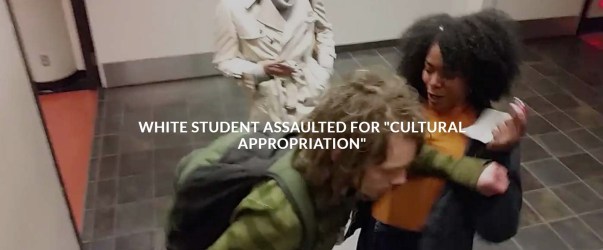
Watch this video of a woman – believed to be Bonita Tindle, possibly a university employee – accosting a white male student in the corridor of a campus building at San Francisco State University, because she objected to the “cultural appropriation” behind his choice of hairstyle.

The Daily Wire gives context:

In a video published on Monday, a black female said to be a campus employee accosts a white male said to be a student at San Francisco State University out of hostility to the “cultural appropriation” of his dreadlock hairstyle.

“You’re saying I can’t have a hairstyle, because of your culture? Why?” asks the white male, who appears to be wearing a dress.

“Because it’s my culture,” responds the black female.

“Do you know that it was in Egyptian culture? Are you Egyptian? Naw,” replied the male student with animated body language.

Interjecting, a black male observer who appears to be wearing pink leggings asks the white male if he’s Egyptian.

As the white male attempts to leave up a staircase, the black female grabs his left arm sleeve. Giving in to the pull, the white male demands to be left alone as he descends back to the main floor.

Except that this is not the whole story. The white male student does indeed attempt to leave up a staircase, and is repeatedly prevented from doing so by the female. He is clearly, demonstrably trying to leave the scene and is prevented from doing so by the person accosting him.

At one point (20 seconds and 25 seconds in), she actually pushes him back as he attempts to walk up the stairs, prompting the student to say “Yo, girl, stop touching me.” Once he makes it up the stairs, the female has a hold of his sleeve and tries to cajole him back down, saying “come back”.

But then, when he does, she has the temerity to exclaim “you put your hands on me!” as though an unconscionable assault on her own person has taken place. “Do not put your hands on me” she warns, gleefully, as she takes out a notepad, presumably to document her own very biased take on the incident.

Forget the stupidity of taking offence at cultural appropriation in the first place.

Were it not for the fact that the encounter was recorded on video, it is not difficult to imagine the white male student being reported to campus authorities for having “put [his] hands” on his own aggressor, being dragged through a disciplinary process and quite possibly being found guilty at the end of it – especially given how spineless many university administrations have proven to be in the face of student power grabs.

Bonita Tindle - Assault White Student for Cultural Appropriation - Identity Politics

Consider the mindset one must have to accost a perfect stranger, harass them about their personal appearance, push them and actively prevent them from leaving, and then turn around and complain “you put your hands on me!”.

Consider, too, the entitled, mischievous grin of the perpetrator as she harasses the male student, believing that her weaponised Identity Politics-driven actions give her the license to do whatever she pleases, because she is “in the right”. We saw exactly the same look on the face of the young student protester who vandalised a pro-life campaign stand and was then unable to explain her actions to a campus security officer.

There is nothing noble about this person’s attempt to fight “cultural appropriation”. This is the action of someone who has been taught that she can get away with anything if only she only uses a few words from the Identity Politics lexicon as her shield. And if the San Francisco State University administration are even remotely competent, the aggressor will (if she is indeed a university employee) be terminated effective immediately.

But the point is not this one incident, caught on camera. Other, similar incidents like these are happening on college campuses across America with increasing frequency.

The same toxic ideology of Identity Politics has infected our academic institutions in Britain, and we are only lagging a couple of years behind the United States.

Those of us sounding the alarm are not making this stuff up. I follow this issue closely and have Google Alerts set to inform me when new stories break about campus authoritarianism, free speech curtailment and Identity Politics-inspired violence, and there are simply too many for me to cover on this blog. I currently have a backlog of over twenty incidents, each one worthy of comment, most of which will never be written up here for sheer lack of time.

Watch the video. Because this is where worshipping the cult of Identity Politics leads. Remarkably, it does not turn out well-rounded, robust young adults ready to become productive, engaged citizens. On the contrary, our Safe Space and Trigger Warning culture is turning out a generation of snarling, vindictive crybabies, people who are completely incapable of managing interpersonal relationships and interactions without the assistance of the higher authorities to which they constantly turn for help.

And when there is no higher authority to hand, these Identity Politics priests and priestesses are quite happy to lash out physically, assured of the righteousness of their cause.

This is no longer a joke. Bad actions – now including physical assaults – spring from bad ideas. And the cult of Identity Politics is the academic mother lode of bad ideas.


Update: It has been confirmed by San Francisco State University that the aggressor is not directly employed by the institution. The university has opened an investigation.


More outrageous “Tales From the Safe Space” are documented here.


Safe Space Notice - 2

Agree with this article? Violently disagree? Scroll down to leave a comment.

Follow Semi-Partisan Politics on TwitterFacebook and Medium.

Tales From The Safe Space, Part 15 – Barack Obama On Campus Censorship

President Obama’s timely criticism of the Safe Space Generation of students

It may come as a surprise to his conservative critics, but President Obama’s stance on the creeping authoritarianism and Identity Politics culture infecting American college campuses is very much on the side of free speech and robust debate.

Pressed to discuss his views on “politically biased colleges” at a high school town hall event held late last year, Barack Obama said:

Sometimes, y’know, there are folks on college campuses who are liberal and maybe even agree with me on a bunch of issues, who sometimes aren’t listening to the other side. And that’s a problem too. I was just talking to a friend of mine about this, you know, I’ve heard some college campuses where they don’t wanna have a guest speaker who, you know, is too conservative. Or they don’t want to read a book if it has language that is offensive to African Americans, or somehow sends a demeaning signal towards women. And you know, I gotta tell you, I don’t agree with that either.

I don’t agree that you, when you become students at colleges, have to be coddled and protected from different points of view, y’know? I think that you should be able to – anybody who comes to speak to you and you disagree with, you should have an argument with ’em. But you shouldn’t silence them by saying “you can’t come because, y’know my – I’m too sensitive to hear what you have to say”. That’s not the way we learn either.

It is interesting to watch the reaction of the students standing behind Obama while he makes these remarks. Some are clearly bored and not paying close attention, but most clap politely when Obama reaches a natural break in his speech.

However, there is also a significant minority of students in the audience who are giving what can best be described as death stares. Clearly they do not like what they are hearing one bit, because Obama’s pragmatic suggestion that college is place where autonomous adults go to debate sometimes difficult ideas in the pursuit of personal and intellectual growth is contrary to everything that they have been taught is progressive and socially just.

Note in particular the two women on the top right of the screen when Obama says that campus speech restrictions are more suited to the former Soviet Union, approximately 3 minutes and 50 seconds into the video. While the other students seem to have fairly neutral expressions at this point, these two students look angry, sullen and passive-aggressive. The president of the United States has dared to come to their school and blaspheme against the Cult of Identity Politics to which they fully subscribe, and so they sit there, arms crossed and doubtless feeling quite triggered, plotting their revenge.

The point is this: it only takes a few such angry zealots to cow and intimidate an entire student population – and university administrations which should know better – into embracing every corrosive aspect of the Identity Politics culture. Of an entire student body, only a minority will drink deep enough from the well of competitive grievance culture that they turn and become the angry, authoritarian stars of many a YouTube video. But those who do are incapable of leaving everybody else alone. They cannot practice their new secular religion privately; all must share in their beliefs and abide by their behavioural codes, on pain of punishment.

Just seven years ago, the image of an African-American man addressing a group of high school students as President of the United States would have been seen as a powerful display of the social change that is possible when free speech is celebrated, guaranteed and used. Barack Obama, whatever one thinks of his record in office, did not become president by sheltering inside an academic safe space, after all. But Identity Politics does not encourage reflection on progress made; it primarily fosters resentment about the sins and injustices of the past.

Today’s generation of Identity Politics-practising students can talk endlessly about their “pain” and write interminable, barely literate screeds demanding that they be sheltered, acknowledged and validated in everything that they do.

But I doubt that a single one of them could write “Dreams from my Father“.


Safe Space Notice - 2

Agree with this article? Violently disagree? Scroll down to leave a comment.

Follow Semi-Partisan Politics on TwitterFacebook and Medium.