Just what are British Values?
Well, apparently the concept is sufficiently fuzzy in the minds of some people that we all now need to take time to argue amongst ourselves and reach a common consensus while one of the biggest and most worrying educational scandals in recent years plays out unobserved.
In response to the ongoing scandal of Birmingham schools being compromised by activist governors to deliver covert Islamic religious teaching, the Education Secretary, Michael Gove, made the slightly awkward if well-meant assertion that in future, all primary and secondary schools will be required to “promote British values”.
The Guardian reports:
Michael Gove, the education secretary, has seized on a finding byOfsted that a “culture of fear and intimidation” existed in someBirmingham schools by announcing that the government will require all 20,000 primary and secondary schools to “promote British values”.
These values will include the primacy of British civil and criminal law, religious tolerance and opposition to gender segregation. Gove also suggested girls wearing the burqa would struggle to find their voice and must not feel silenced in the classroom.
In what is being described by ministers as a decisive shift away from moral relativism in the classroom, the education secretary took action after a landmark series of reports by the schools inspectorate into 21 Birmingham secular schools found an atmosphere of intimidation, a narrow, faith-based ideology, manipulation of staff appointments and inappropriate use of school funds.
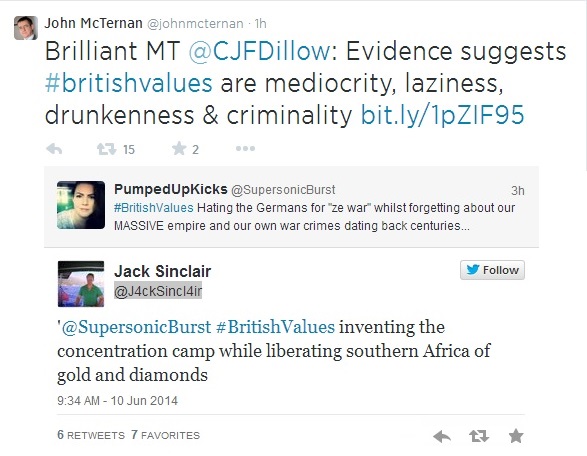
Unfortunately, the predominant response thus far has not been one of outrage that such a thing could happen to compromise children’s education in the UK’s second city; instead, we have seen race to come up with the funniest self-deprecating anti-British putdown as expressed by the #BritishValues hashtag now trending on Twitter.
When presented with the opportunity to express outrage that local school curricula could be so easily hijacked by fundamentalist members of any faith and ‘turned’ to start promoting beliefs very far from the British values of democracy, equality, non-discrimination and obedience to the law, a majority seem more interested in having an introspective discussion about what modern British values really are (at best), or suggesting through Twitter witticisms that any concern is tantamount to xenophobic intolerance (more common).
The Huffington Post has collated a selection of what it considers to be “the best” responses, which take an almost uniformly dim view of British culture and history:
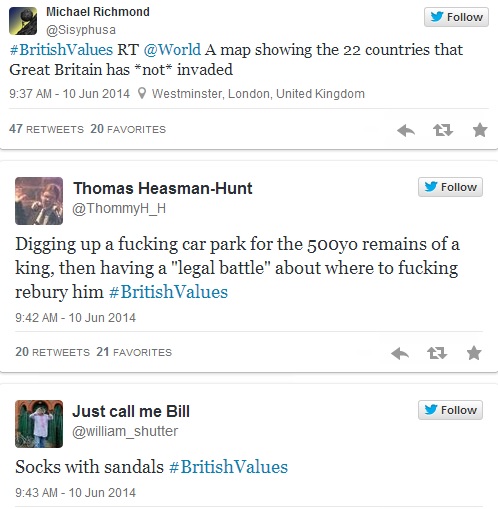
(It should be acknowledged that there have also been some very sensible and thoughtful contributions from others, such as the pianist Stephen Hough).
The hashtag activist comedians and earnest scolds of Twitter currently attempting to look cool by running Britain down on social media are actually revealing a few ingrained British traits of their own – excessive self deprecation and an almost craven desire not to offend or appear controversial – which easily become insidious and harmful when taken to extremes.
There is a gnawing anxiety behind some of the mocking #BritishValues tweets. “Isn’t patriotism so old fashioned?”, they scream. “Let’s list all the bad things that Britain has done so that no-one thinks we’re being boastful”. It may come across as cool, trendy liberalism but look closer and you see that some of it is actually rooted in fear.
Somewhere along the way the idea of expressing pride in Britain, and in British exceptionalism, became interchangeable in the minds of many people with that altogether darker and more insidious disease of racism. To express the former is, in the eyes of many, to come uncomfortably close to embracing the latter. And as a result, people instinctively turn away from patriotism, and instinctively oppose suggestions such as teaching British values at school, mistaking it for something else (and, incidentally, leaving a vacuum that the far right is only too happy to exploit).
And yet there is a serious issue at stake here, with the integrity of children’s education in question. Even the Guardian’s John Harris felt the need to weigh in to the ongoing argument about the fundamentalist Muslim influence in Birmingham schools, reminding his readers that state-subsidised religious indoctrination or interference with the curriculum is wrong whatever the source, and that this is no time for those on the left to bury their heads in the sand:
At the risk of reopening old wounds on the liberal left, for all the noise from those on the right of culture and politics, it is no good crying “witch hunt” and averting your eyes from this stuff. It should have no place in any state school, and most of it is an offence to any halfway liberal principles.
But Harris still felt the need to couch his tortured article in the wider context of a state education system which is failing and falling into disarray under the hated Tory government – the harsh unexpectedness of his gentle reminder that it’s not okay to look the other way and pretend to ignore the fundamentalist corrupting of education for fear of seeming racist or intolerant having to be soothed with a good old swipe at the real enemy, those on the political right.
Efforts to stamp out casual and institutional racism in Britain, while incomplete, have come a long way, even since the 1980s and 1990s. A large part of eradicating the scourge of casual racism has been (quite rightly) to mock it, deride racist thoughts and speech as backward and out of place, and doing everything possible to make racism distinctly uncool. The campaign to eradicate racism from football is a prime example of how successful Britain has been, especially when compared with continental and eastern Europe.
But while there is unquestionably still much work to be done, we must also begin to ask ourselves if one of the side effects has been a growing inability for people to express deeply felt but harmless national pride and patriotism in any but the safest, media-approved settings (such as the 2012 London Olympic Games).
If our generation’s instinctive response when they see criticism levelled at a person or group within a religious or ethnic minority is not to check the veracity and demand action if it is found to be true, but either to flinch and avert their eyes out of shock and unwillingness to believe or to become so embarrassed that their only coping mechanism is to resort to self-deprecating humour on social media, perhaps this is the price that our country has to pay in order to purge itself of the ingrained, widespread, casual racism that was common and socially acceptable for so long. Perhaps.
But being this way makes it much harder for us to deal with the problems facing Britain today, where the pernicious influence of fundamentalists (of all religions) on the young and the lack of assimilation of some cultures into wider British society are real issues that are being only half-heartedly tackled because of the paralysing fear of saying the ‘wrong thing’ or giving the wrong impression.
When asked why it was that Americans are so much more openly patriotic than Brits, the late Christopher Hitchens attributed it to the fact that overt displays of patriotism and love of country in the United States are borne out of the fact that as a nation of immigrants, Americans have no real shared history going back more than a couple of centuries. Therefore, simple acts such as reciting the pledge of allegiance every morning in schools and singing the national anthem before sporting events have, over time, helped to forge that unity within diversity.
But what has always been true of America is now increasingly becoming true of Britain. Immigration into Britain may bring profound economic and cultural benefits, but with each successive year of high net immigration and a lack of assimilation in some quarters, that degree of shared common history is diluted a bit more. And that’s absolutely fine, if other measures are in place to balance it out – like reciting a pledge, offering comprehensive British history as a mandatory subject at schools, or, shock horror, teaching children “British values”.
At the moment, though, these countermeasures are lacking. It should come as little surprise then that certain groups within society do not feel as much desire or pressure to integrate as they rightly should, and that when the door is left wide open in places like Birmingham to influence schools to teach children according to certain subcultural norms, some people will seize the opportunity with both hands.
Unfortunately, in the age of hashtag #Britain, not only does it surprise us when this happens, the thought of condemning or intervening in these events embarrasses us so acutely that we are barely able to have a national conversation without descending to xenophobic conspiracy theorising on one side or accusations of scaremongering on the other, topped off with a sprinkling of nervously self-deprecating Twitter jokes.
As John Harris noted in his article, by this point “inflammatory language and alarmism” have now done their work and made it harder to get to the bottom of what has really been going on in Birmingham’s schools. But there is an equally powerful countervailing force working in the other direction, suggesting that any concern is an unwarranted attack on a minority and misrepresenting any calls for the assertion and teaching of British values as xenophobic, Islamophobic and a direct attack on the principle of multiculturalism. It is not.
If we carry on in this way, we will never succeed in building and maintaining the unified, diverse and tolerant Britain that we all say we want.
If you enjoyed reading this article, please take a second to LIKE or SHARE it on social media using the buttons below. Help to spread the word and continue the debate.





 Semi-Partisan Politics