Can Jeremy Corbyn Redeem Himself On Tackling Extremism?

Jeremy Corbyn - Foreign Policy - Appeasement

Can Jeremy Corbyn rehabilitate his two-dimensional, anti-British foreign policy worldview?

Jeremy Corbyn’s red-blooded socialist domestic policies are generally flawed and counterproductive, but we can forgive him for that because he represents a legitimate strand of political thought that for too long has been marginalised and shut out of the political conversation in favour of the quisling, centre-left socialism of the likes of Ed Miliband.

What is much harder to forgive, however, are some of Jeremy Corbyn’s stances on foreign policy, where he has frequently espoused views and shared platforms with people of highly questionable character and motive. Whether it’s concerning Northern Ireland, Israel/Palestine or the Iraq war, too often Jeremy Corbyn’s public positions have drifted across the line separating conscientious objection from something much worse.

But now that Jeremy Corbyn is the leader of Her Majesty’s Opposition and burdened with one of the formal offices of state, what chance is there that reason, patriotism and propriety might assert themselves to moderate his well-known public stances?

Jonathan Russell, political liaison officer at the Quilliam anti-extremism think-tank, remarkably sees cause for hope:

Continue reading

If Barack Obama Likes The EU So Much, America Can Take Britain’s Place

Barack Obama - EU - Britain - Brexit


The harshest critics of President Obama like to complain that the 44th president of the United States does not believe in American exceptionalism.

But today Barack Obama proved these fears to be unfounded – he does indeed believe that America is different and better than all the other countries of the world. And he did so by using an intervention at the G7 summit in Germany to pointedly suggest that a diplomatic settlement which the United States would never accept for itself (membership of a supernational body with sovereignty over the US government) is perfectly good enough for Britain, America’s closest ally.

From the Huffington Post:

Mr Obama’s comments came as he met Prime Minister David Cameron for talks in the margins of the G7 summit of world leaders in Schloss Elmau, Germany.

They are the strongest indication yet that Washington wants a Yes vote in the referendum which Mr Cameron has promised by the end of 2017 on whether Britain should stay in the EU.

Greeting Mr Cameron at the start of the bilateral talks, Mr Obama said the US-UK relationship remains strong, telling reporters: “We have no closer partner around the world on a whole host of issues.”

And he added: “I would note that one of the great values of having the United Kingdom in the European Union is its leadership and strength on a whole host of global challenges, so we very much are looking forward to the United Kingdom staying part of the European Union because we think its influence is positive not just for Europe, but also for the world.”

It should be noted that by making these pro-European interventions, President Obama is only repeating the longstanding American diplomatic position, which is that Britain should remain part of the European Union, come hell or high water.

Unfortunately, both hell and high water are now nearly upon us thanks to the suffocating economic and political embrace of the Old World, and it is high time we stopped giving any weight or consideration to American entreaties for us to do what is most convenient and beneficial for their own foreign policy over and above what is best for Britain. The United States would certainly like for Britain to remain in the European Union. But don’t take this as a sign of some overriding concern for the future of the UK’s economy or the health of our democracy – far from it.

Continue reading

The EU Still Wants To Control Foreign Policy And Create Its Own Army

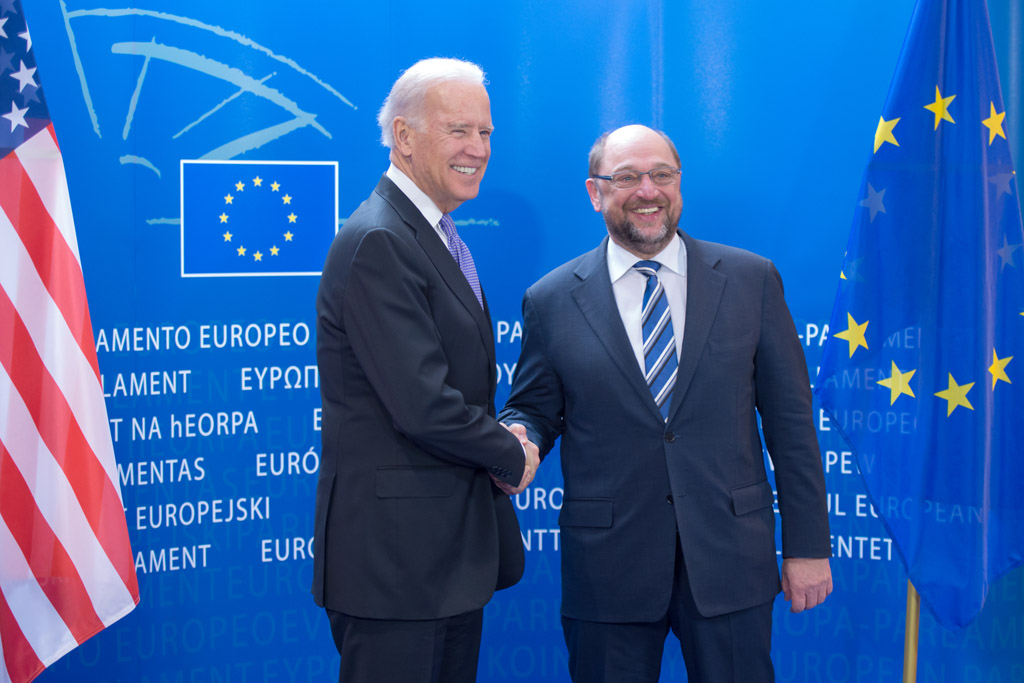
Martin Schulz Joe Biden European Union Common Foreign Policy EU Army


“I appreciate that it is not easy to explain to people back home why we need to cooperate more closely at European level in such a sensitive field as defence and security policy. Protecting its citizens has traditionally been a key task of the nation State and therefore also one of the foundations of its legitimacy. But we cannot close our eyes to reality: the world has changed and we are existentially connected to that world. Nowadays we can only defend our citizens jointly” – Martin Schulz, 2013


Here’s a good rule of thumb: the more powerful and undemocratic the institution, the better it becomes at using weaponised public relations tools in order to present a softer, friendlier, less threatening – and entirely false – picture of themselves.

Thus the President of the European Parliament, Martin Schulz, spent Monday morning hosting a laid back online live-chat on Facebook, in which he fielded carefully-screened softball questions from members of the public. And sneaking back onto the radar during that live-chat today was the prospect of a common European foreign policy, and a European army to enforce it.

From the EU’s own press release today:

To questions concerning the recent proposal on a common European army, Schulz replied “we need a common foreign and security policy”, explaining that combined military capacities would be a way of reducing military spending in a time when “money is certainly needed elsewhere”.

Meanwhile, others in the European Parliament are making rumblings about moving toward “permanent structural co-operation” – meaning there will be no way back once the EU starts taking major steps as an independent actor on the world stage:

Continue reading

On Barraco Barner

gemmaworrall


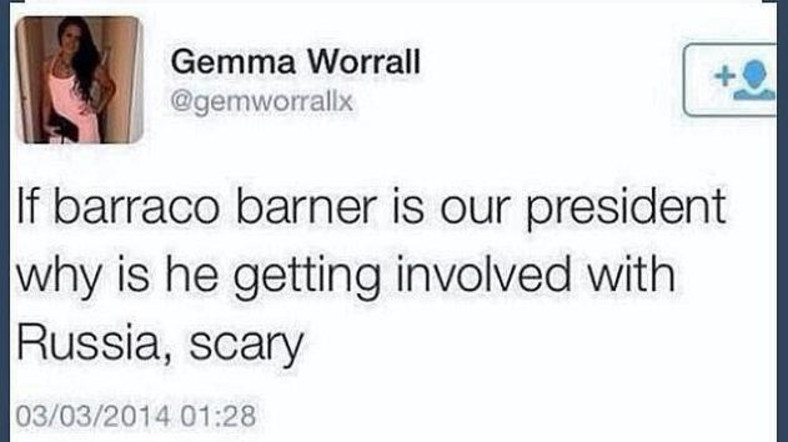
It began with a simple tweet.

Gemma Worrall, a 20-year-old receptionist from Blackpool, picked the wrong day to start following the news. She became confused while watching a television report on the geopolitical chess game underway between Russia, Ukraine and the West, and by sharing her own two cents on Twitter she did more to tarnish the image of British education in a mere second than a whole years worth of falling national examination results could ever do on their own.

Misunderstanding President Barack Obama’s job specification (and grotesquely, if comically, mangling his name), she posed the rhetorical question:

If barraco barner is our president why is he getting involved with Russia, scary

We can all count the ways that this is embarrassing, cringeworthy, depressing. Failing to grasp that Barack Obama is not “our” president. Getting Obama’s name so terribly wrong (a Damn You Autocorrect fail for the ages, if her excuse is to be believed). Not understanding that in carrying out their duties as heads of state or government, leaders “get involved” with other countries as a matter of course. Et cetera.

The ridicule was predictable, and it came. Seven thousand retweets, numerous mean-spirited comments and the usual smattering of death threats from the trolls. This was unfortunate and unseemly, particularly because the author of the offending tweet seems to have no malice about her at all, unlike many of her detractors.

There was no need for the more hateful reactions to the beautician’s blunder, nor even for the snide and scornful ones, because in truth, there is a little bit of Gemma Worrall in us all.

Take the Daily Mail for instance, one of many national newspapers to jump on their story. They and their readers may look down at Worrall for her geopolitical ignorance, but in the same article they feel it necessary to gently explain to their geriatric readership what it is to ‘hashtag’ or ‘retweet’ a statement on Twitter:

Within just 12 hours, her comment had been retweeted (where people send on your tweet for others to read again) almost 7,000 times and screenshots of her words were appearing on television news programmes as far afield as Australia, Canada and America.

A solid argument could probably be made (though not proposed by this blog) that it is actually far more useful to know the intricacies of social media and the workings of smartphones than it is to be up to speed on world leaders and foreign policy, especially given the degree to which technical and IT savvy have become such important prerequisites for employment and the equal degree to which foreign policy is conducted on behalf of us all by those who presume to know best but never deign to ask our opinions.

Rather more concerning is the low esteem in which the supposedly patriotic Daily Mail clearly holds our country in relation to the United States:

It’s a corker of a gaffe by anyone’s standards. Making the most powerful man in the world sound more like the fizzy vitamin supplement Berocca is one thing. Demoting him to leader of the UK is quite another.

Maybe Paul Dacre can order the Daily Mail to publish its definitive ranking of countries so that we can see just how much of a ‘demotion’ it is to go from President of the United States to Prime Minister of the United Kingdom. It is rather astonishing that a major British daily newspaper should hold such an inferiority complex, previously hidden and apparently deeply suppressed, with regard to another country. But this revealing morsel of information and potential area for debate will also no doubt be lost amid the swell of outrage at Gemma Worrall’s personal ignorance – an ignorance from which none of us are entirely free.

Grace Dent, writing in The Independent, hammers home this fact and points out (albeit somewhat condescendingly) that while it is extremely hard to monetise a good layman’s knowledge of geopolitics, Worrall quite probably has other more practical skills that will stand her in much better stead throughout life:

Gemma has a skill. Gemma will most probably have a thorough understanding of Shellac nail procedures and skin exfoliation. She’ll probably know how to remove excess upper-lip hair, push back cuticles and spray a Fantasy tan without missing elbows or staining knees. So, yes, Gemma seemingly can’t spell Barack Obama. But she will always be in employment.

Meanwhile, the clever person with an arts BA Hons 2.2 who can spell Angela Merkel first time without googling it will be sat at home writing petulant blogs to David Cameron about why the Government hasn’t furnished them with a job as a medieval art curator. We deride the differently skilled and slap down the not quite as sharp, but the country’s cogs turn via the energies of people not quite as bookish as you.

While Dent probably cuts Worrall a little too much slack (inferring in their article that her principle error was the misspelling of ‘Barack Obama’ and not her ignorance of the leadership of her own country), there is surely some degree of truth to her conclusion:

As access to the internet makes many of us feel cleverer, more connected, more omniscient, more infallible, it’s tempting to write off all the people “left behind”.

All those little unthinking people without university degrees who shape our nails, or clean our houses, or mend our toilets, or rewire our kitchens, and can’t even spell a president’s name without messing it up.

But the fact is, they might not know where Ukraine is, and they might not know why Germany doesn’t favour sanctions against Russia, but when the lights go out in your house, they know where the fuse box is and which wires to fiddle with to mend it. And right at that moment that’s a damn sight less stupid than you.

Dent labours the point, but it is an important one. Knowledge and skill come in many forms, and it is quite unreasonable to expect everyone’s spheres of knowledge to coincide with our own – though a basic level of fundamental civics awareness really should not be reaching for the stars.

Fraser Nelson, writing in The Spectator, makes a similar point, but while his critique of the Westminster set is dead-on, his excusing of fundamental ignorance is not:

The Spectator’s great coalition of readers include those who think poetry is more important than politics.  Those who buy us just for Jeremy Clarke and cartoons  are certainly getting their money’s worth (just £1 a week, by the way, sign up here).

If you decide that life’s too short to follow the Westminster tragicomedy, it emphatically does not make you stupid. The societies which tend to make a fuss about the bloke in power tend to be the societies in which you don’t want like to live. The freer the country, the less the need to know who is running the government. That’s why Ms Worrall’s tweet can be seen a sign of something going right, rather than wrong, in Britain today.

But what should be of infinitely more concern to everyone than how many minutes of national and international news Gemma Worrall consumes every evening after she finishes work is the fact that a young woman with a seemingly solid and respectable school education has seemingly emerged from twelve years of compulsory education with next to no knowledge of how her own country operates and is governed.

The Daily Mail informs us that Worrall is not stupid on paper, and has the qualifications to back it up:

While Gemma might not be signing up for Mensa any day soon, she’s certainly no Jade Goody. Softly spoken and articulate, she was educated at a local Catholic school and insists that she has 17 GCSEs — an extraordinary number, as most people obtain 11 at most — in subjects including English, Business Studies, Religious Education, Textiles, Technology and Media Studies, all with passes of grade C and above. She also says she has two A-levels, in Travel and Tourism.

Worrall is educated to A-level standard, and yet she is sorely in need of the type of introductory civics lesson that an American child might reasonably expect to receive by the age of eight. And this blogger has extensive personal anecdotal evidence that Worrall is far from alone in her want for basic knowledge.

How is it possible to gain numerous GCSEs (even if the reported figure of seventeen turns out to be inaccurate) and A-Levels and not pick up some civics knowledge along the way?

More pressingly, perhaps especially today with the need to assimilate immigrants and their children, why is civics – the nuts and bolts of British society, citizenship, law and government – not one of the very few mandatory and inescapable classes for all British children?

Michael Gove, Ed Balls, Alan Johnson, Ruth Kelly, Charles Clarke, Estelle Morris, David Blunkett, Gillian Shephard, John Patten and Kenneth Clarke: please stand up. Would you care to explain yourselves?
Seumas Milne Bashes America

seumasmilne

Seumas Milne rides to battle against the United States

It must be a slow news day, because Seumas Milne has taken to his Guardian column to denounce the presence of US military bases on British soil. You might think that resuscitating a dusty old left-wing fall-back piece like this might at least warrant some new angle on the story, or at least be based on some recent newsworthy transgression by the American military that we host here. You might think so, but you would be disappointed. Milne apparently just got out of bed feeling vaguely smug and anti-American, and decided to repeat the same predictable talking points, namely:

1. They came to help fight Nazi Germany in 1942 and the war ended a long time ago, so what can they possibly still be doing here?

2. America has dragged us into unnecessary and failed wars (Iraq was clearly a calamitous mistake, but why this warrants booting 10,000 US servicemen from our shores is never explained by Milne, unless it is supposed to simply be an act of vengeance) but we can absolve ourselves of these sins by closing down their bases here.

3. The British security elite are desperate to maintain a lopsided special relationship with the US, and only tolerate their bases on our soil as the price of achieving this goal.

4. Being so chummy with the Americans makes us less safe. Rather than being proud of our alliance with a country that symbolises democracy and individual freedom (however self-tarnished this image is becoming as a result of the unconstitutional activities of their national security complex), we should actively disown them to curry favour with fundamentalist theocracies who foment terrorism.

The column is not worth quoting at length, but here is an excerpt:

But whose interests are actually served by such a role? No doubt arms contractors are delighted, but it’s hard to argue that it benefits the British people – let alone those on the receiving end of the US and British military. Politicians and securocrats claim it gives them influence over US policy, but they struggle to produce the evidence on the rare occasions they’re asked to explain how. “The foreign policy elite still have a strong idea,” as the Chatham House analyst James de Waal puts it, that intervention based on “values” is an “innate part of what the UK is all about”. In fact, what successive governments have done is mortgaged Britain’s security and independence to a foreign power – and placed its armed forces, territory and weaponry at the disposal of a system of global domination and privilege, now clearly past its peak.

Milne wonders what the Americans would think if we had a military base on their home soil. Aside from the fact that British officers and military personnel routinely serve alongside their American counterparts both at home and in the field, I think that the Americans would be only too happy to see British military spending increased to such a level where we could afford more overseasbases (though whether this itself would be desirable is another matter). The reason for the lack of RAF bases in North Dakota is not that the British are the victims of some one-sided game in which the US gets to play and we have to sit on the sidelines, but everything to do with the fact that we choose to deprioritise defence in sacrifice for other goals, and all the other things that our caring government does for us. And look how that’s working out.

But this is where Milne really reveals his argument for what it is:

Britain’s fake patriots who bleat about the power of the European Commission are more than happy to subordinate the country’s foreign policy to the Pentagon and allow its forces permanent bases on British soil.

Firstly, our foreign policy clearly is not subordinate to the whims of the Pentagon, as the British parliamentary vote against taking military action in Syria made abundantly clear. Try as he might to build a convincing narrative of the British being led by the nose, two conflicts (Afghanistan and Iraq) over thirteen years are not enough to establish the damaging precedent that he wants to portray.

And secondly, I strenuously object to being labelled a fake patriot by Milne, but so bankrupt is his argument that insults are likely the only weapon left in his arsenal. Fake in relation to what, Milne’s more enlightened, cerebral left-wing patriotism? What Milne carefully chooses not to see is the fact that British government policy and the day-to-day experience of British life are influenced far more by the goings-on in the corrupt, undemocratic European Commission than they are by the garrisons of American military personnel on our soil – troops, incidentally, who are there to underwrite our common security objectives. If anything, it is an indictment of the European Union that Milne slavishly and unquestioningly adores that they punch more weight in this country by undemocratic diktat than do the “hostile American occupiers” against whom he childishly rages.

I’m sure that Milne thinks himself terribly persuasive in his closing paragraph:

But the withdrawal of British troops from Germany and this year’s planned renewal of the US-British defence agreement offer a chance to have a real debate on the US military relationship – and demand some transparency and accountability in the process. There is no case for maintaining foreign military bases to defend the country against a non-existent enemy. They should be closed. Instead of a craven “partnership” with a still powerful, but declining empire, Britain could start to have an independent relationship with the rest of the world.

But why should these two things be mutually exclusive? In Milne’s crazed imagination, the fact that we enjoy such a close alliance with a great country like America is shutting us off from good relations with other countries, or, as he puts it, having an “independent relationship with the rest of the world. This would probably come as a great surprise to the British ambassadors representing our country in foreign capitals across the globe, and to everyone working at the Foreign & Commonwealth Office in London toward the same ends. Exactly what relationship with the rest of the world does Milne think we are missing out on by failing to snub and humiliate our closest ally in the way that he proposes? Which are the countries in whose bad graces we currently dwell, who will suddenly warm to us if we send the Americans packing? North Korea? Venezuela? Iran?

I propose to Seumas Milne that he is trying to make an argument in reverse. He is clearly upset about British-American military cooperation and about our alliance in general. He would doubtless prefer to see us much closer to Europe, and have us actively working to further undermine American hegemony. But the American military bases and other visible manifestations of our close alliance are not a cause but an effect. In the case of Britain and America, an alliance such as ours is what you inevitably see when two countries, one larger and one smaller, have so much in common in terms of culture, economic ties and global interests. If Milne wants the US bases to close, he is making the wrong argument. Rather than bleating about Iraq and Afghanistan, he needs to begin convincing us that we are a different country than the one we think we are.

I don’t fancy his chances.