If Barack Obama Likes The EU So Much, America Can Take Britain’s Place

Barack Obama - EU - Britain - Brexit


The harshest critics of President Obama like to complain that the 44th president of the United States does not believe in American exceptionalism.

But today Barack Obama proved these fears to be unfounded – he does indeed believe that America is different and better than all the other countries of the world. And he did so by using an intervention at the G7 summit in Germany to pointedly suggest that a diplomatic settlement which the United States would never accept for itself (membership of a supernational body with sovereignty over the US government) is perfectly good enough for Britain, America’s closest ally.

From the Huffington Post:

Mr Obama’s comments came as he met Prime Minister David Cameron for talks in the margins of the G7 summit of world leaders in Schloss Elmau, Germany.

They are the strongest indication yet that Washington wants a Yes vote in the referendum which Mr Cameron has promised by the end of 2017 on whether Britain should stay in the EU.

Greeting Mr Cameron at the start of the bilateral talks, Mr Obama said the US-UK relationship remains strong, telling reporters: “We have no closer partner around the world on a whole host of issues.”

And he added: “I would note that one of the great values of having the United Kingdom in the European Union is its leadership and strength on a whole host of global challenges, so we very much are looking forward to the United Kingdom staying part of the European Union because we think its influence is positive not just for Europe, but also for the world.”

It should be noted that by making these pro-European interventions, President Obama is only repeating the longstanding American diplomatic position, which is that Britain should remain part of the European Union, come hell or high water.

Unfortunately, both hell and high water are now nearly upon us thanks to the suffocating economic and political embrace of the Old World, and it is high time we stopped giving any weight or consideration to American entreaties for us to do what is most convenient and beneficial for their own foreign policy over and above what is best for Britain. The United States would certainly like for Britain to remain in the European Union. But don’t take this as a sign of some overriding concern for the future of the UK’s economy or the health of our democracy – far from it.

Continue reading

Road Trips And Roaming Charges – The Selfishness Of Left Wing Pro-Europeans

European Union EU Flag Motorbike


What would be the worst consequence of Britain leaving the European Union?

Ask your average, garden variety pro-European this question and they’ll have a number of rote answers to hand – the sudden disappearance of three million British jobs in a puff of smoke, the imposition of punishing new tariffs on British exports, Frankfurt replacing London as the capital of European finance, large multinationals upping sticks and moving to France, the sudden irrelevance of a declared nuclear power and the world’s fifth largest economy, and Vladimir Putin’s imminent invasion of eastern Europe, to name but a few.

Each of these absurd scaremongering warnings, ranging from the wildly pessimistic to the downright laughable, is taken seriously enough to be a mainstay of the threadbare pro-European case for remaining part of the EU. But none of them are the real reason why so many within the political and media class are desperate to avoid Brexit.

These overblown macro-level concerns are, in fact, little more than window dressing, designed to make pro-Europeans feel better about the real reason for their support of the status quo. For in truth, their pro-EU stance has little to do with high-minded ideas about social democracy or statecraft, and everything to do with something far more personal – the protection and advancement of their own narrow, self-serving interests.

Mary Riddell accidentally gives the game away in the Telegraph, in her response to the Queen’s Speech:

Continue reading

Who Should Be Able To Vote In The EU Referendum?

UK British EU Flags - Brexit - European Union - Secession Referendum


It goes without saying that the loudest voices on the pro-European side are desperate for the coming EU referendum to be open to EU nationals currently living in Britain, as well as British citizens. From their selfish perspective, subverting our democracy in this way is a price well worth paying in order to inflict their desired outcome on the rest of us.

But now the europhiles are reaching for another rhetorical weapon in the fight: the fact that Britain, through a number of bizarre constitutional quirks and the pernicious rules of the EU, already allows select groups of favoured non-citizens the right to participate in our democracy.

Mihir Bose, writing in the Guardian, is already taking a gleeful victory lap on the subject, suggesting that eurosceptics are somehow being craven or ideologically inconsistent for objecting to the idea of EU citizens voting to keep Britain chained to Europe while not speaking out against these other cases of non-citizens receiving the franchise:

What [eurosceptics] neglect to mention is that even now you do not necessarily need to be a UK passport holder to vote in a general election. Indeed, for decades the UK has allowed citizens from other countries the right to select members of parliament, a right that even extends to citizens of three EU countries. They are part of a much larger group of 72 countries that includes all Commonwealth territories, British overseas territories and British crown dependencies. Fiji and Zimbabwe may be suspended from the Commonwealth but their citizens resident here have not lost their right to vote in UK elections. The three special EU countries are Ireland, Cyprus and Malta. They enjoy this privilege because while they may now be part of the EU, they once had an older allegiance to a much greater union: the British empire. The sun set on the empire long ago, but its legacy lives on.

What makes all this fascinating is that while Eurosceptics are happy to raise all sorts of scare stories about the EU, these other voters are an issue they are reluctant to discuss. Indeed, as far as the UK electoral franchise is concerned, this is now the great elephant in the room, as I was made well aware during the recent election. At one husting, I had the chance to raise this issue with three panellists from the main parties: Michael Gove for the Tories, Ivan Lewis for Labour and Baroness Kramer for the Lib Dems. Lewis disapproved of my even raising the issue. Baroness Kramer, who did not seem to know that non-citizens could vote, justified it on the grounds that this was a wonderful example of British eccentricity. Gove just said that he did not want to see any change in the franchise.

More fascinating was how Ukip reacted. Some weeks before the election, at a British Future event, Douglas Carswell, now the only Ukip member of parliament, made a very reasoned speech to show that Ukip was not an anti-immigrant party. But when I raised this issue, he made it clear that this was not a question Ukip would touch, remarking that the British system was so complex that to lift the carpet would mean all sorts of things would crawl out. How strange to hear this from a party whose leader, Nigel Farage, makes so much of the fact that he is prepared to go where no other politician dares.

Continue reading

UKIP Must Step Back From The Brink

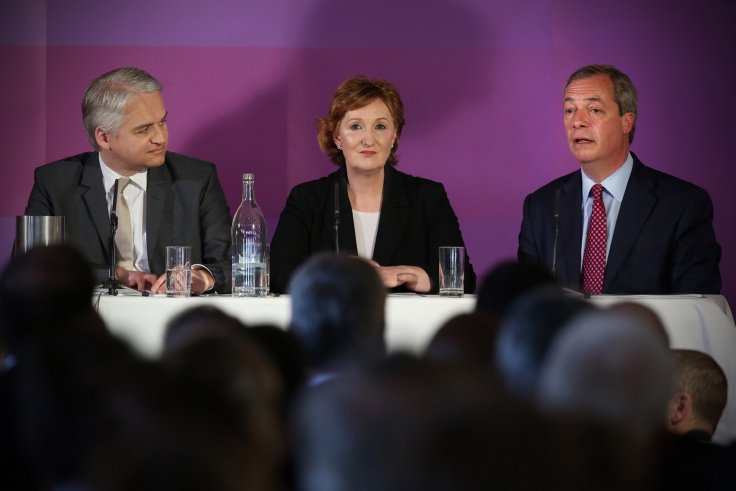
UKIP Leadership Crisis - Patrick OFlynn - Nigel Farage


It’s bad enough that the nearly four million people who voted for UKIP in the 2015 general election are represented by just one MP in Westminster, thanks to Britain’s punishing electoral system.

But now, some personalities within UKIP seem determined to put their own personal egos ahead of the eurosceptic cause at a particularly sensitive time for the still-maturing party, placing all of this hard work in jeopardy.

From The Spectator:

Ukip is doing a very good job of convincing voters it is not a serious party. After days of shadowboxing over the use of Short money to fund the party in Westminster, its economic spokesman Patrick O”Flynn has broken cover to attack Nigel Farage — and he certainly isn’t holding back. In today’s Times, O’Flynn says the Ukip leader has become ‘snarling, thin-skinned, aggressive’, instead of a ‘cheerful, ebullient, cheeky, daring’ politician. He goes on to describe the week of turmoil since Farage quit as leader, before withdrawing his resignation four days later.

And the Guardian:

Continue reading

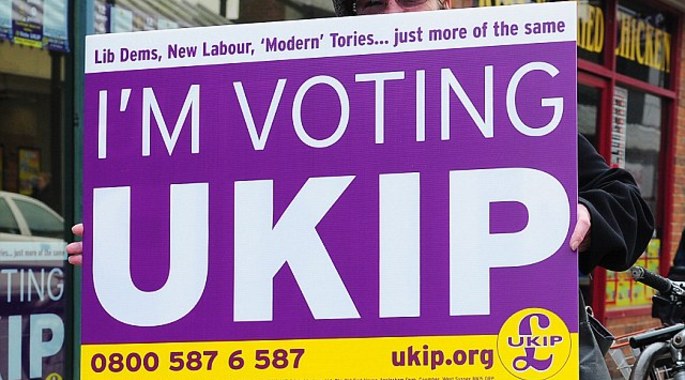
Why I’m Voting UKIP


David Cameron, the Prime Minister I supported for much of these past five years – and for whose party I voted in 2010 – spent the last day of the election campaign not making a powerful case for real conservative stewardship of the country, but by indulging in petty scaremongering about a Labour victory and pre-emptive expectation setting around the “legitimacy” of rival claims to power in the certain event of a hung parliament.

A real leader worth their salt would have been using those last precious hours to try to inspire people and positively win votes, rather than stoking fears about the other side and manoeuvring for position in the event of failure. But then David Cameron has repeatedly proven himself not to be a real leader.

From the London Times account of Cameron’s final pitch (+):

Speaking to reporters on his 36-hour tour of Britain, Mr Cameron accused Mr Miliband of ducking the question of whether he would refuse to enter No 10 rather than rely on SNP support.

“He has said so many different things about no deals or this or that. Basically what he’s doing is a con trick,” Mr Cameron said. “You can see what he’s doing: ‘Look at this strong language about no deals and no pacts, and ignore the fact that I can only become prime minister off the back of SNP votes.’

“The question he needs to be asked more directly is: ‘Are you saying that if there was a hung parliament, and Labour and the SNP had a majority of votes, you wouldn’t become prime minister?’ If asked that question, I suspect the answer is: ‘No, I’m not saying that.’

“At that moment he will in the eyes of the British people totally break with what he said about no deals and no pacts with the SNP. The last promise he made before the election will be the first promise he breaks after the election. He knows this and that’s why he is not answering this point. That’s why it’s the monkey he can’t get off his back.”

Incredibly, as the 2015 general election campaign draws to a close, all David Cameron can do is talk about Ed Miliband, Nicola Sturgeon and the SNP – not his own positive vision for Britain.

Continue reading