The Bishop And The Brexit Debate

christianity-europe-eu-brexit-3.jpg

Apparently, Brexit constitutes a “nightmare scenario” for the Bishop of Guildford. No surprise, coming from an established church with such a dubious record on democracy

Should bishops in the Church of England (or indeed the leaders of any other religious denomination) be free to speak their minds on the subject of Brexit and in advising their flocks how to vote in the coming EU referendum?

Of course they should. To suggest otherwise would be an unconscionable encroachment on religious liberty – the only exception being the intolerable Lords Spiritual whose anachronistic and unwelcome presence in the House of Lords makes Britain, like Iran, a technical theocracy.

But while non-political bishops have every right to express an opinion on Brexit, so we have the right to criticise their thinking on the subject, which tends to be woolly at best, and arrogant with a twist of elitism at worst.

King of the woolly thinkers is the Bishop of Guildford, who shared this recent gem on Twitter:

Adrian Hilton of Archbishop Cranmer dissects the Bishop of Guildford’s europhile ramblings over at Reimagining Europe:

So we read that the Brexit “nightmare” would be “very sad” because it would mark a return to “competing nationalisms” and “very dangerous times”. The EU has been “integral in delivering seven decades of peace and economic security”.We must resist the “widespread rise of populism” because “we are European” and “have nothing to fear or to lose if we remain so”. The Bishop of Leeds, Nick Baines, wants a ‘Third Way’, but that isn’t on the ballot paper. And the Bishop of Willesden, Pete Broadbent, aims directly for the Tories, but this isn’t a general election. As you see, it’s all impeccable political neutrality with rigorous episcopal impartiality.

The laity and other clergy will, of course, make up their own minds, but what manner of neutrality is it when CofE comms tells the media that the institution is neither for remaining nor leaving, while many in the House of Bishops preach the Gospel of Remain? Would a bishop ever tweet that his (or her) “nightmare” would be to wake up to a Corbyn premiership? What guilt does the prospect of voting for the Bishops’ (it probably is plural) Brexit “nightmare scenario” inculcate in the spiritually-discerning democratic intellect of the laity and subordinate clergy?

And here is the crux:

Some say we’d be poorer; others that the cost of holidays would rise; still others that our power stations would go dark and terrorism would increase. There is equal expert opinion to the contrary in every case, and it’s hardly four-horsemen-of-the-apocalypse stuff, is it? The matter of whether our national destiny is to be bound in perpetuity to an anti-democratic United States of Europe which is creeping, ratchet-like, toward continent-wide assimilation and uniformity cannot simply be distilled to short-term economic interests or security scaremongering.

I can understand Bishop Andrew’s desire to sustain a political union which is ostensibly based on sound Christian principles such as subsidiarity and solidarity. But, as Philip Booth has shown, the EU is antithetical to the very concept of localism, notwithstanding the letter of Maastricht. And I feel sure that the Greeks, Spanish, Italians and Portuguese might balk at assertions that the EU project is any longer concerned with fraternal solidarity, mutuality and social harmony.

This isn’t an organic social contract for diversity, liberty and limited state power, but a fabricated mechanism for the enforcement of national assimilation. When you’re locked – seemingly irrevocably – into a model of “economic governance” which hinders growth, destroys jobs, increases poverty, and leads mothers to abandon their children on the streets and fathers to commit suicide, I have to put to Bishop Andrew that his Brexit “nightmare scenario” would be welcomed by millions of Greeks as a dream of Grexit bliss.

The bishops’ willingness to swallow pro-EU talking points and then arrogantly sound off in public about how the EU has “kept the peace” and “delivered prosperity” is not just intellectually lazy. I would charge that it is a failure in their duty of pastoral care to all Christians in their flock, to accuse those who want Britain to leave the EU of trying to bring about a “nightmare scenario”.

Since when did believing in national democracy and sovereignty based at the level of a commonly understood demos represent a “nightmare” for the Church of England? Since when did the concept of self-determination (as opposed to slavishly following a pre-determined path toward unwanted European political integration set in motion decades ago) become unwelcome? And why is the Church willing to wring its hands and worry about human rights abuses and dictatorship abroad, but turn a blind eye when the rights of its own fellow citizens to determine the course of their own future is suppressed by Brussels?

At its root, the pro-European instincts of many bishops seem to rest in a desperate, stubborn insistence in seeing the world – and the European Union – as they would like it to be, rather than how it actually is. As Hilton suggests, the idea of the bad aspects of nationalism being eroded and replaced by shared European values of a vaguely left-wing bent of “subsidiarity and solidarity” is all well and good. But there is no European demos, and the relentless march toward further integration in the absence of a shared feeling of European-ness above national identity will only compound the simmering resentment.

The Church of England would clearly love nothing so much as to operate in a world where the nation state was consigned to the history books, and where we are primarily governed at a European level – no doubt as a stepping stone toward one world government. And they are entitled to that worldview, premature and perverse though it is.

But the Church and her bishops should at least show some embarrassment and contrition at the fact that by casting any concern for democracy aside and throwing their lot in with the European Union, they are helping to impose an elitist vision of a politically united Europe which more people vehemently oppose than have been scared and bullied by the Remain campaign into meekly supporting.

It is not the job of any Christian (least of all me) to judge another’s adherence to and practising of their faith, and so I will pass no comment on whether Andrew Watson’s gnawing fear that the British people might vote for self-government makes him a bad Christian.

But I will say without hesitation or apology that it does make him a bad citizen, a weak example of a community leader and an emblem of everything that is wrong with the established church’s continued role in the political life of our country.
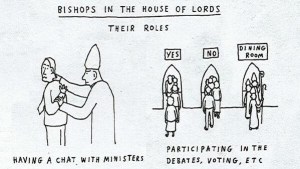
 

Church of England - Church and State - Parliament - Lords Spiritual - Cartoon - 2

Bottom Image: Abbreviated cartoon by Dave Walker

Agree with this article? Violently disagree? Scroll down to leave a comment.

Follow Semi-Partisan Politics on TwitterFacebook and Medium.

Left Wing Eurosceptics – An Endangered Species Flirting With Extinction

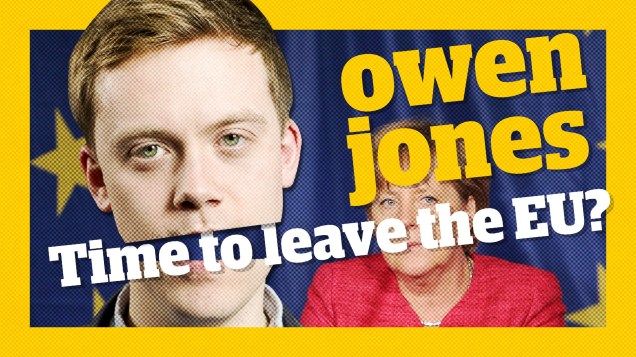
Owen Jones - The left must now campaign to leave the EU - Brexit

Many left-wing Remain supporters have no great love for the European Union, but nonetheless want Britain to remain subservient to Brussels as a means of inflicting left-wing policies on a reluctant Britain. And they call themselves champions of democracy!


“We must be clear about this: it does mean, if this is the idea, the end of Britain as an independent European state. I make no apology for repeating it. It means the end of a thousand years of history. You may say ‘Let it end’ but, my goodness, it is a decision that needs a little care and thought.”

– Hugh Gaitskell, speech to 1962 Labour Party Conference


Pete North, in a justifiably bitter tirade aimed at that group of British left-wingers who persist in stubbornly supporting the EU and campaigning for Remain against their better instincts, writes:

I don’t think I can win over leftists to the Brexit cause. They keep saying “If we leave the EU, the Tories might do stuff I don’t like” – which roughly translates as “I don’t want to live in a democracy where the government responds to the views and wishes of the public”. It also translates as “I am happy to deprive others of the right to choose because my politics are superior”. There’s not really much I can say to that. Traditionally, people like that are wearing uniforms and we shoot them rather than engage in polite discourse. What worries me is that if these people get their way, eventually they will be wearing uniforms and we will have to shoot at them.

Absolutely.

If you ever wanted proof of the British Left’s paper-thin commitment to democracy, you need only compare these two paragraphs from Owen Jones – one written when he was flirting with euroscepticism last year as the Greek euro crisis was at its peak, and the other shortly after David Cameron declared victory in his “renegotiation”.

First, Jones in Grexit mode:

Even outside the eurozone, our democracy is threatened. The Transatlantic Trade Investment Partnership (TTIP), typically negotiated by the EU in secret with corporate interests, threatens a race to the-bottom in environmental and other standards. Even more ominously, it would give large corporations the ability to sue elected governments to try to stop them introducing policies that supposedly hit their profit margins, whatever their democratic mandate. It would clear the way to not only expand the privatisation of our NHS, but make it irreversible too. Royal Mail may have been privatised by the Tories, but it was the EU that began the process by enforcing the liberalisation of the natural monopoly of postal services. Want to nationalise the railways? That means you have to not only overcome European commission rail directive 91/440/EEC, but potentially the proposed Fourth Railway Package too.

Other treaties and directives enforce free market policies based on privatisation and marketisation of our public services and utilities. David Cameron is now proposing a renegotiation that will strip away many of the remaining “good bits” of the EU, particularly opting out of employment protection rules. Yet he depends on the left to campaign for and support his new package, which will be to stay in an increasingly pro-corporate EU shorn of pro-worker trappings. Can we honestly endorse that?

And here he is last month, falling into line with the Remain crowd:

Last July, I suggested that the left should at least consider Brexit, not least because Cameron believed left-leaning voters were in the bag for an “in” vote, giving him little incentive to preserve the progressive elements of the EU. My view is now to stay in, but unite with those across the continent – like the former Greek finance minister Yanis Varoufakis’s new movement – who want a democratic EU run in the interests of working people.

[..] People like me can say: like you, I was sceptical. I’m no pro-EU ideologue, but a genuine floating voter. I understand your concerns. But I’ve come to the conclusion that we must remain in the EU, as a first step to the reform it so desperately needs.

In other words: democracy is a great and noble thing to be defended when it is delivering good old fashioned left-wing policies and high-taxing, high-spending governments. But when the people look like they might be about to vote for anything centrist or right-wing, the Left disown democracy at lightning speed, and embrace any and every procedural or bureaucratic obstacle which might thwart the people’s wishes.

Owen Jones is a smart cookie. He knows the true nature and purpose of the European Union, just as he knows that any “reform” or democratising of the EU is impossible because it would go against the very purpose of the organisation (the creation of a supranational and unaccountable layer of government above the nation state, freeing European leaders to make decisions and implement policies that their own electorates would never otherwise permit).

So when Owen Jones “saw the light” and came out in support of the Remain campaign, it wasn’t because he had suddenly found reason to hope that the EU can actually be reformed. No, it was purely and simply because cold hard political calculus told him that while the European Union may be a “neoliberal” dystopia for lefties, an independent Britain with conservative government would be far worse.

Jones changed his tune because he realises that a conservative government in an independent Britain might – shock horror – implement conservative policies desired by the voters, and the Left would have no means of undemocratically preventing it.

As a strategic piece of hard-headed and pragmatic realpolitik, you can’t fault the vanishing armies of left-wing euroscepticism for their tactical retreat. But as self-styled morally virtuous warriors for social justice and democracy, their hypocritical stance on Brexit stinks to high heaven.


Brexit - EU Flag

Agree with this article? Violently disagree? Scroll down to leave a comment.

Follow Semi-Partisan Politics on TwitterFacebook and Medium.

The Pro-EU Elites Have Not Even Considered The Case For Brexit

Britain in Europe Campaign

More people become eurosceptic with time and experience than come to love the EU. That should tell us a lot about who to listen to in this EU referendum debate

In his Telegraph column today, Charles Moore considers the  soft bigotry of the “swivel-eyed moderates” who instinctively support the Remain campaign for Britain to stay in the European Union without even considering the opposing arguments.

Moore writes:

I do not mean that they do not know a lot about the subject – many of them do. Nor that they are not genuinely concerned for Britain’s future – most of them are. I mean that most have not, for one single second, imagined that life outside the EU might be a viable, even preferable alternative to life within it, so they do not understand the case they are opposing.

This is a form of bigotry, and it is less common on the Leave side – not because the Outers are necessarily deeper people, but because they have lived under the dominance of the pro-EU order, and so have been forced to think hard about it.

The bigotry of successful people is stronger than that of uneducated ones, because their life stories tell them they know best. So they stop thinking and instead merely disdain those who disagree with them. Years ago, Mr Cameron famously derided Ukip as “swivel-eyed loons”. Such people exist, perhaps, but the present danger is much more from the swivel-eyed moderates, who so resolutely refuse to look at the way the world is going.

They also do not see how much they have failed. In the 21st century, the world order and financial systems dominated by the free West have been shaken more profoundly than at any time since 1945, and the people in charge do not know how to correct their own errors, or even admit them. The euro is a major part of this new world disorder, as is the effort to deepen the European Union in the wake of it.

There is a lot of truth in this argument.

Certainly everyone of my age (33) has grown up knowing nothing other than life inside an explicitly political European Union, with many of the same institutions – the Parliament, the Council – which exist today. Unlike those who voted to leave the European Community in 1975, people my age have no recollection of life in a sovereign country, and so have no frame of reference when considering Brexit. No wonder, then, that to many young people the thought of leaving something so seemingly rooted and permanent as the EU (though of course it is nothing of the kind) seems to be crazy.

There is much truth, too, in Charles Moore’s assertion that those of a pro-EU dispensation – particularly the wealthier professional and establishment types who tend to support the EU the strongest – have not been forced to think hard about the question. This is not a criticism of such people, for in many ways it is inevitable.

If you have grown up and prospered under the status quo, with Britain as a vassal state of a larger and ever-more tightly integrating political union, then it takes an extraordinary amount of curiosity, empathy or insight to come to any conclusion other than that the EU has been a resounding success on all counts. By contrast, if you are self-employed or work in a semi-skilled or unskilled job at the sharp end of globalisation, you are more likely to be negatively impacted not just by immigration, but by the inability of your vote to effect any kind of meaningful political change in Britain thanks to the cross-party pro-EU consensus.

As this blog recently noted when discussing the Christian case against the EU:

Too often – at least in Britain, with the media’s patronising and dismissive coverage of UKIP leading up to the European and general elections – we explain away these populist movements, or belittle their support base by suggesting that they are all economically left-behind losers or curtain-twitching village racists.

And it’s partly true, only not as an insult. If you are a well paid professional in rude financial health you can better afford to be a consumer rather than a thinking citizen. You can use your vote to signal your virtue (anyone but UKIP!) or advance your lazily thought out utopian daydreams, with little fear of the consequences. But those of our fellow citizens on the sharp edge of globalisation – those whose livelihoods are impacted by deindustrialisation, new technology, outsourcing and the information economy – tend to see things differently.

This doesn’t mean that we should adopt every nativist, protectionist policy that comes along – because barriers to trade are never the right answer. But it does mean that we should acknowledge that the eurosceptic parties of the Right and the Left are at least asking some important questions that the mainstream parties, trapped in their centrist consensus groupthink, have consistently failed to do.

I feel particularly qualified to talk about this, as growing up I was the most ardent European Union supporter and federalist imaginable. And not in an ignorant way – I had done the reading and acquainted myself with how the EU was structured and how it worked. I firmly believed that the age of the nation state was over, that patriotism was silly and gauche, and that our only hope of a prosperous future lay in dissolving ourselves into a greater European collective. Adopting the euro, creating an EU army – you name it, I believed in it.

I would look enviously across the Atlantic at the power and influence of the United States and, coveting the same, agitate for the European Union become an equally powerful actor on the world stage. Britain seemed small, parochial and redolent of the past. Surely, I thought, our future lies as part of something greater?

Euroscepticism - Eurosceptic - Word Cloud

And I persisted in this belief for some time, the arrogance of youth helping me to dismiss friends, family, experts and the vast majority of the general public who thought differently to me as being xenophobic Little Englanders who just didn’t know what was good for them.

Only when my appreciation for democracy and self-determination (and small-c conservatism) caught up with my authoritarian Utopianism did I realise that the accumulated wisdom of the British people might exceed my own, and that there may be good reasons to be sceptical of the European Union. And only when I came to realise the extent to which the EU is a creation of a small group of European intellectuals and political elites who thought that they knew best – and that the only way to bring about their creation was through stealth and subterfuge, never declaring the ultimate federal destination of travel – did I come to see how profoundly wrong it is.

The point is that I have been on a political journey. I held one set of beliefs and looked to one limited set of facts, and then I questioned those ideas, drew on a wider array of evidence and renounced my previous positions. As Charles Moore would put it, I grew up under the dominance of the pro-EU order, but then thought hard about it and changed my mind.

The pro-EU Remain campaign boasts very few people who have been on a similar journey but in reverse; who were once ardent eurosceptics but came to see the light and learn to love enforced European political union. And that’s because the pro-EU consensus is nothing but a haven for establishment groupthink and bias confirmation. Newcomers to the pro-EU cause such as the Conservative Party’s Sajid Javid and Rob Halfon have not been on an intellectual journey, but merely fell into line behind their party leadership. That’s what makes their “coming out” arguments so desperately unconvincing.

The uncomfortable truth for the pro-EU crowd and the Remain campaign is this: the more you learn about the European Union, its history, the way it came about and its ultimate direction of travel, the more likely you are to oppose it and want Britain to leave. When ignorance prevails and people believe that the EU is nothing more than a friendly club of countries trading and co-operating with one another to Save the Earth, the europhiles win. But when the drip-drip of facts and evidence begins to permeate the debate, people start questioning those pro-EU shibboleths and opposing our continued participation in this mid-century supra-national experiment.

Furthermore, it is those who think primarily with their wallets, as consumers first and foremost, who are most likely to be susceptible to the Remain campaign’s Project Fear and scaremongering tactics about the hysterically hyped “costs” of leaving the European Union, while those who think as engaged citizens and global stakeholders who are most likely to question the European project.

Charles Moore is quite right: there is indeed an army of swivel-eyed ideologues in this EU referendum debate. And though they would hate to admit it, it is those on the Remain side who are most likely to be impermeable to facts, and who are least likely to have ever held a different view on the EU and been on an intellectual journey to arrive at their present position.

And as a rule of thumb, it is generally wisest to listen to those who can show evidence of having thought deeply about an issue and been persuaded by the steady accumulation of evidence to revise their thinking, rather than those who were born with their deeply-engrained love of the European Union pre-programmed in their brains.


Brexit - EU Flag

Agree with this article? Violently disagree? Scroll down to leave a comment.

Follow Semi-Partisan Politics on TwitterFacebook and Medium.

Where Is The Passion For Or Against Brexit From Our Elected Representatives?

When it comes to voting and speaking their conscience on Brexit, British MPs should do as former American congressman Anthony Weiner said…but perhaps not as he did

When the British parliament gets rowdy, it tends to be the braying backbench donkeys at Prime Minister’s Questions making the noise, usually in response to some tenuously witty put-down from David Cameron.

What you see far less in parliament are individual politicians getting angry or visibly passionate about particular issues (Mhairi Black’s vastly overrated maiden speech notwithstanding). Perhaps this is partly because of our British reserve – though this is a comity which notably does not seem to extend to social media.

The parliamentary debate following the announcement of David Cameron’s pitiful renegotiation deal with the European Union was a case in point, and the following drip-drip of MPs and ministers once considered to be dependable eurosceptics dutifully lining up behind the prime minister was especially depressing.

Even when solid arguments were made for or against Britain’s continued EU membership, much of the debate was conducted in that dry, technocratic and risk-averse style which does so much to turn people away from politics.

Thus the media expended many more column inches writing about whether David Cameron felt “betrayed” by Michael Gove’s decision to support Brexit, and what kind of punishment Boris Johnson might expect for doing the same. In the near complete absence of really passionate and full-throated arguments on either side (except in the thriving Brexit blogosphere), the Westminster media focused on the court drama and palace intrigue rather than the policy.

It needn’t be so. It is possible to show passion and wear one’s heart on one’s sleeve in a political debate, and doing so (provided that it is genuine) can actually foster greater trust between the people and politicians who are actually perceived as standing for something.

Former New York representative Anthony Weiner resigned from Congress in disgrace, but during his time in Washington he built just such a reputation as a firebrand, with floor speeches which frequently went viral and broadened the reach and appeal of politics.

One such speech – in which Rep. Weiner excoriated Republicans for hiding behind procedural rules as cover for voting against providing healthcare to 9/11 first responders – is particularly applicable to the Brexit debate as it is now being conducted in Westminster:

You vote yes if you believe yes. You vote in favour of something if you believe it’s the right thing. If you believe it’s the wrong thing, you vote no.

You would think that this would be stating the obvious, but apparently not, judging by the number of committed europhile MPs who are quick to reel off all the things they hate about the EU rather than make a full-throated defence of Brussels, and the eurosceptic turncoats who have suddenly come up with implausible-sounding pressing reasons why now is not the right time for Brexit.

Am I the only one who would like to see a bit more genuine passion (as opposed to the creepy “passion” of Ed Miliband, or David Cameron pretending to be “bloody lively”) in our politics, rather than the same old consensual blandness?

Of course, for fiery debates like this to take place in the House of Commons, certain stultifying rules would need to be relaxed (though PMQs and the reaction to SNP MPs clapping shows just how arbitrary the enforcement of these rules already is).

But more than that, to have Anthony Weiner style passion in our politics, and the Brexit debate in particular, we would need more of our elected representatives to do the following:

1. Dare to make the honest, non-technocratic or fearmongering case for or against Brexit (with the europhiles ceasing to deny their desire and preference for European political union), and

2. Place their sincerely held beliefs over and above thoughts of career advancement.

But partly because the legislature and the executive are intertwined in the British political system, career-minded MPs are not currently incentivised to build a reputation as passionate and independent-minded firebrand legislators, as to do so would immediately mark them out as “troublemakers” to be passed over for promotion.

There is, at present, no attractive or lucrative career path in Westminster politics that does not lead inexorably away from legislating and toward joining the government, and the warping effect that this has on our lawmaking process cannot be overstated.

Yet another reason for comprehensive constitutional reform in Britain, to separate the executive from the legislature so that both are better able to do their jobs.


Parliament - House of Commons - Debate

Agree with this article? Violently disagree? Scroll down to leave a comment.

Follow Semi-Partisan Politics on TwitterFacebook and Medium.

Cameron The Weakling

David Cameron thinks that publicly exaggerating and flaunting Britain’s supposed weakness and vulnerability will make people vote to stay in the European Union, while having no impact on perceptions of his own leadership

We have already been treated to the spectacle of our wobbly-lipped Foreign Secretary insinuating that he is so inept at managing our foreign relations and defending Britain’s interests that we would likely be “punished” by our European friends if we voted to leave the EU.

And now it is David Cameron’s turn to make an ostentatious public spectacle of just how weak and insignificant he believes we are as a country, and how hopelessly unable to defend the British interest he is.

From Michael Deacon’s sketch in the Telegraph:

Francois Hollande, the President of France, respects the British people. He respects their democratic right to choose how they wish to be governed. He would never wish to put pressure on them. And if, when the referendum comes, they decide that the UK should leave the EU, he will respect their decision.

But, he added casually, there would of course be… “consequences”.

He said the word many times. “Consequences.” There would be “consequences” relating to trade, “consequences” relating to immigration. “Consequences?” Oh, he was “unable to deny” there would be “consequences”.

Was it true, asked a journalist, that if the UK left the EU, France would abandon the deal that helps stop migrants crossing illegally from Calais to Britain?

Monsieur Hollande looked at the journalist equably. Well, he replied. Naturally there would be “consequences”.

All of this took place while our prime minister stood limply next to the French president at his podium, as though French special forces had kidnapped Samantha and the kids and were holding them at gunpoint in the background.

At what point does the dirge-like, pessimistic drivel offered up by the Remain campaign and spouted ceaselessly by loyal government ministers stop making the public question whether Brexit is safe, and start making them question why the hell we pay these people if not to aggressively defend our own national interest?

Not to get all Land of Hope and Glory here, but Britain is still a reasonably big deal in the world. A major economic power, the premier European military power and one of a handful of countries in the world with real expeditionary capabilities, and a cultural reach probably second only to the United States. Most British people know this, and do not buy into the miserablist, declinist view of Britain peddled by so many in the Remain camp.

David Cameron has clearly made a calculation that talking about the catastrophic consequences of Brexit on the United Kingdom will scare up a significant number of votes and thus undermine the Leave campaigns. Never mind that it makes him look like a liar for having previously suggested that he might recommend Brexit if he was not successful in securing his pitiful package of “reforms”. And never mind the galling spectacle of a British prime minister actively and passionately running down his own country for electoral advantage.

Allister Heath picks up on this same theme in the Telegraph:

But the Government and many of its anti-Brexit allies have gone too far: instead of carefully stoking the public’s understandable fear of change, and planting doubt in its mind, they have decided to wildly exaggerate the downsides of leaving. The hit to the economy could be greater than that from the Great Recession, we are told by some hysterical economists, and even that best-selling children’s books would no longer be written because, apparently, no non-British authors or illustrators would be allowed into the UK if we were not part of the EU.

These and many other of the similarly extreme claims that have been made in recent days are laughably implausible, even to nervous, swing voters; fear is only effective as a political strategy if it is credible. Even worse for the Government, it has also allowed a toxic narrative to set in: the idea that it would be powerless to stand up for Britain’s interests and look after our economy in the event of a Leave vote.

It’s all rather pathetic and defeatist. It would be too hard and time-consuming to conclude alternative trade deals, we are warned, and we apparently don’t have the requisite skills in the Foreign Office; there is nothing anybody could do to stop our companies, consumers and tourists being bullied and victimised by vindictive foreign governments; and we would be bulldozed by the angry bureaucrats of Brussels wherever we turn. Dominic Grieve, the former attorney general, has claimed that British expats living in Europe would risk “becoming illegal immigrants overnight”, even though their status would in fact be protected under the Vienna Convention of 1969.

Project White Flag, as we should learn to call it, boils down to one long stream of nauseating, miserable, declinist negativity. Alarm bells ought to be going off in Downing Street: politicians don’t win elections or referenda by pretending to be weak and powerless, and by claiming to be at the mercy of foreign governments.

As this blog has repeatedly stated, the Remain campaign need to make up their minds. Is the EU a soft and friendly club of countries getting together to braid each other’s hair and co-operate on a range of mutually beneficial issues, or is it a snarling, angry organisation which threatens to rough us up if we attempt to leave? Are we in a happy marriage with the EU, or an abusive relationship?

And we British citizens also need to make up our minds about something. We need to decide why we should continue to tolerate having in office a prime minister, foreign secretary and other elected officials who hold our country in lower estimation than many of their own citizens, and who – by their own admission – have stated that they would be unable to aggressively defend our national interest in the event of Brexit.

Because we are rapidly reaching the point where the public may start to question the point of keeping a pampered man and his family installed in Number 10 Downing Street at all,  when all he does is openly boast about his inability to influence other nations and stand up for Britain.


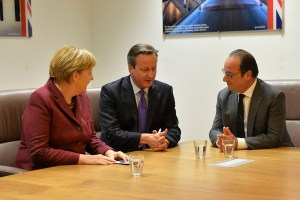
David Cameron - Angela Merkel - Francois Hollande - EU Renegotiation - Brexit

Agree with this article? Violently disagree? Scroll down to leave a comment.

Follow Semi-Partisan Politics on TwitterFacebook and Medium.