By Failing To Back Brexit, Millennial Voters Are Failing Their Generation’s First Great Test Of Character

Students for Europe

Millennial voters who lazily but instinctively support Britain remaining in the European Union are letting down their country and their entire generation

Lately, this blog has been focusing on the younger, millennial generation and our unfortunate propensity to think as scared consumers rather than engaged citizens, and so overwhelmingly support Britain remaining in the European Union (even if many of us are too lazy to carry our opinions as far as the ballot box).

In taking this stance, I have encountered some pushback from readers, who have (rightly) pointed to the fact that older generations can be equally greedy and self-interested, but (wrongly) drawn a false equivalence between the two.

While not all young Remainers hold their position because of perceived material self-interest, those who completely ignore the democratic question to focus exclusively on their own material (typically career and travel) prospects – which would almost certainly be completely unaffected in the event of Brexit – are fully deserving of the criticism levelled at them by this blog and others.

The Guardian breaks down the latest polling data:

Government strategists and pollsters privately admit that the central problem for the Remain side is that its support for staying in the EU is strongest among young people, the group least likely to vote. Opinium found that in the 18-34 age group, 53% said they backed staying in, against 29% who wanted to leave. But only just over half (52%) in this age group said they were certain to actually go out and vote.

Among voters in the 55-and-over category, support for leaving was far stronger, as was their certainty to vote, offering a huge advantage to the Leave side.

Some 54% of voters aged 55 and over said they wanted to leave against 30% who wanted the UK to remain in the EU. But in stark contrast to younger voters, 81% of this group were certain to vote.

Perhaps our generation is in need of a wake-up call. This particular tirade (quoted below) is addressed to American millennials flirting with the presidential candidacy of Bernie Sanders, but parts of it apply equally to younger British voters indignant that the Leave campaign’s quest to restore democracy is interfering with their perceived career options springing from the munificent European Union.

Courtney Kirchoff writes over at Steve Crowder’s website:

Adulthood isn’t what we thought it would be. No, the economy these past several years hasn’t exactly been stellar, either. Okay? Okay.

My fellow millennials, for sure we have our challenges. Many of you were raised in broken homes. Many of you were exposed to divorce. It’s possible a lot of you didn’t live with your father or may not have known him at all. Combine home life with the rise of political correctness in school, taking its dangerous form of “self-esteem above all,” and no wonder you think life is unfair but you should have it all.

Look, I’m sorry life screwed you over in the early years. I’m sorry if you were shuffled to daycare day in and day out. I’m sorry if you don’t have memories of playing with your parents. But most of all, I’m sorry you were not instilled with the grand idea of personal responsibility. I’m sorry you were not empowered with the notion that YOU are the commander of your own life. If you take nothing else from this post, believe that no matter who you are, you can succeed. Without government.

Because guess what, my friends? You’re abject loyalty to socialism is going to tank our country. Your insistence on getting what you want and making other people pay for it, all under the guise of “fairness,” will lead to ruin. For everyone. Including you.

Switch out “socialism” and “government” and replace it with “the EU” and you have a perfect response to the EU’s millennial cheerleaders.

Yes, of course this is an age of anxiety. Just as the boomer generation seriously worried about imminent nuclear annihilation, so we worry about job security and career prospects. But we are hardly a uniquely benighted generation, though there are indeed many ways which our politics currently favours older voters – the government’s lack of a coherent housing policy being an obvious example.

But I’m sorry: growing up in economically uncertain times in an age where there is no guaranteed job for life does not absolve millennials – my generation – from thinking not only as self-interested consumers but also as engaged citizens who care about the country and democracy that they will bequeath to their own descendants.

The generation who spent their prime years fighting fascism – and who saw their contemporary Britain largely reduced to rubble and ruin in the process – could have abstained en masse from fighting the Nazi threat in order to buy a few more years of economic security and job stability through appeasement. But they were willing to go to war and risk what they had for principles which transcended material concerns.

By contrast, our generation is not called to risk or sacrifice nearly as much as our grandparents and great grandparents were to defend democracy and national self-determination – and in fact could have much to gain from British secession from the European Union, materially and otherwise. But by an overwhelming majority we are unwilling to take even that far smaller risk.

And history will long note this colossal failure of courage and character from Generation Me Me Me.


Hello I'm A Millennial

Agree with this article? Violently disagree? Scroll down to leave a comment.

Follow Semi-Partisan Politics on TwitterFacebook and Medium.

Opposing The EU Is A Calling Based On Evidence, Not Blind Faith

File photo of a Union Jack flag fluttering next to European Union flags ahead of a visit from Britain's Prime Minister David Cameron at the EU Commission headquarters in Brussels

Those who accuse Brexit supporters of being ideologically fixated and closed to alternative ideas are not only hypocritical – they have utterly failed to understand what makes eurosceptics tick

One of the drawbacks of being a committed eurosceptic and Brexiteer is that one tends to be painted as a swivel-eyed ideologue, someone whose opinion is not based on considered deliberation but on flawed, base gut instinct.

Thus the two most common insults hurled at eurosceptics – besides the cries of racism and xenophobia, which are sufficiently stupid that we can safely ignore them – are that we hate the European Union as an article of faith (or religion) rather than reason, and that we are closed minded and impermeable to new information (like David Cameron’s triumphant New Deal with Brussels).

Both of these accusations are unfair, although there is a grain of truth – many of us do indeed feel that our euroscepticism is a calling, or at least a cause important enough that we are willing to devote time, money and effort to its advancement.

When I attended the recent launch of The Leave Alliance, for example, it was one of the few times when I have actually been surrounded by large numbers of like-minded people on the Brexit issue, and it was rather humbling to be in the company of people whose curiosity and passion have led them to become experts on the history of the EU and the workings of international trade and regulation. Where it differs from religion, though, is the fact that our understanding of and distaste for European political union is not based on gut instinct or faith, but on a close reading of primary materials – treaties, statements, declarations, meeting minutes, autobiographies, trade journals, news articles – which those who support the European project can rarely match.

(I should note that I hardly consider myself to be such an expert – but through my involvement with The Leave Alliance I now have access to much better information and have shed much of the woolly thinking which clouded my previous euroscepticism).

So yes – we take our euroscepticism seriously. And those who see this as a flaw or a point of ridicule have generally failed to understand what it is about the European Union which offends us so greatly. They rhetorically ask what concessions might prompt us to change our minds – what it would take for us to stop worrying and love Brussels – thinking that by asking the question, they are revealing our blind, unthinking animosity to the harmless idea of countries coming together to trade and cooperate with one another.

Britain in Europe

In answer to this charge, Pete North has an excellent blog post from January, in which he begins with a simple fact – the signing of a protocol by Georgia and Turkey governing the electronic exchange of customs data for goods shipping – and masterfully spins it into a damning case against the European Union, proving that a harmonisation and integration-obsessed EU is actually a barrier to the kind of global co-operation which leads to economic growth and wealth creation.

Read the whole piece – entitled “The EU is not a trade bloc – it’s a power cult“.

Here is the key extract, which I will quote at length:

At the heart of it is a paranoia that without the EU the nations of Europe will once again be at war thus have set about creating a Europe that deprives nations of their democratic will to the ends of creating a single supreme government for Europe – one which actively prevents European nations speaking on their own behalf and getting the best for themselves and Europe.

And so when the question is posed as to what it would take for us hardline leavers to change our minds, we would have to address the central issue. Supranationalism. Were the EU to abandon supranationalism, to dismantle the institutions and cultural programmes designed to engender a single European demos, culture and government, to instead become a common forum for international progress, then I could change my mind. But then I would want to see it as a more open forum where our trading partners can also participate and shape the rules rather than having the EU dictating.

There are two basic problems here. Firstly, the entity a properly reformed EU would resemble already exists. It’s called the United Nations Economic Commission for Europe, and secondly, to demand reforms of this nature – of such era defining significance, we would effectively be calling for the dismantling of le grande project forever.

And so it remains the case that we are hard line leavers in that the EU cannot be reformed, will resist any attempt, and will never serve the best interests of its members – or even Europe. The EU is purely about the preservation of the EU political body that serves to advance the supranational agenda of its long dead architects.

The EU is not about trade, it is not about cooperation and it wouldn’t recognise multilateralism in a billion years. Everything it does is with the intent of affording itself more power and more control while passing the responsibility and the consequences on to member states to deal with. It is here where nuisance turns to malevolence and such an affront to democracy, based on a foundation of intellectual sand, should be resisted.

If we examine EU for what it really is, it’s a power cult – and one that will never stop until it holds all of the power. It confiscates our wealth then acts like some kind of benevolent Father Christmas, buying off all the institutions such as academia, NGOs and local authorities who would otherwise oppose it, so that when it comes to a popular vote the establishment will never turn on its paymaster.

It is for this reason true leavers oppose the EU with every fibre of their being. It is why opposing the EU is a spiritual call and a life obsession. It is why the issue will never go away and it is why a referendum will not settle the argument – because for as long as there are those who know what the EU really is, and its modus operandi, there will always be people willing to fight it to the bitter end.

And that pretty much sums up why committed eurosceptics – at least those affiliated with The Leave Alliance – take this issue so seriously, will not change our minds based on the evidence in front of us, and will not rest regardless of the outcome of the referendum on 23 June.

It comes down to the two S’s – supranationalism and sovereignty. Both cannot exist simultaneously – any key competence is either a sovereign matter or it is decided at the supranational level. And the European Union is an avowedly supranational organisation, spurning healthy intergovernmental cooperation in favour of the creation of a new layer of government over and above the member states.

Were the European Union content to fulfil the much more narrow remit claimed by many of its apologists (i.e. facilitating trade and cooperation) then an accommodation could potentially be reached. But as Pete North rightly points out, all of the evidence – and I mean all of it, to the extent that the Remain camp do not even bother to claim otherwise – is that the EU’s ambitions are much grander. They always were – that’s why the organisation which they pretend is just about trade and cooperation has a flag, an anthem and a parliament.

If anybody is being dogmatic and impermeable to patently obvious facts, it is in fact the Remain camp, who possess a superhuman ability to ignore the federalist facts staring them in the face, and somehow pretend to themselves that events of historical record and verbatim quotes from numerous EU officials did not happen and were not said. If one is not an enthusiastic European federalist, one has to be either ignorant or in extreme denial to believe that the EU as it stands is just a trading bloc, or that there is not far more integration planned for the near future.

So who is operating on blind faith here – the Remain campaign or those fighting for Brexit? While there are plenty of loud and ignorant people on both sides, those EU apologists who naively or deceptively cry “nothing to see here!” while all the edifices of a European state are brazenly built around them should be held in particular contempt.


European Union - United Kingdom - Britain - Flags

Top Image: REUTERS/Francois Lenoir/Files

Agree with this article? Violently disagree? Scroll down to leave a comment.

Follow Semi-Partisan Politics on TwitterFacebook and Medium.

Self-Entitled Young People For Remain

Students for Europe - EU Referendum - Brexit - European Union

The EU’s young cheerleaders have lots to say about their own material self-interest, but fall strangely silent when it comes to democracy

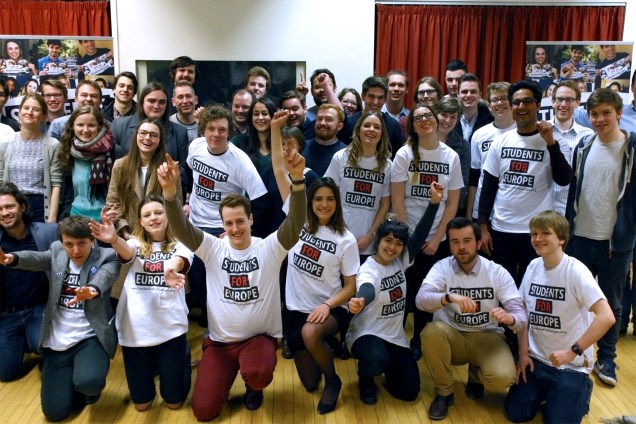
After Abi Wilkinson’s petulant complaint that Leave campaigners attempting to restore British democracy are harming the job prospects of the young, we now have another youthful but clueless voice making the same case.

Presenting Richard Godwin in the Evening Standard:

I just feel European. I’m part of a generation that has had easy access to mainland Europe for both work and play.

I like Penélope Cruz and Daft Punk and tiki-taka and Ingmar Bergman and spaghetti and absinthe and saunas and affordable trains.

As sentimental as it sounds, Europe represents opportunity, cosmopolitanism, modernity, romance, enrichment, adventure to me

Cutting all that off — even symbolically — would feel both spiteful and arbitrary.

Quite why leaving the explicitly political construct of the European Union would mean that Richard Godwin is no longer part of the continent of Penelope Cruz and Daft Punk is never explained – because of course, it wouldn’t. We would be cutting off nothing, symbolically or otherwise, aside from the dead weight of a supranational political organisation which suppresses democracy in a misguided attempt to harmonise 28 distinct European countries into a single, new European state.

But then at least Godwin has the decency to admit that he is being driven primarily by instinct, unlike the hapless Abi Wilkinson who seemed to suggest that the pro-europeanism of the young is based on enlightened consideration while the pro-democracy euroscepticism of older generations is based on selfishness and whimsy (when of course youthful pro-europeanism is almost entirely the product of ignorance and selfishness).

Sadly, this does not stop Godwin from lecturing us about how young people – my generation – have a greater stake in the future:

It should go without saying that the young have more stake in the future but it’s also contrary to electoral logic. Only 34 per cent of over-65s are in favour of remaining, there are more of them, and they’re more likely to vote.

It means that young people end up in a death spiral, defeated by their own disillusionment. But my hunch is that the only way to change that is with an appeal to hearts rather than heads. Shouldn’t we always aspire to act together rather than alone?

Apparently Godwin’s only concern for the future is that he has the maximum chance of living in a big house with lots of shiny consumer goods to distract him from the fact that he no longer lives in a democracy, has no influence over the decisions which affect his life and has no way of removing the people who make all the key decisions.

In other words, Richard Godwin, like Abi Wilkinson, is thinking primarily as a consumer. Material considerations (job, house, iPhones) consume his every thought – at no point in his paean to the European Union did he even mention democracy or self-determination, or acknowledge any of the many and growing flaws in the EU’s governance.

And of course despite the scaremongering of the Remain campaign, there is no evidence to suggest that Britain would face economic ruin by leaving the EU – and every reason to believe that staying in the EU only perpetuates a discredited, anachronistic model of regional protectionism rather than the global regulation and removal of non-tariff trade barriers that are really needed to unleash global trade and unleash real prosperity.

But Godwin wouldn’t know about any of that, because he is too busy eating spaghetti, watching Penelope Cruz movies and congratulating himself for being such an enlightened, post-national, European citizen. He doesn’t care about the history, traditions or culture of the country which gave him life and liberty – or if he does, they are very much secondary thoughts compared to the ignorant and false assumption that he will no longer be able to work and play in Europe if we become an independent, self-governing country again.

Apparently Richard Godwin is happy to behave and be seen as a selfish consumer first and foremost, rather than an engaged citizen whose thoughts extend beyond his own narrow interest. And that’s actually fine. I hope that more Richard Godwins and Abi Wilkinsons come crawling out of the woodwork as this EU referendum campaign goes on.

Because every new spoilt millennial who comes blinking from their parents’ basement to complain that the evil Leave campaign is threatening their gilded future serves to prove that this campaign is about principled citizenship versus naked self interest.

Very few people are covering themselves in glory in this EU referendum campaign. But the European Union’s youthful cheerleaders from Generation Me Me Me are clearly intent on doing everything they can to make young people look as bad as possible.


European Union - United Kingdom - Britain - Flags

Top Image: Students for Europe

Agree with this article? Violently disagree? Scroll down to leave a comment.

Follow Semi-Partisan Politics on TwitterFacebook and Medium.

This Reckless Talk Of Brexit Is Making Whiny Young People Anxious

Team of creative people taking a break and using computer.

Staying in the EU and surrendering our democracy is a small price to pay to keep self-entitled millennials happy, because nothing is more important than generation Me Me Me

We of the millennial generation are fast acquiring a reputation as lazy, self-entitled whiners, endlessly complaining about how hard we have it – as though we are the first generation in history to come of age during economically uncertain times.

One might have thought that living in an age when each of us has a mini computer in our pocket which can tap the accumulated knowledge of the entire world – and when we don’t have to worry about, say, dying from tuberculosis – might make us momentarily grateful. But of course we are not, and now apparently the latest “injustice” being inflicted on the millennial generation – my generation – is the terrifying idea that Britain might vote to leave the European Union and seek to govern ourselves as an independent democracy once again.

Channelling this fear, Abi Wilkinson has written a nauseating piece in the Telegraph, explaining why the existential question of Brexit and Britain’s place in the world should be based entirely on the selfish desires and career insecurity of our generation.

Her piece – hilariously titled “Stubborn old people who want to leave the EU are condemning the rest to a lifetime of uncertainty” – is so patronisingly, finger-waggingly sanctimonious (and so readily swallows every talking point from Britain Stronger in Europe) that it makes anyone under the age of 35 seem completely insufferable, not to mention utterly wrong on the fundamentals.

Wilkinson opens:

When you consider that the risks of leaving the EU fall disproportionately on young people, it’s unsurprising that 18-29s are the group least likely to support the move. Almost three quarters of us say we’ll vote to remain, compared with just 37 per cent of over 60s. For many under-30s, worrying about employment has been a defining feature of our adult lives. Having come of age at the height of the financial crisis I know I’m certainly not keen to endure another similar economic downturn.

Of course becoming an adult and entering the workforce during a major recession is tough. Back in 2008 I had friends at Bear Stearns and Lehman Brothers who came home from work one day with all of their possessions in a cardboard box, and I narrowly escaped a redundancy round at my own company. Nobody wants economic uncertainty if it can be avoided, but at what point do infringements on democracy and the fundamental right to self-determination outweigh the hope of greater short term stability?

Wilkinson sees no such tradeoff at all – she is ready to jettison democracy at the first sign of trouble, throwing away our freedom even if it buys a measly 0.1% additional GDP growth. But the truth is that Brexit is possible while keeping disruption to a minimum by exiting to EFTA and EEA membership (the “soft landing” approach which would almost certainly be adopted by civil servants even if it is currently being furiously ignored by the mainstream Leave campaigns).

Abi Wilkinson might have known that there exists a comprehensive plan to achieve Brexit, extricating us from political union while minimising economic and other disruption. But like too many others of my generation, Wilkinson can’t be bothered to do her research, and so instead she swallows and regurgitates propaganda from the Remain campaign.

A man walks past various currency signs outside a brokerage in Tokyo

Wilkinson continues:

Already, young people are particularly likely to be in low-paid, precarious employment. Many are stuck working jobs well below their qualification level and struggle to secure the full-time hours they need to pay their rent and basic living costs. For anyone in this situation, the TUC’s warning that workers’ rights enshrined in EU law could come under attack following a Brexit vote is another serious worry.

At this point, Wilkinson’s politics become clear. She is one of those cookie-cutter lefties who love the European Union because they believe it acts as a social democratic bulwark against the Evil Tory policies which would otherwise ravage the nation. Or to put it another way, Abi Wilkinson doesn’t give a damn about the right of the British people to vote for the policies that they want for themselves. The population is too conservative for Wilkinson’s taste, and so we must have values and policies imposed upon us which we are not currently enlightened enough to vote for ourselves.

Abi Wilkinson is a great champion of democracy, you see.

But now it starts getting really offensive:

Less negatively, many people in their teens and 20s also appreciate the broader benefits of belonging to the European community. We’re more likely to travel abroad to work or study. Many of us have friends who were born in other countries so we’re less inclined to be wary of other cultures. We’re also much more likely to date someone who was born outside the UK.

In contrast, supporters of Brexit often seem to be motivated by a fear of the unknown. Older people are more likely to distrust migrants and to feel nostalgic for the comparatively homogenous UK of days gone by. Though there’s a sizeable retiree expat community residing in countries such as as Spain, over 60s are statistically likely to see the free movement of people as a threat rather than an opportunity.

Of course, for those who’ve already exited the labour market – or are planning to retire within the next few years – it’s much easier to focus on your gut instinct. If you’ve not got to worry about your employment prospects, the economic facts of the matter can be treated as a secondary concern. Young people have a reputation for being reckless, but in the EU referendum it’s older folk who will be playing fast and loose with the livelihoods of younger generations.

And continues:

As more countries have joined the EU, migration to the UK has gradually increased.

As a 20-something living in London, this isn’t something that worries me. I’m used to hearing a whole range of different languages and accents as I go about my daily life. It’s a mundane fact that many of my neighbours are relatively recent immigrants, not a cause for concern.

For someone who has lived in the same area for decades, however, I can see that it might be harder to adjust to changes in the local community. Still, it’s worth noting that UK-born people who live in relatively diverse neighbourhoods tend to feel more positively about migrants than those who don’t — suggesting that fear of immigration might be disproportionate to the reality.

Young people, open and tolerant; old people, suspicious and racist. Got it?

Note too how Wilkinson has pivoted, portraying young Remainers as the fearless go-getters off to pursue international careers and date hot Italians, while old people are now “[afraid] of the unknown”. She switches perspectives at several points throughout the piece, as though she cannot make up her mind whether young people are brave pioneers or snivelling victims (probably because it suits her purposes to be both at different times).

But worst of all is the suggestion that older people supporting Brexit are doing so not out of considered deliberation, but through “gut instinct”; that they are somehow not taking this seriously, and playing “fast and loose” with the livelihoods of the young.

Here, Wilkinson is seriously suggesting that the generation who have abandoned watching a nightly news bulletin in favour of Buzzfeed listicles pushed to their smartphone screens are the wise and discerning citizens, while those who actually have living memory of the European Union’s incremental power grabs are the ones making light of a critical geopolitical issue. The sheer gall of it is quite unbelievable.

Read the whole thing, if you can get to the end of Wilkinson’s sanctimonious lecture without wanting to punch your computer screen.

EU Referendum - Brexit - Democracy

The problem with Abi Wilkinson – and too many other members of Generation Me Me Me – is that they believe their right to an easy path through life trumps everyone else’s right to live in a representative democracy. As far as they are concerned, the fact that our own elected Westminster and devolved parliaments are increasingly sidelined by a supranational European entity is just the price we will have to pay for their ongoing contentment, because heaven forfend that the fuzzy career aspirations of some first year Gender Studies student are thwarted by a badly-timed outbreak of democracy.

In other words, too many millennials don’t know how to think or act as engaged citizens. Rather, they are capable only of behaving like selfish consumers, jealously guarding what they see as their special pot of privileges without the slightest care for the wider impact on the customs and institutions which together make up the fabric of our country, and which have often existed for decades or centuries before they were even born.

To this arrogant mindset, the older generations (like those strange grey haired people who gather round the Cenotaph every November wearing their silly medals for doing something or other in the past) don’t have a clue about what is best for Britain.

Apparently the generation which fought and bled and died to secure our freedom – whose contemporary Britain was reduced to rubble and rationing and deprivation in the 1940s when they were in the prime of life – is the selfish one, while their descendants (and I include myself) who sacrificed nothing but have mastered the Art of the Selfie somehow have a lot to teach our elders about responsible citizenship.

I’m sorry, but I’m not buying it, and I will not have it proclaimed in my name. Abi Wilkinson can speak for her very selfish self, but she should not presume to speak for the rest of her generation, or to demean the older generations so haughtily and glibly.

Some of us actually respect our elders. Some of us appreciate that coming of age when the building on the corner was a smoking crater from a German V2 rocket – rather than an artisan coffee shop with free WiFi – might possibly have imparted some wisdom and experience that we have not yet managed to acquire for ourselves.

Some of us weren’t born expecting all of the good things in life to be handed to us on a golden plate, or raised to be so rude that we write articles in the Telegraph essentially declaring “to hell with your democracy, give me a job in Madrid and cheap mobile roaming charges!”

Some of us are not so arrogant to assume that because we are “the future”, we are free to completely reshape society as we please, with no regard for the traditions and proven solutions of the past – you know, things like representative democracy, that old-fashioned concept where you actually get to vote out the people who make the key decisions if you disagree with them (try doing that in Wilkinson’s beloved EU).

Abi Wilkinson’s narcissistic, self-centred embrace of the Remain campaign makes me sick. It represents everything bad about the millennial generation, confirming every worst stereotype and instantly negating all of the better angels of our generation’s nature.

To those older Britons who wore the uniform, who fought for this country, who grew up in real deprivation in the early post-war years, who actually remember a time when Britain was a sovereign democracy and who are rightly incensed at being addressed as though you are stupid and greedy by a vapid, know-nothing millennial: please know that Abi Wilkinson does not speak for us all.


 

Hello I'm A Millennial

European Union - United Kingdom - Britain - Flags

Agree with this article? Violently disagree? Scroll down to leave a comment.

Follow Semi-Partisan Politics on TwitterFacebook and Medium.

The EU’s Model Of Supranational Harmonisation Does Not Keep Us Safe

EU - European Union - Security Defence Policy

On national security as with trade and social affairs, the case for Brexit hinges on the conflict between intergovernmentalism and supranationalism

In his latest Telegraph column, Christopher Booker joins this blog in refuting the baseless, scaremongering claims by the Remain camp that being in the EU in any way protects Britain from the risk of terrorist attack.

Booker writes:

It was unfortunate timing for our not very convincing Defence Secretary Michael Fallon, when he used the Brussels terrorist attacks to claim that they only confirm how disastrous it would be for Britain to leave the EU. “The fact is,” he said, that “across Europe we do have these mechanisms now” for “sharing intelligence about terrorists’ movements” that enable “all intelligence services across Europe to pool their efforts”.

Do those “mechanisms” for sharing intelligence include the Parliament, Court of Justice, Commission, the supranational elements by which the European Union undermines nation states and seeks to usurp their role on the world stage? Of course not – these are all explicitly political institutions. All of the collaboration which actually helps to combat terrorism in Europe occurs on an intergovernmental, not a supranational basis, mostly outside of European Union structures.

When sovereign governments are free to co-operate on mutually important issues, they can often do so well. But when a busybody supranational regime seeks to take on ever more responsibilities from the nation state, vesting them in inappropriate and unproven institutions, that’s when things can easily fall through the cracks, as this blog explained yesterday.

Booker rightly goes on to argue:

In fact, there is here a much wider point, which highlights one of the most common misunderstandings about the EU, whose supporters try to persuade us that without it, international cooperation could not exist. In fact, over a whole range of issues, countries have long evolved extremely effective systems of inter‑governmental cooperation, such as on air-traffic control, Interpol, the international postal union, the European Space Agency and dozens more (not to mention Nato).

All these, negotiated between national governments, regardless of whether or not they are in the EU, work very well. And not the least absurd feature of the EU’s attempt to make itself a “supranational government of Europe” is how often it has tried to absorb these examples of effective cooperation into its own clumsy bureaucratic empire: as when it launched its “Single European Sky” programme, or set up “Europol”, or issued directives on postal arrangements with which it then expected non-EU states to comply, or tried to take over the European space programme for its crazy Galileo satellite project.

If only more people appreciated the crucial difference between “inter‑governmental”, which works, and “supranational”, which doesn’t, how much more enlightening our debate might become.

Inter-governmental versus supranational. It is very much in the interests of the EU’s apologists and closet federalists for the general public not to realise the difference between these two important terms.

The former describes the healthy co-operation between friendly allied countries, sometimes bilaterally and other times facilitated by an organising body (like Interpol). The latter describes weak nation states outsourcing key responsibilities to a higher third party, a reckless and unproven approach only ever attempted by national politicians seeking to escape accountability to their own electorates.

If the Remain camp succeed in their effort to lay a thick fog of war over the EU referendum debate so that important terminologies and ideas are confused and muddled, they automatically win. If they can persuade people that the EU equals warm, fuzzy co-operation with our friends while Brexit equals snarling isolationism and being an international pariah, the Remain camp need to nothing else. And so far, they are succeeding.

In order to turn this around, the Leave campaign absolutely must succeed in educating the public on the difference between laudable and (ideally) transparent and accountable co-operation between European countries on one hand, and the outsourcing of core government competencies to undemocratic, unwanted and untested unified European institutions on the other.

This applies not only to national security, but economic and social affairs too. When the Leave campaign are able to cut through the fog of confusion and make people realise that leaving the EU would actually represent an affirmation and strengthening of the only kind of co-operation which actually delivers positive results (the inter-governmental kind), they are far more likely to embrace Brexit and realise how the EU actively harms healthy intergovernmentalism in its rabid pursuit of ever-closer union.

Can the Leave campaign this message across in less than three months between now and the referendum? Perhaps. But enlightenment will not spring from the mouths of deliberately ignorant “leaders” like Boris Johnson.

Those who can actually distinguish between the real issues and the cosmetic ones – which sadly excludes much of the British press corps – urgently need to find a way to amplify their message.


Intergovernmental vs Supranational - European Union - EU Referendum

Bottom Image: Cartoon by Wolfgang Ammer, published in Intergovernmentalism & Liberal Intergovernmentalism

Agree with this article? Violently disagree? Scroll down to leave a comment.

Follow Semi-Partisan Politics on TwitterFacebook and Medium.