Quote Of The Day

Angry Mob Fun Run

Standing athwart the European Union, yelling “Stop!”

This, from William F. Buckley Jr.‘s 1955 founding mission statement inaugurating the American conservative journal National Review, seems particularly apt at this point in British political history:

Radical conservatives in this country have an interesting time of it, for when they are not being suppressed or mutilated by the Liberals, they are being ignored or humiliated by a great many of those of the well-fed Right, whose ignorance and amorality have never been exaggerated for the same reason that one cannot exaggerate infinity.

This certainly holds true for small-c conservative Brexiteers, who have been not only ignored and humiliated but also scorned and threatened by the current Conservative prime minister, he and his chancellor both staunch members of the “well-fed Right”.

But perhaps this later quote from the same article might give hope to Brexiteers regardless of what happens on referendum day, and even if our efforts come up short:

That, a thousand Liberals who read this sentiment will say with relief, is clearly not enough! It isn’t enough. But it is at this point that we steal the march. For we offer, besides ourselves, a position that has not grown old under the weight of a gigantic, parasitic bureaucracy, a position untempered by the doctoral dissertations of a generation of Ph.D’s in social architecture, unattenuated by a thousand vulgar promises to a thousand different pressure groups, uncorroded by a cynical contempt for human freedom. And that, ladies and gentlemen, leaves us just about the hottest thing in town.

Having right on one’s side is no small thing, and we Brexiteers have it. The human desire for freedom and self-determination is not a fad or a passing fashion. It does not grow old, and despite the European Union’s continual attempts to snuff it out, it will only grow stronger the more the EU infringes on our right to exercise meaningful control over our lives and communities, and hold our leaders to proper account.

Brexit will happen one day, whether that process begins with a Leave vote in the referendum this Thursday, in some future referendum or by the unilateral decision of a future British government faced with no other choice. Brexit will happen, even if only when the entire rotten apparatus of the EU’s supranational government disintegrates and comes crashing down around us. This anachronistic attempt to build a post-democratic society of consumers rather than citizens will fail.

As Pete North so eloquently puts it:

But Brexit is not a word that will die quietly because it is an idea, behind which there is passion and a body of knowledge which cannot be silenced. And so for as long as there is no mandate for the EU and people willing to do whatever it takes to get us out, we will be here time and again.

We are told that Brexit is the province of fearful old men, but as I look at my co-conspirators I see thriving minds of all ages, each with their own motives, all of whom have different ideas – but agree on one thing. The EU is not a democracy and there is no resolution until we leave.

Among them are technicians, physicians, lawyers, writers, engineers, scientists, teachers and labourers. In this there is no racism, no seething nationalism and no nostalgic delusions. Just a recognition that the EU remains a thorn in our side and a brake parachute on progress.

And what I can tell you about these people is that they are all kind, warm, dedicated people. It has been humbling to see how many sacrifices they have made to give all that they can to this campaign. A far cry from the devious, scheming liars whom we are pitted against.

And that is why I know we will leave the EU one way or another. That decency will prevail. Maybe not on Thursday, but probably in my lifetime. In the coming months and years, having had this bitter debate, we will all come to know the EU as the castle of lies it has always been.

No matter the result, the democratic case for Brexit (advocated by The Leave Alliance, this blog and our many generous readers and supporters) will not be vanquished. And while it may be stretching truth to describe us as “the hottest thing in town”, it is certain, absolutely certain, that our day will come.


European Union - United Kingdom - Britain - Flags

Agree with this article? Violently disagree? Scroll down to leave a comment.

Follow Semi-Partisan Politics on TwitterFacebook and Medium.


Every American Should Support Brexit

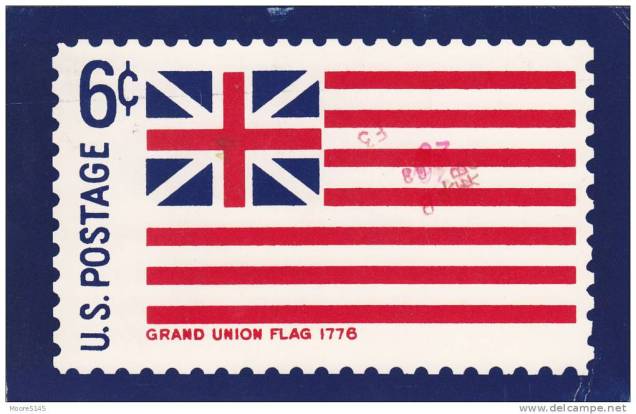
Grand Union Flag

Finally, the democratic case  for Brexit is explained to Americans

With many leading American voices so illogically hostile to Brexit, it is great that one of our own – Ben Kelly of The Sceptic Isle and the Leave Alliancehas seen his concise democratic argument for Brexit published in the New York Times.

Kelly patiently lays out the case for Brexit to an audience which has regrettably proved more likely to skip the democratic question entirely and wrongly view leaving the EU as an illogical, regressive act:

There are worrying levels of resentment in British society. People have little faith in their ability to bring about change through who they vote for and this breeds apathy and represents a grave threat to participatory democracy. And, no, not all of that can be blamed on the E.U., but we have now lost too many policy making powers and essential democratic safeguards. The E.U. maintain exclusive control of our trade policy, fishing and agricultural regulations, and is rapidly gaining power over British policies for foreign affairs, energy, environment, transport and telecommunications.

The E.U. is a supranational government with an executive body in the unelected European Commission, a legislature in the European Parliament and the Council of the E.U., and a powerful judiciary in the European Court of Justice. The “invisible hand” of its power operates through the husks of British political institutions: Our Ministers, MPs and councillors are constrained and must work within imposed parameters that are not conducive to new ideas and innovation. The E.U. hinders effective governance and disempowers and disconnects elected officials from the people who elected them.

When power is so far removed from the people, anger and disillusionment are inevitable. And democracies die when there is little connection between the electorate and those who rule them. Now, there is a pressing need to shift the balance of power back to the people and restore democratic accountability. It is the only hope for rebuilding faith in politics and quelling our current state of discontentment.

Restoring self-governance could inspire British society with a renewed sense of identity, vigor and pride. It means the construction of a new nation and a reversal of the degradation of our political culture. None of this can happen automatically and Brexit is not a silver bullet. But it unlocks the potential for change, and Britain should rise to the occasion.

It should not be necessary to explain these things to Americans, particularly those in the establishment most likely to want Britain to stay in the EU. These people, possessed of a solid understanding of their own nation’s history, should be our natural allies in wanting to free Britain from an increasingly powerful, antidemocratic and unrepresentative supranational government.

The rebellious American colonists because known for the phrase “no taxation without representation”. The EU has not yet – quite – reached the point of directly taxing its citizens, though the day may not be far off. But the phrase “no regulation without representation” applies very well to the Brexit cause. In an age of globalisation, when regulatory harmonisation is important to promote further economic growth, it is more important than ever that the people have an input into the process of making global regulations – particularly when that process has the power to wipe out entire industries at the stroke of a pen.

An independent nation state can wield its “right of reservation” as a last resort, exempting itself from new regulation which it deems particularly harmful to the national interest. A member state of the EU, like Britain, has no such power. The EU has exclusive competency on matters relating to trade, and we must swallow whatever the European Commission agrees on our behalf.

Those roles and institutions within the EU which are directly elected are nothing more than democratic fig leaves. The European Parliament is a toothless rubber-stamping institution which cannot propose new legislation or strike down old. And those who claim that the Council of Ministers or European Council allow national interests to be exerted forget that governing elites from the 28 member states often have far more in common with each other than they do with the ordinary people they represent, and will always face the tendency to do what is best for themselves and the European Union which they serve rather than what is best for the people who put them in office.

In every single way, the European Union as it currently stands should be offensive to the American national psyche. That it is widely popular among American opinion-formers reflects a failure on the part of Brexiteers to do a better job co-opting an important international ally. But more than that it represents a failure of the American elites, who having lost faith and confidence in their own country expect that we should do the same with ours.


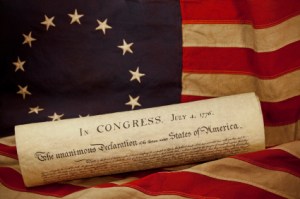
USA Declaration of Independence Lying on Grungy Betsy Ross Flag

European Union - United Kingdom - Britain - Flags

Top Image: delcampe.net

Agree with this article? Violently disagree? Scroll down to leave a comment.

Follow Semi-Partisan Politics on TwitterFacebook and Medium.

American Conservatives For Brexit, Part 3

Jim DeMint - Brexit - European Union - EU Referendum

A bold warning against supranationalism

This blog has rarely found common cause with former Senator for South Carolina Jim DeMint, but his OpEd in CapX (written with Nile Gardiner) is a welcome expression of solidarity with the Brexit cause.

From the OpEd:

The contrast could not have been starker – between a message of genuine optimism on the Brexit side, and the language of gloom and doom emanating from the Remain camp. It was frankly sad to witness an intensely negative campaign by those who suggest that Britain will not benefit from being a free and independent nation.

It is unthinkable that Americans would ever subject themselves to the kind of suffocating supranationalism that exists within the EU, with nation states surrendering large amounts of their sovereignty to unelected bureaucrats in a distant capital, with their courts overruled by foreign judges. It is all the more disturbing therefore that the leader of the free world, the president of the United States, has chosen to warn our British friends against leaving the EU.

This very much echoes the sentiments of this blog – the United States branches of government would not for one second tolerate the kind of subjugation to a supranational entity and curtailments on sovereignty that are required of EU member states – therefore, Barack Obama’s intervention in the EU referendum debate was very much a case of “do as I say, not as I do”.

Moving on to security, they point out:

Ignore the childish scaremongering coming from the White House. If the British people decide to leave the EU, their national security will be enhanced, not least because Britain can retake full control of its own borders. And the NATO alliance would actually be strengthened, rather than weakened, if Britain left the EU. The European Commission’s drive to create a European Union Army would draw vital resources away from NATO, and lead to duplication of key military assets in Europe. It is NATO, not the EU, that has secured peace in Europe in the post-World War Two era.

Before concluding:

A British exit from the EU would be good for Britain, Europe, and the United States. A United Kingdom that is not shackled to a declining EU that is mired in a culture of big government, soaring public debt and welfare dependency, would be a better partner for the US. A resurgent, self-confident Britain that looks outward to the world instead of inward, that is free to shape its own destiny, decide its own laws, craft its own foreign and security policies, and negotiate its own trade deals, can only strengthen the Anglo-American Special Relationship. A Great Britain that has absolute control of its own borders will also be a stronger partner in the fight against ISIS and Islamist terrorism.

Our former Heritage Patron, Margaret Thatcher, loved the United States and cherished the bonds that tie our two great nations together. She condemned the European Project, the idea of a European superstate, as “perhaps the greatest folly of the modern era.” The Iron Lady was absolutely right about the dangers of ever-closer union and rampant supranationalism in Europe, and how it threatened both Britain and the transatlantic alliance. We owe a huge debt of gratitude to Lady Thatcher’s leadership on the world stage. Her warnings against a federal Europe have come true. Today, Great Britain has an opportunity to be a free country once again. If the British people seize the day and break free of the EU, this should be a cause for celebration and rejoicing on both sides of the Atlantic.

Jim DeMint and Nile Gardiner are quite right to warn about “rampant supranationalism”. A point which has rarely been made in the EU referendum debate is the fact that no other countries in the world have rushed to replicate the EU model. One might point to the African Union and its Pan-African Parliament, but the two institutions are hardly comparable – the second objective of the African Union is “to defend the sovereignty, territorial integrity and independence of its Member States”, a goal to which the EU most certainly does not subscribe, in theory or in practice.

Look elsewhere in the developed world, to Asia, Australia and the Americas, and there is no desire whatsoever to form a political union based on the supranational form of government, in which a new pan-national entity takes on more and more of the traditional roles of the nation state. This should tell us something – and yet the EU persists with the steady, stealthy implementation of its mid 20th century blueprint even as globalisation and the emerging global regulatory system makes it increasingly irrelevant, a clumsy middleman rather than an effective defence.

And at a time when too many voices from the United States – the one country which should truly understand the desire for independent self government – have been fearfully urging Britain to stay in the EU, it is good to hear some bold conservative voices supporting Brexit.


European Union - United Kingdom - Britain - Flags

Top Image: Washington Post

Agree with this article? Violently disagree? Scroll down to leave a comment.

Follow Semi-Partisan Politics on TwitterFacebook and Medium.

The Baroness Warsi ‘Defection’ From Leave To Remain Is Virtue Signalling Politics At Its Worst

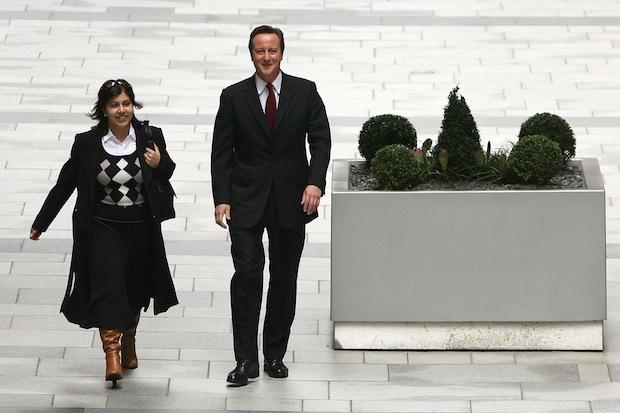
Conservative Party Annual Conference - Day One

Changing one’s mind about an existentially important constitutional and geopolitical question merely because of the tone of the campaign is either criminally idiotic or part of a deliberate campaign of deception

Top of today’s communications grid for the Remain campaign – jostling with their tawdry efforts to make political capital from the murder of Jo Cox MP – has been their attempt to capitalise on the supposed “defection” of former Conservative Party chairman Baroness Warsi from the Leave to the Remain campaign in the EU referendum,

The Telegraph reports:

A former minister has announced that she is abandoning Brexit and defecting to the Remain campaign in protest at its “hate and xenophobia”.

Baroness Warsi has accused Michael Gove, the Eurosceptic Justice Secretary, of “peddling complete lies” and said her final decision was prompted by a Nigel Farage-backed poster depicting Syrian refugees with the slogan “breaking point”.

[..] Baroness Warsi, a former chairman of the Conservative Party, told The Times: “That ‘breaking point’ poster really was, for me, the breaking point to say ‘I can’t go on supporting this’. Are we prepared to tell lies, to spread hate and xenophobia just to win this campaign? For me that’s a step too far.”

She made the decision to defect despite Mr Gove saying that the poster made him “shudder” and describing it as the “wrong thing to do”.

This fails the smell test for a number of reasons, not least of which is that the natural action to take if one feels repulsed by the behaviour of other people arguing for something that you believe in is to disassociate yourself from them, not to join the other side and immediately adopt a completely different set of beliefs and arguments than you were professing moments earlier.

This is precisely what members of The Leave Alliance, including this blog, have done. As proponents of a small-L liberal vision for Brexit in which we leave the EU to better engage with the entire world (and hopefully reboot our democracy in the process), we were naturally repulsed by many of the anti-immigration arguments, as well as the rank amateurism of the official Vote Leave campaign. But this did not turn us into enthusiastic Remainers. Rather, it encouraged us to carve out our own niche of bloggers, experts and advocates to promote our message within the wider Brexit movement.

If Baroness Warsi was really that upset about the tone of the mainstream Leave campaign, she or one of her researchers could have discovered the Leave Alliance in the time it takes to do a quick Google search. Warsi could have found a community of passionate, knowledgeable and highly principled Brexiteers who would have welcomed her into the fold. But Warsi did not do so, either because her mind genuinely cannot conceive of a world and a referendum campaign beyond that waged in the Westminster bubble, or because she had no intention of looking for other Brexiteers with values closer to her own.

Of course, we have seen this before, with the defections of Tory MP Sarah Wollaston and Labour MP Khalid Mahmood, also ostensibly because of their disgust at the tone of the Leave campaign. As backbenchers, one might be more charitable and chalk this up to idiocy rather than political machinations, but in the case of a former Conservative Party chairman and minister like Sayeeda Warsi it all reeks very strongly of a PR stunt.

And shame on the Times newspaper, incidentally, for allowing themselves to be used quite blatantly as the prime minister’s personal propaganda mouthpiece rather than applying the most basic level of journalistic scepticism to their reporting – in their eagerness to report on the supposed “turmoil” created by an utterly inconsequential figure in the broader Leave campaign they made themselves look politically calculating and stupid at the same time.

As Guido Fawkes points out:

The Times have watered down their mischievous first edition claiming Sayeeda Warsi has ‘defected’ from Leave to Remain. No one in Vote Leave thought she was a Brexit supporter or is aware of her doing any campaigning for them at all. She has only tweeted about Vote Leave once – ten days ago – to attack them. She did not appear on the website of pro-Leave group Muslims for Britain. In February Warsi told Eurosceptic campaigners she had not declared. When Dan Hannan invited her to join the Leave campaign, she declined. Neil Kinnock even once backed her for EU commissioner…

Hardly the very model of an arch eurosceptic and committed Leave campaigner.

Much more admirable is the late decision by Bristol West MP Charlotte Leslie to support the Leave campaign. Unlike Baroness Warsi, Sarah Wollaston and Khalid Mahmood, Leslie did not seek to make herself look good by feigning horror at the conduct of the opposing side, but rather made up her mind after much careful thought and deliberation.

This comes through strongly in Charlotte Leslie’s official statement:

My decision is with nothing to do with either the Leave or Remain Campaign, but as an individual who has done their best to assess the situation and come to a conclusion based on my assessment of the facts to which I have access, my experience in working with European colleagues from many EU Member States over the years, and my own personal understanding of human behaviour and risk.

As I have said repeatedly, I do not necessarily think there is a right or wrong answer to this question, and I have the utmost respect and appreciation for those who disagree with me. I celebrate and welcome disagreement and debate.

After all my deliberations, I found myself coming back to a principle on which I try to lead my life: That you have to face realities, however difficult, because to attempt to deny a reality leads to more pain in the long term.

Personally, I cannot see the European Project, whose express aim is to further homogenise the very different nations of Europe into an ever closer political union, as anything but a fantasy, and as such, dangerous.

Therefore, however much I appreciate and understand the risks and challenges of voting ‘leave’, I find myself completely unable mandate this madness.

What a contrast in tone and class with the fiery, bitter and sanctimonious MP defections from the Leave campaign, which have never been based on a genuine reappraisal of the merits of Brexit but always out of a desire by MPs to publicly disassociate themselves from supposedly unsavoury people.

And this is key. Beyond the tawdry, transparent and frankly amateurish attempt at choreographing a political defection stunt, there is a serious point here. As we have seen, Baroness Warsi is not the first politician to rend their garments, reach for the smelling salts and publicly switch sides in the EU referendum in protest at the “tone” of the campaign.

Looked at more broadly, this is symptomatic of the same trend towards public virtue signalling that we see on social media and our university campuses now entering the world of politics. For many contemporary politicians, ideology and policy positions are not things to be adopted based on a serious consideration of their value and applicability to the modern world, but rather items of clothing to be worn or discarded like this season’s latest fashion.

Almost the entire official Remain campaign is based not on an enthusiastic defence of the European Union as it currently is or is likely to become, but rather the flimsy assertion that supporting the EU is somehow the progressive and virtuous thing to do. Hence you will almost never find a Shoreditch hipster or a Brighton artist proudly campaigning for Leave – it would go against the very grain of their “social uniform”. Hence Britain Stronger in Europe’s latest social media advertisement which asserts without a shred of evidence that voting Remain is the “kind, open, inclusive, tolerant” thing to do.

And in this age when politicians sometimes build up substantial social media followings and careers live and die by successful media appearances, is it really any wonder that the glibness of our political discourse now attracts equally glib politicians – MPs who will change their opinion on an issue as fundamental as Britain’s continued membership of the EU at the drop of the hat, depending on which hashtags are trending positively on Twitter?

In the case of Baroness Warsi, we can safely chalk up this non-defection to a good old-fashioned political stunt, a piece of theatre shamefully performed by the Remain campaign to help add to the illusion of momentum and inevitability going into the closing stretches of the EU referendum campaign.

But on a rather sombre day when we seem duty-bound, even pressured, to say nice things about politicians, it is worth considering the calibre of individuals we are actually attracting to Westminster when some MPs clearly possess so few core convictions (and such flair for self-promotion) that they will execute a 180 degree U-turn on the greatest political decision of our generation, based not on the issues but the execution of the campaigns.

At this time we need seriousness and depth in our politics – in parliament and outside -and not this growing superficiality motivated by the gnawing desire to loudly signal our virtue at all times.

 

European Union - United Kingdom - Britain - Flags

Top Image: Spectator

Agree with this article? Violently disagree? Scroll down to leave a comment.

Follow Semi-Partisan Politics on TwitterFacebook and Medium.

Conservative MPs Must Feel The Political Consequences Of Supporting Remain

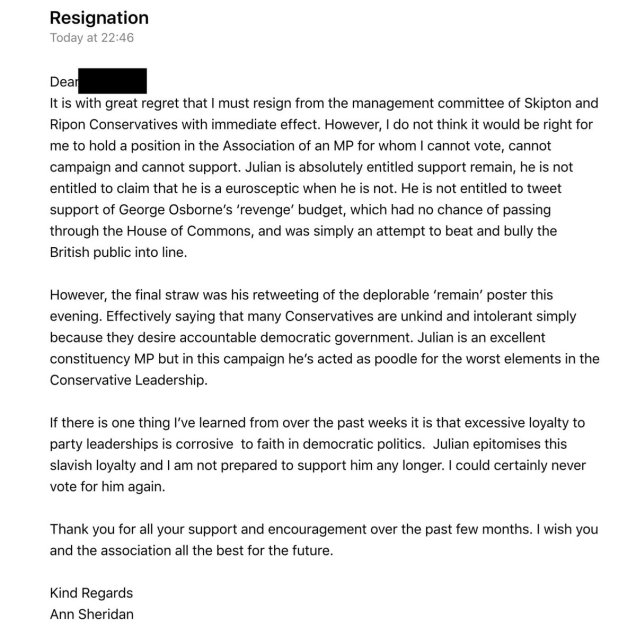
Ann Sheridan Resignation Letter - Julian Smith

Conservative MPs who contravened the will of party members in order to support the prime minister’s tawdry, deceitful Remain campaign should rightly be afraid for their positions

Hopefully this will be the first of many  dominoes to fall – Ann Sheridan, local activist and committee member for Skipton and Ripon Conservatives, is no longer willing to support her turncoat Tory MP, Julian Smith, who ditched his avowed euroscepticism to slavishly support the prime minister’s Remain campaign.

Sheridan writes:

I do not think it would be right for me to hold a position in the Association of an MP for whom I cannot vote, cannot campaign and cannot support. Julian is absolutely entitled [to] support Remain, he is not entitled to claim that he is a eurosceptic when he is not. He is not entitled to tweet support of George Osborne’s ‘revenge’ budget, which had no chance of passing through the House of Commons, and was simply an attempt to beat and bully the British public into line.

However, the final straw was his retweeting of the deplorable ‘remain’ poster this evening. Effectively saying that many Conservatives are unkind and intolerant simply because they desire accountable democratic government. Julian is an excellent constituency MP but in this campaign he’s acted as a poodle for the worst elements in the Conservative Leadership.

If there is one thing I’ve learned from over the past weeks it is that excessive loyalty to party leaderships is corrosive to faith in democratic politics. Julian epitomises this slavish loyalty and I am not prepared to support him any longer. I could certainly never vote for him again.

Ouch.

If this sentiment is widespread among Conservative constituency activists – and personally speaking, I sincerely hope that it it – then the inferno poised to consume the Conservative Party will be even greater than many had previously anticipated. Good. MPs who either ran for selection or cultivated their subsequent reputations as staunch eurosceptics should be made to suffer the consequences for betraying their constituents on such a fundamental matter as Britain’s future governance and democracy. And while it does not presently seem likely, if a wave of de-selections were to take place (as advocated by Momentum within the Labour Party) then this blog would loudly cheer on the process.

Back in 2010, I supported Rob Halfon‘s campaign to unseat the Labour minister Bill Rammell in my hometown of Harlow, Essex. I now sincerely wish that I had not bothered. Halfon’s timid, tremulous and utterly pessimistic argument for staying in the European Union (“I am voting to stay in the European Union because I am frightened by an uncertain world”) is utterly repulsive, the worst of all reasons for Britain to remain in the EU. It betrays a staggering lack of confidence in the country and people which Halfon represents to the degree that his undeniably good work as a constituency MP is utterly negated.

One of the reasons that there is such a “toxic” political atmosphere in the country at the moment directed at our poor old elites is that the main political parties present a stubborn consensus of opinion which is far from settled in the country. Most MPs in nearly all parties are pro-EU, and all parties have been complicit in handing ever more powers and competencies from Westminster to Brussels, hollowing out our own government.

It is bad enough that the Labour Party supports this process of democratic decay – and in fact there are many reasons why principled left-wingers should support Brexit. But it is even worse that so many MPs from the so-called Conservative Party are also cheerleaders for a supranational government of Europe which actively hollows out and undermines the very institutions, traditions and democracy which conservatives are supposed to value.

The decision by so many Conservative MPs to support the Remain campaign has rightly enraged many small-c conservatives, this blog included. It is a show-stopper, a deal-breaker, something which conservatives of principle cannot forgive, forget or move past on 24 June. For whichever way the referendum goes, the fact will remain that over half the Conservative parliamentary caucus – including the prime minister and his despicable chancellor – may as well belong to the Labour Party, for all the good they are doing in power.

Something needs to change – and realistically this can only take the form of real conservatives abandoning the Tory Party en masse, or forcing these ideology-free careerists from their positions and replacing them with people of principle. And since starting a new political party almost never works, most of us choose the latter option. Conservative MPs who betrayed their principles and their constituents to support keeping Britain in the EU should therefore be rightly afraid for their positions. Because hopefully Ann Sheridan’s public denunciation of her own MP will only be the beginning of a grassroots backlash to mirror the turmoil that will soon engulf Westminster.

And those Conservative MPs who served as loyal cheerleaders for the EU from Day 1, or who ditched their previous euroscepticism either through failure of courage or craven desire to curry favour with David Cameron and George Osborne, might then be made to feel the political consequences of their actions by their local constituency associations.

In fact, this blog’s aspiration for the future political and ministerial careers of those Tory MPs like Julian Smith and Rob Halfon is perfectly captured in Job 38:11:

“Hitherto thou shalt come, and shalt go no further.”


European Union - United Kingdom - Britain - Flags

Agree with this article? Violently disagree? Scroll down to leave a comment.

Follow Semi-Partisan Politics on TwitterFacebook and Medium.