There Is Nothing Noble Or Virtuous About Defending The EU

European Union - USA - UK British flags

The EU’s defenders in the middle class and political/cultural elite love to believe that they are supporting a grand and noble project, but close their eyes to the economic and democratic damage wrought by this failing supranational union

An opinion piece in the New York Times provides a welcome antidote to that newspaper’s fatuous, instinctive pro-Europeanism.

Tim Parks writes:

Had I had the right to vote, which I have lost after 30 years living in Italy, I would have voted to remain in the European Union. But I do not think it a scandal that others think differently. If it was a scandal that people voted to leave, then surely it was a scandal to have held a referendum at all. And if it is a scandal to hold a referendum on an issue central to the destiny of a nation and about which its people feel deeply, then I have misunderstood the meaning of freedom and democracy in the West.

So why the extraordinary incredulity and indignation? Why the sense of betrayal? Why do so many people find this result unacceptable? It seems that over the last 30 or 40 years the idea has taken hold that there can be no peaceful or productive future for Europe without the European Union. As a result, anyone who voted to be outside it must be discredited as pernicious or ignorant, perpetrator or victim of some sinister populism. In the United States, this unhelpful reaction has taken the form of likening the leaders of the Leave campaign to Donald J. Trump. But Britain is not America and this was not a presidential election. Immigration played a role, but no one in the Leave campaign was suggesting Muslims be banned from Britain. On the contrary, some Muslims supported the Brexit vote. To see the debates of other countries in terms of one’s own internal politics is always a failure of imagination.

All this shock, horror and kneejerk denigration might be understandable if the European Union were notching up important successes and resolving its member states’ many problems, or if, at the very least, it had a figurehead with whom European citizens could identify, someone of whom one might say, “However badly things are going, I have faith in so and so, I believe he or she really does have the interests of my nation at heart, really is concerned about unemployment in my town,” be it Newcastle or Naples.

Obviously the EU has no such figureheads. Its vaunted “founding fathers” are unknown and unloved by all but the most starry-eyed euro federalists, its parliament a fraud, its stolen anthem a joke and its leaders held in widespread contempt. It cannot appeal to any sense of collective destiny because the loyalty of the vast majority of EU citizens lies first and foremost with their own nation state.

And Parks is quite right to note that the EU is failing across most of the metrics by which one might reasonably judge success. Economic growth, employment and social cohesion have all been thrown under the bus in the name of European political union, while the countries most let down by the EU project remain within the union only because they suffer from a national form of Stockholm Syndrome.

Parks points out:

But the Union’s greatest failing is that after decades of regulations of every possible kind it has not brought the nations of the Continent closer together. Day by day Italians are told whether their government’s economic policy has been accepted or rejected by Berlin, but about the Germans they know little or nothing. In each country, we follow our own national news media and are locked into the agendas of our own political systems. We are separate nations but not sovereign nations. We obey the dictates of Brussels and read Jonathan Franzen and “Harry Potter.” We watch American films and follow the American elections far more closely than those of any other country in the European Union. Is this a community?

But best of all is when Parks turns his gaze on the middle class and political elites who remain the EU’s strongest defenders:

The middle classes, the cultured elite, love the idea that they are taking part in a historic project that will bring peace and prosperity to the Continent, put an end to war, take steps to defend the environment, protect Europeans from superpower ambitions and multinational depredations, etc., etc. I love this idea, too. Like so many others, I take comfort in this noble enterprise.

But when the project does not bring prosperity, when it does not do enough to protect the environment, when its protectionist trading policies systematically damage the economies of the third world, I, like everyone else, don’t want to think about it; we prefer to close our eyes. This is not the narrative we like to believe we live in.

[..] With Brexit this decades-old spell is set to break. And how does the liberal elite on both sides of the Atlantic react to this deafening alarm? They scream foul and blame the dumb British working classes for spoiling the party. It might be wiser to examine our own attachment to a narrative that is going nowhere.

But the defiant liberal elite will not let go of their false narrative, preferring to nurture a sense of grievance and display to the world a shameful contempt for democracy.

Just this weekend, grieving metropolitan Remainers held a “Picnic against Brexit” in Green Park, in what was billed as an opportunity for people to “heal” and “comfort” one another. Disappointed Remainers are literally treating their defeat in the EU referendum as a kind of emotional trauma, an unendurable shock to the system for a group of people who have had their way since 1973, came to rely on the EU’s comfort blanket and who simply cannot conceive of life as a citizen of an independent country.

An emotional reaction of this strength is only possible when one genuinely believes that one is fighting on the side of righteousness and possesses a monopoly on the virtues of wisdom, compassion and truth. It is much like the arrogance of tearful Labour supporters who simply could not understand why the country rejected Ed Miliband and re-elected the Evil Tories in the 2015 general election. The strong overlap between these two groups of people is no coincidence.

For people who make up a supposed intellectual and moral elite, the Remainers-in-denial are extraordinarily unperceptive. Even now, they can not accept that the 52% of their fellow citizens – including many working class voters – who voted to leave the EU might have a point, that their beloved European Union might not be the wonderful and benevolent force for good that they insist it is. On the contrary, they stubbornly continue to insist that those who voted for Brexit did so  either out of ignorance or malice, and work to prevent Brexit from happening.

This will not end well. Sneering contempt for the political opinions and values of ordinary people has not done the elites any good this electoral cycle, in Britain or America. If the elites are at all interested in bridging the divide and repairing their relationship with the rest of the country then they must start displaying the kind of introspection and empathy demonstrated by Tim Parks in his NYT article – and far fewer disdainful middle class picnics against democracy.


Brexit - EU - European Union Flag - Missing Star - Britain - UK

Top Image: CNN

Agree with this article? Violently disagree? Scroll down to leave a comment.

Follow Semi-Partisan Politics on TwitterFacebook and Medium.

Brexit Fallout: Shaming Leave Voters Is Despicable, And Will Backfire

Shame

Remainers were not able to win the EU referendum, but they are determined to make wavering Brexit voters regret and feel ashamed about their vote

I’m now starting to get quite angry at the effect the bullying, hectoring and self-entitled sore loser contingent within the Remain camp are having on soft Leavers.

Many people were genuinely conflicted in their decision, and have already displayed an enormous amount of personal courage in overcoming the incessant Project Fear messages crafted by Will Straw, David Cameron and their Britain Stronger in Europe henchmen. To see them now cowed and bullied into feeling bad about their decision by furious Remainiacs intent on associating them with racists and xenophobes is offensive in the extreme.

Newsweek magazine details some of the abuse received by just one left-wing Brexit supporter:

Here is one of the hateful comments that was posted on my Facebook profile by a male friend in Berlin: “It’s plain & simple: You voted with the fascists and now you use their lingo (that the mainstream media covered it wrong) to justify your naivety. If I hadn’t heard that sentiment a gazillion times from morons in Germany or the UK, it would be pretty funny, but now it just makes me sick and I have to say it somehow fits ya…[sic]” Not content with that, he then followed up with an even more insulting private message to me, at which point he was defriended.

This next one came from a senior male ex-colleague: “You voted leave??? A racist hate campaign based on lies which were admitted not even 24 hours after the vote? I am shocked. But at least Trump sent his congrats. Unbelievable.”

Another male friend, this time from London, wrote: “When you’ve got commenters on the Daily Mail site saying they feel misled and would change their vote if they could, then you know you’ve got problems.” I told him I didn’t feel misled. He didn’t like that very much. Cue more vitriolic and deeply patronizing comments where I was told to “look up this” and “look up that” as if my IQ had dropped.

Newsflash! I didn’t go to bed left-wing and wake up right-wing. As all my real friends know, I believe in integration, tolerance, multiculturalism, the NHS and equal rights. So just to say it once more for those at the back not really listening—that’s definitely not fascist. Perhaps some of my so-called friends would like to talk to people up and down the country, not just in London, and learn how disenfranchised and disappointed many in the U.K. are with the EU, the Conservatives and austerity politics in general.

Latest to succumb to the browbeating is divorce lawyer Ayesha Vardag, who pitifully recants her Leave vote in the Telegraph:

I think there has been a lack of informed debate on both sides. I was not uninformed. But perhaps, in this instance, I was too informed, and I should have voted with my natural, liberal, European-spirited tribe rather than according to my concerns about the federal project, which now feel to me esoteric and unimportant.

With all this, I sound as if I’m making excuses. But I am only trying to explain, I suppose, why I voted as I did and why, too late, I have changed my mind.

I hate much more than anything about the EU the divisions in our country, the racism and xenophobia that have been given voice and legitimacy, the indignity of the shameful lack of leadership in our country, the destruction of our national esteem in our own and others’ eyes, the horrible, horrible mess that engulfs us now.

I feel, bizarrely, personally responsible for everything that goes wrong now, because, with my vote, with my expressed opinions, I contributed to it, and I shall be sorry every day. And those who know me well know I don’t much like to say sorry.

I’m sorry I voted out, given how it has transpired. I am so sorry so many people I care about are upset about the referendum result. I feel guilty that I voted for something that has made them so afraid and unhappy. I also feel massively panicky about the market instability, the social division and the failure of sensible direction at the top.

Guilt trick – successfully accomplished.

This blog is no great fan of Ayesha Vardag, but one should still deplore the fact that a fellow citizen and voter can have such opprobrium heaped upon them – including accusations that they are effectively in collusion with racists and reactionaries – simply for voting based on their perfectly valid and mainstream criticisms of the European Union.

And it is not just angry trolls on social media whipping up this anti-Brexiteer hatred. It is politicians and commentators and supposedly respectable people who have decided to characterise the EU referendum as a battle of good versus evil in which any dissenters from the pro-EU status quo automatically fall into the evil category.

This can only backfire. Loudly and shrilly accusing half of the country of being racist simpletons didn’t work when the establishment was fighting to keep Britain in the EU; it will certainly not work as disappointed Remainers seek to find their footing and regain their influence over political events. Indeed, we already see the opposite happening, with even some Remain voters recoiling from the arrogance and intolerance of their own side.

The Spectator carries the story of one Remain voter who now openly wishes that he had voted Leave:

As the week progressed, and demonstrators with radical piercings marched on Parliament in solidarity with EasyJet and George Osborne, I found my mood change. As one Guardian commentator after another dismissed the opinion of the poor, the old, the white, the uneducated, I began to wonder if the Leavers hadn’t been right all along. Perhaps the Remain side were out of touch with what much of Britain thought.

[..] As my mood changed, yet more taboo thoughts rose to the surface. If the EU has transformed working conditions for the better, why are there so many zero-hours ‘contracts’? Why do ‘left wingers’ trust businesses so reliant on cheap labour? If it’s so important for crime prevention, how do we explain Saliman Barci and Arnis Zalkalns? We are ‘informed’ that we need young blood because there’s a pensions crisis, but won’t migrants also grow old? We are told by Jeremy Corbyn that immigration has no impact on housing, and it’s all because the Tories are too mean to build 300,000 houses a year. What if he’s wrong and the EU did in fact have a negative impact on housing stock?

Then came the petitions. Remainers calling for the referendum to be ignored, or worse, re-run, revealed themselves to be the enemies of democracy. How many of them would tolerate similar calls from the Leave camp if the vote was reversed? And what happens if a re-run took place and a slender majority did vote Remain. Did they really think the Leavers would take that lying down?

By now, I also wanted to repent. I’d voted Remain, but had not realised that my vote would have counted for more if I had voted Leave. I regretted my vote because if the margin had been wider, perhaps those commentators who make a living decrying our country, our electorate, our past, would pause to reflect on what voting meant to ordinary people rarely allowed to make national decisions. For an overwhelming majority of Leave voters it wasn’t about sending messages to Brussels, or wiping the smugness off Cameron’s face; it was about deciding which choice would be best for them, their children, and for the country they love.

In case it was not already apparent (with the ascendancy of Jeremy Corbyn, the SNP and Donald Trump) these are not normal political times in the West. The establishment was already discredited and seriously off balance even before the stunning EU referendum result further highlighted their disconnect from much of the population. And now, many people within and around the establishment seem determined to compound this disconnect by either explaining away the people’s decision to vote for Brexit or angrily chiding them for it.

But for every tearful recanting of a Leave vote under duress on social media we are likely to see two or more hearts hardened against pleas from establishment figures for the people to defer to their arrogant self-interest masquerading as dispassionate expertise. People just aren’t buying it any more.

Ayesha Vardag, for her faults, has absolutely nothing to apologise for when it comes to her vote in favour of democratic self government and against a failing, dysfunctional and terminally un-reformable European Union. And though wall-to-wall catastrophisation of Brexit in the media and screeching denunciations of Brexiteers on social media have caused her to recant her vote, she will be vindicated in her initial decision in the fullness of time.

And this sneering, arrogant and deeply ignorant anti-Brexiteer inquisition being waged by disappointed Remain supporters will not succeed.


Shame - I will not do it again

Brexit - EU - European Union Flag - Missing Star - Britain - UK

Agree with this article? Violently disagree? Scroll down to leave a comment.

Follow Semi-Partisan Politics on TwitterFacebook and Medium.

Every American Should Support Brexit

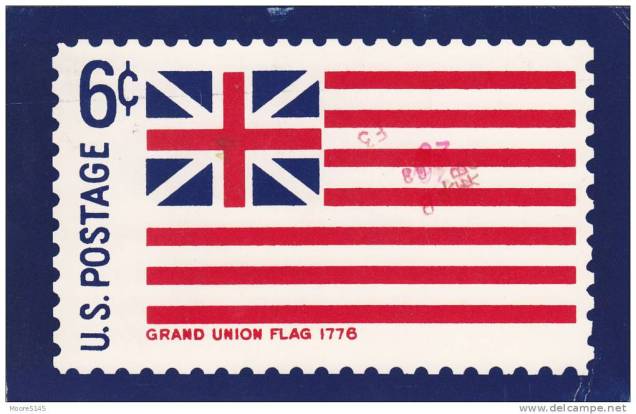
Grand Union Flag

Finally, the democratic case  for Brexit is explained to Americans

With many leading American voices so illogically hostile to Brexit, it is great that one of our own – Ben Kelly of The Sceptic Isle and the Leave Alliancehas seen his concise democratic argument for Brexit published in the New York Times.

Kelly patiently lays out the case for Brexit to an audience which has regrettably proved more likely to skip the democratic question entirely and wrongly view leaving the EU as an illogical, regressive act:

There are worrying levels of resentment in British society. People have little faith in their ability to bring about change through who they vote for and this breeds apathy and represents a grave threat to participatory democracy. And, no, not all of that can be blamed on the E.U., but we have now lost too many policy making powers and essential democratic safeguards. The E.U. maintain exclusive control of our trade policy, fishing and agricultural regulations, and is rapidly gaining power over British policies for foreign affairs, energy, environment, transport and telecommunications.

The E.U. is a supranational government with an executive body in the unelected European Commission, a legislature in the European Parliament and the Council of the E.U., and a powerful judiciary in the European Court of Justice. The “invisible hand” of its power operates through the husks of British political institutions: Our Ministers, MPs and councillors are constrained and must work within imposed parameters that are not conducive to new ideas and innovation. The E.U. hinders effective governance and disempowers and disconnects elected officials from the people who elected them.

When power is so far removed from the people, anger and disillusionment are inevitable. And democracies die when there is little connection between the electorate and those who rule them. Now, there is a pressing need to shift the balance of power back to the people and restore democratic accountability. It is the only hope for rebuilding faith in politics and quelling our current state of discontentment.

Restoring self-governance could inspire British society with a renewed sense of identity, vigor and pride. It means the construction of a new nation and a reversal of the degradation of our political culture. None of this can happen automatically and Brexit is not a silver bullet. But it unlocks the potential for change, and Britain should rise to the occasion.

It should not be necessary to explain these things to Americans, particularly those in the establishment most likely to want Britain to stay in the EU. These people, possessed of a solid understanding of their own nation’s history, should be our natural allies in wanting to free Britain from an increasingly powerful, antidemocratic and unrepresentative supranational government.

The rebellious American colonists because known for the phrase “no taxation without representation”. The EU has not yet – quite – reached the point of directly taxing its citizens, though the day may not be far off. But the phrase “no regulation without representation” applies very well to the Brexit cause. In an age of globalisation, when regulatory harmonisation is important to promote further economic growth, it is more important than ever that the people have an input into the process of making global regulations – particularly when that process has the power to wipe out entire industries at the stroke of a pen.

An independent nation state can wield its “right of reservation” as a last resort, exempting itself from new regulation which it deems particularly harmful to the national interest. A member state of the EU, like Britain, has no such power. The EU has exclusive competency on matters relating to trade, and we must swallow whatever the European Commission agrees on our behalf.

Those roles and institutions within the EU which are directly elected are nothing more than democratic fig leaves. The European Parliament is a toothless rubber-stamping institution which cannot propose new legislation or strike down old. And those who claim that the Council of Ministers or European Council allow national interests to be exerted forget that governing elites from the 28 member states often have far more in common with each other than they do with the ordinary people they represent, and will always face the tendency to do what is best for themselves and the European Union which they serve rather than what is best for the people who put them in office.

In every single way, the European Union as it currently stands should be offensive to the American national psyche. That it is widely popular among American opinion-formers reflects a failure on the part of Brexiteers to do a better job co-opting an important international ally. But more than that it represents a failure of the American elites, who having lost faith and confidence in their own country expect that we should do the same with ours.


USA Declaration of Independence Lying on Grungy Betsy Ross Flag

European Union - United Kingdom - Britain - Flags

Top Image: delcampe.net

Agree with this article? Violently disagree? Scroll down to leave a comment.

Follow Semi-Partisan Politics on TwitterFacebook and Medium.

The Petition To Cancel The EU Referendum Showcases The Remain Campaign’s Dim View Of Democracy

Cancel EU Referendum - Brexit - Remain - Parliament Petition

The divergence between the strong preference of most MPs and the sentiment of the British people is the main reason we are having this EU referendum, not a reason to cancel it

Last week, before the awful murder of Jo Cox MP changed the character and atmosphere of the campaign, it was widely agreed that the Remain campaign were on the back foot, behind in some of the polls and certainly lacking in anything like momentum.

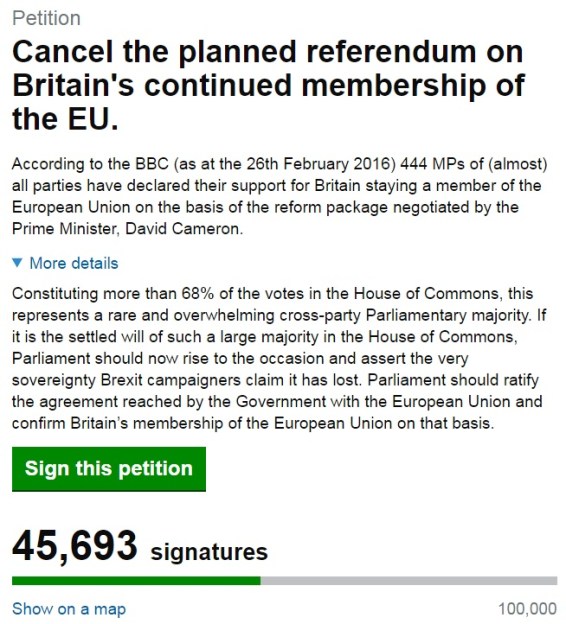
And so perhaps it is unsurprising that late last week, a petition started by Remainers began to circulate on social media, calling for the EU referendum to be scrapped altogether.

The text reads:

According to the BBC (as at the 26th February 2016) 444 MPs of (almost) all parties have declared their support for Britain staying a member of the European Union on the basis of the reform package negotiated by the Prime Minister, David Cameron.

Constituting more than 68% of the votes in the House of Commons, this represents a rare and overwhelming cross-party Parliamentary majority. If it is the settled will of such a large majority in the House of Commons, Parliament should now rise to the occasion and assert the very sovereignty Brexit campaigners claim it has lost. Parliament should ratify the agreement reached by the Government with the European Union and confirm Britain’s membership of the European Union on that basis.

What a cynical, opportunistic and fatuous thing to do – to seek to cancel an imminent referendum just because their own side happens to be in danger of losing.

The “444 MPs” line does not hold water, either. The whole purpose of this referendum is to settle what is in effect a dispute between past and present parliaments on the one hand, and the British people on the other. It is parliament which has knowingly and willingly signed away endless new competencies and powers to the EU, hollowing out the British state at the expense of the growing supranational European government in Brussels – a parliament often composed of many MPs who described themselves as “eurosceptic” while being complicit in the process.

This includes many Conservative MPs who were only ever selected by their parties or constituency associations as candidates because they professed strongly anti-EU sentiments to the Tory party base. Now, it has sadly been the case that many of these MPs were revealed to have lied during their selection processes, telling eurosceptic party members what they wanted to hear while themselves being ambivalent or even pro-European, as evidenced by their decision to support the Remain campaign. But it is clearly disingenuous to claim (as the petitioners do) that the majority of MPs favouring Remain represents the settled will of the people – the tightening polls, some showing a lead for Leave, prove this to be otherwise

It should also be pointed out that many of the “444 MPs” supporting Remain would not presently be sitting in Parliament had David Cameron not taken the sting out of UKIP’s tail by promising the referendum in the first place. Prior to that pledge, two former Tory MPs (Douglas Carswell and Mark Reckless) had already defected to UKIP in a blaze of publicity, and more threatened to follow. If Cameron had not neutered part of UKIP’s appeal by promising the referendum, there could have been up to a dozen more defections prior to the general election, and then tens more UKIP MPs elected in May last year. If anything, promising the referendum helped to keep a pro-EU majority in the House of Commons. That same majority can not then also be used as grounds to take the referendum away.

But the root of the matter is the “parliamentary sovereignty” referenced in the petition text. I cannot speak for all Brexiteers, but I know I speak for many other liberal leavers when I say that I am not fighting with every fibre of my being to secure a Brexit vote because I want to re-establish the sovereignty of parliament and re-empower the very people who so blithely gave it away to Brussels in the first place. On the contrary, I want the British people to finally be sovereign in this country. And this is the wider debate which has been entirely missing throughout this sorry referendum campaign, but which we need to have.

What, after all, would be the point of striving to claw back sovereignty and decision-making power from Brussels only to give it back to the same people operating under the same laws who gave it away? This is why Brexit must just be part of a broader process of democratic renewal, making the people sovereign and beginning with the assumption – much as in the United States of America – that “Parliament shall make no law…” except in those areas where we the people explicitly grant permission.

This then opens up a whole load of other questions which gleeful Remainers would doubtless seize upon as more evidence that Brexit would cause problems and be “difficult”. Well, yes, it would. Unsurprisingly, great deeds require a commensurate effort in their accomplishment, and throw up lots of problems which need to be patiently solved along the way. Man did not walk on the moon the day after John F Kennedy idly thought out loud that it might be a good idea. The Apollo Programme took place in many stages after Kennedy set the initial goal, each one solving a particular problem or proving a new competency until all of the pieces were in place for Apollo 11 to finally touch down on the surface of the moon.

It is reasonable to expect that the process of extricating our country from forty years of gradual, incessant political integration by stealth should be a task of comparable difficulty. But it is not scientific and technical expertise which we must rebuild, but political, constitutional, democratic, trade and regulatory knowledge, much of which we have lazily outsourced to the EU.

And unfortunately the prize cannot be measured in pounds or euros, or any economic model pointed to by David Cameron’s hallowed “experts”. The ability of people to exercise meaningful control over their leaders, communities and futures cannot be boiled down to numbers in an Excel spreadsheet or one of the smug infographics shared by the Remain campaign. But this does not mean that democracy lacks value – rather, that it is priceless.

Those who would have us vote Remain on June 23rd look at British independence and see it as a series of problems and risks, all of which our country and our people are too small, too weak and too incompetent to overcome. They genuinely cannot understand why a country as “small” and supposedly inconsequential as Britain would want to leave a supranational political union in which we trade our democracy for the illusion of influence which comes from being a member of a big club.

Those advocating Brexit, on the other hand, see opportunity and feel a sense of optimism grounded in a healthy sense of what this country and its people are capable of accomplishing. They generally accept that there may be some short term political instability, but that there is just as much instability in our future if we remain shackled to an EU beset with so many intractable problems it is simply unwilling and unable to address. And they also value democracy sufficiently highly that endless, apocalyptic scaremongering with doomsday economic scenarios simply doesn’t resonate. The prime minister appears genuinely frustrated that we Brexiteers are not more responsive to his Project Fear, because he fails to appreciate that the core Remain argument does nothing to neutralise the reasons why many of us want out of the EU.

And sadly, this difference in mindset is not one which we can reconcile (or persuade any hardcore Remainers to the Brexit side) in the little time left of the campaign. But while we Brexiteers are happy to fight on to the end, making the case as best we can, some on the Remain side want to circumvent the process and take the choice away. Hence this ridiculous petition, arguing that because a majority of the very people you would expect to love the EU think that we should stay in it, there is no need to further consult the British people.

I would state again that the very existence of this petition shows a contempt for the will of the British people – but when the entire Remain campaign focuses myopically on short term economic indicators rather than the long term health of our democracy, it hardly needs saying.


European Union - United Kingdom - Britain - Flags

Agree with this article? Violently disagree? Scroll down to leave a comment.

Follow Semi-Partisan Politics on TwitterFacebook and Medium.

Labour Blames Its Own Supporters For Failing To Enthusiastically Back Remain

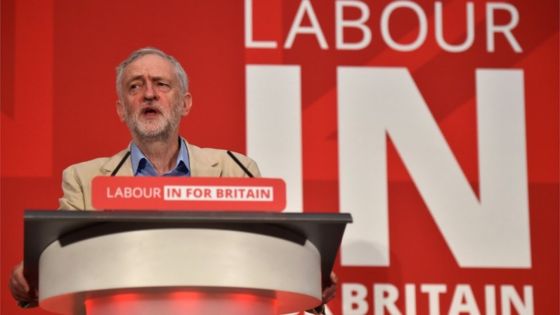
Jeremy Corbyn - Labour In for Britain

Don’t blame Jeremy Corbyn for the ambivalence verging on hostility toward the European Union seen in Labour Party strongholds

Hilariously, the Labour Party is finally waking up to the fact that their leader’s (at best) ambivalence about the Remain campaign might be harming their slavish desire to remain in the European Union at all costs.

This vignette from the BBC provides a telling insight into the hive mind of pro-EU Establishment Labour (my emphasis in bold):

Comparatively unnoticed, cast into shadow by the pyrotechnic light-show in the Tory party, the Labour Party has come to realise it is losing the argument, and may be in real danger of losing the referendum for the Remain campaign.

This morning, Labour’s shadow cabinet agreed the party needed to “up its game” and to do so urgently. Alarmed backbench MPs have been excusing themselves from parliamentary duties to kick-start what they describe as the near-torpid campaigning in their constituencies.

MP after MP has returned to Westminster with depressing tales from their home turf; of door-knocking in staunchly Labour areas where apathy towards the EU question has given way to rank hostility. One former minister contacted dozens of local Labour councillors urging them to mobilise behind the Remain campaign. To the MP’s fury, the appeal elicited one single reply.

To be clear: the Labour former minister’s response, upon realising that none of their local councillors were interested in helping the Remain campaign, was one of fury. Not surprise, or shame, or introspection – wondering why so many people in the Labour Party have no interest in spending the next couple of weeks singing hymns of praise to the European Union. No. Just fury.

This is the arrogance and entitlement of the Labour Party establishment. To be sure, many Corbynites – at least the virtue signalling middle class clerisy brigade – are little better. But it would take a considerable effort to surpass this former Labour minister quoted by the BBC, who believes that he/she and the Remain campaign deserve and are somehow entitled to the support of grass roots Labour supporters.

This is the arrogance of a class of Labour politicians who have forgotten that it is still their job to make the case, and to persuade people. And thus far, the Remain campaign has been an endless parade of miserabilist, declinist, pessimistic drivel, simultaneously talking down the prospects of the country of which many Labour supporters are justifiably proud while simultaneously painting a childishly naive picture of the European Union (puppies and unicorns) which almost nobody believes to be true.

In this context, the anonymous Labour former minister should be grateful to have received even one positive response from a Labour councillor – they were lucky to avoid a torrent of justified verbal abuse.

Once again, the Labour Party has absolutely nothing to say to those working class communities utterly unmoved by the woolly Fabianism of Ed Miliband or the edgy, student-friendly activism of Jeremy Corbyn. With no real debate over whether or not it was the right move, the party swung unthinkingly behind the Remain campaign because doing so is the instinctive response of many Labour elected representatives and donors. Too few Labour MPs – Kate Hoey, Graham Stringer, Frank Field, Gisela Stuart, Kelvin Hopkins, Khalid Mahmood and Roger Godsiff for a total of seven – have been willing to challenge the groupthink and articulate a different position.

And even now, with polls tightening and the discovery of a vast sea of apathy toward the EU throughout the Labour heartland, all that the party bigwigs can do is rage against their own supporters for failing to unquestioningly support the party’s Remain position, handed down to them from on high with no consultation and no fresh analysis since Labour became staunchly pro-EU in the late 1980s.

So if Labour bigwigs are casting around for someone or something to blame for their party’s weak contribution to the Remain campaign, they shouldn’t blame Jeremy Corbyn and they certainly shouldn’t blame their own supporters. The fault lies with their own arrogance and often disconnection from their communities.


European Union - United Kingdom - Britain - Flags

Top Image: BBC

Agree with this article? Violently disagree? Scroll down to leave a comment.

Follow Semi-Partisan Politics on TwitterFacebook and Medium.