Where Is The Passion For Or Against Brexit From Our Elected Representatives?

When it comes to voting and speaking their conscience on Brexit, British MPs should do as former American congressman Anthony Weiner said…but perhaps not as he did

When the British parliament gets rowdy, it tends to be the braying backbench donkeys at Prime Minister’s Questions making the noise, usually in response to some tenuously witty put-down from David Cameron.

What you see far less in parliament are individual politicians getting angry or visibly passionate about particular issues (Mhairi Black’s vastly overrated maiden speech notwithstanding). Perhaps this is partly because of our British reserve – though this is a comity which notably does not seem to extend to social media.

The parliamentary debate following the announcement of David Cameron’s pitiful renegotiation deal with the European Union was a case in point, and the following drip-drip of MPs and ministers once considered to be dependable eurosceptics dutifully lining up behind the prime minister was especially depressing.

Even when solid arguments were made for or against Britain’s continued EU membership, much of the debate was conducted in that dry, technocratic and risk-averse style which does so much to turn people away from politics.

Thus the media expended many more column inches writing about whether David Cameron felt “betrayed” by Michael Gove’s decision to support Brexit, and what kind of punishment Boris Johnson might expect for doing the same. In the near complete absence of really passionate and full-throated arguments on either side (except in the thriving Brexit blogosphere), the Westminster media focused on the court drama and palace intrigue rather than the policy.

It needn’t be so. It is possible to show passion and wear one’s heart on one’s sleeve in a political debate, and doing so (provided that it is genuine) can actually foster greater trust between the people and politicians who are actually perceived as standing for something.

Former New York representative Anthony Weiner resigned from Congress in disgrace, but during his time in Washington he built just such a reputation as a firebrand, with floor speeches which frequently went viral and broadened the reach and appeal of politics.

One such speech – in which Rep. Weiner excoriated Republicans for hiding behind procedural rules as cover for voting against providing healthcare to 9/11 first responders – is particularly applicable to the Brexit debate as it is now being conducted in Westminster:

You vote yes if you believe yes. You vote in favour of something if you believe it’s the right thing. If you believe it’s the wrong thing, you vote no.

You would think that this would be stating the obvious, but apparently not, judging by the number of committed europhile MPs who are quick to reel off all the things they hate about the EU rather than make a full-throated defence of Brussels, and the eurosceptic turncoats who have suddenly come up with implausible-sounding pressing reasons why now is not the right time for Brexit.

Am I the only one who would like to see a bit more genuine passion (as opposed to the creepy “passion” of Ed Miliband, or David Cameron pretending to be “bloody lively”) in our politics, rather than the same old consensual blandness?

Of course, for fiery debates like this to take place in the House of Commons, certain stultifying rules would need to be relaxed (though PMQs and the reaction to SNP MPs clapping shows just how arbitrary the enforcement of these rules already is).

But more than that, to have Anthony Weiner style passion in our politics, and the Brexit debate in particular, we would need more of our elected representatives to do the following:

1. Dare to make the honest, non-technocratic or fearmongering case for or against Brexit (with the europhiles ceasing to deny their desire and preference for European political union), and

2. Place their sincerely held beliefs over and above thoughts of career advancement.

But partly because the legislature and the executive are intertwined in the British political system, career-minded MPs are not currently incentivised to build a reputation as passionate and independent-minded firebrand legislators, as to do so would immediately mark them out as “troublemakers” to be passed over for promotion.

There is, at present, no attractive or lucrative career path in Westminster politics that does not lead inexorably away from legislating and toward joining the government, and the warping effect that this has on our lawmaking process cannot be overstated.

Yet another reason for comprehensive constitutional reform in Britain, to separate the executive from the legislature so that both are better able to do their jobs.
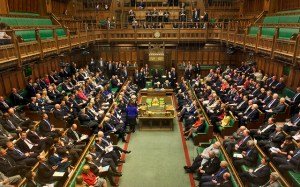
 

Parliament - House of Commons - Debate

Agree with this article? Violently disagree? Scroll down to leave a comment.

Follow Semi-Partisan Politics on TwitterFacebook and Medium.

Hate Speech / Free Speech

Earlier this month I had the privilege of attending an event organised by Spiked, entitled “A New Intolerance On Campus”.

The final panel of the day focused on the question “Is hate speech free speech?”, and while it was a little unbalanced (Dan Hodges was due to provide the counterpoint opinion but was unfortunately unable to attend) there were eloquent arguments in favour of unrestricted free speech from Brendan O’Neill, Maryam Namazie and particularly Douglas Murray.

While the arguments expressed here will be familiar to anyone who closely follows the debate on free speech and the climate of censorship on university campuses – particularly those who have read Mick Hume’s worthwhile book “Trigger Warning: Is The Fear Of Being Offensive Killing Free Speech” – the video is still worth a watch.

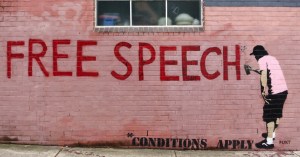
Free Speech - Conditions Apply - Graffiti

Agree with this article? Violently disagree? Scroll down to leave a comment.

Follow Semi-Partisan Politics on TwitterFacebook and Medium.

The World’s Greatest (Un)deliberative Body

This innocuous looking Politico article (http://www.politico.com/news/stories/0212/73417.html) about the planned resignation of Senator Olympia (R-Maine) at the end of her current term began with the following statement:

“In one fell swoop Tuesday afternoon, Olympia Snowe may have not only crushed Mitch McConnell’s dreams of taking over the Senate, she also wrote the epitaph for political moderates in the world’s greatest deliberative body.” [my emphasis in bold]

The world’s greatest deliberative body. This is a phrase used frequently by American political pundits when describing the upper chamber of their legislature, and like many tropes it spews from their mouths and pens without much thought. Which is a shame, because its continued use is starting to make them look ridiculous. The greatest deliberative body in the world? To which any sane person, once successfully divested of the notion that everything in America is automatically the best example of its kind in the world, would surely have to say:

Really?

The writers at Politico are a smart bunch though, so I am sure before making such a bold and boastful proclamation, even as an aside, they carefully studied the British Houses of Parliament, the Israeli Knesset, the German Bundesrat and the legislatures of all the other major democracies, in addition to the histories of those from the ancient empires of Greece and Rome. But let’s just assume for a moment that they didn’t.

Deliberation can be defined as “long and careful consideration or discussion”. This, in turn, would suggest that some form of debate has to take place between opposing viewpoints to either conclusively disprove one and approve the other, or to forge a working compromise between the competing ideals. None of this has happened in the US Senate for a long time now. There are no “debates”. Members from the two political parties (and the few independent members) take turns standing at a lectern and reading pre-prepared speeches full of leadership-approved talking points that no one else in the chamber listens to, before sitting down and making way for someone from the other side of the aisle to do the same thing. Sure, legislation has to pass through the Senate before it can become law, but to suggest that it is deliberated is a woeful overstatement of what happens. No, the deliberation as it still exists now happens in polls and focus-groups before the parties even draw up legislation, and by the cable news and talk radio pundits who drive public opinion before legislation even reaches the house floor. Now, some of this is good (the public engagement part) and some is undoubtedly bad, but one would certainly need rose-tinted spectacles of a very strong prescription indeed to look at the US Senate today and call it a deliberative body at all, let alone the world’s greatest. There are high school debating clubs more worthy of the title.

Add to this failure to properly debate issues the fact that individual Senators can block key governmental appointments on a whim without giving a valid reason (though personal grudges and a desire for lucrative earmarks for their states usually feature quite highly on the list), and the existence of arcane Senate rules requiring a “super-majority” of 60 votes in order to pass anything remotely contentious (surely just as the founding fathers intended), and the greatest deliberative body in the world appears to be on even shakier ground. Let us also not forget that this hallowed institution currently enjoys a 13% approval rating with the American public (http://abcnews.go.com/blogs/politics/2012/01/congress-hits-a-new-low-in-approval-obama-opens-election-year-under-50/).

The larger theme that I want to touch on is the idea of American exceptionalism. I am a firm believer in this idea, but not in the blind, unthinking way that many – especially in today’s Republican party – seem to do. I was born in 1982 and history was taught exceptionally badly in British schools when I was younger, so my knowledge of the mid century is not all that it should be – though I am striving to correct this. But it is my belief that Americans of previous generations made their country great, yes, because they believed in the exceptional nature of their country’s founding and its unique mission in the world, but also because they didn’t just talk about being great all the time. They just quietly got on and did it, with much less boasting and chest-thumping than is often now the case.

A country that can betray its Constitution by passing such laws as the Patriot Act, allow torture to take place under its jurisdiction, or whose presidential candidates receive warm applause by accusing the sitting incumbent of either subverting or “apologising for America” is fundamentally more insecure about itself than has been the case for many years. And, in some ways, so is a country whose political class willingly overlooks the mounting pile of contrary evidence to declare their dysfunctional, hyper-partisan upper house the “greatest deliberative body in the world”.