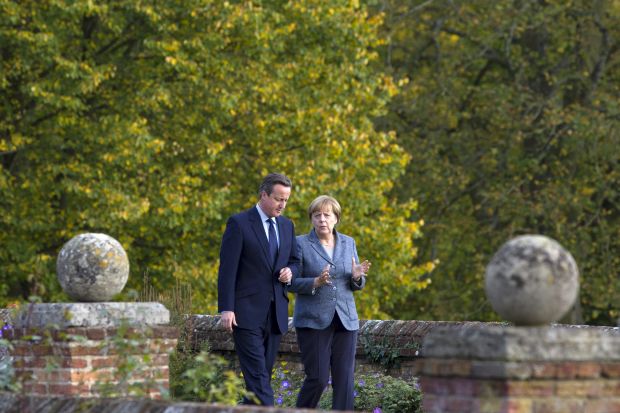
The Daily Smackdown: Europhiles Cry About The “Brexit Bullies”

BSE - Britain Stronger in Europe - Crybabies

It is laughable for Britain Stronger in Europe to claim that the Prime Minister and the Confederation of British Industry were “threatened” by two teenage hecklers

The Britain Stronger in Europe campaign group sent this victimhood-wallowing missive to their supporters today:

We always knew UKIP and the Leave campaigns would try and pull the wool over people’s eyes – we didn’t know they’d try and threaten them.

But this week the Head of Vote Leave tweeted: “You think this is nasty you ain’t seen nuthin yet (sic).” Classy, hey?

It’s clear what type of campaign they’re going to run, Samuel – they can’t win the argument so they’re going to try to silence anyone who disagrees with them. We can’t let them win.

Sounds like something serious happened, right? Wrong.

The “threat” that so upset BSE was a couple of young Vote Leave activists who stood up in the middle of a speech the Prime Minister was giving to the CBI and started shouting “CBI, voice of Brussels!” over and over again.

While it’s a documented fact that the CBI grossly misrepresented a survey of their membership to falsely claim that a majority of British firms back staying in the EU, these two first-time hecklers were hardly political heavies sent to intimidate the opposition. In fact, they were pretty poor even by modern dumbed-down heckling standards – the prime minister came off looking simultaneously wittier and more serious by the time the Vote Leave duo were escorted from the hall.

Watch this video of the encounter, and judge for yourself who comes across as calmer and more intelligent:

Hilariously, BSE are now parading the incident to their supporters as evidence of some dastardly eurosceptic plot to threaten all those sweet, innocent europhiles.

And now failed Labour leadership candidate Chuka Umunna is getting in on the act too, writing in the Telegraph:

Rather than seeking to promote debate, however, the leave campaigns are now desperately trying to shut it down and muzzle those who take a different view. They are behaving like gangsters, trying to close down the debate with behaviour that has no place in public life.

In their repeated attacks on the Confederation of British Industry (CBI), trying to force the organisation’s hand and sit out of this debate, Vote Leave’s is making a concerted attempt to stifle the views of some of the country’s largest businesses. Protests outside the CBI conference, disrupting speeches, aggressive letters – these bully boy tactics are a sign they are losing the argument rather than embracing it.

Well excuse me, but I can’t find a violin small enough to play in mournful solidarity with the mighty CBI, let alone the Prime Minister of the United Kingdom – who has the bully pulpit of his high office and the entire machinery of government with which to campaign against Brexit. It is frankly ludicrous to suggest that eurosceptics possess the official, financial or physical muscle to drown out the europhile message in the way that BSE pretend.

But what we lack in a bully pulpit, we eurosceptics more than compensate for by the simple virtue of being right. Right on the facts, and on the right side of history, too.

The pro-EU campaigns will inevitably get away with a lot of lies and distortions during this referendum campaign, simply because it will not be possible for us Brexiteers to refute each and every single one of them. But one thing that BSE and other europhile campaigns absolutely must not be allowed to get away with is successfully portraying themselves as the plucky underdog, fighting an uphill struggle against the mighty forces of euroscepticism.

I don’t think that there is currently a great chance of that happening, but we should take care to slap down any attempts to portray the pro-EU juggernaut as some kind of rough-and-ready insurgency. Nothing could be further from the truth.

But I do hope that someone remembers Chuka Umunna’s impassioned defence of the CBI – and how he came out swinging in support of downtrodden multinational corporations in their battle to be heard over the little guy – the next time he runs for the Labour leadership.
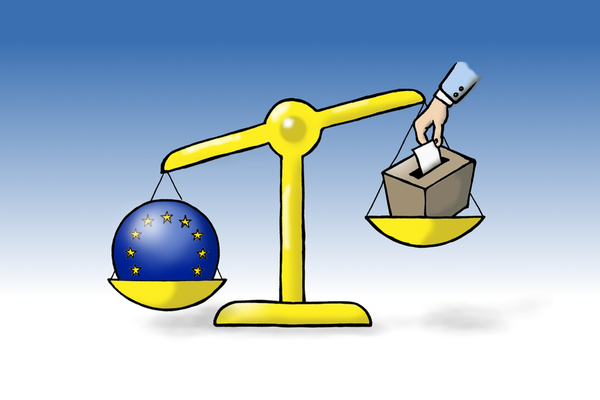
EU Democracy - Brexit

Agree with this article? Violently disagree? Scroll down to leave a comment.

Follow Semi-Partisan Politics on TwitterFacebook and Medium.

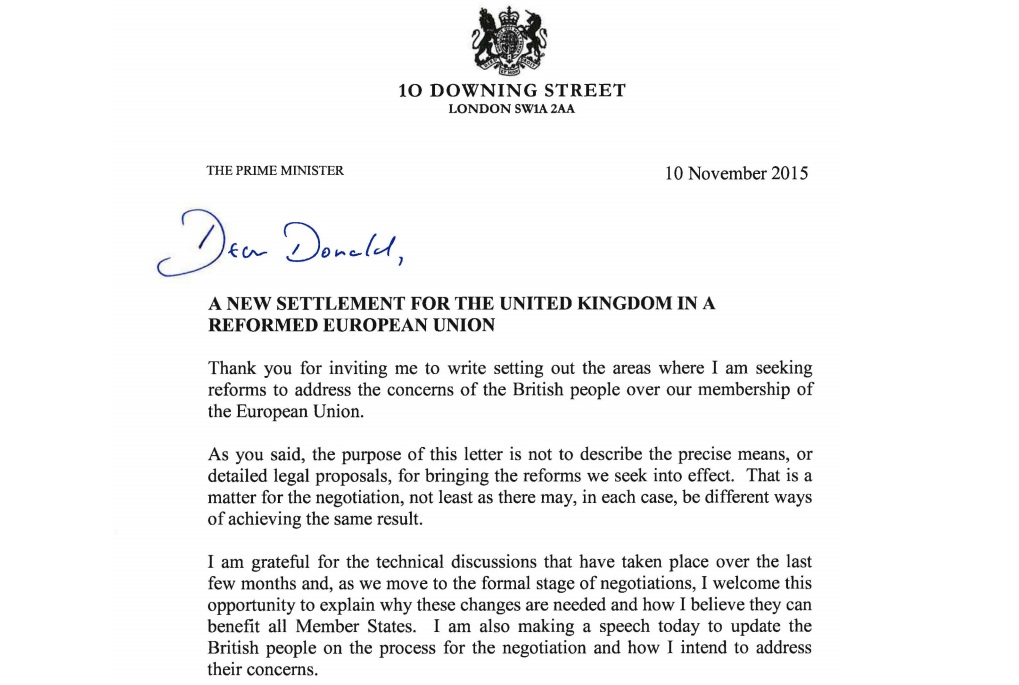
The Daily Smackdown: David Cameron’s Begging Letter To The EU

David Cameron - Donald Tusk - EU Renegotiation - Brexit - Referendum

The problem with the European Union cannot be solved through a renegotiation, because the renegotiation is just another symptom of the problem

If you hadn’t already worked out that David Cameron’s EU renegotiation is a sham, a PR exercise from a PR prime minister designed to make it look as though Britain is leading real change in Europe when in fact we are merely haggling over a few cosmetic and inconsequential concessions, then your remaining doubts should now be answered.

Yesterday, the government released the wheedling, subservient letter that David Cameron has written to Donald Tusk, president of the European Council, begging his permission to reclaim a few minor and superficial aspects of British sovereignty. The fact that half of the prime minister’s demands – such as the call for the European Union to respect the principle of subsidiarity – are things which the EU has long been committed to doing on paper, but shown zero interest in following in practice – gives zero hope that whatever Cameron takes home from Brussels will be honoured.

But Britain’s fundamental problem with the European Union cannot be solved through a renegotiation, because the renegotiation itself is just another symptom of the problem. For as long as any British prime minister must flatter and beg countries like Portugal or Malta and seek their permission before acting in our own national interest, we have no true sovereignty and the European Union will remain an unwanted, antidemocratic millstone around our necks.

No possible outcome of David Cameron’s EU renegotiation will come close to touching this fundamental issue, because the EU is determined to remain a supranational political union, sitting above national governments and gradually acquiring more and more of their power. That’s just a fact, and those europhiles still in denial need to stop deluding themselves that an organisation with its own parliament, executive and judiciary is somehow just there to promote love and understanding between the peoples of Europe, with no designs on our democracy. Such a view is childishly naive.

Even if Cameron’s plea for Britain to be somehow exempted from the Treaty of Rome commitment to ever-closer union is heard, this will simply relegate us to a form of “associate membership” which would leave us – as Leave HQ put it so succinctly – “out on the edges and still on the leash”.

And so we are left with a cosmetic list of demands based not on any attempt to reflect the concerns of the British people, but based instead on what limited concessions David Cameron thinks he might be able to cajole from his European friends. He is essentially starting at his desired outcome (Britain voting to “remain” in the EU) and then working backward, rather than starting with Britain’s national interest at the forefront of his mind, and then letting the chips fall where they may when it comes to the renegotiation.

The whole exercise is a sham, and I refuse to be a part of it. I will not report the ups and downs of the coming “renegotiation” effort, with the inevitable carefully choreographed table-banging rows between Britain and France or the back-and-forth with Poland on migrant benefits access, because the whole thing is a PR exercise designed to make it look like our Conservative In Name Only government are looking out for our national interest when in reality they are only looking for a way out of an unwanted political problem.

Or as my Conservatives for Liberty colleague Ben Kelly puts it in his must-read piece:

There are no negotiations because the outcome of this act of political theatre has been decided for some time, the great deception is already in play. Osborne and Cameron will go through the ridiculous charade of demanding “associate membership” and their EU colleagues will play along and agree to their “demands”.

They will then return declaring a great victory for Britain and ask the public to endorse it in the referendum and give them a mandate to create our “new deal” in a “reformed EU”, which may very well include promises of minor concessions of reduced contributions and some leeway on the “four demands”.

On the surface, this two tier structure will seem enticing, in reality not only will we retain all the major disadvantages we currently suffer – from our trade policy being an ‘exclusive policy of the EU’, to the union’s redundancy in a globalised world, to its essentially anti-democratic nature – but once the eurozone integrates further we will be truly isolated within the union as a second class member.

What matters most now is not whatever choreographed stunt George Osborne or David Cameron cook up every day to make it look like they are going to battle for Britain. What matters most is honing our arguments in favour of Brexit to reach out to the undecided middle. And this means coalescing around a viable plan for a phased British exit from the EU, one which reassures wavering voters that stepping away from the EU is a prudent move, and not a leap into the unknown.

That plan is called Flexcit – I have seen no others that come close to Flexcit’s level of detail and rigour. All eurosceptics, Brexiteers and “Leave” campaigners now have a duty to read it, improve it where possible and then either champion it or propose a better plan of their own.

EU Renegotiation - Brexit - European Union

Further Reading:

The biggest gamble of all is to stay in the EU

The Cameron Deception: “associate membership” of the EU

Mr. Cameron still can’t beat the Flexcit offer

The EU makes us self-absorbed and insular

Agree with this article? Violently disagree? Scroll down to leave a comment.

Follow Semi-Partisan Politics on TwitterFacebook and Medium.

Chinese State Visit: This Fawning Spectacle Is No Nixon In China Moment

Richard Nixon and Henry Kissinger are hardly role models. But unlike David Cameron and George Osborne, at least they had the self-respect to meet the Chinese leader on equal terms

Iain Martin thinks that Chinese President Xi Jinping’s state visit to Britain marks the beginning of the downfall of George Osborne, who has assiduously courted and flattered his way back into the Chinese government’s good graces:

Of course we have to trade with China, and it is going to be especially vital for the City of London, but do we have to be quite so shameless and pathetic about it? Osborne is the architect of the UK’s China policy, and has made sure that everyone knows it. Now, the optics of this state visit, as viewed on television news, look increasingly like a national humiliation.

It’s hard to disagree with that assessment, and to feel a mounting sense of shame at Britain’s determinedly mercantilist foreign policy. It may reap financial and political rewards, but craven spectacles such as this gravely undermine Britain’s role as a world leader.

It is all the more galling because it is so unnecessary. No disrespect intended to Spain’s westward neighbour, but Britain is not Portugal. We are not, thankfully, some middle-ranking economic and military power. Our armed forces may be worryingly pared back and our workforce’s productivity frustratingly low, but Britain is still one of the few indispensable nations. Though we have been introspective and full of self doubt of late, our fundamentals – world leading firms, popular culture, arts and music, legal system and democracy – are among the most popular and most envied in the world.

None of this is to say that we should not have welcomed Xi Jinping to Britain – we are right to do so. It is absolutely in our interests to forge and maintain good diplomatic relations with China. But we should not allow ourselves to be seduced or intimidated by China’s new economic and geopolitical clout. Continued Chinese growth – and the ongoing stability of their autocratic, dictatorial regime – depends on maintaining friendly relationships with key countries like Britain. Neither country can much afford to freeze the other out for the long term.

The problem is not the Chinese – it’s us. It is the attitude of some of our politicians and their friends in the media, who seem too eager to buy into the pessimistic narrative of British decline and waning relevance. Listening to some of them, one would almost think that we were back in the dark, pre-Thatcher days of the 1970s all over again.

Back in 1972, when Britain truly was floundering in the economic doldrums, riven by industrial strife and a failed post-war consensus while the United States grappled with problems of their own, President Richard Nixon travelled to Beijing to “reset” America’s relations with China in far more tense and unpredictable circumstances than those which bring Xi Jinping to London this week.

As a general rule, it’s best to avoid the examples set by Richard Nixon and Henry Kissinger. But on this one particular  occasion, our political and media class might take a useful lesson in terms of how they conduct themselves.

Richard Nixon - Zhou Enlai - Nixon In China

Xi Jinping - State Visit - Britain

Music: “Cheers” chorus from the opera “Nixon in China” by John Adams

Agree with this article? Violently disagree? Scroll down to leave a comment.

Follow Semi-Partisan Politics on TwitterFacebook and Medium.

The Glib And Oily Art Of David Cameron’s Superficial EU Renegotiation

David Cameron’s EU renegotiation is less a firm-handed assertion of Britain’s national interest, and more a collusion with fellow EU leaders to dupe the electorate into believing that real reform is possible

The fact that David Cameron’s key demands and red lines for the EU renegotiation now underway are wilfully vague and almost comically detached from the concerns of British voters is hardly news. But this depressing truth is hammered home even more forcefully today with the leaking of the prime minister’s four-point plan to win concessions from Brussels.

From the Telegraph:

Cabinet sources have told the Telegraph they are confident they can find a way to keep Britain inside the EU with better terms of membership. Their plan involves:

  • Forcing Brussels to make “an explicit statement” that Britain will be kept out of any move towards a European superstate. This will require an exemption for the UK from the EU’s founding principle of “ever closer union”.
  • An “explicit statement” that the euro is not the official currency of the EU, making clear that Europe is a “multi-currency” union. Ministers want this declaration in order to protect the status of the pound sterling as a legitimate currency that will always exist.
  • A new “red card” system to bring power back from Brussels to Britain. This would give groups of national parliaments the power to stop unwanted directives being handed down and to scrap existing EU laws.
  • A new structure for the EU itself. The block of 28 nations must be reorganised to prevent the nine countries that are not in the eurozone being dominated by the 19 member states that are, with particular protections for the City of London.

Of these, only one point (the final one) comes anywhere close to defending Britain’s national interest and reflecting the concerns of the electorate. Of the others, the first two points are completely irrelevant, while the third is guaranteed to meet stiff resistance from other EU leaders and will likely require so many other concessions from the government that securing it would be the ultimate Pyrrhic victory.

Continue reading

Just Build The Damn Runway

Heathrow Airport Third Runway - Aviation Policy


Build the third runway at Heathrow airport. And a fourth. Build new runways at London’s Gatwick and Stansted airports too. And then build a helipad directly on top of the homes and gardens of all the selfish, hand-wringing, growth-averse, NIMBY-ish naysayers who think that their decision to live by an airport gives them veto rights over Britain’s economic future.

Chicago’s O’Hare international airport has seven runways. Count them. Seven. Five of these runways run east-west and the other two run diagonally. So long as your aircraft possesses an engine and wheels, there is almost certainly a runway at O’Hare suitable for landing without the need to circle the city in a never-ending holding pattern before finally lining up for approach and touching down an hour after actually arriving.

You can fly in and out of Chicago quickly, efficiently and cheaply because generations of local political leaders – for all their many other faults – have understood that aviation provides a huge boost to the economy, and that a city which makes access and connection quick and convenient for all types of traveller will surely reap the economic rewards.

Nine hours away in London, this common-sense attitude is sorely lacking. Despite the fact that no new full-length runway has been constructed in London or the south-east of England since the 1940s – when we were still digging ourselves out of the rubble of the Blitz – Britain is wasting time, energy and precious economic opportunities debating whether or not to increase airport capacity at any one of several implausible choices in south-eastern England beside the obvious option of committing to London’s Heathrow Airport, the largest and most popular.


–   CONTINUE READING HERE   –

Conservatives for Liberty - Con4Lib - Blog - Samuel Hooper - Sam Hooper


Follow Semi-Partisan Politics on Twitter here.

Follow Semi-Partisan Politics on Facebook here.