Church Of England Parliamentary Team Revel In Their Antidemocratic Role

Church of England - Church and State - Parliament - Lords Spiritual - Cartoon - 2

The Church of England’s Parliamentary Team have taken to joking on Twitter about the various ways in which they subvert British democracy. But there’s nothing funny about these modern-day theocrats

Imagine if a private sector firm had twenty six seats in the upper house of the British Parliament and possessed the ability to debate bills, lobby government ministers and even vote on Acts of Parliament – all without receiving a single vote from anyone in the United Kingdom. That organisation would be counting its undeserved blessings, and doing its best to keep a low profile and avoid drawing attention to their wildly over-privileged position.

If the RMT possessed nearly thirty votes in Parliament and used them to thwart key transport bills or trade union legislation, there would rightly be an uproar. If Tesco had their own parliamentary caucus who voted against minimum wage increases and greater employee protection rights, people would march on Westminster with burning torches to evict the voice of the Evil Corporations. And yet when the Church of England enjoys the exact same privilege – twenty six Lords Spiritual who sit in the House of Lords and exert influence over our democracy in the name of the established church – there is a deafening silence.

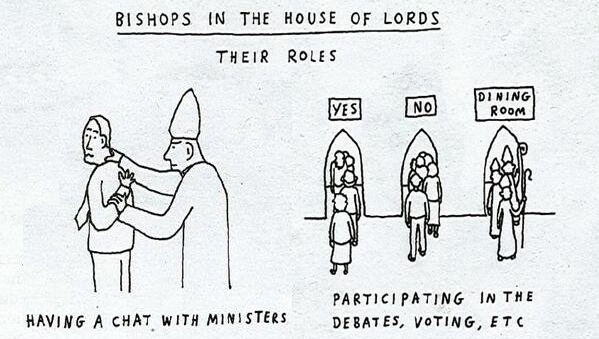
Well not quite. The one group of people making any kind of noise about this state of affairs are the Church of England’s own Parliamentary Team, who thought that it would be in great taste to post this cartoon on their official Twitter feed today:

Continue reading

First Woman Bishop In The House Of Lords, Same Rotten Old Theocracy

Rachel Treweek - Bishop of Gloucester - Tax Credits

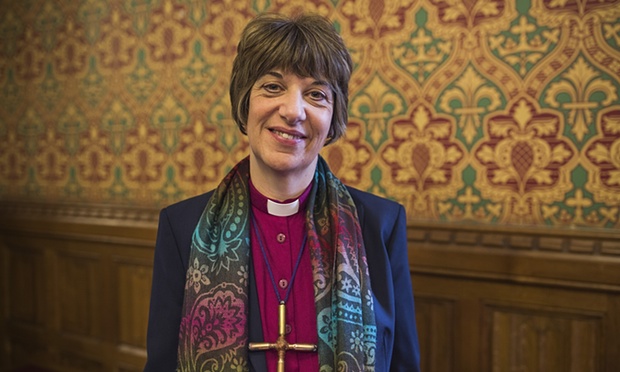
Don’t cheer for Rachel Treweek as she takes up her unelected, theocratic position in the House of Lords. Chase her – and all of her fellow Lords Spiritual – out of Parliament and back to the pulpits where they belong

So let’s get this straight: Scottish National Party MPs are scolded and warned by the Speaker when they spontaneously applaud what they believe to be a good speech in the Commons chamber, because clapping is wrong and unbecoming. But today, peers give a standing ovation to the first female bishop to take her seat in the House of Lords, and that is A-OK?

The appointment of Rachel Treweek, Lord Bishop of Gloucester, to the red benches is nothing to celebrate. Don’t misunderstand – it’s great that the Church of England now allows women bishops, and some of the first female candidates appear to be excellent theologians and pastoral leaders.

But in every other respect, the enoblement of Rachel Treweek is just another case of the British theocracy doing what it always does – appointing clerics of the favoured national church to unelected positions of power and influence in the heart of our political system. Don’t expect us to cheer on this occasion just because the Lord Bishop in question is a woman. Our belief in equal rights and opportunities for women should not be so glib and superficial.

Continue reading

Election 2015 Uncertainty Makes Everyone A Fair Weather Constitutional Reformer

UK Britain Constitution General Election 2015


With just sixteen days to go until we cast our votes in the 2015 general election, politicians and commentators of all stripes are suddenly waking up to the realisation that the party they hate most – be it Labour, the Evil Tories, the nationalist parties or UKIP – may very easily end up in government despite failing to win anything close to a popular mandate, thanks to some unpredictable and largely unstoppable backroom deal following a hung parliament.

In response, every commentator in the land seems to be turning into a bad-weather constitutional reformer, bemoaning the impending political chaos now that it is nearly upon us, despite having taken almost no interest in these dull, un-sexy  constitutional issues when there were other, more fun things to write about.

Here is Philip Johnston’s contribution for The Telegraph:

If neither Mr Cameron nor Mr Miliband were able to put together a viable government, a second election would normally follow; but the Fixed-Term Parliaments Act 2011 complicates matters. It provides for a dissolution of Parliament only when there is a specific vote of no confidence in the government or if two thirds of all MPs vote for an election. This makes the prospect of another early general election less likely. In any case, the parties may have little appetite for one given the expense and the prospect of losing support in a fresh contest.

Without a dissolution we would have a legislature but no government, a bit like Belgium, where the prime minister resigned in April 2010 and no new parliamentary majority could be established for almost two years. The country was run by a former prime minister brought out of retirement and a caretaker administration. It didn’t do them much harm. A report by academics at the University of Leuven noted that the government continued to make “legitimate decisions” on urgent matters of public finance and national security while MPs squabbled. They concluded that “in mature democracies, a power vacuum is taken care of in a constructive, creative, and responsible way”. Do we have such virtues? We might be about to find out very soon.

One thing is clear: a minority Labour government, with fewer seats than the Tories, running the country while in thrall to a nationalist party that has only 2 or 3 per cent of the total UK vote, would test our constitutional structures to breaking point, and maybe beyond. More than that, it could test our creaking, centuries-old Union to destruction.

Isn’t it funny how Britain’s growing ranks of amateur constitutional scholars and reform zealots have only come crawling out of the woodwork now that they are faced with the prospect that the party they dislike might end up calling the shots while not being the largest party in terms of either vote share or seats?

Continue reading

British Prime Ministers Should Have Term Limits, But Wider Constitutional Reform Is Needed

David Cameron 2015 election Term Limits Parliament Constitutional Reform


After the initial shock at David Cameron’s casual announcement that he intends to limit himself to two terms in office as Prime Minister should he win the 2015 general election, the nature of the media response is changing.

First came confusion and uncertainty as to what (if any) impact the announcement would have on the outcome of the election campaign currently upon us. Then came speculation about the impact on the Conservative Party, and whether the Tories would find themselves riven with infighting and jostling for position from the start of any new administration, effectively making David Cameron an instant lame duck. And then there were some rather tenuous claims from the left that Cameron’s decision was “arrogant” and presumptuous.

This blog believes that a far more interesting question is the mystery of who will replace Ed Miliband in the quite likely scenario that he fails to lead Labour out of opposition and back in to government, and is gently encouraged to fall on his sword on 8 May.

But now there is a school of thought among those riding to Cameron’s defence which holds that the Prime Minister’s actions were principled and honourable, and that his example should be formalised through the introduction of term limits for the role of Prime Minister.

Daniel Finkelstein, writing in The Times (+), is the latest high-profile convert to the cause:

Ten years is quite long enough for anyone to be prime minister. It’s not a good idea for anyone to enjoy power in perpetuity even if they have to get re-elected from time to time. Instead of this charade of asking the prime minister a question to which we all deserve an answer, and then calling him a fool or presumptuous if he answers, or a liar and evasive if he doesn’t, why don’t we just solve the problem for him or her?

We should have a term limit for prime ministers. Two terms and that’s your lot. And if you quit half way through your term, your successor should require an election within months. David Cameron’s answer should be compulsory.

Continue reading

Constitutional Reform Is The Elephant In The Room This Election Season

Constitutional Reform British General Election 2015


Conservative Home is currently running an important series on the three urgent political issues which are being pointedly and shamefully ignored by the main political parties in the run-up to the 2015 general election. These are identified as the constitution, national defence and the truth about spending reductions.

On constitutional reform in particular, ConHome is quite right to call attention to the lurking threat:

Yes, there’s plenty of speculation about what might happen in a hung Parliament, and who might form coalitions or pacts with whom.  But there has been no big debate to date about how we should be governed – what an English-votes-for-English-laws Commons would look like; what the knock-on effects on Scotland might be; what would happen to the Lords in consequence; how much devolution there should be in England (and elsewhere); what would replace the ECHR (if anything) were Britain to leave it; where an EU referendum fits into this picture; whether the UK will survive at all.

Will the UK survive at all? A sobering question to ponder, and yet when faced with these unresolved questions of national character, purpose and even survival, too often our politicians focus on the minutiae of daily life as they seek to either prey on our fears or appeal to our wallets.

This blog makes no apology for having singled out the Labour Party and Ed Miliband as the worst culprits as they seek to reduce the 2015 general election to a petty contest about public services, when Britain’s greatness is so much more than the sum of local government services and “our NHS”, here on the occasion of the Labour Party leader’s most recent relaunch:

Continue reading