CCHQ Should Not Automatically Protect Tory MPs From Deselection

Conservatives Tories start candidate selection process early - mandatory reselection - deselection of rebels

A seat in the House of Commons is not a job for life. And just as the Parliamentary Labour Party should not be encumbered with MPs increasingly at odds with their local constituency parties, so Tory MPs should not be immune from deselection if they repeatedly ignore the priorities and concerns of grassroots Conservative Party members

Try as I might, I simply cannot get myself worked up about the government’s “shock” defeat over the amendment to the EU Withdrawal Bill. While the legislative drama seems to have Hard Brexiteers up in arms and Remainers parading their newfound (and one suspects rather less than genuine) love and respect for Parliamentary sovereignty, I don’t see that these machinations will have any real bearing on the eventual outcome.

So Parliament gets to have a “meaningful” vote on the terms of the UK-EU agreement? Fine, so be it – though I have always held that the people, not Parliament, should be sovereign, and that no government should be able to divest itself of fundamentally important powers or seek to repatriate such powers without an explicit and specific mandate from the people. Of course, if we had a written constitution then such things would likely be enshrined automatically rather than be up for furious debate as new issues and obstacles are encountered along the road. But then if we had a written constitution we likely would never have ceded so much sovereignty to the European Union in the first place and would not now be in this position, making it all a rather moot point.

Of far more interest to me is the fact that talk of deselection of MPs has bubbled up again. We saw this last year as Jeremy Corbyn and his supporters sought to cement their control of the Parliamentary Labour Party, and for democratic reasons I supported the idea of mandatory reselection in principle. And now there are new calls to deselect sitting MPs, this time from Conservative politicians and activists angry at what they see as the Tory rebels’ deliberate undermining of the prime minister and the country’s negotiating position with the EU:

On this occasion I do not share the Tory Brexiteer outrage, but their case is every bit as compelling as was that of the Corbynite leftists who wanted to rid their party of centrist MPs who do not reflect the values and priorities of their local associations. While I personally find it hard to work myself into a spittle-flecked fury at the antics of Dominic Grieve or Heidi Allen, if it is the case that these MPs represent Leave-voting constituencies and a majority of local party activists find their voting record objectionable then I see no reason why they should be protected and continually re-imposed on an unwilling local party organisation.

Of course, CCHQ and the Tory Party machinery vehemently disagrees. Reflexively opposed to any notion that grassroots activists or local constituency associations should have any input as to the direction, policies or running of the party, CCHQ sees individual conservatives as little more than indentured servants campaign material distributors at election time, to be put to work when necessary and then roundly ignored the rest of the cycle.

Nick Timothy, Theresa May’s intellectual bloodbank-in-exile, makes it perfectly clear that the present Conservative leadership remains determined to run the party (if not the entire country) as their personal private fiefdom, and that local constituency associations should shut up and do as they are told, whether they like the candidate or MP chosen for them or not. Timothy unapologetically and shamelessly spelled out as much on Twitter today:

https://twitter.com/NickJTimothy/status/941254029488873472

This is an open admission that Theresa May, the prime minister and leader of the Conservative Party, saw fit to interfere in local constituency business and keep an unwanted MP foisted on an unwilling local party.

But what the hell business should it be of the prime minister who gets to stand as a Conservative candidate in a local constituency? This is everything that is wrong with the current Tory party – overcentralised and overbearing, with CCHQ pig-headedly declaring that it knows best while confidently marching us all to ruin. Given the litany of gaffes, unforced errors, scandals and bad judgements which have emanated from Theresa May’s cabinet, I would sooner entrust a panel of ten individuals randomly selected from the phone book to choose good Tory candidates than I would have Theresa May make the judgement call.

Of course, there is a counter-argument to all this, as a reader pointed out on Twitter:

We certainly don’t want a situation where conscientious, independent-minded MPs are peremptorily driven from office or from their political party because they fail to toe the hardest of hard lines demanded by their activists. We have recently witnessed just such a phenomenon lead the Republican Party to ruin (at best Pyrrhic victory) in America, where a succession of primary challenges and forced retirements saw an influx of ideologically uncompromising Tea Party politicians into Congress, hard-liners who thwarted any attempt at sane governance in the second term of Barack Obama, rendered the Republican congressional caucus unmanageable and ineffective and set the stage for Donald Trump’s hostile takeover of the GOP.

In actual fact we need both of these opposing forces – greater responsiveness to grassroots opinion and a cool, dispassionate process to adjudicate in the event of rogue or underperforming MPs – to be in balance. We need a far greater measure of accountability of MPs to their local party associations, and a more meritocratic system of selection (preferably primaries) which draws more people into the political process and prevents the mediocre-but-well-connected from leveraging their connection to CCHQ to be shortlisted or ultimately foisted on a constituency.

But we also need to build safeguards into the system so that the bar for triggering deselection is high but achievable – the recourseshould only become available at the time of a general election or by-election, so that MPs are judged on the body of their work and their voting record throughout a Parliament and not on the basis of any one single contentious vote.

Ultimately, the resurgent argument about deselection of MPs reminds us that Brexit is a necessary but not a sufficient condition for meaningful democratic renewal in Britain. Brexit was never going to be a cure-all no matter what some cynical Brexiteers may have implied, and we must all now recognise this fact. Achieving Brexit only to return power to the hands of the same MPs who negligently frittered it away in the first place, and who think so little of the people who campaign to put them in office that they seek to be made immune from their judgement, will not solve anything.

To this extent, the worries of Hard Brexiteers that the EFTA/EEA route may be used as cover by some Remainers in order to thwart Brexit entirely are quite valid. When there are so few penalties or recourses available to voters when politicians betray their own supporters, the trust required to sustain a well-functioning democracy is inevitably corroded.

But the real tragedy is that when we should be discussing how to respond to the period of disruption and discontinuity facing Britain, developing bold new mutually-reinforcing policies to tackle 21st century challenges, instead the Conservative Party is bickering about process and thwarting any attempts to clear out the intellectual deadwood and bring in some new ideas and personalities. Constitutional and electoral reform is important and eventually necessary, but there are pressing issues facing Britain which cannot be put on the back burner while we argue about the rules of play. Unfortunately, we seem less interested in these big debates and more interested in arguing about process stories.

When the Conservative Party fails to stand for anything – and Lord knows that under the rootless leadership of Theresa May, the Tories stand for little more than surviving the day at hand – it has plenty of time to devote to juvenile, internecine spats like the one playing out over the EU Withdrawal Bill rebels.

This is highly entertaining for the political media and a gift for Jeremy Corbyn and the Labour Party, but very bad indeed for everyone else.

Conservative Party Logo - Torch Liberty - Tree

Support Semi-Partisan Politics with a one-time or recurring donation:

Agree with this article? Violently disagree? Scroll down to leave a comment.

Follow Semi-Partisan Politics on TwitterFacebook and Medium.

Resurrecting The Citizen Politician

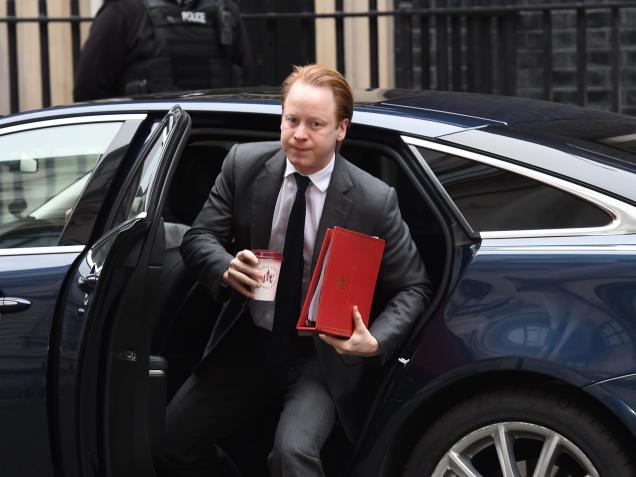
Ben Gummer MP

After Brexit, attracting more exceptional citizen politicians and fewer mediocre career politicians is the next crucial step towards democratic renewal in Britain

A worthwhile article by new Labour MP Laura Smith for LabourList underlines the urgent need for more politicians who look and sound like contemporary human beings rather than cautious clones who have been training to become MPs their whole life.

Laura Smith writes:

I’m new to politics. I’ve never been in local government; I was an activist, a member of the union and came from a long-standing Labour Party family. I haven’t come from a background of jargon and empty words, and I know what it’s like when life throws you a curve ball that takes the wind from your sails and the plans that you had made lay shattered in a million pieces. I can say with integrity that I will try my best to fight against the injustice that members in my constituency feel, and I’ll do it with vigour and sincerity.

Entering Westminster has been an eye opener without a doubt. Never have I been more sure that the ambitions of many there come from a place of self-indulging hypocrisy, and the decisions that they make are sheer games rather than coming from a place of care.

I don’t know the parliamentary protocol nor do I care much for it, I speak with a northern accent, I came to the door with an overdraft, no savings and a limited wardrobe purchased on a credit card to try and look smart.

I am what I am and that is representative of millions of women in Britain. My class has been with me my whole life, forged from the experiences of my Scottish mining grandfather, and I’ve ridden on the rollercoaster of the ups and downs of life. I’m proud to be working class, I’m proud of my people and for as long as my constituency wish to keep me in Westminster I will fight for the working people of this country.

How refreshing it is to hear a politician – especially a Labour politician – speak passionately about the politics of class rather than the politics of identity. Both are divisive, to be sure, but the former is at least reassuringly familiar and relatively harmless these days, while the latter is doing more than anything else right now to tear apart the fabric of British society.

I would probably disagree strongly with about eighty percent of what Laura Smith stands for, but there can be no denying that this is exactly the kind of decent, committed person we should want to attract to Westminster – somebody with strong convictions, a record of community service but also, crucially, a life outside politics (Smith held real jobs and ran her own business).

It cannot hurt to have more MPs of all parties who know what it is to live on a budget as Smith has done, or to have struggled with debt, unemployment or work-life balance issues, to complement those who know how to be an ambitious party functionary but little else. Being an MP is a calling and not a career, but certain accommodations can and should be made which would make serving in Westminster more appealing while still demanding sufficient dedication to public service.

Smith’s dismissal of parliamentary protocol will also chime with many people, including all those SNP MPs who didn’t understand why clapping after a speech was verboten while braying like a donkey at Prime Minister’s Questions is positively encouraged. While there will always be an important place for tradition and rituals which remind us of our heritage and the small part we play in our larger shared history, it is also undeniable that certain habits and protocols are hopelessly outdated and serve no useful purpose. There is no reason why Parliament should not adopt electronic voting, for instance, rather than wasting time while MPs physically traipse in and out of the Commons chamber to record their vote.

But most impressive in Laura Smith’s article is the fact that she clearly went to Westminster with a purpose greater than her own political advancement. Not every MP can or should be a statesman, a philosopher or a leader, though MPs of all backgrounds and ideologies have fulfilled these roles. We also need MPs who care deeply about their constituents and about particular issues, campaigning MPs who want to use their term(s) in office to make a specific difference. Indeed, such MPs can often be far more valuable and effective than those who merely spout reheated rhetoric from four decades ago, be it Michael Foot-style socialism or unreconstructed Thatcherite dogma.

Yet too often we let motivated MPs of this calibre languish for a term or two on the backbenches before they either become disillusioned and stand down, or else lose their inner fire and slowly transform into unremarkable, uninspired time-servers.

One of the best recent citizen politicians in Parliament was former Conservative MP Dan Byles, a man who was the first in his family to attend university, received a prestigious Army scholarship, served on active duty in Bosnia, rowed across the Atlantic, climbed mountains and served on the board of several charities before serving a single term in Parliament from 2010-2015.

This is exactly the kind of person who should now have a senior Cabinet role, and whose charisma and leadership skills might presently be leading the Conservative Party in a more inspiring, less suicidal direction. Yet despite becoming one of relatively few first-term backbench MPs to rack up some real accomplishments to his name (including constitutional reform of the House of Lords via a private member’s bill), Byles stood down in 2015 to “pursue new challenges”. Some of our most exceptional people no longer feel that they can make a meaningful difference by serving in Parliament.

Westminster attracts the power-hungry, the ambitious but also – thanks to elitism and nepotism – the mediocre and the self-serving. And too often, the genuinely talented are overlooked in favour of the well-connected. Witness Theresa May’s government, which managed to find a place for the utterly unremarkable Ben Gummer (son of former Tory minister John Gummer) in Cabinet while leaving thoughtful and intelligent conservative voices like Kwasi Kwarteng or James Cleverly to languish on the backbenches. Note also how Harlow MP Rob Halfon, who could actually articulate a positive (if controversial) vision for conservatism, was sacked as a minister while Theresa May kept faith in Home Secretary Amber Rudd, who entered politics not to advance any deeply-felt political agenda but to “get a grip on her life” and add another accomplishment to her CV.

As if the chaotic Brexit negotiations did not already make it abundantly clear, the calibre of leadership we manage to attract at the national level does not serve us well. This is in significant part due over-centralisation at Westminster and the neutering of local government in Britain, where at present there is probably only one executive role outside of Cabinet – the mayoralty of London – which might remotely prepare a politician to plausibly step into the role of prime minister. But it is also because we expect too little from the people we choose to represent us.

To take the next step in renewing British democracy, we must break the stranglehold that national political party headquarters wields over candidate selection. We must do away with affirmative action shortlists and central casting candidate lists alike, empower constituency party organisations and allow them to nominate candidates who they feel best represent their values and their concerns. We must devolve and decentralise significant powers away from Westminster to the counties and the regions, so that local government can transform from being adult daycare to a useful incubator of future national leadership talent.

And we must re-embrace the idea of the citizen politician, valuing the contributions of those candidates with different backgrounds.We must identify and advance talent wherever it is found rather than demanding that passionate and inspired MPs with executive experience outside politics first spend years acting as bag-carrier for other ministers before being trusted with any real responsibility.

Only if we embrace this radical decentralisation and ideological renewal – here it is particularly important that committed small-C conservatives seize back control of the Tory Party from the dead hand of Theresa May, just as the Corbynite Left deposed the centrists within Labour – can we take the next step after Brexit and finally begin the democratic renewal of Britain.

The alternative is more of the same uninspiring, grinding disappointment with which Britain has sadly become so familiar.


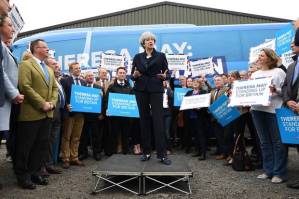
Theresa May - Conservative campaign bus - photo op campaign phony

Support Semi-Partisan Politics with a one-time or recurring donation:

Agree with this article? Violently disagree? Scroll down to leave a comment.

Follow Semi-Partisan Politics on TwitterFacebook and Medium.

The Abnormalization Of President Trump

Abnormalization of Donald Trump

Donald Trump is not the first US president to ride roughshod over the Constitution or flout the checks and balances on executive power – and an honest media with any credibility would acknowledge as much

In highlighting the latest craven example of oversensitive American university students and administrations rescinding invitations to prominent conservative-leaning speakers, the Washington Post reports:

Once reserved for cheesy senior photos at campus landmarks, college commencement exercises have graduated into something different six months after Donald Trump was elected president: a battleground for protesting conservative policies and the people who promote them.

This is incredibly disingenuous. The trend of academic institutions and strident students refusing to tolerate the presence of anybody whose opinions diverge from the current leftist, social justice orthodoxy has been on the ascendance for well over a decade now, has accelerated rapidly in the last five years and has been widely commented on, written about and discussed – not least on this blog.

And yet here the Washington Post seeks to present the “student snowflake” syndrome as a new development which only now is rearing its head “six months after Donald Trump was elected president”. This comes perilously close to excusing the rising tide of illiberalism as merely a symptom or reaction against Trump’s unexpected victory, when in actual fact anybody with a functioning brain knows that Donald Trump’s victory was largely the symptom or reaction against the illiberal, intolerant Control Left.

But we are now witnessing a trend of articles and Op-Eds such as this, all seeking to portray every last one of Donald Trump’s actions as US president as being extreme and unprecedented in recent history. On foreign policy, domestic policy, constitutional matters and social issues, critics of Donald Trump (including the prestige Washington media) often seek to portray Trump as far more extreme than he has thus far shown himself to be, at least as far as policy initiatives and executive actions are concerned.

None of this is to support Donald Trump or excuse the atrocious start he has made to his presidency, which has been characterised by one largely self-inflicted political wound after another. Rather, the point is that by falsely pretending that every time Donald Trump breathes he is gravely wounding the Republic in ways unmatched by any previous president, Trump’s critics and the media inadvertently excuse serious failings in US policy and of past US administrations which deserve to be studied, criticised and rectified rather than merely glossed over.

Nicole Hemmer picked up on some of these areas as part of an article in Politico Magazine:

Many journalists covering the White House have lapsed into a practice of “Trump exceptionalism,” a tendency to assume each move the administration makes is new and nefarious. This assumption comes from a well-meaning place—a worry that they will be complicit in normalizing dangerous behavior in an American leader. But there are real risks, too.

First, it leads to quick-trigger panic over events that are normal. Take the reaction to the administration’s dismissal of 46 U.S. attorneys. Journalists framed it as a purge, and the panic escalated when one of those attorneys, Preet Bharara, refused to resign and was subsequently fired. But the dismissal of U.S. attorneys has been standard practice since the 1990s. The novel behavior here was Bharara’s. There’s a cost to getting this wrong: Cry wolf too many times, and readers are less likely to listen when the real dangers appear.

But perhaps the more important consequence of Trump exceptionalism is that it encourages journalists to overlook continuities. Trump is an abnormal president, unprecedented in many ways. But he is not sui generis. His anti-Muslim policies, hard-line anti-immigration stance, even his economic populism and free-trade skepticism all have long histories—even within mainstream conservatism. His nomination of Neil Gorsuch to the Supreme Court was as straightforwardly Republican as it gets.

One can quibble over the wording and focus of Hemmer’s argument – hysterically and disingenuously talking about Trump being “anti-immigration” when he has expressed no clear reservations whatsoever about legal immigration, for example. But her basic point is correct – inexperienced and superficial DC journalists have been too eager to cram every piece of news into their “Trump is unprecedented” narrative, whether each individual action happens to fit the mould or not.

When it comes to the Trump administration’s recent overtures to more authoritarian regimes (including Saudi Arabia and Turkey’s dictator-in-gestation Recep Tayyip Erdoğan), Glenn Greenwald does a far better job counting the ways that US support for morally questionable allies is far from unprecedented:

Since at least the end of World War II, supporting the world’s worst despots has been a central plank of U.S. foreign policy, arguably its defining attribute. The list of U.S.-supported tyrants is too long to count, but the strategic rationale has been consistent: In a world where anti-American sentiment is prevalent, democracy often produces leaders who impede rather than serve U.S. interests.

Imposing or propping up dictators subservient to the U.S. has long been, and continues to be, the preferred means for U.S. policymakers to ensure that those inconvenient popular beliefs are suppressed. None of this is remotely controversial or even debatable. U.S. support for tyrants has largely been conducted out in the open, and has been expressly defended and affirmed for decades by the most mainstream and influential U.S. policy experts and media outlets.

The foreign policy guru most beloved and respected in Washington, Henry Kissinger, built his career on embracing and propping up the most savage tyrants because of their obeisance to U.S. objectives. Among the statesman’s highlights, as Greg Grandin documented, he “pumped up Pakistan’s ISI, and encouraged it to use political Islam to destabilize Afghanistan”; “began the U.S.’s arms-for-petrodollars dependency with Saudi Arabia and pre-revolutionary Iran”; and “supported coups and death squads throughout Latin America.” Kissinger congratulated Argentina’s military junta for its mass killings and aggressively enabled the genocide carried out by one of the 20th century’s worst monsters, the Indonesian dictator and close U.S. ally Suharto.

Nor is Trump’s foreign policy behaviour a particular departure from more recent US administrations:

U.S. devotion to the world’s worst dictators did not end, or even recede, upon the end of the Cold War. Both the Bush and Obama administrations continually armed, funded, supported, and praised the world’s worst dictators.

In 2009, then-Secretary of State Hillary Clinton actually said of the murderous Egyptian dictator supported by the U.S.: “I really consider President and Mrs. Mubarak to be friends of my family.” When Egypt’s defense minister, Gen. Abdel-Fattah el-Sisi, overthrew that country’s first elected government, Clinton’s successor, John Kerry, hailed him for “restoring democracy,” and as Sisi became more brutal and repressive, the Obama administration lavished him with more weapons and money. The U.S. government did the same for the human-rights abusing dictators in Bahrain.

And of course this is to say nothing of Saudi Arabia.

It is bad enough having a US president who seems to suffer from self-delusions. That the Washington media and commentariat are engaging in fantastical delusions of their own is doubly dangerous for American democracy and policy.

To read the combined output of the American media, one would be forgiven for thinking that the George W. Bush administration never sanctioned the illegal torture of prisoners through dubious legal memos, and that the Obama administration never once decided to blast American citizens off the face of the earth with drone strikes, maintaining a “kill list” of US citizens who could be zapped without any due process.

No, apparently all of these sins are now forgiven – to the extent that the servile, sycophantic Washington media bothered to hold past administrations or senior officials accountable for their actions in the first place, generally preferring to party and intermarry with the political elite rather than be remotely adversarial.

In fact, the harsh truth is this: the only reason that Trump administration officials are being dragged over the coals for their own skirting of the Constitution and departures from US diplomatic and international norms are that Donald Trump has refused to cozy up to the Washington media class in the manner typical to all previous presidents, and so has failed to build up the traditional reserves of goodwill which would otherwise lead to effective immunity from scrutiny or criticism of himself and his administration.

This is a real and pressing problem, because every instance when the mainstream US media freaks out and acts as though Donald Trump is breaking new ground in authoritarianism by simply behaving in the same way as his predecessors only serves to drive a wedge between those media outlets and Trump-sympathising voters who already widely distrust the mainstream media – often with good reason.

Trump supporters need to be legitimately informed of occasions when the US president is acting in an unprecedentedly negative way, and examples of such behaviour – like the firing of FBI director James Comey for an ever-changing kaleidoscope of official reasons – are already rapidly mounting up. But their impact is massively diluted when Trump supporters have legitimate reason to believe that the media, angry at their rude treatment by the White House, is deliberately whipping every story into a major scandal, regardless of individual merit.

And the same goes for the rest of us, too. It does dissenting Republicans, Democrats and independents no favours when their every prejudice about Donald Trump is endlessly reconfirmed by an hysterical media which was only too happy to overlook some of the same faults, vices and mistakes in his predecessors of both parties. This behaviour by the media is not new, but the partisan debasement of political journalism has certainly sunk to new lows since Donald Trump took office.

A strong, almost irrefutable argument can be made that Donald Trump has brought the US presidency to an historical nadir through his personal coarseness, egotism, vengefulness and sheer inability to get to grips with public policy. The degree to which Trump’s political radar – so astute in helping him triumph over the establishment in the Republican primaries and general election – has now deserted him as he seeks to manipulate the levers of power in Washington D.C. is remarkable, if somewhat predictable.

Last week, a journalist was arrested in Washington D.C. for questioning Donald Trump’s Health & Human Services secretary, Tom Price, supposedly too aggressively. The alarming story was widely covered in American media at the time, but it has not driven the news cycle to nearly the same extent as other events which have ultimately proved to be little more than Donald Trump following the precedent set by previous administrations.

Why? Because too many in the media are ready and eager to go to DEFCON 1 every time that Trump opens his mouth, rather than cross-checking to see whether the latest presidential pronouncement or action is genuinely unprecedented or merely a more coarsely-worded rehash of something which would have gone unreported during the Clinton, Bush or Obama years.

Those of us with an active interest in the US media repairing and retaining its credibility in the wake of Donald Trump’s presidency should demand better from journalists, pundits and TV talking heads who currently paint every decision made by the Trump White House as an unprecedented step down the road to dictatorship.

The prestige media pretending to its audience that Donald Trump’s upcoming meetings with authoritarian dictators like Turkey’s Recep Tayyip Erdoğan are somehow unprecedented in American history is every bit as “fake news” as the ludicrous stories on the fringe Right about President Obama operating a paedophile ring out of the White House – only the prestige media’s lies and distortions are ultimately far more damaging, being read and believed by people with real power and influence in American society.

In short, Donald Trump is providing enough fresh new worrying material for us all. There is no need for the media to add to the drama by inventing more.


Donald Trump speaks to reporters

Support Semi-Partisan Politics with a one-time or recurring donation:

Agree with this article? Violently disagree? Scroll down to leave a comment.

Follow Semi-Partisan Politics on TwitterFacebook and Medium.

Constitutional Originalists Are Right To Oppose Donald Trump And Fear Him More Than Hillary Clinton

american-us-constitution

For some Constitutional Originalists, there are worse things than a potential Hillary Clinton presidency

The Weekly Standard has an interesting article by Terry Eastland, recounting a conversation with Stephen Sachs of Duke Law School, in which Sachs made the Constitutional Originalist case against Donald Trump.

Originalists – typified by the late Supreme Court Justice Antonin Scalia – are those who believe that when deciding cases or evaluating potential laws, the Constitution should be interpreted in the context of how the text was commonly understood by society at the time of writing. They are the opposite of Living Constitution advocates, who believe that the US Constitution is a “living and breathing” document which should be continually reinterpreted in line with changing moral values and societal views.

Eastland writes:

Originalists Against observes that the Constitution vests in a single person the executive power of the United States but contends that “we would not vest that power in Donald Trump,” in light of his “character, judgment, and temperament.”

Originalists Against also doubts that Trump would do as the president’s oath of office (itself in the Constitution) requires, and protect the Constitution. Trump has “shown [himself to be] indifferent or hostile to the Constitution’s basic features—including a government of limited powers, an independent judiciary, religious liberty, freedom of speech, and due process of law.”

The statement identifies several instances of this constitutionally indifferent and hostile Trump. The president must take care that the laws be faithfully executed, but Trump admires dictators as above the law. The president must hold a public trust on behalf of all Americans, but Trump courts those who would deny to others the equal protection of the laws. The president must preserve, protect, and defend the Constitution, but Trump has treated the legal system as a tool for arbitrary and discriminatory ends, especially against those who criticize him or his policies.

And Eastland summarises:

“Originalists Against also does not trust Trump to respect constitutional limits in the rest of his conduct in office, of which judicial nominations are only one part.” Here the signatories recognize that because a constitutional government is necessarily a limited government, political actors may not simply do as they wish.

Of course, none of this means that Hillary Clinton is anything like a principled Originalist herself – quite the opposite. Only at the last presidential debate against Donald Trump, when the subject of nominating Supreme Court justices was raised, Hillary Clinton immediately started waxing lyrical about the importance of selecting judges who would be partners in achieving progressive change. She sees the judiciary as wielding an explicitly political role which of course is the absolute last thing that a good Supreme Court nominee should do.

As this blog summarised the exchange at the time:

Chris Wallace’s first question is about the Supreme Court, and where both candidates “want to see the court take the country”. He follows on to ask whether they believe the Constitution is a living document or set in stone.

[..] Hillary Clinton immediately politicises the Supreme Court, saying that it should stand on the side of “the people” (meaning her leftist policies). I’m sorry, but no. The Supreme Court should stand on the side of the Constitution, not on the side of whatever basket of special interests Clinton decides to label “the people”.

Clinton sees the Supreme Court as an essential vehicle for continual, aggressive social change, far beyond anything that can be reasonably inferred from the text of the document and the original intent of the Founders. Not good.

But it is encouraging to see the Originalists Against Trump movement place fidelity to America’s fundamental governing document over narrow political interest. One cannot imagine that many of the Originalists are enthusiastic Hillary Clinton supporters, yet they seem principled enough to declare that some things matter more than the outcome of a single presidential election:

Trump says he will pick individuals with views of judging like Scalia’s to the Supreme Court and the lower courts. Advised by the Federalist Society and the Heritage Foundation, he has compiled a list of 21 prospects for the Supreme Court among whom he could choose in filling vacancies, starting with Scalia’s seat.

[..] The problem would not appear to be with any of the 21 on his list—the originalists have not doubted them—but with Trump himself, whom they do not trust to do what he says. Here again character is the concern.

Originalists Against thus are willing to accept a Clinton presidency even if that means a Clinton Court. Says the statement: “Our country’s commitment to our Constitution is not so fragile that it can be undone by a single administration or a single court. Originalism has faced setbacks before; it has recovered. Whoever wins in November, it will do so again.”

This chimes with my own thinking. I’ve been clear all along that I find this US election an unpalatable but obvious choice. In many ways Hillary Clinton represents a continuation of everything that is bland, uninspiring and statist about American politics – but she is the kind of bad that America as endured before and can endure again if necessary. Or as PJ O’Rourke recently put it, “she’s wrong within the normal parameters of wrong”.

With Donald Trump, by contrast, you just don’t know. What we do know of his policies and instincts suggest a frighteningly authoritarian mindset which doesn’t sit any more comfortably with American liberty than Hillary Clinton’s reflexive statism and faith in Big Government. And there is much that we still don’t know about Trump, like when his miraculous Damascene conversion from being a Clinton-admiring Democrat to a strident nationalist actually happened, and if it is even for real. Never mind whether Donald Trump’s policies are good or bad – at this point we don’t even know whether or not they are just a cynical act.

Ultimately, my thinking comes down to this: one should not take risks with the US Constitution. Of course it is likely that Hillary Clinton would do her best to pack the Supreme Court with as many “Living Constitution” acolytes as new vacancies permit over her four or eight years in office, which would be a mostly bad thing in terms of policy outcomes and a comprehensively bad thing in terms of the law. But I have no faith that Donald Trump remotely respects the Constitution either; in fact, I think it is far more likely that Trump would seek to override or subvert the Constitution in a fit of pique than would a machine politician like Hillary Clinton.

Originalists Against Trump seem to recognise this danger too, and no matter how much some of them may prefer the policies and attitudes currently being expressed by Donald Trump, they know better than to trade their support for the Constitution for any potential short-term political gain.

Which makes Originalists Against Trump one of the most principled and selfless actors in this entire tawdry presidential election season.


us-constitution-convention-signing

Top Image: Pixabay

Support Semi-Partisan Politics with a one-time or recurring donation:

Agree with this article? Violently disagree? Scroll down to leave a comment.

Follow Semi-Partisan Politics on TwitterFacebook and Medium.

Politicising The Supreme Court: A More Liberal SCOTUS Is Nothing To Celebrate

Jeffrey Toobin in The New Yorker salivates at the prospect of a President Hillary Clinton loading the Supreme Court with a bunch of zealous, ideological progressives:

For the first time in decades, there is now a realistic chance that the Supreme Court will become an engine of progressive change rather than an obstacle to it. “Liberals in the academy are now devising constitutional theories with an eye on the composition of the Court,” Justin Driver said. The hopes for a liberal Court will begin—or, just as certainly, end—with the results on Election Day.

Of course there have been times when conservative Republicans have bent the spirit or the letter of the law in pursuit of their own obsessions – cracking down too restrictively on voting rights stands as an obvious, shameful example. But liberal excitement about getting to stamp their mark on the makeup of the Supreme Court seems to extend far beyond merely righting these examples of conservative overreach:

The liberal wish list expands rapidly from there—limited only by the imaginations of law professors, advocates, and the Justices themselves. One possibility is that the Court might recognize a constitutional right to counsel in civil cases. (Currently, only criminal defendants are guaranteed legal representation.) In criminal law, the Court might adopt the idea, which Sotomayor has suggested, that the Constitution forbids incarcerating individuals who are too poor to pay fines. Several scholars have proposed a constitutional right to education, which might force increased funding for poor districts, or, even more speculatively, a right to a living wage.

These goals range from the worthy (no longer imprisoning people who are so poor that they have no prospect of paying large court fines) through the interesting-but-unworkable, all the way to the downright authoritarian and unconstitutional (a federal “living wage”).

But while the Supreme Court is the third and equal branch of government, activists on all sides of the political spectrum are playing with fire when they seek to co-opt the court to be an “engine of progressive change” (or resistance to that change) where they cannot muster popular support to achieve their goals through Congress or, if necessary, amend the Constitution.

The Supreme Court has long been politicised, and American democracy has suffered as a result. And while it may be wishful thinking that the tit-for-tat partisan drama will come to an end any time soon, liberals in particular should be careful. For their side is already ascendant or even victorious on many fronts in the culture war. Social changes which would have been unthinkable three decades ago are now a tangible reality – often a positive thing, sometimes less so. Seeking to gain the last 10% of their social objectives by turning the screws on American conservatives through the Supreme Court will only foster resentment and sow division.

Perhaps liberals genuinely don’t care. Perhaps they are fine with the idea of achieving their goals by circumventing the political process and pushing their “living constitution” interpretations to the limit of coherency. But there will be a backlash, just as there are always consequences when political elites of any stripe push stubbornly ahead with their agendas while forgetting to bring the country with them.


US Supreme Court

Support Semi-Partisan Politics with a one-time or recurring donation:

Agree with this article? Violently disagree? Scroll down to leave a comment.

Follow Semi-Partisan Politics on TwitterFacebook and Medium.