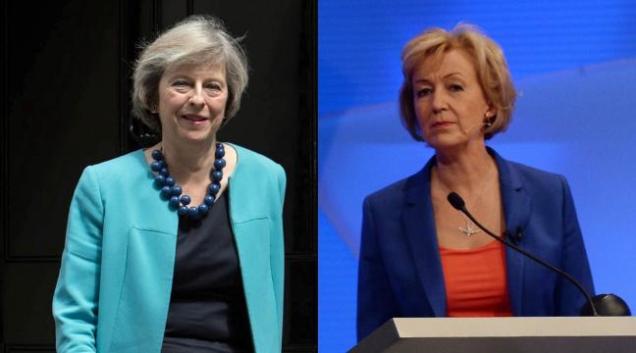
Leadsom vs May – Two Risky Options

Theresa May - Andrea Leadsom - Conservative Tory Party leadership

The very qualities which make Theresa May an awful Conservative leadership candidate on domestic policy mean that she is best equipped to handle our tough secession negotiations with the EU in Brussels. But the future leadership of the United Kingdom cannot be viewed solely through the lens of Brexit…

Dr. Richard North perfectly captures this blog’s dilemma in trying to choose between two highly sub-optimal candidates for Conservative Party leader and the next prime minister:

With a final contest between May and Leadsom, [if] Leadsom wins, we are faced with the great danger of having a woman as prime minister who has little understanding of what it takes to negotiate a successful withdrawal from the EU, and no capacity to develop that understanding.

On the other hand, if May is elected, we are faced with a danger just as great, in having a prime minister who brokers an exit plan which is so successful that we end up stuck with it, and in a position far worse than we are at present.

If this sounds perverse, it is. What we are seeing from the “remains” is a sudden enthusiasm for the Efta/EEA or “Norway option”, an option which, prior to the referendum, they had all been falling over themselves to demolish.

This, as readers here well know, we support as an interim option, acknowledging that it would be completely untenable for the United Kingdom in the longer term. We thus look for a different end game, which then takes us out of the EEA – with other Efta members – leaving the Agreement to collapse.

Unfortunately, the opposition is wise to the flaws of the EEA option and, from the Robert Schuman Foundation, the intellectual heart of the EU, we see proposals to modify the EEA to such an extent that it will soften some of the worst features of the EEA, and thus weaken the pressure to move on.

Dr. North goes on to describe the chicanery by which this might be accomplished – basically by making the EEA Council rather than the Council of the European Union the lead body in approving single market legislation, tackling the (already disingenuous) complaint that being in the EEA means accepting all of the rules while “having no say”.

While superficially appealing, this could lead to Britain being permanently parked in a significantly sub-optimal position on the edge of a still-integrating Core EU in which the eurozone would inevitably be dominant. It would certainly undermine one of the key benefits of Brexit to an interim EFTA/EEA access “departure lounge”, namely the restoration of Britain’s right of reservation which we could apply to new regulation which threatened to inflict significant or unacceptable harm on our key industries or vital national interests.

But while a Theresa May premiership increases the risk that Britain is sucked into a sub-optimal “associate member” status on the EU’s margins, Andrea Leadsom would do almost the exact opposite – invoke Article 50 almost immediately and then effectively let Jesus take the wheel, hoping that something satisfactory is miraculously negotiated within two years. Having recently started to appreciate the true complexity of the global trading and regulatory environment, largely thanks to my involvement with The Leave Alliance, it is immediately apparent that Leadsom’s cavalier approach to our EU secession negotiations is fundamentally unserious, no matter how genuine her euroscepticism.

Leaving aside issues of personality, experience and gravitas – for few could seriously deny that May would be the more formidable negotiator to fight Britain’s corner – it is hard to see how a Leadsom negotiation could succeed when the candidate seems sure of little besides her impulse to take Britain out of the EEA, making our trade subject to the EU’s common external tariff in the far from certain hope that doing so dramatically cuts immigration.

Therefore, from a purely Brexit-related perspective, Theresa May seems (counter-intuitively) to be the better choice if we want to maximise our chances of escaping from the EU’s always-tightening political union while disrupting trade as little as possible – even if this means that we have to remain permanently vigilant to ensure that May does not backslide from her commitment that Brexit means Brexit.

But of course this Tory leadership election is not only about Brexit – though our secession from the European Union is by far the most important issue on our national plate, and will be for some time. Still, other issues cannot be overlooked entirely. Foreign policy, civil liberties, economic freedom, education, healthcare and the role of government matter enormously too. And in many of these areas, Theresa May is extraordinarily deficient.

This is why I cannot simply swallow my distaste and endorse Theresa May outright. All of these other policy considerations must also be factored into the mix – which is what I shall attempt to do in my next blog post.


Brexit - EU - European Union Flag - Missing Star - Britain - UK

Top Image: BT

Agree with this article? Violently disagree? Scroll down to leave a comment.

Follow Semi-Partisan Politics on TwitterFacebook and Medium.

Andrea Leadsom vs Theresa May – An Impossible Choice, On Which The Fate Of The Conservative Party Rests

Stepping Stones Report - Goals and Risks - Brexit - EU Referendum

At this difficult time we can take inspiration from our recent history and our last successful effort at national renewal

So it’s Theresa May versus Andrea Leadsom – the final two candidates in the Conservative Party leadership race whose names will now go forward to the wider Tory Party membership in September.

I’m delighted that the Conservatives will soon have given Britain her first two female prime ministers, I really am. When it comes to equality of opportunity the Tories deliver, while Labour bang on endlessly and fruitlessly about equality of outcome, peddle in tawdry identity politics and choose one white male after another to lead them onwards.

But does the successor to Ted Heath Mark II David Cameron really have to be one of these two women? When she entered 10 Downing Street, Margaret Thatcher already had the “Stepping Stones” report in her pocket and on her mind. By contrast, Andrea Leadsom brandishes an overhyped yet still rather thin CV, while Theresa May has your entire internet browsing history and the paranoia to use it against you.

And so, when deciding who to support in this battle to be the next British prime minister I find myself faced with an impossible choice – one may as well flip a coin.

This blog will inevitably write more about the Conservative Party leadership race in the coming days and weeks as I try to make a decision – right now I see pitifully few upsides to either candidacy, and great risk behind either option.

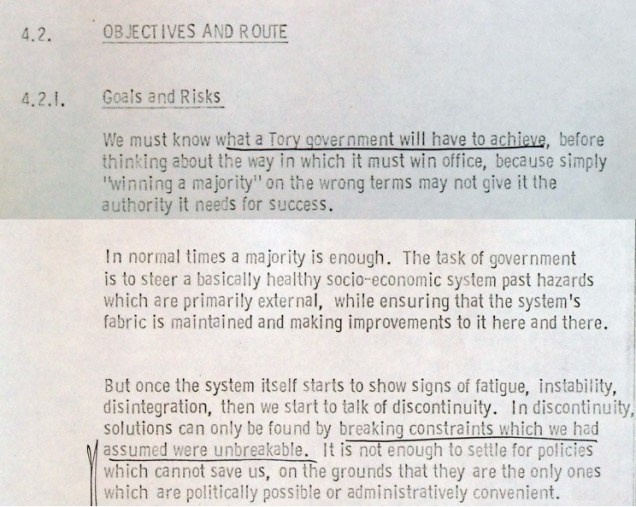
But for now I content myself with re-reading the seminal “Stepping Stones Report” authored by the late John Hoskyns, that masterful diagnosis of everything which ailed Britain in the late 1970s when the state socialist cure had almost succeeded in killing the British patient.

This report – and the solutions contained within it – quite literally saved this country when Margaret Thatcher, who had studied it, came to power in 1979. Without Stepping Stones, Britain would quite likely be a colder, more populous but equally poor and dysfunctional version of Greece. I say this to underline the amazing good which the Conservative Party can do when under the right leadership, and the thread by which such hopes often hang (Margaret Thatcher was considered a rank outsider when she first declared her candidacy for the Tory leadership in 1975).

At this time I am drawn to this passage in particular:

We must know what a Tory government will have to achieve, before thinking about the way in which it must win office, because simply “winning a majority” on the wrong terms may not give it the authority it needs for success.

In normal times a majority is enough. The task of government is to steer a basically healthy socio-economic system past hazards which are primarily external, while ensuring that the system’s fabric is maintained and making improvements to it here and there.

But once the system itself starts to show signs of fatigue, instability, disintegration, then we start to talk of discontinuity. In discontinuity, solutions can only be found by breaking constraints which we had assumed were unbreakable. It is not enough to settle for policies which cannot save us, on the grounds that they are the only ones which are politically possible or administratively convenient.

It is safe to say that the Conservative government of David Cameron and George Osborne has been in office but not really in power since being re-elected with a tiny outright majority in 2015. And aside from their creepy manifesto pledge about having “a plan for every stage of your life” it has been almost impossible to discern what the Tories actually stand for, besides staying in power.

Winning a majority has not been enough because the majority was won on the wrong terms – by a prime minister who often pitched himself to the left of Tony Blair in the tawdry hunt for centrist votes. And these are far from ordinary times. As this blog recently pointed out, quoting Lincoln, the dogmas of the quiet past are inadequate to the stormy present.

Theresa May is an accomplished technocrat, but also a fierce and implacable authoritarian. Even her more restrained actions – such as denying the former London mayor Boris Johnson the power to use his expensively purchased second hand German water cannon for crowd control – smack more of political chicanery rather than any shred of liberal principle.

On civil liberties, May is utterly monstrous. But more to the point, Theresa May came down on the wrong side of the most fundamental, existential question to face this country since the end of the Second World War.Worse, she supported the Remain campaign with a calculated half-heartedness, refusing to boldly commit and make the public case for her position. What kind of leadership is this?

Andrea Leadsom is no better. She has publicly and irresponsibly spoken about triggering Article 50 almost immediately, well before any initial scoping discussions have even had the opportunity to commence and well before the British government has had the proper chance to decide how best to implement Brexit, and seems intent on taking us out of the EEA as we secede from the European Union. Her haste is not evidence of super-virtuous commitment to democracy or an uncommon respect for the will of the people, but is the conclusion reached by what seems to be a rather glib and uncurious mind.

But whether you are less repulsed by the flinty-eyed authoritarianism of Theresa May or the oversimplifying, CV-padding antics of Andrea Leadsom, it seems reasonable to say that neither of the two remaining candidates have anything approaching a latter-day Stepping Stones report waiting in their pockets for immediate unveiling as soon as the Queen has invited one of them to become prime minister. And that is what we need most of all right now.

Theresa May’s authoritarian streak, contempt for civil liberties and belief in wielding the coercive power of the state is incredibly objectionable to this blog – yet as by far the more experienced candidate, May is best placed to negotiate good secession terms for Britain with the EU (assuming that she doesn’t double-cross us and effectively condemn Britian to “associate membership” on the margins).

Andrea Leadsom has precious little track record in government or politics in general, and has distinguished herself by saying some downright irresponsible things about Brexit. As a result, she could potentially overshadow the democratic dividend of Brexit through unnecessary self-inflicted economic wounds (e.g. by taking Britain out of the EEA). Yet she is superficially more Thatcher-like (I won’t say Thatcherite), and has the potential, however small, to grow into a far more radical Conservative leader than the soul-sappingly ideology-free Theresa May could ever be.

Choose May and you risk turning Britain into a dystopian police state while rewarding yet another ideology-free, politics-by-numbers technocrat, the kind of person whose unambitious, managerial approach to the great issues of the day turns millions of people off politics altogether.

Choose Leadsom and you risk a tumultuous and highly suboptimal form of Brexit while taking an enormous leap of faith that an untested neophyte will successfully get to grips with one of the steepest learning curves in the world, and that they will be advised well in the process.

Who can choose between these two flawed options with any degree of certainty?


Stepping Stones Report - Wiring Diagram

Brexit - EU - European Union Flag - Missing Star - Britain - UK

Top Image: ‘Stepping Stones’ Report

Agree with this article? Violently disagree? Scroll down to leave a comment.

Follow Semi-Partisan Politics on TwitterFacebook and Medium.

American Conservatives For Brexit, Part 5 – The National Review Endorses Brexit

Americans for Brexit - EU Referendum

If the future is a post-democratic world then Brexiteers should be proud to have the support of the magazine founded by William F Buckley in order to stand athwart history yelling “Stop!”

“A conservative is someone who stands athwart history, yelling Stop, at a time when no one is inclined to do so, or to have much patience with those who so urge it”William F Buckley

The National Review comes out forcefully for Brexit, in an excellent piece which takes David Cameron to task for the tawdry and nauseatingly left-wing campaign he has run.

Money quote:

One of the less noticed aspects of the referendum campaign has been the extent to which Cameron has had to rely more and more on fundamentally left-wing arguments to make the case for the EU — and, indeed, to rely more and more on Labour and trade-union organizations, too. He removed from the government’s program some items of legislation that were especially offensive to labor unions in return for the unions’ spending more on campaigns to arouse their apathetic members (many of whom are in fact Euro-skeptic). That oddity has gradually revealed two hitherto unseen truths about the campaign: First, the EU is essentially a left-wing corporatist cause that is hard to support on conservative grounds; second, the traditional Tory arguments of patriotism and free enterprise not only can’t be appealed to, but would arouse emotions on the right that would weaken Remain’s entire case, including its only positive argument for staying in.

That argument is that Britain would face ruin outside the EU and prosperity inside, as all “experts” know. Those experts turn out to be (some) corporate businessmen, the leaders of international organizations such as the International Monetary Fund, and heads of governments such as President Obama. Delegations of all three have been turning up in London and issuing grave warnings about Brexit at regular intervals. Small businesses and native entrepreneurs such as inventor James Dyson apparently don’t count as experts, but they have been speaking out in favor of Brexit, as have a significant number of leaders of both British and multinational corporations. What is emerging as a fault line is that this battle is between Davos Man and the rest of us.

The National Review goes on to criticise the sheer defeatism and pessimism of the Remain campaign, whose pitch to the electorate has basically been that Britain is too small, weak and puny to prosper outside of the EU’s political union:

It would be easy to continue rebuking the alarmist scare stories from Remain — and distinguished economists, including two former British finance ministers, have been doing so with zest. What is more important is to realize that they are designed not to persuade but to instil a sense of defeatism in the British people. Their consistent message is that the Brits are rubbish, can’t hack it, need the protection of Europe, and that anyone who differs from this masochistic view is in the grip of an imperialist nostalgia.

That is nonsense. The Brits are an unusually influential middle-ranking power in military, diplomatic, and intelligence terms. Culturally speaking, they are a global superpower. And — to repeat — Britain is the fifth-largest economy in the world, a leading member of all the main international bodies and likely to remain so, and a country which is a byword for effective democratic constitutional governance. It is — or ought to be — shocking that a British government should seek to instil a false sense of failure and dependency in its citizens in order to win a campaign they can’t win on the intellectual merits of the case.

And of the three explanations later offered by the National Review for this appalling behaviour from the British establishment, the third is the most persuasive:

Third, and above all, a half-conscious rejection of democracy. For the EU is a mechanism that enables the political and other elites in Britain to escape from the constraints of democracy. It removes power from institutions subject to the voters in elections, such as the House of Commons, and vests it increasingly in courts and bureaucracies in Brussels that are effectively free of democratic control and even of democratic oversight. As a result, the EU is seductively appealing to those who want to exercise power and who believe they would do so more responsibly and successfully if they did not have to account for their decisions to… well, ordinary people like their relatives.

All three passions are temptations to the power-hungry, and they have shaped a Remain campaign reflecting the interests and values of post-national, post-democratic elites. Once we step outside the moral universe of these elites, however, there is no case whatever for Britain to surrender its self-governing democracy to Brussels.

With the due deference of outsiders, we urge the British people, our friends in peace, our allies in war, to be true to themselves and to their democratic traditions on Thursday. That should be more than enough.

A good argument, well made. When publications as diverse as the National Review and Spiked are making the same case, warning against the attempt by European elites to construct an unaccountable, post-democratic society, alarm bells should seriously start to ring.

And in the fight against the dystopian, post-democratic future heralded by the European Union, it is good to have the endorsement and support of the American publication whose founding mission is to “stand athwart history, yelling Stop!”


European Union - United Kingdom - Britain - Flags

Top Image: CNN

Agree with this article? Violently disagree? Scroll down to leave a comment.

Follow Semi-Partisan Politics on TwitterFacebook and Medium.

American Conservatives For Brexit, Part 4

UK EU flags

Brexit is very much in the American spirit of independence, and in no way harmful to long term US interests

In an excellent piece for Colorado Christian University’s Centennial Institute, James C. Bennett argues convincingly that the US national interest is no longer best served by pursuing the post-war policy of playing midwife to a terminally flawed United States of Europe.

Bennett begins by exposing the sheer implausibility of a stable, functional, democratic European state – the clear and unabashed goal of most EU leaders – ever emerging at all:

To begin with, the idea of a united Europe that would be genuinely federal, which is to say anything other than an empire of one culture over the others, is highly unlikely if not chimerical. To the extent Europe today works, it is an empire of Germans, with the French as their lieutenants, over the rest. The Germans try to be polite about it, unless money is at stake, but the reality is a bit too visible for comfort these days. The British who believe in the idea of their place in a federal Europe, tend to work as lieutenants to the Germans on economic matters, and allies of the French on security matters, except where it comes to cooperation with the US, where they have only minor allies from Eastern Europe, who do not count for much in Brussels.

As many critics of the EU have noted, democracy requires a demos — a distinct national community, which shares the language, institutions, memories, and experiences that make possible a meaningful discussion about the decisions that must be made through political means. There is no such European people, rather, a series of national communities who each have their own discussions. European institutions are therefore particularly prone to decision-making by consensus of elites, many of whom are distant and insulated from the opinions of the people they supposedly represent. However, it is also the case that decisions are often simply not made, and inertia rules, while problems are merely kicked down the road year after year. The Single Currency provides examples of all of these phenomena — it took a long time to come to the decision to launch it; it was only ever wanted by a few elites; popular opinion was almost universally against it; it worked better for some nations than for others, but poorly for most; and there is no momentum either for changing institutions to make it work better, on the one hand, or abandoning it on the other.

This point about the perennially absent European demos is absolutely key. Even if one were to wave a magic wand and instantly make all of the European Union institutions directly elected, properly empower the European Parliament and take other measures to correct what is understatedly termed the EU’s “democratic deficit”, it would not give those institutions any greater legitimacy.

If Britain were suddenly annexed by India and British citizens given a vote in Indian elections this would not be “democracy”, but rather the smashing together of one demos against another. British citizens would not feel part of the Indian state, would have no emotional connection to it and no great political interest in it. And so it is now that Britain is effectively annexed by the European Union. Even building a perfectly modelled federal government for Europe would not erase the stubborn fact that most British people do not “feel” European first and foremost, and therefore cannot participate meaningfully in its political life.

Bennett goes on to criticise the EU as a weak partner to the United States:

Furthermore, the EU is not turning out to be a useful ally for the US, nor is Britain able to influence very much in directions the US desires. To the extent it has ambitions in the security area, these typically create a rival and inferior capability to what already exists through NATO. To the extent it has ambitions in the foreign policy area, it is so hard to establish a consensus among European powers that its policies are usually much weaker than what Britain typically adopts by itself. The European federalists are now agitating for France and Britain to give over their UN Security Council seats to the EU, which will again substitute the weak and uncertain voice of the EU for the more assertive voice of the UK.

While the EU’s leaders clearly have dreams of wielding great influence on the world stage, they are constantly stymied in their ambitions by the fact that they are called on to reflect the squabbling and divergent interests of 28 separate member states. Floridians and Californians are happy to be jointly represented by the State Department because they owe their primary allegiance and affinity to the United States of America. By contrast, Brits and Swedes are not greatly thrilled to be jointly represented on the international stage by Italian former Young Communist Federica Mogherini. On paper, Mogherini speaks for all of Europe. In reality, she speaks only for an EU elite numbering in the thousands, not millions.

Bennett, like this blog and others of The Leave Alliance, believes that an interim EFTA/EEA (or Norway Option) Brexit path is the most likely outcome in the event of a Leave vote, minimising the economic and political risks by guaranteeing Britain’s continued access to the single market:

The international financial community would probably default to the second most desirable option from their point of view, which would be to press for British membership in the European Economic Area and the European Free Trade Association, the so-called “Norway Model.” Although in theory there are a number of potentially viable options for post-Brexit relations between the UK and the remnant EU, the EEA-EFTA model would be the most accessible, best understood, and least disruptive option, and therefore the one the financial interests would prefer. The major European leaders would then come under very strong pressure to announce their support for such an outcome. Once made, along with guarantees to expatriates and other interests, this would restablilize markets and probably become the signal for a sustained rally.

This recognition of economic and political reality immediately puts James Bennett well ahead of serious American journalistic outlets including CNN, USA Today and the New York Times, all of which defaulted to the most apocalyptic and unlikely of Brexit scenarios in their effort to make the idea of Britain leaving the EU seem like a reckless risk with no potential upside.

However, Bennett’s assessment on the impact of Brexit on American interests is better still (my emphasis in bold):

From a short-term perspective, Brexit would have relatively little effect on American interests. Article 50 of the European Union’s current constitutional document, the Lisbon Treaty, provides for member-states to withdraw by giving a two-year notice of intent to withdraw, and mandates the EU to negotiate in good faith for free-trade measures during that time period. During that time period all rights and obligations of membership continue as normal, so US companies operating in Britain would continue to function as normal. The EEA-EFTA option would also permit such companies to operate as normal after EU membership was terminated. Most other US-UK cooperation, such as military and intelligence cooperation, is conducted under bilateral or multilateral agreements having nothing to do with the EU, and would continue to function as normal.

The biggest short-term effect will be on the American foreign policy establishment, in seeing the fundamental assumptions of their world view challenged. Some will cling to the past, and hope that the UK, humbled by life outside of the EU, will repent and ask to rejoin. This is highly unlikely, as it is more likely that the EU, now shorn of the most powerful and stubborn opponent of a United States of Europe, will proceed to greater centralization, although it is also possible that it will shed a few other recalcitrant members, perhaps including Denmark and/or Sweden. The Franco-German core, and the principal Eastern and Southern European dependent states will likely remain. However, this reduced remnant EU will still not become the capable and willing partner the US State Department has always craved. Rather, it will be a medium-large power with problems, somewhat like Japan but with a less capable military.

Exactly so. The only threat posed by Brexit concerns the outdated thinking of certain fossils and arthritic thinkers within the State Department, many of whom seem to be operating based on mental software which has not been updated since the height of the Cold War, when large regional blocs were both the norm and the key to the West’s victory against the Soviet Union. The world has moved on.

And in this age of globalisation, when regulatory harmonisation and convergence are key precursors to unlocking further economic growth, what matters most – though you may not hear many others speaking of it – is ensuring that ordinary people, through their national governments, have the ability to influence these standards and decisions when they are made, and on rare occasions to exempt themselves from them as a last resort. This applies as much to America as to Britain. But from the British perspective, the EU is an active impediment to this process, diluting our influence before we even get to the regional and world bodies which are the source of much new regulation.

And away from the trade sphere, it is self-evident that Britain will remain the only truly indispensable ally of the United States for the foreseeable future. Our shared history and overlapping cultures, together with the fact that Britain wields a military and diplomatic clout far in excess of any other European nation (though recent generations of meek political leaders have often failed to properly leverage this advantage) mean that the idea of Washington pivoting away from London and towards Berlin is pure fantasy. Simply put, you don’t ditch the partner which offers a blue water navy, a nuclear deterrent and a permanent seat on the UN Security Council, no matter how much certain wobbly-lipped EU apologists may suggest that Brexit would somehow damage the special relationship.

Ultimately, a realisation must eventually dawn on the American political elite and foreign policy establishment that the dream of a United States of Europe incorporating the United Kingdom – a term conjured by Churchill but never intended to include Britain – is untenable. A federal Europe may yet emerge from the “core” EU nations, but as James Bennett points out, this will be a distinctly medium-sized power beset with many intractable problems of its own and unlikely to be a great proactive partner to the United States, at least in military matters.

Thus a re-evaluation is necessary. Today, Britain is seeking to assert her independence from a terminally flawed and profoundly, deliberately antidemocratic supranational government of Europe. Americans once knew something about seeking independence from empire and asserting the right of a people to govern themselves, captured in the cry “no taxation without representation”.

America also knows something about turning up a bit late to important, existential fights. And so even at this late hour, it would be gratifying if more American leaders paid heed to James C. Bennett, sought to rediscover that spirit of independence, democracy and national destiny which has been increasingly absent of late, and lent their vocal support to the Brexit cause.


Winston Churchill - United States of Europe

European Union - United Kingdom - Britain - Flags

Top Image: WalesOnline

Agree with this article? Violently disagree? Scroll down to leave a comment.

Follow Semi-Partisan Politics on TwitterFacebook and Medium.

Quote Of The Day

Angry Mob Fun Run

Standing athwart the European Union, yelling “Stop!”

This, from William F. Buckley Jr.‘s 1955 founding mission statement inaugurating the American conservative journal National Review, seems particularly apt at this point in British political history:

Radical conservatives in this country have an interesting time of it, for when they are not being suppressed or mutilated by the Liberals, they are being ignored or humiliated by a great many of those of the well-fed Right, whose ignorance and amorality have never been exaggerated for the same reason that one cannot exaggerate infinity.

This certainly holds true for small-c conservative Brexiteers, who have been not only ignored and humiliated but also scorned and threatened by the current Conservative prime minister, he and his chancellor both staunch members of the “well-fed Right”.

But perhaps this later quote from the same article might give hope to Brexiteers regardless of what happens on referendum day, and even if our efforts come up short:

That, a thousand Liberals who read this sentiment will say with relief, is clearly not enough! It isn’t enough. But it is at this point that we steal the march. For we offer, besides ourselves, a position that has not grown old under the weight of a gigantic, parasitic bureaucracy, a position untempered by the doctoral dissertations of a generation of Ph.D’s in social architecture, unattenuated by a thousand vulgar promises to a thousand different pressure groups, uncorroded by a cynical contempt for human freedom. And that, ladies and gentlemen, leaves us just about the hottest thing in town.

Having right on one’s side is no small thing, and we Brexiteers have it. The human desire for freedom and self-determination is not a fad or a passing fashion. It does not grow old, and despite the European Union’s continual attempts to snuff it out, it will only grow stronger the more the EU infringes on our right to exercise meaningful control over our lives and communities, and hold our leaders to proper account.

Brexit will happen one day, whether that process begins with a Leave vote in the referendum this Thursday, in some future referendum or by the unilateral decision of a future British government faced with no other choice. Brexit will happen, even if only when the entire rotten apparatus of the EU’s supranational government disintegrates and comes crashing down around us. This anachronistic attempt to build a post-democratic society of consumers rather than citizens will fail.

As Pete North so eloquently puts it:

But Brexit is not a word that will die quietly because it is an idea, behind which there is passion and a body of knowledge which cannot be silenced. And so for as long as there is no mandate for the EU and people willing to do whatever it takes to get us out, we will be here time and again.

We are told that Brexit is the province of fearful old men, but as I look at my co-conspirators I see thriving minds of all ages, each with their own motives, all of whom have different ideas – but agree on one thing. The EU is not a democracy and there is no resolution until we leave.

Among them are technicians, physicians, lawyers, writers, engineers, scientists, teachers and labourers. In this there is no racism, no seething nationalism and no nostalgic delusions. Just a recognition that the EU remains a thorn in our side and a brake parachute on progress.

And what I can tell you about these people is that they are all kind, warm, dedicated people. It has been humbling to see how many sacrifices they have made to give all that they can to this campaign. A far cry from the devious, scheming liars whom we are pitted against.

And that is why I know we will leave the EU one way or another. That decency will prevail. Maybe not on Thursday, but probably in my lifetime. In the coming months and years, having had this bitter debate, we will all come to know the EU as the castle of lies it has always been.

No matter the result, the democratic case for Brexit (advocated by The Leave Alliance, this blog and our many generous readers and supporters) will not be vanquished. And while it may be stretching truth to describe us as “the hottest thing in town”, it is certain, absolutely certain, that our day will come.


European Union - United Kingdom - Britain - Flags

Agree with this article? Violently disagree? Scroll down to leave a comment.

Follow Semi-Partisan Politics on TwitterFacebook and Medium.