This Extraordinary Pope, Ctd

Andrew Sullivan’s take on the extraordinary interview given by Pope Francis to a Jesuit publication is well worth a read. In this series of articles, Sullivan explores not just the stylistic differences between the new pope and his predecessors, but also the likely (and less likely) implications for church doctrine and policy. Well worth a read.

Andrew Sullivan's avatarThe Dish

Pope Francis Attends Celebration Of The Lord's Passion in the Vatican Basilica

Well, if the theocons hadn’t got the message by now, they can only blame themselves. The new interview with Pope Francis is a revelation. This Pope is not the Pope of a reactionary faction obsessed with controlling the lives of others – a faction that has held the hierarchy in its grip for three decades. He is a Pope in the spirit of the Second Vatican Council, a Pope with a larger and more humane perspective than the fastidious control-freaks that have plagued the church for so long. I need to read and absorb the full interview – it’s 12,000 words long – before I comment at any greater length. But here are the key phrases that are balm to so many souls:

“This church with which we should be thinking is the home of all, not a small chapel that can hold only a small group of selected…

View original post 215 more words

More Praise For The Vatican

Well, for its current occupant, to be more precise. MSNBC host Chris Hayes (who mirrors his mentor Rachel Maddow in speech and writing to a remarkable degree), is the latest to fall under the spell of Pope Francis I, for many of the same reasons that this blog has praised the new pontiff.

francis1

Hayes gushes:

You know who I freakin’ love? This new pope. Pope Francis. You know who I’m talking about, right? The pope. Are you watching this guy? Because you should be. It’s early, but I’m thinking… best pope ever.

That’s original emphasis, by the way. Aside from the redundancy of explaining to his viewers and readers that Pope Francis is indeed the pope, the style is just like Rachel Maddow Mark 2, right? The stylistic similarities between Maddow and her protege are quite astounding. But I digress. Hayes also picks up on the new pope’s penchant for making cold-calls to the faithful who write to him of their problems:

Perhaps most amazing of all: the pope is now picking up the phone and calling people who write to him for advice and prayers—earning him the nickname “Cold Call Pope.” He phoned a woman who had been raped by a police officer in Argentina, telling her she was not alone, and to have faith in the justice system.

He’s comforted a pregnant woman whose married boyfriend tried to pressure her into an abortion, Francis offering to personally baptize her baby.

He also rightly picks up on Francis’ more humble demeanor:

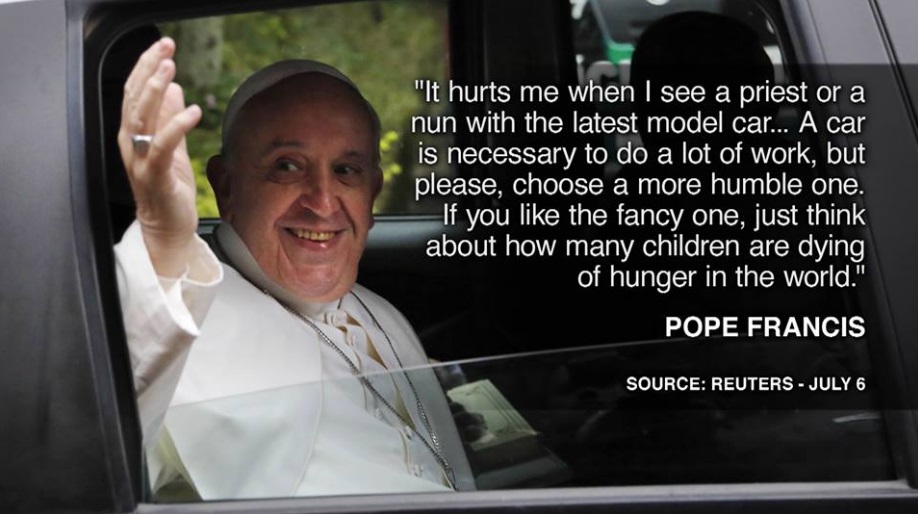
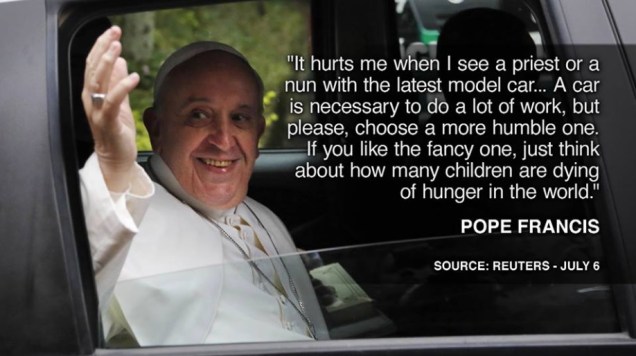
He showed up to World Youth Day in Rio de Janeiro, not in the imposing Popemobile, but in the back of a rental car. He’s not above taking a selfie with the kids. He plans on driving a used car around town. And he’s urged others to do the same: ”It hurts me when I see a priest or a nun with the latest model car. A car is necessary to do a lot of work, but please, choose a more humble one. If you like the fancy one, just think about how many children are dying of hunger in the world.”
francis2

The one area where Hayes and I differ is the degree to which this wonderful, welcome rhetorical shift will actually lead to any significant step change in Church doctrine or Vatican policy. Hayes says this in his article:

But Francis has also shown he’s pretty good substantively, as well. On the once taboo subject of homosexuality, Francis told reporters: ”If someone is gay and he searches for the Lord and has good will, who am I to judge?”

Clearly, he sees this as something substantive, but I find it hard to apply that term unless there are meaningful changes afoot to reform Church teachings on gay marriage, the ordination of women priests and other such issues – something that is clearly not on the horizon.

Nevertheless, I join Chris Hayes in celebrating the warmer, more inclusive tone now emanating from the Vatican. May it spread down from Pope Francis to his brother cardinals, the archbishops, bishops, priests and of course the laity, where it might really start to do some good.

Some interesting and fun Pope Francis memes can be found here.

Glenn Beck Analyses Reza Aslan

By now you have probably already watched the toe-curlingly, excruciatingly embarrassing car crash of an interview between Fox News host Lauren Green and her guest, the author and religious scholar Reza Aslan:


Every website, commenter and pundit has already said their piece, most to the tune of “what do you expect from Fox News, they are the unabashed mouthpiece of the religious, fundamentalist Christian right wing in America”. After awhile, watching and reading the variations-on-a-theme commentary became tiresome.

Until I discovered Glenn Beck’s alternative analysis on Reza Aslan and his book, “Zealot”:


Apparently, Aslan is a phony Muslim and a phony scholar. His true identity – of course – is that of a radical progressive. This is made clear by the fact that Beck sticks the logos of various liberal groups (and, of course, archvillain George Soros) tenuously associated with Aslan on his rotating blackboard:

Reza Aslan + Liberal Organisation Logos = Evil, apparently

Oh no! MediaMatters! The Center for American Progress! Beck has torn apart Reza Aslan’s shadowy liberal secret life in only nine minutes.

Because of course in Glenn Beck Land it is impossible to be a Muslim, a scholar and a liberal all at the same time. To acknowledge that fact would be to undermine his entire fear mongering, super profitable worldview.

Sexism, Alive And Well in Georgia

One ball more than Patrick Stuart - CEO of Strong Rock Christian Academy - possesses.
One ball more than Patrick Stuart – CEO of Strong Rock Christian Academy – possesses.


Some depressing but thoroughly unsurprising news from the land of segregated school proms, this time concerning sports and religion today, centering on a private Christian school in Atlanta where apparently the teachers and administrative staff are every bit as immature as some of the students.

ThinkProgress reports that a twelve year old girl was kicked off her school’s football team for a reason so jaw-droppingly moronic that it took me several minutes to come to terms with the knowledge that something of this nature could take place in the twenty-first century:

A private school outside Atlanta recently informed 12-year-old Madison Baxter that she would not be welcome at tryouts for the 7th-grade football team, even though she started on the sixth-grade team and has been playing football since second grade. The reason she won’t be allowed on the field? Because her male teammates are beginning to have “impure thoughts” about her, Strong Rock Christian Academy school administrator Patrick Stuart told Baxter’s mother.

“In the meeting with the CEO of the school [Patrick Stuart], I was told that the reasons behind it were one, that the boys were going to start lusting after her and have impure thoughts about her and that the locker-room talk was not appropriate for a female to hear even though she had a separate locker room from the boys,” Baxter’s mother, Cassy Blythe, told Atlanta’s WXIA-TV.

So the school’s reaction to finding out that the boys on the team were lusting after the one girl (which is pretty much what twelve year old boys do), was not to tackle the problem with any sense of proportionality, or direct their action at the people doing the “lusting” (which goes mysteriously undefined throughout the article and the school’s statements), but rather to penalise the innocent girl and remove her from the team.

The article caustically concludes:

There are more than 1,500 girls playing football at American high schools, according to the National Federation of State High School Associations, and that number has increased more than 17 percent in just four years. It’s not just a boys’ sport anymore. And more than that, playing football with a girl could have been a valuable experience for Baxter’s teammates about how to appropriately interact with women and girls, about how a person’s sex doesn’t make her inherently inferior athletically or in any other way, and about how having “impure thoughts” doesn’t mean you have license to act on them. They won’t get that lesson, though, because the adults in charge of Strong Rock Christian Academy’s athletics program apparently have yet to learn it themselves.

Absolutely. This poor girl is being denied the opportunity to continue to represent her school on the football team because the “adults” supposedly in charge of the Strong Rock Christian Academy (with a name like that, you can already be quite sure that they harbour and teach some fairly wacky views) are too prudish or squeamish to sit down with the boys on the team and have a serious – and yes, mildly uncomfortable and awkward – discussion about acceptable behaviour toward people of the opposite sex. If, given this gold-plated opportunity to impart some useful information to the boys on the team, the adults choose to duck the challenge, how much does this diminish the chances of those boys to grow and develop healthy attitudes to their female peers?

My shock at reading this story, not in 1953 but 2013, was tempered, however, when I realised that the unfortunate events took place in the great state of Georgia. Georgia is, of course, famous for being the last state in the union to have a school district that continues to hold racially segregated proms.

Way to go.

Want To Change Religion? Get Permission From A Judge First

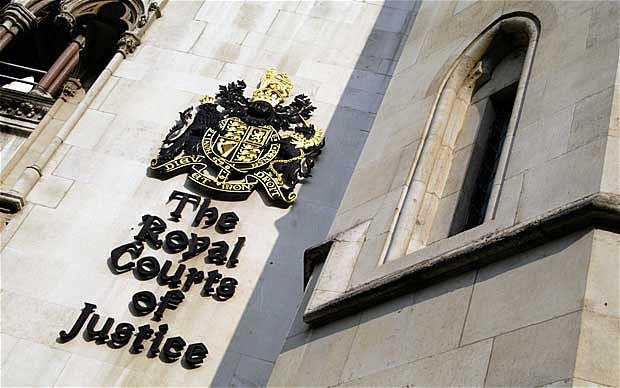
Royal Courts of Justice

Want to change religion? Then you’d better get permission from a judge first, if you happen to be under the age of eighteen and your parents can’t don’t give you their blessing.

That is apparently the law of the land in Britain today, or at least the precedent set by a recent ruling in which a a County Court judge ruled that a ten-year-old girl would be allowed to follow her wish to convert from Judaism to Christianity and be baptised, denying a request from the girl’s mother to grant an injunction forbidding the father from allowing her to proceed.

The Telegraph reports:

The court heard that the girl, who cannot be named for legal reasons, was born in late 2001 to Jewish parents and grandparents. But her mother and father divorced in 2010 and she, and her younger brother, now live for a week at a time with each under a shared parenting agreement.

Her father converted to Christianity after the breakdown of his marriage.

In November the girl’s mother, without telling anyone, applied for a court order forbidding the father from baptising or confirming her into the Christian faith. The judge heard evidence before deciding how to respond to the application.

I happen to think that the judge in this case ruled very wisely and sensitively on the case – you can read the full decision here. He also wrote and made public a letter to the girl in question, explaining his decision. I believe that he did a good job in a difficult situation.

But to my mind, this isn’t the type of matter that should ever come up for judicial review at all, or be subject to the whims of a random judge. Family law is a complicated area in which I have absolutely no expertise, but the crucial principle at hand in this case is liberty. There mere fact that the mother and father of this girl were arguing in court about the worthiness of an injunction preventing a person from changing their religion is highly inappropriate.

Religion and faith are matters of personal conviction and are private to that individual. No conceivable harm could befall this girl as a result of converting from one religion to another, and therefore this matter should be well beyond the remit of what a court injunction can be used for. The girl, and she alone, should be free to believe whatever she wants to believe, and to be received into the faith of her choosing in a manner consistent with their customary rites and practices. There is no welfare issue at stake for the child – indeed, the only conceivable harm that could occur would be to the hurt feelings of one or other parent.

In this case, the girl’s freedom of thought and speech were ultimately protected by an empathetic and restrained judge. However, a future court might rule differently, and issue an edict forbidding the person concerned from following their own will and their beliefs. In order to preserve freedom for the individual, and religious liberty, it must be made clear to the courts that they have no business arbitrating parental disputes such as this, or making religious choices for any British citizen.

Whether this is done through bespoke legislation, or my preferred route of a full-scale UK constitutional convention to once and for all settle the limits of crown, government and judicial power, rests – depressingly – in the hands of those who hold power today.

I would hope that they will see this case as a warning sign, and take meaningful action in defence of liberty.