He does this to make a point that should be fairly obvious, but which too many of us continually miss – that were the shoe on the other foot, or rather the other religion, it would be unequivocally expected and demanded of moderate Christianity to root out the fanaticism from within its base, without delay and with no excuses or exceptions.
The fact that we add so many caveats and exceptions when making this demand of moderate Islam is therefore, according to Hodges, prima facie evidence that we currently give leeway and grant concessions to Islam that we would not do for any other faith. In Hodge’s imaginary alternate universe:
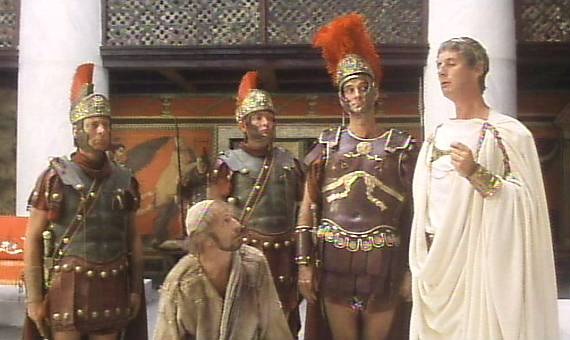
Then came another attack. Two Christian gunman walked calmly onto the stage of the O2 arena, and machine-gunned to death John Cleese, Terry Gilliam, Eric Idle, Terry Jones and Michael Palin, as they performed their comeback tour. It was, their killers later revealed in a video-taped message, in revenge for the lampooning of Jesus in “The Life Of Brian”. Witnesses at the O2 claimed that as they ran from the stage, the assailants were heard to shout “We have just killed Monty Python”.
A day after the O2 attack, the BBC Today program sent a reporter to High Wycombe, to gauge the reaction of members of the local Christian community. It was “painful people had to die in this way” one interviewee conceded. But the Monty Python cast should not have mocked Jesus. “I love Jesus,” he said. “More than my mum, more than my dad, more than my children.” It was legitimate to insult individuals or people he added, “but not God, not Jesus. We will not allow that. If they are going to do that, that [the attacks] will happen again and again.”
One of the aspects of British life that this blog finds hardest to tolerate and justify – aside from our lack of a written constitution, the complete absence of checks on Parliamentary power, our deference to government authority and the eternally unrealistic expectations heaped upon the England football team – is the fact that in the year 2014, our supposedly liberal democracy maintains the absurdity that is an established church (and de facto national religion).
The notion that Britain is a Christian nation has been a laughable, if ubiquitous proposition for many years now. To arrive at the conclusion that the UK is a Christian land, one has to redefine Christianity not as a religion, a set of beliefs, teachings or practices, but rather as some woolly abstract incorporating cherry-picked elements of history, patriotism, nationalism, whiteness, tradition, middle class anxiety and fear of change. The rather more trustworthy indicators such as weekly church attendance, changing census data and the public’s knowledge of basic Christian tenets point stubbornly and persistently in the opposite direction.
David Cameron, always more comfortable on the woollier side of a debate, naturally favoured the abstract markers of Britain as a “Christian” nation when he made his recent intervention, a rare instance of a senior politician addressing matters of faith which also conveniently eclipsed the ongoing media coverage of his incompetent handling of the Maria Miller expenses scandal.
First comes Cameron’s woolliness:
In an article in the Church Times ahead of Easter Sunday, Mr Cameron acknowledged that he is a “bit vague” on the “more difficult parts of faith” but said he has “deep respect” for the national role of the Church.
He said: “I am a member of the Church of England, and, I suspect, a rather classic one: not that regular in attendance, and a bit vague on some of the more difficult parts of the faith.
And then the pivot toward the bold assertion that despite the fact that Cameron is a religious zealot by today’s standards, “vague faith” such as this on the part of a dwindling segment of the population can be extrapolated to mean broad national consent for the primacy of one religion and denomination over all others:
He said: “I believe we should be more confident about our status as a Christian country, more ambitious about expanding the role of faith-based organisations, and, frankly, more evangelical about a faith that compels us to get out there and make a difference to people’s lives.
But the emphasis really is on the word ‘dwindling’. The Rt Rev Graham James, Bishop of Norwich, inadvertently gives the game away when he seeks to explain what he claims are “heartening” church attendance figures:
These figures are a welcome reminder of the work and service undertaken by the Church of England annually – 1,000 couples married, 2,600 baptisms celebrated and over 3,000 funerals conducted every week of the year.
The fact that there were 400 more departures than additions to the ranks of the faithful in his diocese may have failed to set off alarm bells in the head of the Bishop of Norwich, but for the more numerate reader it does illustrate rather starkly the problem faced by the wider church.
Once it has been explained that 2,600 minus 3,000 equals a net loss of 400, the Rt Rev Graham James (and the Church of England as a whole) must concede the fact that a higher number of Christian funerals than baptisms represents a real and existential threat, or else they are essentially admitting that the sacraments of the church are no real way to measure the faith of the people, and that they therefore no longer matter. An admission of the latter seems unlikely.
The response of many – both to the decline in church attendance and in attempts to loosen the Church of England’s disproportionate grip on the levers of power – has been to rail against the damage of that destructive group known as the “militant atheists”, those shadowy PC paramilitaries who fight the War On Christmas and dare to suggest that claiming religious objection does not exempt a person from their contract of employment or license to do business. The Daily Mail leads the charge from this side:
The truth is that there is a new breed of militant atheists who are capable of being as unreasoning as the most bone-headed creationist. Their intolerance is a strange mirror reflection of the bigotry of religious extremists.
‘Intolerance’ here is given the broad definition of the perpetual victim, an insult hurled by those who suddenly find themselves losing their ability to impose their values and lifestyle choices on everyone else.
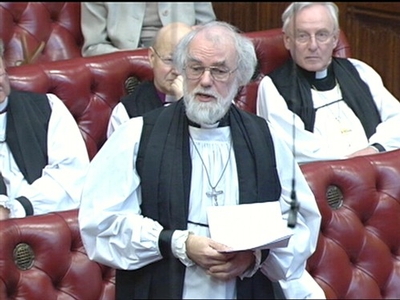
According to this school of thought, it is bone-headedly ignorant to see anything wrong in the fact that our Head of State has a constitutional duty to defend one faith above all others, or that twenty-six members of that one faith alone are entitled to sit in the upper house of the British Parliament and participate in our lawmaking.
Neither do the traditionalist defenders agree on when, if at all, Britain might no longer be considered a Christian country. Would it be when more people regularly attend another faith or denomination’s services? If so, that ship has already sailed and Britain should once again be pledging fealty to Rome and the Holy See. Or perhaps the moment of severance can be declared when a majority of people no longer agree with Church teaching on matters such as gay marriage or equality for women? But again, that moment has been passed. More likely, their answer would be “never”, simply because they will it to be so.
Parliament and the Church – divorce is needed to save both institutions
None of this means that Christianity has lost its place as the predominant religion in Britain – indeed, this is one thing clearly supported by the 2011 census data. It is certainly true that among people expressing a religious affiliation, the vast majority identify as Christians. But there is a huge gulf between acknowledging this fact and deciding that British laws and the British system of government itself should continue to be organised around and influenced by the teachings of a religion that most people only identify with on a nominal, cultural basis.
And it is on this this basis that the Deputy Prime Minister, Nick Clegg, joined the debate with a proposal to disestablish the Church of England, in order to prevent any more unnecessary harm coming either to that church or to the rest of us.
Nick Clegg has said the church and state should be separated, a view he has expressed before but one that is likely to gain fresh currency after David Cameron described Britain as a Christian country.
Clegg, an atheist, said he would like to see the disestablishment of the Church of England, which would lead to the Queen’s removal as the head of the church.
“In the long run it would be better for the church and better for people of faith, and better for Anglicans, if the church and the state were over time to stand on their own two separate feet,” the deputy prime minister said on his LBC radio phone-in show. He said he did not think this would happen overnight.
Heads will surely explode at The Daily Mail, and the likes of Cristina Odone will stay up late into the night to pen angry rebuttals, but in fact here is a very sensible proposal that would help to keep the church out of some of the more hot-button political and social debates affecting the country as a whole, while going a few steps toward establishing a more sane, comprehensible constitution for the United Kingdom.
Indeed, many of the reasons given by apologists for why the UK is a Christian country are symptoms of an established church, not justifications for continuing to tolerate one – artefacts such as the Queen’s role as the head of the church, or the presence of the Lords Spiritual in the House of Lords, for example. But this is akin to claiming that an Egyptian mummy is a living, breathing human being – sure, the body parts are in the right place (just as the constitutional elements are in place for a British theocracy) but the heart does not beat, the blood does not flow and the brain does not think like a living person.
Nick Clegg goes on to claim that the Church of England would “thrive” if disestablishment were to occur, and this may well be the case. At present, the Church has to walk a tightrope with doctrine on one side and popular opinion on the other, making it appear weak and indecisive, and pleasing to no one. Unshackled from the state, however, the church could continue to discriminate against gays and women (or more hopefully recognise their equality) without dragging the rest of the country into the debate.
Mr Cameron said: “I think our arrangements work well in this country. We are a Christian country, we have an established church,” adding that disestablishment was “a long term Liberal idea but it is not a Conservative one.”
This is conservatism of the bad kind, the reflexive hanging on to tradition not because the alternative is untried and the status quo works well, but simply out of a reluctance to rock the boat, upset the party base or start a real, informed debate. Cameron believes that the current constitutional arrangement “works well”, but take this with a pinch of salt – he also believes that parliamentary oversight of the security services works very well indeed, though it transpired that they were undertaking far more extensive and intrusive surveillance than the public had ever been aware of or given their consent.
Religious believers who oppose such a move should look to the US, where faith has flourished alongside the country’s secular constitution. Indeed, in an interview with the New Statesman in 2008, the then Archbishop of Canterbury, Rowan Williams, (who went on to famously guest-edit the magazine) suggested that the church might benefit from such a move: “I can see that it’s by no means the end of the world if the establishment disappears. The strength of it is that the last vestiges of state sanction disappeared, so when you took a vote at the Welsh synod, it didn’t have to be nodded through by parliament afterwards. There is a certain integrity to that.”
What Rowan Williams delicately calls a “certain integrity” is actually just plain old democracy, properly executed, with each citizen having a voice and no powerful interests able to sway policy based on their own narrow interests. Both church and state can make decisions in their own interests without running to each other for contentious debate or rubber-stamp approval.
The British people, usually so quick to voice their distaste for money in politics and big donations from wealthy individuals, corporations or trades union, should ponder this simple fact: of all the business moguls, special interest groups and union barons jostling to influence British government policy in their favour, only one organisation is powerful enough to boast twenty-six loyal, paid representatives ready to do its bidding in the upper house of the British Parliament. Britain’s 100 biggest employers, ten largest unions and her wealthiest people combined do not have the lobbying and legislative clout of the Church of England, an organisation that commands a weekly attendance of just 1.8% of the UK’s population.
To say all of these things does not imply a hostility of any kind to religion and faith-based organisations, despite the misleading accusations of the traditionalists; regular readers will know that this blogger is a practicing (if somewhat Cameron-vague) Catholic. Indeed, disestablishment of the Church of England, combined with a loosening of the government’s hand on all matters of faith, can only benefit religious organisations, schools, charities and initiatives through the plurality that would immediately be created.
But even if disestablishment would cause difficulty or a degree of harm to the church, that alone is not a sufficient reason to preserve the status quo. It is not the business of government to pick winners and losers, to favour some more than others, and institutions (corporate or otherwise) who rely on state aid of any kind tend to fail regardless in the longer term.
Christianity – and the Church of England – have formed a huge part of who we are as a country, influencing our laws, culture, art and traditions. We should be very grateful for this – just ask anyone who suffers or whose life prospects are narrowed or extinguished under a modern day Muslim theocracy. But we should not be content merely to be better than Iran or Saudi Arabia – the time has come to do away with an established state church entirely.
In the year 2014, it is time to finally remove the theological shackles from the British constitution, and to take the state church off life support so it may live and breathe unaided. Committed Christians and Church of England members should have the confidence in their faith and institutions to accept, if not actively welcome, this change.
Public fretting about the supposed War on Christmas may be behind us for another year, but that does not mean that the sound of wailing and gnashing of teeth emanating from certain grumpy Christian quarters has ceased entirely.
There is always some new perceived slight or attack to form the next rallying point for indignant protest at the assault on religious freedom (which can be translated as the end of state-sponsored primacy for one religion over all others, or none). And if nothing is currently happening to cause new outrage – no matter, they can quite happily argue their case to anyone who will read or listen without a clear jumping-off point.
Almost a third of children do not know their Adam from their Noah or that David slew Goliah. The Good Samaritan is a stranger and the Nativity just a Christmas play.
The latest Bible Society findings prove that the West has erased its Christian heritage from public life. I’m not surprised – only saddened that No God Zone, my e-book on the subject, has been vindicated. After decades of concerted efforts by secularist zealots, the Bible is a truly alien subject. Future generations will look on “the greatest story ever told” and think it is a 1965 movie starring Charlton Heston and Max von Sydow.
At fault, of course, is the ever-present, ever-menacing atheist brigade, who want nothing more than to tear down her church, prohibit her from celebrating her religious holidays and re-educate her to worship at the altar of multiculturalism:
A few faith schools still teach “the Good Book”; but they are under fire from the atheist brigade, and many feel that they will only survive if they promote a multicultural syllabus that stars Gandhi and Mandela rather than Abraham and Jesus.
The extraordinary, subversive book, with its lessons on charity, compassion and respect for others inspired generations to rebel against tyrannies of all kinds – dictators, addictions, vices. Men and women dedicated their lives to its teachings – and were ready to die for it. But today it seems that a host of martyrs lost their lives in vain: the Bible is just another book that sold more than the Hunger Games trilogy at some point.
How very melodramatic.
No longer the exclusive preserve of Bill O’Reilly and the Fox News Channel.
Odone worries about the children, but really it is the adults and parents who should be the focus of her concern – two thirds of British adults have no connection with the Christian church at present, half of whom having left at some point and the other half never having had any involvement at all.
As a practicing Catholic this saddens me, but unlike Cristina Odone it is not my first instinct to go lurching off to the government for redress, to make them make people behave the way that I want them to. Indeed, it speaks very poorly indeed of Odone’s supposed conservative credentials that she thinks that such a thing would be at all appropriate. A religion that requires government promotion makes itself immediately vulnerable to government influence, interference and control – something that no supporter of religious liberty should wish upon themselves.
If there is to be a Christian, or any type of religious revival in this country, it will not come about by going back to what Cristina Odone clearly sees as the “good old days” of having the Church of England shoehorned into every conceivable tradition or aspect of British life. Singing Christian hymns at public school assemblies, cramming public squares with nativity scenes or erecting stone carvings of the Ten Commandments outside courthouses are not going to make a blind bit of difference to church attendance or the practicing of Christian teachings.
Maybe Odone would rather tie the awarding of jobseeker’s allowance to church attendance rather than the claimant’s willingness to take remedial literacy and numeracy training where required – I would love to watch her make that argument, just for the fireworks that it would create. But short of extremely heavy-handed government coercion such as this, I am at a loss as to exactly what external actions she thinks should be taken.
Rather than looking outside for help that will never arrive, people of faith would be far better off engaging with their local churches, parishes or faith groups and helping them in their work to serve their communities and make themselves more relevant to the people whom they serve. For it is only through this bottom-up approach that any meaningful progress will be made.
My own track record in this area is far from impressive – very occasional bouts of deep involvement in parish life followed by months or years of either lazily sitting back in the pews or not attending church at all. But this is exactly the point – if I can only halfheartedly and sporadically muster the will to do something, why should I expect the government to enforce it on people who may have different beliefs and have no desire to follow along at all?
A parallel argument – perhaps better suited to the boardroom than the church hall, but perhaps not – would be that is it not far better to have a smaller, leaner church that is filled with more committed members and does more to show God’s love and do His work in the community than a bloated, lazy, state-supported church, topped up with unwilling attendees and with no clear direction other than to keep pleasing the government on which it depends for survival?
I believe that a strong argument can be made for just such an adaptation, one that is in any case well underway – for just as businesses must retrench and refocus during economic recessions, so too, perhaps, must religious organisations during times of spiritual recession.
Yes, the church and the values that it professes (love, understanding, charity – I’m less worried about society’s rejection of archaic cultural rules about gay people, wearing garments made from multiple types of cloth or the eating of shellfish) have experienced an unbidden and unwelcome decline, and this is a legitimate cause for concern. But if it also provides space for a sober reassessment and recalibration of our understanding as to the role of faith in our society, is there not also a great opportunity to be exploited as well? Sometimes, after all, it is necessary to go backwards first in order to move forward.
There are parts of the world where Christians really are being persecuted, quite terribly. Cristina Odone’s leafy corner of west London is not one of them, and she would do well to acknowledge this and to give thanks that she lives in a place where she is free to openly practice and profess her faith.
In this excellent piece, Andrew Sullivan anticipates the potential eventual outcomes from Pope Francis’ survey of Catholics on their views on the family and family life. Whilst I fear that a wholehearted embrace by the Church hierarchy of the more “progressive” responses such as that by leading German theologians (heavily discussed by Andrew in the article), we can all dare to dream. Any move by Francis and the Church to move toward viewing human sexuality as a gift rather than a doctrinal minefield of issues to be policed and rules to be enforced can only be a good and wonderful thing.
One of the great question marks still hanging over Pope Francis’ tenure as Bishop of Rome is whether any actual doctrinal changes will occur. Damon Linker has a provocative and honest piece out wondering if “liberal” Catholics even care about doctrine any more – because so many have been content simply to celebrate the sharp transformation of tone in the Francis era and the new emphasis on Christianity as an urgent and empowering and demanding way of life. Money quote:
I had assumed all along that liberal Catholics wanted to liberalize Catholic doctrine — that they wanted to bring the church, as I wrote in TNR, “into conformity with the egalitarian ethos of modern liberalism, including its embrace of gay rights, sexual freedom, and gender equality.” But here was a liberal Catholic telling me I’d gotten it all wrong. The pope’s warm, welcoming words are “everything,” Trish said, because…
Christians actively NOT being persecuted in Britain.
The Telegraph’s resident Moraliser-in-Chief, Cristina Odone, has done it again.
In a short column, clearly phoned in and devoted more to promoting her “new ebook” than advancing an intellectual idea of any kind, Odone decides to directly compare the persecution of Christians in other lands – persecution often marked by violent killing – to what she sees as persecution of Christians at home here in Britain. No really, she does:
Being a Christian, in some parts of the world, carries a death sentence. It carries little weight — and attracts a lot of opprobrium — in this part of the world. Having done their best to erase God from public life, secular authorities have stealthily loosened our identity as Christians. As I have written in my ebook, “No God Zone”, traditional ceremonies, rituals and even pledges have been suppressed because of their “religiosity”. Thus, when we witness the sufferings of our “brothers and sisters in Christ”, we feel only a twinge, where once we would have felt a shock.
One poorly written ebook about how Cristina Odone is prohibited from practising her religion in that terrible place, the United Kingdom, available now on your Kindle or iPad. Check for yourself.
And let me paraphrase. Cristina Odone feels so persecuted and reviled for her faith here in Britain that when she sees fellow Christians hacked to death in the middle east it is now all she can do to give them a wry, knowing nod of the head, empathising with their pain? And she thinks that other similarly “afflicted” British Christians feel the same way?
There follow a couple more uninspired paragraph where Odone waffles and fails to express an idea, and then we end with this:
Tragedies like the ones in Nairobi and Peshawar do not make me think all Muslims want to kill Christians; the al-Shabaab guerrillas are no more representative of Islam than the suicide bombers in Pakistan are. But these atrocities do bring home, as a Spectator blog quotes the former Chief Rabbi saying, the dangerous “silence of our friends”. Sadly that silence is rooted in hostility to our faith.
Where to begin? Let’s start with the notion that nefarious “secular authorities” have “stealthily loosened our identity as Christians”.
Odone would do well to find out how many readers of her column attended a church service last Sunday. Or this year. Or in their recent memory. I suspect that when she talks of “our [shared] identity”, she is actually speaking to a minority, even if they call themselves Christian (let’s call them CINOs, people who erroneously use the word Christian interchangeably with “British” or “white”).
While we’re at it, we should also send Odone back to Citizenship 101 class, so that she can learn about our hereditary monarchy pledged to “defend the faith”, the Lords Spiritual who meddle in our laws and seek to impose their particular brand of Christianity on the nation, the fact that public holidays in Britain coincide with Christian festivals and that Christian hymns are sung in state school assemblies up and down the land. How dreadfully secular.
A walking, talking advertisement for the benefits of separation between church and state
How huge must Odone’s white persecution complex really be, to behold these manifold examples of the Christian faith woven into the fabric of our society, and still come away feeling slighted, aggrieved and persecuted? Newsflash, Odone – denying civil rights to gay people and imposing your morality on others is not part of expressing your faith. Expressing your faith is all about what you yourself choose to say, read, write, eat or wear – not what you want other people to do.
Odone also chooses to bemoan what she perceives as a weak-willed response by western nations to [real] persecution of Christians abroad:
Why should the Foreign Office move heaven and earth to protect Christian minorities in the Middle East when this Coalition allows Christians to lose their livelihood on account of their religious beliefs? Why should the EU get heavy with governments in the Middle East when its member states have signed up to 41 laws that discriminate against Christians?
Here we actually have the semblance of a lucid thought, but of course Odone stops at the feeling aggrieved part rather than proposing any potential solutions to this problem. The EU does not seek to use any of its economic leverage to stop persecution of Christians in the middle east – okay, so what form should this leverage take? Cristina Odone is silent on the matter.
Actual persecution of Christians might look like this.
As for the recent suicide bombings and mass shootings at churches in Pakistan and Kenya, Odone is similarly silent when it comes to a plan of action. Does she favour a military intervention, economic sanctions, or just harsher diplomatic words? We don’t know, because she doesn’t say. And she doesn’t say because she hasn’t given it a moment’s thought.
Because of course, to Cristina Odone, this isn’t really about those long-suffering Christians tucked away in the far corners of the world. It is all about her, the Cristina Odone show, railing against the fact that centuries of engrained bias in favour of her own religion (my religion too, incidentally) are starting to be rolled back in favour of something more slightly resembling equality before the law.





 Semi-Partisan Politics