The Significance Of That Bizarre Eddie Izzard Appearance On Question Time

https://www.youtube.com/watch?v=tqSZ0QhgIw4

Eddie Izzard, Brexit Ambassador

While it was infuriating to watch at the time – I actually had to put down my iPad at times to stop myself tweeting things which I might later regret – Eddie Izzard’s tour de force of ignorance and condescension on BBC Question Time last night will have been a great boon to all Brexiteers.

Here, in one man, is embodied the distilled nature of the entire Remain campaign argument – a child’s level of understanding of the European Union’s history, what it does and how it actually works coupled with an unjustified level of arrogance and assumed intellectual and moral superiority which somehow makes them come off as smug, arrogant, condescending, pitying and self-aggrandising all at the same time.

Eddie Izzard’s strategy for the programme was clearly “Take Down Nigel Farage In A Blaze Of Glory”, and the comedian went at the UKIP leader from the outset. He would have been far better to focus his fire on the others. Nigel Farage is a man who has easily dispatched stageloads of Britain’s leading politicians in a single debate and twice bested Nick Clegg in one-on-one encounters. Coming at him with a paper thin case and the debating style of an over-excited sixth former is never going to work. It certainly didn’t last night.

The shriller Eddie Izzard became, the more he cut across Nigel Farage and make his grandstanding appeals to the audience, the more Farage looked like the adult in the room. As Izzard’s plea for more ice cream became ever more desperate, Farage leaned back in his chair with a look of bemused resignation. Considering that one of the Remain campaign’s key aims is to demonise Farage and then inextricably tie him to the Leave campaign, this was a huge unforced error.

But more than that, it showed the vacuity at the heart of the Remain campaign. Sure, there are a few honourable die hard euro federalists out there – my friend Paddy Briggs is one – but you will scarcely hear from them in this campaign. The only people with a coherent and honourable case for Britain remaining in the EU (and indeed deepening our participation) are shoved in the closet, the Remain campaign’s dirty little secret as they pretend to the rest of us that We Are All Eurosceptics Too.

The rest of the campaign is built on ignorance and fear. Yes of course large swathes of the Leave campaign are little better. But once Remain have dispatched with their meaningless pleasantries about “staying in Europe to reform it” and the importance of “cooperation” (which in europhile land can only take place between countries when facilitated by a supranational political union, for some reason), all they have left are their Armageddon stories about how Brexit would bring us all to economic ruin, or how the supposedly benign and friendly EU would behave like an abusive spouse to a departing Britain.

Pete North agrees:

We’ve heard all the europhile fluff. All the sanctimonious cliches about “not walking away from the table” and “getting in there to make it work better” and “respecting the rules of the club” and when you’re dealing with someone of great charisma it’s hard not to want to buy into that.

These are all positive and constructive sentiments reinforced with words like “cooperation” and “unity”. But sentiment is all it is. Contrivances. And if you hold only a superficial notion of what the EU is, how it works and the actual consequences of it, then that leap of faith is easier to make.

And this perhaps explains the gulf between age groups and voting intentions. Those who have wised up to the EU want out. The youthful ideologues lack the maturity and historical context to see through the veneer of shallow and meaningless rhetoric. This is what the remain camp is banking on.

And this is why I can muster a venomous contempt of Eddie Izzard. Think what you will of him and his politics but he is not a stupid man. Fatuous maybe, but not stupid. He has always been a true believer. He is a europhile to the core. And while they are capable of an extraordinary self-deception one thing europhiles do without exception is lie through their teeth. Up becomes down, black becomes white, dog becomes cat. No lie is too big and any lie will do.

Being a comedian and habitually attuned to audiences accepting a flawed premise in order to relate to the material, Izzard is able to lie with no self-awareness at all. It’s what permits him to lie as often as he does to an extent that even professional politicians would hesitate.

And this is what has characterised the European Union debate for as long as we’ve been having this debate. The attempt by europhiles to frame this as though it were a generational stand off between young progressives and old reactionaries. For one to be against the EU, in the mind of the europhile, one must naturally be a xenophobic, little Englander who could only possibly have selfish motives. This is the deceit that they wish to impress upon those new to the debate.

And this is actually what drives the blood curdling hostility between the two camps. We have a broadly europhile media class. A set of self-regarding luvvies largely culturally and financially insulated from the consequences of EU membership, believing themselves to be the living embodiment of virtue.

People wonder how the country will knit back together after this referendum. I’m not sure that it will. Pete North is certainly convinced that it will not. One thing is certain – there will be no magnanimity from the Remain side if they win.

Sure, a smiling David Cameron might come out of 10 Downing Street and make a little speech about his “renegotiation” just being the start, and how he will continue to fight for change in Europe. I can write the speech in my head already. But it will mean nothing, just as every single one of David Cameron’s convictions is built on sand. The Remain camp will take their gruesome little victory lap and crow about having defeated the forces of “xenophobia and isolationism”, and that will be that. A reconciliation reshuffle? That means nothing.

But the intellectual case for Brexit and the moral case for democracy will not have been defeated. What’s more, those of us who are custodians of these high ideals will not easily forget what has been said about us by sneering, grandstanding, virtue-signalling oiks in the Remain campaign, and their spokesperson Eddie Izzard.

Call someone wrong and they may be angry for a time. Call them morally deficient in some way (as Remainers do with their claims of boomer selfishness etc.) and it will wound a lot more. But call someone stupid and publicly mock them to their face, and you will nurture a resentment and antipathy which are almost impossible to undo. Over the course of this referendum campaign, the Remain camp have done all three.

Fortunately for Brexiteers, the glibness and shallowness of the Remain case become more exposed with every passing day. There is no new layer of complexity once one overturns their false assertion that Brexit means leaving the single market, or that all of the cooperation and partnership they seek can be accomplished just as easily outside of our current political union. The Remainers can hardly wheel out the hardcore euro federalist brigade to make their impassioned case – they would alienate far more people than they could possibly attract with their creepy, dystopian vision.

By contrast, a greater depth to the Brexit case is finally starting to emerge, as more and more influencers in the media pick up on the interim EFTA/EEA (Norway) option as an attractive first step in the Brexit process. Though it has taken an age (and may in fact still have come too late) at least the only thorough, comprehensive and safe plan for achieving Brexit is now finally starting to get a public hearing and an opportunity to allay the concerns of undecided voters.

I still feel that the odds of victory very much favour Remain, no matter what the opinion polls may say two weeks out from Referendum Day. But it is also undeniable that the broader Leave campaign has finally gained some traction – despite, rather than because of Vote Leave.

And if the Remain campaign continues to respond to these turns of events by wheeling out people like Eddie Izzard – who I think probably created a thousand new Brexiteers for every minute he had the floor on last night’s Question Time – then this might be a much more closely run thing after all.
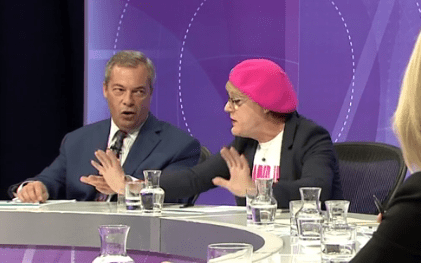

 

Nigel Farage - Eddie Izzard - BBC Question Time - EU Referendum

European Union - United Kingdom - Britain - Flags

Bottom Image: Huffington Post

Support Semi-Partisan Politics with a one-time or recurring donation:

Agree with this article? Violently disagree? Scroll down to leave a comment.

Follow Semi-Partisan Politics on TwitterFacebook and Medium.

If Wanting To Leave The EU Makes Me A Quitter, I’ll Wear The Label With Pride

https://www.youtube.com/watch?v=OAn6C-Oqqn8

Sometimes it is good to quit things. Like heroin, or the European Union…

The latest drivel to ooze from the Britain Stronger in Europe campaign is a recent clip of the prime minister, filmed at last week’s Sky News Q&A, doing his creepy “I’m so passionate” thing and suggesting that those of us who want Britain to leave the European Union to retake our rightful global role are “quitters”.

(Of course, back on planet reality there is no greater demonstration of being a quitter than for people to cling to their membership of that ragged self-help group for countries who have lost their self confidence known as the EU.)

But David Cameron insists that “Britain is a leader, not a leaver” – the logical extension of which is that we must doggedly persist with every single decision we ever make as a country, never acknowledging our errors and never stepping back from the precipice of decline, because to admit that past choices are no longer working for us (or never worked for us at all) would be to appear weak and indecisive.

What we should be doing instead, of course, is taking that “leading role in Europe” that David Cameron and his new best buddies on the political Left continually tell us is our rather dubious birthright.

And we shall show our leadership by cowering inside an anachronistic, decaying, dysfunctional and parochial regional political union dreamed up in the early 20th century and hopelessly inadequate to the challenges and opportunities of globalisation in the 21st.

It makes perfect sense, if you start from a position of rabidly and unthinkingly wanting Britain to stay in the European Union at all costs, and then carefully cherry-pick your facts and news sources in order to receive a constant stream of confirmation bias-inducing Utopian propaganda.

Stronger In, everyone!!!!!111!!!one1!


European Union - United Kingdom - Britain - Flags

Agree with this article? Violently disagree? Scroll down to leave a comment.

Follow Semi-Partisan Politics on TwitterFacebook and Medium.

There Can Be No Rational Debate With Those Who Deceive Themselves About The EU’s Purpose And Destination

European Union - EU Referendum - Supranational Government - Brexit - Remain - Leave

I am no longer willing to indulge Remain supporters who insist on deceiving themselves (and others) that the European Union is a humble trading organisation with no pretensions to statehood or aspirations for ever more power

The question which exasperated EU defenders often ask when they (unsurprisingly) fail to win Brexiteers over to their side goes something like this: “But all these world leaders and heads of NGOs want Britain to stay in the European Union! Do you really think that you know better than all of these important people?”

And on the very surface it sounds like quite a disarming point – who are we, after all, to second guess the learned and wise decisions of our rightful rulers? But then one remembers that this is precisely what we are supposed to do. The very reason we moved beyond despotism and absolute monarchy is the fact that we do not want (and no longer have to suffer) a small, homogeneously educated “born to rule” class making decisions on our behalf unchecked; that the mere fact of occupying positions at the top of the establishment makes it likely that vested interests will begin to corrupt decision making, and that democratic checks and balances are the best means we have yet devised of guiding and restraining the behaviour of our very flawed, very human leaders.

This point is eloquently expanded upon in a new piece by Pete North, itself a response to a very smug and very ignorant piece in the Guardian by Nick Cohen, gloating at the unarguable ineptitude of the official Leave campaign.

Cohen simperingly asks:

There are dozens of good reasons for leaving the EU. Before endorsing them you should ask, do you feel that the Institute for Fiscal Studies, Bank of England, IMF, OECD and the hundreds of economists we survey this week are all lying? Do you feel that all our allies who are begging us to stay wish to lead us to our ruin? Do you feel that Boris Johnson is fit to be prime minister or any kind of minister for that matter? Do you feel that Scotland won’t leave? Do you feel that Irish politics won’t darken? Do you feel that Putin won’t rejoice? Do you feel the Leave gang will find answers in June to the questions it cannot answer in May?

In short, you’ve gotta ask yourself one question: do I feel lucky?

Well, do ya, punk?

To which Pete North replies:

In his closing remarks [Cohen] asks “do you feel that the Institute for Fiscal Studies, Bank of England, IMF, OECD and the hundreds of economists we survey this week are all lying?”

I think they are politically slanted toward the status quo. I think they are exploiting the weakness of Vote Leave to disingenuously cloud the issue. I think they are wilfully ignoring facts they don’t like thus lying by omission. And I also think they are wrong because (and I say this in full knowledge of how it sounds) I have examined it from more angles than they have, and have thought about it longer and harder than they have, and I have explored areas they are barely aware of. They are largely ignorant of the political and practical dynamics. Their forecasts are of limited use and only their short term forecasts based on the immediate aftershocks have any real worth. I will argue that til the cows come home.

Cohen then asks “Do you feel that all our allies who are begging us to stay wish to lead us to our ruin?”

This is a shallow question. Firstly who governs us is absolutely none of their business. But there is a consensus groupthink at the top of global politics where they believe their own rhetoric and the rhetoric upon which the EU stands. That drives their calls for Britain to remain. But this is not about what they want. That is why we are having a referendum. I also feel that Brexit threatens to disturb that cosy consensus and it threatens their agenda for the accumulation of power. I think that is a good reason to leave in its own right. Brexit is a message that the power belongs not to them but the people. And that’s what this is fundamentally all about.

Absolutely so. Remainers love to affect that they live in a world of hard-headed reality while those of us who support Brexit and the restoration of nation state democracy are either conspiracy theorists or dangerous fantasists. But in fact it is the other way around – we have seen how supporting Brexit in the face of a chorus of establishment opposition is not only understandable but absolutely necessary in order to prevent too much power accumulating among the elites at supranational level. And it is the Remainers who studiously ignore mountains of evidence in which the EU’s architects and leaders speak quite openly about their motivations and desire to create a common European state.

But of course this does not stop Remainers from prancing around as though the burden of proof were somehow on the side of the Brexiteers. Typically, this arrogance expresses itself through articles which read something like this:

Before we can even begin to think about leaving the EU, Brexit supporters have to answer these ten simple questions:

1. What categorical assurances can the Leave campaign give that there will not be a 3 point magnitude earthquake in Torquay if Britain votes to leave the EU?

2. Where is the Leave campaign’s fully costed plan showing Britain’s GDP increasing above current trends once we cut ourselves off from the world and hang up a big sign declaring that Britain is closed for business?

3. Where is the Leave campaign’s signed (in blood) declaration from Angela Merkel that British citizens will not have to pass an IQ test before entering Germany in the event of Brexit?

4. How many human sacrifices will Britain make to appease Barack Obama after angering the US president by ignoring his advice in the referendum?

5. Where is the Leave campaign’s signed (in blood) declaration from John Kerry that the United States will not close its embassy in London and suspend diplomatic relations with Britain?

6. Where is the Leave campaign’s statement, signed by 500 economists, standing behind an economic model which proves that the price of foie gras will remain stable if Britain leaves the EU?

7. Prove that average global temperatures will not rise in the event of Brexit.

8. Prove that France and Germany will not face off against one another precipitating a new world war in the event of Brexit. (And didn’t millions of soldiers perish in two world wars precisely so that a united, supranational government of Europe might one day arise in Brussels?)

9. Prove that the Evil Tory government will not pass a bill on June 24 abolishing maternity leave and establishing mandatory child labour if we leave the EU.

10. Produce a list of fifty elected heads of state, all of whom have clear political interests in the steady maintenance of the established international order and avoiding the slightest disruptions to (or distractions from) their domestic agendas, all declaring that they want Britain to leave the European Union (with which they must simultaneously maintain good diplomatic relations)

And when Brexiteers look puzzled and inevitably fail to answer each question in a way which satisfies the EU’s cheerleaders:

Aha! See, they don’t know what Brexit will look like! Can we really afford to take the risk? Etc. etc.

Personally, I’m done playing that game. Dancing to the sanctimonious tune of the EU cheerleaders does not interest me. I do not have to prove anything. Yes, in order to persuade a plurality of people that voting to leave the European Union is safe, there must be a comprehensive and rigorous plan. Such a plan already exists, and is finally being spoken of (in content if not always in name) by a growing number of Brexiteers and commentators alarmed at the childish incompetence of Vote Leave.

But beyond promoting this plan and urging people to read it, there is nothing further left for thinking Brexiteers to do in this regard. It will never be possible to give the EU worshippers the assurances they demand – to prove that the recipe for Nutella will never change if we leave the EU. And they know this. Definitively proving a counterfactual is not possible, and it is this con which is helping the Remain campaign to a consistent lead in the polls.

But it might be possible to respect Remain campaigners a little more if they were capable of being honest themselves about the organisation which they so eagerly defend. And so when asked by sneering Remainers to prove to 100% probability that the cabbage harvest will not wither in the event of Brexit, we should respond with some challenges of our own.

And this blog’s challenge to sincere, thinking Remain supporters is for them to complete the following statements in an honest and remotely plausible manner.

Statement 1: I understand that continent-wide supranational political union is not strictly necessary in order for countries and people to cooperate and work together to solve common challenges, but I still think Britain should remain in the EU because…

Statement 2: I appreciate that global bodies such as UNECE, Codex Alimentarius, the IMO and ILO are responsible for creating much of what goes on to become EU regulations and directives, but I believe Britain should remain in the EU rather than seeking to regain our seat and wield influence at the true top tables because…

And, of course:

Statement 3: I, [insert name], want Britain to remain in the European Union because in my heart I feel more European than British, and do not want to be torn away from what I really consider to be my true country.

Remain campaigners who repeat any of these statements straight into a television camera will have my grudging respect because they will be making a case for the European Union based not on airy wishful thinking about what the EU is and might become, but rather on truthfully admitting their understanding of and acquiescence to the EU’s eventual aim of becoming a unified European state.

Those who persist in pretending to themselves and the rest of us that the European Union is benign, super democratic and Just About Trade, however, can take a hike for the remainder of this referendum campaign.

I am no longer willing to debate this issue while the Remain side occupy a position of fundamental dishonesty as to their understanding and intentions. From 10 Downing Street to Canterbury Cathedral we are being lied to, and I will no longer do anything which remotely assists these invidious people in their shameful, dishonest work.


European Union - United Kingdom - Britain - Flags

Top Image: Telegraph

Agree with this article? Violently disagree? Scroll down to leave a comment.

Follow Semi-Partisan Politics on TwitterFacebook and Medium.

Any Artist Worth Their Salt Should Abhor The Insidious, Antidemocratic EU

Save EUYO - European Union Youth Orchestra - Propaganda

The British artistic and cultural community’s almost reflexive support for the European Union and disdain for reclaiming our democracy should be a source of great shame

Like this blog, the Telegraph’s Allison Pearson is surprised that a conclave of the nation’s most successful creative types seem to prefer the dull conformity and supranational managerialism of the European Union to the democracy and freedom which could potentially flourish outside the EU.

Pearson writes:

What they really love, then, is a platonic ideal of Europe, of solidarity between friendly nations with each other’s best interests at heart. Marvellous idea, darlings, until you look at Greece. Punished, fearful and running out of medicine, the Greek people had to be sacrificed for the greater European ideal. Orwell was right. All animals are equal, but some animals are more equal than others.

Why do all these senior cultural figures support the rotten EU status quo when they should be leading the revolt against it? Munira Munzi, who was in charge of cultural policy in London under Boris Johnson, claims that many arts people agree with Brexit, but “they are worried about their careers and what people might think of them. They assume that everyone who wants to leave the EU must be anti-immigration”.

Still, not all creative types are too mushily politically correct to understand what’s at stake on June 23. Take the actor who said: “There’s so much in the 21st century that’s stymied by bureaucracy and mediocrity and committee.” His name was Benedict Cumberbatch.

The “platonic ideal of Europe” – that’s exactly it. Not the reality.

There are two factors at work here. First is the immense groupthink and social pressure within the cultural elite to hold right-on, progressive political opinions, and the potential ostracisation (or worse) which could befall particularly young artists and actors trying to make professional connections, build a network and establish their careers if they associate themselves with a movement lazily assumed to be all about xenophobia and nationalism.

Many of the key people and institutions are rabidly pro-EU beyond all reason. Classical Music magazine spent most of Friday pumping out endless “Save the EU Youth Orchestra” propaganda on Twitter, regardless of the sentiments of their readers about the coming referendum, and utterly oblivious to the fact that moments like these are precisely why the EU funds orchestras and the like in the first place – so that they have a guaranteed praise chorus ready to spring into action as soon as the hand which feeds finds itself threatened, in this case by Brexit.

(The EUYO is under threat because of a recent withdrawal of funding from Brussels, and not specifically because of Brexit).

Say you are a young orchestral musician and a supporter of democracy. Knowing that a majority of your colleagues, the trade publications and the key influencers with the ability to help your career are all passionate defenders of the EU, are you more likely to say “the hell with it!” and publicly campaign for Brexit anyway, or quietly swallow your political feelings and go with the crowd? And who could blame such a person from choosing the latter, quieter path?

The second factor leading to the infamous Britain Stronger in Europe letter is good old fashioned woolly thinking – the idea that the warm, platonic ideal of Europe in the minds of the EU’s supporters in any way actually resembles the snarling, antidemocratic beast which exists in reality.

I took this apart yesterday:

This referendum is serious business. So can Remainers please stop projecting whatever they desperately wish the EU to be onto an organisation which has never really been about friendly trade and cooperation, but is actually all about slowly and inexorably becoming a supranational government of Europe. And which is not going to abandon that long-held goal just because the British are now expressing a few doubts.

Right now, too many of our cultural leaders and elites are letting short term financial greed and/or wishful thinking about the EU’s true nature get in the way of their responsibility to think and act as engaged citizens.

Sure, if one buries one’s head in the sand and ignores the stated intentions of the EU’s founding fathers, the trajectory of integration since the 1957 and the imperative for further integration if the euro is to survive, one might successfully convince oneself that the EU is just a harmless gathering of countries who come together to trade, tell jokes, save the Earth and advance human rights. It takes near Olympian levels of denialism or apathy to maintain this self delusion, but clearly a great number of our most prominent actors, directors, producers and musicians are willing to do what it takes.

Pretending that the EU is a benign club with no pretensions or aspirations to statehood is ridiculous, and increasingly untenable. But even more unforgivable than that is being willing to overlook this reality in the grubby pursuit of grants and funding from EU bodies, or out of a desperate desire to appear forward-thinking and progressive.

And the unedifying sight of so many “household name” artists lining up to sing the praises of an explicitly political construct which falsely attempts to take credit for the cultural achievements of an entire continent is, frankly, sickening.

It has been claimed by some people that democracy is killing art. Others claim that it is liberalism which is destroying art. I disagree with both theories.

Though repression can occasionally produce its own kind of tortured beauty (see Shostakovich), generally speaking the extent to which an artist is not free and is required to make their work conform to certain external directives, requirements or purposes is the same extent to which their output falls short of greatness.

Real artists care about freedom, and cannot function without it. Unlike Benedict Cumberbatch and Sir Patrick Stewart, they don’t actively collude in suppressing freedom in order to protect the integrity of their EU begging bowl.


EUYO - European Union Youth Orchestra

European Union - United Kingdom - Britain - Flags

Support Semi-Partisan Politics with a one-time or recurring donation:

Agree with this article? Violently disagree? Scroll down to leave a comment.

Follow Semi-Partisan Politics on TwitterFacebook and Medium.

Bring It, Benedict

Benedict Cumberbatch - EU Referendum - Brexit

In their barely literate open letter praising the European Union, Benedict Cumberbatch and his cohort of EU apologist luvvies not only fail to understand what the EU is or how it works, they also shamefully pass off their own financial self interest as high-minded concern for the future of Britain

If assorted celebrities are going to sign their names to a public letter calling for the British people to vote a certain way in a referendum of existential importance, it would be decent of them to be honest about why they really want people to make that choice.

This is hardly rocket science, but apparently it was too much for the cognitively tepid minds who signed their names to a letter calling for Britons to reject Brexit for the supposed good of the arts.

The signatories are exactly the kind of people you would expect to see flaunting their right-on, progressive virtue to their fans and peers. Tracey Emin. Anish Kapoor. Vivienne Westwood. Jo Brand. Patrick Stewart. Keira Knightley. Jude Law. John Hurt. The ubiquitous Benedict Cumberbatch.

So to what exactly did they put their gilded names? Here is the full text of the letter:

The EU referendum marks the biggest democratic decision of our time, and the outcome will have lasting and far-reaching consequences for the future of this country for generations to come.

The referendum forces us to look in the mirror and ask ourselves: what kind of nation do we want to be? Are we outward-looking and open to working with others to achieve more? Or do we close ourselves off from our friends and neighbours at a time of increasing global uncertainty?

Because choosing to step out of a steadily integrating political union with an overarching supra-national government obviously means “closing ourselves off”. There are only two models of engaging with the world – the path to euro federalism or North Korea. Absolutely no other options in there at all. Sure.

From the smallest gallery to the biggest blockbuster, many of us have worked on projects that would never have happened without vital EU funding or by collaborating across borders. Britain is not just stronger in Europe, it is more imaginative and more creative, and our global creative success would be severely weakened by walking away.

And where exactly do you think that “vital EU funding” actually comes from, Benedict? Did you fall for that old chestnut about the secret magic money volcano deep beneath the European Parliament building in Strasbourg, regularly belching out €500 notes and showering them down upon grateful starving artists?

Of course there is no “EU money”. There is only British taxpayer money, the majority of which contributes toward general EU spending with only a small proportion being disbursed to various organisations in Britain, to be spent strictly as agreed by whichever organ of Brussels loftily granted it in the first place.

So is your argument actually that if Britain no longer contributed to EU cultural initiatives, the government would be inclined to use the money for other purposes? And if that is your legitimate fear, why don’t you take it up with your fellow citizens, whom you apparently believe do not value the arts highly enough? Why are you content for higher levels of taxpayer funding of the arts to take place in Britain than you think the British people themselves would allow? Doesn’t that make you the textbook definition of an enemy of democracy?

And what is all this bilge about “collaborating across borders”? Nearly all of the high profile signatories to the letter have worked on various international projects – many of them involving the United States of America, with whom of course we share no political union. Does the lack of a parliament overseeing both Britain and America mean that artists in each country can no longer collaborate on projects? Hardly.

The letter continues:

And what would ‘Out’ really mean? Leaving Europe would be a leap into the unknown for millions of people across the UK who work in the creative industries, and for the millions more at home and abroad who benefit from the growth and vibrancy of Britain’s cultural sector.

Remember when art was bold and visionary? No, neither do I. I was born in 1982, so I do not recall a time when the artistic establishment was not firmly in the orbit of government, keeping the politicos sweet in order to keep a hand in the Treasury.

But despite never having known a time when (unlike the United States of America) our greatest artistic institutions were privately funded and supported by great philanthropists, I still get the nagging feeling that any artist worth their salt – unless of the Soviet variety – should instinctively chafe at the idea of stale political union and remote continental governance, rather than rejoice in it and argue for its continuance.

Leaps into the unknown seem to me to be the whole purpose of art – to boldly go in new directions, try new things and above all seek the maximum freedom possible (the EU hardly being synonymous with freedom). And yet here assembled are the great and the good of Britain’s acting crop, telling us that the best we can now hope for is continued membership of an anachronistic 1950s model of governance dreamed up by old men scarred from the 20th century’s wars. The utter lack of vision and ambition from people supposedly paid to be bold visionaries is as shocking as it is profoundly depressing.

More:

From the Bard to Bowie, British creativity inspires and influences the rest of the world. We believe that being part of the EU bolsters Britain’s leading role on the world stage.

Let’s not become an outsider shouting from the wings.

“We believe”. Well, good for you. I believe in unicorns. But just stating a belief does not make it so. Where is the proof that being a member state of the European Union increases the demand for art, films, television programmes, sculptures, compositions, songs, albums, plays, skits, musicals or operas conceived, designed or produced in the UK? They provide no evidence because there is no evidence. If and when Britain exits the European Union and moves to an interim EFTA/EEA relationship to maintain single market access, the only thing we lose is the supra-national government. Is Cumberbatch seriously suggesting that the political institutions of the EU are his muse of fire?

It hardly needs pointing out that the two British icons cited by the signatories themselves – William Shakespeare and David Bowie – both took the world by storm before Britain joined the European Economic Community, in Shakespeare’s case by quite a few years. The beauty of art is that good or bad, high or low, it has ways of crossing political and cultural boundaries. That’s how a future North Korean defector came to watch a smuggled copy of Titanic in silent wonder, shocked and captivated by the idea of dying for a love other than love of the Dear Leader. That’s how the opening bars of Beethoven’s Fifth Symphony became a symbol of British resistance when all around us was pulverised to rubble during the Blitz. So don’t stand there and fatuously tell me that political union is required in order for art to thrive and spread, Mr. Cumberbatch. You should know that this much is a filthy lie.

Ultimately, one simply cannot take this letter seriously. And neither can one take the signatories seriously. It is certainly much harder to respect someone in public life when they knowingly use their public position to help propagate a series of lies, half-truths and obfuscations in service to an anti-democratic, embryonic government of Europe; an unrequested, unwanted and unloved supra-national government which buys the unconditional praise of scientists, university leaders, politicians and artists with your taxes and mine.

If Benedict Cumberbatch and his right-on friends want to virtue-signal their trendy, progressive opinions then good for them. Have at it. But when they seek to use their fame to influence others in the referendum debate, they should expect to be attacked for casually parachuting into the middle of the fray for the sole purpose of spreading lies, half-truths and a childishly naive view of the European Union which makes one wonder when they last watched the news (if ever).

This risible letter is nothing but a childish hymn of praise to the EU written by people convinced of their own righteousness despite being among the least educated on the topic, and who think they can trick the public by constantly conflating Europe with the power-hungry political entity which wishes to control it. In other words, the letter’s signatories are pawns, and not very bright ones at that, to allow themselves to be used in such a way. I give the whole sorry performance one star out of five, and I’m probably being too generous.

Don’t like what I’m saying? Then bring it, Benedict. I’m available to debate morning, noon or night, any time between now and the referendum. You’re an actor. I have been a lifelong supporter of the arts, and in my 20s was the London Symphony Orchestra’s youngest ever patron. You pick the time and the place, and we’ll talk a bit about the role of the arts in British and European life, and just how intertwined – or not – they are with the political construct known as the European Union.

But do your homework first – and I don’t mean learning canned lines from Britain Stronger in Europe. I mean actually trying to learn something about the subject before you start grandly soliloquising and attempting to sway other people.

Maybe the kind of unrehearsed extemporising revealed in this letter works when you try it on hordes of screaming fans at the rope line after one of your performances. But when you try and pull the same stunt in front of the British electorate you and your chums in the art world look stupid. Very stupid.

And until you either issue a retraction or double down with a proper grown-up argument, I will continue to say so.


European Union - United Kingdom - Britain - Flags

Support Semi-Partisan Politics with a one-time or recurring donation:

Agree with this article? Violently disagree? Scroll down to leave a comment.

Follow Semi-Partisan Politics on TwitterFacebook and Medium.