Brexit Catastrophisation Watch, Part 4 – Project Fear Begins To Unravel

edvard-munch-the-scream

By arguing that the British people “didn’t vote for recession” as part of their advocacy for soft Brexit, Remainers inadvertently reveal that there is nothing intrinsically economically damaging about leaving the EU’s political union. Whoops.

With the post-EU referendum debate having moved on from the establishment’s sheer incomprehension of the result to an arbitrary and rather redundant battle over whether the British people voted for “hard” or “soft” Brexit (answer: read the bloody ballot paper), a curious chink in Remainer logic has been exposed.

Here is politics.co.uk’s Adam Bienkov, writing about the challenges facing Theresa May:

The first point to understand is that this is almost certainly the high water mark for her government. With Brexit negotiations not yet even underway, May is able to dismiss all questions about what exit from the EU will actually look like as being unpatriotic attempts to ignore the will of the British people.

As she told Corbyn repeatedly today: “Unlike the right honourable gentleman we think that we should deliver on what the people want.”

But while this approach may chime with the kind of attacks on ‘Remoaners’ we saw on the front page of today’s Daily Mail, it is a trick that can only be deployed for a limited amount of time. Yes the British people did vote to leave the EU, but they certainly did not vote to plunge the UK into a period of recession and international decline. And as the continuing collapse of sterling has shown this week, the sharks are already circling the UK economy. And pretty soon the prime minister is going to have to find a serviceable life raft.

My emphasis in bold.

Slavishly europhile politicians like Labour MP David Lammy are also now taking up the same “nobody voted for recession” refrain:

Funny. It’s almost as though Bienkov and Lammy are suggesting that leaving the EU needn’t necessarily mean “plung[ing] the UK into a period of recession and international decline”, and that Britain’s economic and diplomatic health is actually contingent on the kind of choices that Britain makes once we are free of the supranational political union.

Claiming that a mismanaged, uncontrolled or “hard” Brexit might cause serious economic harm is a perfectly respectable position. More than that, it is basic common sense. But that isn’t the argument that Remainers were making during the EU referendum campaign. No, they were claiming that any form of Brexit would be disastrous, that Britain leaving the European Union would be economically calamitous in and of itself, regardless of how Brexit unfolded or the model of our future trading relationship with the EU.

Here’s Adam Bienkov back in June, failing to draw that very distinction and blithely claiming that Brexit would automatically be damaging, no matter its ultimate shape or form:

Remain’s strongest arguments in this campaign are its warnings that Brexit would cause an economic shock that could cost jobs, increase prices and even push the UK into recession. These are warnings which have been endorsed by an overwhelming majority of economists, politicians, trade unions and international organisations.

One could chalk all of this up to normal political posturing were it not for the fact that Remainers are currently engaged in an insidious exercise to place themselves on the side of truth and reason while casting Brexiteers as bigoted and stupid enemies of truth and deniers of what should be indisputable facts.

Immediately prior to the EU referendum, Adam Bienkov fretted about “the growing disdain in the UK for the very concept of facts themselves”, as though voting for Brexit was somehow an irrational act of self harm:

But with the British public apparently so resistant to facts and the people whose job it is to deal in those facts so mistrusted, there does not seem to be overwhelming cause for optimism.

Even if Remain do somehow scrape a narrow win on Thursday, there should be little cause for joy on the left. Whatever the result next week, this referendum campaign should strike real terror into the hearts of all those on the progressive side of British politics.

If the UK does indeed vote for Brexit then it will open the door to a dark new political era. And it will do so at the same time as the left’s favourite weapons of facts, evidence and reason are less powerful than they have ever been before.

But of course this is a comforting leftist, pro-European lie. The British people did not suddenly become immune to facts. They simply cared about other, more important facts than the ones obsessed over by the Remain campaign – facts, hopes and fears which EU cheerleaders like Bienkov refused to even acknowledge.

Sudden geopolitical change inherently involves economic risk, and so Remainers gravitated toward the economic risk argument like flies to you-know-what, thinking that they could browbeat the public into voting Remain without ever having to do the thankless task of trying to make a positive case for the hated European Union. But it wasn’t enough, because even if Remainers were 100% right about the short to medium term economic risks of Brexit (and they certainly weren’t), the British people cared about other, more important facts.

The public cared about the continued self-governance of our nation and the self-determination of the British people. Even the lowest of low information voters could glance at the history of the EU, all of those furiously denied ratchets towards greater political integration, and see that much more was going on than the “friendship ‘n cooperation” tripe served by the Remain campaign.

The British people didn’t see why their country should remain part of an integrationist, 20th century euro-federalist experiment when every other advanced country in the world outside Europe manages just fine without a continental parliament, supreme court and unaccountable government. They didn’t see how a European Union made up of 28 countries could possibly fight Britain’s corner better than an elected government of the British people, by the British people and for the British people. And they were quite right to question all of these things.

But the leftists and the pro-Europeans had nothing to say to the British people about their legitimate concerns. Zip. Nada. Zilch. Tumbleweeds. They slobbered to stay in the European Union like rabid dogs, but they never gave a good reason why. Instead, they shouted louder and louder about the economic risk, wheeling out one politically compromised “expert” after another to warn us of the impending apocalypse, while pretending that arguments about democracy, sovereignty and national identity were silly, or somehow fringe concerns.

And having been so wrong about the facts which the people considered to be most important, now it also turns out that the key Remainer “fact” – that Brexit would inherently harm the economy, no matter its form – was a steaming pile of nonsense.

Adam Bienkov is free to go on making the argument that a “soft Brexit” in which the current single market access is maintained would be by far the best way to approach our secession from the EU. As it happens, this blog agrees with him – considering that Britain must rebuild atrophied political and diplomatic trade competencies from almost zero, and that the default secession period set out in Article 50 is nowhere near long enough to negotiate a comprehensive replacement, risking additional short term economic obstacles by forgoing the single market without a new framework in place seems ludicrous.

But in making a distinction between hard and soft Brexit, Bienkov is also effectively admitting that Brexit needn’t be economically harmful at all, if done the right way. And if that is now his position, as an advocate of soft Brexit, then he should do the decent thing and apologise to his readers for the thousands of words of pre-referendum doomsaying and post-referendum hysteria to fly from his keyboard.


European Union - United Kingdom - Britain - Flags

Support Semi-Partisan Politics with a one-time or recurring donation:

Agree with this article? Violently disagree? Scroll down to leave a comment.

Follow Semi-Partisan Politics on TwitterFacebook and Medium.

Brexit Catastrophisation Watch, Part 3 – The Cultural Elite’s Ongoing Anti-Brexit Tantrum Is Pointless And Childish

girl-tantrum-eu-brexit-catastrophisation

Hell hath no fury like a self-involved, virtue-signalling, pig ignorant artist forcibly separated from his beloved European identity

Anyone who has ever had the misfortune to be in close proximity to a young child having a screaming meltdown in a supermarket, church or (worst of all) on a long aeroplane journey will immediately recognise the tenor and tone of the Guardian’s latest offering in their ongoing “But The Evil Tor-ees Took My European Identity From Me” series.

And this week’s whinnying public tantrum comes courtesy of writer Tom McCarthy, who can’t wait to tell us how he spurned the opportunity to attend a festival of British arts because daring to celebrate British artistic creativity post-Brexit is clearly akin to having attended the Nuremberg Rallies in 1930s Germany.

McCarthy pompously declares:

In our society, the artist may have no executive power whatsoever, but their ace-card lies in the fact that they command a means – perhaps the primal one – of putting value in the world: a means of making meaning. They can use this status to subvert, or to shore up, power – sometimes both at the same time – and they can do this well, badly or indifferently; but one thing they can never do is be politically neutral.

A few weeks ago I received an invitation to a special reception to be held at the Royal Academy for “British artists” to celebrate “British creativity”. In normal times such a gesture might have seemed a little jingoistic, but essentially innocuous. But these are not normal times. Given the extraordinary far-right takeover the country seems to be undergoing, current talk of “British” X or Y or Z (“values” or “decency” or “culture”) usually marks one end of a chain, at the other end of which someone is being shunned in a playground, spat at in a supermarket, or worse. The invitation mentioned designers and businesses who “shape our culture”, and outlined the security procedures that would surround the event. It wasn’t hard to read between the lines: while Martin Roth at the V&A had made it clear his institution would have no truck with such nonsense, the RA was helping to assemble a roll-call of figures from the arts to pose arm-in-arm with ministers, royalty and innovators of the James Dyson variety, for a soft-power, post-Brexit rebrand of “British” culture.

How terribly brave of McCarthy to make such a principled stand, which will have cost him absolutely nothing and cemented his status as a hero among other pig-ignorant europhiles in the cultural scene. No, really. How terribly subversive, taking a public action which panders to the existing groupthink and prejudices of the political and cultural elite, nearly all of whom remain horrified by Brexit. The idea that Tom McCarthy is in any way being countercultural or subversive is as hilarious as it is pitiful.

McCarthy continues:

The fact is, I’m not an example of “British creativity”. Like all English-language writers, I’m thoroughly European. To read Shakespeare is to read a rich remix of Ovid, Petrarch and Lucretius; to read Joyce (a British passport-holder) is to read Mallarmé, Laforgue, Goethe. The wellspring of our shared archive is Greek – and since the Hellenic world was in fact spread all around the Mediterranean basin, this means that to be European is already to be African and Asian.

Millennia of trade and empire, of diaspora and endlessly crisscrossing migration, have produced a culture that is and always will be cross-pollinated. If London and other British cities have become cultural hubs, this is because they stand at intersections within larger, international flows and networks. To credit an intersection with creating (“innovating”) the currents from which it merely feeds, though, is like calling a lightbulb a generator.

The number of idiotic sentences about Brexit and democracy uttered by self-proclaimed artists probably now registers in the tens of millions, but still McCarthy’s claim that all English-speaking writers are “thoroughly European” is particularly fatuous.

If “all English-language writers” are European, why do we not hail F. Scott Fitzgerald as a great European author? And even if we did consider Fitzgerald to be European, using McCarthy’s tortured logic, isn’t this yet more damning evidence that one does not need to be part of a supranational political union to derive a sense of regional or continental identity? Fitzgerald’s European-ness is innate and inalienable, according to McCarthy, and utterly uncontingent on belonging to a power-hungry, relentlessly integrating Cold War-era club like the EU. So what exactly in the problem with Brexit?

Is Switzerland, outside the European Union, not “European”? Is Norway somehow severed from the continent, its artists unable to “cross-pollinate” ideas with their French or Spanish peers? And if the likes of John Steinbeck and F. Scott Fitzgerald are great European writers despite both of whom having perished before the sainted European Union came into being, isn’t this proof that sharing an undemocratic set of supranational institutions is entirely unnecessary in forging a common heritage and identity?

Weepy British artists still in floods of tears at the thought of Britain leaving the EU should in fact take heart from Tom McCarthy’s rant. Since “all English-language writers” are “thoroughly European”, even those who lived their entire lives on a different continent decades before the institutions of the European Union even came into existence, why get so upset simply because Britain will shortly cease to send MEPs to Brussels and Strasbourg?

The culmination of McCarthy’s virtue-signalling extravaganza:

About the same time, I received another invitation, this time to read from my work at an anti-Brexit art festival in Hackney’s gallery-filled Vyner Street. Beneath bunting designed by Fiona Banner, Bob and Roberta Smith and Jessica Voorsanger played a gig, Katrin Plavcak and Ulrika Segerberg did an electronic sewing machine-enhanced performance, Lucy Reynolds conducted a “choir” who chanted in 20 languages at once, and a large crowd who could trace their heritage to every corner of the Earth ate, drank and generally had fun celebrating internationalism and renouncing tribalist bigotry, while children darted round their legs.

It’s quite possible that several of the Vyner Street participants, being high-profile culture-shaping innovators, were invited to the RA too. I doubt they’ll go, though, any more than I will.

And there it is. That’s what this is really all about. Tom McCarthy hasn’t had his European identity ripped away from him, as by his own admission his sense of European-ness transcends any one political institution and seemingly includes African and Asian culture, too (perhaps someone needs to have a quiet word with him about his imperialist, oppressive cultural appropriation).

No, this is members of the British artistic and cultural scene, left-wing almost to the last man, doing what they do best: spurning patriotism at every turn (embracing “all centuries but this and every country but their own”, as W.S. Gilbert might have put it), revealing their exquisite discomfort with anything British and promoting a rootless form of virtue-signalling internationalism instead. It is self-evident that Tom McCarthy would have no qualms about attending a celebration of French or Italian culture, were he invited to one. No, it is only his own culture which he detests and sees fit to associate with the “far right”.

“Look at me, look at me! I’m a citizen of the world! I’m not beholden to your base, quasi-fascistic preoccupations with national identity and community”, screams Tom McCarthy’s insufferable hissy fit in the Guardian. Well, good for him. Thankfully, a majority of Britons (even those cowed by Project Fear into voting Remain) disagree with this toxic notion.

Castigating the inventor James Dyson for having “[thrown] his lot in with Nigel Farage” in supporting Brexit, McCarthy declares “I don’t even dry my hands in public toilets” any more following the EU referendum, a riveting declaration that this brave, Super Virtuous Man will have absolutely nothing to do with those who dared to defy the pro-EU orthodoxy.

If Tom McCarthy chooses to forego washing his hands after using the lavatory as part of some pinch-faced middle class anti-Brexit rebellion, that is his own business. This blog would be quite content if he simply took pity on the rest of us and ceased to sculpt prissy, virtue-signalling little articles in the Guardian out of his own faeces.


Thousands Of People Take Part In The March For Europe

Top Image: Pixabay

Support Semi-Partisan Politics with a one-time or recurring donation:

Agree with this article? Violently disagree? Scroll down to leave a comment.

Follow Semi-Partisan Politics on TwitterFacebook and Medium.

What Conservative Government? – Part 7, 2016 Party Conference Edition

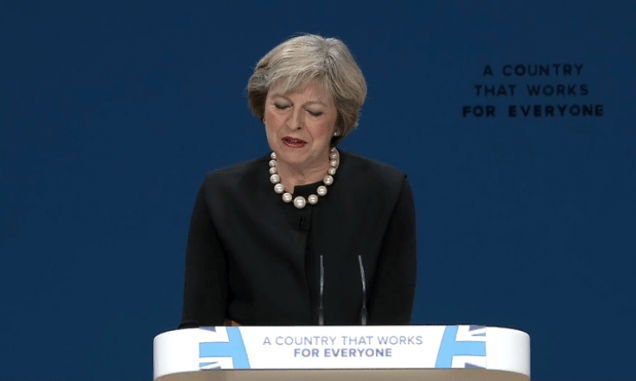
theresa-may-conservative-party-conference-2016-birmingham

Fiscal incontinence, a bizarre grammar school obsession and a new crackdown on civil liberties – forgive me for not cheering along as Theresa May’s Conservative In Name Only Party assembles, victorious, in Birmingham

Theresa May would never have been this blog’s choice to be Britain’s new prime minister, but I have tried to maintain a spirit of cautious optimism in the months since the EU referendum toppled David Cameron and upended our national politics.

And there have been some genuinely positive signs along the way. For one, healthy national pride and patriotism – dead and buried for so long, with New Labour the principal executioner – is starting to make a comeback, no longer automatically scorned by all of Britain’s leading politicians.

Indeed, the Telegraph reports that Theresa May made patriotism one of the lynchpins of her keynote speech to Conservative Party Conference in Birmingham today:

The establishment must stop sneering at the patriotism of ordinary Britons, Theresa May will say today.

During her keynote speech to the Conservative conference, the Prime Minister will proclaim that the Tories are now the party of working class people.

In a bid to attract millions of disaffected Labour voters across the country, she will add that concerns about immigration have for too long been dismissed as “distasteful” and “parochial”.

She will attack the condescending views of politicians and establishment figures who are “bewildered” by the fact that more than 17 million people voted for Britain to leave the European Union.

[..] “Just listen to the way a lot of politicians and commentators talk about the public,” Mrs May will say. “They find their patriotism distasteful, their concerns about immigration parochial, their views about crime illiberal, their attachment to their job security inconvenient. They find the fact that more than seventeen million people voted to leave the European Union simply bewildering.”

This is good. While sneering, elitist anti-democrats like Matthew Parris may suffer convulsions any time somebody outside Zone 2 or with an income of less than £100,000 dares to utter a political opinion, great (and deserved) political rewards potentially await a major political party which stops treating working and middle class patriotism like an infectious disease.

And there was more to admire in today’s keynote speech, not least the fact that Theresa May delivered it from behind a lectern while reading from a printed transcript rather than adopting the tiresome Gordon Brown / David Cameron habit of prancing around the stage while reciting from memory, like an over-eager Shakespearean actor or a Silicon Valley executive delivering a TED talk.

But unfortunately, in that same speech Theresa May also declared “I want to set our party and our country on the path towards the new centre ground of British politics”. In other words, gifted a blank canvas and meaningful opposition only from the ranks of Conservative backbenchers, Britain’s new prime minister is going to play it safe and stubbornly occupy the same tedious middle ground marked out by David Cameron and George Osborne, only a couple of steps further to the left.

But the worst part of Theresa May’s keynote conference speech came when she declared:

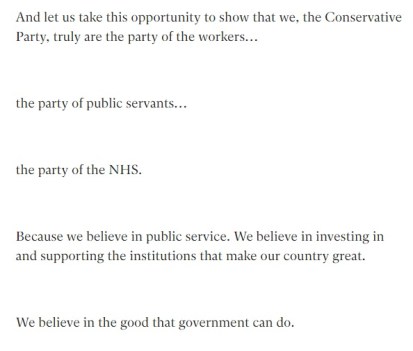
“A change has got to come. It’s time to remember the good that government can do. Time for a new approach that says while government does not have all the answers, government can and should be a force for good; that the state exists to provide what individual people, communities and markets cannot; and that we should employ the power of government for the good of the people.”

Excuse me, but no. What is this Miliband-esque, woolly Fabian nonsense?

Opinions differ as to what ails modern Britain, but almost nobody remotely serious would suggest with a straight face that we currently suffer because the state is not yet involved enough in our daily lives, or that it is not performing activities which the market could reasonably undertake. Nobody apart from our new prime minister, that is.

With a new Conservative prime minister singing hymns of praise to an activist state constantly meddling in the lives of its dependent citizenry, we may as well be back in the 1970s. At least David Cameron used to talk about the Big Society (even if he never made it a reality), and suggested that there might be a whole world out there beyond the suffocating reach of the public sector. If we take Theresa May at her word, she seems to believe the opposite – that we should expect to rely on the state in all matters of life, and that markets are terminally “dysfunctional”, requiring constant state intervention.

I’m sorry, but this is unforgivably leftist fluff coming from a supposedly Conservative prime minister. One appreciates that Theresa May has come to office at an exceedingly difficult time, with Britain’s EU secession by far the most ambitious enterprise which this country has attempted in decades. But that is absolutely no excuse for kicking ideology and founding principle to the kerb and engaging in what can only be described as flagrant socialist cross-dressing.

Furthermore, Theresa May’s sloppy wet kiss to Big Government presupposes that until now we have somehow been living in a Hayekian, libertarian nirvana, where the government stayed out of our lives, the successful didn’t have to fork over half of their income in taxes and everybody was left to sink or swim according to their merits. This was hardly the case. The terrible “austerity” inflicted by David Cameron and George Osborne was in reality nothing more than the meekest, politest attempt to stem the constant increases in public spending. Six years on and the deficit remains, the national debt is larger and interest on Britain’s sovereign debt rivals our annual Defence budget.

In other words, Theresa May’s speech made it seem as though working British people had up to now been left to starve in some awful libertarian dystopia, when in fact we remain prisoners of the welfare state/public sector prison created decades ago and put on steroids by Tony Blair and Gordon Brown.

And yet the parties of the Left uniformly fail to realise just how lucky they have it with Theresa May in charge of the country. A Britain led by David Davis, Liam Fox or Jacob Rees-Mogg would quite possibly offer a taste of real austerity for those parts of the country which have grown fat suckling on the taxpayer teat, but with Theresa May they don’t have to worry about any of that. For the prime minister is every bit as much of a champion of the state as Tony Blair, Gordon Brown or Ed Miliband ever were.

Not that you would know it, to read hysterical, weepy editorials like this one in Left Foot Forward:

Theresa May’s speech to Conservative Party conference was supposed to showcase her philosophy. And it did.

It showcased a nightmarish new Conservative ideology that cloaks drastic social illiberalism in the language of inclusive economics, panders to one section of the working class in order to marginalise another, and brands anyone who dares to disagree as unpatriotic and sneering.

And it takes the vote to leave the European Union as a justification for extreme, inward-looking and divisive policies, completely disregarding the 16 million people who voted to remain, not to mention all the decent leave voters, who voted for change, not for for xenophobia.

The delicious irony of a weepy leftist complaining about being disregarded and demonised when such flagrant hostility is the default left-wing attitude towards anybody with remotely conservative opinions is almost too much to bear, but it gets better:

However, the truly frightening aspect of this speech was its divisiveness, its aggression towards anyone who doesn’t fit into the prime minister’s definition of ‘ordinary’.

This includes anyone not born in Britain, despite May’s claim to want ‘a country where it doesn’t matter where you were born.’

It comprises most of the 48 per cent of people who voted to remain in Europe — May seems to have forgotten she was one of them — and all those who envision a more progressive approach to crime, immigration, human rights, healthcare or education.

Here is a prime minister who did everything but daub herself in red paint and sing the Internationale right on the stage of the Conservative Party Conference in Birmingham, and still it isn’t enough for the leftists because the Big Mean Scary Lady apparently used “non-inclusive” language. Truly there is no winning with these people.

In fact, the hysterical reaction from the Left only shows how far Labour’s metro-left ruling class have diverged from their party base and from traditional left-wing thought. Theresa May promises German style corporate governance, more wealth redistribution and the state as an overbearing, omnipresent parent – all of which which would have delighted 1980s socialists – yet the modern metro-left pitches a hissy fit because Theresa May didn’t sing paeans of praise to unlimited immigration or bow down before the altar of corrosive identity politics.

The goalposts keep moving and the ratchet keeps tightening and dragging us leftward. But ordinarily one might at least reasonably expect a Conservative prime minister to act as an anchor and a drag on that influence. Theresa May, though, seems eager to beat the centrist, metro-left in a full-on sprint to the left.

Look: I get that Theresa May is not a socialist herself. But the mere fact that she is comfortable using the same woolly, often meaningless language of Ed Miliband should be a real cause for concern among libertarian-leaning conservatives because it shows that she is far more interested in hoovering up centrist Labour voters than making a bold, compelling case for small government, conservative policies. It is undoubtedly the correct approach if one wants to pursue the path of least resistance, but to tack to the authoritarian centre at a time when the Labour opposition has all but disintegrated is an almost criminal waste of an opportunity to radically reshape Britain – not just through Brexit, but in terms of the relationship between government and citizen.

I know I can be a bit of a bore when it comes to analysing political speeches, but it is also depressing to see Theresa May adopt the short sentence / no complex paragraph style also favoured by Ed Miliband.

An excerpt:

theresa-may-conservative-party-conference-2016-speech-transcript


And another:

theresa-may-conservative-party-conference-2016-speech-transcript-2

Put aside for a the obscenity of a Conservative prime minister neglecting to talk about the importance of a flexible labour market to a dynamic economy in favour of trying to outdo Labour in promising counterproductive employment rights, and focus instead on the speechwriting style.

This is the same choppy, disjointed, machine-assembled soundbite speech favoured by Gordon Brown and honed to dismal perfection by Ed Miliband, as this blog explained some time ago:

Behold the short, stunted phrases, written with the news editor’s cropping software in mind while the poor listener’s brain isn’t given a second thought. This is nothing more than a word cloud, a jumble of phrases and platitudes deemed by a focus group to be pleasing or reassuring and then awkwardly bolted together by a computer and beamed onto a teleprompter.

Britain is about to embark on the most complex national endeavour that we have attempted in decades. In seceding from the European Union and deciding to forge our way once more as an independent country, the people of Britain are serving as a case study to the world in how best to maintain and strengthen democracy and accountability in the age of globalisation. Is it really so much to ask that we have a prime minister capable and willing to speak in complete paragraphs rather than ten-word soundbites?

Is it honestly unreasonable to expect that the first major set-piece speech of Theresa May’s premiership should make reference to history, to human endeavour, to our national destiny, rather than simply be a laundry list of bribes to the British people, promising them newer, better public services and an easier life?

This is Milibandism all over again. And while Theresa May is more traditionalist authoritarian than Fabian socialist, alarm bells should be sounding that she intends to govern using the same tired New Labour playbook. May’s conference speech reveals a depressingly small conception of what it means to be the prime minister of the United Kingdom, casting Theresa May as a mere Comptroller of Public Services or a puffed-up cruise ship director rather than a consequential world leader.

Nonetheless, Conservatives seem to be streaming away from Birmingham in a very cheerful mood – some almost outrageously so:

Et tu, Montie?

Yes, libertarian individualism is indeed “THE Tory weakness” if one is trying to appeal to people who love socialism and a big, activist state. Which is why a healthy, virile Conservative Party should either seek to make such people see the error of their ways or else quit pandering to them entirely.

But this is clearly not Theresa May’s approach. She has a different strategy. And what has it wrought thus far?

After three months of reflection over the summer, the Tories are absolutely nowhere when it comes to tackling Brexit, but every indication we have seen suggests that they are toying with the unnecessary self-harm option which would see Britain forsake the single market in a couple of years at the time of EU secession, well before any comprehensive replacement could possibly be negotiated.

We were supposed to be wowed by a so-called “Great Repeal Bill” to undo the 1972 European Communities Act, until five seconds of reflection revealed this grand piece of posturing to be nothing more than a statement of the bleeding obvious – if Brexit is to happen at all, the primacy of EU law and courts must be brought to an end at the moment of departure.

Flagship proposals to build new grammar schools only scratch the surface of problems with British education, but jubilant Tories seem to be treating this policy as the alpha and omega of their plans to create a more educated and skilled workforce when in fact so much more needs to be done to make the British education system the best in the world.

The last Chancellor of the Exchequer was bad enough, with his limp deficit reduction targets, obsession with white elephant infrastructure projects and shameful Brexit scaremongering. But his replacement, Philip Hammond, has taken what little authority the Tories retained on fiscal responsibility and thrown it out the window. Now Conservatives are mocked by John McDonnell of all people – John McDonnell! – for failing to grapple with the public finances, and the national debt will have increased every year after a decade of Tory rule.

And to add insult to serious libertarian injury, Theresa May’s steely-eyed authoritarian side is revving up, with planned new laws to criminalise insulting the army or advocating shariah law for Britain veering from the unworkable to the stupid all the way to the totalitarian.

So I’m sorry, but I can’t get excited about this revamped Conservative In Name Only government. While Theresa May is off to a bright start in terms of tone and temperament, what we have seen so far in terms of policy suggests a shift even further to the economic left than Cameron/Osborne, balanced out by a rise in authoritarianism and government meddling in every aspect of private life.

And for what? To beat Jeremy Corbyn’s Labour Party by a slightly greater landslide in 2020 than is already expected?

Maybe I’m alone in this, but I would rather Theresa May’s government struggle to a 30 seat majority in 2020 based on a really radical, small government manifesto in the model of Thatcher – and then actually go about reshaping the country based on that clear vision – rather than win a 100 seat majority by dressing up in the abandoned clothing of Ed Miliband.

As Margaret Thatcher said in 1968:

There are dangers in consensus; it could be an attempt to satisfy people holding no particular views about anything. It seems more important to have a philosophy and policy which because they are good appeal to sufficient people to secure a majority.

Theresa May clearly disagrees, and there is a very low limit to the respect that this blog can give to a leader who thinks in such unambitious, tactical terms.


David Cameron - Coke Zero Conservative - I Cant Believe Its Not Miliband

Top Image: International Business Times

Support Semi-Partisan Politics with a one-time or recurring donation:

Agree with this article? Violently disagree? Scroll down to leave a comment.

Follow Semi-Partisan Politics on TwitterFacebook and Medium.

Remainers Are Trying To Rewrite History, Claiming Media Coverage Favoured The Leave Campaign

eu-referendum-media-coverage-television-news-bias-2

Yes, the BBC let the public down with their spineless, uninquisitive EU referendum coverage. But this only benefited the Remain campaign, not the Brexiteers, and to suggest otherwise is absurd

Disappointed Remain activist Hugo Dixon takes to the pages of InFacts with with a sullen litany of the many ways in which the (ahem) notoriously eurosceptic television news media supposedly hindered the pro-EU camp’s chances and aided the fact-free Brexiteers at every turn.

Dixon writes:

The BBC has rightly been criticised for its weak referendum coverage. If the broadcaster had done a better job of challenging interviewees, informing the public and making room for a variety of viewpoints, voters would have had a better chance of sifting fact from fiction. The BBC, after all, dominates our news coverage: 77% of the public use it as a news source, according to Ofcom.

The most common criticism aired against the BBC is one of phoney balance – namely that it gave equal airtime to experts and their opponents’ unsubstantiated bluster. But this is probably not the most serious charge. After all, it would not have been fair to deny the two sides of the referendum equal airtime or to keep off the air campaigners who were telling fibs or spinning fantasy.

However, what the BBC could and should have done was grill its guests more vigorously – and make more space for coverage that didn’t fit into the tired Punch-and-Judy style battle between spokespeople put up by the two official campaigns.

There is a kernel of a sensible point in here. This blog has written numerous times that sensationalist or craven news coverage which merely allows two opposing talking heads to scream at each other without any effort to arbitrate or discern truth is a pox on our journalism – whether it is infecting the US presidential election or the EU referendum in Britain.

Dixon is also admirably on-point when he criticises the media’s reliance on the sanitised, focus-group approved  media grids of the two opposing lead campaign groups, effectively suggesting to their viewers that these incompetents and nepotism beneficiaries represented the full spectrum of eurosceptic and pro-European thought:

This wasn’t the BBC’s only failing. It also allowed too much of its coverage to become a Punch-and-Judy style battle between the official campaigns. The broadcaster, of course, had to give a lot of airtime to Vote Leave and Stronger In. But it allowed its coverage to be virtually dictated by their agendas.

I know the Remain side of the story better. Stronger In had a “grid”, on which it set out what stories it wanted to push on particular days and which people it wanted to push those messages. It coordinated this grid closely with Craig Oliver, David Cameron’s director of communications. Indeed, Stronger In was effectively in Number 10’s pocket. It rarely put forward people who weren’t on message with its Project Fear strategy.

The BBC should not have allowed itself to be manipulated in this way, particularly since it was aware of the potential problem. Its guidelines said: “Where there is a range of views or perspectives, that should be reflected appropriately during the campaign.” They went on to say: “The designated Campaign Groups – whilst offering spokespeople to programme-makers and other content producers – cannot dictate who should or who should not appear on BBC output.”

But the broadcaster didn’t do enough to resist the pressure. As a result, Downing Street and its puppets dominated the Remain camp’s share of airtime, and people who wanted to make a positive case for Britain’s involvement were edged out. Even Gordon Brown – who was trying to argue that we should lead Europe, not leave Europe – found it hard to be heard.

While Hugo Dixon’s heart wells over with sympathy for Gordon Brown’s inability to claim his fair share of the limelight, this blog would point to the many independent and non-aligned voices on the Brexit side who struggled to get a hearing of any kind, despite (in some cases) holding media events in the heart of Westminster under the very nose of the establishment.

So on both of these complaints, Dixon is on solid ground. But to go on and suggest that intellectually lazy journalism which impacted the Leave side every bit as much as the Remain campaign somehow decisively swung the outcome of the referendum is to venture into the realm of fantasy.

Dixon concludes:

For every such example, the BBC could presumably come up with a counter-example. But when its senior figures search their souls, do they really think they fulfilled their mission of informing and educating the public well during the referendum? And, if not, what are they going to do about it? How about an independent, public audit of how the BBC fared during the referendum backed up by recommendations on how to do better in future?

The world is not getting any simpler. Hard, honest thinking about how to cover often very complicated questions could stand the BBC in good stead. Audiences and license fee payers definitely deserve it.

The underlying assertion, carefully left unsaid, is that these various journalistic failures added up to a succession of “microbiases” which somehow cumulatively tipped the referendum result, and that if only BBC and other television news presenters had challenged guests and demanded more “facts” then the British people would have come to their senses and realised just how star-spangled awesome the European Union really is.

And maybe in an alternative universe that was the case – that there simply weren’t enough highly credentialed experts, both hysterical and sober, using abundant media platforms to lecture the British people that seeking freedom from the EU would be an unmitigated disaster.

Why oh why were these noble voices, these latter-day Cassandras so cruelly shut out of the national debate, swamped by a relentlessly pro-Brexit television media amplifying the Leave campaign’s monopoly on falsehoods and scaremongering?

But that’s not how I remember the EU referendum campaign.

Hugo Dixon inhabits an interesting parallel universe, and no doubt a comforting one for disappointed Remain campaigners so deeply invested in their failed euro-federalist dream. But it bears no resemblance to the real world, where the plucky, haphazard, incoherent and almost terminally disorganised Leave campaign triumphed against the arrayed forces of the establishment and a television news media which only amplified rather than diminished their influence in support of the status quo.


European Union - United Kingdom - Britain - Flags

Support Semi-Partisan Politics with a one-time or recurring donation:

Agree with this article? Violently disagree? Scroll down to leave a comment.

Follow Semi-Partisan Politics on TwitterFacebook and Medium.

The Economic Challenges Beyond Brexit

Bitter, swivel-eyed (and unrepentant) europhile he may be, but the FT’s Martin Wolf makes some valid points in his latest column, warning against any complacency that Britain’s persistent economic weak points will be automatically restored to health upon leaving the European Union.

Wolf writes:

British economic policymakers confront big challenges. They have to manage departure from the EU with the minimum damage. They also need to make the UK economy far more dynamic. The latter cannot be achieved if they do not abandon the myth that Britain is already an economic success, albeit one choked by the dead hand of an over-regulated European economy.

Simon Tilford of the Centre for European Reform provides a far more realistic picture in his Brexit Britain. Measured at purchasing power parity, the rise in the UK’s gross domestic product per head between 2000 and 2015 was smaller than in Germany, Spain and France. Over this period, the UK outperformed only Italy, among the EU’s largest pre-2000 members. In 2015, the UK’s GDP per head was lower relative to the average of the 15 pre-2000 EU members than in 2000: its GDP per head was a mere ninth within this group.

The UK also has the highest income inequality among these countries. Furthermore, notes Mr Tilford, UK real wages fell by 10 per cent between 2008 and 2014, before a tiny uptick in 2015, while German and French real wages rose. In 2015, only London and the South-East had higher GDP per head than the average of the EU-15 countries. Other UK regions were at or below that average. In all, it is hardly surprising so many UK voters feel left behind, as shown in the EU referendum.

True, the increase in French real wages has coincided with high unemployment. But that is not true in Germany. UK workers also work longer hours than those in other EU-15 countries. This is presumably to make up for low real wages, themselves largely due to the UK’s poor productivity. According to the Conference Board’s invaluable “total economy database”, the only EU-15 countries to have lower output per hour than the UK are Greece, Italy and Portugal, while the UK’s productivity per hour has stagnated since 2007. Again, of the biggest five EU-15 members only Italy performed worse on this measure. The UK also now runs the largest current account deficit, relative to GDP, in the EU-15.

The UK, then, has low unemployment. But it also has high inequality, mediocre real incomes, at least by the standards of its European peers, and poor external competitiveness. Above all, recent productivity growth has been truly awful.

These are hard, inescapable criticisms – particularly in terms of productivity growth and purchasing power parity, which is ultimately the only yardstick that matters in terms of whether people actually feel better off.

And concludes:

The implications of a realistic view of the UK economy is that, even without the looming shock of Brexit, the economy suffers from big weaknesses relative to the European economies that many Brexiters despise. Some argue that a real depreciation of sterling is mainly what is needed. If sustained, the post-referendum devaluation should indeed help, though it means a fall in real incomes and wealth. Yet devaluation alone will not cure UK weaknesses.

The UK has to rectify longstanding supply-side failings. The list includes: low investment, particularly in infrastructure; inadequate basic education of much of the population and the innumeracy of much of its elite; a grossly distorted housing market; over-centralisation of government; and a corporate sector whose leaders are motivated more by the share price than by the long-term health of the business. Not surprisingly, given all this, the UK economy is highly dependent on inward foreign direct investment, which Brexit would seem virtually certain to weaken.

If the UK is to thrive economically, it will not be enough for it to manage Brexit, hard though that will surely be. Its policymakers must also start from a realistic assessment of the UK’s mediocre performance. This is no world-beating economy. It is not even a Europe-beating economy, except on creating what are too often low-wage jobs. It will have to do far better if it is to deliver the higher living standards its people want in the tougher environment ahead.

The danger with Brexit was always that the sheer complexity of managing our secession from the European Union would prove too much for a mostly unremarkable generation of politicians and civil servants, nearly all of whom have never known life outside the EU and can scarcely imagine self-government. Even now, three months after the historic Brexit vote, there is little evidence that the government has started to get to grips with the challenge ahead of them.

Therefore, it is not unreasonable to ask – as Martin Wolf does – how much mental capacity will be left to tackle other burning issues like Britain’s low productivity, the low-skill / low-wage segment of the economy or decades-old weaknesses in British management, identified by Thatcher’s Conservatives in the late 1970s but still barely tackled even now.

And I’m not sure there is a quick fix to this problem. Brexit will inevitably dominate the political agenda, probably for the next decade, to the near exclusion of all else. And even if there was excess capacity, there is precious little evidence to suggest that Theresa May’s new government has a blazingly clear vision for reforming Britain anyway – as Isabel Hardman outlines in this excellent Spectator piece.

In short: many of these problems, though long-festering, are probably going to have to wait to be tackled, unless the government surprises us all with its radical zeal and far-reaching reform plans at the upcoming Conservative Party Conference, which seems unlikely at best.

If you wake up to discover your house is ablaze and smoke pouring into the bedroom, you don’t waste precious minutes ensuring that you are beautifully dressed and immaculately turned-out before evacuating the building. Likewise, in whatever shape Brexit ends up happening, Britain will likely emerge from the EU in much the same shape as before, with the same nagging issues and weaknesses clamouring to be addressed.

Inspiring? No. Ammunition for assorted bitter Remainers, EU-lovers and anti-patriots? Sadly, yes. But that is our lot. Brexit is likely to be a grinding, painstaking, lengthy process at the end of which the same Britain will be blinking back at us, largely unchanged, with all the rest of our work to realise the benefits of Brexit still ahead of us.

But does that mean the enterprise is not worth the effort? Hell no. And it is very telling to see those who are prepared to steel themselves for the work ahead, and those who seek to use it as a whinnying justification for giving up.


Thousands Of People Take Part In The March For Europe

Support Semi-Partisan Politics with a one-time or recurring donation:

Agree with this article? Violently disagree? Scroll down to leave a comment.

Follow Semi-Partisan Politics on TwitterFacebook and Medium.