The British Media’s Shameful Coverage Of The EU Referendum

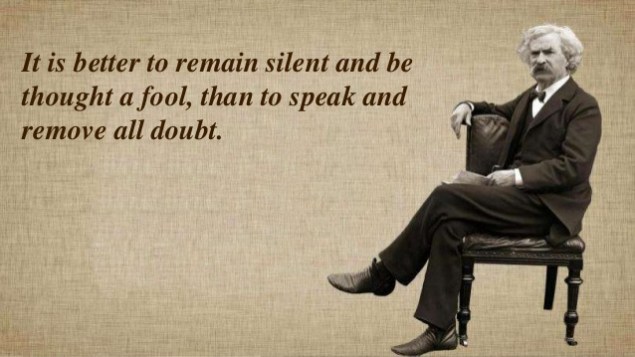
Mark Twain - It is better to remain silent and be thought a fool, than to speak and remove all doubt

Of the many disappointments in this EU referendum campaign, the utter failure of the British press to discharge its basic professional duty stings worst of all

A well-functioning, free press is essential to the health of a democracy.

Rigorous journalism, conducted with integrity, is the lifeblood of a vigilant, engaged citizenry – without it, the people cannot make informed decisions and corruption, incompetence and decay quickly begin to corrode good government.

The current EU referendum should therefore be a great test for our nation’s media elite, and reveal whether or not the British press are fulfilling their essential function. After all, here is an absolutely existential question facing the nation – do we stay in the European Union or do we leave? There are many interweaving areas to consider – trade, foreign policy, defence, national security, trade, immigration, the economy. And there is the temporal aspect – what is awkward or uncertain in the short term may have huge benefits in the long run, and vice versa. In every respect, this is a big, meaty issue for Britain’s finest journalistic minds to wrap their heads around.

Of course, no one journalist or publication can perfectly embody all of the great journalistic characteristics of fearlessness, impartiality, scepticism and rational enquiry all the time. That much is not possible, nor expected. We are all human beings and we all have motivations and core beliefs which give us blind spots or encourage us to take mental shortcuts. That’s normal. But at the macro level, if our democracy were in good shape, by now we should see an accumulation of evidence of rigorous enquiry by the media class. Even in a media market where newspapers and websites make no claim of impartiality we should still see evidence of lies being exposed, truth being searched out and upheld, and assertions constantly questioned.

This holds true even when the quality of the discourse itself – in this case driven by the two official campaigns on each side of the EU referendum – is poor, as is very much the case with the fearmongering establishment Remain campaign and the unhinged, loose cannon Vote Leave. Bad ideas are bad ideas and false statements are false statements, whether they come from the shouty man on Twitter or an oleaginous SW1 spokesperson. Therefore, bearing the imprimatur of establishment authority should make one more open to questioning, not less, and there should always be a healthy scepticism of authority and social status.

So are we currently passing the test? On this most important of issues, has the British media been doing its job properly?

It hardly needs stating that the answer is a resounding “no”. In fact, the quality of coverage has fallen incredibly short of the standard we should expect from a healthy democracy – but then, our democracy is hardly healthy. Or particularly democratic. Tthis is not a criticism of any one journalist or publication – though there are several whose deserve full and individual criticism for their groupthink, confirmation bias and craven deference to power. But for the purposes of this blog post we will focus our attention on the overall national media output.

And the best way to see how the media have fallen short in their EU referendum coverage is through their utter lack of curiosity about a plan for Brexit. This is particularly odd given the fact that the SNP government’s weighty tome outlining a plan for Scottish independence provided such rich pickings for journalists during the 2014 referendum. As time dragged on and on, one might have reasonably expected calls in the press for the release of a Brexit plan to have reached a loud crescendo, eventually forcing the hand of the official campaign.

But no – when it was high handedly decided that having an actual plan for what to do after the referendum would be stupid because it would (shock horror) invite scrutiny, there was barely a peep from the media. Vote Leave were allowed to get away with fighting this most rare and consequential campaign without so much as a list of bullet points scribbled on the back of a napkin. Yet you will struggle to find one television or newspaper interview where senior Vote Leave figures (or Leave.EU figures prior to the designation decision) were put on the spot about their lack of an agreed plan.

And yet a Brexit plan exists, and has done for several years. It’s called Flexcit and is hosted at the eureferendum.com blog authored by Dr. Richard North, one of Britain’s foremost authorities on the history and workings of the European Union. Now, it may not bear the stamp of the Westminster bubble, but it was at one point being considered for adoption by Leave.EU (who shamefully decided not to do so because it detracted from the simplistic anti-immigration, economically illiterate message which is working such wonders for the Leave campaign at the moment).

And yet does this warrant the slightest attention from the Westminster media? Apparently not. Besides a vaguely disparaging article in the Herald Scotland, you won’t find a single mention of it by name in a major UK newspaper, let alone on television. Those columnists and pundits who know of Flexcit (and thanks to many ordinary supporters and a large web footprint it is hard to miss in a Google search) and support the plan are forced to make murky allusions to it, because openly mentioning the one citizen-authored plan for leaving the European Union would mean the torpedoing of that article before it ever saw the light of day.

This is a plan which was originally drawn up as an entry to an official competition organised by the IEA, and which has now been downloaded nearly 100,000 times. It isn’t some child’s finger-painting stuck lovingly to the fridge door with a magnet – it is a serious piece of work. And yet even as Britain debates the merits of leaving or staying in the EU and the process by which Brexit might occur, apparently no “household name” Westminster journalist has considered it worthwhile to write about the only comprehensive Brexit plan in existence.

Why the media blackout of Flexcit? One can only speculate – but none of those speculations lead to a very pleasing conclusion. Some journalists and publications overlooking Flexcit might be accepted as a very odd act of omission. The entire Westminster media stubbornly refusing to to mention Flexcit while hanging on every word uttered by Boris Johnson begins to look like a conspiracy of silence. Particularly since The Leave Alliance – the network of Brexit campaigners united under the Flexcit banner (this blog is a member) – has twice met right under their noses in prestigious central London locations.
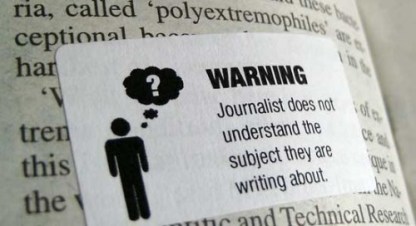
Warning - Journalist does not understand the subject they are writing about

In fact, if you want to see a serious mention of Flexcit and the staged withdrawal from the EU advocated by the Flexcit plan, one has to look in the American media – Andrew Stuttaford has twice written about Flexcit while covering the EU referendum for the prestigious conservative journal National Review, meaning that American readers are perversely better informed about the most comprehensive (and likely to be adopted) plan for leaving the European Union than most British people.

Take a moment to let that sink in. Britain is having a great national debate about whether and how to leave the European Union. There exists a comprehensive plan for doing so, which is particularly relevant now because one of the Remain campaign’s chief attack lines is that Leave supporters don’t know what Brexit looks like. But if you want to read about this plan, you will have to rely either on the American media or the small but dedicated army of citizen journalists and bloggers who promote it, because nobody in the British media cares to report on something of material significance to the campaign.

You don’t need to be a fully paid-up Brexiteer to realise that there is something profoundly wrong with this picture. Surely, if there exists a properly thought-out plan for how Brexit might work, it would be in the public interest to mention this plan? Maybe a couple of SW1’s finest journalists might take a few hours out of their busy day to skim the 400 pages and form an opinion, heck, even contact the author with a few questions. But apparently not. If it wasn’t dribbled into a microphone by Boris Johnson – a man who had not even decided that he wanted Britain to leave the European Union a few short months ago – the British media don’t seem to think it is worth covering.

Stuttaford’s latest National Review piece says what the British media will not:

David Cameron’s predictably dishonest ‘Project Fear’ is working predictably well.

The best way to counter it is to show that Brexit is, economically speaking, manageable, and the best way to manage it (there are alternatives) is by joining the European Economic Area—doing a Norway, to use the shorthand. It’s dull, and that’s the point: Dull is reassuring. Signing up for the EEA also recognizes the reality that, after decades of British entanglement with Brussels, leaving the EU is a process, not one bold break, however much romantics might wish otherwise.

Over at EU Referendum, Richard North has, as I have mentioned before in this Corner, been making this point for years (his EEA-based ‘Flexcit’ plan remains—for anyone who wants to get into the details—an essential read).

Before concluding:

I have always thought that Brexiteers would be the underdogs in this referendum. That’s how it has turned out to be, but if those who want out of the EU want to have a shot of winning this thing, they have to show that they have come to grips with the ‘how’ as well as the ‘why’ of Brexit. Their version of ‘how’ will not necessarily be definitive, but the fact that it is being articulated will go quite some way to reassuring an understandably nervous electorate that its concerns are being thought through.

[..] Like it or not, Johnson is the most prominent ‘face’ in the Leave camp.  He needs to start talking about a Brexit route with enough substance to it to reassure the anxious. Arguing that the UK has the economic and political clout to cut a good economic deal with its future former EU partners is not crazy, but it is not enough to convince nervous voters to take the Brexit ramp.  It looks too much like wishful thinking.  And what voters want to hear is evidence of serious thinking.

We can talk until we are blue in the face about the many failings of Vote Leave. And when the history of this campaign is written, they will rightly come in for much criticism for failing to embrace a comprehensive, risk-minimising Brexit plan like Flexcit. But a rigorous press should and would have discovered Flexcit without needing it to be trumpeted by Boris Johnson or slapped onto the side of Nigel Farage’s battle bus. Professional rigour should have seen to that much, or even (one would have hoped) natural curiosity.

The fact that the one rigorous Brexit plan in existence has played almost no role in the national referendum discussion to date is damning evidence of the British media’s lack of interest in rigorous reporting, and strong preference for covering the personality-based, tit-for-tat human drama. And one can understand the temptation. Reading through a 400-word tome about how to withdraw from the European Union while maintaining economic stability is soooo boring, especially when one could be writing breathless gossip pieces about how Michael Gove’s wife and Samantha Cameron have fallen out over their husbands’ divergent views on Brexit. Why do the serious research and analysis when it’s far easier – and generates far more precious web traffic – to report on the latest incendiary nugget to fall from the… mouth of Boris Johnson?

Here, Pete North says it best:

As present, we are only superficially aware that we don’t have democracy because we are missing an essential component of a healthy democracy – a free and inquisitive press. It is not that the state censors our media, rather it censors itself largely to appease advertisers and corporate cronies. In that regard the government does not need to censor the British press.

But as much as anything it has lost its essential inquisitiveness. It is concerned only with the entertainment aspect of politics rather than the dreary business of policy. It is for that reason I look forward to the day when our newspapers go the way of the dinosaur. A fate well deserved.

But in having such a dismally inept media, decisions that affect our lives go unnoticed. We are often taken by the idea that government takes sweeping decisions behind closed doors but the ultimate joke is that they are held in the open, transcribed and published on the web. These days the best way to ensure nobody will read something is to put it on the EU website.

Regardless of which side they happen to occupy in this referendum, most thinking people agree that the level of debate has been shockingly bad. Whether it is David Cameron suggesting that it is “immoral” to vote for Brexit (despite having “ruled nothing out” himself during the renegotiation) or Vote Leave insisting that Brexit would free up £350 million every week which they would prefer to spend building a brand new NHS hospital on every street corner, both sides are spewing out misinformation and hysteria, and talking down to the general public in an immensely grating fashion.

If the Westminster media were doing their job, they would not only fact-check the obvious untruths and misrepresentations emanating from both sides, they would also search out and report on the best of Brexit and Remain thinking from outside of the SW1 bubble. Yet it does not seem to occur to them that people who are not currently MPs, journalists, celebrities or the spouses of MPs, journalists and celebrities also have ideas and opinions about the EU referendum. Sometimes, those ideas and opinions are actually quite good. Sometimes – gasp – they are a lot better than what the professional politicians and pundits are saying.

As things stand, Britain is probably on course to vote to Remain in the European Union, based on a campaign in which both sides were reduced to screaming “but the NHS!” at each other until exasperated voters stopped paying attention. Very few of us will go into the polling booth with an understanding of the EU’s history, its strategic impetus and its future direction of travel. Very few of us will cast our vote with so much as a basic understanding of the global regulatory environment and the EU’s (diminishing) role in setting standards. And as the results start to come in, few of us will have voted purely according to the specific question on the ballot paper, which merely asks us whether we want to leave or remain in the European Union.

And to some extent that’s normal. Not everybody can be an expert. Most people have lives, and do not live and breathe this stuff 24/7. But conversely, just as not everybody can be an expert, nobody has to be totally ignorant, either. There is no reason why the British people, at this late stage in the campaign, could not have a better base level of knowledge than we do. There is no good reason why (for example) important terms like the EEA, Single Market and Schengen Area are routinely confused or conflated with one another. There is no good reason why, in a referendum about deciding whether or not to leave the European Union, so few people know about the one comprehensive plan to deliver precisely that outcome. No good reason at all. Yet here we are.

And for this dismal state of affairs you can thank the Great British Media.

You’re doing a heckuva job, Fleet Street.
 

If you actually put faith in modern journalism youre gonna have a bad time

European Union - United Kingdom - Britain - Flags

Agree with this article? Violently disagree? Scroll down to leave a comment.

Follow Semi-Partisan Politics on TwitterFacebook and Medium.

Could The Media Have Prevented The Rise Of Donald Trump?

There is no longer an Edward Murrow or Walter Cronkite to stand up to Donald Trump

Could mainstream television, radio, print and internet journalism outlets have done more to prevent the rise of Donald Trump? And should they have done more?

Glenn Greenwald thinks so:

Actually, many people are alarmed [by the rise of Trump], but it is difficult to know that by observing media coverage, where little journalistic alarm over Trump is expressed. That’s because the rules of large media outlets — venerating faux objectivity over truth along with every other civic value — prohibit the sounding of any alarms. Under this framework of corporate journalism, to denounce Trump, or even to sound alarms about the dark forces he’s exploiting and unleashing, would not constitute journalism. To the contrary, such behavior is regarded as a violation of journalism. Such denunciations are scorned as opinion, activism, and bias: all the values that large media-owning corporations have posited as the antithesis of journalism in order to defang and neuter it as an adversarial force.

[..] This abdication of the journalistic duty inevitably engendered by corporate “neutrality” rules is not new. We saw it repeatedly during the Bush years, when most large media outlets suppressed journalistic criticism of things like torture and grotesque war crimes carried out by the U.S. as part of the war on terror, and even changed their language by adopting government euphemisms to obscure what was being done. Outlets such as the New York Times, the Washington Post, and NPR refused to use the word “torture” to describe techniques long universally recognized as such — which were always called torture by those same media outlets when used by countries adversarial to the U.S. — because to do so would evince “bias,” lack “neutrality,” and “take sides” in the torture debate.

Contrary to what U.S. media corporations have succeeded in convincing people, these journalistic neutrality rules are not remotely traditional. They are newly invented concepts that coincided with the acquisition of the nation’s most important media outlets by large, controversy-averse corporations for which “media” was just one of many businesses.

I’m not so sure.

While Greenwald is absolutely right to chastise mainstream media outlets for clinging desperately to an “appearance of objectivity at all costs” dogma which routinely sees them humiliate themselves by speaking and writing about the utterly ridiculous as though it were merely an equal and opposing side to an argument, the idea that prestige nightly news anchors could have killed Trump’s candidacy in the crib either by initially declaring it ridiculous and mocking it, or by waging an Edward Murrow or Walter Cronkite crusade against him, seems to be wishful thinking.

It’s wrong because it underestimates the anti-establishment surge now underway in America (and in Britain too, as we saw with the rise of UKIP and the SNP). Suppose that mainstream news outlets like the New York Times, NBC, NPR and others had come out strongly to argue that Donald Trump’s ideas were outside the Overton window of “acceptable” political thought in America, and that he should henceforth be ignored by the media regardless of how many people were attending his rallies or how high he climbed in the opinion polls. What difference would it have made?

Political journalism is scorned by the public as much as Washington politics itself, and often for quite valid reasons – the incestuous, back-scratching relationship between the two is often entirely self serving and actively prevents the holding of government to proper account. Trump’s candidacy is fuelled in significant part by the opposition of those opinion columnists and TV talking heads who have come out to criticise him. If they were joined by everyone else, including news anchors and print journalists whose material does not appear in the opinion section of their television shows or newspapers, it is hard to see it doing anything other than confirming the suspicion of Trump fans that the “establishment” is out to get them, thus driving his poll ratings even higher.

This is important. Trump is riding high partly because of a small group of “let it burn” conservatives who believe that Washington is so corrupt that an authoritarian outsider beholden to no one is as good a choice as any to sweep out the garbage, but mostly because Trump supporters feel ignored and patronised by almost everybody else. And frankly, the opposition to Trump in the media has not helped, tending toward hand-wringing “ooh, isn’t he evil” editorials and one-sided accounts of violence at his campaign rallies rather than granular deconstructions of his policy proposals (such as his policies exist). Increasing the frequency and volume of the existing anti-Trump media coverage will not fix the problem, because it does little to tackle the sentiments and ideas which drive his support.

But more to the point, if we are to set arbitrary limits on our political discourse, beyond which any candidate promoting “unacceptable” ideas is rounded on by the corporate media as it is currently comprised, who gets to set the limits? Who gets to decide which ideas are okay to debate, and which are traps which will bring the entire media establishment crashing down on the person who dares to raise them?

There is almost nothing as infuriating as watching high profile journalists discuss an issue where one side obviously has the moral and intellectual high ground in terms that suggest that it is a finely balanced debate – witness the debates on torture, climate change, Brexit (UK secession from the European Union)  and more. But even worse than this would be a collusion between media outlets to freeze out certain ideas or candidates from being mentioned altogether because they are “evil” or contradict prevailing orthodoxies.

I’m sure that this is not what Greenwald has in mind. As a consistent advocate of free speech, I’m sure that he would prefer a brash and lively media landscape of much more fractured ownership, in which a multitude of independent news outlets are free to carry out the kind of unabashedly partisan campaigning journalism that Greenwald (and to some extent this blog) advocates. Greenwald would likely be fine if some outlets produced coverage very supportive of Trump, so long as other outlets were equally free to oppose him.

But we do not have such a media landscape right now, and moving in this direction would be a process taking years, not months – certainly too long of a timescale to have any impact on the rise of Donald Trump. The difficult truth is that given the hysterical, rabble-rousing behaviour of the Republican Party over the course of the Obama presidency – in which they chose hyperbolic, apocalyptic scaremongering over principled opposition to bigger government – there was nothing that could have prevented the monster they created from coming to life, breaking free of its chains and devouring them, as Trump is now doing.

It may feel good to imagine an American media landscape filled with luminaries like Edward Morrow and Walter Cronkite, journalists who would have taken one look at Donald Trump back when he launched his presidential bid, and masterfully snuffed it out in the course of one withering nightly news broadcast or newspaper column. But that is not the world we live in. Any attempt by major media outlets to scrutinise or inveigh against Trump in these anti-establishment times would only have fuelled his campaign even more than his many critics already have.

“Compelled journalistic neutrality” is not to blame for the rise of Donald Trump. Though corporate media has many faults – witness CBS chairman Les Moonves enthusing about the ratings Donald Trump’s presidential campaign is bringing to his network – they did not create the Trumpian monster, and nor can they stop it.

Far more deserving of blame are the Republican Party establishment, who shamelessly and hypocritically rode the anti-establishment, anti-Obama tiger for seven years before finally it turned on them. And also at fault is an entire remote and self-serving political establishment which in many ways thoroughly deserves the kicking it is now receiving – just not by Donald Trump, the opportunistic and undeserving current beneficiary.

Would it be a cathartic experience to witness more mainstream media types casting objectivity aside and coming out against Trump? Quite possibly. But would it have done anything to stop his rise? Let’s not kid ourselves.


Postscript – The following is an excerpt from Edward R. Murrow’s famous report on Senator Joseph McCarthy:

Earlier, the Senator asked, “Upon what meat does this, our Caesar, feed?” Had he looked three lines earlier in Shakespeare’s Caesar, he would have found this line, which is not altogether inappropriate: “The fault, dear Brutus, is not in our stars, but in ourselves.”

No one familiar with the history of this country can deny that congressional committees are useful. It is necessary to investigate before legislating, but the line between investigating and persecuting is a very fine one and the junior Senator from Wisconsin has stepped over it repeatedly. His primary achievement has been in confusing the public mind, as between the internal and the external threats of Communism. We must not confuse dissent with disloyalty. We must remember always that accusation is not proof and that conviction depends upon evidence and due process of law. We will not walk in fear, one of another. We will not be driven by fear into an age of unreason, if we dig deep in our history and our doctrine, and remember that we are not descended from fearful men — not from men who feared to write, to speak, to associate and to defend causes that were, for the moment, unpopular.

This is no time for men who oppose Senator McCarthy’s methods to keep silent, or for those who approve. We can deny our heritage and our history, but we cannot escape responsibility for the result. There is no way for a citizen of a republic to abdicate his responsibilities. As a nation we have come into our full inheritance at a tender age. We proclaim ourselves, as indeed we are, the defenders of freedom, wherever it continues to exist in the world, but we cannot defend freedom abroad by deserting it at home.

The actions of the junior Senator from Wisconsin have caused alarm and dismay amongst our allies abroad, and given considerable comfort to our enemies. And whose fault is that? Not really his. He didn’t create this situation of fear; he merely exploited it — and rather successfully. Cassius was right. “The fault, dear Brutus, is not in our stars, but in ourselves.”

Good night, and good luck.


Donald Trump - Make America Great Again - Hat

Agree with this article? Violently disagree? Scroll down to leave a comment.

Follow Semi-Partisan Politics on TwitterFacebook and Medium.

Only The Brave Now Dare Admit To Being Conservative Or Eurosceptic

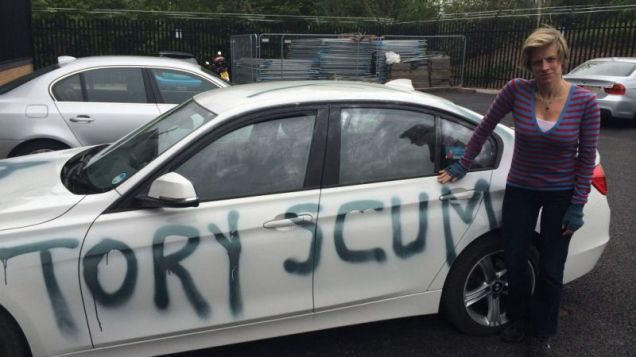
Tory Scum - Graffiti Car

When ordinary people with perfectly mainstream opinions are hesitant to express themselves for fear of being accused of racism, prejudice, stupidity or worse, our democracy is in real trouble

If you voted Conservative or UKIP at the 2015 general election, you could be forgiven for wondering where the other fifteen million people who made the same choice are currently hiding themselves. David Cameron’s leadership may be uninspiring and his government’s achievements few, but these are hardly the paranoid, dying days of the Brown government – ordinarily there should still be a level of authentic, spontaneous support to be found out and about the country.

Equally, you may wonder how on earth it was possible for Ed Miliband and Labour to have lost that election, given the fact that social media and popular culture roar their hatred of the Evil Tories louder than ever, that it is almost impossible to find kindred spirits willing to admit to voting Conservative or UKIP, and the fact that conservative policies and beliefs are routinely derided as ignorant and selfish at best, and violent and vengeful at worst.

The current political environment can be quite lonely for anybody with conservative leanings – and it makes one wonder why the people who delivered David Cameron his House of Commons majority and propelled UKIP into a remarkably strong third place are so desperate to avoid drawing attention to themselves.

There have been a couple of worrying pieces in the media this week which highlight the fact that furious open hostility toward anything vaguely conservative or eurosceptic – often emanating from a small but determined band of opposing activists – is having a chilling effect on the political discourse and preventing small-c conservatives from openly articulating their opinions.

First, the Independent carries a letter from former Labour MP Tom Harris, who only felt able to “come out” as a eurosceptic after having left elected office. Sounding as though a weight had been lifted off his shoulders, Harris writes:

I was never a fully paid-up member of the Euro team. Early signs of unsoundness manifested themselves in my outright opposition to British membership of the euro when it was first launched. The whips’ office had its eye on me after I added my signature to a letter, back in 2002, warning the then Chancellor, Gordon Brown, to resist committing to abolishing the pound. And once you’ve decided to oppose that central mechanism for the creation of a European superstate, it’s a fairly short step to being painted as “anti-EU”.

But my instinct to vote Leave (probably running at 53 to 55 per cent right now) is not something that can be confessed in polite middle-class company. Such an admission might too easily be interpreted as a dislike of foreigners or, worse, a tolerance of Nigel Farage.

[..] The question is precisely the same one we were asked in 1975: should we stay or should we go? In the meantime, if asked over dinner how I intend to vote, I’ll do the sensible thing and change the subject to the range of breads in the Marks & Spencer food hall. Or The Archers.

And follows up in the Telegraph:

As for me, I will continue to pursue this enigma known as “the normal life” by having, expressing, then rejecting various opinions. No doubt they will be variously correct, wrong, misplaced, insightful and dangerous. I may believe in all of them, some of them, or none of them.

What’s it to you?

But among Labour circles and much of the wider Left, it is simply no longer “permissible” to hold eurosceptic views, or to believe that Britain’s democracy and vital national interests would be better served by leaving an explicitly political and ever-more closely integrating union which we never realised we were joining in the first place. The Tories are perceived to be eurosceptic (even though many of them are not), and so the prevailing dogma has it that one must be pro-EU to be anti-Tory.

Aside from the few brave (and mostly decidedly retro) souls who form Labour Leave, the question of Britain’s ongoing EU membership simply is not up for discussion. And to express any doubt whatsoever about Britain playing an enthusiastic part in this European political union is seen as treachery, automatic disqualification from membership of the movement.

Look at Jeremy Corbyn’s reversal on the issue. Love or hate Corbyn, he has been willing to stand up to a mostly hostile Parliamentary Labour Party on issue after issue, from military action in Syria to the Paris attacks to the question of Trident renewal. On all of these issues, the Labour leader has proven himself willing to enrage many of his MPs by holding firm to his deeply held convictions.

But what of his eurosceptic convictions? Jeremy Corbyn has been a lifelong eurosceptic, and voted for Britain to leave the European Community in the 1975 referendum. Corbyn holds this view about as strongly as any other, and yet it was on this issue alone where he instantly capitulated to the establishment and became a pro-EU advocate. What should rightly be a non-partisan issue pertaining to sovereignty and self-determination is instead imbued with nearly the same cultural weight and quasi-religious fervour as one finds in the American culture wars. Such is the power of the Left’s infatuation with the EU.

Jeremy Corbyn - EU Referendum - 1975 - Eurosceptic

The second article of concern is this worrying testimonial from a conservative-leaning history supply teacher who found himself drummed out of the school where he taught because colleagues complained when he failed to join in their frequent denunciations of the Tory government and all things conservative.

Joe Baron writes in The Spectator:

After keeping schtum for two months, I finally challenged a colleague’s view of the Tories. ‘Why are Tory voters thick?’ I asked. ‘Is it just because they happen to disagree with you?’

‘No,’ he replied. ‘Because they voted for cuts’.

‘Perhaps they saw the cuts as necessary,’ I said. ‘Surely it’s better to make savings now, rather than keep spending money we don’t have, go bankrupt and, like the Labour government of 1976, be forced to make even deeper cuts after going cap in hand to the IMF.’

‘That’s rubbish!’ said another colleague. And so it continued, though no one actually raised their voices, until they brushed off my argument with a blasé ‘yeah, yeah, yeah’ before gesturing towards the office door as if dismissing a recalcitrant child.

If Joe Baron had been loudly and forthrightly expressing his views in favour of Ed Miliband and the Labour Party, he would have been met with a chorus of approval and the respect of his colleagues. But in choosing to defend conservative ideas like government fiscal responsibility and personal self-sufficiency, Baron chose another path. A darker path:

I was called into the head’s office and told that, after a complaint from colleagues in my department, the school would no longer require my services. So I was effectively being dismissed for holding the wrong views, though of course the head dressed it up in a different garb: it was my manner rather than my opinions. Apparently I was ‘too assertive’.

As I remember it, my interlocutors were both red-faced and angry, and more than willing to use inflammatory language. I was told, at one point, that I was unfit to teach.

Interestingly, the head of department who refused to work with me — effectively calling for my dismissal — had several weeks previously decried the cruelty of zero-hours contracts. Where was her left-wing compassion when it came to sacking me, a married man with two children to support?

I suppose I’ve only got myself to blame. For a brief moment, I deluded myself into believing that schools actually encouraged tolerance and the questioning of orthodoxies through intellectual exploration, freedom of thought and speech. How silly of me.

Both cases – Tom Harris the former MP and Joe Baron the supply teacher – are examples of the visceral, real-world retribution which is threatened (and sometimes carried out) by those on the Left against people who have committed the thought crime of being a conservative. And this climate of anti-Tory hate-mongering not only distorts our political discourse, but undermines the health of our democracy, whose proper functioning relies on people with political differences being able to speak their consciences in good faith.

My own personal experience of this phenomenon has thrown up more depressing anecdotes than I can relate here. Friends who have sat next to me on the couch shouting at the television when one smug-faced Question Time panellist (or audience member) after another have deliberately misinterpreted and sanctimoniously condemned Nigel Farage or David Cameron, but who fall fearfully silent when the inevitable anti-Tory hate mobs form around the water cooler or on social media.

Or the senior PR executive I was chatting with at a recent event for the launch of Dan Hodges’ excellent chronicle of the 2015 general election, “One Minute To Ten”, who furtively looked around and dropped her voice to a hushed whisper before confiding to me that she actually voted Conservative, picking David Cameron over Ed Miliband.

Or the look on the faces of people I speak with in my hometown of Harlow, Essex, at the precise moment when a voice in the back of their head tells them to self-censor their speech and hold back their real opinions, for fear of ridicule or attack. They may have re-elected an excellent local Conservative MP in Robert Halfon, but few are willing to proudly and publicly stand by their decision months later, away from the privacy of the polling booth.

You just don’t see this same reticence on the other side. For a political movement which makes a great performance of supposedly being the voice of the voiceless and most marginalised people in the country, left-wingers have a near monopoly in many areas of the public discourse, particularly in the arts and entertainment sectors. And there are far fewer occasions or settings where it is necessary to pause and “read the room” before confessing one’s left-wingery than there are situations where conservatives have brutally learned the wisdom of self-censorship.

The problem is that it is not just the unhinged crazies sharing misspelled memes on the internet and typing in ALL CAPS below the line on news website articles. People like that exist on all points on the political spectrum from left to right, and the misogynistic ranting of one barking CyberKipper no more represents UKIP than the conspiratorial, anti-Semitic sermons of a self-declared Corbyn supporter reflect on Labour.

No, the real problem is the softer bigotry of bien-pensant public opinion – the arrogant assumptions of the dinner party set, well-heeled professional people in the office or having dinner at Carluccio’s – the middle class clerisy, Brendan O’Neill called them. Their willingness to lazily believe and repeat hysterical left-wing smears about conservatism and to virtue-signal in front of their friends by flaunting their vague and incoherent opposition to the Evil Tory government are the problem.

And it becomes a self-fulfilling prophecy. The more that left-wingers openly flaunt their views while attacking or shunning anybody who thinks differently, the more likely they are to only ever hear ideas and opinions which chime with their own worldviews, and falsely assume that they are universal.

But it’s not true. The 2015 general election proved that there is no silent left-wing majority in Britain, and there will be no “rainbow coalition” of left-wing political parties coming together to kick the Evil Tories out of office any time soon.

In fact, the only question is how much longer the Left can continue to punch above their rhetorical weight before the British people finally tire of the sanctimonious yapping of a bunch of ideologically incoherent, virtue-signalling, anti-aspirational opportunists and the temper tantrum they are throwing in the face of a very mild and utterly unremarkable centrist government.

How much longer will the silent majority-makers of this country be willing to silence themselves, censor their speech and edit their public opinions solely to avoid the screeching disapproval of these losers?

Right now, it may be hard for some to “come out” as conservatives. But the Left are loudly and brazenly overplaying a very weak hand, and the sooner that more of us start calling them out on it, the easier it will be for more people to stand up and take pride in not being just another centre-left drone.

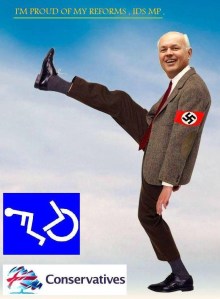
Iain Duncan Smith - Tory Scum - Conservative Party - Nazis

Agree with this article? Violently disagree? Scroll down to leave a comment.

Follow Semi-Partisan Politics on TwitterFacebook and Medium.

Why Did The BBC Silence John Darvall?


John Darvall BBC bias General Election 2015 WordPress Blog 2


The personal WordPress blog of John Darvall, the BBC Radio Bristol presenter removed from his regularly scheduled programme because of his relationship with a Conservative MP, offers further clues as to why the DJ was silenced ahead of the 2015 general election.

In an article dated 9 November 2014, Darvall struck a decidedly cynical tone in response to the posturing of all the main political parties:

There is an election coming. You may have noticed. All the parties are squaring up to each other while trying to convince you that they ‘have a plan’. They all want to ‘help’ you and yours have a better life, they all say other parties offer you nothing and scare you about why you should be afraid of them if they get in.

We are, of course, being ravaged by ‘crisis’ in all our public services, there is failure on every front and it is all everyone elses fault, but not yours. You are the victim. This was the same in 1979, 1983, 1987, 1992, 1997 and so on. You didn’t ask to [borrow] the money, you didn’t use the services and you said yes when you should have said no. So now, as we hope for actual leaders to actually lead and real ideas to inspire us, it’s time to test and debate what they are offering. Exciting isn’t it? Well maybe it just might be in a world of four or even five party politics.

Does this sound like the ranting of an ethically compromised journalist eager to spin the news in favour of his fiancée’s political party?

On the contrary, it is the type of indiscriminate “plague on all your houses” lament that could be uttered by any but the most stridently partisan British voter. Rather than indicating a desire to talk up Conservative Party policies and accomplishments, this blog post suggests a weariness with all of the political parties, and impatience with the voters who keep falling for the same promises time after time.

Later in the piece, Darvall goes on to outline his semi-serious “manifesto” for Britain:

We all pay a flat income tax at 20% of our income, after that income exceeds £15,000 per annum. National Insurance is abolished, along with VAT. Once you earn over £100,000 you then pay 30% income tax and 40% over £200,000.*

You pay a further 2% of you income to you [sic] local council.*

Fuel Duty and Vehicle Tax is abolished and you pay 2p for every 1 mile you drive.

Both national and local councils must send you an annual receipt of what you paid and what they spent it on.

A visit to the Doctor will cost you £18.50, like a basic visit to the dentist, which is currently £18.50. The same exceptions will apply as in dental treatment and if you are undergoing treatment for a chronic illness you do not pay.

Flat taxes, a pay-per-use approach to Britain’s sacred public services and full transparency of how local and national government spend taxpayer money? Quelle horreur!

Not to mention Darvall’s heretical idea that the British people may themselves be partly to blame for the stale political consensus that currently entraps the main political parties.

It is starting to look as though the BBC torpedoed John Darvall’s career not because of any potential pro-Conservative bias he may have shown, but simply because he was no longer willing to pretend that this election (and the major parties competing in it) offers the British people anything like real democratic choice.

And shattering that particular illusion would be just terrible for ratings.

John Darvall And The BBC’s Warped Approach To Editorial Impartiality

John Darvall BBC bias General Election 2015


It can’t be easy for the BBC’s news division, required by law to produce strictly non-partisan coverage while being assailed by both left and right for failing to sing their respective praises loudly enough. And while much of this criticism may be deserved, the fact remains that most BBC journalists perform a difficult and valuable job to a good standard, much of the time.

But the BBC would make life much easier for itself by taking a more consistent approach to its handling of editorial, investigative and disciplinary matters. At present there is no consistency at all, leading to the strong (and correct) perception that there is one rule for some people (and political parties), and another rule for others less favoured.

Take the case of John Darvall, a local radio presenter for BBC Bristol who was removed from his regular presenting slot because he happens to be engaged to a Conservative MP:

John Darvall, of BBC Radio Bristol’s Mid-morning programme, is being moved before the general election but says that he has had no guarantee he will be able to return.

Darvall, 48, and Charlotte Leslie, the MP for Bristol North West, met four years ago on his programme. They began dating in October and the twice-married father of four proposed on Christmas Day.

He is being moved to an afternoon show with less emphasis on news due to “heightened sensitivities” and to avoid accusations of a conflict of interest. BBC bosses said that he will be back after May. During a phone-in on the sacking of Jeremy Clarkson, Darvall suggested that he might not be back even after the election. A caller suggested that he should apply for a job on Top Gear, to which the host replied: “Trust me, I have a lot of reasons myself to be angry with the BBC at the moment. I am coming off this programme tomorrow, so I might consider something of a career departure.”

Questioned by another caller, he added: “It’s to do with the election and protecting BBC impartiality. It’s not my decision. I’m honouring what the BBC have asked me to do and I sincerely hope to be back after the general election, and the BBC have sort of said that I might possibly be, barring any unforeseen circumstances.”

In short, John Darvall was removed from his position not for something he did, something he said or even something that he thought, but rather because of who his future spouse happens to be. This harsh and career-damaging reaction by the BBC –  as taking a journalist off the political beat at election time surely is – was meted out not even for thought-crime, but in Darvall’s case for existence-crime.

Continue reading