BBC Daily Politics: If Students Need Safe Spaces, They Have No Business Voting

BBC Daily Politics - Sam Hooper - Samuel Hooper - Semi Partisan Politics - semipartisansam

Today I will be a guest on the BBC’s flagship Daily Politics show, discussing the worrying and accelerating infantilisation of today’s university students and asking whether young people who need the protection of trigger warnings and safe spaces can possibly be trusted to responsibly exercise their democratic right to vote.

Last year, in response to a brilliantly provocative column by American law professor and political blogger Glenn Reynolds – in which he argued that today’s generation of coddled, micro-aggression fearing students have utterly failed to earn the right to vote – I went along for the ride, agreeing:

It is ironic that at the same time there is a push to lower the voting age in the UK – the Lords recently voted to allow sixteen and seventeen-year-olds to vote in the coming Brexit referendum – people only slightly older and now at university, who already have the vote, are busy regressing back into emotional childhood.

[..]  Given the increasing number of campus incidents of precious snowflake students demanding that the authorities curtail their liberties for their own “safety” – and the fact that increasing age is the last, best hope of gaining wisdom – the idea of raising the voting age does start to feel awfully tempting.

Response written, I then didn’t think much more of it. That is, until the other week when I was contacted by the BBC and asked whether I wanted to state the same case on their flagship political programme, the Daily Politics.

The context of the issue is known well enough, and I have blogged extensively about the worrying and absurd rise of calls to outlaw clapping and booing, tearful temper tantrums about dress codes, stifling ideas by labelling them ‘problematic’, the tedious insistence on “safe spaces” and mandatory sexual consent workshops, all of which are flourishing on British and American university campuses.

Now, do I really want to stomp around like a little authoritarian, summarily revoking the franchise from every group of people who happen to rile me up? Well, as readers of this blog already know, I would generally rather leave the screeching, sanctimonious authoritarianism to those who do it best – the student activists busy cocooning their young minds in an ideologically homogeneous bubble, and purging any dissenting viewpoints which threaten their “mental safety”.

But I couldn’t resist the opportunity to make the urgent case that if things continue on their current course – with children being raised to believe that “sticks and stones may break their bones, but words will kill them stone dead”, and growing up to become intolerant students intent on purging anybody who fails to fawn deferentially over their delicate sensibilities – then before long, none of us will possess the intellectual and social robustness required of an engaged citizenry. And none of us will make good voters.

I want to stop the rot before it gets that far. But doing so will require confronting some difficult truths. And among these truths are the fact that the world of academia (particularly in the US – but where America goes, Britain already follows) has become infected with a virus which produces legions of what can only be described as adult babies – people who are physically mature, but with the emotional and psychological resiliency of a toddler.

The extent of the rot was laid bare in Spiked’s 2016 university free speech rankings, which forensically detail the extent to which free speech is curtailed at every university campus and students union in the country.

To give just a few examples, at present there are 30 students union which have banned newspapers (no prizes for guessing which publications), 25 which have banned mainstream hit songs for being “offensive” and 20 which have banned clubs or societies. But they only take their cue from the universities themselves, nearly half of which enforce “No Platform” policies against controversial speakers and a fifth of which have already moved to import American-style “safe space” policy onto their campuses.

I’m due to debate with Conservative MP and Culture Minister Ed Vaizey, as well as Labour MP Kate Green. It will be very interesting to see whether I am able even to extract any acknowledgement that there is a problem which needs to be tackled. However, with the Conservative government leaning hard on universities to protect the fragile minds of their students by banning extremist speakers and Labour poised to benefit disproportionately from the authoritarian student vote, I’m not expecting a tremendously sympathetic hearing.

Watch this space!

Watch me debate on Wednesday’s edition of the Daily Politics, broadcast on BBC Two at 11:30 for the start of the programme (and PMQs), and at 12:20 onwards for my segment.

Alternatively, watch live or catch-up on BBC iPlayer.

Safe Space Cartoon - 1

Bottom image: Honey Badger Brigade

Support Semi-Partisan Politics and independent political writing:

Agree with this article? Violently disagree? Scroll down to leave a comment.

Follow Semi-Partisan Politics on TwitterFacebook and Medium.

The Daily Smackdown: Cynical Bishops Exploit Terrorism For Publicity

BBC Religion Television

Who will condemn the bishops for exploiting our fear of terrorism in their grubby bid to preserve taxpayer funding of the BBC’s religious output?

The Church of England is very upset that the BBC is considering cutting the amount of taxpayer money it spends on (predominantly) Christian television output.

From the Telegraph:

A spokeswoman confirmed that the BBC was planning to “look at ways we can reduce costs” as it faced “huge financial challenges” but added that cuts would come from across the corporation.

The Bishop of Norwich, the Rt Rev Graham James, the Church of England’s lead spokesman on media issues, said the move could threaten something which was “fundamental to our public life”.

“It seems to me that religion has already taken a hit,” he said.

“It has already been reduced certainly in terms of its scope as an independent part of the BBC, at a time when we already need – as everyone acknowledges – more religious literacy in the nation.”

Nothing unusual there. The Church of England is a well oiled lobbying machine, and any private organisation lucky enough to have a bloc of 26 unelected representatives sitting in parliament to influence our laws in their favour would be foolish not to make good use of them. Thus it is no surprise that the unelected theocrats of our state church have been hard at work speaking out against the BBC’s planned actions.

But the fact that the Church of England’s behaviour is understandable does not make it any less reprehensible. Firstly, because it makes a total mockery of the idea of the BBC as an independent broadcaster. Nobody seriously believes that an organisation whose budget is nearly totally dependent on taxpayer money can be truly independent, but the fact that the Lords Spiritual are now actually speaking in parliament about the internal decisions and strategy of the BBC makes any pretence of the BBC’s impartiality or the government’s non-involvement utterly ridiculous.

Worse than this, though, is the flimsy rationale now offered by the bishops as a pathetic excuse for more taxpayer funded religious programming:

Bishops have warned the BBC it risks turnings its back on efforts to tackle extremism and aid integration by slashing spending on religious programming.

[..] The first female cleric in the House of Lords, the Bishop of Gloucester, the Rt Rev Rachel Treweek, remarked that the decision had presumably been taken “to reduce the possibility of offending people with too much God stuff over the holiday”.

It is good to see the newly enobled Rachel Treweek, my Lord Bishop of Gloucester, is wasting no time in rolling up her sleeves and interfering in our national democracy as generations of theocrats have done before her. She will be making the home team very proud. But unfortunately, she and her fellow Lords Spiritual are talking nonsense.

The argument that cutting the amount of taxpayer money devoted to religious television and radio programming on the state broadcaster is somehow a threat to anti-extremism efforts is as ridiculous as it is unfounded.

More moderate Christianity on TV will not result in less Islamic extremism on the margins of British society. And pontificating, busybody bishops who abuse their parliamentary platform to suggest otherwise should provide evidence for the supposed link, or else retract the claim and admit that they are simply exploiting serious issues of national security in a cheap ploy to gain more taxpayer-funded airtime.

The real issue is not so much the pull factor of extremism as the push factor of the alienation of too many young Muslims from British society. It’s the fact that we have living among us too many self-segregated societies comprised of people who hold the same passports as us, but look upon us – and the enlightenment values of reason, education, liberty and democracy to which we try to adhere – as alien and unwelcome. By failing to inculcate a strong and inclusive sense of Britishness, out of craven fear of causing offence, we provide the Islamist recruiters with easy fodder.

Do my Lord Bishops of Gloucester and Norwich (flowery titles for a bygone age) seriously believe that the kind of alienated youths and their families who are now quietly slipping away to ISIS in Syria or seeking out radicalising materials online are the same type of people who tune in to BBC Two at six o’clock in the evening, ready to be reached out to and placated with a documentary about public spirited imams, rabbis and priests working together to open a new community centre? What nonsense.

The people most in need of the BBC’s moderate religious programming and generally liberal worldview are those whose eyes are glued to YouTube videos of anti-American 9/11 conspiracy theories or seditious social media conversations on their smartphone screens. More government intervention – be it through Prevent or the BBC – is not going to make meaningful inroads to these people. The only lasting solution must come from the bottom up, a revitalisation of patriotism and pride in Britain, and the promotion of a common British identity which transcends racial divides (rather than revelling in a multicultural dystopia which sees groups living side by side but separately in parallel, alienated lives.

Do the Lord Bishops have anything meaningful to say about that? No, they do not – perhaps with the exception of the Bishop of London, Richard Chartres.

This is in no way intended as an attack on religion, or on the Church of England (so long as it stays within its own boundaries and stops trying to play an undue role in our public life). I grew up watching Songs of Praise on a Sunday, and have happy memories of doing so. But it is not right for general taxpayers of an increasingly secular country to continue funding religious programming using a model that invites some appointed bureaucrat or another to choose which religions or denominations are to be favoured above others.

Perhaps the Lords Spiritual begin to grasp this. Perhaps they are grasping at these increasingly ludicrous excuses for their continued influence because deep down, they realise that they have no place in the government of a twenty-first century democracy.

But if these are the death throes of theocracy in Britain, they are still very offensive indeed. Claiming that the BBC should continue to spend taxpayer money on religious output favouring the established church because failing to do so will unleash more extremism – and note how the bishops cannot bring themselves to utter the name of the religion from which that extremism currently emanates – is cynical and manipulative, playing on the fears of British people just to win more free promotion.

I have never expected much from the Church of England’s upper hierarchy, or their antidemocratic parliamentary delegation. But this is low, even by their rock-bottom standards.

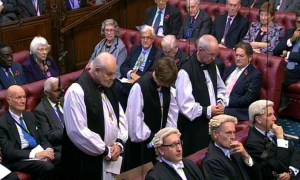
First female bishop to sit in House of Lords

Agree with this article? Violently disagree? Scroll down to leave a comment.

Follow Semi-Partisan Politics on TwitterFacebook and Medium.

In Defence Of Andrew Neil’s Anti-ISIS Rant – Political Journalism At Its Best

No, Andrew Neil’s magnificent anti-Islamist rant was not a violation of the BBC’s commitment to impartiality

It’s a strange world where I find myself writing in support of Andrew Neil twice in the same week, but then these are very strange political times.

Nick Cohen sings Andrew Neil’s praises in The Spectator this week, before going on to condemn Neil’s rousing anti-ISIS monologue at the start of his This Week programme – a speech which this blog strongly supported – on the puzzling grounds that it broke the rules on journalistic impartiality.

Cohen writes well as always, but there are so many mistaken premises and inaccurate comparisons in this piece that a proper rebuttal is needed.

His criticism of Neil begins:

Everywhere you look you can see broadcasters following Neil and Snow and pushing against the fuddy-duddy rule that they must show ‘due impartiality’. The Church of England is joining in, and pushing against equally antiquated restrictions on political and religious advertising.

They must be stopped. However admirable Neil and Snow’s sentiments are, and however inoffensive the Anglican’s celebration of the Lord’s Prayer was, we have to shut them up. The BBC and Channel 4 should never have broadcast their interviewers’ opinion. The cinema chains were right to tell the Church of England it was not welcome on their screens.

Britain is a country with rules to prevent wealthy politicians buying votes and wealthy televangelists buying converts. We are also a country that has fought to maintain the principle that broadcasters must be politically neutral – not always successfully, I grant you.

Three points here. First, the requirement for broadcasters to show ‘due impartiality’ applies to news programmes, and not to commentary – least of all when we are nowhere near a general or local election, the time when the rules governing broadcaster impartiality are at their strictest. The BBC’s This Week is a political magazine show, not a straight-laced news bulletin. Of course one would not expect Evan Davis, Kirsty Wark or Huw Edwards to pepper their delivery of the news with caustic criticisms or sarcastic asides – that would be highly improper. But a political magazine show is by definition an opinion-based show, relying for its content on a parade of partisan guests from different political parties and the media.

Cohen attempts to lump Andrew Neil’s tirade against ISIS along with Jon Snow’s coverage of the Israeli siege of Gaza, but this is comparing apples and oranges – one is a daily news bulletin required to be impartial, and one is a weekly talk show where opinions and partisan debate are essential ingredients.

Second, this is Andrew Neil we are talking about – a seasoned veteran journalist and businessman with a vast political Rolodex and a personal “brand” all of his own. Neil was also editor of the right-leaning Sunday Times for over a decade, is chairman of the company which owns the reliably Tory-friendly Spectator, and in previous life was a researcher for the Conservative Party. Neil was never supposed to be an anonymous newsreader, nor is he marketed as one – people watch This Week because Andrew Neil presents the show, and they know exactly what they are getting when they do so. The BBC are fine with that, and there is nothing to suggest that either the letter or the spirit of the rules are not being followed.

And thirdly, while Cohen’s assertion that Britain is “a country with rules to prevent … wealthy televangelists buying converts” might plausibly be true, we are also a nation with an established state Church – one whose grasping tentacles reach into nearly aspect of our politics and our national life. The ongoing row about the Church of England’s cinema advert is a separate issue, but we should not pretend that our United Kingdom is a nation where we even pay proper lip service to the concept of separation of powers.

When meddlesome bishops speak out in parliamentary debates without a shred of a democratic mandate, and when there are still scenarios whereby the Queen might conceivably end up picking the next government, we should not act as though there is some ancient and grave constitutional requirement for television stations to broadcast opinionless, equivocating platitudes 24/7.

BBC Values - Impartiality

Cohen continues:

Broadcasters themselves know a dirty secret newspaper editors understand too well: extreme opinions sell. They confirm the partisan in their beliefs and draw in outraged opponents.

[..] Broadcasters want a piece of that action. Opinion is cheap. News is expensive. The public watched Andrew Neil and Jon Snow’s polemics in their millions. What possible justification is there for insisting on balance, accuracy and impartiality?

It may be the case that news is expensive while opinion is cheap, but without the forceful expression of political opinions there could be no This Week in the first place – indeed, there could be no Question Time or Newsnight interviews either, let alone the crucible that is Radio Four’s Today Programme. And if Cohen is saying that the host should always be impartial even on political magazine shows then he sets a standard which can simply never be met, since every raised eyebrow, incredulous glance, rude interruption or “gotcha moment” will be seized on as evidence of deepest bias. Far better that we have good presenters with transparent histories like Neil, and then allow the public to adjust their perceptions accordingly.

Besides, this is not a question of political neutrality, at least as we traditionally understand the matter. Britain is not at war with a sovereign nation, however much ISIS may try to strut and pose as such. We are in conflict with a nihilistic, totalitarian death cult which seeks to spill the blood of everyone who does not adhere to their harsh, warped interpretation of Islam. They stand for nothing save creating hell on Earth to please their petty, jealous and vindictive god. Why shouldn’t the presenter of a serious political talk show be able to say that which we all know to be true?

And since when did expressing an opinion prevent something from being “real journalism”? Is Cohen himself not a journalist because his Spectator piece failed to strike an impartial position between Andrew Neil and himself? Whenever a broadcast news presenter reports on a “horrifying murder” or a “tragic death” they are making a value judgement and presuming to speak on behalf of the 99.5 percent of people who will agree with them. There is no moral or statutory requirement for the newsreader to treat criminal and victim alike in their tone and description, nor should there be. Similarly, ISIS are torturers, rapists and murderers. They break the law every moment of every day in their campaign to spread hatred and ignorance around the world. What’s wrong with saying so?

If ISIS were a legitimate, functioning state or political party and Andrew Neil went on a two minute tirade about their fiscal policy or industrial strategy then there might be grounds to accuse him of political bias. But that is absolutely not the case. Andrew Neil saw ISIS (or Islamist Scum, as he now calls them) take their patented formula of death and suffering, and smear it across the bright lights of Paris one unsuspecting Friday night, and he called it what it was – an act of savage murder that history suggests is doomed to fail in its stated goals.

If ISIS supporters were greatly offended by Neil’s words and lack of objectivity then by all means they can submit a complaint via OFCOM or the BBC Trust. I rather hope that they try.

But they do not need Nick Cohen – or anyone else – to help them out.

BBC - British Broadcasting Corporation

Agree with this article? Violently disagree? Scroll down to leave a comment.

Follow Semi-Partisan Politics on TwitterFacebook and Medium.

The Daily Toast: After Paris, Andrew Neil’s Bravura Anti-Islamist Speech

Three cheers to Andrew Neil for his bravura speech praising Western enlightenment values in comparison with murderous “Islamist scumbags” – and their sleazy apologists on the British Left

It’s fair to say that this blog has not always been the biggest fan of Andrew Neil, or what he has done with the BBC’s flagship political television output.

But I have only admiration for his opening monologue on today’s Daily Politics, responding to last week’s terrorist attacks in Paris. It’s worth transcribing Neil’s speech in its entirety:

Welcome to This Week. A week in which a bunch of loser jihadists slaughtered a hundred and fifty-two innocents in Paris to prove the future belongs to them rather than the civilisation like France.

Well, I can’t say that I fancy their chances. France: the country of Descartes, Boulez, Monet, Satre, Rousseau, Camou, Renoir, Berlioz, Cézanne, Gauguin, Hugo, Voltaire, Matisse, Debussy, Ravel, Saint-Saëns, Bizet, Satie, Pasteur, Molière, Franck, Zola, Balzac, Blanc, cutting edge science, world class medicine, fearsome security forces, nuclear power, Coco Chanel, Château Lafite, coq  au vin, Daft Punk, Zizou Zidane, Juliette Binoche, liberté, égalité, fraternité and creme brûlée.

Versus what? Beheadings, crucifixions, amputations, slavery, mass murder, medieval squalor, a death cult barbarity that would shame the Middle Ages. Well, IS, or Da’esh, or ISIS, or ISIL, or whatever name you’re going by, I’m sticking with IS – as in Islamist Scumbags.

I think the outcome is pretty clear to everybody but you: whatever atrocities you are currently capable of committing, you will lose. In a thousand years’ time, Paris – that glorious city of lights – will still be shining bright, as will every other city like it, while you will be as dust, along with a ragbag of fascists, Nazis and Stalinists who have previously dared to challenge democracy. And failed.

What a marvellous, stirring speech in defence of Western civilisation. Between Andrew Neil and John Oliver, here we have all the response we need to those who preach an ideology of hatred, ignorance and death.

If only more of our political and civic leaders had the self-confidence and moral fibre to speak like Neil (Oliver would probably be going too far) – and not just in the aftermath of a major terrorist attack on a European capital – perhaps we would not be facing such a crisis of confidence in Western and British values.

And that crisis of confidence is unfortunately summed up in some of the responses to Neil’s speech on Twitter:

Andrew Neil - Twitter Response 1

Andrew Neil - Twitter Response 2

Andrew Neil - Twitter Response 3

Through an insatiable desire to signal their virtue, flaunt their multiculturalist credentials and deliberately misinterpret those who dare to criticise the Islamists – but never Muslims in general – there are some on the Left who will only ever see bad in the West, and a plucky underdog in the murderous fanatics who bring death to innocent people in Paris, Madrid, New York and London.

These people are despicable. If our civilisation does ever collapse, it will be entirely thanks to their self-flagellating, virtue-signalling, moralising vacuity – not the Islamists, whose brief time strutting around the world stage will perish just like all of the failed ideologies that came before it.

A big toast to Andrew Neil for a full throated and very welcome defence of Western enlightenment and civilisation in the face of primitive Islamist barbarism.

And shame on each and every one of the virtue-signalling, West-hating, terror-appeasing, amoral leftists who chose to attack the speech on social media to flaunt their warped “tolerance” credentials.

They and the murderous Islamists fully deserve one another.

© HAROLD DAVIS

Agree with this article? Violently disagree? Scroll down to leave a comment.

Follow Semi-Partisan Politics on TwitterFacebook and Medium.

Are People Waking Up To Left Wing Virtue-Signalling?

When it comes to the British political debate, what you say now matters more than what you do. The BBC has apparently just noticed this trend

The standard Daily Politics slapstick comedy treatment makes it almost unwatchably patronising, but this segment of the BBC’s dumbed-down flagship political programme is actually on to something.

Last week, the Daily Politics invited journalist James Bartholomew – coiner of the phrase “virtue signalling” – on the show to talk about why more and more of us stop after stating our good intentions rather than following through by acting on them.

First, we get this candid and refreshingly frank take on the virtue-signallers:

“Virtue signalling without actually doing anything is not true virtue. It is self-righteous, vain and silly. It’s not what you say or think that matters, it’s what you do.”

Bartholomew then offers this interesting angle:

“I think the welfare state is a lot to do with it. People feel that they have outsourced their decency. I’ve paid my taxes, therefore I don’t have to do anything. I think that’s part of the cause, why virtue signalling without actually doing anything has increased.

[..] But what really irritates me is those people who I’ve met, in contrast to people who do real good, the people who think ‘oh, I can say I hate the Daily Mail and I hate UKIP, and I vote Labour once every five years. I’m a morally superior person.’ And that really irritates me because there are people who go out and make sacrifices and effort.”

I think there’s a lot of truth in this idea that the welfare state leads us to outsource our decency. Obviously there are many people who both contribute to the welfare state through their taxes and also find the time and resources to do additional good in their communities. But there are also many of us who do not.

There are too many of us who think that an angry Facebook meme or a lazy re-tweet counts as doing something meaningful and helpful. You could argue that we see the same phenomena every time something like the Ice Bucket Challenge sweeps the internet – a well intentioned fundraising initiative that soon led to large numbers of (particularly young) people uploading their own videos out of a desire to participate and show off, without then going on to make the all-important cash donation to MND charities.

This phenomena is an annoyance when it is confined to the social or charitable arena, but it becomes most problematic – and distorting – when it starts taking over the field of politics. Bartholomew himself has written about how the virtue signalling Left make any serious discussion about the future of British healthcare almost impossible:

It’s noticeable how often virtue signalling consists of saying you hate things. It is camouflage. The emphasis on hate distracts from the fact you are really saying how good you are. If you were frank and said, ‘I care about the environment more than most people do’ or ‘I care about the poor more than others’, your vanity and self-aggrandisement would be obvious, as it is with Whole Foods. Anger and outrage disguise your boastfulness.

One of the occasions when expressions of hate are not used is when people say they are passionate believers in the NHS. Note the use of the word ‘belief’. This is to shift the issue away from evidence about which healthcare system results in the greatest benefit for the greatest number of people. The speaker does not want to get into facts or evidence. He or she wishes to demonstrate kindness — the desire that all people, notably the poor, should have access to ‘the best’ healthcare. The virtue lies in the wish. But hatred waits in reserve even with the NHS. ‘The Tories want to privatise the NHS!’ you assert angrily. Gosh, you must be virtuous to be so cross!

This blog made the same point on the NHS only yesterday.

But whether it’s worshipping the NHS, opposing the bedroom tax or hating George Osborne’s plans for tax credits, it is clear that millions of people are willing to share a supportive tweet or Facebook post, but less willing to do anything else – even so much as vote in accordance with their own social media timelines, as Ed Miliband discovered to his cost on May 7.

Why is this? Are people that self-centred that they’ll give the poor a swipe of their thumb if they come across a lefty meme on their phones while commuting to work, but won’t march down to their local polling booth? Or are these lefty memes being shared not because people have given serious thought to the issues at stake, but rather because Politics via Social Media encourages everyone to treat their political opinions like this season’s fashion, casually adopting or discarding opinions in order to fit in with the group and gain acceptance by one’s peers?

Both factors are probably at play. But one thing is clear: when we are all so busy “raising awareness” of our pet causes on social media, we neglect the people actually making real-world policy at our own peril.

NOTE: It should be pointed out that virtue-signalling exists on the political Right, too, though not to the same extent. In the United States, some of the more craven military-fetishising and quasi-religious #humblebrags (“Feeling so blessed that the Lord has graced me with this promotion / pay rise / new washing machine”) would certainly count as virtue-signalling. And elements of the online meme-sharing Tea Party clearly got caught up in a bubble of their own and deluded themselves into expecting a Mitt Romney victory in the 2012 presidential election. So the phenomenon does cut both ways.

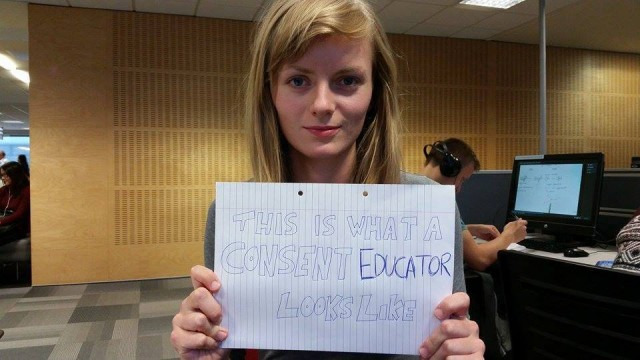
Sexual Consent Class - Consent Educator

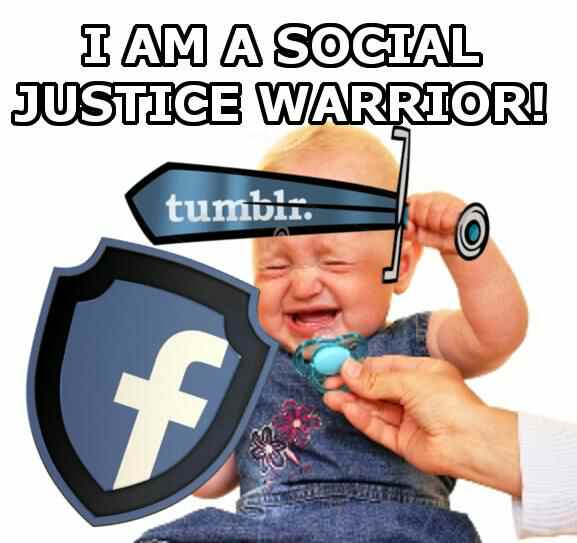
Social Justice Warrior

h/t Guido Fawkes

Agree with this article? Violently disagree? Scroll down to leave a comment.

Follow Semi-Partisan Politics on TwitterFacebook and Medium.