Tales From The Safe Space, Part 15 – Barack Obama On Campus Censorship

President Obama’s timely criticism of the Safe Space Generation of students

It may come as a surprise to his conservative critics, but President Obama’s stance on the creeping authoritarianism and Identity Politics culture infecting American college campuses is very much on the side of free speech and robust debate.

Pressed to discuss his views on “politically biased colleges” at a high school town hall event held late last year, Barack Obama said:

Sometimes, y’know, there are folks on college campuses who are liberal and maybe even agree with me on a bunch of issues, who sometimes aren’t listening to the other side. And that’s a problem too. I was just talking to a friend of mine about this, you know, I’ve heard some college campuses where they don’t wanna have a guest speaker who, you know, is too conservative. Or they don’t want to read a book if it has language that is offensive to African Americans, or somehow sends a demeaning signal towards women. And you know, I gotta tell you, I don’t agree with that either.

I don’t agree that you, when you become students at colleges, have to be coddled and protected from different points of view, y’know? I think that you should be able to – anybody who comes to speak to you and you disagree with, you should have an argument with ’em. But you shouldn’t silence them by saying “you can’t come because, y’know my – I’m too sensitive to hear what you have to say”. That’s not the way we learn either.

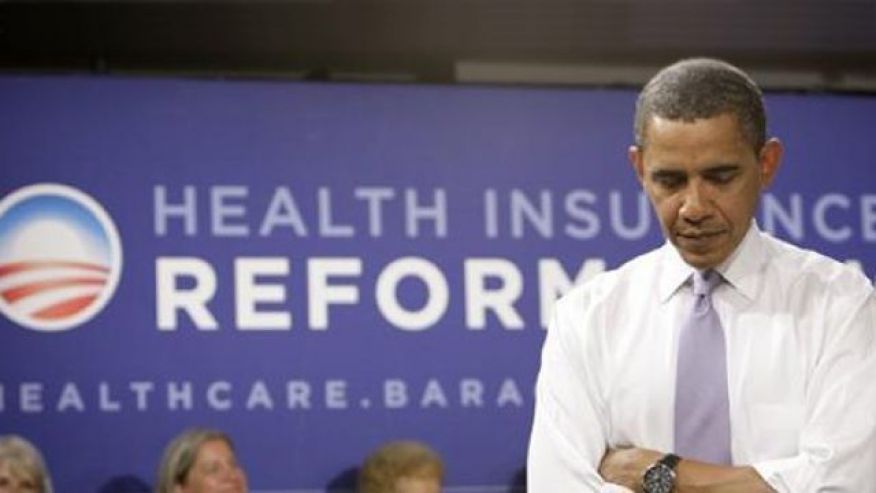
It is interesting to watch the reaction of the students standing behind Obama while he makes these remarks. Some are clearly bored and not paying close attention, but most clap politely when Obama reaches a natural break in his speech.

However, there is also a significant minority of students in the audience who are giving what can best be described as death stares. Clearly they do not like what they are hearing one bit, because Obama’s pragmatic suggestion that college is place where autonomous adults go to debate sometimes difficult ideas in the pursuit of personal and intellectual growth is contrary to everything that they have been taught is progressive and socially just.

Note in particular the two women on the top right of the screen when Obama says that campus speech restrictions are more suited to the former Soviet Union, approximately 3 minutes and 50 seconds into the video. While the other students seem to have fairly neutral expressions at this point, these two students look angry, sullen and passive-aggressive. The president of the United States has dared to come to their school and blaspheme against the Cult of Identity Politics to which they fully subscribe, and so they sit there, arms crossed and doubtless feeling quite triggered, plotting their revenge.

The point is this: it only takes a few such angry zealots to cow and intimidate an entire student population – and university administrations which should know better – into embracing every corrosive aspect of the Identity Politics culture. Of an entire student body, only a minority will drink deep enough from the well of competitive grievance culture that they turn and become the angry, authoritarian stars of many a YouTube video. But those who do are incapable of leaving everybody else alone. They cannot practice their new secular religion privately; all must share in their beliefs and abide by their behavioural codes, on pain of punishment.

Just seven years ago, the image of an African-American man addressing a group of high school students as President of the United States would have been seen as a powerful display of the social change that is possible when free speech is celebrated, guaranteed and used. Barack Obama, whatever one thinks of his record in office, did not become president by sheltering inside an academic safe space, after all. But Identity Politics does not encourage reflection on progress made; it primarily fosters resentment about the sins and injustices of the past.

Today’s generation of Identity Politics-practising students can talk endlessly about their “pain” and write interminable, barely literate screeds demanding that they be sheltered, acknowledged and validated in everything that they do.

But I doubt that a single one of them could write “Dreams from my Father“.


Safe Space Notice - 2

Agree with this article? Violently disagree? Scroll down to leave a comment.

Follow Semi-Partisan Politics on TwitterFacebook and Medium.

If Barack Obama Likes The EU So Much, America Can Take Britain’s Place

Barack Obama - EU - Britain - Brexit


The harshest critics of President Obama like to complain that the 44th president of the United States does not believe in American exceptionalism.

But today Barack Obama proved these fears to be unfounded – he does indeed believe that America is different and better than all the other countries of the world. And he did so by using an intervention at the G7 summit in Germany to pointedly suggest that a diplomatic settlement which the United States would never accept for itself (membership of a supernational body with sovereignty over the US government) is perfectly good enough for Britain, America’s closest ally.

From the Huffington Post:

Mr Obama’s comments came as he met Prime Minister David Cameron for talks in the margins of the G7 summit of world leaders in Schloss Elmau, Germany.

They are the strongest indication yet that Washington wants a Yes vote in the referendum which Mr Cameron has promised by the end of 2017 on whether Britain should stay in the EU.

Greeting Mr Cameron at the start of the bilateral talks, Mr Obama said the US-UK relationship remains strong, telling reporters: “We have no closer partner around the world on a whole host of issues.”

And he added: “I would note that one of the great values of having the United Kingdom in the European Union is its leadership and strength on a whole host of global challenges, so we very much are looking forward to the United Kingdom staying part of the European Union because we think its influence is positive not just for Europe, but also for the world.”

It should be noted that by making these pro-European interventions, President Obama is only repeating the longstanding American diplomatic position, which is that Britain should remain part of the European Union, come hell or high water.

Unfortunately, both hell and high water are now nearly upon us thanks to the suffocating economic and political embrace of the Old World, and it is high time we stopped giving any weight or consideration to American entreaties for us to do what is most convenient and beneficial for their own foreign policy over and above what is best for Britain. The United States would certainly like for Britain to remain in the European Union. But don’t take this as a sign of some overriding concern for the future of the UK’s economy or the health of our democracy – far from it.

Continue reading

A Sermon On Justice And Reconciliation From Ferguson, Missouri

Ferguson Missouri MO Fourth 4th July parade 2


What to say about the slow-motion tragedy unfolding in Ferguson, Missouri?

The few known facts – that a black teenager, Michael Brown, was shot to death by Darren Wilson, a white police officer, in disputed circumstances – belie the visceral anger that has consumed the town.

The subsequent actions by the authorities, notably the St. Louis County Police – stonewalling on releasing the name of the officer involved, refusing to release the autopsy details, waging an increasingly military-style war of aggression against legitimate protesters and journalists, and releasing CCTV footage of Michael Brown purportedly robbing a convenience store in what can only be interpreted as an act of pre-emptive character assassination – have only compounded the sense that a predominantly white establishment have more interest in protecting their good names and quelling dissent than administering justice.

St. Louis is a city that I know, have spent much time in, and feel close to. People should not be put off St Louis, Missouri and the surrounding area by the horrible scenes unfolding there now on television and Twitter, because the current crisis is not representative of the state and its citizens. But having personal experience of the area,  it is also glaringly evident that the violence and racial tension that forced itself into our collective consciousness with the shooting of Michael Brown last week was looming, unaddressed, for a long time.

Since I have known St Louis, it has been a city of two halves – the still somewhat dicey downtown area and select suburbs with higher black and lower income populations on one level, and the highly desirable enclaves and suburbs (such as Clayton and University City) that surround them, populated by a much wealthier (and whiter) demographic on the other. Everyone may cheer on their hometown St. Louis Cardinals baseball team on game day, but there is a clear divide between those who can afford tickets to watch the game at Busch Stadium and those who have to tune in on the radio or TV.  Tensions between the city’s two halves, while not ordinarily visible to the casual observer, have roiled this part of Missouri for years.

The New York Times thoroughly summarised the history of this divide in a recent article, revealing the underlying causes of the difference between St. Louis City and County:

Back in 1876, the city of St. Louis made a fateful decision. Tired of providing services to the outlying areas, the city cordoned itself off, separating from St. Louis County. It’s a decision the city came to regret. Most Rust Belt cities have bled population since the 1960s, but few have been as badly damaged as St. Louis City, which since 1970 has lost almost as much of its population as Detroit.

This exodus has left a ring of mostly middle-class suburbs around an urban core plagued by entrenched poverty. White flight from the city mostly ended in the 1980s; since then, blacks have left the inner city for suburbs such as Ferguson in the area of St. Louis County known as North County … 

Many North County towns — and inner-ring suburbs nationally — resemble Ferguson. Longtime white residents have consolidated power, continuing to dominate the City Councils and school boards despite sweeping demographic change. They have retained control of patronage jobs and municipal contracts awarded to allies.

This history lesson may seem a million miles away from the reality on the streets of Ferguson today, but it is directly relevant. It is because of structures such as this, where the now-minority white establishment continues to wield almost unchallenged control over the levers of local government, that allow the scenes of high-handed crackdowns on civil assembly and free speech as practiced by the predominantly white County Police.

The attitude – sometimes explicit, sometimes more subtle – of many of the wealthy St. Louis County residents to their St. Louis City and poorer County neighbours – has often been one of impatience and grudging forebearance on one end of the spectrum, and wilful ignorance on the other.

In 2009, St. Louis residents faced draconian cuts to their Metro public transportation service, the network of buses and light rail that connects the city. Residents of generally wealthy St. Louis County voted against an increase in the transit sales tax that would have raised $80 million to fund the Metro’s operation. They made little use of public transportation themselves – they were wealthy and drove cars. But the subsequent service cuts predominantly impacted the poorer County residents and the City residents who rely on public transport to get around. One figure implied that access to jobs in St. Louis County was reduced from 98 to 71 per cent.

Why does this matter? Because it was the poorer, predominantly black workers who served the coffee, sold the groceries and worked in the nursing homes used by the wealthy St. Louis county residents. A measure came up for vote that would have prevented it from becoming exponentially harder for these people to get to work in their low paid jobs every day. And the response of the County voters: Tough luck, we won’t pay a penny more to fund the civic infrastructure that you need. Screw you, we got ours.

Take this attitude and repeat it in every area, from education to police traffic stops, and you get a sense of the climate in which the Michael Brown shooting took place, and how little the two sides of St. Louis have historically been able to empathise with one another.

And on Saturday 9th August, it led to this:

Ferguson Missouri Michael Brown Protests Police


On my visits to St. Louis, a visit to the Episcopalian Christ Church Cathedral was always on the itinerary. The church and its community made a lasting impression on me with their many acts and expressions of love, welcoming and tolerance which sometimes seem so much at odds with the prevailing impression of Midwestern Christianity in America.

The way that Christ Church Cathedral (both in its grand stone home on Locust Street and its lively Facebook presence online) is responding to the crisis as it roils the city is perhaps a model to be studied and followed by all of the jostling interest groups – police forces, politicians, civil rights groups, the media and the oft-reported but scarcely-heeded residents – that have descended upon the area.

Yesterday, the Cathedral’s Dean Michael Kinman had this to say:

“The police and the justice system needs to hear the cries of the people and the people need to hear the cries of the police and the justice system, and we as followers of Jesus are the ones to stand in the breach between and even as we are being convicted and converted ourselves, help everyone on every side have their Jesus moment of conviction and conversion, of truth and reconciliation….

“The cry is ringing out from St. Louis around the world. The mothers are crying “Save my child,” and it is time for us to hear that cry and let it change our hearts and with changed hearts together lead this change in the world.

“St. Louis, this is our moment. And we know that this is not a child that will be healed instantly. The tasks are many, the obstacles are large and the journey will be long. But we are the Body of Christ and, with God’s help, together we will get the job done.”

Amen to this. Thus far, the police and the justice system have not been hearing the cries of the people. And in many cases they have conspicuously not been listening, either. Not in Ferguson, Missouri, and, sadly, not in many other towns and cities across America. For black Americans, the police are not automatically the reassuring presence on the street that they are to most whites – in fact, quite the opposite.

The protests taking place now would not be happening on their current scale and intensity if the death of Michael Brown was not just the latest of a litany of tragedies – and perhaps even injustices, depending on the outcome of this investigation – to disproportionally befall black victims and black communities. Looting and violence are reprehensible, but the situation in Ferguson does not exist in a vacuum, and it is not fair or intellectually honest to haughtily condemn them exclusively as failures of personal responsibility and ethics without taking the context of deprivation and repression in which they are happening.

That is not to say that a better, more peaceful path is not there for the taking. The police captain whose empowerment to take over control of the ongoing Ferguson situation from the hapless (and very culpable) St Louis County Police initially caused such a lull in the violence and bitter feeling showed the way with his early remarks:

“And we all ought to be thanking the Browns for Michael. Because Michael is going to make it better for our sons to be better black men. Better for our daughters to be better black women. Better for me so I can be a better black father. And, our mothers, so they can be even better than they are today. Lets continue to show the nation who we are. But, when these days are over and Michael’s family is still weeping, still on their knees praying. No matter what positive comes out, we still need to get on our knees and pray. We need to thank Mike for his life. We need to thank him for the change that he is going to make in America. I love you, I stand tall with you and I’ll see you out there.”

The difference that good leadership – and one man – can make is telling, and is encapsulated in this quote from a local resident, given last Thursday when hopes that the crisis was easing were still high:

But the presence of Johnson was clearly the difference between Thursday and the four nights of turmoil that preceded it.

 “I love this man so much,” said Angela Whitman of Berkeley. “He’s been here since the beginning,giving us encouragement and letting us know we’ll get through this.”

Conversely, the fact that the residents of Ferguson are not yet “through this” shows the limitations of good leadership and one man. Putting a local police chief – with black skin and roots to the community – in charge was a good first step, but it does not make up for the woefully slow response of Missouri Governor Jay Nixon. Nor does it make up for the fact that America’s libertarian political cheerleaders paused so obviously to test the waters before finally jumping into the fray.

The parachuting in of a black police captain does not make up for the many blatant violations of civil liberties – and the dignity of Ferguson protesters – inflicted by the overequipped and underprepared St Louis County Police in the preceding days. It does not make up for the flagrant inequalities in the American justice system, which incarcerates and punishes a huge number of young black men, stamping an indelible black mark on their records and making it even harder for them to ever break free from their circumstances and achieve the American Dream. And it does not make up for the false but universally known fact – reinforced over and over again, in lessons from cautionary tales like those of Trayvon Martin and now Michael Brown – that in America, a black life is worth far less than a white one.

One way or another, the protesters will eventually leave the streets of Missouri. So will the riot police, the clouds of tear gas and the world’s media filming it all. Michael Brown’s family will continue to grieve. These facts are certain, predictable, unchangeable. What remains within the power of people to influence is the legacy of this latest tragic black death on a city street. Will there be a meaningful and lasting change in police tactics, and a broader change in the way that the police seek to interact with – and reflect – the communities that they serve? And will there be a recognition that on America’s present trajectory, Michael Brown’s death was every bit as inevitable as that of the next person shot down without justification or consequences?

It takes a lot to change the culture of a local police department, let alone the judicial system of an entire nation. And for all the good that the players in Ferguson can do to bring these issues to our attention and make us face uncomfortable facts as they seek to reconcile and come to terms with what has taken place, it is usually at the state and national level where any lasting, widespread changes are enacted.

Unfortunately, this means that it is left to the slow-moving and cautious Missouri governor Jay Nixon, the vacationing President Obama (himself hamstrung in his response after failed interventions in the Trayvon Martin shooting and other incidents) and a host of national politicians who are more inclined to use the pain of Ferguson, Missouri for their own ends than to solve a common problem. With this predictable cast list, there seems little hope that we will not be reassembling in a few months’ time to beat our breasts over the next police shooting, mass shooting or other act of wanton violence.

But still, we must hope. And in the absence of any meaningful national leadership, the people of Ferguson, Missouri must lead the way themselves in turning a case study in “Community Policing – How Not To Do It” into a model of outreach and reconciliation for the rest of America.

For the sake of everyone, black and white, city and county, this dark chapter in American history must not be endured for nothing.
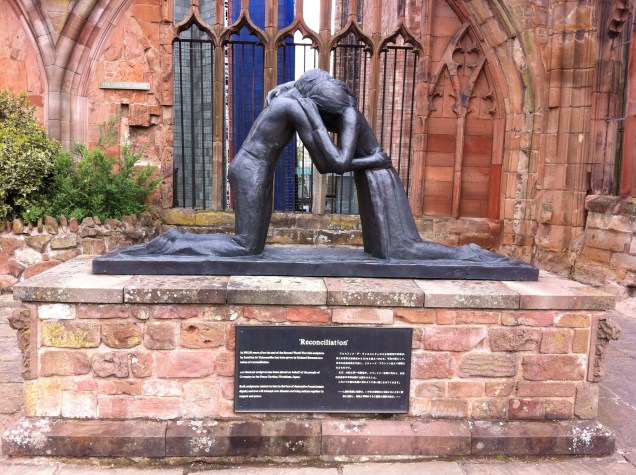
  

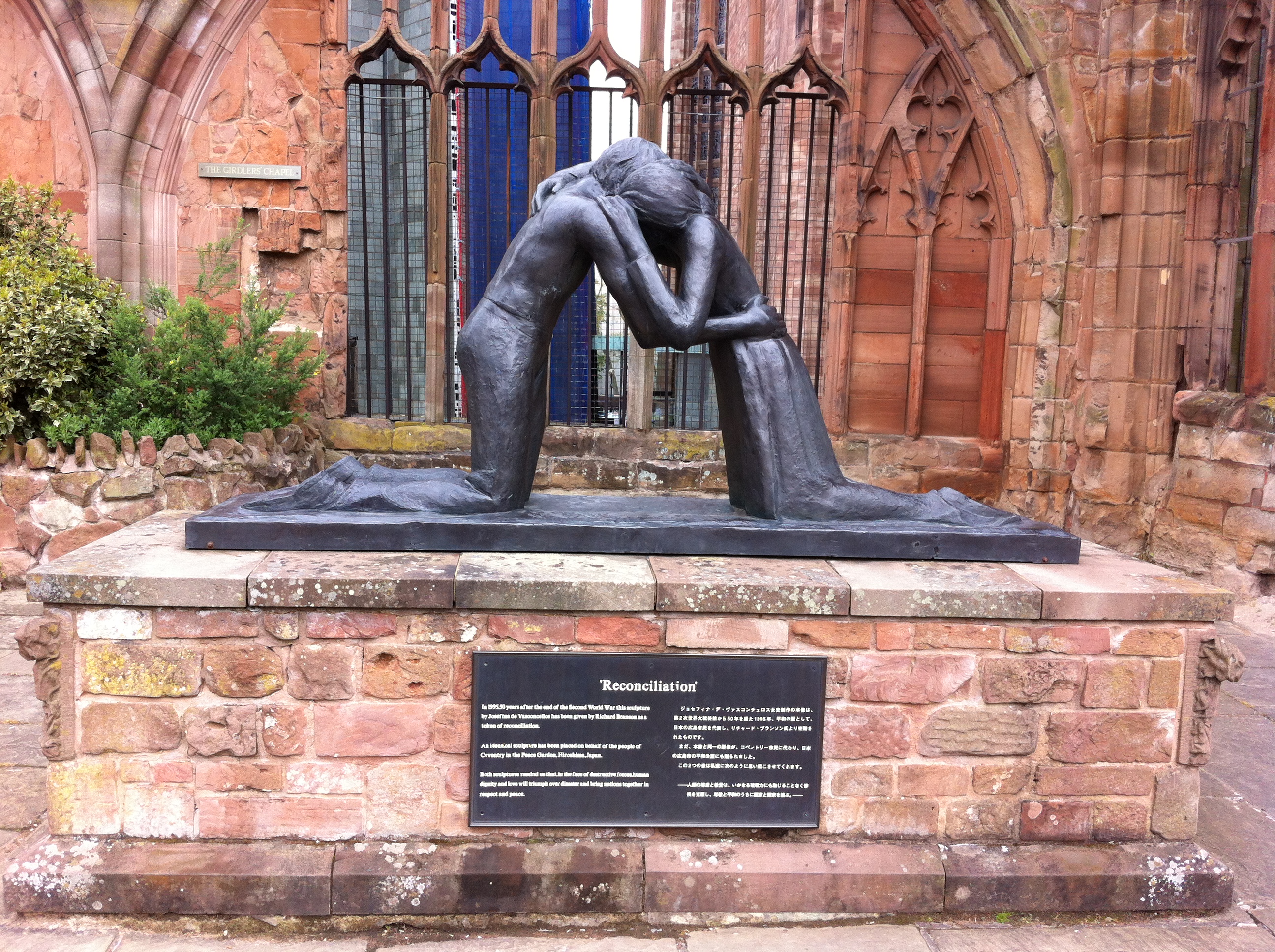
Statue of Reconciliation Coventry Cathedral Britain


Cover Picture: Fourth of July Parade in Ferguson, Missouri – NOCO magazine

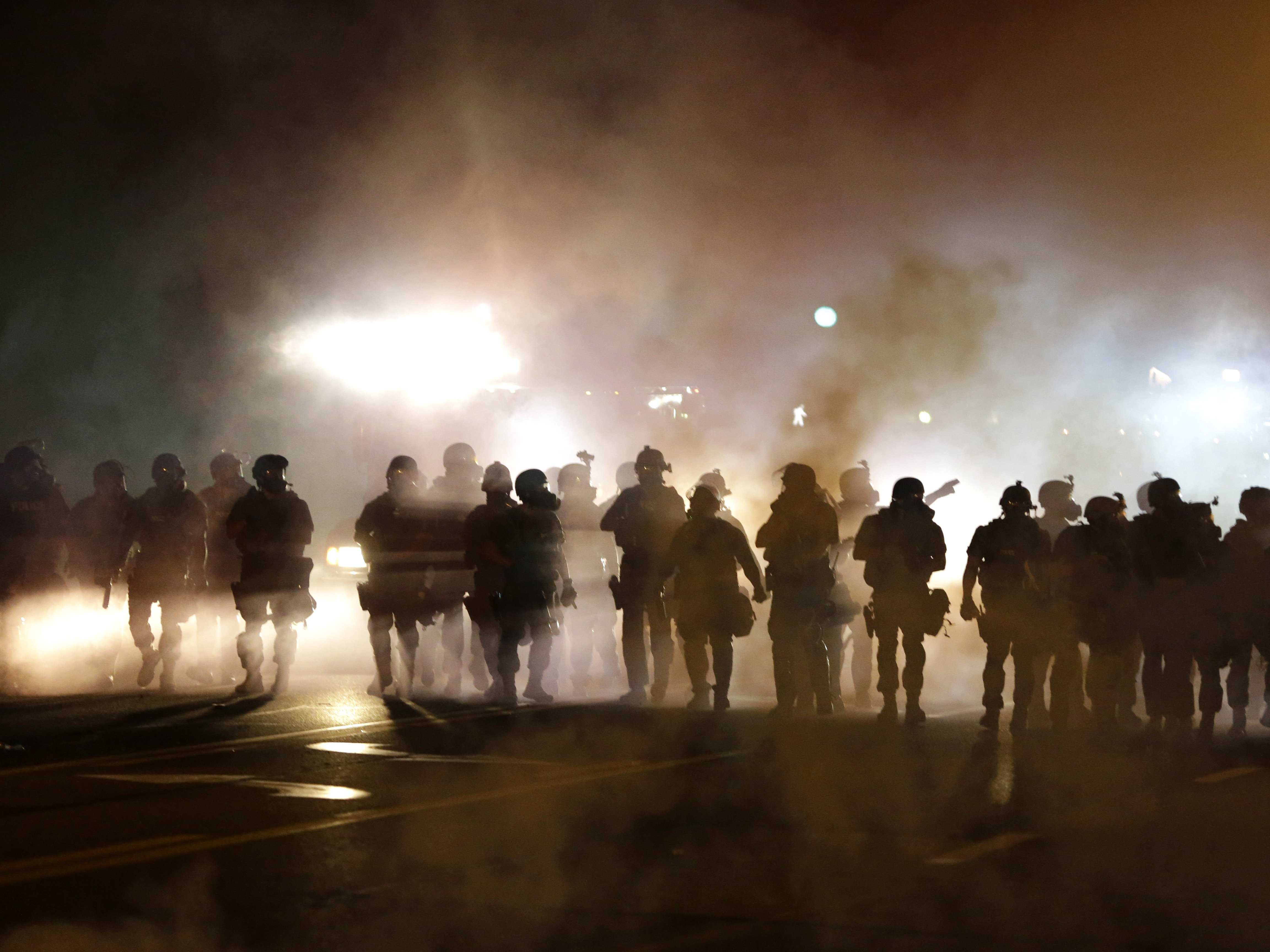
Middle Image: Police in riot gear advance through clouds of tear gas in Ferguson

Closing Image: Statue of Reconciliation, Coventry Cathedral, Coventry, UK


ObamaCare, Four Years After Signing

obamacare

The Patient Protection and Affordable Care Act – otherwise known as the ACA or ObamaCare – was signed into law four years ago this week after tortuous rounds of planning, posturing, arm-twisting and televised negotiating in Washington.

And while many of the features (to say either ‘benefits’ or ‘drawbacks’ immediately displays one’s political bias) of ObamaCare are only now taking effect, this is a good moment to take stock, step back from the thrust and parry of partisan bickering and reflect on what has actually happened since America decided – with the GOP kicking and screaming defiance to the bitter end – that as a country they would no longer tolerate the spectacle of millions of people without health insurance or reliable access to preventive medicine.

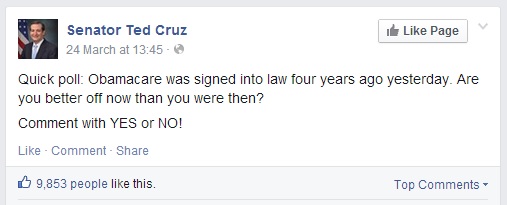
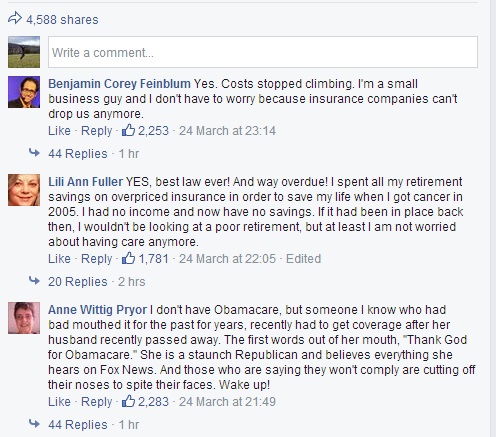
Tea Party darling Ted Cruz, the junior senator from Texas – who fancies himself an intellectual heavyweight and a man of deep principle – took the opportunity to reflect by posing a question to the public on his Facebook page:

tedcruz1


Perhaps surprisingly, given the likely political leanings of a Ted Cruz facebook follower, the majority – the real, undeniable, vast majority – of responses to Cruz’s question are unabashedly, overwhelmingly in favour of ObamaCare.

The following responses are the most recent as of the time of writing, and are entirely representative of the rest:

tedcruz2


The warmth of these responses to the effect of ObamaCare – some from staunch Republicans – is quite arresting, and really reveals the gap between the GOP rhetoric on healthcare reform and the way it is perceived by many of those directly impacted.

This is not to say that there are not dissenters among those who answered Ted Cruz’s question on facebook – there are plenty. But the fact that they are in such a minority (and that they often failed to directly answer the question in terms of impact on their finances or lives) again exposes a fundamental weakness in the Republican party’s full-throated opposition to the bill.

While there are certainly – as with any major legislation – those who have lost out as a result of ObamaCare, either through having to change their healthcare plan, pay a higher premium or lose some other benefit – for every one of these cases, there seem to be other people being rescued from catastrophic personal and financial ruin or uninsurability. It is quite telling that when Ted Cruz opened the floor to the public to make their voices heard – without the controlling hand of opinion pollsters or leading questions in focus groups – the message painted was overwhelmingly positive.

The GOP has long tried to paint the passing of ObamaCare as the sudden imposition of socialism on America (conveniently forgetting huge programs such as MediCare for seniors, which are real, tangible socialism in action) against the will of the people and the founding values of the nation. In GOP-world, everyone is a small business owner or unspecified “wealth creator” being taxed to death in order to fund this extravagant giveaway by the “takers”. The real world, as glimpsed through the windows of Ted Cruz’s Facebook page, appears to contradict this worldview.

With ObamaCare, as with most big policies, there is merit in the arguments of both supporters and detractors. President Obama’s signature domestic policy achievement is not without multiple flaws, but those who oppose it undermine themselves by the fact that they made no effort to tackle the glaring problems in America’s healthcare system – sometimes laughably called the “greatest in the world” by ignorant people who have never set foot outside the United States – before Obama took office, and then decided to adopt a position of total, unwavering obstruction once reform efforts got underway – even denying and repudiating policies and ideas once favoured by their own side as conservative reforms.

The Republicans could very well win total control of Congress at the midterms this November, and then go on to win back the presidency in 2016. If they do so, they will have to decide – and admit to the world – how much of their opposition to ObamaCare is real and principled, and how much was political posturing and pandering to the base. And the measure of this will be the provisions that they seek to repeal and those which they keep.

If the Republicans want to be a serious party of government again – and sadly, there is currently very little sign that they do, even though America sorely needs a sane right-wing voice as part of her political discourse again – they will have to confront people like those who shared their positive stories of ObamaCare on Ted Cruz’s Facebook wall, and tell them precisely which of their newfound securities will be ripped away, and why.

Over 7 million Americans have now signed up for health insurance through the various ObamaCare exchanges. If the Republican Party is to regain power, it must face a political day of reckoning with each and every one of them.

Who Is To Blame For The Left’s Stalled Agenda?

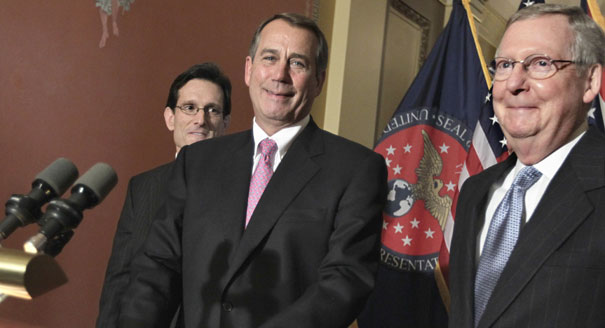
The masterminds
The masterminds


If you were wondering exactly how deep goes the rot in the American conservative commentariat in the Age of Obama, you need look no further than the editorial and letters pages of the Wall Street Journal.

When these pages are not screeching warnings of an imagined upcoming Kristalnacht for wealthy Americans to be carried out by the seething, envious masses, they have taken to publishing seemingly highbrow retrospectives on the Obama presidency, paying particular attention to America’s failures and shortcomings under President Obama, whilst brazenly whitewashing the conservative or Republican part in those failures.

Danniel Henninger has the honour of writing the latest of these historically revisionist editorials on the WSJ’s aptly named “Wonder Land” blog – apt because what is written there bears so little resemblance to fact, or reality. In this piece, Henninger asks “The left can win elections. Why can’t it run a government?”

The editorial gets off to a bad start, attempting to link three quite ideologically disparate politicians and use their waning fortunes as evidence of a socialist malaise:

Surveying the fall in support for the governments of Barack Obama, New York City’s progressive Mayor Bill de Blasio and France’s Socialist President François Hollande, a diagnosis of the current crisis begins to emerge: The political left can win elections but it’s unable to govern.

It may have become what now passes for a fact by some on the American right, but in truth – if you look up the dictionary definition or compare his policies to those of previous Democratic presidents – Barack Obama is not a socialist. Therefore, Obama’s troubles have little to do with the travails and setbacks experienced by President Hollande of France, a legitimate socialist whose actual, socialist policies continue to do damage to that country.

Henninger then spends the rest of the article expanding on his cheeky proposition that the political left can win elections, but are unable to govern once in power. He fastidiously examines every possible reason for Obama’s failure to advance his agenda, save the most glaring one – the fact that the Republican opposition have consistently been more interested in token opposition, nihilism, public posturing and pandering to their base than they have bothered to engage in the processes of government while in opposition.

But Henninger is less interested in any kind of introspective analysis of the rights own complicity in America’s current difficulties than in spewing misleading half-truths:

Once in office, the left stumbles from fiasco to fiasco. ObamaCare, enacted without a single vote from the opposition party, is an impossible labyrinth of endless complexity.

The merits and drawbacks of ObamaCare aside, the blanket Republican opposition was more a strategic move to damage the Obama presidency than a principled stance (Republicans having long been content to leave “the best healthcare system in the world” and all it’s flaws untouched and unaddressed), and Henninger conveniently forgets that Anh Joseph Cao of Louisiana provided a solitary GOP vote for the draft version of the health bill.

Henninger’s next exhibit is the world’s response to climate change, an issue which he says has more political support than any other in our time:

No idea in our time has had deeper political support. Al Gore and John Kerry have described disbelievers in global warming as basically idiots—”shoddy scientists” in Mr. Kerry’s words. But somehow, an idea with which “no serious scientist disagrees” has gone nowhere as policy. The collapse of the U.N.’s 2009 Copenhagen climate summit was a meltdown for the ages.

It may or may not be correct to state that global warming is the greatest area of consensus in world politics at the moment, but what is truly laughable is Henninger’s neglect to admit that all of the opposition to taking any action on climate change comes from his own side. In doing so, he really answers his own question, except that it is not so much the left who are terrible at governing, but more that the ideologically inflexible American right are brilliant when it comes to using whatever political power they still wield to throw a spanner in the works and thwart the majority.

Sometimes it may be right to use opposition power in this way, in order to prevent abuse of power by that majority – but using that same tactic over and over in response to every initiative from the governing party is overkill, and the opposite of good governance.

Henninger sums up:

Making the unworkable work by executive decree or court-ordered obedience is one way to rule, and maybe they like it that way. But it isn’t governing.

True – and Henninger can rightly point to numerous cases where the left has taken these shortcuts to governance, especially recently. But he fails to take the next step and ask why President Obama and the Democratic party are behaving as they are, showing a complete unwillingness or inability to examine the GOP’s own role in creating the acrimonious partisan deadlock for which executive orders and court judgements have been the only pressure release valve.

Under the presidency of George W. Bush, the Republican Party had a tight grip on the reigns of power, holding the executive branch and both houses of Congress for a time. And in this time meaningful legislation was passed, sometimes in the face of vociferous opposition from the left and from libertarians. Significant legislation such as the PATRIOT Act, Sarbanes-Oxley and the 2003 Partial-Birth Abortion Ban Act were all shepherded through Congress without Democratic Party histrionics or threat of filibuster.

One can argue that the Republicans’ willingness to remain united as a single block in order to successfully oppose legislation is a sign of strength, and that the Democrats’ tendency to fracture and allow members of their caucus to be picked off in order to garner support for conservative proposals is a sign of weakness. But in that weakness is also the flexibility and willingness to compromise – hell, to acknowledge that some people in America hold a different point of view – that is so utterly lacking in today’s GOP and in much modern conservative thinking.

The American left may sometimes be catastrophically bad at advancing their agenda, framing the debate and winning the now all-important war of words (death panels, death taxes, job-creators) when courting public opinion, but the American right plays a daily role in the left’s emasculation. In many ways, even in opposition the Republicans have seemed like the playground bully who grabs hold of his prey’s wrist and turns his fist against him, all the while asking why the hapless victim likes punching himself so much.

Blanket, unthinking opposition to everything that the governing party tries to do has been effective for the GOP of late. They have successfully stopped President Obama’s legislative agenda in its tracks. The conservative strategy has been proven to work very well, but good responsible governance it is most certainly not.