Conservatism, Behind Enemy Lines

Rod Dreher reports on a fascinating (and depressing) exchange posted on the wall of Princeton professor Robert P. George, between Professor George and a closeted conservative colleague.

The recounted exchange is worth posting in full:

Closeted conservative colleague: “I don’t feel I can say what I think, at least not at this stage. I have a family to care for and other responsibilities, you know.”

Me: “Sure. I’m not criticizing you.”

CCC: “I’ve seen people’s careers ruined for saying what they think.”

Me: “I have, too. I’m really not criticizing you. I assume you’re following your conscience.”

CCC: “You say what you think and you’ve survived. But your the exception.”

Me: “I’ve been very fortunate. That’s true. But there are plenty of others. I’m not unique. There’s Harvey Mansfield, Hadley Arkes, Mary Ann Glendon, Jim Ceaser, and others. Even some people they’ve tried hard to destroy have survived. Mark Regnerus at the University of Texas, Austin,” for example. They threw everything they could find at him, every calumny imaginable. They tried to get him formally investigated and fired. But he has beaten them. I predict he’ll be promoted to full professor this year.”

CCC: “Yes, but there have been lots of victims, too.”

Me: “Yes. Alas. Lots of victims.”

CCC: “You think I should say what I think.”

Me: “I think you should follow your conscience.”

CCC: “That’s just your way of saying I should say what I think.”

Me:; “Look, as I said, I’m not criticizing you. Only you can discern the demands of your own conscience. I didn’t even bring this whole subject up, you did.”

CCC: “I know what you tell your graduate students to do. You tell them not to hide their politically incorrect views.”

Me: “Well, yes, I hardly hide my advice to them. They initially find it counterintuitive. Their natural instinct is to hide their dissenting beliefs or downplay them. I think that’s risky from a character point of view and also not the best strategy for success.”

CCC: “You ARE judging those of us who keep our opinions to ourselves, then.”

Me: “For heaven’s sake, I’m just saying that there is a certain moral hazard in not speaking your mind. As scholars, we’ve got a special obligation to truth and a vocation to truth-telling. Of course, everybody has a basic obligation to honor the truth, as best they grasp it, but our obligation is even more central to who we are. So, speaking for myself, I don’t see what the point of being a scholar is if we’re not willing to speak the truth as best we understand it. I mean, there are lots of other fields we could go into. We could be lawyers, or doctors, operate hedge funds. There’s the insurance business. Wendy’s franchises. Anyway, again speaking for myself, if I felt I couldn’t speak the truth out loud, I would abandon academic life and go do something else.”

CCC: “You’re not afraid to say what you think because you’ve been able to get away with it without your academic career being ruined.”

Me: “That’s exactly backwards. I’ve been able to get away with it because I’m not afraid to say what I think. Fear empowers the bullies. They’re far less bold and aggressive when they know you’re not afraid of them.”

CCC: “Well, I am afraid of them.”

What emotion do you suppose is primarily motivating CCC? I think that the answer is quite clear: terror. Sheer, unbridled terror at the thought of being purged not only from one’s current job but from one’s profession field altogether if one so much as questions the progressive, social justice/identity politics dogma which has descended on academia like a suffocating blanket.

Where else in history have we seen such terror, such fear of having one’s heretical personal beliefs exposed and punished by the state or the mob? It’s hard not to give way to hyperbole, but this is literally the stuff of Orwell’s 1984, or (back in the real world) Soviet Russia during the purges.

And for what? To bring about forced adherence to the new orthodoxy on gender identity, racial politics, climate change, immigration and any other left wing cause du jour. Left-wing academics and students have abandoned any glancing interest in persuasion as a tool, and have jumped straight to brutal enforcement. Some academic fields will take longer than others to fall under the jackboots of this new authoritarianism – the STEM subjects are still relatively free, the humanities dangle over the precipice while the social sciences have long since fallen – but all are heading in the same direction.

And this is why Robert P. George’s own stance matters, and is correct. Just as there can be no equitable accommodation with people who want to establish a fundamentalist Islamist caliphate across the West, neither can conservative academics and other defenders of free speech split the difference with the authoritarian, petty tyrants who are busy consolidating their control over the university campus. One either has academic freedom and the right to free speech, or one does not. There is either censorship and an ideological test for working in certain professions, or there is not.

The time for keeping one’s head down and trying to avoid trouble is over. Those of us who believe in free speech and unrestricted academic enquiry have an obligation to speak out in defence of those being persecuted or intimidated for their beliefs, today and in the future, whether we agree with the particular speech in question or not.

They can’t arrest us all and they can’t fire everyone simultaneously. Conservatism needs to make a stand, to boldly assert that it will not be intimidated and purged from academia without a fight, or without exposing the progressive, social justice cultists as the modern day tyrants that they are.

 

academia-learning-conservatism

Support Semi-Partisan Politics with a one-time or recurring donation:

Agree with this article? Violently disagree? Scroll down to leave a comment.

Follow Semi-Partisan Politics on TwitterFacebook and Medium.

Isabel Hardman Is Right To Criticise The Labour Party’s Toxic Brand Of Feminism

Isabel Hardman has a great piece in The Spectator in which she rightly castigates Harriet Harman and the Labour Party for their narrow, possessive and parochial attitude towards feminism and gender equality.

Hardman writes:

Harriet Harman also described the Prime Minister as ‘no sister’, arguing ‘we’ve got a new Tory prime minister – and she’s a woman. But like Margaret Thatcher before her, Theresa May is no supporter of women’.

Now, it’s probably quite irritating for Labour to have to hold a women’s conference while the Tories are still crowing that they’ve got another female Prime Minister. But is this sort of ‘you’re not a real feminist’ moaning very, well, feminist? Naturally, Theresa May has a different interpretation of what a feminist politician should do to some Labour MPs: though perhaps not as different as they might think. After all, she did set up Women2Win, which has increased the number of female Tory MPs in parliament by lobbying the Conservative party and mentoring candidates. And after all, she did do quite a lot of work on domestic violence when in the Home Office, including working with the now Labour MP Jess Phillips when she was working as a national adviser on domestic abuse, and introducing the offence of coercive and controlling behaviour. And she also introduced a number of measures on female genital mutilation and forced marriage. But still, she’s not a Labour MP, so that means that obviously she’s not really a feminist.

Sorry, ladies, but feminism is even more important than partisanship. If you start claiming that only women who meet with your politics are real feminists, then you break into the People’s Front of Judea when feminists haven’t run out of problems to solve. You also alienate those on the right who are feminists but who you tell aren’t welcome in your special exclusive left-wing ladies’ club. Feminism has to span the political spectrum, otherwise it gets stuck in one party. And given the Labour party isn’t going anywhere right now, that’s not much use to the women who still need a politician who’ll show them what a feminist in government looks like.

Amen to that. Feminism (or egalitarianism) is much bigger than the Labour Party – thank God. And Lord knows that it needs to be.

Labour’s brand of feminism views women as weak supplicants and perpetual victims, helpless waifs entirely dependent on government largesse, social protection and financial support from the state.

It is a toxic creed of inferiority which imagines that women cannot make it on their own without help from enlightened white knights in the Labour Party to vanquish their foes and smooth their path in life. And that’s why Harriet Harman and other left-wing feminists hate Theresa May, and hated Margaret Thatcher before her. For here are two unapologetically conservative women who strove and succeeded on their own merits, and and overcame an (at times) extremely sexist culture and workplace by quietly getting on with the job rather than exulting in their own supposed fragility and victimhood.

Harriet Harman views Theresa May as a traitor to Proper Socialist Feminism because Theresa May (and other independent conservative women like her) never asked for Labour’s help on her path to success, and because Britain’s new prime minister is a living, breathing example to girls and young women (and men, for that matter) that success and full equality are not contingent on swallowing Labour’s nasty, backbiting politics of identity and victimhood.

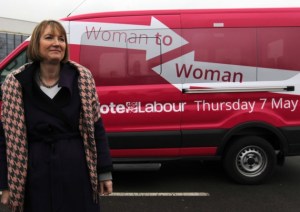
For in reality, it has been the Conservative Party who have put egalitarian and meritocratic principles into practice when it really counted, electing not one but two female party leaders. Labour is the party of the all-woman shortlist, affirmative action, gaudy pink minibuses and thinly-veiled misandry. The Tories are the party of Britain’s two first female prime ministers.

So three cheers for Isabel Hardman reminding us that believing in gender equality should not and does not also require swallowing whole Labour’s politics of grievance, weaponised victimhood and government dependency.

Feminism and egalitarianism are bigger than the Labour Party, which is probably just as well – because Labour’s leading feminists are looking mighty churlish and downright small right now.


harriet-harman-labour-party-pink-bus-feminism-identity-politics

Support Semi-Partisan Politics with a one-time or recurring donation:

Agree with this article? Violently disagree? Scroll down to leave a comment.

Follow Semi-Partisan Politics on TwitterFacebook and Medium.

Live Blog: Jeremy Corbyn Elected Leader Of The Labour Party (Again)

jeremy-corbyn-victory-labour-leadership-contest-2016

Jeremy Corbyn destroys Owen Smith’s pathetic candidacy, is re-elected leader of the Labour Party – Live Blog

Contact: semipartisansam@gmail.com


13:26

At this point I’m not sure what more there is to say. All of the arguments about how the Labour Party ended up in this position have been stated and restated over and over.

Inglorious defeat was long predicted by this blog – not least here, here and here.

One can only think that the restless, self-entitled centrists have shot themselves (and their party) in the foot with this reckless and doomed leadership challenge – and for what? Corbynism, however misguided, has earned the right to be tested at a general election. And all of these furious attempts by the PLP to circumvent that process and disenfranchise Jeremy Corbyn’s base have only hardened his support – and strengthened the impression that the centrist Westminster establishment do not trust the British electorate to choose from a full palette of political shades, insisting on artificially limiting our choice beforehand lest we make the “wrong” choices.

As this blog recently noted:

One way or another, the establishment seems determined not to give the quaintly antiquated socialism of Jeremy Corbyn the opportunity to fail on its own. Labour’s centrist MPs do so because they are hungry to pursue what they see as the quickest route back to power (and some fear losing their seats in a 2020 anti-Corbyn landslide), and the rest of the political and media establishment do so because they are alarmed by Corbyn’s views on NATO, Trident and other issues, and do not trust the British people to likewise see the flaws in these ideas and reject them.

Of course, the sad irony is that by going to such extreme lengths to prevent Jeremy Corbyn’s socialist ideas being tested in a general election, the establishment is doing more than anyone else – more even than Corbyn himself – to harden support for those failed ideas, ensuring that they live on even longer past their “sell by” date.

Furthermore, the idea of centrist MPs enforcing what is essentially a de facto ideological test for any politician seeking high national office is grossly offensive to our democracy, revealing the establishment’s contempt for the people in all its hateful glory. We the people are more than capable of determining which political ideas are good, bad, offensive, dangerous or otherwise, and we have no need for a sanctimonious elite to pre-screen our choices for us.

The only things necessary to defeat Corbynism are Jeremy Corbyn himself and the British electorate. It’s sad that Labour MPs and the political / media establishment are simultaneously too selfish and too distrustful of the British people to realise this obvious truth.

This failed coup against Jeremy Corbyn has also revealed the utter dearth of talent among Labour’s centrist MPs. Even the supposed “big beasts” are little more than field mice – none of them had the courage to put their own political careers and future leadership ambitions on the line by challenging Jeremy Corbyn, leaving it to the underwhelming Owen Smith to carry their banner.

But worse than failing to field a serious candidate, the centrists had no vision to offer. Like Jeremy Corbyn or loathe him, he has a vision for a different Britain and principles which he has stuck to for decades, not bending and shapeshifting in an attempt to flatter different interest groups. The centrists offered no vision at all, other than their naked hunger for power. But if you cannot articulate in an inspiring way what you choose to do with that power, it will not be granted to you.

Will the Labour centrists finally learn this lesson? I have absolutely zero confidence that they will.

12:40

Submission.

See my “submission” series – Part 1, Part 2, Part 3.

12:29

Good question from Norman Smith to Diane Abbott – “why shouldn’t local parties deselect local MPs who continue to be vocally critical of a popularly elected leader?”

Abbott deflects, choosing to be polite and magnanimous today – but Norman Smith’s question is a fair one. Why should pro-Corbyn CLPs continue to tolerate Labour MPs who do not share their beliefs and actively seek to undermine Corbyn’s leadership?

In fact – mandatory reselection for all!

12:24

To do otherwise would have required competence and vision, qualities with which the angry, self-entitled centrists are not exactly brimming over.

12:22

Thinking of starting an “it’s time for the Labour Party to come together” counter on this blog. Nearly everybody interviewed on the BBC so far has used that phrase, however unconvincingly.

12:16

Interesting report from Huffington Post – apparently Owen Smith “won” among under 24s (and pre-2015 members) according to an exit poll:

Owen Smith beat Jeremy Corbyn among Labour party members who joined the party before 2015, a new exit poll has revealed.

Although he was defeated in the overall election, the YouGov/ElectionData poll found that Smith also won among 18-24 year-olds and Scottish party members.

The survey found that 63% of pre-2015 party members had backed the Pontypridd MP, to just 37% for Corbyn.

But the current leader had a huge lead among the tens of thousands who have joined the party since Ed Miliband quit, with 74% of them backing him to just 24% for Smith.

Among those who had joined since Corbyn became leader, a massive 83% said they had voted for him in the 2016 leader election, and 15% voted Smith.

While this sounds quite surprising at face value, digging a little deeper I’m not so sure that it is unexpected. Look at the young people who typically get into politics – a significant number of them tend to be university Labour/Conservative types, people who entertain either vague or determined ambitions to one day climb up the greasy pole and launch political careers of their own. Young Labour activists such as these likely want to taste political power one day rather than dwell in permanent opposition, and since prevailing wisdom (right or wrong) is that Jeremy Corbyn is unelectable is it really surprising that many of them fell into line behind the candidate who looked the part of the typical, professional political candidate? I don’t think so.

12:14

Yeah, I picked up on this too:

12:11

Not a whole lot of sympathy for Owen Smith from the Left:

Good. Owen Smith is an awful politician and was a terrible leadership candidate. He deserves neither consolation nor sympathy.

12:06

Chuka Umunna on the BBC, on the defensive against the potential deselection of “good, hardworking and popular” local Labour MPs.

Newsflash, Chuka – if they were so tremendously “popular” among the party activists who sweat blood to get them elected to Parliament in the first place, they wouldn’t be at risk of deselection. But since they have openly defied the wishes of their own local party members, they must now steel themselves to face the consequences.

12:02

Hilarious watching sulking centrists stalking out of the conference hall and refusing to even talk to the BBC reporter (Norman Smith) stationed outside. They have only themselves to blame for pitching the biggest hissy fit in the world against Corbyn’s leadership while utterly failing to come up with a compelling vision of their own for the future of the Labour Party and Britain.

12:00

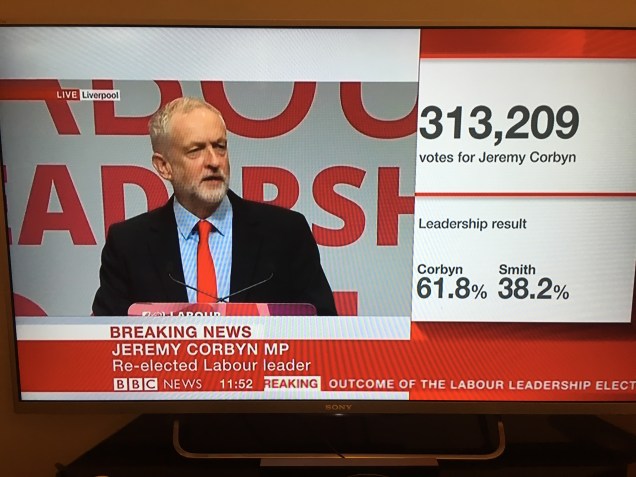
Well, that wasn’t a bad victory speech from Jeremy Corbyn – far more magnanimous than I would have been under the circumstances. He congratulated the supporters and activists of both leadership campaigns in a general paean to political activism, and tried to immediately move the focus forward by plugging some big campaign for education (basically against grammar schools) next week.

I’m not sure if that will be enough to glue the warring Labour Party back together – however many times the phrase “we all need to come together” are uttered by different Labour MPs and officials over the course of the day. But for Jeremy Corbyn, it is clearly now business as usual.

11:50

And it’s Jeremy Corbyn (naturally), with 313,209 votes of 506,428 cast, meaning a breakdown of Corbyn 61.8% / Smith 38.2%.


Jeremy Corbyn - Paris Attacks - Terrorism - Appeasement

Support Semi-Partisan Politics with a one-time or recurring donation:

Agree with this article? Violently disagree? Scroll down to leave a comment.

Follow Semi-Partisan Politics on TwitterFacebook and Medium.

Donald Trump Meets Social Justice Therapy Culture, And No One Comes Away Looking Good

donald-trump-anxiety-therapy

Now apparently Donald Trump has made it impossible for millennials to experience love. Hysterical accusations and overreactions like this from his opponents will do more than anything to sweep Trump to victory in November

Donald Trump would almost certainly make a terrible president – and yet one is half tempted to give him a shot when confronted with the hysterical reactions of America’s permanent victims, who have naturally found a way to make a debate about the future of the republic and the possibility of a Trump presidency all about them, their own anxieties and their pwecious feewings.

Michelle Goldberg has a particularly nauseating article in Slate, in which a succession of weepy Manhattan therapists drone on about the sleepless nights and anxiety attacks being suffered by their patients, and even by their fellow therapists, at the mere thought of Donald Trump sitting in the Oval Office.

Some choice quotes:

“People are scared,” says Fiachra “Figs” O’Sullivan, a psychotherapist in San Francisco who specializes in relationships. “People are distressed, and it’s affecting their level of presence in their relationships with their significant others.” Dorie Chamberlain, a 54-year-old stay-at-home mom in Los Angeles who says she talks about Trump every time she goes to therapy, says watching the election “is like living in a house where everybody screams.”

There is, of course, no way to quantify the scope of mental anguish caused by Trump’s campaign; these stories are entirely anecdotal. There are, however, a lot of anecdotes, as I discovered when I started speaking to both therapists and panicking voters. I’ve covered four elections as a journalist, but this is the first one to regularly poison my dreams; at least once a week I wake up in the middle of the night in clammy, agitated horror.

Oh good grief. Mental anguish? At this point one should already have a good idea of the thrust of the piece – journalist and subjects alike are self-regarding, quivering mounds of useless emotion.

More:

Some of the therapists told me they are talking their patients through their Trump terror while trying not to succumb to it themselves. “The therapists that I know are pretty overwhelmed by managing their personal feelings, which we have to do and we’re doing, but it’s a lot,” says psychologist Heather Silvestri. She belongs to a meditation group for therapists and says the election comes up in every session.

I have also recently been through a high-stakes election – the EU referendum on 23 June, which was far more of an existential question for Britain than even this high-stakes election is for America. By some miracle, my side won and Britain voted to leave the European Union. But if we had lost (as I fully expected to happen) I would not have claimed to have suffered severe emotional harm and retreated to my safe space. I would have dusted myself off, licked my wounds and prepared to fight another day.

A Donald Trump presidency would be bad for any number of reasons, but to carry on as though it were automatically the end of the world – as though the American system of government had no checks and balances to limit the impact of a buffoon leading the executive branch (it wouldn’t be the first time) – is an overreaction in the extreme. Be upset about the rise of Donald Trump for political reasons; don’t make it about “personal feelings”.

More:

About two weeks ago, Liz, a 45-year-old photographer in suburban Minneapolis who asked to be identified only by her first name, started noticing alarming symptoms: headaches, jitteriness, tightness in her chest, sometimes even difficulty breathing. She went to her physician, who said it sounded like she was suffering from anxiety. “I thought, huh, I don’t even have a stressful job. I don’t know what that can be,” she says. Then she went home and turned on the news, “and all the sudden the symptoms came back with a fury.” She realized that thinking about Trump was affecting her health.

Liz hasn’t agreed with past Republican candidates, she says, but she didn’t think they would “ruin my country, or cause civil war, or cause World War III.” But her fear also stems from her incredulous realization that so many of her fellow citizens inhabit a reality that barely intersects with her own. “I can no longer see where they’re coming from,” she says of Trump supporters. “I feel like I’m in The Twilight Zone.” Even if Clinton wins, she’s terrified of Trump’s followers responding with violence. “We’re getting closer and closer and closer to something that seems so insane,” she says, “The thought of him winning, or even the thought of her winning and parts of the country imploding in chaos as a result—it all just seems like a nightmare.”

The anxiety is encroaching on her relationships, Liz says. Sometimes she’ll delay putting her 9-year-old daughter to bed because she’s so caught up in the news.

I don’t contest for a moment the fact that Donald Trump is an extremely egotistical person – an “oleaginous clump of non sequiturs [who] sweat[s] his insecurities on national television”, in the immortal words of Jonah Goldberg. But this “Liz” character must really have personally wronged or provoked Trump very badly indeed if she is literally having sleepless nights and neglecting her daughter out of fear of what might happen to her if he gets the nuclear codes. This seems like a vast overreaction.

But in another sense, Liz’s case really cuts to the heart of the issue – particularly her “incredulous realisation” that so many Americans see the world so differently. This suggests a failure to empathise with other Americans prior to this point, particularly the economically struggling lower middle class who make up the backbone of Trump’s support.

We saw the same thing in Britain with the EU referendum. I am loathe to draw any parallels at all between Brexit and the rise of Donald Trump, primarily because Brexit is pure and noble and about democracy, while Trump is mostly about authoritarianism and demagoguery. But suffice it to say that the Remain side lost partly because it was comprised of and led by urban-dwelling metro-leftists who had no conception of what life is like in hard-scrabble towns or the suburbs, and who had only contempt for the people who live in such places, including people who have tended to be on the losing side of globalisation.

There was an utter failure of empathy in Britain, with the pro-EU ruling class furiously unwilling to look at things from the perspective of anybody not like them. It was this failure of empathy which blindsided the British establishment to the extent of anti-EU sentiment, and it could likewise be this failure of the American creative and upper middle class to show any solidarity with those struggling beneath them that effectively pushes people into the arms of Donald Trump.

More:

Fear of a Trump presidency is a normal human reaction, of course, not a clinical condition. A vertiginous sense of unreality is a symptom of an anxiety attack, but it is also a symptom of being a thinking person in America in the fall of 2016. People with anxiety disorders tend to imagine that catastrophe is imminent, but in this case they may not be wrong. “You can’t pathologize this anxiety,” says Andrea Gitter, a New York psychotherapist and member of the faculty at the Women’s Therapy Centre Institute. “People who are marginalized to begin with know that they are targets because of the hatred that’s been unearthed.” Gitter says the election comes up daily in her practice.

Ah yes, the marginalised people, all of whom Trump intends to ship to concentration camps within the first hundred days of his presidency. We all remember that pledge from his campaign website.

This is a familiar trick from the EU referendum campaign, too. In Britain, desperate Remainers attempted to smear eurosceptics and Leave voters by suggesting that they were solely responsible for the toxic political climate in the country. This culminated in the shameful harnessing of the murder of MP Jo Cox by cynical Remain supporters who thought they could make political capital by effectively blaming innocent Leave campaigners for the death of a young woman.

Now, Donald Trump has admittedly gone further than the British anti-EU campaign in terms of his rhetoric, appalling statements about Muslims and seeming comfort in the presence of his fringe supporters. But he has not incited “hatred”, and the people that Michelle Goldberg patronisingly refers to as being “marginalised” are grown adults with voices of their own, and are certainly free to rebut anything and everything that the Trump campaign says.

But then the article gets really surreal:

Sometimes the election’s psychic fallout takes less obvious forms. [Psychologist Heather] Silvestri, for example, has noticed a curious phenomenon among some of the millennial women in her practice: The rise of Trump has made them wonder how much they can reasonably expect from romantic relationships. Trump embodies some of the worst aspects of their ex-boyfriends, men who were “self-aggrandizing, self-important, not amenable to collaboration, cooperation, etc.,” Silvestri says. “When you break up with someone you need space, and they’re feeling like they can’t get space because their ex is sort of incarnate all over the news.”

It’s not just that Trump reminds them of their exes. It’s that Trump’s success seems to validate the men’s behavior. “They had gotten themselves to a place of, This is not what I deserve, I deserve better, I can do better,” Silvestri says. But watching dutiful, responsible Clinton struggle to best Trump, “people are really backtracking and saying, ‘I made this move to be more empowered and be who I am based on my values, but now I see my ex writ large on the national stage, and everyone’s following him,’ ” Silvestri says. They start thinking that, for a woman, maybe being beautiful really is more important than being smart, assertive, and authentic. “What happens in microcosm on a Friday night,” she says, is now playing out on the national stage. “The men have the power, and [the women] are trying to be a better version of themselves, but it doesn’t play well.”

We are through the looking glass now, folks. Apparently the mere fact of Donald Trump’s existence is so triggering to American millennial women that his candidacy (I feel stupid even writing this) conjures up painful memories of their ex-boyfriends – all of whom were (naturally) swaggering, chauvinistic misogynists utterly lacking in the virtuous qualities of “collaboration” and “cooperation”. And this is so traumatic that it is preventing these poor triggered millennial women from successfully forming future romantic relationships. Yes – Donald Trump has ruined love itself.

What can one say in the face of such preening, baseless hyperbole? This is the Cult of Social Justice and Identity Politics writ large, throwing absolutely everything it can at Donald Trump in the hope of discrediting him, and not realising that it renders Trump’s accusers every bit as ridiculous as the man himself.

Are there some people with legitimate anxiety disorders whose conditions have been exacerbated through worry about the presidential election and the possibility of a Trump victory? I have no doubt. But by definition, these are people with a specific illness, and not representative of the general population. If Michelle Goldberg had wanted to write an article about the impact of the Donald Trump candidacy on people with diagnosed anxiety conditions then she could have done so. But she didn’t – Goldberg painted with a far broader brush, including the perspective of therapists as well as therapy patients, ordinary people not in therapy and even millennial women in general.

The result is an incoherent mess of an article which proves nothing at all and makes no clear argument of any kind, other than the fact that the Bad Man Donald Trump has evidently replaced the monster under the bed in the childlike imaginations of America’s infantilised millennials and assorted other permanent victims.

The trouble with pursuing a line of attack against a presidential candidate based not on facts or policy (where there is plenty of material to damn Trump) but rather on how that candidate makes certain other people feel is that Trump and his supporters can legitimately respond by saying “so what?”

Above all, it is a lazy line of attack. It reeks of a lazy refusal to take on Donald Trump on the issues, instead seeking to void and invalidate his candidacy because he generates overwhelmingly negative emotions in certain sensitive souls.

And while there are many reasons why Trump would make a terrible president, the fact that his name keeps coming up on the therapist’s couch is not one of them.


Donald Trump Hosts Nevada Caucus Night Watch Party In Las Vegas

Top Image: Washington Post, Dominick Reuter/Reuters

Support Semi-Partisan Politics with a one-time or recurring donation:

Agree with this article? Violently disagree? Scroll down to leave a comment.

Follow Semi-Partisan Politics on TwitterFacebook and Medium.

Julia Hartley-Brewer Is Wrong To Fear Mandatory Reselection Of MPs

Why are conservatives so concerned that the Labour Party is moving in a more socialist direction?

On last night’s Question Time, journalist Julia Hartley-Brewer – a journalist with whom this blog often agrees – held forth on the state of the Labour Party, and calls by some activists for the implementation of mandatory re-selection of MPs prior to a general election in order to make the Parliamentary Labour Party more representative of the membership.

Huffington Post reports:

Journalist Julia Hartley-Brewer said Britons would “never elect a Socialist Government” on Thursday’s edition of the programme, as Corbyn is expected to be re-elected Labour leader easily on Saturday.

She was speaking after Blairite Labour MP Liz Kendall was the target of an audience member who advocated the mandatory re-selection of MPs before they could defend their seats in a General Election, something Corbyn supporters could use to remove those critical of the Labour Party leader.

“What a depressing conversation, genuinely,” Hartley-Brewer said.

“I’m a great believer in democracy. The thing about democracy is you have a Government but you also have Her Majesty’s Opposition.

“The reality is the Labour Party needs to make a decision about whether it wants to be a serious alternative Government in waiting or a Friday night Marxist book club. It can’t be both.”

This, of course, is a common refrain from conservative types either hoping to have some fun at Labour’s expense or express genuine concern about what they see as an unbalancing of Britain’s political system.

Personally, I don’t understand why so many prominent movement Conservatives – people who would never vote Labour in a million years – are so upset that the Labour Party is once again expressing genuine socialist tendencies, and desperate for it to tack back to the centre and become an electoral threat to the Tories again. Even after the EU referendum have these people learned nothing about the dangers of a stultifying cross-party consensus in the middle of British politics which shuts out whole swathes of people who dare to hold staunchly conservative or socialist (or individualist/authoritarian) beliefs?

The Huffington Post continues:

Hartley Brewer then defended [Liz] Kendall, calling her a “very good, very sensible hard-working MP” who “talks about the real issues affecting real people”. She bemoaned the fate of Labour MPs who face either “deselection for speaking sense” or losing their seats at an election.

I can’t help but feel that Julia Hartley-Brewer is failing to consider the upside of mandatory reselection for conservatives. Finally, real small government conservatives would have a mechanism to get rid of statist, pro-European Tory-lite interlopers like the pointless Anna Soubry, and those numerous other MPs who pretended to be staunchly eurosceptic during their initial constituency selection procedures only to come running to the Remain campaign like loyal dogs the moment that David Cameron snapped his fingers. Don’t Conservative Party members deserve a parliamentary party – and a government – which more closely reflects their interests and priorities, too? And what better way to do this than through mandatory reselection?

Yet many people with whom this blog usually finds common cause seem to see this issue differently. They seem aghast at the idea that a party founded on socialist ideals should actually dare to be socialist, which is puzzling to me. Julia Hartley-Brewer will probably never vote Labour for the remainder of her lifetime – so why the concern that Labour avoid becoming a “Marxist book club”? At a time when the Conservative Party is so soul-sappingly centrist in outlook, would she really rather have a battle-ready, equally centrist Labour Party nipping at its heels?

As this blog recently commented:

It is as though it is no longer enough for the party we personally support to reflect our own views and priorities – we now expect opposing parties to reflect them too. This is a politically stultifying and increasingly ludicrous state of affairs. As a small-c conservative I believe strongly in maintaining our nuclear deterrent, a strong military, the NATO alliance, low taxes and small government. But I don’t for a moment expect the leader of the Labour Party to hold these exact positions, too. And while it would be calamitous were Jeremy Corbyn to become prime minister by some dark miracle and actually enact all of his policies, I trust in the wisdom of the British people to see through his policies and reject Corbynism at the ballot box.

And that’s the difference, I suppose, between this blog and the political and media establishment. I trust the people to look at the political parties and refuse to vote for a party campaigning on a manifesto which is so clearly damaging to our economy and national interests. The establishment do not trust the people, because they do not respect the people. They have no faith that the British people will make rational decisions when presented with a range of political alternatives – therefore they see it as their job to artificially limit our choice beforehand, taking certain options off the table by declaring them “unacceptable” and suppressing their very discussion by mainstream politicians.

Besides, who should be the judge of whether an MP is “sensible” and “hardworking”? Come general election time, surely the best people to pass judgment are those from the local constituency party, who know best whether their MP is adequately representing their values. If they are dissatisfied with their candidate, why should their views be steamrollered by a cliquish Westminster conspiracy to protect the centrist Good Old Boys (and Girls)?

If Labour’s centrist MPs really do speak such “sense”, they will surely have no difficulty in winning the support of thousands of non-aligned voters who do not subscribe to the Jeremy Corbyn agenda. If they are so wise and pragmatic, surely they could not fail to succeed by striking out on their own and forming a new centrist party?

And yet the centrists are going nowhere, because they have no compelling vision of their own to offer the electorate, and many of them would struggle to even win back their deposits if they ran as independent candidates or under the banner of a new centrist party. Therefore their only hope, in the short term, is to cling on to their seats despite often being loathed by their own local parties, in the hope that one of them will come up with an alternative policy agenda which actually commands enthusiasm and respect. And frankly, few Labour centrist MPs have done anything to deserve such an unfair helping hand.

The cold, hard truth is that the Labour Party has shifted decisively to the Left. Julia Hartley-Brewer’s attitude seems to be “to hell with the party members who actually do all of the hard work and unglamorous campaigning – they should be lumbered with a centrist leader they despise, just so that British politics can continue to be fought over a vanishingly small sliver of real estate in the centre ground”. Personally, I find that idea repellent.

In a democracy, decisions are made and influence is wielded by the people who actually bother to show up. And right now, the Corbynite Left are showing up and making their voices heard, while the various centrists (despite their prestige) are able to conjure up all the excitement of a cold bucket of sick. The left-wing have earned the right to be heard, while the centrists have demonstrably not. Hearing what the Corbynites have to say and abiding by their wishes is therefore not only the fair thing for the Labour Party to do, it is the only remotely democratic thing for the Labour Party to do.

And the proper reaction from conservatives is not to brim over with sympathy for the poor Labour centrist MPs who have so grievously lost touch with their own party base – it is to demand a similar rebirth of radicalism on the Right.

Julia Hartley-Brewer is aghast at the idea of mandatory reselection for Labour MPs, but I say bring it on. Let the Tories have their own version of Momentum too, something to put a rocket up the government’s complacent and depressingly un-ideological posterior – and then give Conservative Party members the same opportunity to shape the future of their party, hopefully by dragging it away from the smoking ruins of Cameron-era centrism.


Jeremy Corbyn - Labour Leadership Election - Victory Nears

Support Semi-Partisan Politics with a one-time or recurring donation:

Agree with this article? Violently disagree? Scroll down to leave a comment.

Follow Semi-Partisan Politics on TwitterFacebook and Medium.