–
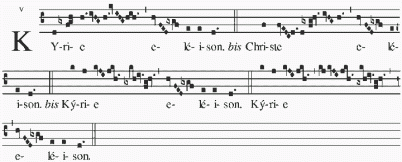
Kyrie, from Mass VIII, de Angelis.
Performed here on the organ. Sung version here.
I used to enjoy singing this at the Latin Mass at Corpus Christi church in Boscombe.
–
Follow Semi-Partisan Politics on Twitter, Facebook and Medium.

–
Students who are offered Play Doh and “therapy horses” to help them make it through university will be cannon fodder in an unforgiving, competitive global labour market
At this point we are used to seeing outrageous stories of overbearing, coddling universities going to extraordinary lengths to teach the young adults studying on their campuses like delicate, helpless infants.
But the Chicago Tribune has done quite a job in summarising all of the instances of infantilisation-posing-as-stress-management taking place at institutions in and around the city. And the extent of the trend is quite shocking to behold.
Some excerpts:
Sephanie Delgado can feel the stress of her to-do list as she works to finish the semester at Roosevelt University: three essays, a presentation and exams.
To escape the pressure, the 20-year-old college junior, who also works as a restaurant cashier to help pay for school, sculpted a chunk of blue Play-Doh into Popplio, a Pokemon character. She was at a table next to other students who colored and decorated cookies before two miniature therapy horses wearing sneakers trotted into the room Wednesday for the university’s De-Stress Fest.
“I know I still have to do all that work, but coming here I’m able to take some time off to hang out with friends, have fun and empty my mind for a little bit,” said Delgado, who lives on the Southwest Side. “It’s like a refresh. My mind is nice and clear so when I go to start my homework, I’m well focused.”
As the semester nears its end — and students pull all-nighters to cram for exams, type papers and finish projects that weigh heavily on final grades — colleges in the Chicago area are taking steps to help students manage stress. It’s part of a broader approach to focus on students’ mental health and expand proactive outreach efforts instead of waiting for students to seek help. Local schools this week are offering activities ranging from animal visits at Roosevelt to a bubble-wrapped room at the University of Illinois at Chicago to the long-standing tradition of a stress-busting primal scream at Northwestern University.
More:
At Northwestern, “because of the hectic academic pace that exists here, it is stressful and very pressure-packed,” university spokesman Alan Cubbage said.
Students can blow off steam with a visit from miniature horses Friday and release their frustration through a campuswide scream, in which students let out a collective yell at 9 p.m. Sunday before finals week. Next week, a number of activities such as Lego building, board games, midnight coffee breaks and late-night breakfast are planned for exam relief.
More:
The series of events UIC hosts during finals week helps junior Liz Huss manage stress in a healthful way.
Students got a visit from comfort dogs Wednesday and are invited next week to pop bubble wrap at the student center, get chair massages, do candlelight yoga and leave notes of encouragement for fellow students.
“I like to take 10, 15, 20 minutes to rejuvenate, reflect and relax, and these events really help with that,” said Huss, an accounting major.
I’m sure that the large professional services firm that she may one day seek to join will be more than happy to bend over backwards to accommodate Liz Huss’s artificially-instilled need to reach for the soothing presence of a “comfort dog” whenever the going gets tough.
More:
For Andersonville resident Rob Chesler, a junior at Roosevelt, stress can motivate him to get his work done. But he also welcomed the distraction of the De-Stress Fest, during which he took a selfie with Lunar, the oldest miniature horse from the Barrington-based nonprofit Mane in Heaven.
“If you’re living in this world of hard work every second of every hour of your life, then you’re not going to be happy and you’re just going to be all about work,” he said. “If you have little horses every now and then, you have moments where you can just breathe and enjoy life.”
Little horses for everyone!
Fortunately there are also voices of sanity:
Clay Routledge, psychology professor at North Dakota State University, believes universities should be promoting psychological strength and resilience, not coddling students.
“I’m not ignorant to the fact there are vulnerable students that need services,” he said. “I’m not against that at all. My criticism is: Are we promoting more broadly a culture of sensitivity and victimhood than we need to do?”
Many colleges and universities are becoming more than educational institutions and overreaching by not letting students figure things out on their own, he said.
“We need to promote toughness and strength, and we know from decades of research that humans are extremely resilient,” Routledge said. “You have to have real stressors in life. You have to fail. You have to be embarrassed and you have to face situations where you’re wrong and you’re challenged — and you’ll be strong as a result.”
A rare voice arguing for building resilience the way that university has done for decades, if not centuries – focusing on the academia, not seeking to micromanage every moment of each student’s pastoral experience on campus, and letting them grow through trial, error and experience. Expect Professor Clay Routledge to be blacklisted by the social justice / identity politics cultists at his university and drummed out of his job any day now.
I have always found American universities to be slightly odd places. Having spent a reasonable amount of time on various campuses in the Mid-West, I have always been struck by the way that universities do not treat their students like autonomous adults to the extent that one might expect in Britain.
Despite eye-wateringly high tuition and accommodation costs, undergraduates are usually expected to share a small room with a roommate, at least in their first year, an almost unheard-of indignity for British students (who would probably feel the same way about this as Americans would feel about staying in one of the NHS’s communal hospital wards rather than having a private room of their own). American universities often see fit to correspond with the parents of students as though they are still school children rather than adults over the age of eighteen, old enough to wear the uniform and fight for their country (though not old enough to drink). These, and many other odd customs, long predate the social justice and identity politics craze which has infected Western academia.
But while customs and practices such as these treat students as though they are not quite yet fully-grown adults, the new trend for safe spaces and infantilising activities masquerading as “stress relief” are of a different order because they effectively serve to stunt any further emotional growth, making it harder for students to ever become autonomous, successful adults.
Making an eighteen-year-old incurring $60,000 of annual student debt sleep three yards away from a roommate is one thing. Treating students as though they are fragile and unresilient children who need bubble wrap, puppy videos and therapy horses to make it through the academic year effectively becomes a self-fulfilling prophecy, ensuring that they enter the world utterly unprepared to function in a society and labour market which does not put their feelings and emotional health on a pedestal.
Social psychologist Jonathan Haidt joked about this when he compared two fictional universities – Strengthen University and Coddle University – in a lecture / college recruitment pitch given to high school seniors. But more and more, Haidt’s send-up of Coddle University is coming to pass and being made real on campuses across America, and in Britain too:
We are based on a very simple psychology which is that people are fragile. People are so easily hurt. Anything that upsets you could trigger trauma, repressed trauma, unrepressed trauma, trauma that you somehow put up there in the closet and forgot to take – there’s trauma all over your mind and your memory. And we don’t want to trigger your trauma. That could damage you.
And this is especially true for members of the six protected classes [women, African Americans, Latinos, LGBTQ, differently abled, and Native Americans]. If you are a member of one of the six marginalised and oppressed groups you are especially vulnerable. You’ve been traumatised and oppressed your whole lives. Microaggression theory teaches us that when people repeatedly cut these little nicks, these little insults, these little exclusions, they don’t develop calluses, they bleed to death. And so we will not let you be cut while you are at Coddle. We will protect you. Now don’t try to do it yourself, that’s very dangerous. WE will protect YOU from aggression.
At Coddle University we offer access to therapists 24/7. Just dial 811 from any phone, or we have this new feature – just raise three fingers, go like this [he gestures] and we have sensors all around campus, go like this and a therapist will be airlifted right into you.
University is supposed to be stressful. Balancing the academic workload and social events and newfound freedom away from the family home is supposed to develop key skills required to navigate the world as an independent adult later in life. Shipping in a bunch of therapy horses onto campus is not “offer[ing] students opportunities to learn self-care”, as one University of Missouri jobsworth claims, because it simulates an environment which will not exist outside of the university campus.
There are no therapy horses laid on for employees in the average workplace. Teaching students to survive daily stress by reaching for Play Doh and therapy animals is like training an astronaut to undertake spacewalks while failing to simulate the essential conditions of weightlessness and limited oxygen supply, and every bit as likely to lead to disaster.
But still the universities teach this nonsense and lay on these extravagant, infantilising services, unaware or unconcerned that they are setting their students up for failure the moment they set foot off campus.


–
Support Semi-Partisan Politics with a one-time or recurring donation:

–
Agree with this article? Violently disagree? Scroll down to leave a comment.
Follow Semi-Partisan Politics on Twitter, Facebook and Medium.

–
Slightly different to the Brexit Catastrophisation Watch series, these Brexit Denial Watch posts will focus on public figures of power and influence who marshal Olympian levels of denial to pretend to themselves and others that the British people did not really vote for Brexit, and that the referendum result can and should be overturned
Let’s all take a moment to savour the defeat of former Conservative MP for Richmond Park, Zac Goldsmith, in the by-election which he foolishly triggered after following through on his word to flounce out of the Conservative Party if the government finally took its boot of the neck of the aviation industry and authorised the expansion of London’s Heathrow airport.
Zac is a wishy-washy watercolour impression of a man, a Conservative In Name Only, Crown Prince of the NIMBYs, a snarling anti-aviation zealot and an utterly useless London mayoral candidate. British politics will miss his early departure like I missed my inflamed appendix after the Royal Free Hospital scooped it out. (How’s that one, Matthew Parris?)
But naturally, the Liberal Democrats’ surprising win in Richmond Park is being spun by a gleeful party as rather more than it is. One can understand the jubilation of a party reduced from being junior coalition partner to a pathetic rump of eight MPs at being able to add another warm body to their number, but they go too far when they claim that 20,000 people in leafy Richmond is such a representative sample of Britain that a by-election result (which often go against the government of the day) can be safely interpreted as the British public “changing their minds” about Brexit.
And this is exactly what the LibDems, in their arrogance, are now claiming. The Spectator reports:
Goldsmith hoped to focus on airport expansion and his decision to fulfil his promise to constituents to stand down if it was given the green light. But the Lib Dems had other ideas and made it about the EU. The Richmond borough voted heavily to remain — at 69/31 — and the Lib Dem campaign — which was also anti-Heathrow — focused on this. They highlighted Goldsmith’s support for Brexit and reached out to Remain voters — with Olney even promising to vote down Article 50 in the Commons, if elected.
In her acceptance speech, Olney said voters had ‘sent a shockwave through this Conservative Brexit government’ while Tim Farron made the bold claim that if this were a general election the ‘Conservatives would lose dozens of seats to the Liberal Democrats – and their majority with it’. Now this is jumping the gun a bit, and as Fraser notes, a lot of the result can be put down to the Lib Dem’s effective ground game where Goldsmith just didn’t seem to have one. But it can’t be denied that the Lib Dem strategy is working. In the Witney by-election, the party increased its votes share from 7pc to 30pc. They have clearly defined themselves as the party of Remain and in constituencies that voted to stay in the EU this message is resonating.
The newly-elected MP herself was even more explicit on Sky News:
Olney told Sky News that ‘it does look now as if we can have a vote in Parliament that might override the referendum – and I will, obviously, be voting to Remain because that is always what I have believed’.
This is hilarious. Furious, tantrum-throwing Remainers have been complaining since the small hours of 24 June that the 52% of people who put their cross in the box voting to leave the European Union were in fact doing anything other than seriously voting for Brexit. It was just a cry of dissatisfaction, we were told. It’s all about immigration, or globalisation, or multiculturalism, and if only politicians say enough platitudinous things to placate public feeling on those issues then there will be no need to go ahead and trigger Article 50 of the Lisbon Treaty, setting in motion the wheels of our departure.
And yet despite 17 million British voters casting their ballots to leave the European Union when the referendum question was both crystal clear and painstakingly discussed in advance (and the consequences clearly printed on the pro-Remain government propaganda sent to every household during the campaign), now we are supposed to believe that this vote was actually not a mandate or instruction to take Britain out of the European Union, while a single solitary by-election in leafy, pro-EU west London in which voters were explicitly choosing who to represent them in Parliament until the next general election, not casting a single-issue decision about Brexit is enough to cancel the whole thing.
Do these people hear just how arrogant they sound, and just how plain their attempts to game the system to their own advantage appear now that the curtain has been pulled back and the desperation of the moment has forced them to dispense with their usual subterfuge?
Besides, who knows whether the voters of Richmond Park really do want Liberal Democrat Sarah Olney as their new MP? As Brendan O’Neill put it on Facebook:
Anti-Brexit Lib Dem wins by-election in Richmond. But how can we be sure the people of Richmond really knew what they were voting for? Maybe they’re “low information”. Maybe they were made poisonously anti-Brexit by Guardian and Economist propaganda. Maybe they’re so hooked on Newsnight and Radio 4 that they can no longer think for themselves. Perhaps they were brainwashed by the demagogues Tony Blair and Richard Branson. Can we really trust such people to make big, important decisions like who should sit in parliament? We need a second vote. Give them another chance to get it right. The country must be saved from their ignorance.
Since the election, alarming new evidence has come to light – in the form of a car crash interview with Julia Hartley-Brewer on LBC radio, in which Sarah Olney jabbered like a madwoman, couldn’t answer a single question about Brexit and eventually panicked and had to be rescued by her spokesman after less than four minutes on air – which suggests that the people of Richmond Park may have unwittingly elected a complete and utter cretin to be their representative in Parliament for the next three and a half years.
Since the people of Richmond Park thought they were electing a competent human being with a basic grasp of the issues rather than a flailing dilettante who cracks under the immense psychological pressure of a casual interview on morning radio, clearly they did not have all the facts. Clearly they were misled. Clearly they need another opportunity to consider their response in the light of this new information.
Isn’t that what we keep hearing about that idiotic “£350 million for the NHS” Vote Leave NHS bus?

–
Support Semi-Partisan Politics with a one-time or recurring donation:
–
Agree with this article? Violently disagree? Scroll down to leave a comment.
Follow Semi-Partisan Politics on Twitter, Facebook and Medium.

–
The long-awaited follow-up single is finally here…
Madeleina Kay, an almost Vera Lynn-like character among disappointed Remainers, has released another classic ode to the EU, following up on her first hit, “All I Want For Christmas Is EU“.
This one is an adaptation of the Elvis Presley classic “Can’t Help Falling in Love”, re-engineered as a tearful plea from a contrite Britain for the European Union to take us back.
The immortal lyrics:
Wise men say
Only fools Vote Leave
‘Cause I can’t help falling in love with EU
Shall we stay
Would it be a sin
If we can’t help falling in love with EU?Every Remainer knows
It’s a catastrophe
But Brexit rest assured
It’s not meant to beTake my hand
Accept this apology
‘Cause I can’t help falling in love with EU
As the Ode to Joy from Beethoven’s Ninth Symphony has been co-opted to serve as the European Union’s anthem, let this effort – sung here with the sweet innocence of a child – become the EU equivalent of Parry’s “Jerusalem”, etched into the hearts of every European citizen and fondly sung on all those many euro-patriotic occasions which we have in common across the continent, and which are so important to us all.
Deep breath.
Think about the European Union for a moment. Think about what the EU actually is, how it was founded, how it deliberately grew by stealth, its deliberate corrosion of member state democracy and the impact that the outsourcing of government to a supra-national level has had on political engagement across an entire continent.
Think about the harm that the EU’s protectionist trade policies have wrought on developing nations without and on economic competitiveness within.
Think about the way that this hulking relic from the post-war era, totally lacking in popular legitimacy and unable to meet the challenges of the 21st century without inevitably making them immeasurably worse, grinds ever-onward towards its pre-ordained federalist destination, deaf to all opposition.
Then imagine writing not one, but two love songs to that organisation.
Just think about it for a moment.
The more I see of Kay’s output, the more I am starting to suspect that she may actually be a cunning Brexiteer, trolling the pro-EU Brexit-deniers from deep behind enemy lines.
If so, then she is doing an absolutely masterful job.

–
Support Semi-Partisan Politics with a one-time or recurring donation:
–
Agree with this article? Violently disagree? Scroll down to leave a comment.
Follow Semi-Partisan Politics on Twitter, Facebook and Medium.


–
Slowly, tentatively, a few identity politics activists are starting to question their current scorched earth tactics and the unforgiving way that they tackle “heresy” within their own ranks. But will it make a difference?
Everyday Feminism may be the go-to site for all things Social Justice, but at least one writer there has started to display some unusual self-awareness, questioning whether the constant backbiting, jockeying for position and competitive victimhood within the activist world might actually be doing more harm than good.
Kai Cheng Thom, a self-described Chinese trans woman writer, poet, and performance artist, writes:
When I found activist culture, with its powerful ideas about privilege and oppression and its simmering, explosive rage, I was intoxicated. I thought that I could purge my self-hatred with that fiery rhetoric and create the family I wanted so much with the bond that comes from shared trauma.
Social justice was a set of rules that could finally put the world into an order that made sense to me. If I could only use all the right language, do enough direct action, be critical enough of the systems around me, then I could finally be a good person.
All around me, it felt like my activist community was doing the same thing – throwing ourselves into “the revolution,” exhausting ourselves and burning out, watching each other for oppressive thoughts and behavior and calling each other on it vociferously.
Occasionally – rarely – folks were driven out of community for being “fucked up.” More often, though, attempts to hold people accountable through call-outs and exclusion just exploded into huge online flame wars and IRL drama that left deep rifts in community for years. Only the most vulnerable – folks without large friend groups and social stability – were excluded permanently.
Like my blood family, my activist family was re-enacting the trauma that we had experienced at the hands of an oppressive society.
Credit where it is due – this is a mature and thoughtful observation, especially from somebody in the thick of the Cult of Social Justice and Identity Politics. It cannot be easy to admit such a glaring flaw in one’s own social movement, so kudos to Kai for doing so.
This is actually one of the aspects of the whole social justice phenomenon which fascinates me the most – the dual scrambles to both climb the victimhood pyramid and claim the most “oppressions” while also seeking to be the most fastidious observer of the new rules laid down to govern how people speak and interact with one another.
For me, it crystallised with the story in Britain of NUS LGBT officer Fran Cowling, who sanctimoniously and publicly refused to share a stage with lifelong gay rights campaigner Peter Tatchell, on the grounds that he was insufficiently enthusiastic about banning the speech of people who disagree with the current orthodoxy about transgender issues.
As I wrote at the time:
It is obvious that NUS LGBT officer Fran Cowling is attempting to gain a vast amount of social currency and standing from her peers by trying to take down Peter Tatchell, an A-lister in activist circles. By refusing to share a stage with him, Cowling is effectively declaring to the world that she is morally superior to Tatchell, he having failed the latest racism and transphobia tests. Thus, she can bank all of Tatchell’s personal accomplishments for herself, add the fact that unlike him she is not a “transphobe”, and Win the Game.
And that’s the rotten core of today’s student identity politics movement. A constant, bitchy, backbiting game of snakes and ladders, with one insufferable petty tyrant rising to the top of the Moral Virtue Pyramid only to be brought down by their jealous rivals, either for no reason at all, or for having unknowingly violated one of the many red lines that they themselves helped to draw across our political discourse.
Too often the internal machinations and politicking of these activist movements seem to vastly overshadow any possible good that they may seek to accomplish. Too often it seems that social justice warriors are more interested in enforcing arbitrary rules and squashing dissent than actually making tangible efforts to help the people on whose behalf they claim to speak.
Kai Cheng Thom goes on to quote an anonymous writer:
There are no activist communities, only the desire for communities, or the convenient fiction of communities. A community is a material web that binds people together, for better and for worse, in interdependence…
If it is easier to kick someone out than to go through a difficult series of conversations with them, it is not a community.
At present, social justice activists are very proficient at excluding and excommunicating those who stray from the One True Path. Never mind agnostics or opponents; many SJW communities will excommunicate fellow members for little more than not being fully up to speed on the latest terminology – a constantly changing glossary of “correct” and “incorrect” words.
In other words, as Kai puts it, many activists currently operate according to the philosophy that “if I could only use all the right language, do enough direct action, be critical enough of the systems around me, then I could finally be a good person”. It is almost a points-based system. Attend enough protests, share enough memes on social media, parrot enough orthodoxy and avoid committing too many mistakes and in time you will “level up”. Fail to keep up with the herd, however, and you will be left in the wilderness.
Kai Cheng Thom’s article at least suggests that there are growing glimmers of awareness that this approach is a) not working, and b) hardly an appropriate way to live the values that they preach.
For in truth, the social justice movement is a symptom of the only real kind of privilege left out there – rich, Western country privilege. That’s not to say that racism, sexism, homophobia and transphobia have been fully vanquished – clearly not. But the fact that so many people in the English-speaking Western world are now able to devote such significant amounts of time to activism tackling the remaining vestiges of oppression in their own back yards is itself a sign that we live in unprecedentedly prosperous and egalitarian times.
In large part, social justice activism is nothing more than a luxury pursuit, indulged in primarily by those people who have the fortune to be attending college or university in one or other of the richest and most prosperous democratic countries on this Earth. Anyone marching in a campus protest to restrict the rights and freedoms of other people to say things which they may find offensive would, if they actually took the words “social justice” remotely seriously, immediately redirect their anger toward those benighted parts of the world where racial minorities, women, gay, transgender and disabled people face overt and often physical hostility. Yet for some reason the social justice community often has little negative to say about many of these places, while remaining ever-ready to criticise the good-faith efforts of those closer to home.
And the online obergruppenführers of this petty, thin-skinned self-actualisation cult, this morally lost movement, have grown accustomed to consolidating their power by doing the one thing they claim to be most against – oppressing and marginalising other people, in this case those who step out of line and deliberately or accidentally say, think or do the “wrong” thing.
It is wonderful that some of these cultists may be starting to realise the error of their ways. For as Kai says, “only the most vulnerable – folks without large friend groups and social stability – [are] excluded permanently”. And why is that the case?
Because at its rotten heart, the social justice movement can be most likened to that quintessential bastion of “white privilege”, the suburban country club. The club has many strict rules. Arcane rules which are often incomprehensible to outsiders. Rules which must be acknowledged and obeyed, and only ever flouted if one has sufficient social currency within the group to get away with it.
That is what the social justice movement has become. A virtual, worldwide country club for privileged young millennials and some aged hangers-on in academia, easy to join (so long as one passes ideological inspection) but swift to exclude those caught breaking the finicky, ever-changing rules. A club in which anyone and everyone is ultimately disposable in the neverending competition for power and status.
Can the social justice revolution ever stop eating its own? I don’t see how. Most of those at the country club’s core seem motivated primarily by the desire to feast on the shortcomings and innocent mistakes of others. Take that inducement away and they may as well just join their nearest fraternity or sorority, fully embracing the “social” aspect and ceasing to feign an interest in “justice” altogether.

–
Support Semi-Partisan Politics with a one-time or recurring donation:
–
Agree with this article? Violently disagree? Scroll down to leave a comment.
Follow Semi-Partisan Politics on Twitter, Facebook and Medium.


