No, Brexit Is Not The Fault Of The Evil British Tabloids

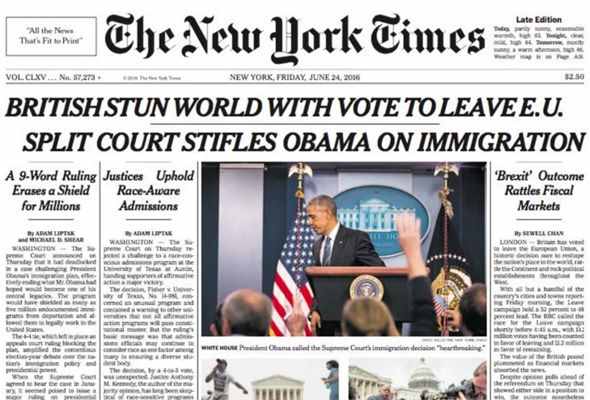
New York Times - Brexit Headline - EU Referendum - British stun world with vote to leave EU

The fearless and forensic New York Times continue their penetrating post-mortem investigation into the causes of Brexit. This week’s scapegoat – the Evil British Tabloid Press

Fresh from speculating about how the impact of Brexit on London will equal the fall of Babylon in terms of destruction and woe, the New York Times is back with another self-exonerating tonic for the global metro-left, reassuring them that Britain’s imminent departure from the European Union in no way reflects a serious failing on their part, but instead is entirely the result of sinister machinations by evil outside forces.

In the crosshairs this week: Britain’s tabloid press, led by The Sun newspaper, everybody’s favourite bogeyman. The strong implication of the New York Times article is that Britain’s tabloids are powerful and nefarious, exerting great sway over the political leanings of their simple-minded, provincial readers. The natural inference is that it is a worrying phenomenon when Evil Tabloids “influence” their gullible readers in a populist direction, but entirely laudable and unremarkable when the prestige media – outlets like the New York Times and the Guardian – serve their wise readers up with a consistent globalist, elitist worldview.

One can imagine the tone and content of the piece – sanctimonious, condescending and displaying a stunning lack of self-awareness – without even reading a word, but below are a few choice quotes:

In Britain after the so-called Brexit vote, the power of the tabloids is evident. Their circulations may be falling and their reputations tarnished by a series of phone-hacking scandals. But as the country prepares to cut ties with the European Union after a noisy and sometimes nasty campaign, top politicians court the tabloids and fear their wrath. Broadcasters follow where they lead, if not in tone then in topic.

Of course, when the Times talks about a “sometimes nasty campaign”, they are alluding exclusively to supposedly nativist and anti-immigration rhetoric, and not the hatred and contempt frequently pored on people who campaigned and voted in good conscience for Brexit. This becomes clear through all of the campaign incidents cited in the article, culminating in an attempt to link the murder of Jo Cox MP directly to pro-Brexit rhetoric.

More:

Their readers, many of them over 50, working class and outside London, look strikingly like the voters who were crucial to the outcome of last year’s referendum on membership in the European Union. It is these citizens of Brexitland the tabloids purport to represent from the heart of enemy territory: Housed in palatial dwellings in some of London’s most expensive neighborhoods, they see themselves as Middle England’s embassies in London.

In the campaign leading up to a snap election on June 8, most tabloids can be counted on to act as the zealous guardians of Brexit and as a cheering section for the Conservative government of Prime Minister Theresa May — even though the city that houses them voted the other way.

This is actually true. And the reason that many of the tabloids are bastions of working class populism surrounded by a sea of metro-leftism is that these are national newspapers, not city-specific or regional publications.

One has to take issue with the Times’ reference to “Brexitland” though, as if despite representing a majority of voters, Brexit supporters are somehow strange and exotic creatures whose behaviour requires analysis and interpretation by the prestige media – which, of course, is exactly how the New York Times sees them.

A more worthy article would turn the gaze back toward “Remainland” or “Europeland” and seek to understand how 48 percent of the country managed to drift away and treat the concerns, fears and aspirations of the 52 percent with such complete indifference. But this is the New York Times, and they have no interest in turning a forensic gaze on people like their own reporters, editors and readers – the “good people” whose behaviour needs no explanation or introspective analysis.

The article then takes a divergence to discuss Boris Johnson, even though the Foreign Secretary’s execrable journalistic career was spent at supposedly prestige broadsheets, not tabloids:

In the marble-and-glass lobby of the 17-story News Building, home to Mr. Murdoch’s British media empire, there is a small plaque that commemorates the building’s 2014 opening by Boris Johnson, then the mayor of London and now the British foreign secretary.

Mr. Johnson, wild-haired and witty, became a chief architect of Brexit when, four months before the referendum, he threw his weight behind a cause until then most closely associated with the populist U.K. Independence Party. But his main contribution to Brexit may go back more than two decades.

A correspondent in Brussels for The Daily Telegraph in the early 1990s, Mr. Johnson was credited by fellow reporters with pioneering the euroskeptic coverage of the European Union that has since become the default setting for much of the British press. With little regard for the truth — he was previously fired by The Times of London for making up a quote — Mr. Johnson wrote about a Europe scheming to impose standard condom sizes and ban his country’s beloved prawn-cocktail-flavored chips (both untrue).

“Boris invented fake news,” said Martin Fletcher, a former foreign editor of The Times, who was in Brussels shortly after Mr. Johnson. “He turned euroskepticism into an art form that every news editor in London came to expect.”

Ah, so the reason for bringing up Boris Johnson in an article supposedly about tabloid journalism was in order to shoehorn “fake news” into the discussion. Well, while nobody would seriously defend the quality of Johnson’s Europe reporting for either the Times of London or the Telegraph, these stories were primarily consumed by broadsheet-reading elites, not the oafish, Sun-reading working classes held in such contempt by the New York Times. And it should be noted that whatever the failings of the British newspaper media with regard to Brexit – and they are many – serious journalists like the Telegraph’s Christopher Booker have contributed consistently powerful analysis and criticism of the EU, shedding far more light than heat (unlike Johnson).

Besides, as this blog has previously discussed, focusing exclusively on “fake news”, much of which is so obviously hysterical and false as to be unbelievable to all but the most swivel-eyed of social media sharers, ignores the far more pernicious impact of ideologically skewed mainstream news, which is read by elites and decision-makers, often actually driving the political debate.

The example I always return to is the fact that nearly all prestige American news outlets have stopped referring to illegal immigrants as such, referring to them euphemistically as “undocumented” or “unauthorised” immigrants instead. Similarly, when an American politician seeks to crack down on illegal immigration they are nearly always described as being antagonistic toward the “immigrant community”, suggesting a deep-seated conservative antipathy toward all immigrants, making them seem far more extreme than they really are.

This linguistic trickery, common throughout the American mainstream media, seriously impacts the way that people view the subject of immigration. Read about Donald Trump’s hostility to “immigrants” often enough and you could be forgiven for thinking that the American president is actively plotting the deportation of law-abiding, visa or green card-holding immigrants, when this is simply not the case. American news outlets know that they are misleading their readers and viewers by stoking these alarming fears but do so anyway, purely in order to push a certain political outcome (acceptance and normalisation of illegal immigration).

All of this should be borne in mind when the New York Times article goes on to discuss tabloid treatment of immigration in the Brexit debate:

Britain makes many of its own laws, of course. But it is an interesting choice of example. A more obvious one might have been immigration.

Research by a former Times journalist, Liz Gerard, showed that tabloids pounded the immigration issue, with at least 30 hostile front-page splashes in The Daily Mail in the six months leading up to the referendum, and 15 in The Sun. The headlines — “Britain’s Wide Open Borders” The Daily Mail shouted — often tended toward histrionic. The Sun insinuated that child refugees arriving in Britain were lying about their ages and should have dental X-rays.

“Tell Us the Tooth,” the headline read.

A week earlier, I had met Kelvin MacKenzie, a former Sun editor and a columnist who was subsequently suspended for referring to a mixed-race soccer star as a “gorilla.” He said that the paper still reflected the “beating heart of Britain,” and that Brexit was won on immigration “by a thousand miles.”

Has the British tabloid media focused heavily on immigration, and often covered the subject in a crass and obnoxious way? Yes, of course – both news reporting, editorial lines and political commentary in the tabloids have been troubling at times. But one must remember that left to their own devices, the prestige media would hardly cover the issue at all. Newspapers like the high-minded Guardian have zero sympathy for those who object to uncontrolled mass immigration, and even more supposedly conservative outlets like the Times or Financial Times would happily ignore the subject altogether were it not for the tabloids keeping the issue on the national agenda. One cannot examine the sins of the tabloid press while pretending that the prestige press is somehow faultless.

Or can we?

Well, the New York Times certainly seems capable of obsessing about the mote in their British cousin’s eye while ignoring the beam in their own. As far as the New York Times is concerned, Brexit is purely the result of rabble-rousing tabloids (with an assist from glib superficial coverage in the prestige conservative press) whipping up xenophobic feelings among their working class readership. According to this self-exonerating narrative, Brexit has absolutely nothing to do with the prestige media failing to hold politicians to account for progressively signing away sovereignty and governing competencies to a barely accountable supranational government, or helping to make a nuanced conversation about immigration impossible.

No, instead we are expected to believe that the earnest saints of the prestige media and their establishment readers and cheerleaders are totally blameless. We are expected to close our minds to the possibility that more people might have heeded some of (say) the Guardian or the New Statesman’s more accurate concerns and reporting during the EU referendum if those publications had not conducted themselves for years in such a screechingly, stridently blinkered pro-EU manner.

And even now, after the New York Times managed to cocoon its own readership in such a self-reinforcing ideological bubble that almost none of them saw Donald Trump as a potential threat to their world order, in examining Brexit America’s newspaper of record is unable to question whether producing news and commentary almost entirely of the elites, by the elites and for the elites might not be the smartest way to approach journalism.

For God’s sake, New York Times, wake up. Turn your concerned gaze around 180 degrees and question the assumptions, biases and blind spots in your own reporting. Stop worrying about the evil tabloid press and its hold over the impressionable British working class mind for two seconds, and spend at least a moment considering how your own prestige journalism has unhelpfully perpetuated and reinforced failing globalist shibboleths for years, leading to these harsh instances of political correction in domestic and world affairs.

Because if the unexpected election of Donald Trump and the vote for Brexit (different though the two phenomena are) have taught us anything, it’s that blue-collar, working-class folks are far from being the only people who can be plausibly accused of being brainwashed by the news media that they consume.
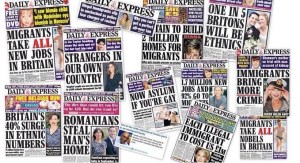


Brexit - Daily Express Headlines - immigration

Support Semi-Partisan Politics with a one-time or recurring donation:

Agree with this article? Violently disagree? Scroll down to leave a comment.

Follow Semi-Partisan Politics on TwitterFacebook and Medium.

At The White House Correspondents’ Dinner, The Political Media Circle-Jerk Proceeded Minus Donald Trump

White House Correspondents Dinner - First Amendment - Washington Political Media

At the annual Washington D.C. bash, the political media class were more concerned by the lack of Hollywood celebrities to ogle than the fact that half the country holds them in contempt, feels deliberately misunderstood and distrusts nearly everything that they have to say

The Washington Post reported today on the fact that brave members of the Washington D.C. political media class somehow managed to soldier on and enjoy themselves at the annual White House Correspondents’ Dinner and associated glitzy after-parties despite President Trump’s cruel boycott of the event (Trump decided to hold another one of his dubious rally-style events in Pennsylvania).

Without a single hint of self-awareness, the Post reports:

His voters sent him to Washington to break stuff, and this weekend Donald Trump tried to break the annual dinner of the White House Correspondents’ Association. As with some of his business ventures, he was not wholly successful.

“They’re trapped at the dinner,” the president boomed at a rally in Harrisburg, Pa., celebrating his first 100 days in office. “Which will be very, very boring.”

Instead, it was just fine. It happened. There’s an inertia to these Washington traditions, and a determination to soldier on in the face of — whatever it is we’re facing. Everyone survived this weekend without the president, or without the crush of Hollywood celebrities who for years had been decorating the dinner in ever-increasing density, until now.

It was a bit like an off-year high school reunion: diminished numbers and fewer crazy stories but still no shortage of hors d’oeuvres and dancing and gossip. Everyone settled for sightings of Michael Steele and Debbie Dingell instead of Jon Hamm or a Kardashian. In past years, virtually the entire cast of “Modern Family” would come to the dinner; this year, United Talent Agency only secured the kid who plays Luke.

Well, now we can all sleep easy in our beds. Despite the president of the United States refusing to perform the traditional routine of being self-deprecating and massaging the egos of the people supposed to hold him to account, the Washington press corps somehow managed to rescue the evening and enjoy themselves. Despite being deprived of the opportunity to rub shoulders with Hollywood royalty, the assembled journalists and media executives still managed to mingle, network and slap each other on the backs for a job well done serving the interests of American democracy.

Aren’t you relieved? I know that I am.

More:

Was it only a year ago that Barack Obama dropped the mic, literally, at his final correspondents’ dinner, as if to put an exclamation point on eight years of media savvy and pop-culture propaganda? He knew his role in this circus. It was Obama’s yearly chance to inspire a meme, rib a rival, come off as folksy royalty, remind the public that the media was not the enemy. His cool factor iced out the haters, smudged away red lines, papered over unkept promises. Afterward, the French ambassador’s mansion would swell with swells — both conservatives and liberals, all buddy-buddy in private, united by the daytime charade they pulled off together on TV.

As yes, good old Obama knew his place, knew his role in the “circus” – to dance like a performing seal in an attempt to make the self-satisfied hacks chuckle. Sure, Obama was more successful than most – thanks to a largely uninquisitive media he managed to maintain the “cool factor” right to the end of his presidency – but he stayed firmly within the tramlines of what was expected of him.

And what was that role? What has it traditionally been for administration after administration? Nothing more than making the media class look noble for one evening a year when they spend the other 364 making themselves look tawdry and partisan. Fudging important ideological questions and reducing them to laughing points. Papering over “unkept promises” as the trivialities that they are to the Washington political class – little frauds perpetrated on the American voters, some of whom are naive enough to expect political promises to be kept.

But the Washington Post is certainly in no mood to dwell on the accumulated failure of prestige American news outlets to hold leaders to account or properly represent the range of interests and opinion in the country. After all, the Post are enjoying a bumper season of increased subscriptions and web traffic thanks to the Trump presidency, drunk not on $25 cocktails but on their own sense of nobility (as evidenced by their hilariously overwrought “Democracy Dies In Darkness” motto).

Indeed, the Washington Post seems most anxious for us to know that this year’s event was a dud because Trump might have attended, not because he ultimately chose not to do so:

The guest list suffered not because Trump sent his regrets but, more likely, because of the chance he might attend; he remains dauntingly unpopular with the New York and Hollywood A-list that he had long aspired to join. The pre-dinner receptions, hosted by outlets such as the Wall Street Journal and The Washington Post, were staid and perfunctory, absent the usual angling for a sighting of a “Game of Thrones” star.

Apparently at no point has it occurred to the Post or other such outlets whether the presence of Hollywood celebrities at a political media event might actually be a bad thing rather than something to be celebrated and missed in its absence. It is merely taken for granted that the presence of numerous multimillionaires from the entertainment industry is some kind of sign that the health of American political journalism and culture is in fine fettle.

The focus of the stripped-down event was on defending free speech and celebrating the importance of a free press guaranteed under the First Amendment, something which we can certainly all applaud but which rarely merited such prime-time coverage when the Obama industry was, say, prosecuting whistleblowers with uncommon zeal. Has Trump made numerous troubling statements with regard to freedom of the press, libel laws and freedom of speech and association in general? Absolutely.  But it is telling that much of the media is happy to trumpet the issue now, when it costs them little reputationally or financially, but maintained a pained silence under a more popular “liberal” president.

More:

The dinner itself featured a dutiful pep talk by Watergate legends Bob Woodward and Carl Bernstein.

“Mr. President, the media is not fake news,” Woodward said from the dais, and the media elite applauded.

“CNN and MSNBC are fake news,” Trump said in Pennsylvania, and some of the 97 percent who say they’d still vote for him applauded.

Two worlds, talking past each other, from 100 miles apart. The latest prime-time iteration of POTUS vs. Beltway.

Only it isn’t just POTUS vs Beltway. It is half of America versus the Beltway news outlets and punditocracy. The cosseted Washington media class is so busy being angry at Donald Trump for his bombastic insults and threats that they remain largely unable to look beyond the president to see the many Americans who may not agree with Trump but who share his hatred of the people who filter and report the news.

As this blog has previously discussed, the mainstream American news media is indeed not “fake news” inasmuch as the likes of CNN or the New York Times do not routinely print sensationalist and patently false accounts of fabricated events designed to excite partisan zealots. But they have other far more insidious and effective methods of shaping the narrative through their editorial stances and very deliberate use of language.

As I wrote last year:

Fake news can incorporate false facts, but also correct facts which have been deliberately misinterpreted or spun. And far more insidious than any one fake news story, no matter how egregious, is the way in which language is often used to subtly change public perceptions over time – note how we now speak about “undocumented” rather than “illegal ” immigrants, a change adopted by nearly all of the mainstream media in America, and now in Britain too.

When the media is secretly complicit in ideologically-driven agendas, trust in the more reputable media is rightly weakened. But this leaves people more vulnerable to peddlers of deliberately fake news, as they search for alternatives. The obvious answer is for mainstream prestige outlets to rediscover their integrity and stop forcing readers away with ideologically skewed coverage, but they will not desist, and so they fuel the exodus of readers away to the fringes of the internet, a place where the more outrageous a story sounds, the more people will read it.

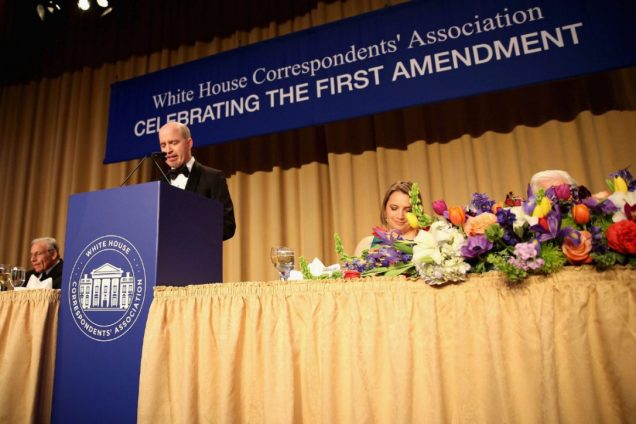
But there they all sat, facing a stage emblazoned with the words “Celebrating the First Amendment” and no doubt feeling inordinately pleased with themselves for the stellar work they believe they are doing in standing up to the Trumpian dystopia, unaware or more likely just unconcerned by just how hated and distrusted they are throughout vast swathes of their own country.

The New York Times had an interesting feature article today looking at the upcoming final round of the French presidential election between centrist empty-suit Emmanuel “status quo” Macron and depressing protectionism advocate Marine Le Pen. The piece focuses on the struggling northern town of Calais, a place I know quite well through many visits during my adolescence, and is actually quite fair in its examination of the erosion of the town’s biggest industry in the face of global competition and the lack of political answers

For a piece of New York Times journalism, it is pretty good – especially compared to their godawful “Will London Fall?” hitpiece on Britain and their generally hysterical and uncomprehending coverage of Brexit.

The only problem? The New York Times has to send reporters on expeditions into towns like Calais in order to talk to the locals and get to know their concerns, just as American reporters descended with newfound intensity on Trumpland after the US presidential election trying to figure out what went wrong, and just as shellshocked London political journalists stumbled shellshocked beyond the great metropolis in a bid to understand what Middle England was thinking.

The New York Times article’s author, Liz Alderman, is naturally based at the newspaper’s Paris bureau. Unless she makes a conscious effort, nearly every human interaction she makes will be likely with somebody who intends to vote for Macron in the second round. This is not to impugn Alderman’s work or journalistic ethics – the Calais piece proves that she does seek out contrary opinions in the unloved regions of France when required. But when the majority of your professional and social life is spent among people who hold one set of values, the occasional field trip to the other side of the tracks cannot make up for deep-rooted understanding of – and empathy with – the more pro-globalism, pro-EU, pro-market side.

And so it is in Washington D.C. The people who gather each year for the White House Correspondents’ Dinner (and then grumble about how they no longer get to rub shoulders with Hollywood stars thanks to the big bully in the White House) may make the occasional foray into Trumpland if the needs of a story require it. But the vast, vast majority do not live the lives of Trump supporters, nor live among them, nor count such people among their friends or family. And you simply cannot report fairly, accurately or honestly about people whom you have to interview to get any kind of sense of who they are or what their hopes, dreams and fears may be.

The White House Correspondents’ Association clearly does not care. They have calculated that they can prosper just fine by continuing to swagger around like noble seekers of truth, bellowing about free speech and holding President Trump to “account” (while furiously ignoring just how much their lust for TV ratings and pageviews fuelled his rise in the first place). But should one of the tuxedoed dinner attendees ever stop to wonder how Donald Trump is able to effortlessly turn a crowd of people against the media at a campaign rally, this is the reason.

Trump’s non-attendance was the perfect excuse to cancel a sleazy and tawdry annual event which should have been axed many years ago, if only the bipartisan ruling class had any self-awareness or a care for how they appeared to the rest of the country.

But even now they party on, while America burns.


Chris Matthews - Al Sharpton - MSNBC

Support Semi-Partisan Politics with a one-time or recurring donation:

Agree with this article? Violently disagree? Scroll down to leave a comment.

Follow Semi-Partisan Politics on TwitterFacebook and Medium.

General Election 2017: An Unpredictable Race In Hampstead & Kilburn

General Election 2017 - Hampstead and Kilburn Conservatives attack leaflet - Tulip Siddiq Labour Party Jeremy Corbyn - 1

Game On in Hampstead & Kilburn

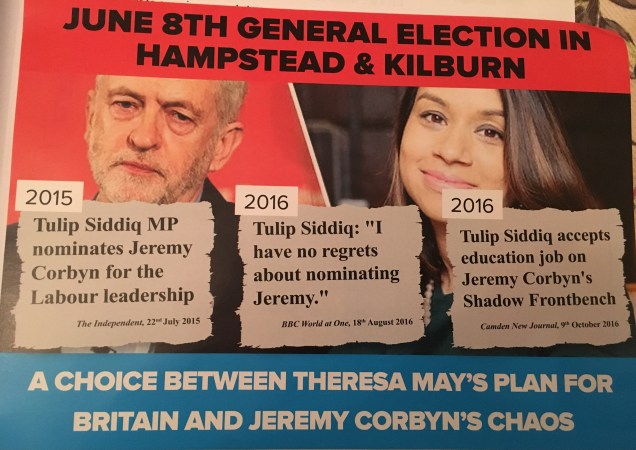
Today I received the above piece of campaign literature from the Hampstead and Kilburn Conservatives. It isn’t exactly subtle, and it perfectly encapsulates the problem facing incumbent Labour MP Tulip Siddiq, defending her slim majority of 1,138.

When Glenda Jackson was defending the seat in 2010, Labour squeaked home with a majority of just 42, making the seat the most marginal in England. And crucially, back then the seat was a tight three-way marginal, with the Liberal Democrats less than a thousand votes off the pace. In 2015, the LibDems suffered in Hampstead & Kilburn as they did nationwide, despite fielding an excellent candidate in Maajid Nawaz, and slumped to just 3,039 votes.

By way of further context, Hampstead & Kilburn voted strongly in favour of remaining in the European Union during the referendum, 75% Remain to 25% Leave,  with nearly 23,000 constituents signing an angry petition demanding a second referendum when things didn’t go their way with the first one.

So what will happen in the snap general election on 8 June 2017?

Given Labour’s current polling, and the personal polling of leader Jeremy Corbyn, by all rights Tulip Siddiq should be packing her office in Portcullis House and looking for something new to occupy her time. A majority of 1,138 puts Hampstead & Kilburn high on the Tories’ target list, and a few ministerial campaign visits and perhaps a drive-by from the PM herself ought to flip the seat, all other things being equal.

However, all other things are not equal.


The Brexit Factor

Brexit is a real factor here. Following the EU referendum I sat on the 139 bus from West Hampstead alongside numerous “March for Europe” protesters bearing placards weepily declaring themselves to be not British but European. Anger at Brexit runs deep here, as I discovered when I inadvertently carried a Brexit-themed shopping bag into the local Waitrose supermarket on Finchley Road during the campaign. The strength of pro-Remain feeling and the depths of the anger (and let’s face it – the arrogant refusal to even attempt to empathise with the opposing side) on display in this constituency throws everything up in the air when it comes to predicting general election results.


The LibDem Factor

To my mind, the key question is what happens to the Liberal Democrat vote. Nationally, the LibDems have come back from the dead, more in spite of Tim Farron’s leadership than because of it, and driven almost entirely by that party’s near-unambiguous anti-Brexit position. One knows that a successful vote for a LibDem candidate would result in an MP determined to delay or even scupper Brexit altogether were it remotely possible to do so, and this will be very attractive to a lot of voters here – the kind of people who abandoned the party in a hissy fit back in 2015 because of their coalition with the Evil Tor-ees, but who suddenly realise that they have common cause with Farron & Co. once again.


The Tory Factor

This is likely to see a number of voters – the “wetter”, less ideological and pro-EU Tories – switching their support from the Conservatives back to the Liberal Democrats. If your imagined “European identity” is the most important factor in your vote, then going LibDem is the only smart decision here.

In 2015, the Tories pandered to the constituency by running an extremely wet, centrist candidate – Simon Marcus was against the “bedroom tax” and welfare reform, and even against Trident renewal – and still came up short. I have yet to get a good sense of where 2017 candidate Claire-Louise Leyland stands on core ideological identifiers like tax policy, welfare reform, education, defence spending and civil liberties, but it seems likely that as an embryonic career politico (she stood for the Northern Irish constituency of West Tyrone back in 2015) she would generally toe the party line, perhaps diverging to the left on occasions.

Voters basing their decision on economic competence and basic credibility will probably therefore feel safe in voting Tory with Leyland on the ballot. Even though the Hampstead & Kilburn Conservatives probably don’t have any wiggle room to move further to the left, what else can centrist voters do – plump for Jeremy Corbyn? Hardly likely. That leaves the threat posed by the LibDems to the Tory europhile wing as the only real danger to be addressed.

However, just as Brexit is pushing some soft conservatives out of the Tory Party toward the LibDems, Jeremy Corbyn’s leadership of the Labour Party is likely to push a number of Hampstead & Kilburn voters away from Labour, also to the LibDems. Quite how much this will occur is hard to predict.


The Labour Factor

The more Hampstead side of the constituency has its share of trustafarian Corbynista types who think that reheated 1970s socialism is the best thing since sliced bread, but I suspect that there are far more young lefty creative professionals here who recoil from Corbyn’s haphazard management of the party and the very real chance that he will significantly hike their taxes given half a chance. There are a lot of people here for whom being seen as a “lefty” is important for social and professional acceptance and/or advancement, but who also quite like having disposable income and a functioning economy in which to spend it. Thus Jeremy Corbyn isn’t really their guy.

Meanwhile, the more Kilburn side of the constituency contains an awful lot of Corbyn true believers – as I saw when I attended a Corbyn rally at the Kilburn State Cinema during the post-Brexit leadership coup. However, there are also a number of working and lower-middle class constituents who might recoil from the kind of metropolitan identity politics that the Labour Party currently peddles, as Channel 4 news discovered when they trawled Kilburn High Road for vox pops.

In short, the Labour vote here is even more unpredictable than the Tory vote. The Guardian suggests that Hampstead & Kilburn may be part of a “metropolitan firewall” for Labour. Hmm, now where have I heard vastly over-optimistic talk of an electoral firewall before?


Too Many Moving Parts

While it is safe to say that the Liberal Democrats will exceed their 2015 vote total (despite fielding a candidate without Maajid Nawaz’s household name factor), it is hard to predict just how strongly the party will rebound, or at whose expense. Theresa May’s Brexit position (and revulsion at Brexit in general) will drive some Tory voters over to the LibDems, while lack of confidence in Jeremy Corbyn will drive some Labour voters the same way.

Will the combined effect be sufficient that the LibDems manage a miraculous come-from-behind victory, sneaking past the two big parties to snatch the seat? Unlikely. It would take an awful lot of defectors to bump up the LibDem total by such a large amount. But it is not impossible. The LibDem vote here fell by 13,452 between 2010 and 2015 just because their voters were in a strop with Nick Clegg for his decision to pragmatically enter a coalition with the Evil Tor-ees in the national interest rather than propping up the rotting carcass of Gordon Brown’s Labour government. Stung by Brexit, how much more reason have they now to return to the fold, more motivated than ever before?

However, I think it is more likely that the Hampstead & Kilburn constituency will be won by the party which manages to do the best job preventing their peripheral supporters from defecting to the LibDems. And it seems to me that the Conservatives have an advantage here.

While 2017 candidate Claire-Louise Leyland remains something of an unknown quantity (former Stronger In campaigner turned Theresa May supporter, passionate about mental health and otherwise fill in the blanks), she at least represents a party viewed rightly or wrongly as basically competent. This article is not the place to relitigate the many ways that Theresa May’s government is endangering our national interests through their glib and superficial approach to Brexit negotiations, but in a head-to-head between Tory ideologues and fratricidal Labourites you pick the swivel-eyed Tory every time.

Labour, on the other hand, risk losing their most pro-European supporters – the kind of tedious people who paint the EU flag on their face at public demonstrations and call themselves “citizens of the world” – to the LibDems, together with portions of their young professional vote and working class anti-Corbyn vote.

In other words, while even an ardently pro-European Conservative voter has many reasons to think long and hard before abandoning the party, pro-European Labour voters with little real expectation of a general election victory have every incentive to shrug and vote for LibDem candidate Kirsty Allan (while furiously humming “Ode to Joy”, naturally).

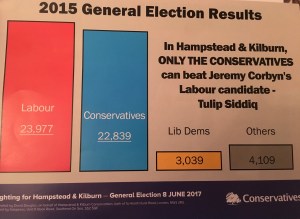
And that is why the piece of campaign literature which came through my door today should be extremely worrying for Labour’s Tulip Siddiq. The helpful chart on one side makes it look as though this is a straight-up fight between Jeremy Corbyn’s loopy, crackpot Labour Party and the Tories (thus underplaying the possibility of a LibDem fightback), while the reverse side trumpets three “damaging” headlines in which Siddiq proudly takes credit for nominating Jeremy Corbyn to the Labour leadership, refuses to concede that it was an error and then actually joins his Shadow Cabinet (while conveniently omitting the fact that Siddiq later resigned from the shadow frontbench in order to clutch the EU flag and vote against Article 50).


Where Things Stand

If this is indeed a scenario in which the two leading parties – Labour and the Conservatives – are attempting to win by losing the least number of votes to the Liberal Democrats, then the Tories presently have the advantage, and if they are smart they will do everything they can to tie Tulip Siddiq to Jeremy Corbyn in the public imagination. This will certainly be the advice/orders filtering down from Lynton Crosby and CCHQ in any case.

The more that Hampstead & Kilburn constituents are seeing and talking about how Tulip Siddiq helped inflict Jeremy Corbyn on the country and repeatedly enabled his chaotic leadership of the party (fair characterisation or not) rather than how the Tories have a childlike understanding of Brexit and an increasingly tarnished reputation for economic competence, the more likely it is that the Conservatives will prevail on 8 June and Claire-Louise Leyland will be returned as our new MP.

To survive and retain the seat for Labour, Tulip Siddiq must find a way of beating the Labour Party’s unbeatable Brexit conundrum while also distancing herself from Jeremy Corbyn – but not to the extent that it keeps the Corbynista vote at home or threatens any support she might need from the party leadership. In other words, Siddiq really has to thread the needle to prevail here.

Meanwhile, the Liberal Democrats need to make the local race all about Brexit, and nothing else. Kirsty Allan needs to paint herself as the only candidate with the courage to stand up for all of Hampstead & Kilburn’s heartbroken “citizens of the world” by acting with other LibDems as a drogue parachute on Britain’s departure from the European Union. Then she must hope that she can tempt enough such people away from their 2015-era partisan loyalties in order to pull the LibDems back to their 2010 levels of support, plus a little bit extra. It is a tall order, but not quite an impossible one.

So, all to play for at the moment. Bring on the hustings!


Update – 30 April

This interesting analysis from the Guardian and Electoral Calculus uses ICM polling to suggest that the Liberal Democrat resurgence may be a paper tiger – an attractive theme (and one eagerly picked up by the Remain-sympathising Westminster press) but with little basis in actual reality.

In particular, it shows that while a number of previously Labour-voting Remainers are indeed likely to jump ship to the LibDems, the Conservative vote looks far stickier, with 2015 conservative voters far less likely to jump ship even if they disagree with Brexit. This would seem to pour cold water on any hopes of a LibDem resurgence here.

The upshot of their analysis:

Our model sees the Tories on 422 seats, with Labour reduced to just 150, and the Lib Dems declining from 9 to 6. The Conservative majority would be north of 190. Labour would be wiped out beyond what most people are currently predicting. Leadership candidates like Clive Lewis would no longer be leadership candidates, because they would no longer be MPs.

The Lib Dems could lose a third of their MPs even after gains in places like Cambridge, with seats like Carshalton & Wallington, Richmond Park and Southport especially vulnerable. The danger in these seats is pretty clear. In Carshalton, Tom Brake won a majority of 1,510 in 2015. If a fraction of the town’s 7,000 UKIP voters return to the Tories, that majority will be wiped out. Southport is almost identically poised. Unless a major influx of Remain voters arrives from somewhere – and there’s no indication in any of this data that it will – then these seats will be lost. The Lib Dems don’t face the same problem in Richmond Park, which only turned back to the Lib Dems in December; but with a majority of less than 2,000 and a recent history of flipping, you wouldn’t bet the mortgage on a hold.

Devastating if correct.

On the plus side for Labour, there is hardly any UKIP vote in Hampstead & Kilburn to drift back to the Tories, unlike some other constituencies where the potential backwash of ex-UKIP voters to the Conservative Party threatens to sink LibDem and Labour candidates alike. This means that Tulip Siddiq’s fate as the constituency MP is firmly in Labour’s own hands, and their ability to hold on to their vote in the face of Jeremy Corbyn’s broad unpopularity.


General Election 2017 - Hampstead and Kilburn Conservatives attack leaflet - Tulip Siddiq Labour Party Jeremy Corbyn - 2

Support Semi-Partisan Politics with a one-time or recurring donation:

Agree with this article? Violently disagree? Scroll down to leave a comment.

Follow Semi-Partisan Politics on TwitterFacebook and Medium.

Quote For The Day

Brendan O’Neill, writing on Facebook:

With trustafarian Corbynistas on one side and media Blairites on the other, Labour is now entirely the property of people who do not labour, and have never laboured, and will never labour, and whose only experience of labour is when they keep an eye on the stupid bloke from Barking who probably voted Brexit as he fixes their boiler, to make sure he doesn’t steal anything.

An insult made devastating because it is so undeniably true.

This is not to say that there are not still (potentially) many good people within the Labour Party – people who perhaps voted Remain but who do not see Brexiteers as unthinking, subhuman trolls with racist tendencies, people who want to bend markets to do more of the state’s bidding but who have fundamentally made their peace with capitalism.

In fact, Brendan O’Neill was at pains to say that the Labour Party is now the “property” of the elites, not that the entire composition is rotten – just the Corbynite and centrist factions together with their sycophantic allies. Meanwhile, the decent people of moderate left-wing persuasion are utterly out of power and deep in the political wilderness right now. The direction of the party is firmly out of their hands.

Instead, with one hand on the reins of power we have the die-hard Corbynistas with their coherent but deeply unpopular worldview, and on the other we have the angry, bitter centrists, furious at having been forced from power since 2015 and eager to snatch back control so that they can pick up right where they left off, ratcheting up the size of the state, bowing down to public sector interests and eagerly fellating the NHS-Industrial Complex.

Both groups are led (if not wholly constituted) by elites – on the Corbyn side, the kind of “trustafarians” who will never have to worry if far-left policies tank the economy and render millions permanently unemployed, and on the centrist side, London-dwelling political and media types locked in an unhealthy symbiotic parasitic relationship and utterly beholden to the previous pro-EU status quo.

Where are the Labour MPs who rise up through the trades union, who might have some tangential claim to represent the interests of ordinary workers? Where are the Labour parliamentary candidates with actual firsthand knowledge of working in modern day call centres, warehouses and retail environments? Where is the great body of Labour MPs and candidates who represent the 52% of British voters who voted for Brexit in a non-partisan referendum? As a solid caucus within the Parliamentary Labour Party, they simply do not exist.

The Labour Party is not run for their benefit and so does not require their input.


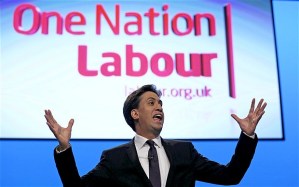
Ed Miliband Labour One Nation

Support Semi-Partisan Politics with a one-time or recurring donation:

Agree with this article? Violently disagree? Scroll down to leave a comment.

Follow Semi-Partisan Politics on TwitterFacebook and Medium.

Social Justice Watch: Bill Nye’s Junk Science And Rachel Bloom’s ‘Sex Junk’

The Cult of Social Justice and Identity Politics is metastatising throughout popular culture – this is not a problem safely confined to university campuses

When I watch videos like this and think to myself “This is it; this is the end of Western civilisation, the acceleration of the fall of Rome”, am I on the money, or am I overreacting just as cantankerous old men once ardently believed that rock ‘n roll was corrupting the kids?

I honestly don’t know any more. Some people seem to be clapping along and cheerfully encouraging this quadrillion gender + ‘satisfy any passing whim that pops into your head’ worldview and its metastatisation throughout the culture, as though it is the most positive and welcome development in the world. A smaller number of people (such as myself) are sounding notes of caution to varying degrees, though perhaps not loudly enough. But the bulk do not seem to believe there is an issue at all.

And now we must suffer the perverse spectacle of Bill Nye the “Science Guy” bestowing the imprimatur of science and rationality on avant-garde gender theory by bopping along while actress and singer Rachel Bloom frantically cavorts, declaring:

‘Cause my sex junk is so oh, oh, oh
Much more than either-or, or, or
Power bottom or a top off
Versatile love may have some butt stuff
It’s evolution, ain’t nothing new
There’s nothing taboo about a sex stew

And:

Sexuality’s a spectrum, everyone is on it
Even you might like it if you sit up on it
Drag queen, drag king, just do what feels right
You’re a tall pansexual flirty wood sprite

Sure, why not? After all, it’s science.

Rod Dreher seems pretty clear in his verdict:

Keep in mind that Bill Nye is considered a pop culture icon by the rationalist crowd intent on demonstrating what poltroons religious people are. And yet, this trash makes “Veggie Tales” play like the Oresteia.

[..] Crazy people. Batsh*t crazy.

I think I’m with Rod.


Teachers for Social Justice

Support Semi-Partisan Politics with a one-time or recurring donation:

Agree with this article? Violently disagree? Scroll down to leave a comment.

Follow Semi-Partisan Politics on TwitterFacebook and Medium.