When The Devil Is In Your House: Charlottesville, The Alt Right And Conservatism

There is nothing conservative about the resurgent white identitarian movement taking root in America, and all decent conservatives must vehemently reject this toxic ideology – and its adherents – before we are further tarred by association

There seem to be two main responses from conservatives to the awful violence which took place in Charlottesville, Virginia last weekend.

One approach – and the correct one – is to forcefully condemn the rise in white nationalism and the specific act of domestic terror which one individual from that movement perpetrated on society, pointing out that no matter what these people call themselves (Alt Right, Far Right or anything else) there is no place for them in the conservative movement.

The other approach is to point angrily at the leftist counterprotesters, particularly the militant Antifa contingent, and point out that these thugs were also violent, punching people, wielding clubs and attacking journalists with very little intervention from the police. This is the “whataboutism” approach – pointing out the speck in your brother’s eye while ignoring the beam in your own.

Sadly, we have seen too much of the second approach and not enough of the first in the days since violence came to Charlottesville.

The video above is a segment of the Andrew Klavan show. Klavan is a podcast host on Ben Shapiro’s conservative website The Daily Wire, and in this segment he demonstrates by example the way that conservatives should respond when racist, far right fanatics try to hijack our movement and sabotage our policy agenda in service of their own warped agenda.

Beginning at 6 minutes into the video, Klavan says:

Let us start among ourselves, because we’re all good conservatives here. Let us gather together and just remind ourselves – these clowns are in our house, okay? These evil, satanic clowns are in our house.

And it’s no good saying “well, they don’t believe what we believe”, of course they don’t believe what we believe. Of course they don’t. They don’t believe in the Constitution, they don’t believe in E Pluribus Unum, they don’t believe in the great American tradition of bringing people in, transforming them into America through our creed that we conservatives are fighting so hard to defend, they don’t believe in low taxes, they don’t believe in any of this stuff. They don’t believe in America, they don’t believe in the whole thing that makes America what it is.

But they’re in our house. They identify themselves as right wing, they vote for the people we vote for, they have their slogans “Unite the Right” and all this stuff. It’s no good – when the devil is in your house you gotta take care of that, it’s no good saying “well, the devil is in the other guy’s house too” – of course he is. But let’s not mince words about it.

Absolutely. And conservatives cannot afford to be hypocrites here. Whenever a terrorist atrocity is committed by a radical Islamist, many of us on the political Right correctly demand that the Muslim community do more to confront and defeat extremist Islamist ideology wherever it manifests in their mosques, their workplaces, their social circles or even their own homes. The state can not be fully responsible for making radical or violent interpretations of Islam unacceptable to susceptible people, and its attempts to do so (through the PREVENT programme in Britain, for example) will only ever be partially acceptable. The ultimate solution to Islamist extremism cannot be enforced from outside, it must be midwifed by responsible people within the community.

But if we make this demand of our Muslim compatriots, friends and neighbours, we conservatives must also be honest when a violent and extremist ideology is lurking in the fringes of our own movement. The domestic terrorist who killed one person and injured many more in Charlottesville, Virginia last Saturday is no more representative of the conservative movement than the depraved Islamist terrorists who kill innocent people in London, Paris or Brussels is representative of all Muslims – possibly even less so. But still we have an obligation to stand up and vociferously object when our movement is hijacked by those who would seek to appropriate our language, policies and even our political parties for their own warped purposes. It is only fair to be morally consistent in this way.

In the face of resurgent (or at least emboldened) white nationalism it is not enough to do what some stalwarts of the American Right did, and loudly proclaim that Nazism is actually a far-left ideology, trying to pretend that the white nationalist identitarian resurgence is not a problem primarily of the Right:

This is just supremely unhelpful, not because Dinesh D’Souza doesn’t have a point but because this “whataboutism” makes it look – quite reasonably – as though conservatives are deflecting. Yet D’Souza seemed to spend most of the weekend labouring this angle of attack, which while technically true does nothing to purge conservatism of the parasites in our midst, or convince sceptical people that we have our house in order.

Right now I don’t think Republicans or many American conservatives realise just what a severe reputational issue they are facing at the hands of this president. Is the media always fair with its coverage? Of course not. Does the media lazily try to fit every story into their “conservatives are racist” framework much of the time? Yes. But that only makes it more important for us to be whiter than white at all times (if you’ll pardon the unintentional pun).

Conservatives know that they will be attacked for racism if there is even the slightest possibility of malice, while leftists will be given a free pass. We know this, so there is absolutely no excuse for acts like Donald Trump’s latest press conference where he opened himself up to valid accusations by the media that he was drawing a moral equivalence between the violence of the neo-Nazi thugs and the actions of the counterprotesters (yes of course violence took place on both sides, but the ideologies in question are not morally equivalent, and only one side committed an act of domestic terrorism).

And yes, sometimes the Republican Party has been too willing to make a home for racists in their house, a fact which is not expunged by the fact that Democrats did the same in the 1960s. Engaging in whataboutism does not shift the spotlight away from conservatives, it merely makes it look to ordinary people as though we have something to hide.

At this point we are rapidly running out of excuses and mitigating factors for Trump’s behaviour. No, scratch that – the reserve of excuses has long since been exhausted, and the barrel is now bare. And if this presidential behaviour continues largely unchallenged by mainstream conservatives then only one of two things can happen – either conservative and Republican elected officials face deserved electoral annihilation in the midterms and the next presidential election cycle, or they are propped up and kept in office not by genuine conservatives but by uber-motivated Alt Right types – at which point small-government, constitutional conservatives will have been definitively pushed out of their own party.

This is untenable. The white nationalist and white supremacist Alt Right is a cancer on conservatism because they choose to align themselves with conservatism and live in our house, and rather than administering a welcome dose of chemotherapy the President of the United States is allowing the tumour to grow unchecked – either for cynical political ends, or else for a much darker purpose.

Meanwhile, every hysterical criticism and slander of conservatism ever made by leftists becomes slightly more plausible when Donald Trump, face of the Republican Party, cannot bring himself to disavow gushing words of praise from white supremacists like David Duke.

Abraham Lincoln once said:

Fellow-citizens, we cannot escape history. We of this Congress and this administration, will be remembered in spite of ourselves. No personal significance, or insignificance, can spare one or another of us. The fiery trial through which we pass, will light us down, in honor or dishonor, to the latest generation [..] We — even we here — hold the power, and bear the responsibility.

We are rapidly reaching the point where all conservatives of conscience who have not already done so – including elected officials at all levels – must take a public stand and declare whether they accept the White House’s inexplicable Entente Cordiale with the Alt Right, or whether they repudiate it as a matter of conscience.

Those people who choose the wrong side of this existential debate, or who shamefully sit on the fence, will be remembered in spite of themselves.  And one day they will have to answer for their cowardice.


White Supremacists March with Torches in Charlottesville

Support Semi-Partisan Politics with a one-time or recurring donation:

Agree with this article? Violently disagree? Scroll down to leave a comment.

Follow Semi-Partisan Politics on TwitterFacebook and Medium.

Violence And Death In Charlottesville, And A Morally Compromised President

Charlottesville protest - car attack - far right domestic terrorism

If President Donald Trump cannot bring himself to explicitly condemn an act of domestic terror perpetrated against anti-racism protesters in Virginia, one must question not only whether he is capable of bringing Americans together as one nation, but whether he even intends to try

What hath identity politics wrought?

That was the question that stuck in my mind as I sat and watched footage of the far right and Antifa protests in Charlottesville, Virginia today, culminating in that heinous act of domestic terrorism where a car rammed a group of counterprotesters at high speed, killing one and injuring nineteen – a deliberate copy of the kind of low-tech attack perpetrated by radical Islamist extremists recently in Europe.

As part of my media monitoring watching this story develop, I spent some time tuned into a livestream report from Alt-Right conspiracy site Infowars. Their reporter was embedded with a group of Alt-Right protesters who had been dispersed by the police and were trying to regroup. Several of them openly admitted to being racist on camera. A couple spoke about the conspiracy of “international Jewry”, while others just barked the name George Soros over and over again. One talked about the demographic timebomb that threatened America when Texas finally turns into a Blue state due to Hispanic immigration. Lots seemed to want a complete shutdown of all immigration, legal and illegal. And all this on top of the images we have seen of protesters bearing swastikas and making Nazi salutes.

Nobody is covering themselves in glory at this point – not the far Right white supremacist protesters, not the more extreme Antifa elements of the counterprotest, not the news media, not people on Twitter and certainly not the President of the United States.

Many people have made the point that the Left’s obsession with identity politics has helped to fuel the white nationalist/supremacist backlash we are now seeing from the far Right. They’re not wrong. For every action there is an equal and opposite reaction, and the relentless growth of identity politics, aided and abetted by cynical left-wing politicians, has certainly put rocket boosters on right wing extremist sentiment.

But none of that matters in the moments after a car is driven at speed into a crowd of anti-racist protesters, in what can only be described as an act of domestic terrorism. At that point it doesn’t matter whether the counterprotesters were trying to suppress the free speech of the far Right, or whether their own leftist ideology is flawed. At that point, these discussions should be put on hold, to be relitigated after we have condemned this singular and abhorrent act of violence.

If there was a time for Donald Trump to step up and show that whatever his flaws he could be president of all Americans, this was it. He failed that test, making a statement consisting of weasel words that condemned violence “on all sides” but without mentioning the focal violent incident of the day.

Remember: this is a president who is happy to shoot his mouth off on Twitter about terror attacks in distant lands, offering certainty and condemnation even before the facts are fully established (and sometimes getting it plain wrong in the process). This is a president who can be frighteningly specific when a particular person or group has roused his anger – when he wants to be. As one Twitter user noted, it would have been nice to hear the President of the United States condemn the mowing down of protesters with the same stridency and tone he uses to attack the likes of Rosie O’Donnell or any of the other celebrities he likes to feud with.

But instead Trump said this:

“We condemn in the strongest possible terms this egregious display of hatred, bigotry and violence on many sides, on many sides.”

Well yes, there were certainly acts of bigotry and violence committed by Antifa and others among the counterprotesters. But to paint any kind of equivalence when violence from one side has resulted in death and multiple injury is morally questionable, and politically self-destructive.

There exists a preset media narrative that the Trump White House is staffed with people who are white nationalists at best, and white supremacists at worse. This is mostly media hysteria – while Trump certainly made racist comments during the presidential campaign (not least of which suggesting that Judge Gonzalo Curiel would be incapable of ruling fairly in a Trump University pre-trial hearing because his Mexican heritage would create bias because of Trump’s border wall policy) he has not yet taken any executive action which a reasonable person could construe as being motivated by white supremacist leanings.

Nonetheless, Trump should have realised – and probably was fully aware – that anything less than irreproachable behaviour on his part on any issue touching race would be jumped on by political opponents and the media, bogging his administration’s agenda down and giving Americans just cause to fear that their president was in fact not equally concerned with the welfare of all citizens regardless of race.

And yet when given the lowest of hurdles to jump over – unambiguously criticising violence committed by white supremacist protesters – Trump failed to clear the bar, instead preferring to issue a meandering blanket condemnation of violence which was never going to be enough to satisfy the politicians, media outlets and commentators sniffing for blood.

Why not? Well, to my mind there are only two potential explanations. Firstly, Trump did not specifically condemn the white supremacists because he sympathises with their cause. Or secondly, Trump does not agree with (or is ambivalent about) their cause, but values the votes and political support of this subgroup too much to risk displeasing them by making an overt criticism.

In the first instance, this would make Donald Trump utterly depraved and unworthy of political support from any decent elected official. And in the second instance, this would make the President of the United States a coward for failing to risk taking a political hit in order to tell the kind of harsh truths and specific admonishment to the far Right that much of America needed to hear. Complicity in racism or rank political cowardice – neither characteristic befits the office of president.

Rod Dreher gets it right:

Trump’s response to the racist rally has been — how to put this? — underwhelming.  No, I’m sorry, it’s not “underwhelming”. It’s disgusting. And given that professional racist David Duke invoked Trump’s name favorably at Friday night’s rally, Trump has every reason in the world to condemn this rally and its attendees in no uncertain terms. But he didn’t do it.

[..] Yes, we can and should talk about how left-wing racism and antifa violence are feeding this right-wing racism and violence. But that can come later. Today, all that needs to be said is: these white thugs who desecrated Charlottesville today are evil, and must be condemned and resisted by all decent people. And also, by the American president.

The National Review’s Rich Lowry also makes a fair point:

I don’t have a problem with Trump condemning both sides, since both sides resorted to violence. And he did denounce bigotry and hatred. But I agree that it was mealy-mouthed and wrong not to specifically name and slam the white supremacists whose march was the precipitating event here. Putting aside the merits, if you are a president people suspect is allied with the nastiest forces on the right, you should leap at the opportunity to denounce violent white nationalists. I wouldn’t be surprised if a Trump takes a second bite at the apple sometime soon, but this shouldn’t be so hard.

While Michael Brendan Dougherty is even more appalled:

This weekend in Charlottesville Richard Spencer organized his “Unite The Right” march.  David Duke was there too. Fights broke out between the demonstrating racists and the people protesting them. A motorist driving a Dodge muscle car rammed into a group of anti-racist protestors, injuring several and killing at least one.

Even if you believe as I do, that Spencer’s form of white nationalism is a marginal movement granted far too much attention, the sight of hundreds of unmasked young men marching through Charlottesville with torches and chanting racist slogans inspires genuine fear in many Americans. Trump was given a chance to speak to that fear today, and to offer the same moral condemnation and deflation he’s given others. Instead he essentially repeated his disgraceful half-disavowal of Duke. He refused to call out these white supremacists by name, and condemn them. He merely condemned “all sides.”  An energetic law and order president who had any sense of the divisions in his country would have announced today that he was instructing his Justice Department to look into the people in these groups, and zealously ferret out and prosecute any crimes they turned up.

This is a target-rich environment. Some of these scummy racists in Charlottesville wore chainmail, others went around shouting their devotion to Adolf Hitler. A president with Trump’s intuitive sense of depravity should be able to call them what they are: evil losers. More pathetic: evil cosplayers.  Just as Spencer took Trump’s “I disavow” without a direct object to be a kind of wink in his direction, surely he’ll take today’s statement about “all sides” as another form of non-condemnation. With his performance today, Trump confirms the worst that has been said about him. He’s done damage to the peace of his country. What a revolting day in America.

What stubborn obstinacy exists within Donald Trump that makes him unable to do the sensible thing, to follow the path of least resistance, time and time again? Trump knows that his every statement and every tweet will be parsed by the media, many of whom are actively antagonistic to his agenda (see CNN White House Correspondent Jim Acosta’s preening, virtue-signalling battle with Stephen Miller over immigration at a recent press briefing). So why feed them more ammunition? Surely Trump knows that given widespread concerns about his attitudes to race, he needs to be whiter than white (if you’ll pardon the pun)?

More importantly, Trump should realise that criticisms of identity politics from his administration and other conservatives will be even less likely to get a fair hearing than would otherwise be the case, so long as he refuses to condemn white nationalist violence with the same zeal that he criticises violence committed by other identitarian movements such as Black Lives Matter.

Maybe somebody smarter than me can come up with a better and less worrying theory as to why Trump deliberately avoided the path of least resistance when making his statement. But to my mind, the only reason the president would refuse to explicitly condemn white nationalist violence – when he knew that the entire country was watching and waiting for him to do so – is because there is a certain constituency he is sufficiently keen to keep on-side that he is willing take the political hit for issuing a mealy-mouthed, non-specific condemnation of the violence in Charlottesville.

There is an exceedingly unpleasant subgroup within Donald Trump’s support base that holds utterly abhorrent views which need to be acknowledged and confronted, not just by ordinary grassroots conservatives or sycophantic GOP politicians but by Trump himself. And every day that the president fails to denounce that racist element, what little moral authority he has left will continue to ebb away.


Charlottesville protest - Unite the Right - white supremacists salute

Support Semi-Partisan Politics with a one-time or recurring donation:

Agree with this article? Violently disagree? Scroll down to leave a comment.

Follow Semi-Partisan Politics on TwitterFacebook and Medium.

‘Compassionate Conservatism’ Plays Into The Left’s Hands

If any more evidence were needed (and at this point it really shouldn’t be) that embracing “compassionate conservatism” is not the answer to the Tories’ problems, then a new piece by Abi Wilkinson mocking their efforts at rebranding should make things clear.

Wilkinson writes in Total Politics:

Since the recent general election, there has been a noticeable upswing in the number of Conservatives fretting about inequality, material hardship and issues with the current economic system.

[..] At some level, it’s gratifying to see an increased willingness amongst right-wingers to admit that things are not currently alright. On the other hand, it’s hard not to be frustrated that these conversations are only happening now – when the left is in resurgence and appears a viable political force. If they’re capable of seeing these issues, why didn’t they say something sooner? Why have they been happy to cheerlead governments that have overseen massive increases in homelessness and child poverty, underfunding of public services, the erosion of employment rights and growing income inequality?

The biggest issue with this sudden surge of compassionate conservatism, however, is the failure to identify real solutions to the stated problems.

The moment that conservatives start waffling on about compassion is the moment that we start fighting on Labour’s terrain and lose the war. The parties of the Left have already convinced a huge swathe of the electorate that compassionate conservatism is an oxymoron:

https://twitter.com/sestos007/status/896261761267097600

Any time that conservatives try to frame their pitch to the electorate in terms of compassion or any of the other paternalistic buzzwords used by the Left, voters will simply ask why they should pick the Tories when Labour is offering the full-fat version of socialism.

If anything, conservatives should attack the Left’s lazy, self-serving definition of compassion, which largely consists of assuming that half the population belongs to a perpetual victim class in need of constant nourishment, assistance and succour from the state; that parking people on welfare and forgetting about them is somehow a sign of love and solidarity; that tearing down the wealthy through punitive taxation will do anything to improve the material circumstances of the poor; that interfering with free markets, the greatest engine of wealth creation available, will somehow protect consumers.

The term “virtue-signalling” is becoming quite overused (not least on this blog), but it really does apply to much left-wing policy-making, where what matters most is to be seen to be taking action against some social injustice or inequity rather than coming up with sustainable policies to attack those problems in the long-term. We need to start making this point more forcefully, pointing out that it is in fact evil to do what feels good and conscience-soothing today if it only perpetuates or exacerbates a problem further down the road (see the Left’s sanctimonious outrage when it was proposed that migrant boats heading to Europe be stopped and sent back – by thwarting this policy, hundreds if not thousands more people have drowned, just so that leftists could look compassionate on Twitter).

For too long, conservatives have been content to portray themselves as rational and dispassionate administrators of the machinery of state, making difficult but necessary decisions in the name of fiscal rectitude (not that this rhetoric ever carried through into action – see the persistent budget deficit and rising national debt). And in so doing, the Right has repeatedly ceded the language of morality, of right and wrong, to the parties of the Left, who are only too happy to run with it and paint themselves as having a monopoly on virtue.

This approach won’t cut it any more. To halt the advance of Jeremy Corbyn, a party leader who actually has principles (however misguided and odious some of them may be) and the courage to defend his beliefs in public, conservatives need to start talking in the same self-assured language of right and wrong. Pointing out the unworkability of socialist policies is insufficient – we need to make the moral case for why cranking up the size of the state and making more people dependent on the government is bad for everybody. We need to become more comfortable speaking in the language of good vs evil – which people understand and respond to – rather than the dry, technical language of financial feasibility.

But more than anything, we conservatives must stop apologising for our belief in smaller government and individual liberty. Our stance should not be that Jeremy Corbyn’s hard left policies would be wonderful if only the magic money tree actually existed. Rather, we should make the case that even if we could afford to implement the Labour manifesto it would have negative impacts on incentives to work, invest and be self-reliant. We have to fight fire with fire.

That’s not to say that the conservatives should not come up with compelling policies to offset the negative consequences of globalisation and automation, some of the most pressing medium term issues we face – of course we should. But we should also explain that the Left’s perpetual fallback of waving their magic wand and creating an expensive new government programme to solve every issue is the wrong way to go – that if we are actually to bind ourselves more closely together as a nation we need to reinvigorate civil society rather than continually undermining it with big government.

Will it be difficult to change our messaging? Absolutely. But as Theresa May can attest, our current method of engaging the electorate isn’t exactly delivering great returns (yes, you can argue that the Tories received their highest vote share in many years, but this doesn’t really matter when conservatives are effectively fighting against a coalition of all the parties of the Left and can’t muster a Commons majority on 42% of the vote).

Chasing after the Labour Party on a race to the Left will not work. If voters want socialism, they’ll choose the real thing. And waffling on about compassionate conservatism will only evoke scorn from commentators like Abi Wilkinson, and provide an easy opening for the Left to virtue-signal all over again.

If the Tories want to actually be in power rather than merely in office, a new approach is required. One which involves more courage and less appeasement.


My longer essay on why embracing compassionate conservatism will not make the Tories more popular is here.


Conservative Party Logo - Torch Liberty - Tree

Support Semi-Partisan Politics with a one-time or recurring donation:

Agree with this article? Violently disagree? Scroll down to leave a comment.

Follow Semi-Partisan Politics on TwitterFacebook and Medium.

Centrism Is The New Extremism

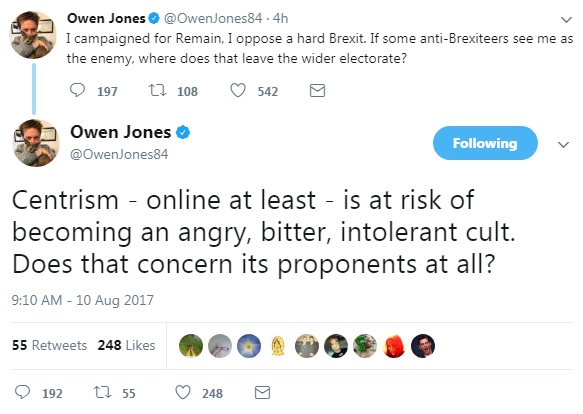
Owen Jones - Brexit - Hardline Remainers - Extremism

For many years, the most angry and bitter invective in our political discourse hailed from the far Left and Right. But now it is the supposedly rational and pragmatic centrists who are becoming unhinged and increasingly uncivilised.

Like the stopped clock which still tells the correct time twice a day, once in awhile Owen Jones has a passing moment of clarity and perception and utters a statement with which a normal person can actually agree.

Today is one of those days. Noting that he is taking increasing amounts of flak not from hard Brexiteers but from hardcore ideological Remainers, Owen Jones noted on Twitter that “centrism – online at least – is at risk of becoming an angry, bitter, intolerant cult. Does that concern its proponents at all?”

Jones follows up by noting that “a certain type of Hard Remainer online have become angry, bitter, intolerant, and determined to root out the impure on their own side”:

Slow hand clap.

Jones isn’t wrong, and while one might legitimately question whether he is the best person to be accusing others of being angry and bitter, he makes a fair point – there is a very real and growing rage building among the pro-EU centre-left, a rage which is spilling over and causing people to say all manner of outlandish things.

In the immediate aftermath of the EU referendum there was a sort of stunned silence from the Remain camp. Many arch-Remainers were also the same establishment centre-left figures who found themselves banished to the margins of the Labour Party by the Jeremy Corbyn ascendancy back in 2015. To be cast from power and influence within their own party and then to feel Britain’s EU membership – which has become emblematic of their perception of themselves and the country as enlightened, progressive internationalists – slip through their fingers only a year later was more than many centrists could bear. At first.

But it did not take long for shock to turn into anger and defiant resolve. Harnessing huge amounts of denial (“the referendum was only advisory”, “the Leave campaign had a monopoly on lies and so the result should be invalidated”) many centre-leftists, realising that their entire worldview was not only under attack but on the verge of defeat, stirred themselves into action.

We saw this with the court case brought by Gina Miller, in which the Supreme Court ultimately ruled that Parliament must have a say on the final Brexit deal negotiate by the government. We saw it too in the flourishing of groups and social media accounts dedicated not to making the best of Brexit now that the country had voted for it, but rather trying to overrule that vote and remain in the EU at all costs.

I noted this phenomenon myself a few weeks ago, admitting that we Brexiteers had underestimated the ability of the pro-EU, centrist establishment to launch a reactionary hissy fit several orders of magnitude bigger than the anti-establishment backlashes which led to Brexit in Britain and President Trump in America:

Perhaps we should have seen it coming. Effectively overruling the establishment’s carefully laid out plan for our lives was always going to generate a huge backlash, from powerful and well-connected people with the ability to make traditional grassroots anti-establishment backlashes look like a cake sale at the Women’s Institute.

Perhaps we forgot this fact because we Brexiteers and defenders of nation state democracy were so used to being part of a backlash ourselves – the backlash against the establishment – that we didn’t give enough credence to the fact that globalists, disinterested “citizens of the world” and other assorted types are equally as invested in their worldview as we are in ours, and in a far stronger position to defend it from attack.

And now that they have experienced repudiation at the ballot box, the establishment’s ability to turn howls of outrage into a full-on filibuster of democratically-made decisions is stronger than many of us planned for.

We are definitely witnessing an ossifying or hardening of positions among many Remainers. Before the EU referendum last year, some of these people could occasionally be found admitting that the European Union was not perfect and urgently needed reform, and even that membership had some downsides (even if outweighed by the positives).

You won’t find arch-Remainers talking like this in the press or on social media any more. Now that the prospect of Brexit looms, the EU is perfect and irreproachable, and Brexiteers aren’t just misguided but actively evil for casting Britain into the abyss. (Well, to be fair, many hardcore Remainers always asserted that Brexiteers were evil racists, but they now do so with increased frequency and venom).

The Guardian recently published a piece by Will Hutton, who declared that Brexit is “our generation’s Dunkirk”, as though tactical retreat in the midst of an existential world war is in any way comparable to the peaceful, diplomatically negotiated departure from a supranational political union.

In a spittle-flecked fury, Hutton wails:

Last week, Labour peer Lord Adonis compared leaving the EU as a mistake analogous to appeasement. He is right. Brexiters Davis, Fox and Johnson are from the same anti-modern, delusional world view that produced the strategic foreign policy mistakes of the 1930s and the emasculation of the mixed-economy, state-led approach that underpinned the economic success of 1931-50.

Then, at least, we had underlying strengths, representing the opposite of their philosophy, upon which to fall back on. Brexit is our generation’s Dunkirk, but with no flotilla of small boats and no underlying economic strength to come to the rescue. It’s just defeat.

Now this blog has no time for Liam Fox or Boris Johnson, but even if Theresa May’s government drops the ball completely on Brexit the economic ramifications (bad though they may be) will still fall several degrees short of colossal military failure and impending invasion. To compare Brexit to Dunkirk or to Chamberlain’s policy of appeasement is wild hyperbole of the first order.

But this is what you now have to look and sound like to be accepted into the Remainer / centrist tribe – at least on social media, where nuance and restraint have never been in great supply. Just as the Cult of Social Justice and Identity Politics doles out “victimhood points” and social status depending on the number of ways that a person can describe themselves as oppressed, the Cult of the EU demands ever more flamboyant declarations of love for the European, furious denunciations of those who disagree and pledges of extreme measures to be taken to stop Brexit at all costs. Because being pro-EU is bound up so tightly in the centrist psyche, Brexit is making many establishment centrists behave like any other identity group that feels under attack, blindly lashing out and playing the role of the victim.

And so in many ways it was inevitable that arch-Remainers would be suspicious of the likes of Owen Jones, and seek to publicly denounce him. Back in 2015, when the EU was turning the screws on Greece and effectively subverting Greek democracy, Jones came close to openly advocating for Brexit. Of course, like many others (most notably Ian Dunt, who had virtually nothing good to say about the European Union until he realised that the EU referendum could boost his profile if only he switched sides) Jones eventually returned to the fold, taking the wishful thinking Varoufakis position that we should remain in the EU in order to reform it.

But like all extremist movements, the hardcore ideological Remainers have long memories and no statute of limitations when it comes to heresy. Owen Jones once expressed doubts about Our Beloved EU, Fount of All Good Things. And he compounded this thoughtcrime by accepting the reality of Brexit rather than raging against it, even penning a lengthy account entitled “Why I’m a remainer who accepts the EU referendum result”. Therefore he must be punished and cast out. As Jones notes, “the Hard Remainers want to overturn the EU referendum and regard the likes of me as traitors and impure for wanting a soft Brexit instead.”

The centrists of old – back when they were free and easy, on the ascendancy, certain that their basic worldview was coming to fruition and would perpetuate itself forever – had a reasonable degree of tolerance for differing opinions. That’s why the likes of Ken Clarke could fit (ideologically at least) under the same political umbrella as someone like Tony Blair, Yvette Cooper or Chuka Umunna. A few honest differences on a few political points were expected and allowed, since everybody was pulling in the same basic direction. But no longer. Cast out of power, hardcore centrists increasingly use a person’s attitude toward Brexit as an acid test to determine whether they are Good or Bad.

Where will this end? Well, certain excitable centrist MPs and their media cheerleaders seem to be itching to set up a new political party, first with the sole objective of stopping Brexit and remaining in the European Union, and once that deed is accomplished to turn into some kind of new centrist party, a shelter from Theresa May’s authoritarianism and Jeremy Corbyn’s unabashed socialism.

I wrote an entire blog post yesterday about why this idea is idiotic and will never come to fruition. But what would such a party look like, if the normal constraints of British electoral politics were magically removed and a new “centrist” party formed?

By definition it would be full of extremists – the kind of people whose fanatical devotion to the European Union is such that it overrides their previous party loyalties and makes them willing to jump into bed with other people who might have quite different ideas about the optimal size and function of the state, spending priorities, social issues or a million and one other policies.

Such a party would be full of EU-worshipping zealots who would pay any price and bear any burden to thwart Brexit – ironic, since many of them complain about so-called Brexit extremism. But more than that, it would be full of deluded souls who think that if only Brexit can be stopped, everything would just go back to how it was before David Cameron called the referendum; that the anti-establishment backlash which helped to deliver Brexit would simply melt away as people shrugged their shoulders and accepted being overruled by their social betters.

This is delusional. The reason that Blairite and Cameronite centrism lies discarded in the gutter right now is because its most ardent practitioners were content with a system which rewarded people like themselves while leaving millions of others in dead-end jobs or left on the welfare trash heap with little realistic prospect for self-betterment – and because they were openly, snarlingly contemptuous of anybody who dared point this out or raise an objection. Centrism is discredited because it inspired successive British governments to effectively outsource whole swathes of governance and policymaking to the European Union, with MPs and ministers enjoying the trappings of power despite having vested many of their responsibilities in a supranational government even less accountable or responsive to the popular will than Westminster.

A new political party (or government) full of centrist extremists, bitter and vengeful at having been temporarily dethroned, would immediately seek to roll Britain back to 2015 (or 2010, depending on whether they are centre-left or centre-right extremists). But the British people have moved on. A majority want to get on with Brexit even if they voted to Remain in the referendum. They want to move forward, not backward.

But despite being totally impractical and doomed to failure, expect to hear more talk of a new, dedicated anti-Brexit party. Expect to hear more overwrought headlines and tweets comparing Brexit to such and such atrocity or genocide. The rage continues to grow among the dispossessed centrists, and they have a vastly bigger platform to air their grievances than those on the ideological Left or Right.

You see, these people have never lost before. They are accustomed to winning, and do not know how to behave in the face of defeat. Since 1997, whichever party was in power, Labour or Conservative, the centrists’ worldview inched ever closer to fruition. And if that consensus failed to deliver for millions of Britons – those at the sharp end of globalisation or those who simply care a lot about democracy and constitutional matters – then so be it. They got theirs, and that’s all that mattered.

Thank goodness that this cosy centrist consensus has finally been broken, and that these arrogant, selfish and overrated people will have to take their failed and discredited ideology to battle in the political arena along with the rest of us, rather than continuing to win by default.


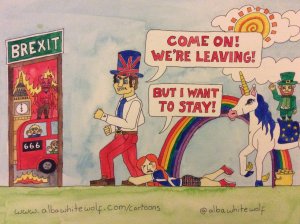
madaleina-kay-european-union-brexit-cartoons-unicorns-and-leprachauns-2

Support Semi-Partisan Politics with a one-time or recurring donation:

Agree with this article? Violently disagree? Scroll down to leave a comment.

Follow Semi-Partisan Politics on TwitterFacebook and Medium.

Exhuming McCarthy: Corporate Social Justice And The Google Memo Saga

Google diversity memo - free speech - social justice

A software engineer at Google published an internal memo questioning the current diversity strategy and warning that the company was becoming an ideological echo chamber where dissenters felt intimidated about expressing their views. Google immediately validated these concerns by firing him.

One wonders exactly what Google would have to do before senior executives at the company are forced to admit that their corporate motto, “Don’t Be Evil”, is little more than a bitter joke.

The company has been in the headlines the past few days thanks to a “scandal” precipitated when software engineer James Damore published an internal memo questioning Google’s approach to diversity in the workplace.

Entitled “Google’s Ideological Echo Chamber”, the memo alleges that “differences in distributions of traits between men and women may in part explain why we don’t have 50% representation of women in tech and leadership”, before pointing out that a free discussion cannot take place because:

“when it comes to diversity and inclusion, Google’s left bias has created a politically correct monoculture that maintains its hold by shaming dissenters into silence. This silence removes any checks against encroaching extremist and authoritarian policies.”

The memo goes on to consider various non-bias related causes of the gender gap in tech. At all times, James Damore is at pains to emphasise that he is not suggesting that all men or all women share the various traits under discussion, merely that there are indisputably different distributions of preferences and abilities between men and women which might account for some or all of the gender representation gap in the industry. Damore emphasises that “many of these differences are small and there’s significant overlap between men and women, so you can’t say anything about an individual given these population level distributions”.

Damore then goes on to propose a number of potential ways to reduce the gender representation gap without relying on methods that could be described as affirmative action, including a genuine embracing of part-time work, rewarding cooperative as well as competitive behaviour and striving to make it more socially acceptable for men to free themselves from expectations of the male gender role:

Feminism has made great progress in freeing women from the female gender role, but men are still very much tied to the male gender role. If we, as a society, allow men to be more “feminine,” then the gender gap will shrink, although probably because men will leave tech and leadership for traditionally “feminine” roles.

Read the whole memo here – it is only ten pages in length, and quite unlike the monstrous manifesto that it has been portrayed as by a hopelessly biased media.

As it happens, I agree with some of Damore’s premises but not his conclusion. I was swayed partly by this article by Josh Barro in Business Insider, which posits that if there are indeed natural gender imbalances in tech because of differences in aptitude and interest, it still behoves corporations to guard against the possibility that hiring managers, expecting that women will be less suited for certain roles, then subconsciously discriminate against female candidates.

Barro explains how this phenomenon might manifest itself:

  • A widespread assumption that “most” of the good job candidates will be men may lead to stereotyping in the hiring process, with hiring managers more likely to assume that men are good candidates and overlook qualified women.

  • Women may self-select out of the field because they internalize the stereotype that it is “for men,” and the stereotype may also make men overconfident in their fitness for the field and more inclined to pursue employment in it.

  • A male majority in the field is likely to be excessively self-reinforcing, as research shows that hiring managers tend to use the qualitative and “culture fit” aspects of hiring to hire candidates who resemble themselves, and most of the hiring managers in a male-dominated field will be men.

  • As seen in several high-profile cases in Silicon Valley, male-dominated management structures may foster cultures of pervasive workplace sexism and harassment that drive women out of the field.

Barro goes on to explain:

The memo misses this entirely, jumping from a claim that gender differences in interests and aptitude “may in part explain” the strong male skew in Google’s engineering groups to a conclusion that specific efforts at Google to recruit and retain women and underrepresented minority candidates are counterproductive and should be ended.

For example, the author complains about “hiring practices which can effectively lower the bar for ‘diversity’ candidates by decreasing the false negative rate.” That is, he’s upset that women candidates get a second look when men don’t.

But this is something you would absolutely want to do to prevent a phenomenon described above: hiring-manager biases and stereotypes leading to a lopsidedness by gender in hiring that exceeds the actual lopsidedness by gender in the qualified candidate pool. It makes sense to be extra certain that women who got screened out were rejected on the basis of qualifications and aptitude, not something else.

These are sound points, some of which I did not stop to fully appreciate when originally penning my response – I’m glad that I waited 24 hours and did some wider reading before hitting “publish” on this.

Of course, there was no such reflection and nuance to be found in the mainstream media, whose reporting might well leave you thinking that Damore had rewritten Mein Kampf for the 21st century and published a bitter screed attacking women, ethnic minorities and LGBT people.

CNN certainly took this hysterical approach:

“Aren’t biologically fit for tech jobs”? CNN should be ashamed of themselves for this blatant misrepresentation, if only they still had the capacity to feel shame. Of course, James Damore actually said no such thing. One can agree or disagree with the various premises and conclusions in the memo, but on the whole it was a thoughtful, measured and articulate reflection on a very topical issue. Rather than firing him, Google should have been proud to employ somebody who raised the issue respectfully with the aim of improving the company.

But apparently the memo has taken a grave psychological toll on Google’s “woke” and sensitive workforce. Now we hear that several female Google employees apparently failed to show up to work the following day because they were too distressed about the contents of the memo.

From NPR:

Another software engineer who used to work for Google, Kelly Ellis, says some women who still work at the company stayed home on Monday because the memo made them “uncomfortable going back to work.”

Seriously? What reason had they to feel uncomfortable? The memo was the creation of one employee – an employee who was publicly chastised by Google’s Head of Diversity, who hinted strongly that the memo “crossed the line” and violated the company’s code of conduct – and who was later fired from his job. It is hardly as though Google had suddenly been invaded by a swarm of alt-right campaigners or men’s rights activists. The corporation is overwhelmingly and publicly set against Damore’s position, to the extent that they excommunicated him for his beliefs.

The only person for whom Google proved to be a hostile work environment here is James Damore. And the only reason for any employee to stay home from work claiming distress was to parade their conspicuous victimhood and revel in their own (largely) imaginary oppression.

When I was eleven years old and in my first year of secondary school, I was queuing for the school tuck shop when some massive neanderthal of an inbred fifth-year kid shoved me out of the line and called me a nigger. And yet somehow I managed to board the school bus and show up to class on time the next day. And I was a child. Now these are intelligent, grown-ass women working for one of the most prestigious firms in the world, and we are supposed to believe that they are so fragile, so wounded by a MEMO of all things that they weren’t able to do their jobs. Again, I ask: are you for real?

This is why I say that social justice is a cancer on society. A cancer. Not just because it suppresses the free speech rights of ideological dissenters and creates a truly chilling atmosphere in which a significant portion of the population is cowed into sullen, fearful silence for fear of losing everything if they dare to express themselves reasonably and honestly. Not just because of that, but also because the Cult of Social Justice and Identity Politics is turning fully grown adults with jobs, mortgages, credit cards and often kids of their own into little more than oversized, perpetually vulnerable babies. It poisons the body politic and fractures society into separate warring special interest or “victimhood” groups, all jostling for attention, sympathy and affirmative action. Social justice activism is corroding our society from within.

There is no good reason for anyone to be traumatised by the Google memo, even if they disagree with its contents. One can disagree with the either the premises or the conclusion of the memo’s main argument, but it should be possible to have a civil discussion without acting as though real physical or mental harm has been done by the mere expressing of an opinion.

Anybody smart enough to work at Google should be capable of articulating a response to the “offensive” memo if they disagree with it strongly enough. Moreover, they should actively welcome the opportunity to debate these ideas so as to win over more supporters. That’s how social causes have traditionally advanced themselves, often with great success and rapidity.

But now this is apparently too much of a burden. Now the regressive Left is unwilling to do the hard work of argument and persuasion, preferring instead to push the “fast forward” button and speed ahead to an imagined time when everybody agrees with their social justice dogma. And since this ideological consensus does not yet exist (and God willing never will), the Left must instead artificially enforce it by clamping down on contrary opinions and making dissenters feel so fearful that they simply cease to express themselves.

David French makes this very point in the National Review:

The primary victims of this new culture of groupthink are social conservatives and other dissenters from identity politics. In field after field and company after company, conservatives understand that the price of their employment is silence. Double standards abound, and companies intentionally try to keep work environments “safe” from disagreement. Radical sexual and racial politics are given free rein. Disagree — and lose your job.

It takes a person of rare constitution and moral courage to speak up. And that’s precisely how the far Left likes it. After all, what value is there in disagreement? They’ve figured out that elusive path to racial, gender, and sexual justice, and disagreement only distracts. It does worse than distract. It wounds.

But take heart, conservatives. It’s not all bleak. After all, the government is highly unlikely to persecute you for your speech. And if you want to succeed in cutting-edge businesses or enjoy equal opportunity in the academy, you do have one good option. You can shut your mouth.

You can shut your mouth. Which is precisely what the social justice brigade wants to happen – we have recently seen reports that various employees at Google are maintaining personal “blacklists” of other staff with whom they will refuse to work or consider for promotion because they have supposedly failed to publicly embrace the diversity agenda with sufficient enthusiasm.

One such boastful threat reads:

“While Google appears to be doing very little to quell the hostile voices that exists inside the company, I want those hostile voices to know:

I will never, ever hire hire/transfer you onto my team. Ever. I don’t care if you are perfect fit of technically excellent or whatever

I will actively not work with you, even to the point where your team or product is impacted by this decision. I’ll communicate why to your manager if it comes up.”

“You’re being blacklisted by people at companies outside of Google. You might not have been aware of this, but people know, people talk. There are always social consequences.”

And it’s not just Google. I logged in to LinkedIn the other day to check my notifications and was immediately barraged with tens of status updates from various connections working at a variety of large corporations, bragging about all of the amazing things that their firms are doing to celebrate Pride month. Now from a personal perspective I have no problem with that. But if I was a social conservative who takes seriously the responsibility to treat everybody with respect but feels unable to endorse certain social movements for religious reasons, I would be very nervous right now.

Why? Because more and more, employees are exhorted to make explicit their “allyship” of various designated identity groups, or otherwise endorse the aims of the broader social justice movement. We saw this in Britain last week with the National Trust furore, where volunteers were prohibited from serving in customer-facing roles unless they agreed to wear Pride ribbons (eventually the National Trust backed down under public pressure).

The bar has been moved. Mere tolerance is no longer sufficient – increasingly we must be seen to actively affirm and celebrate every lifestyle choice, gender identity or dubious fad which falls under the auspices of the social justice movement.

This is incredibly dangerous. The idea of our employers becoming auxiliary parents to us is as insidious as the idea that the state should play this role in our lives. In fact, the current moves by many corporations to enlist their employees as agents of social change on top of their day to day responsibilities is incredibly paternalistic, almost like something out of the early Industrial Revolution, when benevolent (or not so benevolent) industrialists housed their factory workers, provided for their basic welfare but also carefully regulated their leisure activities and social lives to uphold moral standards.

As I wrote yesterday:

Whereas a decade ago one could reliably find leftists railing against the power of corporations and the supposedly unfair, coercive power balance between employer and employee, now those very same leftists are screeching that big corporations are not doing enough to indoctrinate their employees with the new social justice dogma.

Of course, vesting corporations with such power is in fact highly dangerous and quite likely unconstitutional, particularly when lawsuits start to emerge where employees allege that their employer has pressured them to violate their own conscience when it comes to matters outside the workplace.

If this trend continues, we will soon reach a point where social conservatives, social justice agnostics and anybody else who fails to actively affirm progressive dogma becomes as unwelcome in the corporate world as those suspected of communist sympathies were in 1950s Hollywood. That is the direction in which we are headed.

The rejection of truth in favour of total ideological conformity. Groupthink, paranoia and blacklists. McCarthyism is being exhumed and reanimated before our eyes in the year 2017 – this time not by anti-communists, social conservatives or the religious right, but rather by the so-called progressive Left.


UPDATE: 9 August, 23:00 BST

Curiously, nobody ever seems to ask why the male to female ratio is so skewed in other professions such as steelworking, mining, forestry or construction, careers which are often less glamorous, more dangerous and entail greater physical labour. It is almost as though gender equality activists tacitly admit that there are in fact differences between men and women which make one or other gender better suited (though by no means exclusively drawn) to certain careers. And if we accept this in the case of physical labour, why not also with mental labour – other than the fact that to even ask the question is now considered heresy?

And why do we only care about diversity in high-status non-manual jobs? Could it possibly be because the world of social justice largely consists of a self-appointed priesthood of middle and upper-middle class people talking exclusively to one another about their First World Problems and busily confirming their own biases, while working class people are too busy trying to get by to worry about whether their employer is sufficiently nurturing of their chosen identity?


Safe Space Notice - 2

Support Semi-Partisan Politics with a one-time or recurring donation:

Agree with this article? Violently disagree? Scroll down to leave a comment.

Follow Semi-Partisan Politics on TwitterFacebook and Medium.