Britain’s Surveillance State Expands, Unnoticed

Yesterday, David Cameron told the House of Commons Select Committee on National Security Strategy that he accepted that he and his government had thus far failed to make the case for the extraordinarily invasive government surveillance practices which have been secretly going on beyond the view of the public and our elected MPs, and that he and his ministers needed to do a better job selling the benefits of an intrusive, omniscient government to the British public.
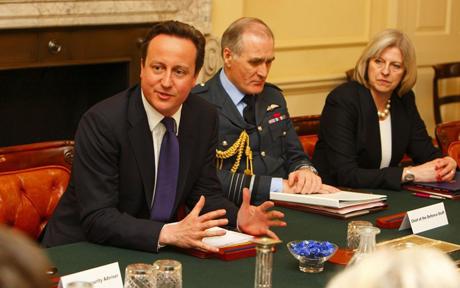
So busy protecting us, he forgot to tell us precisely what he was doing in our name.
So busy protecting us that he forgot to mention precisely what he was doing in the name of our security.

The Guardian reported at the time:

Discussing the communications legislation, Cameron said: “Over time we are going to have to modernise the legislative framework and practice when it comes to dealing with communications data. It is a politically contentious topic. I am not sure we are going to make progress on it in the coming months in terms of legislation, but there may be things short of legislation that we could do.

“I do think politicians, police chiefs, the intelligence services have got a role in explaining what this is all about. Snowden inevitably raises questions about ‘who has access to my data and why’.

“But I am absolutely convinced that proper rules for communication data collection are essential. I do not think we have got across to people yet the absolute basis of this.

“In most of the serious crimes, such as child abduction, comms data – who called who when and where was the phone at the time, not the content of the call – the comms data is absolutely vital.”

It may well be the case that the majority of the most serious crimes are indeed solved by the analysis of telephony metadata by law enforcement agencies. But David Cameron is making an entirely separate argument here. No one is proposing that the police and other law enforcement agencies should be denied access to telephone and other digital records (which are already maintained by the telecoms companies for the purposes of billing) when investigating these crimes, because in these scenarios there will almost always be a suspect in custody or at large who has created reasonable suspicion and is then the target of the search.

What GCHQ and the NSA have been doing, on the other hand, is nothing to do with this standard law enforcement practice of searching the possessions and digital footprints of an active suspect. Rather, they have been collecting reams of metadata (and more) on people who are under no suspicion of doing anything at all, in secret and without permission, to dip in and out of at their leisure. By equating these two entirely different practices, Cameron is trying to make it sound as though people who value and speak out in defence of civil liberties are somehow extremists or absolutists who want to deny basic crimefighting tools to the police. This is clearly not so.

The false equivalence is made fully apparent in this next quote from Cameron:

He continued: “I love watching crime drama on the television, as I should probably stop telling people. There is hardly a crime drama that is not solved without using the data of a mobile communications device. If we don’t modernise the practice and the law over time we will have the communications data to solve these horrible crimes on a shrinking proportion of the total use of the devices.

The Prime Minister is basically saying that because telecoms companies and devices themselves only hold the most recent usage data, it is only through exercising powers of unlimited and total surveillance that the government can maintain a complete picture of a person’s communications, for use should they ever happen to become a suspect in a crime.

Note also that we are no longer even talking about terrorism, but just “horrible crimes”, among which the Prime Minister includes child abduction and a mysterious category of offence called “comms data”. It was bad enough when a government minister could mumble something inane involving the word “terrorism” to justify gaining complete access to a person’s communications and digital life, but through a couple of seemingly-innocuous turns of phrase it seems that David Cameron now wants to broaden the use of pre-emptive digital searches to stop any and all illegal activity. And since the government has no idea who may or may not be harbouring whims of child abduction or committing a ghastly act of “comms data”, the logical inference is that he believes that the security services are perfectly entitled to collect and monitor all of our telecommunications metadata now and forevermore, on the offchance that we do decide to commit one of these crimes.

Park your outrage for a moment, because the most incredible thing of all is not that all of this has apparently been occurring with regularity – that is, collection and use of the telephony metadata of British citizens, not just for counterterrorism and national security purposes but, in Cameron’s own words, also ostensibly to prevent child abduction and any number of other nominated crimes – but that in examining the actions and conduct of his government and himself, the only thing he can find to beat himself up about is the fact that he did not do a sufficiently vigorous job selling this flagrant intrusion of government into personal privacy to the British public.

Where is the oversight? Where is the outrage?

Music For The Day

Some chamber music to close out the week – Brahms Piano Quartet no. 1, Op. 25:


Performed here by a rather all-star cast of Emanuel Ax (piano), Isaac Stern and Jaime Laredo (violin) and Yo-Yo Ma (cello).

British Citizenship Now A Perk, Not A Right

The media has rightly devoted a lot of time and attention today to the fact that David Cameron’s authority was challenged by over 90 Conservative backbenchers who supported an amendment to the Immigration bill to make it harder for foreign criminals to avoid deportation by appealing to the European Court of Human Rights on the grounds that their right to a family life would be infringed.

Foreign criminals can stay; British citizens merely suspected of terror offences to lose their citizenship.

The BBC’s Nick Robinson does a good job of unpacking the ludicrous exercise in Game Theory that led the various Conservative, Labour and Liberal Democrat factions to adopt their particular stances:

The home secretary believes that a proposal to give her stronger powers to deport foreign criminals is illegal, unworkable and may, in fact, lead to fewer deportations.

So, Conservative ministers have been ordered by the prime minister not to oppose it.

Yes, you read that right.

Despite all of the above David Cameron has told his troops to abstain rather than face headlines about a massive Tory revolt. He is said to be sympathetic to the aims of the backbench rebels who have refused to back down.

I personally fail to see why the Home Secretary or any elected politician should be personally involved in deciding deportation cases, in much the same way that I find it bizarre that they can determine whether or not to release prisoners serving life sentences. These matters should be non-political and sit with the judiciary, and while I am in favour of deporting foreign criminals I would much rather achieve this end by empowering judges and allowing them to apply clear legislation stating that criminal conviction of a non-citizen would result in the rescinding of the right to reside in the UK than by conferring even more powers on the Home Secretary to make life-and-death decisions over individual cases. But this is by the by.

The chicanery and slapstick attempts by the Home Secretary Theresa May and the party leadership to first outmanoeuver and then placate the rebellious backbenchers, some of which I personally witnessed from the public gallery of the House of Commons, are certainly newsworthy. But there is a real danger that the story will be framed as being primarily about Cameron’s leadership, or the potential impact of intraparty fighting on the Conservatives’ prospects at the next election, when something much more fundamental is also taken place. Namely, the fact that the bill, as it stands, would give government the power to strip a naturalised British citizen of their citizenship on the mere suspicion of being engaged in terrorist conspiracy.

The Guardian reports:

[Deputy Prime Minister Nick] Clegg said he supported the home secretary’s proposal to strip naturalised British citizens of their citizenship if they are judged to present a threat to national security. It would even apply to those who have no other citizenship, rendering them stateless.

He said the current laws had become a “passport for endless games in the courts to prevent people being deported that should be.

“We are tightening up the way the courts can interpret article 8, the right to a family life, so it cannot became an excuse for unjustified legal procrastination.”

Speaking on LBC’s Call Clegg, he added he knew the plan to make some naturalised British citizens stateless was controversial, but justifiable in a very small number of cases. He said the revocation of British citizenship “would apply in cases where individuals pose a real threat to the security of this country”.

“Judged” to present a threat to national security, but not convicted of any crime by a jury to back up the allegation. Perhaps this is just the inevitable next step given the fact that the British government for a long time also advocated control orders to keep terrorism suspects in a state of legal and personal limbo without giving them full legal due process.

Of course, Nick Clegg is eager to assure us that any cases of citizenship revocation will be extremely rare and only conducted in the gravest of circumstances – but since those circumstances would always be opaque to the general public, any words that he utters in support of this draconian and inhumane measure can be distilled into the much shorter phrase “just trust me”. He has given the British public no good reason to do so. And if the number of cases is really so small, what exactly is the compelling reason that they cannot have their day in court to determine their guilt or innocence of conspiring to commit terrorist acts? By Clegg’s own admission it certainly can’t be concern for the workload of the courts.

Fortunately the ever-watchful eye of Liberty, the National Council for Civil Liberties, picked up on what is happening and issued a stern public rebuke to the government, for what little good it will do:

Shami Chakrabarti, director of Liberty, said: “Liberty always said that terror suspects should be charged and tried. First politicians avoided trials for foreign nationals; now they seek the same for their own citizens.

“This move is as irresponsible as it is unjust. It would allow British governments to dump dangerous people on the international community, but equally to punish potential innocent political dissenters without charge or trial. There is the edge of populist madness and then the abyss.”

It is tragically ironic that, if the bill passes in its current form, the law will grant a convicted foreign criminal the right to remain in the UK and avoid deportation because of a fictitious invented “human right” to remain with their family in a country not their own, while a legal, naturalised British citizen merely suspected of a terrorism offence stands to have their British citizenship revoked, potentially rendering them stateless.

Surely this is one civil liberty infringement and constitutional idiosyncrasy too far, even for our increasingly draconian, secretive national security State?


Note – The BBC’s Mark D’Arcy has an excellent explanation of the parliamentary rules and procedures which influenced the outcome of today’s parliamentary antics. The bill is currently at Report stage, the only opportunity for the entire House of Commons to debate the bill in detail and propose amendments, and at this stage it is essentially left to the whim of the Speaker, John Bercow, to determine which amendments are debated and vote on in the limited time available. If this doesn’t seem to you like quite the best way to scrutinise and amend new legislation, you are not alone in your thinking.

The Labour Party Wants To Criminalise Stupidity

Hot off the press, we have the Labour Party’s next proposal to make Britain a happier, fairer, more green and pleasant land. Operating under the twin delusions that fastidiously tweaking laws will affect the behaviour of people who hold the law in zero regard in the first place and that there is no bad thing in the world that cannot be quickly put right through national legislation, Labour have decided that their path back to power lies in demonising adults who smoke in cars when minors are present, and vowing to include a pledge to Save The Children in their general election 2015 manifesto unless the coalition government takes action first.

Really, officer? I had no idea!

The Guardian reports:

The shadow health secretary, Andy Burnham, said Britain should follow the example set by Australia, Canada and a number of American states.

He told Sky News, “When it comes to improving the health of children, we are duty bound to consider any measure that might make a difference.

“Adults are free to make their own choices but that often does not apply to children and that’s why society has an obligation to protect them from preventable harm.

“Evidence from other countries shows that stopping smoking in the confined space of a car carrying children can prevent damage to their health and has strong public support.”

I have no doubt that there may often be strong public support for not smoking in cars carrying children as Andy Burnham says, but he cleverly does not say whether or not there is equally strong support for actually legislating on the matter. Besides, if you are going to ban something it is generally best to have the means of monitoring compliance and enforcing the ban, significant details which are not mentioned in the amendment. Will a new branch of the British Transport Police be established to watch out for the tell-tale glow of a lit cigarette end in the presence of a child? And is the threat of a £60 penalty really going to change public behaviour?

If someone is so foolish as to smoke their child like a side of bacon in the car on the morning school run, the sad reality is that the unfortunate child is likely to come a cropper at the hands of their inept parents one way or another regardless of any heroic feats enacted on their behalf by a future Labour government. The dangers of second hand smoke have acquired such apocryphal universality that they are known by people who outwardly seem to know very little about anything – people who know nothing about nutrition, for example, can crack a “this counts as one of my five-a-day” joke when helping themselves to a strawberry jam doughnut or (in my case) a roll of Rowntree’s Fruit Gums.

People who subject their children to second hand smoke in the claustrophobic confines of a car know exactly what they are doing, and if they aren’t actively encouraging their children to poke metal objects into the electrical outlets at home then they almost certainly come close to that level of dereliction of parental duty in other areas as well.

Andy Burnham and Luciana Berger are clearly intent on proving themselves the “true guardians” of child safety, unlike the callous, horrible old Tory government. But there is only so much that members of Parliament, the police and the judiciary can do in their taxing role as parents-of-last-resort to a nation that is happy to keep breeding but less sure of how best to deal with the results and that awkward business of raising children.

Some acts are so evil, heinous or injurious to the public good that criminalising them is right and proper, and one of the correct functions of the legislature is to make sure that criminal law keeps up with these activities. And some other things are just plain stupid, and common sense tells any person in their right mind that to do those things would be ridiculous. Hermetically sealing your child in a vehicle and exposing them to tar and nicotine is just such a thing. The social disapprobation and public shunning of people who make their children passively smoke in cars is more of a deterrent than a £60 fine.

But while I have dwelled on the detail, Andrew Brown, writing in The Telegraph, gives the bigger picture reason why banning smoking in cars is not as noble or clever as its proponents make out:

There is a vital principle at stake: do we really want to live in a country where the state interferes to this degree in the minutiae of people’s daily lives and in private spaces like cars? The claim about protecting children is really just a Trojan horse to disarm opposition, as passive smoking was. Once people were persuaded that there was a risk of “passive smoking” (even though the risk is minimal or non-existent) then it was far easier to justify the smoking ban. If a law banning smoking in cars were to be passed, and the principle of “protecting third parties” conceded, where would it end? There would be no logical reason why the government couldn’t prohibit smoking in people’s houses where children are present. The public may tell pollsters that they support this kind of law, because it might sound plausible, but politicians have a responsibility to hold back the creeping tentacles of the meddling nanny state, not think up new ways to persecute private citizens.

Precisely. And if we really do need a Labour government to tell us that it might not be wise to give our children lung cancer and threaten us with slap-on-the-wrist penalties for doing so, then they have already achieved the kind of docile, unthinking, collectively dim and dependent society for which they sometimes – as they have done again today – so clearly and loudly agitate.

Music For The Day

The first movement from “Chichester Psalms” by Leonard Bernstein:


Performed here by the LA Philharmonic Orchestra under the baton of Gerard Schwarz, at the Walt Disney Concert Hall, Los Angeles.

הָרִיעוּ לַיהוָה, כָּל־הָאָרֶץ.

עִבְדוּ אֶת־יְהוָה בְּשִׂמְחָה;

בֹּאוּ לְפָנָיו, בִּרְנָנָה.

דְּעוּ– כִּי יְהוָה, הוּא אֱלֹהִים:

Hari’u l’Adonai kol ha’arets.

Iv’du et Adonai b’simḥa

Bo’u l’fanav bir’nanah.

Du ki Adonai Hu Elohim.

Make a joyful noise unto the Lord all ye lands.

Serve the Lord with gladness.

Come before His presence with singing.

Know that the Lord, He is God.


More on the Chichester Psalms here.