The Daily Smackdown: Jeremy Corbyn’s Anti-Americanism

Instead of calling for a more “independent” foreign policy, Jeremy Corbyn should simply admit that he hates America and wants Britain to sever links with our closest ally

Jeremy Corbyn took to Facebook over the weekend to demand that Britain chart a new, more “independent” foreign policy.

This came off the back of a speech that Corbyn had wanted to deliver last week blasting Britain’s close alliance with America, but was forced to postpone because of the Paris terror attacks.

Corbyn finally gave the speech he was itching to give at the Labour Party’s South West Region conference in Bristol, where he said:

The third pillar of our vision for Britain is a different kind of foreign policy – based on a new and more independent relationship with the rest of the world. A relationship where war is a last resort.

For the past 14 years, Britain has been at the centre of a succession of disastrous wars that have brought devastation to large parts of the wider Middle East. They have increased, not diminished, the threats to our own national security.

Few would now seriously argue that Western interventions in Iraq and Libya did anything other than deplete our resources and further inflame the region. But Corbyn’s professed desire for a “more independent relationship with the rest of the world” is pure nonsense.

Jeremy Corbyn does not want Britain to pursue a more “independent” foreign policy. He is simply unhappy with our existing foreign policy and allegiances – where Britain recognises the many shared mutual interests we have with the Anglosphere and other Western powers, and seeks to build on those natural alliances which inevitably form where there is such a close fit of culture, history and legal systems.

If Jeremy Corbyn really wanted Britain to pursue a truly independent foreign policy, his first act as Labour leader would not have been to cravenly roll over and submit to the rabid europhiles within his party, who insisted that he follow their lead and slavishly promise to campaign for Britain to stay in the European Union come what may.

This decision is all the more surprising given Corbyn’s subsequent willingness to enrage his own backbenchers – and even his shadow cabinet – on almost every other question, from air strikes on Syria to hiring controversial and divisive staff and flip-flopping on George Osborne’s fiscal charter. Clearly Jeremy Corbyn is happy walk his own path on nearly every policy other than the pressing question of Britain’s future sovereignty.

How can Corbyn claim to want Britain to pursue an “independent” foreign policy when he has committed Britain to remaining in the EU and being part of the Common Foreign and Security Policy? How can Britain claim to be an independent diplomatic force when the EU’s High Representative for Foreign Affairs, Federica Mogherini, is more active and visible on the world stage than our own Foreign Secretary?

You can argue the rights and wrongs of whether Britain should pool so much of our diplomatic clout into a single European voice – over which we exert only 1/28th of the influence. But the one thing you absolutely cannot do with a straight face is to call the resulting foreign policy an independent one.

But of course Corbyn does not really want Britain to pursue a truly independent foreign policy. What he really means by this dog-whistle to Stop the War types and extremism sympathisers is that he wants Britain to specifically forsake the United States of America, and cease our friendship and co-operation with our closest ally in the world.

Jeremy Corbyn doesn’t look at the special relationship between Britain and America and see an unparalleled alliance which spilled blood and treasure in defence of democracy twice in the last century, and whose embrace of the free market has pointed the way for other nations around the world to achieve prosperity.

No, Jeremy Corbyn looks at the special relationship and sees Britain yoked against her will to the Great Satan – an awful, dystopian, capitalist war machine, economically and militarily subjugating the countries which Corbyn would much rather call his friends. He sees no good in the United States because his “friends” in Hamas, Stop the War and the far Left in general spend every waking hour ranting about just how evil and immoral America is.

Yet on Europe, Corbyn is firm: Britain should remain a member of this relentlessly tightening political union come what may – regardless of David Cameron’s cosmetic renegotiation, and regardless of the direction the EU is heading in the future. The Labour leader succumbs to the same negative, pessimistic view of Britain’s capabilities and international stature as the other europhiles, believing that Britain is too pathetic and ineffectual to do what Australia and Canada manage to do every day – engage with the world as an independent nation.

Jeremy Corbyn’s foreign policy simultaneously views Britain as being so weak and pathetic that our only pathway to influence on the world stage is to have the same sliver of influence over a common European Union foreign policy as tiny Malta or Slovenia, but also so potentially dangerous to the world that we must terminate the one alliance which has been the bedrock of our foreign policy since the second world war.

It is a risible, childlike worldview – one which would be funny if only a Corbyn premiership would not see Britain giving moral and tangible succour to some of the most odious regimes in the world.

Corbyn is right to point out our own moral failures in foreign policy, such as our close partnership with the brutal Saudi regime, working closely with that dictatorship in exchange for scraps of intelligence about the various terror plots that they are themselves funding and encouraging. But he undermines his own point by letting his actions and statements imply that there is any moral equivalence between regimes like Saudi Arabia and the United States.

Or as Nick Cohen put it in this week’s Spectator:

Corbyn, along with too much of ‘progressive opinion’, has a mistrust bordering on hatred for western powers. They do not just condemn the West for its crimes, which are frequent enough. They are ‘Occidentalists’, to use the jargon: people who see the West as the ‘root cause’ of all evil.

Their ideology is in turn genuinely rootless. They have no feeling for the best traditions of their country, and their commitments to the victims of foreign oppression are shallow and insincere. They rightly condemn western support for Saudi Arabia. But if the Saudis were to become the West’s enemy tomorrow, their opposition would vanish like dew in the morning sun.

Before concluding:

Jeremy Corbyn and the left he comes from cannot campaign for office by saying what they really think or they would horrify the bulk of the population. They say enough to keep their ‘base’ happy, and then dodge and twist when they speak to the rest of us. Far from being authentic, Jeremy Corbyn is one of the most dishonest politicians you will see in your lifetime.

If Jeremy Corbyn wants to be taken seriously as a straight-talking, honest politician he should admit that he has absolutely no desire for Britain to pursue an independent foreign policy – or an independent anything else, for that matter – and that all of this posturing is just his way of signalling to a certain audience that he disapproves of one country in particular.

Jeremy Corbyn: Anti-Austerity, Anti-America.

That’s a campaign slogan people might actually believe.
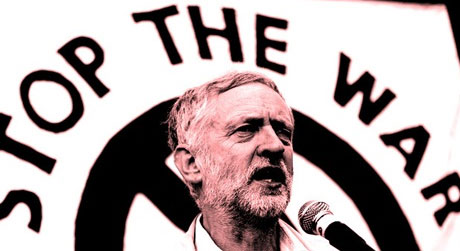
Jeremy Corbyn - Stop the War - Anti American

Further reading:

The anti man

The threat of Jeremy Corbyn’s radically anti-American agenda

Jeremy Corbyn isn’t anti-war. He’s just anti-West

Agree with this article? Violently disagree? Scroll down to leave a comment.

Follow Semi-Partisan Politics on TwitterFacebook and Medium.

For In The Final Analysis

John F. Kennedy, May 29, 1917 – November 22, 1963

“So, let us not be blind to our differences, but let us also direct attention to our common interests and to means by which those differences can be resolved. And if we cannot end now our differences, at least we can help make the world safe for diversity. For, in the final analysis, our most basic common link is that we all inhabit this planet. We all breathe the same air. We all cherish our children’s future. And we are all mortal.”

For those of us who have grown up never having heard a great contemporary political speech, here is the remarkable speech given by President John F Kennedy at American University on June 10, 1963.

Kennedy was assassinated on this day in 1963, fifty-two years ago.

Powerful words, but does Kennedy’s analysis still hold true in the Age of Jihad – when we are preoccupied with ISIS and Al Qaeda rather than the Soviet Union, and when our enemies eagerly embrace death and have no thought at all for their children, let alone their own earthly future?

Imagine David Cameron giving a speech like this about the threat posed by Islamist terrorism, or Britain’s future relationship with the European Union. Imagine David Cameron, George Osborne, Theresa May, Boris Johnson, Jeremy Corbyn, Chuka Umunna, Yvette Cooper, Tristram Hunt, Andy Burnham, Tim Farron or Nicola Sturgeon giving this speech. Try picturing it without laughing out loud.

The challenges today are different to those faced by Kennedy and our political leaders half a century ago. But rarely have our political leaders seemed so helpless, so inadequate to the tasks at hand. At best, our current prime minister might be described as a reasonably competent Comptroller of Public Services. And it is far from certain that he even aspires to be anything more.

They say that we get the politicians and leaders we deserve. If so, the time has come for us all to engage in some serious introspection.

JFK - John F Kennedy - American University Commencement Address

Scroll down to leave a comment.

Follow Semi-Partisan Politics on TwitterFacebook and Medium.

Time To Raise The Voting Age?

Safe Space Crybabies

Young people who cannot hear dissenting ideas without running to the authorities have no business voting at the ballot box

Since the generation of coddled students now going through university expect and demand to feel “comfortable” at all times, insisting that trigger warnings be slapped on anything which may challenge them – and retreating into strictly enforced “safe spaces” if that doesn’t work – perhaps the time has come to stop treating people in their late teens and early twenties like real adults.

After all, if today’s wobbly-lipped generation of Stepford Students need the authorities to ban controversial speakers, punish dissenting opinions and treat everybody as though they are either current or recovering victims of severe trauma, they are essentially already asking to be treated like children.

At least that’s the point made by Glenn Reynolds, a University of Tennessee law professor, in USA Today:

In 1971, the United States ratified the 26th Amendment, lowering the voting age from 21 to 18. In retrospect, that may have been a mistake.

The idea, in those Vietnam War years, was that 18-year-olds, being old enough to be drafted, to marry and to serve on juries, deserved a vote. It seemed plausible at the time, and I myself have argued that we should set the drinking age at 18 for the same reasons.

But now I’m starting to reconsider. To be a voter, one must be able to participate in adult political discussions. It’s necessary to be able to listen to opposing arguments and even — as I’m doing right here in this column — to change your mind in response to new evidence.

This evidence suggests that, whatever one might say about the 18-year-olds of 1971, the 18-year-olds of today aren’t up to that task. And even the 21-year-olds aren’t looking so good.

Reynolds goes on to cite the various examples of student and young adult infantilisation with which we have become depressingly familiar over the past year – calls to outlaw clapping and booing, tearful temper tantrums about dress codes, stifling ideas by labelling them ‘problematic’, the insistence on safe spaces and mandatory sexual consent workshops.

If people still look to external authorities to help them navigate daily life, mediate normal encounters and resolve commonplace disputes, we should probably keep them as far away from the ballot box as possible, argues Reynolds:

This isn’t the behavior of people who are capable of weighing opposing ideas, or of changing their minds when they are confronted with evidence that suggests that they are wrong. It’s the behavior of spoiled children.

[..] But children don’t vote. Those too fragile to handle different opinions are too fragile to participate in politics. So maybe we should raise the voting age to 25, an age at which, one fervently hopes, some degree of maturity will have set in. It’s bad enough to have to treat college students like children. But it’s intolerable to begoverned by spoiled children. People who can’t discuss Halloween costumes rationally don’t deserve to play a role in running a great nation.

It is ironic that at the same time there is a push to lower the voting age in the UK – the Lords recently voted to allow sixteen and seventeen-year-olds to vote in the coming Brexit referendum – people only slightly older and now at university, who already have the vote, are busy regressing back into emotional childhood.

This blog believes firmly in universal suffrage and a single, defined threshold of legal adulthood at the age of eighteen. But given the increasing number of campus incidents of precious snowflake students demanding that the authorities curtail their liberties for their own “safety” – and the fact that increasing age is the last, best hope of gaining wisdom – the idea of raising the voting age does start to feel awfully tempting.

Top Image: grrrgraphics.com

h/t Patrick West in Spiked

Agree with this article? Violently disagree? Scroll down to leave a comment.

Follow Semi-Partisan Politics on TwitterFacebook and Medium.

The Daily Toast: After Paris, Andrew Neil’s Bravura Anti-Islamist Speech

Three cheers to Andrew Neil for his bravura speech praising Western enlightenment values in comparison with murderous “Islamist scumbags” – and their sleazy apologists on the British Left

It’s fair to say that this blog has not always been the biggest fan of Andrew Neil, or what he has done with the BBC’s flagship political television output.

But I have only admiration for his opening monologue on today’s Daily Politics, responding to last week’s terrorist attacks in Paris. It’s worth transcribing Neil’s speech in its entirety:

Welcome to This Week. A week in which a bunch of loser jihadists slaughtered a hundred and fifty-two innocents in Paris to prove the future belongs to them rather than the civilisation like France.

Well, I can’t say that I fancy their chances. France: the country of Descartes, Boulez, Monet, Satre, Rousseau, Camou, Renoir, Berlioz, Cézanne, Gauguin, Hugo, Voltaire, Matisse, Debussy, Ravel, Saint-Saëns, Bizet, Satie, Pasteur, Molière, Franck, Zola, Balzac, Blanc, cutting edge science, world class medicine, fearsome security forces, nuclear power, Coco Chanel, Château Lafite, coq  au vin, Daft Punk, Zizou Zidane, Juliette Binoche, liberté, égalité, fraternité and creme brûlée.

Versus what? Beheadings, crucifixions, amputations, slavery, mass murder, medieval squalor, a death cult barbarity that would shame the Middle Ages. Well, IS, or Da’esh, or ISIS, or ISIL, or whatever name you’re going by, I’m sticking with IS – as in Islamist Scumbags.

I think the outcome is pretty clear to everybody but you: whatever atrocities you are currently capable of committing, you will lose. In a thousand years’ time, Paris – that glorious city of lights – will still be shining bright, as will every other city like it, while you will be as dust, along with a ragbag of fascists, Nazis and Stalinists who have previously dared to challenge democracy. And failed.

What a marvellous, stirring speech in defence of Western civilisation. Between Andrew Neil and John Oliver, here we have all the response we need to those who preach an ideology of hatred, ignorance and death.

If only more of our political and civic leaders had the self-confidence and moral fibre to speak like Neil (Oliver would probably be going too far) – and not just in the aftermath of a major terrorist attack on a European capital – perhaps we would not be facing such a crisis of confidence in Western and British values.

And that crisis of confidence is unfortunately summed up in some of the responses to Neil’s speech on Twitter:

Andrew Neil - Twitter Response 1

Andrew Neil - Twitter Response 2

Andrew Neil - Twitter Response 3

Through an insatiable desire to signal their virtue, flaunt their multiculturalist credentials and deliberately misinterpret those who dare to criticise the Islamists – but never Muslims in general – there are some on the Left who will only ever see bad in the West, and a plucky underdog in the murderous fanatics who bring death to innocent people in Paris, Madrid, New York and London.

These people are despicable. If our civilisation does ever collapse, it will be entirely thanks to their self-flagellating, virtue-signalling, moralising vacuity – not the Islamists, whose brief time strutting around the world stage will perish just like all of the failed ideologies that came before it.

A big toast to Andrew Neil for a full throated and very welcome defence of Western enlightenment and civilisation in the face of primitive Islamist barbarism.

And shame on each and every one of the virtue-signalling, West-hating, terror-appeasing, amoral leftists who chose to attack the speech on social media to flaunt their warped “tolerance” credentials.

They and the murderous Islamists fully deserve one another.

© HAROLD DAVIS

Agree with this article? Violently disagree? Scroll down to leave a comment.

Follow Semi-Partisan Politics on TwitterFacebook and Medium.

Imagine Britain Without The NHS

NHS Worship - London Olympic Games 1

It’s easy if you try

Imagine a Britain without the NHS.

A Britain where the state did not directly employ or contract nearly every doctor and nurse in the entire country.

A Britain where the government did not decide which cutting edge treatments would be offered to the public, and which ones were simply too expensive.

A Britain where citizens were not reliant on the state for the physical delivery of nearly all their healthcare needs.

A Britain where healthcare was unconstrained by politically influenced national targets.

A Britain where angry, jealous talk of “postcode lotteries” did not act as a brake on excellence or a requirement for dull, uniform mediocrity.

A Britain where every hospital superbug or missed A&E waiting target did not automatically become the prime minister’s overriding personal concern, freeing them up to actually be a world leader.

A Britain where we are able to have a rational, level-headed discussion about healthcare, and what kind of system would achieve the best outcomes for the most people at an acceptable cost.

A Britain where we understood that healthcare need not be a choice between the NHS and the infamous US system.

A Britain where we were able to take inspiration from the best aspects of different healthcare systems around the world in reforming our own.

A Britain where criticism of the NHS was not treated like blasphemy, with the offenders shamed on social media and their political careers curtailed.

A Britain where we gave nearly as much respect, honour and resources to our armed forces and veterans as we do to the NHS.

A Britain where we did not reflexively worship a giant, mid-century bureaucracy as our secular national religion.

A Britain which thought enough of itself to realise that there is far more that marks us out as a powerful, great and indispensable nation than our anachronistic 1940s healthcare system.

A Britain where lean, efficient public services existed to serve the people, rather than we the people existing only to serve our insatiable, rapacious public services.

A Britain where saying “the NHS served us ably for many decades after the war, but now it is time to look again at how we provide healthcare to our fellow citizens” was not a shocking, unacceptable statement.

Imagine a Britain where the link between politics and healthcare was broken and the NHS monopoly split up, meaning that things like the coming national strike of junior doctors could never happen.

Just imagine what could happen – all that we could accomplish – if only we were able to have a calm, rational conversation about healthcare in modern Britain.


National Health Service - NHS Leaflet - 1948

Further reading:

Our deadly obsession with the NHS

A Haidtian take on ‘NHS worship’

Worshipping the NHS costs lives

Britain’s cult-like worshop of the NHS must end

To save the NHS, let’s stop worshipping it like a god

Support Semi-Partisan Politics with a one-time or recurring donation:

Agree with this article? Violently disagree? Scroll down to leave a comment.

Follow Semi-Partisan Politics on TwitterFacebook and Medium.
