Tales From The Safe Space, Part 9 – Safe Space Culture Stunts Young Minds

Safe space culture stunts young minds and prevents activist students from learning how to debate. Whatever happened to “use your words”?

If one video could perfectly encapsulate the deleterious effect of having students marinate 24/7 in Identity Politics culture, protected by safe spaces, trigger warnings and campus speech codes, it would be this brief video of a scene from a pro-life protest and pro-choice counter-protest at the University of California, Davis.

Some context, from Campus Reform:

During the “three days of demonstrations,” Students for Life at UC Davis set up shop in a common area on campus where members distributed pro-life materials and polled students on whether or not later terms abortions should remain legal in California.

But counter-protesters were quick to disrupt the demonstration, throwing pro-life materials to the ground and even harassing some participants for taking pictures of the protest.

In a video obtained by Campus Reform, members of UC Davis Students for Life appear to be talking to a counter-protester who in turn pushes a stack of pro-life flyers to the ground and proceeds to walk away.

“I’m not sorry, I’m not sorry!” she said to cheers from her fellow protesters.

Although a campus police officer was monitoring the protests, no action was taken against the student.

Now, this has nothing to do with the rights or wrongs of the protest and counter-protest. Whether you personally believe in completely unrestricted abortion or are vehemently pro-life is irrelevant here. What matters is the behaviour of the protester who chose to vandalise the pro-life students’ materials, throwing their literature to the floor and walking away without even seeking to engage them in discussion.

Note the exchange which takes place when the student speaks with the campus security officer who witnessed the event:

Officer: Did you touch their stuff? Yes?

Student: Yes.

Officer: Why?

Student: Well, cause, like… [gestures limply at the pro-life stand, smirks and rolls eyes]

This student, accosted by a campus security officer for vandalising the pro-life students’ display, is utterly unable to account for her actions. She clearly believes she is completely in the right – as evidenced by her supporters’ chants of “she did nothing wrong!”. But when pressed as to the reason for her behaviour, the student is utterly incapable of accounting for herself with even the simplest of intellectual arguments.

But while the student was capable of nothing more than dumb aggression, we can easily paraphrase the argument which went through her mind as she picked up a bunch of leaflets with contrarian views and threw them to the floor. She thought: “I don’t like this. I disagree with this, and therefore I should not have to put up with its presence. Because I am offended and am unambiguously in the right, I have the right to lash out in any way I please at those who contradict me”.

This is what the Politics of Identity does to young minds. Not all protesters are so sulkily monosyllabic, of course. Many are able to speak quite eloquently, and in so doing give the outward  appearance of being reasonable, happy and willing to debate their beliefs and hear from those who disagree. But even those students who are able to do more than shrug and smirk betray themselves with their calls for safe spaces, campus speech codes and mandatory re-education or social probation for those whose hold opinions which are deemed “offensive”.

Because these students have been raised to treat encountering a contrary opinion from someone the same way as being physically or mentally “assaulted”, they can never be content, never rest, until they impose their ideological homogeneity on their entire campus environment, using either the carrot or the stick as suits their purposes.

And yet in many ways, these student crybullies are more sinned against than sinning. They did not make themselves this way. They are the product of a society which has increasingly promoted authoritarian restrictions on freedom of speech on the spurious grounds of public “safety”, as well as a therapeutic culture which constantly told them as they were growing up that “sticks and stones may break their bones, but words can kill them stone dead”. They did not grow up in a vacuum, and those responsible for educating them and governing during their formative years have much to answer for.

But the fact that the snowflake student generation are not entirely to blame for the way that they turned out does not absolve us of our responsibility to criticise what we see, and call it what it is – a real and present danger to academic freedom on university campuses, and freedom of speech and thought in our wider societies.

A more intellectually and emotionally developed student would have been able to walk past the pro-life student display and either ignore it or engage in a robust exchange of views with the organisers. But modern campus Identity Politics does not teach or encourage this skill. Rather, it affirms the existing world view of the student and tells them that they have the right not to ever have to see or hear a dissenting opinion. And so rather than debate, we have toddler-style lashing out and defacing of opposing literature.

Identity Politics and safe space culture do not merely coddle the American mind. They actively stunt and inhibit young minds on college campuses everywhere they are present. And the damage they inflict on certain individuals may not be reversible.


Safe Space Notice - 2

Agree with this article? Violently disagree? Scroll down to leave a comment.

Follow Semi-Partisan Politics on TwitterFacebook and Medium.

Tales From The Safe Space, Part 8 – Discussing Crybully Students At CPAC

The United States may have helped to incubate the crybully student phenomenon, but American conservatism also points the way towards a cure

Following on from yesterday’s Tale From The Safe Space, which focused on Oklahoma Wesleyan University president Dr. Everett Piper showing us how university administrators should be pushing back on ludicrous student demands and complaints, the video shown above develops these ideas further.

Dr. Piper made minor waves last year when he admonished his students, reminding them that they are not in daycare but rather at an adult university. And last week he was invited to speak on a panel at CPAC 2016, entitled “Campus Crackdown”.

The entire panel discussion is worth watching or listening to in full, but here is the money quote from Dr. Everett Piper, responding to a question asking why the problem of student attacks on free speech has exploded in recent years:

I personally believe it’s the result and the consequence of several decades of teaching lousy ideas. I addressed it last night in my speech to the Reagan Gala. Richard Weaver told us in 1948 that ideas have consequences. That was the title of his seminal work – “Ideas Have Consequences“. What was his point, what was his premise? Ideas have consequences. Ideas always lead somewhere. Bad ideas lead to bad culture, bad community, bad college. Good ideas lead to the opposite. So I think we’re reaping the results, to quote Barack Obama’s pastor, “the chickens are coming home to roost”.

What we’ve done is taught this ideological narcissism, we’ve taught ideological fascism and that’s really what we have today, we have an ideological fascism that’s prevailing on the college campus rather than the academic freedom that we hold dear.

The liberal arts academy was established – let’s go back to Oxford, some one thousand years ago – to educate a free man and a free woman, to liberate us, to give us an understanding of liberty and liberation and freedom and justice, and to give us the context for embracing those truths. And when we get rid of those ideas and embrace the narcissism of our time we’re gonna suffer the consequences accordingly, and it will result in a fascist attitude of “you shall submit, you shall agree, and if you don’t you shall be silenced and you shall be expelled”. That is what is prevailing on the campus today.

But the unreasoning, free speech-hating crybully students only win when spineless, obsequious university administrators roll over and submit to their demands for fear of being labelled as cavalier about student “mental safety” rather than pushing back robustly at their attempts to self-infantilise.

If this trend is to be reversed, it will only be when more university leaders like Dr. Everett Piper in the United States, and Oxford chancellor Chris Patten in Britain, are prepared to poke their heads above the parapets in defence of academic enquiry and freedom of thought and speech.


Postscript: And isn’t it about time that we in Britain had our own version of CPAC, an alliance of people willing and able to carry the torch for freedom, liberty and conservative-minded thought when the Conservative Party in government seem intent on betraying those principles at every turn?


Safe Space Notice - 2

Agree with this article? Violently disagree? Scroll down to leave a comment.

Follow Semi-Partisan Politics on TwitterFacebook and Medium.

Tales From The Safe Space, Part 7 – Halting The Encroachment Of Identity Politics On Campus

A role model for spineless university administrators everywhere

If rolling over and meekly submitting like a well trained dog is not the answer to the ideological coup underway in many of our universities – and it most assuredly is not – then what is the correct way for university administrators to respond to the encroachment of Identity Politics and its attendant chilling effects on freedom of thought and speech on campus?

Amid the ignominious resignations and grovelling apologies, we have seen a few encouraging early signs of academic leaders pushing back on the demands of their coddled students for their universities to be turned into ideologically homogeneous, endlessly self-validating bubbles. The speech by Oxford University chancellor Chris Patten, in which he told students protesting a statue of Cecil Rhodes that they should consider being educated elsewhere if they are unable to tolerate difficult or contrary points of view, stands out as one such example.

But no response to student complaints has been so direct as that of Everett Piper, president of Oklahoma Wesleyan University, a Christian institution in the American heartland.

After attending a mandatory chapel service at university, in which the sermon was from the book of Corinthians and on the topic of love (of all seemingly benign subjects), a student approached Piper and complained that he felt invalidated and victimised for not having lived up to the Biblical standard in his own life. Because being set an aspirational standard of moral behaviour at a religious institution was, to the student’s mind, an intolerable criticism of his own “lived experience”.

Piper perhaps had a little more latitude in the frankness of his response than many other university administrators, being the president of an explicitly religious private institution rather than a public university in receipt of taxpayer money. But nonetheless, his electrifying response is worth reproducing in full, because it puts so many other academic leaders to shame.

From the Oklahoma Wesleyan University president’s blog:

This past week, I actually had a student come forward after a university chapel service and complain because he felt “victimized” by a sermon on the topic of 1 Corinthians 13. It appears this young scholar felt offended because a homily on love made him feel bad for not showing love. In his mind, the speaker was wrong for making him, and his peers, feel uncomfortable.

I’m not making this up. Our culture has actually taught our kids to be this self-absorbed and narcissistic. Any time their feelings are hurt, they are the victims. Anyone who dares challenge them and, thus, makes them “feel bad” about themselves, is a “hater,” a “bigot,” an “oppressor,” and a “victimizer.”

I have a message for this young man and all others who care to listen. That feeling of discomfort you have after listening to a sermon is called a conscience. An altar call is supposed to make you feel bad. It is supposed to make you feel guilty. The goal of many a good sermon is to get you to confess your sins—not coddle you in your selfishness. The primary objective of the Church and the Christian faith is your confession, not your self-actualization.

So here’s my advice:

If you want the chaplain to tell you you’re a victim rather than tell you that you need virtue, this may not be the university you’re looking for. If you want to complain about a sermon that makes you feel less than loving for not showing love, this might be the wrong place.

If you’re more interested in playing the “hater” card than you are in confessing your own hate; if you want to arrogantly lecture, rather than humbly learn; if you don’t want to feel guilt in your soul when you are guilty of sin; if you want to be enabled rather than confronted, there are many universities across the land (in Missouri and elsewhere) that will give you exactly what you want, but Oklahoma Wesleyan isn’t one of them.

At OKWU, we teach you to be selfless rather than self-centered. We are more interested in you practicing personal forgiveness than political revenge. We want you to model interpersonal reconciliation rather than foment personal conflict. We believe the content of your character is more important than the color of your skin. We don’t believe that you have been victimized every time you feel guilty and we don’t issue “trigger warnings” before altar calls.

Oklahoma Wesleyan is not a “safe place”, but rather, a place to learn: to learn that life isn’t about you, but about others; that the bad feeling you have while listening to a sermon is called guilt; that the way to address it is to repent of everything that’s wrong with you rather than blame others for everything that’s wrong with them. This is a place where you will quickly learn that you need to grow up.

This is not a day care. This is a university.

What astonishing, revolutionary words – the idea that university should not be first and foremost a place of “comfort and home“, but rather a place of academic enquiry and personal growth through challenge. How astonishing, too, that a Christian university leader might dare to suggest that campus life should not revolve around the arbitrary offence-taking of students, and indeed that things larger than the individual self – community, society, God’s creation – are equally important and deserving of attention.

Except that none of this should be astonishing at all. This should be the way that every university president or chancellor reacts when confronted with the self-obsessed complaints of a generation of students who by most measures are the most privileged in history, but who nonetheless want to wallow and talk endlessly about their “pain”.

Piper’s interview with The Daily Signal (see video above) is also instructional as to the root of  the problem. Today’s snowflake students did not create themselves – they are a product of social and educational policies stretching back decades, and cannot be separated from the therapeutic yet authoritarian culture that has given us draconian hate speech laws, absurd political correctness and the elevation of Identity Politics.

In the interview Piper argues:

We’ve taught lousy ideas for decades. Let’s just cut to the chase. The academy, the university, the College with a capital C has created this monster. We’ve taught narcissism and self absorption. We’ve taught self-actualisation rather than personal morality. We’ve told students generation after generation it doesn’t matter what you believe as long as it works for you. We’ve actually come to the point where we can say I can’t tolerate your intolerance and I hate you hateful people and I’m sure that nothing is sure and I know that nothing can be known and I’m absolutely confident that there are no absolutes.

It’s the self-refuting duplicity of the 60s and 70s and 80s coming home to roost in the current generation, so we’ve got faculty who have created this monster and celebrated it until it turned around and bit them and starts consuming them, and now they’re scared.

Could there be a more blisteringly accurate condemnation of the missteps which have led our colleges and universities to their current dystopian reality of trigger warnings, safe spaces and Identity Politics mob trials?

And could there be a greater demonstration of how to show true leadership of an academic institution – not by meekly surrendering to the brazen power play being executed by today’s youthful, misguided activists, but rather by placing free speech, academic enquiry and debate first and foremost in the life of a university?


Postscript: Dr. Everett Piper was presented with the Jeane Jordan Kirkpatrick award for Academic Freedom at CPAC on 4 March.

h/t Rod Dreher at The American Conservative


Safe Space Notice - 2

Agree with this article? Violently disagree? Scroll down to leave a comment.

Follow Semi-Partisan Politics on TwitterFacebook and Medium.

Douglas Carswell Warns Against The Allure Of Protectionism

Container Ship - Cargo - Trade - Protectionism

Douglas Carswell makes the short and eloquent case against protectionism:

The prosperity we take for granted today couldn’t have happened without free markets and free trade. That doesn’t stop people – even presidential candidates – saying we’d be better off starting trade wars, and only buying goods made at home. But the fact remains: protectionism is the route to poverty.

Globalisation gets a bad press. When manufacturing moves from Britain or the US to China and India, it looks like we’re losing out. But the result is that we get our clothes, shoes, computers, phones, and televisions much more cheaply. And lower prices don’t just make us better off. They also increase demand, and create jobs.

As Adam Smith and David Ricardo realised 200 years ago, prosperity comes from specialisation. If each of us tried to be self-sufficient, we would all be living in prehistoric penury. Instead, we specialise in what we’re best at, and exchange the product of our work for what we need.

The same applies to countries. Today, Britain’s comparative advantage is in services. Other countries are best at heavy industry or agriculture. By specialising in services, we get more and better manufactured goods and agricultural produce than we would if we diverted our resources into making them ourselves.

Protectionism might seem like the solution for people who have lost out to globalisation. But its effect would be regressive – like the poll tax. It would force prices up, and employment down. That would hit the poorest hardest.

Carswell goes on to argue that protectionism does not bring prosperity, but rather leads to inefficient, monolithic corporations like British Leyland, churning out low quality product that nobody really wants – and even then, only at the cost of massive subsidies from the taxpayer.

The case against protectionism cannot be restated enough at a time when globalisation and free trade is under sustained attack on both sides of the Atlantic – by the otherwise polar opposite Donald Trump and Bernie Sanders in America, and by the worst elements on both sides of the EU referendum debate in Britain, who believe that we should retreat either into mercantilist isolationism or protectionist euro-parochialism.

There is an important debate here to be had among advocates for smaller government. Clearly the state is presently far too involved in our lives in all manner of ways, but surely one of the things that a smart, lean and effective small government absolutely should do is watch out for its citizens when they are impacted by massive changes to the way that the world trades and communicates.

Labour’s solution has been to park people on welfare and then forget about them, which is remarkably immoral for a group of people who love to endlessly brag about how virtuous and compassionate they are. The intelligent Right should come up with something better. And that means doing something more than simply aping Labour policy by raising the minimum (or “national living”) wage to £9 an hour so that the most tedious of low-paying McJobs keep people just out of working poverty.

The new permanent majority will not be secured by the Cameron / Osborne strategy of enacting Tony Blair’s fourth term of New Labour governance. It will come about by radically rolling back the state in all manner of areas where it should be doing less, while also giving citizens the tools and opportunity to prosper in the new economy.

Less protectionism, less pretending that the old jobs will come roaring back if only we leave the EU, embrace the EU or otherwise throw up barriers to global trade. Less shooting for the middle all round, and more empowerment of British citizens to pursue high value-add, high-wage, twenty-first century careers.

Now put that on a bumper sticker.


Semi Partisan Politics Logo

Agree with this article? Violently disagree? Scroll down to leave a comment.

Follow Semi-Partisan Politics on TwitterFacebook and Medium.

When The Established Church Goes To War With Half The Country

Kate Bottley - Gogglebox - Church of England - Partisan - Conservative Party - Tory Scum

What to do when the established church makes no attempt to hide its hatred for conservatives?

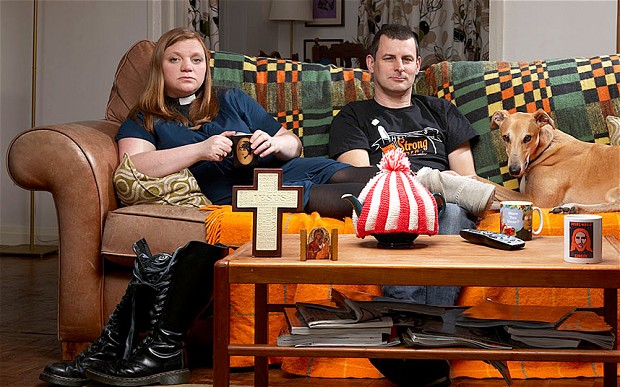
Those who watch Gogglebox are no doubt familiar with the Reverend Kate Bottley, whose ambassadorship for the Church of England probably reaches many millions more people than most bishops.

Should we be concerned, then, that one of the established church’s most high profile characters holds a seething contempt and hatred for one of our country’s two main political parties?

Archbishop Cranmer lays down the charge, based on Bottley’s recent on-air admission that “I hate it when I agree with a Tory”:

She wasn’t wearing her dog collar this week, but she doesn’t need to: the whole country knows (and so do Channel 4 editors and producers) that she is a Church of England vicar and a minister of the Word. And she is very well liked and respected: there is no hint of moral or doctrinal delinquency, but national admiration for her personal spirituality and great teaching capacity. She is a manifestly gifted, active communicator who is dedicated to serving her parish.

But ministry isn’t simply service, for that is the whole of Christian life. Her task as a vicar is distinctively liturgical, catechetical and pastoral, principally for the needs of the whole Christian community, including Tories. As an ordained priest, she is both servant and shepherd among the people to whom she has been sent, and that includes Tories. Her task is to proclaim the Word of the Lord and to watch for signs of God’s new creation, including in Tories. Her vocation is to teach, admonish, feed and provide for her flock, which includes Tories.

The majority of England is instinctively conservative: it appears to be a natural disposition; an affinity with the natural order; part of the psyche of essential Englishness. The Rev’d Kate Bottley is by no means obliged to approve of that: indeed, she is free to repudiate its consoling power and turn her religious fervour to more meaningful transcendent bonds. But you’d think there might be some sensitivity to the political-philosophical implications for mission praxis. Why should those Tories who attend her church bother to listen to her tell the story of God’s love, if all the time she is pinching her nose at their spiritual halitosis? Why should all those Tories who watch Gogglebox even consider walking with her in the way of Christ, hoping to be nurtured and encouraged in their faith? Why should they gather round the Lord’s Table if their vicar deems them to be unworthy or unable to resist the evil philosophies of men?

Bottley is far from an isolated case. Seething anti-Tory sentiment clearly exists much higher up in the church hierarchy, too, judging by the Bishop of Manchester’s decision to play host to Jeremy Corbyn and a left-wing rally coinciding with the Conservative Party conference taking place in the city.

Long gone, it seems, are the days when the Church of England was commonly known as the Tory party at prayer. And with church personalities using their pulpits to inveigh against right-wing policies and pontificate on the supposed dangers of Brexit, the time has come to urgently look again at the privileged position which the partisan established church holds in our constitution.


Church of England in Parliament - Church and State

Agree with this article? Violently disagree? Scroll down to leave a comment.

Follow Semi-Partisan Politics on TwitterFacebook and Medium.